
The LCA Problem Revisited Michael A Bender Martin
The LCA Problem Revisited Michael A. Bender & Martin Farach-Colton Presented by: Dvir Halevi
Agenda n n n Definitions Reduction from LCA to RMQ Trivial algorithms for RMQ ST algorithm for RMQ A faster algorithm for a private RMQ case General Solution for RMQ 2
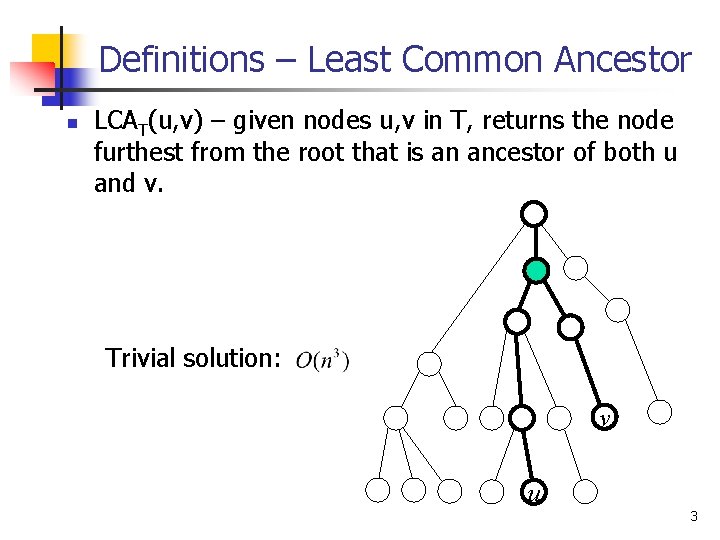
Definitions – Least Common Ancestor n LCAT(u, v) – given nodes u, v in T, returns the node furthest from the root that is an ancestor of both u and v. Trivial solution: v u 3
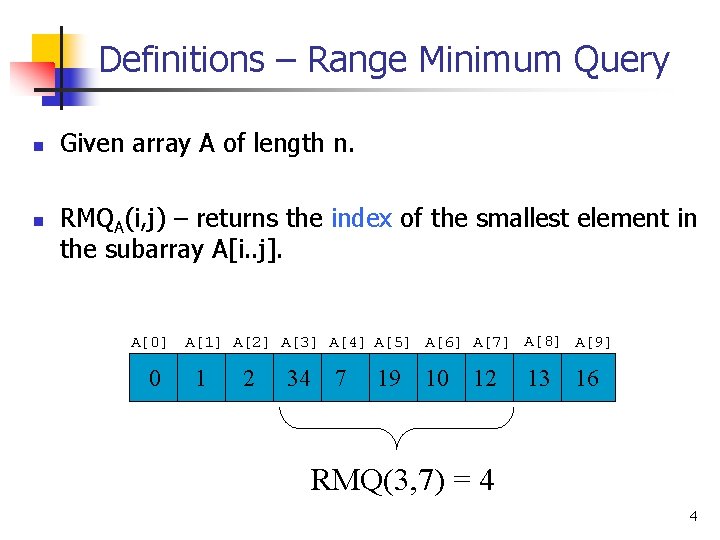
Definitions – Range Minimum Query n n Given array A of length n. RMQA(i, j) – returns the index of the smallest element in the subarray A[i. . j]. A[0] A[1] A[2] A[3] A[4] A[5] A[6] A[7] A[8] A[9] 0 1 2 34 7 19 10 12 13 16 RMQ(3, 7) = 4 4
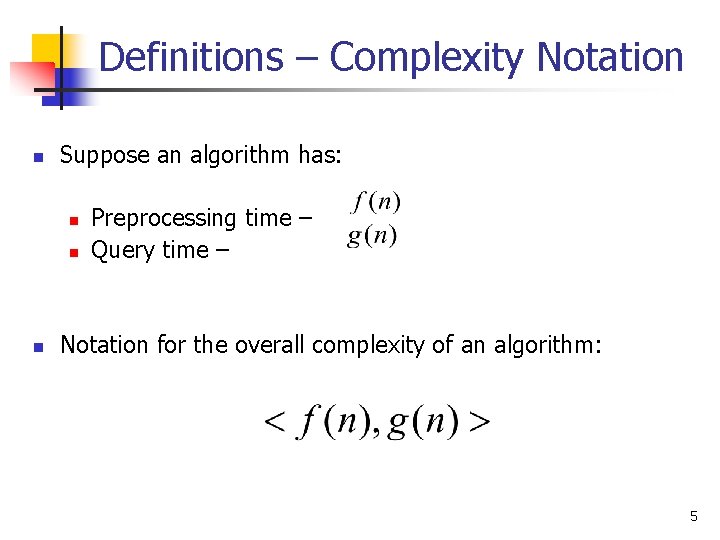
Definitions – Complexity Notation n Suppose an algorithm has: n n n Preprocessing time – Query time – Notation for the overall complexity of an algorithm: 5
n n n Definitions Reduction from LCA to RMQ Trivial algorithms for RMQ ST algorithm for RMQ A faster algorithm for a private RMQ case General Solution for RMQ 6
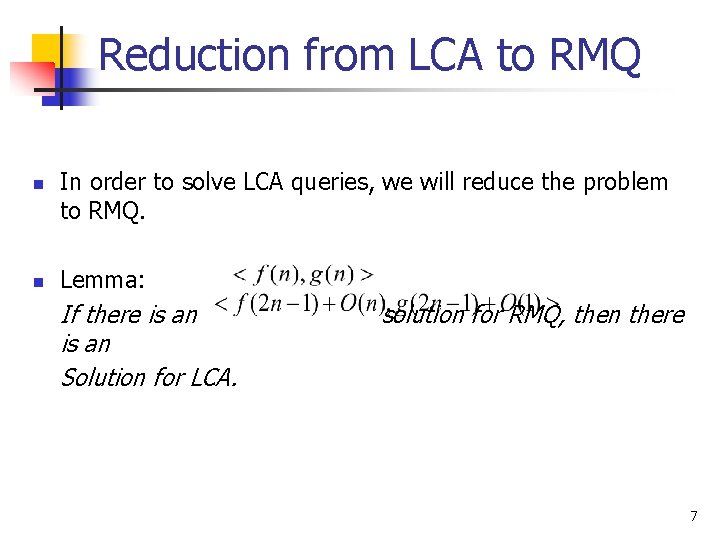
Reduction from LCA to RMQ n n In order to solve LCA queries, we will reduce the problem to RMQ. Lemma: If there is an Solution for LCA. solution for RMQ, then there 7
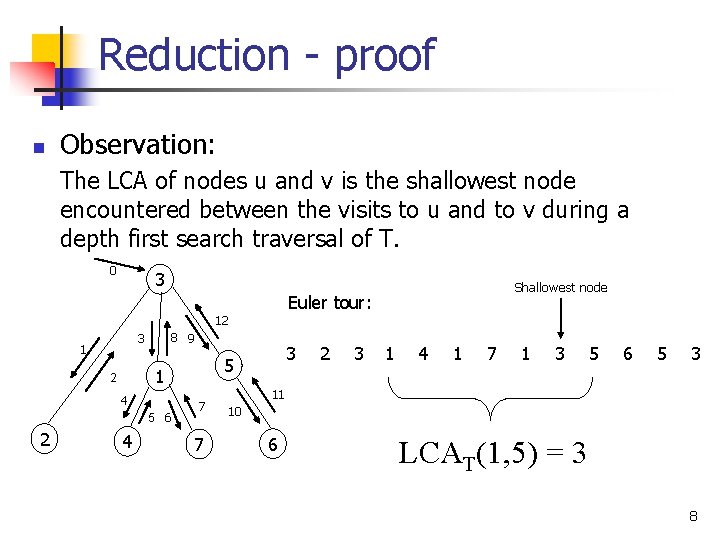
Reduction - proof n Observation: The LCA of nodes u and v is the shallowest node encountered between the visits to u and to v during a depth first search traversal of T. 0 3 Shallowest node Euler tour: 12 8 9 3 1 4 5 6 2 5 1 2 4 3 7 7 2 3 1 4 1 7 1 3 5 6 5 3 11 10 6 LCAT(1, 5) = 3 8
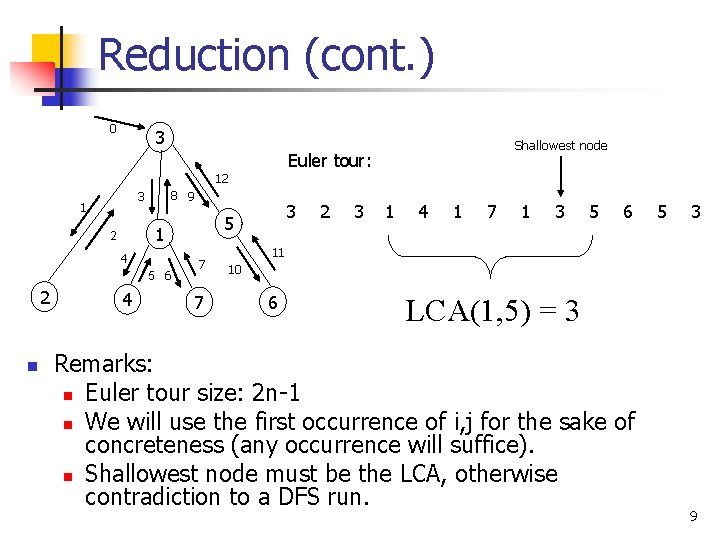
Reduction (cont. ) 0 3 Shallowest node Euler tour: 12 8 9 3 1 1 2 4 5 6 2 n 4 3 5 7 7 2 3 1 4 1 7 1 3 5 6 5 3 11 10 6 LCA(1, 5) = 3 Remarks: n Euler tour size: 2 n-1 n We will use the first occurrence of i, j for the sake of concreteness (any occurrence will suffice). n Shallowest node must be the LCA, otherwise contradiction to a DFS run. 9
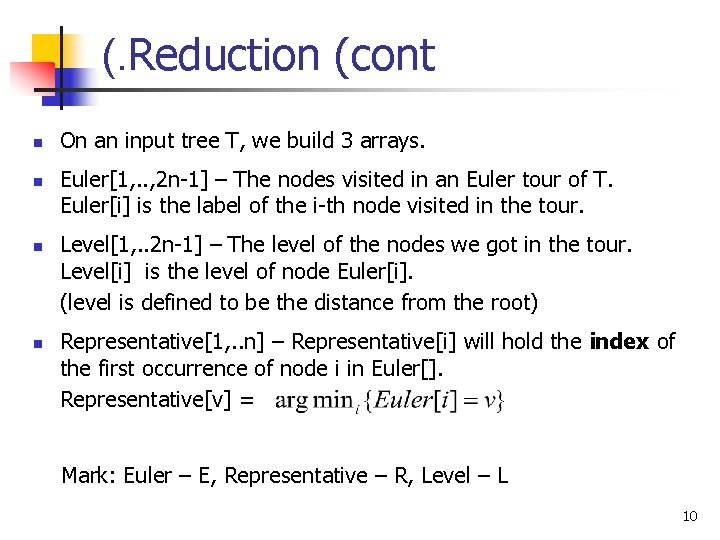
(. Reduction (cont n n On an input tree T, we build 3 arrays. Euler[1, . . , 2 n-1] – The nodes visited in an Euler tour of T. Euler[i] is the label of the i-th node visited in the tour. Level[1, . . 2 n-1] – The level of the nodes we got in the tour. Level[i] is the level of node Euler[i]. (level is defined to be the distance from the root) Representative[1, . . n] – Representative[i] will hold the index of the first occurrence of node i in Euler[]. Representative[v] = Mark: Euler – E, Representative – R, Level – L 10

(. Reduction (cont n Example: 1 6 2 3 9 10 5 4 8 7 1 2 3 4 5 6 7 8 9 10 11 12 13 14 15 16 17 18 19 E: 1 6 3 6 5 6 1 2 1 9 10 9 4 7 4 9 8 9 1 L: 0 1 2 1 0 1 2 3 2 1 0 R: 1 8 3 13 5 2 14 17 10 11 11
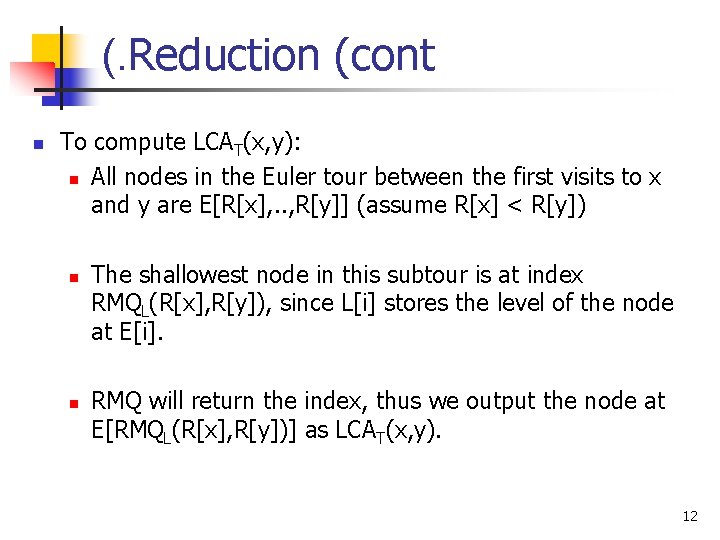
(. Reduction (cont n To compute LCAT(x, y): n All nodes in the Euler tour between the first visits to x and y are E[R[x], . . , R[y]] (assume R[x] < R[y]) n n The shallowest node in this subtour is at index RMQL(R[x], R[y]), since L[i] stores the level of the node at E[i]. RMQ will return the index, thus we output the node at E[RMQL(R[x], R[y])] as LCAT(x, y). 12
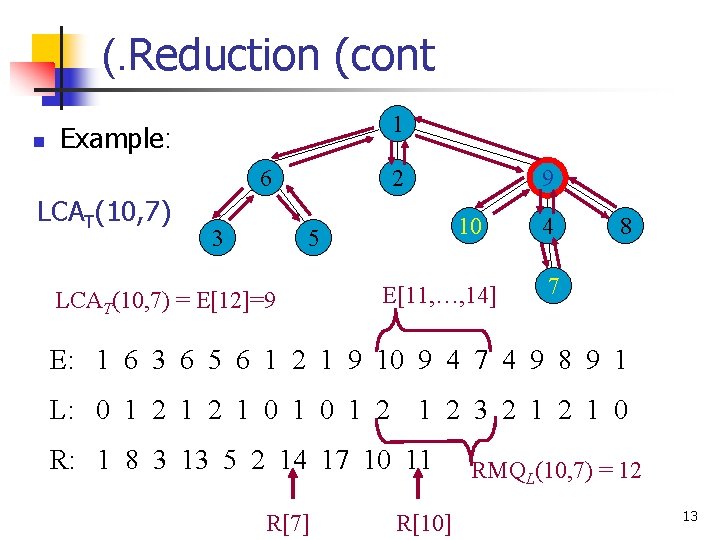
(. Reduction (cont n 1 Example: 6 LCAT(10, 7) 3 2 9 10 5 LCAT(10, 7) = E[12]=9 E[11, …, 14] 4 8 7 E: 1 6 3 6 5 6 1 2 1 9 10 9 4 7 4 9 8 9 1 L: 0 1 2 1 0 1 2 3 2 1 0 R: 1 8 3 13 5 2 14 17 10 11 R[7] R[10] RMQL(10, 7) = 12 13
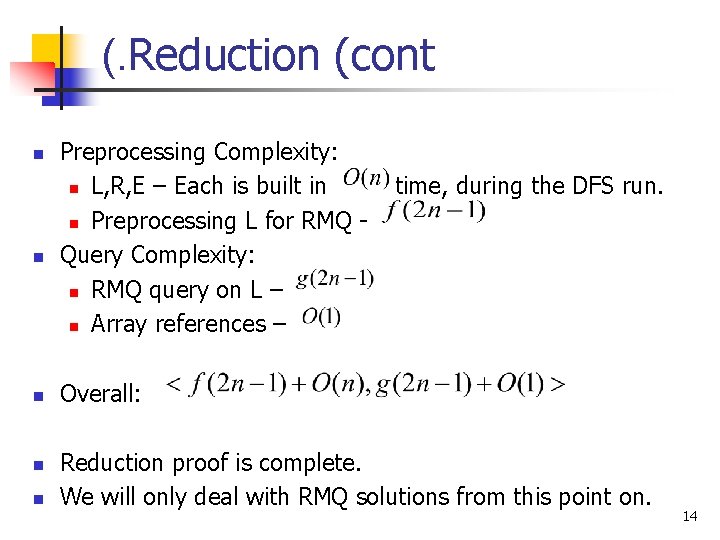
(. Reduction (cont n n n Preprocessing Complexity: n L, R, E – Each is built in n Preprocessing L for RMQ Query Complexity: n RMQ query on L – n Array references – time, during the DFS run. Overall: Reduction proof is complete. We will only deal with RMQ solutions from this point on. 14
n n n Definitions Reduction from LCA to RMQ Trivial algorithms for RMQ ST algorithm for RMQ A faster algorithm for a private RMQ case General Solution for RMQ 15
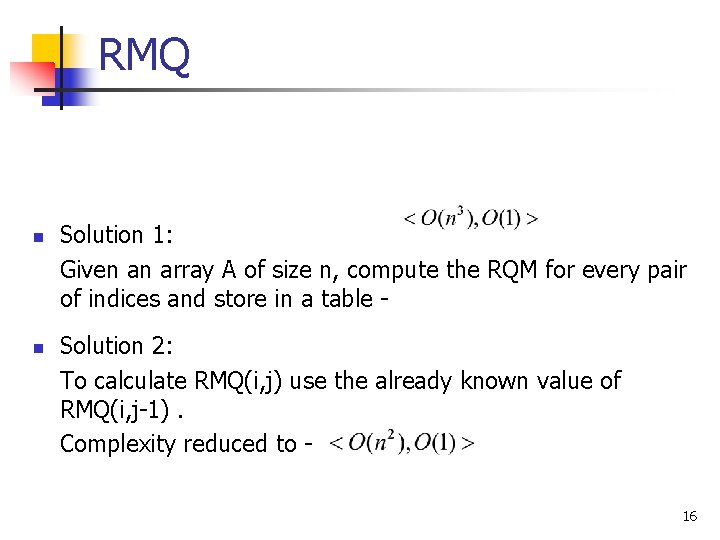
RMQ n n Solution 1: Given an array A of size n, compute the RQM for every pair of indices and store in a table Solution 2: To calculate RMQ(i, j) use the already known value of RMQ(i, j-1). Complexity reduced to 16
n n n Definitions Reduction from LCA to RMQ Trivial algorithms for RMQ ST algorithm for RMQ A faster algorithm for a private RMQ case General Solution for RMQ 17
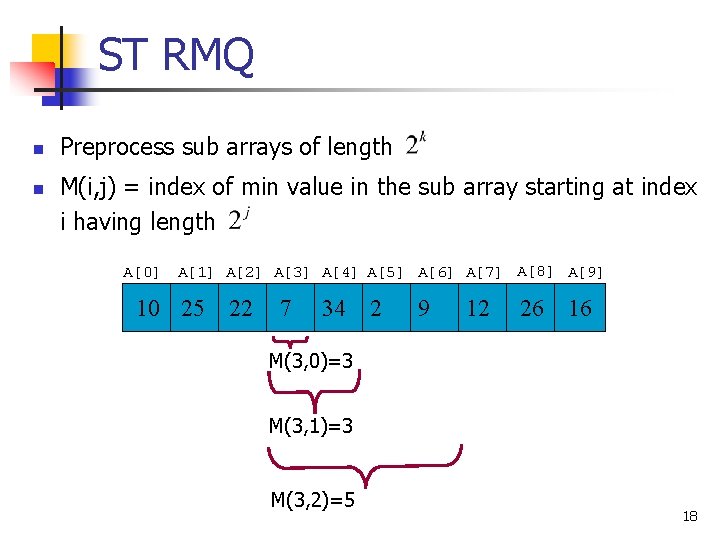
ST RMQ n n Preprocess sub arrays of length M(i, j) = index of min value in the sub array starting at index i having length A[0] A[1] A[2] A[3] A[4] A[5] A[6] A[7] A[8] A[9] 10 25 22 7 34 2 9 12 26 16 M(3, 0)=3 M(3, 1)=3 M(3, 2)=5 18
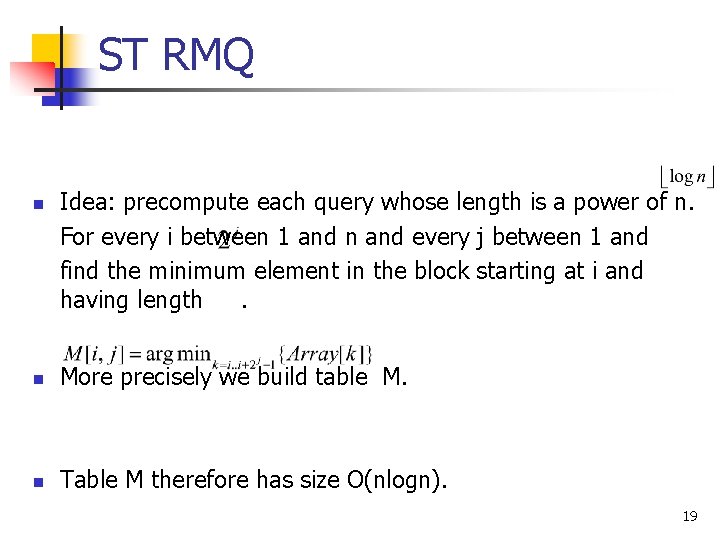
ST RMQ n Idea: precompute each query whose length is a power of n. For every i between 1 and n and every j between 1 and find the minimum element in the block starting at i and having length. n More precisely we build table M. n Table M therefore has size O(nlogn). 19
![ST RMQ A[0] A[1] A[2] A[3] A[4] A[5] A[6] A[7] A[8] A[9] n Building](http://slidetodoc.com/presentation_image_h/9d93d9021015de80d8d6832c1aa15ee5/image-20.jpg "ST RMQ A[0] A[1] A[2] A[3] A[4] A[5] A[6] A[7] A[8] A[9] n Building")
ST RMQ A[0] A[1] A[2] A[3] A[4] A[5] A[6] A[7] A[8] A[9] n Building 10 M – 25 using 22 dynamic 7 34 programming 9 2 12 we 26 can 16 build M in O(nlogn) time. M(3, 1)=3 M(5, 1)=6 M(3, 2)=6 20
![ST RMQ n Using these blocks to compute arbitrary M[i, j] Select two blocks](http://slidetodoc.com/presentation_image_h/9d93d9021015de80d8d6832c1aa15ee5/image-21.jpg "ST RMQ n Using these blocks to compute arbitrary M[i, j] Select two blocks")
ST RMQ n Using these blocks to compute arbitrary M[i, j] Select two blocks that entirely cover the subrange [i. . j] Let ( is the largest block that fits [i. . j]) n Compute RMQ(i, j): n n i a 1 . . . 2 k elements j . . . 21
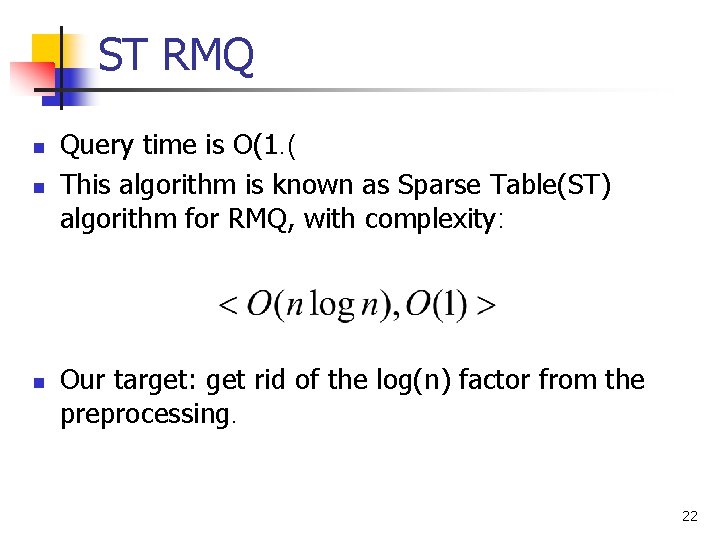
ST RMQ n n n Query time is O(1. ( This algorithm is known as Sparse Table(ST) algorithm for RMQ, with complexity: Our target: get rid of the log(n) factor from the preprocessing. 22
n n n Definitions Reduction from LCA to RMQ Trivial algorithms for RMQ ST algorithm for RMQ A faster algorithm for a private RMQ case General Solution for RMQ 23
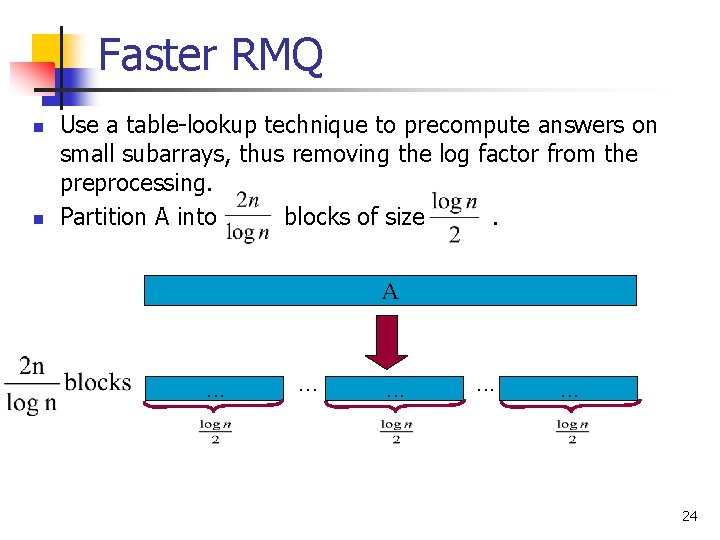
Faster RMQ n n Use a table-lookup technique to precompute answers on small subarrays, thus removing the log factor from the preprocessing. Partition A into blocks of size. A . . . . 24
![Faster RMQ n A’[1, . . , ] – A’[i] is the minimum element](http://slidetodoc.com/presentation_image_h/9d93d9021015de80d8d6832c1aa15ee5/image-25.jpg "Faster RMQ n A’[1, . . , ] – A’[i] is the minimum element")
Faster RMQ n A’[1, . . , ] – A’[i] is the minimum element in the i-th block of A. n B[1, . . , ] – B’[i] is the position (index) in which value A’[i] occurs. A A’[0] . . . A’[i] . . . … B[0] . . . A’[2 n/logn] B[i] B[2 n/logn] 25
![n Example: n=16 A[] : 0 1 2 6 7 10 25 22 7](http://slidetodoc.com/presentation_image_h/9d93d9021015de80d8d6832c1aa15ee5/image-26.jpg "n Example: n=16 A[] : 0 1 2 6 7 10 25 22 7")
n Example: n=16 A[] : 0 1 2 6 7 10 25 22 7 34 9 2 12 26 33 24 43 5 A’[] : 0 1 10 7 2 9 4 8 5 10 25 3 22 7 … 9 10 … 34 9 B[] : 11 12 0 1 2 0 3 5 13 14 15 11 19 27 =8 … 26
Faster RMQ n n n Recall RMQ queries return the position of the minimum. LCA to RMQ reduction uses the position of the minimum, rather than the minimum itself. Use array B to keep track of where minimas in A’ came from. 27
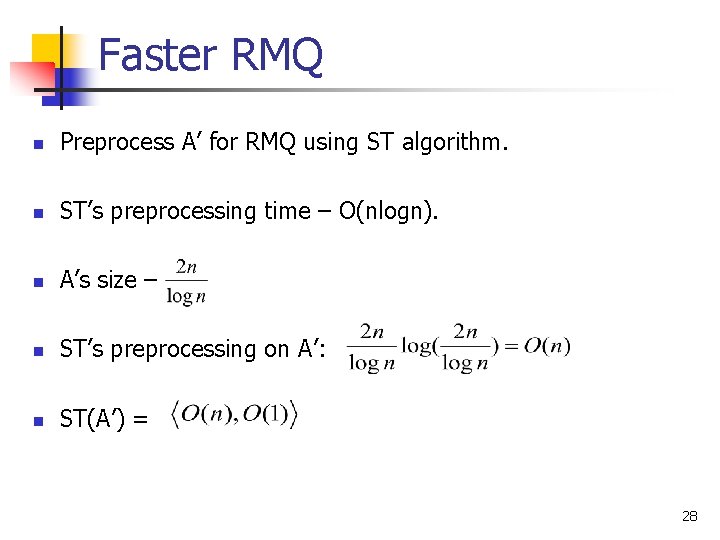
Faster RMQ n Preprocess A’ for RMQ using ST algorithm. n ST’s preprocessing time – O(nlogn). n A’s size – n ST’s preprocessing on A’: n ST(A’) = 28
Faster RMQ n Having preprocessed A’ for RMQ, how to answer RMQ(i, j) queries on A? n i and j might be in the same block -> preprocess every block. n i < j on different blocks, answer the query as follows: 1. 2. 3. n Compute minima from i to end of its block. Compute minima of all blocks in between i’s and j’s blocks. Compute minima from the beginning of j’s block to j. Return the index of the minimum of these 3 values. 29
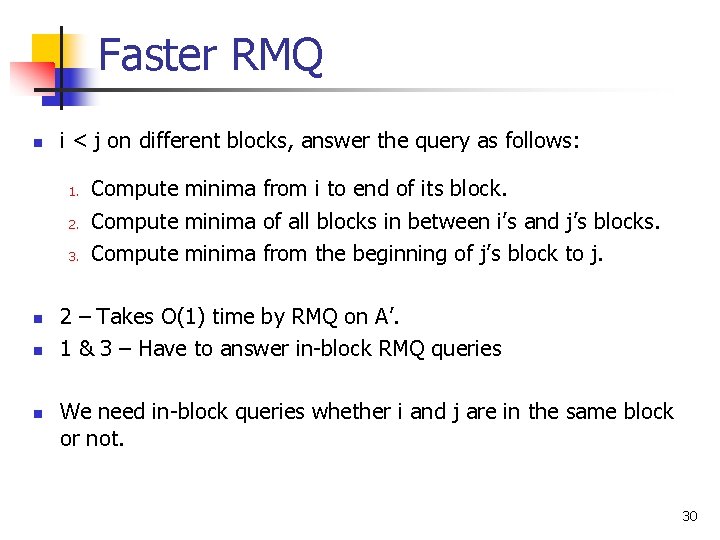
Faster RMQ n i < j on different blocks, answer the query as follows: 1. 2. 3. n n n Compute minima from i to end of its block. Compute minima of all blocks in between i’s and j’s blocks. Compute minima from the beginning of j’s block to j. 2 – Takes O(1) time by RMQ on A’. 1 & 3 – Have to answer in-block RMQ queries We need in-block queries whether i and j are in the same block or not. 30
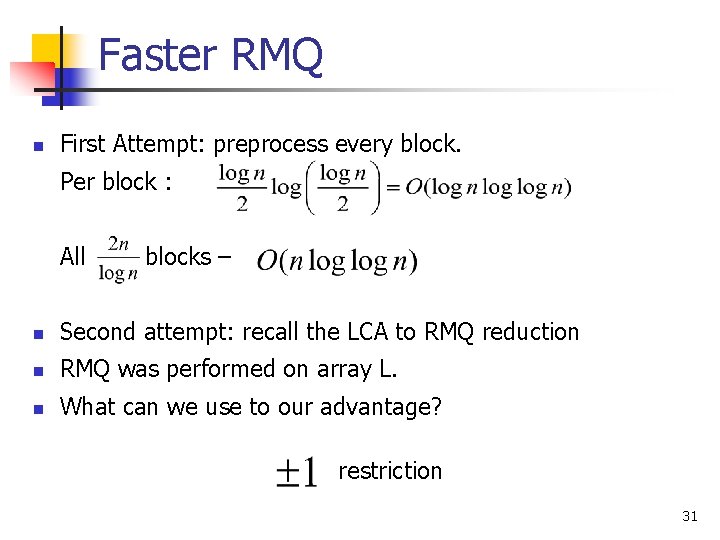
Faster RMQ n First Attempt: preprocess every block. Per block : All blocks – n Second attempt: recall the LCA to RMQ reduction n RMQ was performed on array L. n What can we use to our advantage? restriction 31
![Faster RMQ n Observation: Let two arrays X & Y such that Then A[0]](http://slidetodoc.com/presentation_image_h/9d93d9021015de80d8d6832c1aa15ee5/image-32.jpg "Faster RMQ n Observation: Let two arrays X & Y such that Then A[0]")
Faster RMQ n Observation: Let two arrays X & Y such that Then A[0] A[1] A[2] A[3] A[4] A[5] A[6] A[7] A[8] A[9] 3 4 5 6 5 4 B[0] B[1] B[2] B[3] B[4] B[5] B[6] B[7] B[8] B[9] 0 1 2 +1 +1 n There are 3 2 1 2 3 2 +1 -1 -1 +1 +1 -1 normalized blocks. 1 -1 32
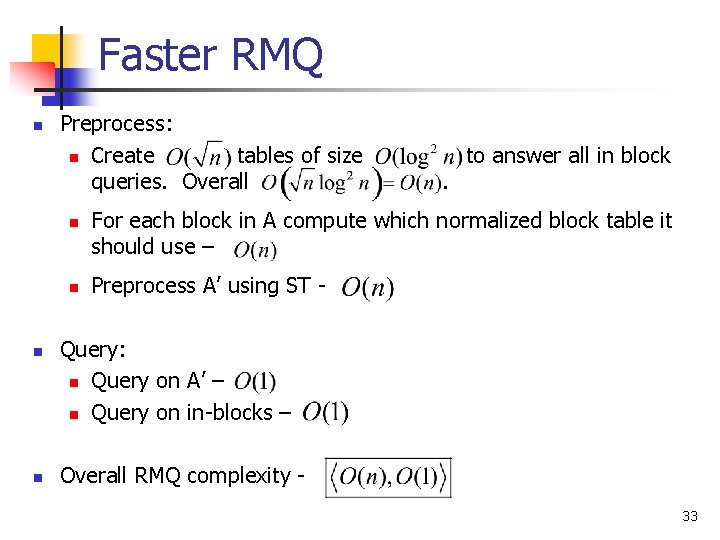
Faster RMQ n Preprocess: n Create tables of size queries. Overall n n . to answer all in block For each block in A compute which normalized block table it should use – Preprocess A’ using ST - Query: n Query on A’ – n Query on in-blocks – Overall RMQ complexity 33
n n n Definitions Reduction from LCA to RMQ Trivial algorithms for RMQ ST algorithm for RMQ A faster algorithm for a private RMQ case General Solution for RMQ 34
General O(n) RMQ n n Reduction from RMQ to LCA General RMQ is solved by reducing RMQ to LCA, then reducing LCA to RMQ. Lemma: If there is a solution for LCA, then there is a solution to RMQ. Proof: build a Cartesian tree of the array, activate LCA on it. 35
![General O(n) RMQ A[0] A[1] A[2] A[3] A[4] A[5] A[6] A[7] A[8] A[9] 10](http://slidetodoc.com/presentation_image_h/9d93d9021015de80d8d6832c1aa15ee5/image-36.jpg "General O(n) RMQ A[0] A[1] A[2] A[3] A[4] A[5] A[6] A[7] A[8] A[9] 10")
General O(n) RMQ A[0] A[1] A[2] A[3] A[4] A[5] A[6] A[7] A[8] A[9] 10 25 n 22 34 7 19 9 12 26 16 Cartesian tree of an array A: n n Root – minimum element of the array. Root node is labeled with the position of the minimum. Root’s left & right children: the recursively constructed Cartesian tress of the left & right subarrays, respectively. 36
![General O(n) RMQ A[0] A[1] A[2] A[3] A[4] A[5] A[6] A[7] A[8] A[9] 10](http://slidetodoc.com/presentation_image_h/9d93d9021015de80d8d6832c1aa15ee5/image-37.jpg "General O(n) RMQ A[0] A[1] A[2] A[3] A[4] A[5] A[6] A[7] A[8] A[9] 10")
General O(n) RMQ A[0] A[1] A[2] A[3] A[4] A[5] A[6] A[7] A[8] A[9] 10 25 22 34 7 19 9 12 26 16 4 0 6 2 1 5 7 3 9 8 37
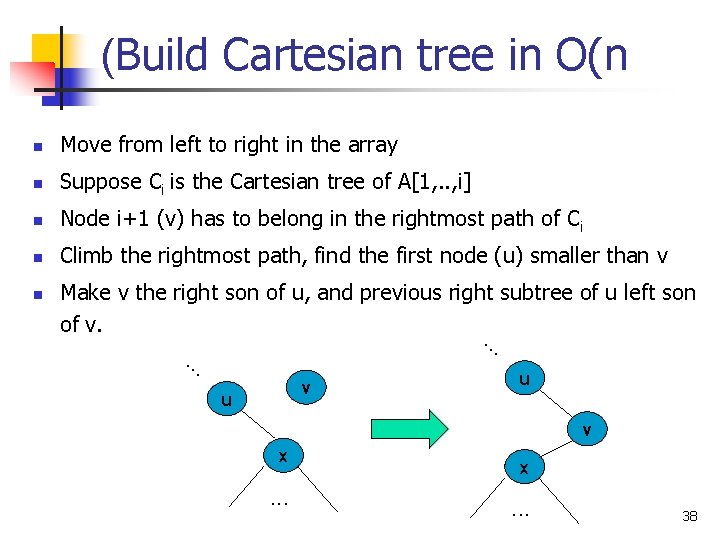
(Build Cartesian tree in O(n n Move from left to right in the array n Suppose Ci is the Cartesian tree of A[1, . . , i] n Node i+1 (v) has to belong in the rightmost path of C i n Climb the rightmost path, find the first node (u) smaller than v n Make v the right son of u, and previous right subtree of u left son of v. . . . v u u v x . . . 38
![(Build Cartesian tree in O(n A[0] A[1] A[2] A[3] A[4] A[5] A[6] A[7] A[8]](http://slidetodoc.com/presentation_image_h/9d93d9021015de80d8d6832c1aa15ee5/image-39.jpg "(Build Cartesian tree in O(n A[0] A[1] A[2] A[3] A[4] A[5] A[6] A[7] A[8]")
(Build Cartesian tree in O(n A[0] A[1] A[2] A[3] A[4] A[5] A[6] A[7] A[8] A[9] 10 25 22 34 7 19 9 12 26 16 10 0 39
![(Build Cartesian tree in O(n A[0] A[1] A[2] A[3] A[4] A[5] A[6] A[7] A[8]](http://slidetodoc.com/presentation_image_h/9d93d9021015de80d8d6832c1aa15ee5/image-40.jpg "(Build Cartesian tree in O(n A[0] A[1] A[2] A[3] A[4] A[5] A[6] A[7] A[8]")
(Build Cartesian tree in O(n A[0] A[1] A[2] A[3] A[4] A[5] A[6] A[7] A[8] A[9] 10 25 22 34 7 19 9 12 26 16 10 0 25 1 40
![(Build Cartesian tree in O(n A[0] A[1] A[2] A[3] A[4] A[5] A[6] A[7] A[8]](http://slidetodoc.com/presentation_image_h/9d93d9021015de80d8d6832c1aa15ee5/image-41.jpg "(Build Cartesian tree in O(n A[0] A[1] A[2] A[3] A[4] A[5] A[6] A[7] A[8]")
(Build Cartesian tree in O(n A[0] A[1] A[2] A[3] A[4] A[5] A[6] A[7] A[8] A[9] 10 25 22 34 7 19 9 12 26 16 10 0 22 2 25 1 41
![(Build Cartesian tree in O(n A[0] A[1] A[2] A[3] A[4] A[5] A[6] A[7] A[8]](http://slidetodoc.com/presentation_image_h/9d93d9021015de80d8d6832c1aa15ee5/image-42.jpg "(Build Cartesian tree in O(n A[0] A[1] A[2] A[3] A[4] A[5] A[6] A[7] A[8]")
(Build Cartesian tree in O(n A[0] A[1] A[2] A[3] A[4] A[5] A[6] A[7] A[8] A[9] 10 25 22 34 34 77 19 9 12 26 16 10 0 22 2 25 34 1 3 42
![(Build Cartesian tree in O(n A[0] A[1] A[2] A[3] A[4] A[5] A[6] A[7] A[8]](http://slidetodoc.com/presentation_image_h/9d93d9021015de80d8d6832c1aa15ee5/image-43.jpg "(Build Cartesian tree in O(n A[0] A[1] A[2] A[3] A[4] A[5] A[6] A[7] A[8]")
(Build Cartesian tree in O(n A[0] A[1] A[2] A[3] A[4] A[5] A[6] A[7] A[8] A[9] 10 25 22 34 7 19 9 12 26 16 7 4 10 0 22 2 25 34 1 3 43
![(Build Cartesian tree in O(n A[0] A[1] A[2] A[3] A[4] A[5] A[6] A[7] A[8]](http://slidetodoc.com/presentation_image_h/9d93d9021015de80d8d6832c1aa15ee5/image-44.jpg "(Build Cartesian tree in O(n A[0] A[1] A[2] A[3] A[4] A[5] A[6] A[7] A[8]")
(Build Cartesian tree in O(n A[0] A[1] A[2] A[3] A[4] A[5] A[6] A[7] A[8] A[9] 10 25 22 34 7 19 9 12 26 16 4 0 6 2 1 5 7 3 9 8 44
General O(n) RMQ n How to answer RMQ queries on A? n Build Cartesian tree C of array A. n RMQA(i, j) = LCAC(i, j) n Proof: n n n let k = LCAC(i, j). In the recursive description of a Cartesian tree k is the first element to split i and j. k is between i, j since it splits them and is minimal because it is the first element to do so. 45
General O(n) RMQ n Build Complexity: n Every node enters the rightmost path once. Once it leaves, will never return. n O(n). 46
![General O(n) RMQ A[0] A[1] A[2] A[3] A[4] A[5] A[6] A[7] A[8] A[9] 10](http://slidetodoc.com/presentation_image_h/9d93d9021015de80d8d6832c1aa15ee5/image-47.jpg "General O(n) RMQ A[0] A[1] A[2] A[3] A[4] A[5] A[6] A[7] A[8] A[9] 10")
General O(n) RMQ A[0] A[1] A[2] A[3] A[4] A[5] A[6] A[7] A[8] A[9] 10 25 22 34 7 19 9 12 26 16 4 0 6 2 1 5 7 3 9 8 47

The Level-Ancestor Problem simplified Michael A. Bender & Martin Farach-Colton
LA defined n n n n Depth(u) – distance from the root. Height(u) - # of nodes from u to its deepest descendant. LA(u, d) = v iff v is an ancestor of u where depth(v)=d. LA(u, 0) = root LA(u, depth(u)) = u Natural solutions: Climbing up the tree from u – O(n) query time. Precompute all answers – O(n^2) preprocessing. 49
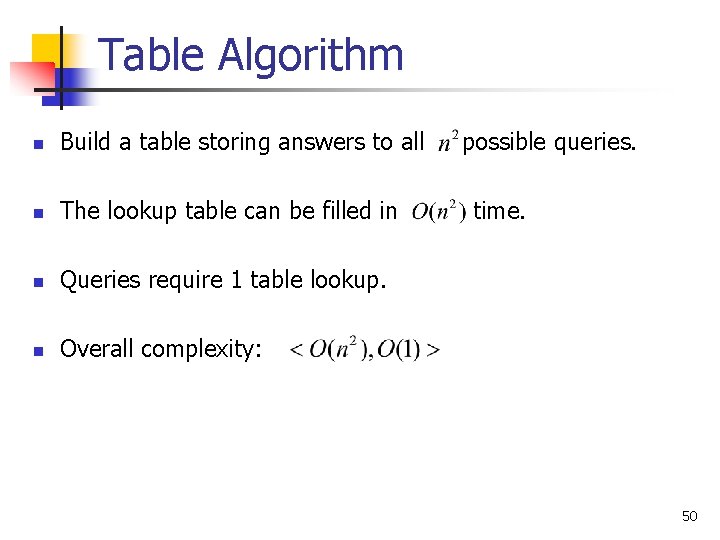
Table Algorithm n Build a table storing answers to all n The lookup table can be filled in n Queries require 1 table lookup. n Overall complexity: possible queries. time. 50
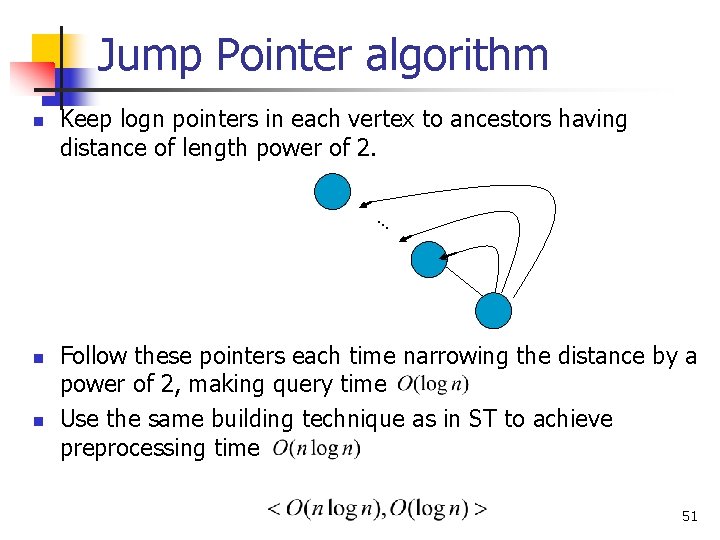
Jump Pointer algorithm n Keep logn pointers in each vertex to ancestors having distance of length power of 2. … n n Follow these pointers each time narrowing the distance by a power of 2, making query time Use the same building technique as in ST to achieve preprocessing time 51
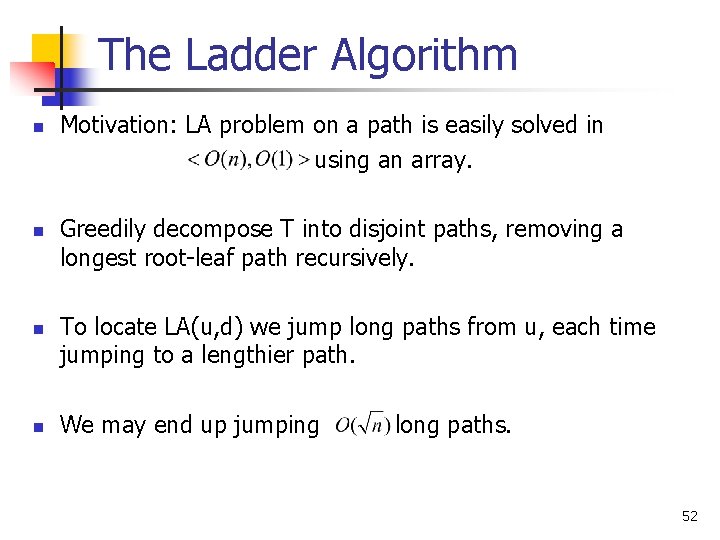
The Ladder Algorithm n n Motivation: LA problem on a path is easily solved in using an array. Greedily decompose T into disjoint paths, removing a longest root-leaf path recursively. To locate LA(u, d) we jump long paths from u, each time jumping to a lengthier path. We may end up jumping long paths. 52
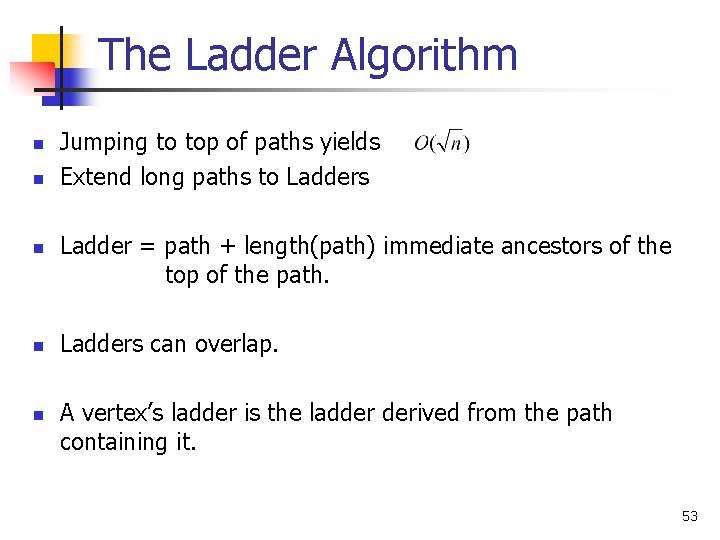
The Ladder Algorithm n n n Jumping to top of paths yields Extend long paths to Ladders Ladder = path + length(path) immediate ancestors of the top of the path. Ladders can overlap. A vertex’s ladder is the ladder derived from the path containing it. 53
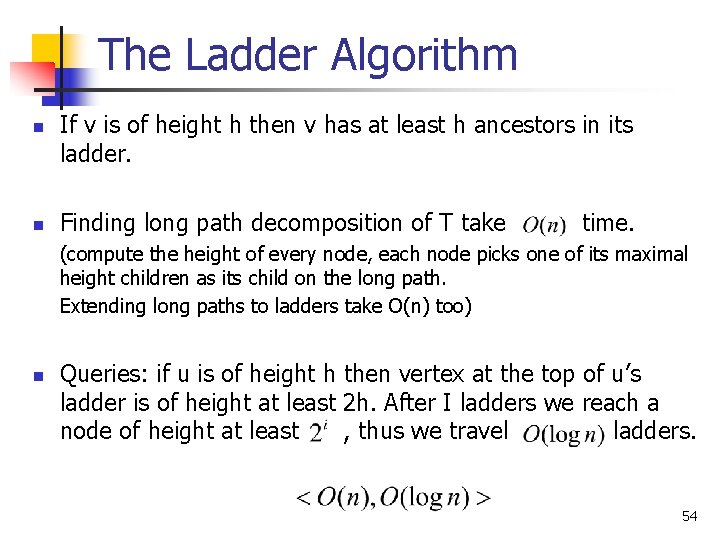
The Ladder Algorithm n n If v is of height h then v has at least h ancestors in its ladder. Finding long path decomposition of T take time. (compute the height of every node, each node picks one of its maximal height children as its child on the long path. Extending long paths to ladders take O(n) too) n Queries: if u is of height h then vertex at the top of u’s ladder is of height at least 2 h. After I ladders we reach a node of height at least , thus we travel ladders. 54
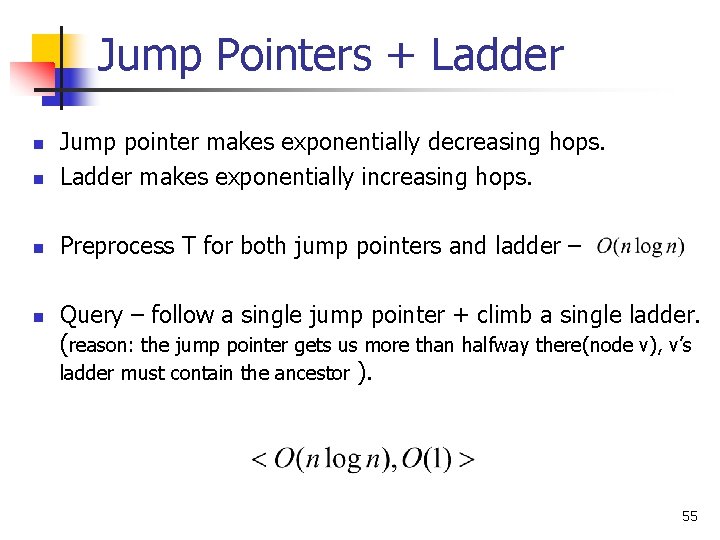
Jump Pointers + Ladder n Jump pointer makes exponentially decreasing hops. Ladder makes exponentially increasing hops. n Preprocess T for both jump pointers and ladder – n n Query – follow a single jump pointer + climb a single ladder. (reason: the jump pointer gets us more than halfway there(node v), v’s ladder must contain the ancestor ). 55
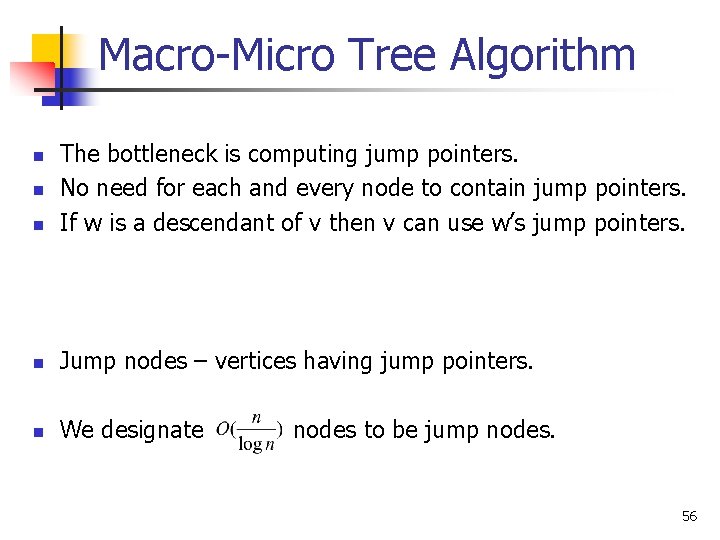
Macro-Micro Tree Algorithm n The bottleneck is computing jump pointers. No need for each and every node to contain jump pointers. If w is a descendant of v then v can use w’s jump pointers. n Jump nodes – vertices having jump pointers. n We designate n n nodes to be jump nodes. 56
Macro-Micro Tree Algorithm n n n Macro node – any ancestor of a jump node. Micro node – a node which is not a macro node. Macro tree – The macro nodes form a connected subtree. Micro trees – The connected components obtained from T after removing macro nodes. Jump node – the maximally deep vertices having at least log(n/4) descendants. There at most O(n/logn) jump nodes. 57
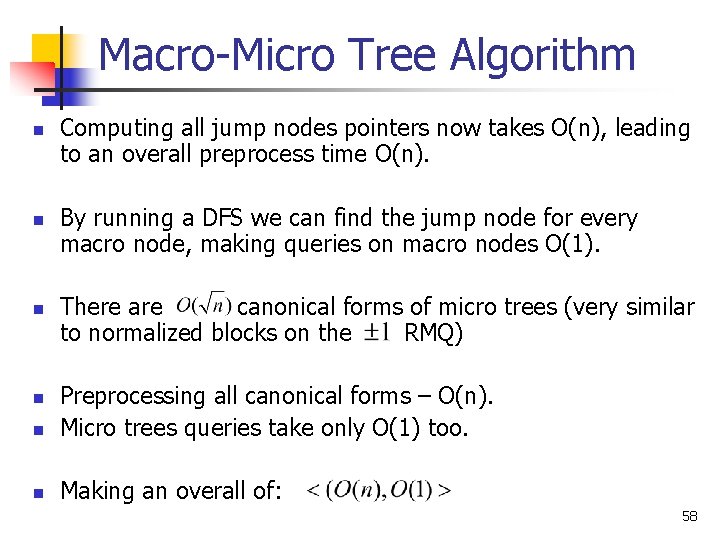
Macro-Micro Tree Algorithm n n n Computing all jump nodes pointers now takes O(n), leading to an overall preprocess time O(n). By running a DFS we can find the jump node for every macro node, making queries on macro nodes O(1). There are canonical forms of micro trees (very similar to normalized blocks on the RMQ) n Preprocessing all canonical forms – O(n). Micro trees queries take only O(1) too. n Making an overall of: n 58
- Slides: 58