
The Large Underground Xenon LUX Experiment An Overview
- Slides: 10
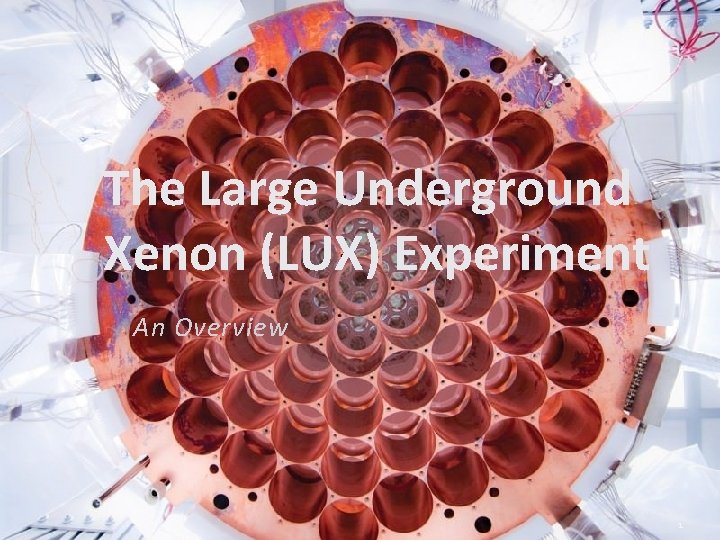
The Large Underground Xenon (LUX) Experiment An Overview 1
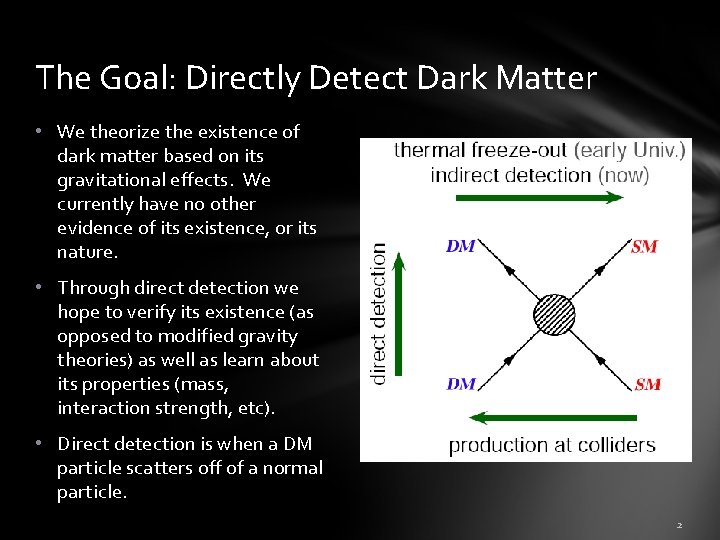
The Goal: Directly Detect Dark Matter • We theorize the existence of dark matter based on its gravitational effects. We currently have no other evidence of its existence, or its nature. • Through direct detection we hope to verify its existence (as opposed to modified gravity theories) as well as learn about its properties (mass, interaction strength, etc). • Direct detection is when a DM particle scatters off of a normal particle. 2
The candidate: WIMPs • The leading candidate for dark matter is a particle called the WIMP. • WIMP stands for Weakly Interacting Massive Particle, so called because it interacts only via the weak force and via gravity. • This is because in order to get the correct amount of dark matter out of the big bang in the simplest models requires a particle with a self interaction cross section at the weak scale. • WIMPS are expected to have mass in the 100 Ge. V range. This makes Xenon an ideal detection medium, having mass ~120 Ge. V. 3
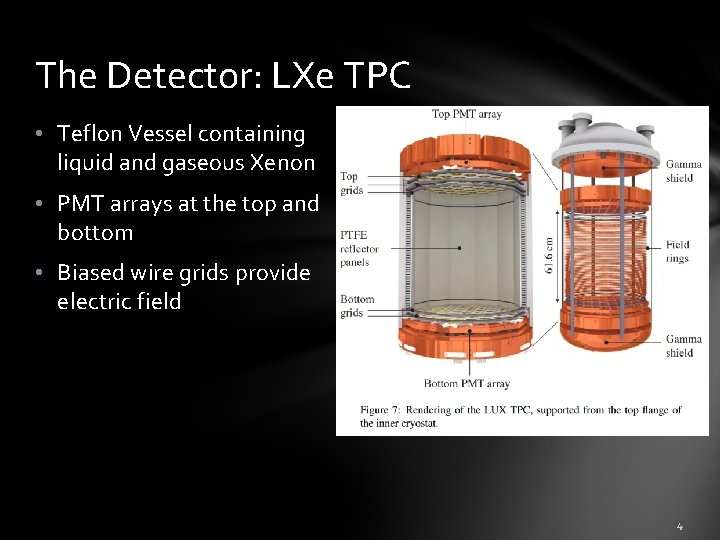
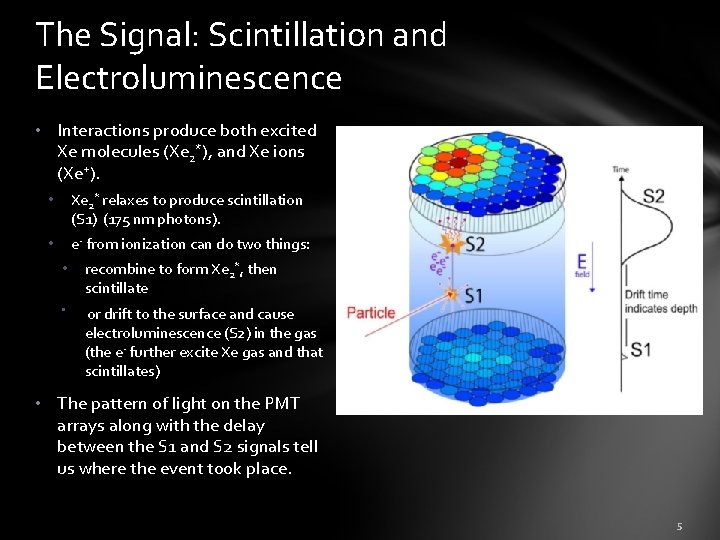
The Detector: LXe TPC • Teflon Vessel containing liquid and gaseous Xenon • PMT arrays at the top and bottom • Biased wire grids provide electric field 4
The Signal: Scintillation and Electroluminescence • Interactions produce both excited Xe molecules (Xe 2*), and Xe ions (Xe+). • Xe 2* relaxes to produce scintillation (S 1) (175 nm photons). • e- from ionization can do two things: • recombine to form Xe 2*, then scintillate • or drift to the surface and cause electroluminescence (S 2) in the gas (the e- further excite Xe gas and that scintillates) • The pattern of light on the PMT arrays along with the delay between the S 1 and S 2 signals tell us where the event took place. 5
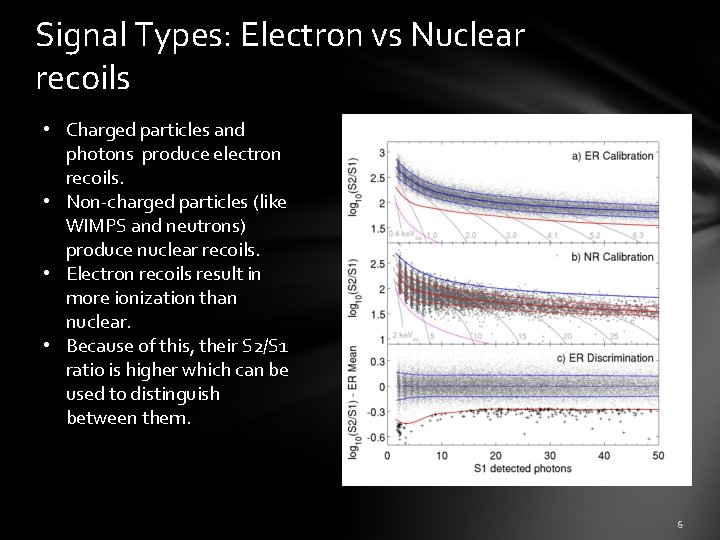
Signal Types: Electron vs Nuclear recoils • Charged particles and photons produce electron recoils. • Non-charged particles (like WIMPS and neutrons) produce nuclear recoils. • Electron recoils result in more ionization than nuclear. • Because of this, their S 2/S 1 ratio is higher which can be used to distinguish between them. 6
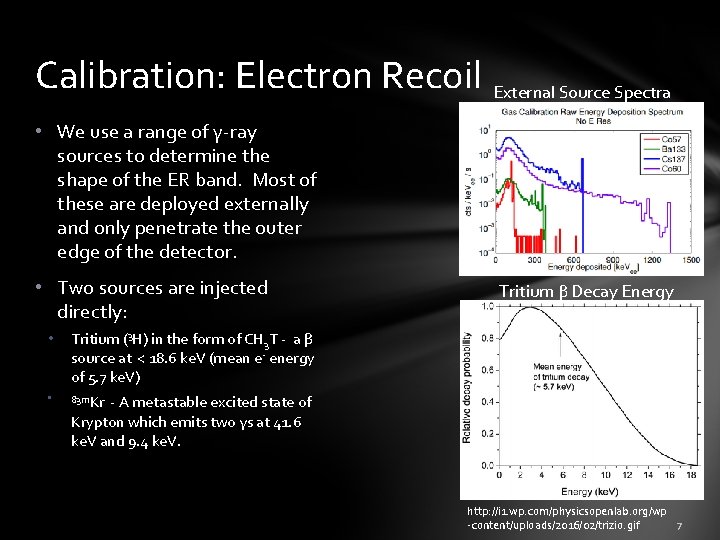
Calibration: Electron Recoil External Source Spectra • We use a range of γ-ray sources to determine the shape of the ER band. Most of these are deployed externally and only penetrate the outer edge of the detector. • Two sources are injected directly: • Tritium (3 H) in the form of CH 3 T - a β source at < 18. 6 ke. V (mean e- energy of 5. 7 ke. V) • 83 m. Kr Tritium β Decay Energy - A metastable excited state of Krypton which emits two γs at 41. 6 ke. V and 9. 4 ke. V. http: //i 1. wp. com/physicsopenlab. org/wp 7 -content/uploads/2016/02/trizio. gif
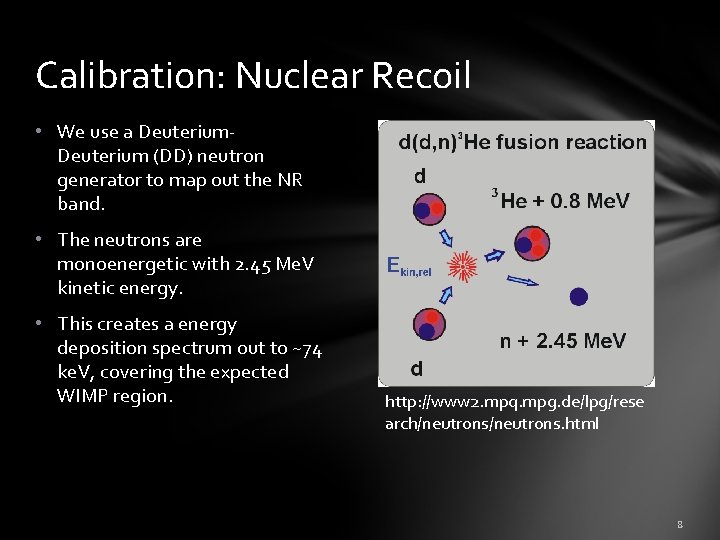
Calibration: Nuclear Recoil • We use a Deuterium (DD) neutron generator to map out the NR band. • The neutrons are monoenergetic with 2. 45 Me. V kinetic energy. • This creates a energy deposition spectrum out to ~74 ke. V, covering the expected WIMP region. http: //www 2. mpq. mpg. de/lpg/rese arch/neutrons. html 8
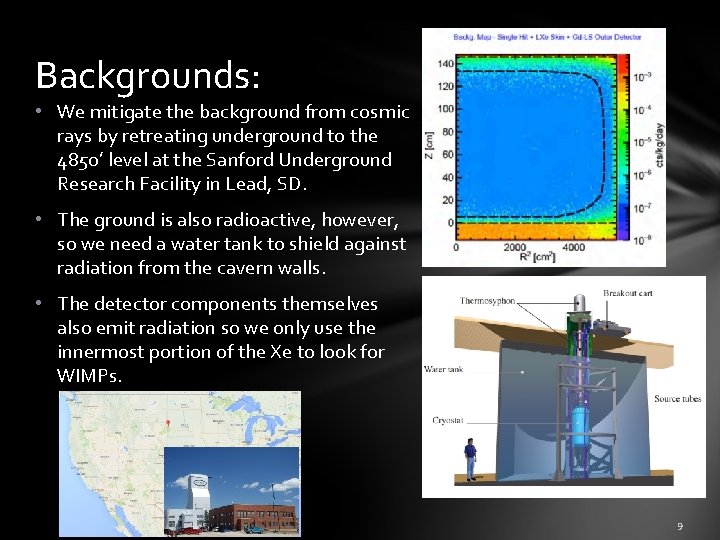
Backgrounds: • We mitigate the background from cosmic rays by retreating underground to the 4850’ level at the Sanford Underground Research Facility in Lead, SD. • The ground is also radioactive, however, so we need a water tank to shield against radiation from the cavern walls. • The detector components themselves also emit radiation so we only use the innermost portion of the Xe to look for WIMPs. 9
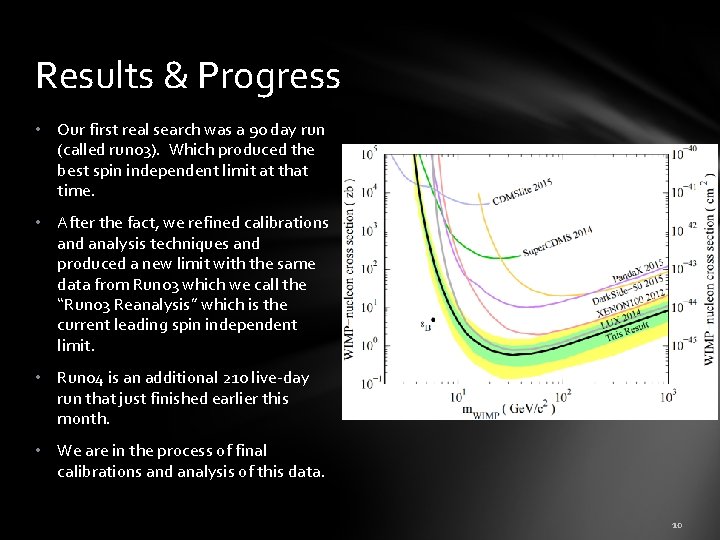
Results & Progress • Our first real search was a 90 day run (called run 03). Which produced the best spin independent limit at that time. • After the fact, we refined calibrations and analysis techniques and produced a new limit with the same data from Run 03 which we call the “Run 03 Reanalysis” which is the current leading spin independent limit. • Run 04 is an additional 210 live-day run that just finished earlier this month. • We are in the process of final calibrations and analysis of this data. 10