
The large scale convection electric field ring current
![Adapted from Grebowsky 1970 Adapted from Goldstein [2006] Van Allen Probe A Orbit, June](https://slidetodoc.com/presentation_image_h/2f036de10a1b0694dd2fbdb8b71faa8b/image-9.jpg "Adapted from Grebowsky 1970 Adapted from Goldstein [2006] Van Allen Probe A Orbit, June")

- Slides: 20
The large scale convection electric field, ring current energization, and plasmasphere erosion in the June 1, 2013 storm Scott Thaller Van Allen Probes SWG telecon July 10, 2015
Based on the paper: Van Allen Probes investigation of the large -scale duskward electric field and its role in ring current formation and plasmasphere erosion in the 1 June 2013 storm S. A. Thaller, J. R. Wygant, L. Dai, A. W. Breneman, K. Kersten, C. A. Cattell, J. W. Bonnell, J. F. Fennell, Matina Gkioulidou, C. A. Kletzing, S. De Pascuale, G. B. Hospodarsky, and S. R. Bounds Thaller et al. , [2015] is published in JGR, DOI: 10. 1002/2014 JA 020875
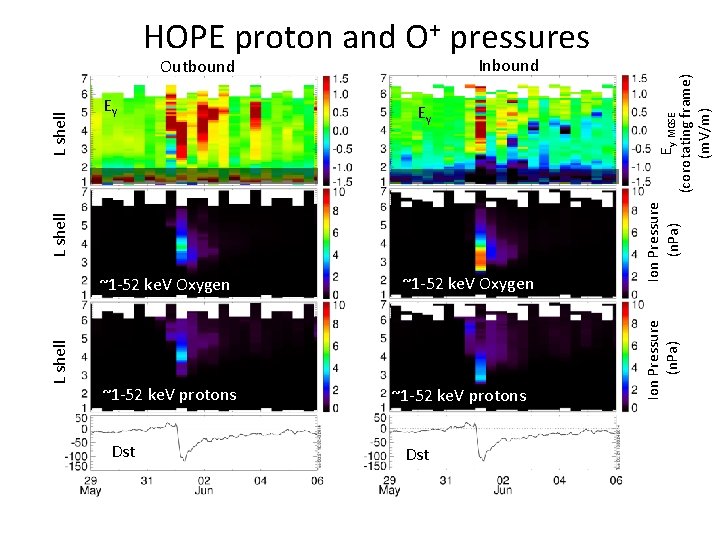
Main Points (Introduction) • During the strong geomagnetic storm on June 1, 2013 (min. Dst ~ − 120 n. T), a large scale convection electric field is observed, lasting at least ~7 hours, with enhancements ~1 -2 m. V/m, and extending down to L~2. 3. • We investigate the response to this electric field of the plasmasphere (erosion), and the ring current ions with energies 58 -267 ke. V. • Note that lower energy ions (1 -52 ke. V) are present, and do contribute to the ring current ion pressure, but not the focus of this study. The 58267 ke. V ions have undergone a greater amount of energization than the lower energy ions.
Main Points (Introduction) • We show nearly simultaneous enhancements in the duskward convection electric field, plasmasphere erosion, and increased pressure of 58– 267 ke. V ring current ions. • The duration and intensity of the electric field enhancement is long enough to drive the plasmasphere erosion and transport the ring current ions, while energizing then to the observed energies, according to a simple calculation. • These observations suggest that we are observing the electric field that energizes the ions and produces the erosion of the plasmasphere. • Injection events also likely play an important role in ring current ion energization in this storm. There will be some discussion of these too.
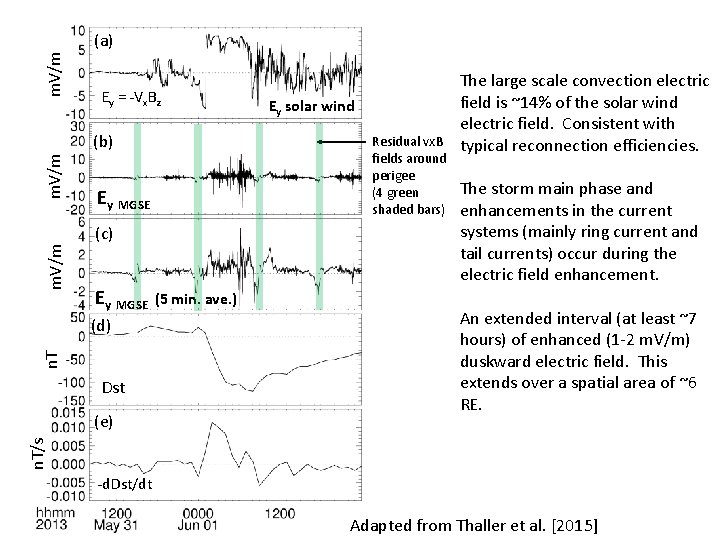
m. V/m (a) Ey = -Vx. Bz m. V/m (b) Residual vx. B fields around perigee (4 green shaded bars) Ey MGSE m. V/m (c) Ey MGSE n. T (d) Dst (5 min. ave. ) The storm main phase and enhancements in the current systems (mainly ring current and tail currents) occur during the electric field enhancement. An extended interval (at least ~7 hours) of enhanced (1 -2 m. V/m) duskward electric field. This extends over a spatial area of ~6 RE. n. T/s (e) Ey solar wind The large scale convection electric field is ~14% of the solar wind electric field. Consistent with typical reconnection efficiencies. -d. Dst/dt Adapted from Thaller et al. [2015]
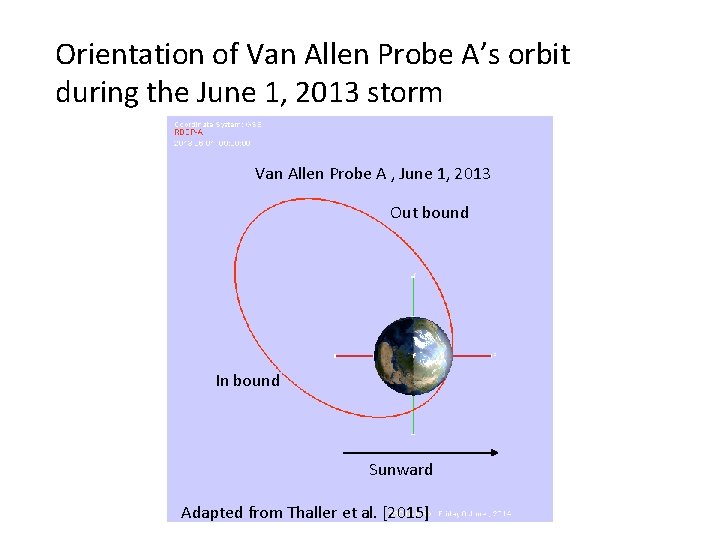
Orientation of Van Allen Probe A’s orbit during the June 1, 2013 storm Van Allen Probe A , June 1, 2013 Out bound In bound Sunward Adapted from Thaller et al. [2015]
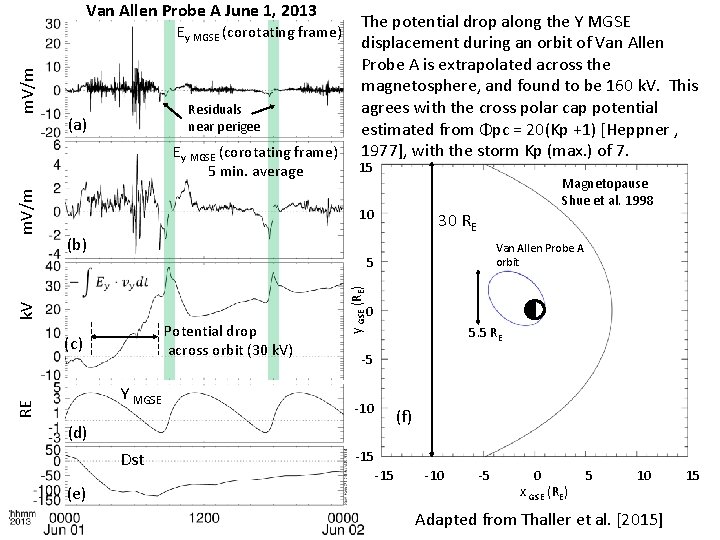
Van Allen Probe A June 1, 2013 m. V/m Ey MGSE (corotating frame) Residuals near perigee (a) m. V/m Ey MGSE (corotating frame) 5 min. average v The potential drop along the Y MGSE displacement during an orbit of Van Allen Probe A is extrapolated across the magnetosphere, and found to be 160 k. V. This agrees with the cross polar cap potential estimated from Φpc = 20(Kp +1) [Heppner , 1977], with the storm Kp (max. ) of 7. 15 Magnetopause Shue et al. 1998 10 (b) 30 RE Van Allen Probe A orbit 5 y GSE (RE) k. V 0 Potential drop across orbit (30 k. V) (c) RE Y MGSE -5 -10 (d) Dst (e) 5. 5 RE (f) -15 -10 -5 0 5 10 15 x GSE (RE) Adapted from Thaller et al. [2015]
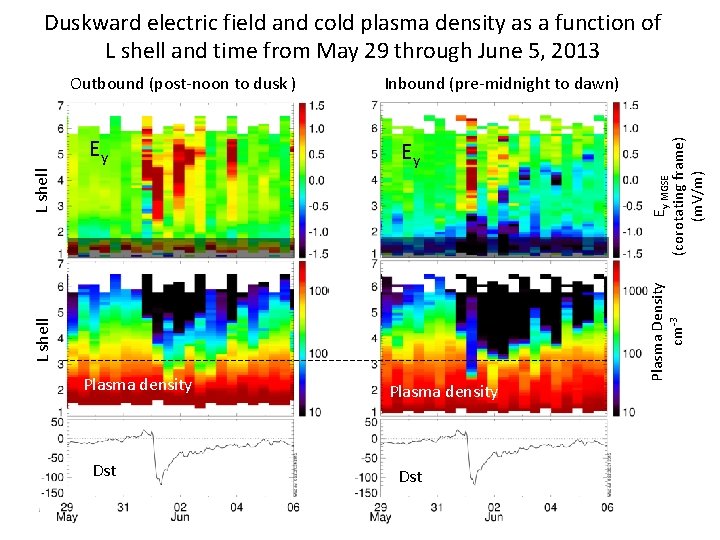
Duskward electric field and cold plasma density as a function of L shell and time from May 29 through June 5, 2013 Plasma density Dst Ey MGSE (corotating frame) (m. V/m) Ey L shell Ey Inbound (pre-midnight to dawn) Plasma Density cm-3 Outbound (post-noon to dusk )
Adapted from Grebowsky 1970 Adapted from Goldstein [2006] Van Allen Probe A Orbit, June 1, 2013 General plasmasphere shape for steady Ey >0 Ey = 0. 9 Lsp = 3. 9
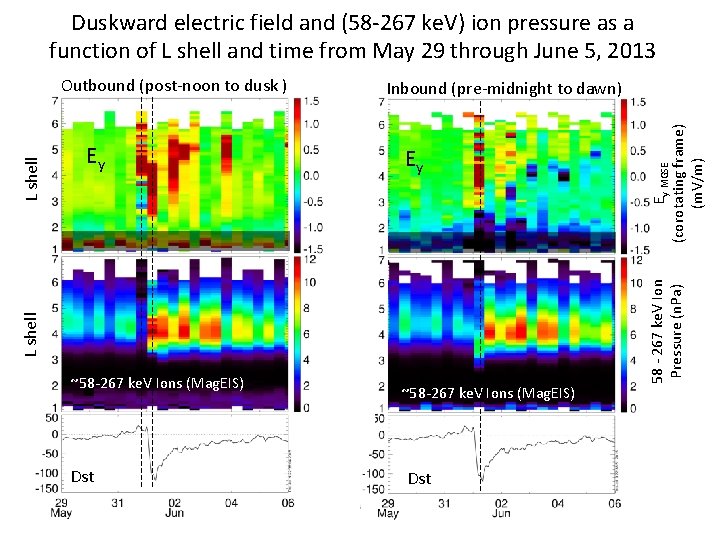
Duskward electric field and (58 -267 ke. V) ion pressure as a function of L shell and time from May 29 through June 5, 2013 Ey ~58 -267 ke. V Ions (Mag. EIS) Dst 58 - 267 ke. V Ion Ey MGSE Pressure (n. Pa) (corotating frame) (m. V/m) Ey Inbound (pre-midnight to dawn) L shell Outbound (post-noon to dusk )
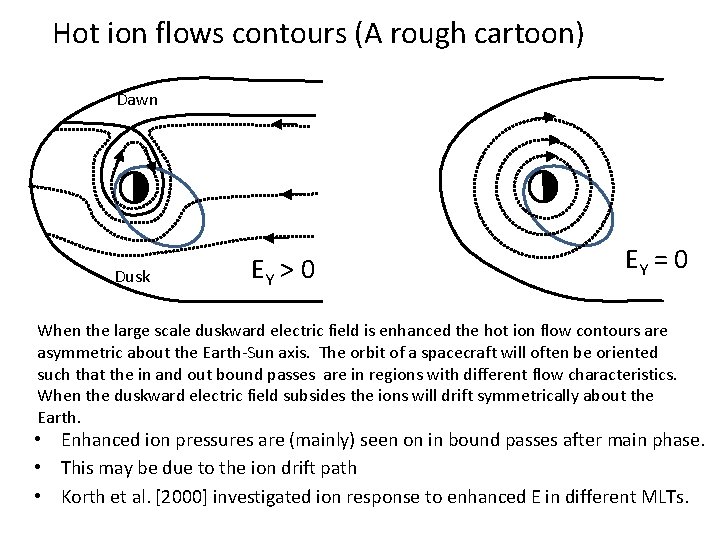
Hot ion flows contours (A rough cartoon) Dawn Dusk EY > 0 EY = 0 When the large scale duskward electric field is enhanced the hot ion flow contours are asymmetric about the Earth-Sun axis. The orbit of a spacecraft will often be oriented such that the in and out bound passes are in regions with different flow characteristics. When the duskward electric field subsides the ions will drift symmetrically about the Earth. • Enhanced ion pressures are (mainly) seen on in bound passes after main phase. • This may be due to the ion drift path • Korth et al. [2000] investigated ion response to enhanced E in different MLTs.
L shell ~1 -52 ke. V Oxygen ~1 -52 ke. V protons Dst Ion Pressure (n. Pa) L shell Ey Ion Pressure (n. Pa) Inbound Outbound Ey MGSE (corotating frame) (m. V/m) HOPE proton and O+ pressures
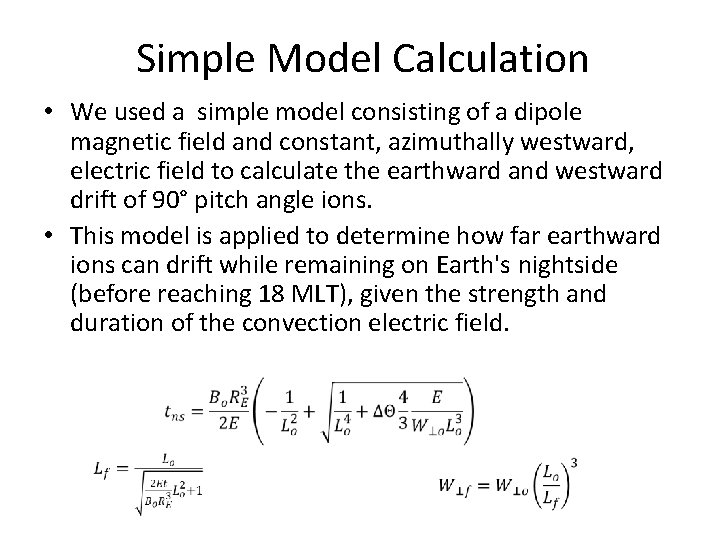
Simple Model Calculation • We used a simple model consisting of a dipole magnetic field and constant, azimuthally westward, electric field to calculate the earthward and westward drift of 90° pitch angle ions. • This model is applied to determine how far earthward ions can drift while remaining on Earth's nightside (before reaching 18 MLT), given the strength and duration of the convection electric field.
Simple Model Calculation • For a duskward/azimuthal electric field with an intensity of 0. 9 m. V/m (the average of the field observed), an ion starting at L = 8, MLT = 3 with an initial energy in the range of ~5 -26 ke. V (not observed by RBSP) will drift earthward in 1 -2 hours to locations between L~3. 5 - 5, and have final energies of ~65 -130 ke. V. • This shows that such a convection electric field as that observed in the June 1, 2013 storm can take ions near the inner edge of the plasma sheet (if the enhanced E field exists there) and transport them to the location of the observed ring current, while energizing them to typical ring current energies.
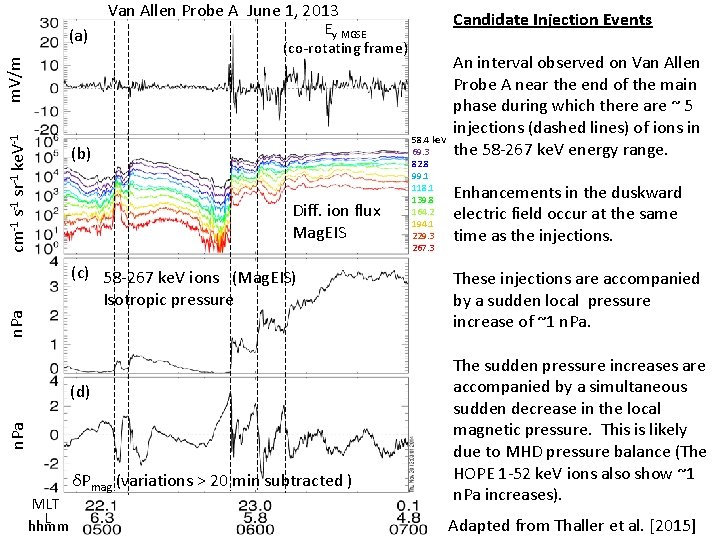
Van Allen Probe A June 1, 2013 cm-1 sr-1 ke. V-1 m. V/m (a) Ey MGSE (co-rotating frame) (b) Diff. ion flux Mag. EIS n. Pa (c) 58 -267 ke. V ions (Mag. EIS) Isotropic pressure n. Pa (d) δPmag (variations > 20 min subtracted ) MLT L hhmm Candidate Injection Events An interval observed on Van Allen Probe A near the end of the main phase during which there are ~ 5 injections (dashed lines) of ions in 58. 4 ke. V 69. 3 the 58 -267 ke. V energy range. 82. 8 99. 1 118. 1 139. 8 164. 2 194. 1 229. 3 267. 3 Enhancements in the duskward electric field occur at the same time as the injections. These injections are accompanied by a sudden local pressure increase of ~1 n. Pa. The sudden pressure increases are accompanied by a simultaneous sudden decrease in the local magnetic pressure. This is likely due to MHD pressure balance (The HOPE 1 -52 ke. V ions also show ~1 n. Pa increases). Adapted from Thaller et al. [2015]
Conclusions • 1. ) The simultaneous enhancements in the large scale duskward electric field, plasmasphere erosion, and ring current ion pressure, combined with a simple model calculation, indicate a direct role of the electric field in ring current energization and plasmasphere erosion. • 2. ) The range of L shell in which the most intense duskward electric field enhancements occurred was similar to that in which the ~58 -267 ke. V ring current ions had the highest pressure. This occurs: – On the pre-midnight to post midnight side after the convection electric field decreases; – On the post-noon to dusk side both during and after the convection electric field decreases.
Conclusions • Other storms (March 17, 2013 and June 28 -29, 2013) were examined, the results of those analyses were consistent with those of the June 1, 2013 storm. • Injection events and associated increases in the local ion pressure do occur during the main phase of the June 1, 2013 storm, often in association with large duskward electric fields of ~10 m. V/m, which are superimposed on the large scale convection electric field. • The ions in these injections are located in magnetic cavities likely associated with MHD pressure balance. • The typical duskward (“injection”) electric field intensities are ~10 m. V/m and the ions have characteristic energies ~100 ke. V. Assuming the ions are energized by drifting through this electric field, a width of the injection region can be inferred to be ~1. 6 RE. This width is consistent with the injection width of ~1. 8 RE, determined by other means (arrival time of different energy ions) by Gkioulidou et al. [2014].
Extra slides
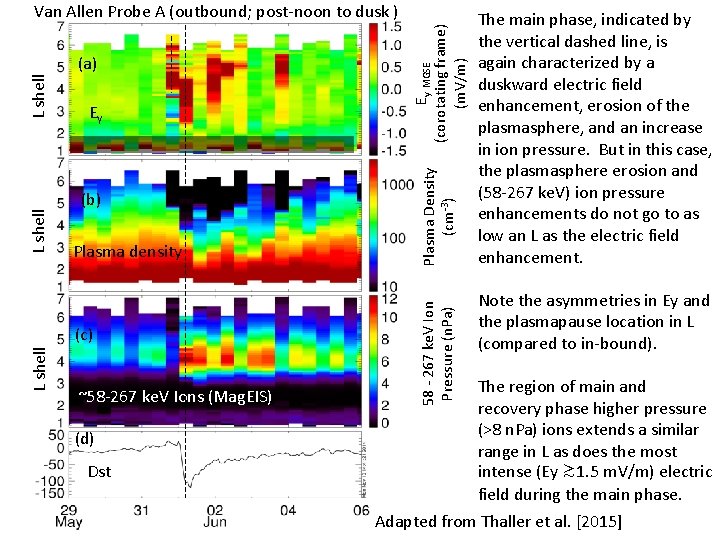
L shell Ey (b) Plasma density L shell (c) ~58 -267 ke. V Ions (Mag. EIS) (d) Dst Ey MGSE (corotating frame) (m. V/m) L shell (a) 58 - 267 ke. V Ion Plasma Density Pressure (n. Pa) (cm-3) Van Allen Probe A (outbound; post-noon to dusk ) The main phase, indicated by the vertical dashed line, is again characterized by a duskward electric field enhancement, erosion of the plasmasphere, and an increase in ion pressure. But in this case, the plasmasphere erosion and (58 -267 ke. V) ion pressure enhancements do not go to as low an L as the electric field enhancement. Note the asymmetries in Ey and the plasmapause location in L (compared to in-bound). The region of main and recovery phase higher pressure (>8 n. Pa) ions extends a similar range in L as does the most intense (Ey ≳ 1. 5 m. V/m) electric field during the main phase. Adapted from Thaller et al. [2015]
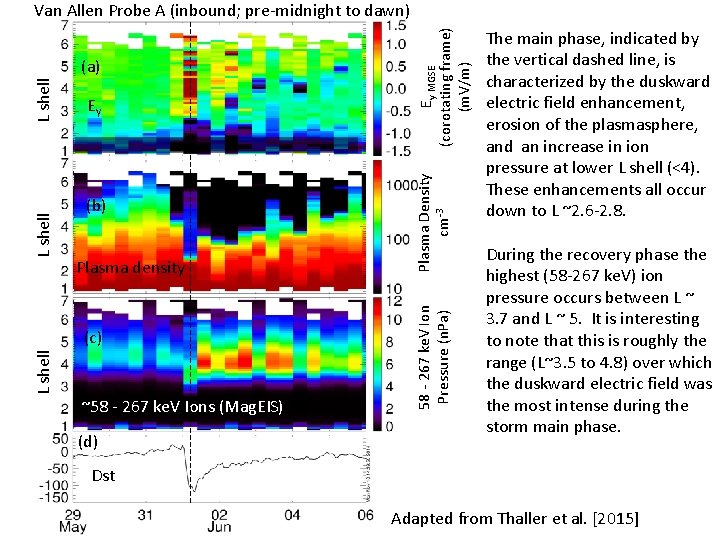
Ey (b) Plasma density L shell (c) ~58 - 267 ke. V Ions (Mag. EIS) (d) 58 - 267 ke. V Ion Plasma Density cm-3 Pressure (n. Pa) L shell (a) Ey MGSE (corotating frame) (m. V/m) Van Allen Probe A (inbound; pre-midnight to dawn) The main phase, indicated by the vertical dashed line, is characterized by the duskward electric field enhancement, erosion of the plasmasphere, and an increase in ion pressure at lower L shell (<4). These enhancements all occur down to L ~2. 6 -2. 8. During the recovery phase the highest (58 -267 ke. V) ion pressure occurs between L ~ 3. 7 and L ~ 5. It is interesting to note that this is roughly the range (L~3. 5 to 4. 8) over which the duskward electric field was the most intense during the storm main phase. Dst Adapted from Thaller et al. [2015]