
The Language of Mathematics Questions to Answer Today




- Slides: 54
The Language of Mathematics
Questions to Answer Today • What are the dimensions of academic language? • How can I facilitate student use of precise language when communicating with others about math? • How do I use various models to support student use of language? • How can I provide students with opportunities to be precise?
Let’s Begin With Math David is painting his room. The area of his walls is 384 square feet. If one quart of paint covers 105 square feet, how many quarts of paint does David need to buy? What do we need to know, understand, and be able to do to successfully solve this problem?
Importance of Language in Math Principles and Standards for School Mathematics (NCTM 2000, p. 60) states that students who have opportunities, encouragement, and support for speaking, writing reading, and listening in math classes benefit because “they communicate to learn mathematics , and they learn to communicate mathematically, ” which helps children be successful in math class. National Council of Teachers of Mathematics (Ed. ). (2000). Principles and standards for school mathematics (Vol. 1).
How Do Language Experiences Help Make Concepts “Stick” Forever? Concept in Isolation Concept Strengthened with Many Connections through Language
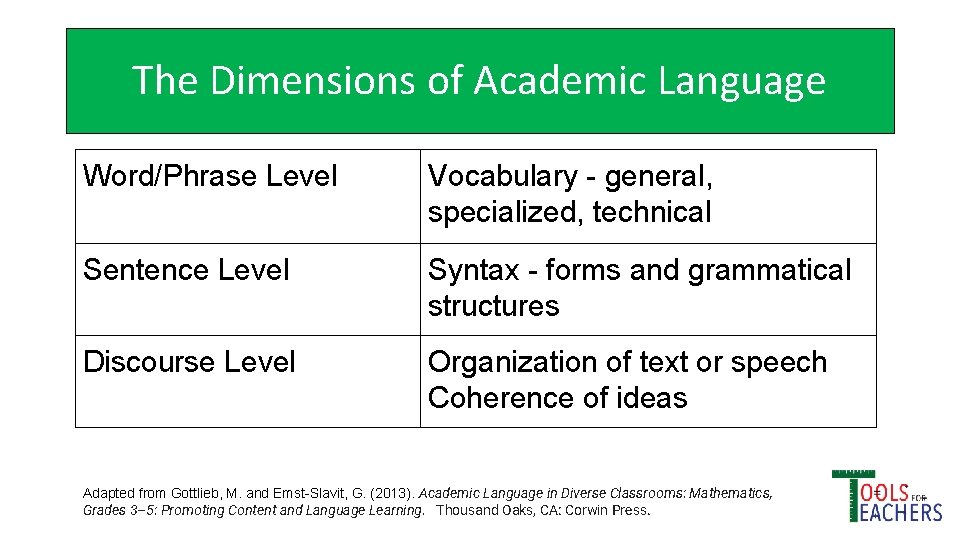
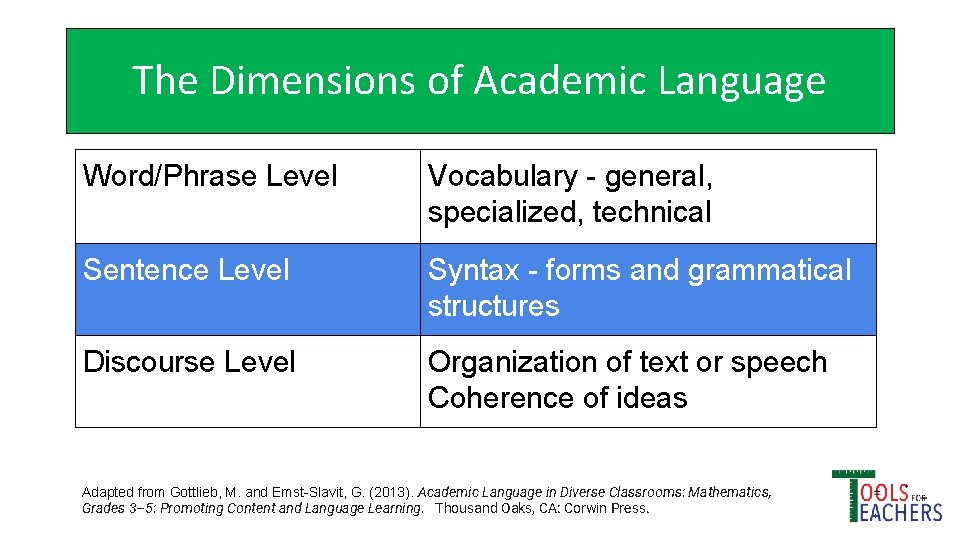
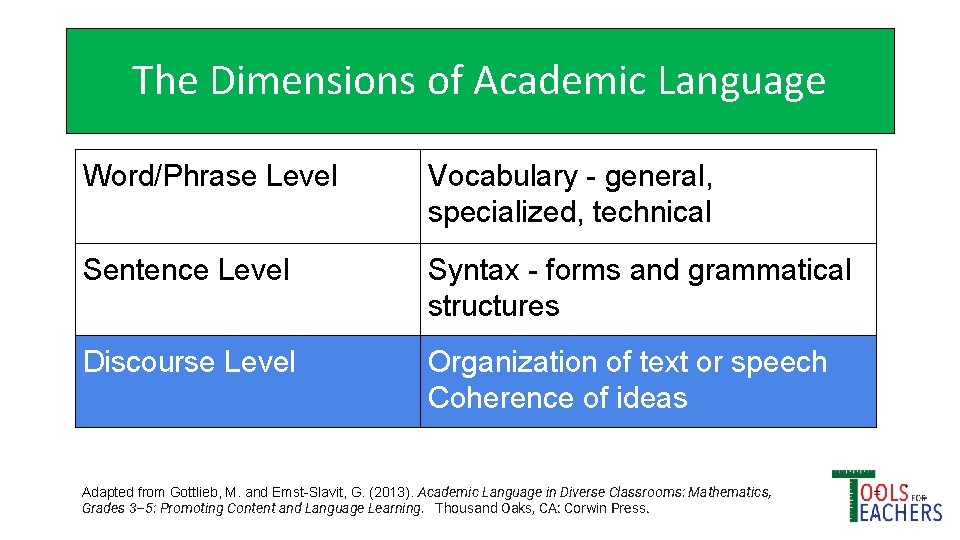
The Dimensions of Academic Language Word/Phrase Level Vocabulary - general, specialized, technical Sentence Level Syntax - forms and grammatical structures Discourse Level Organization of text or speech Coherence of ideas Adapted from Gottlieb, M. and Emst-Slavit, G. (2013). Academic Language in Diverse Classrooms: Mathematics, Grades 3– 5: Promoting Content and Language Learning. Thousand Oaks, CA: Corwin Press.
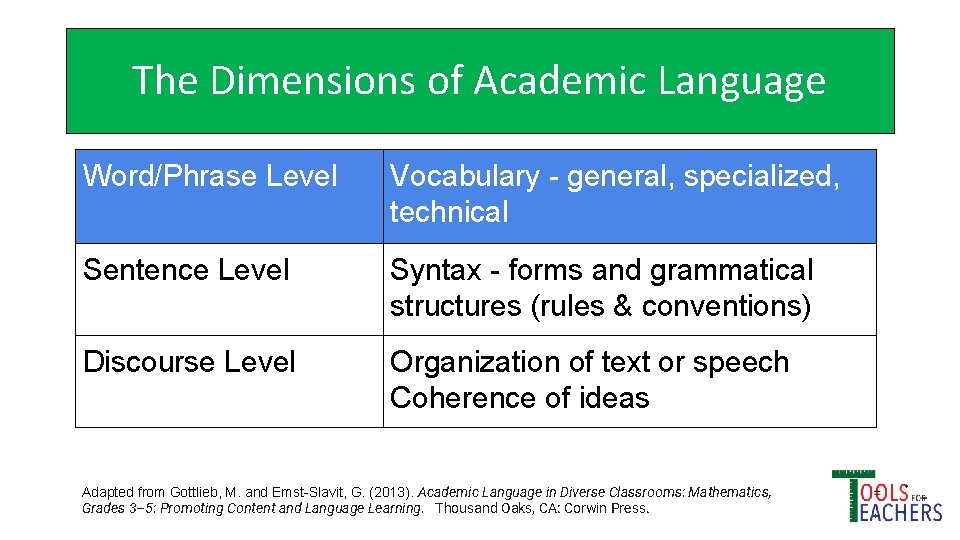
The Dimensions of Academic Language Word/Phrase Level Vocabulary - general, specialized, technical Sentence Level Syntax - forms and grammatical structures (rules & conventions) Discourse Level Organization of text or speech Coherence of ideas Adapted from Gottlieb, M. and Emst-Slavit, G. (2013). Academic Language in Diverse Classrooms: Mathematics, Grades 3– 5: Promoting Content and Language Learning. Thousand Oaks, CA: Corwin Press.
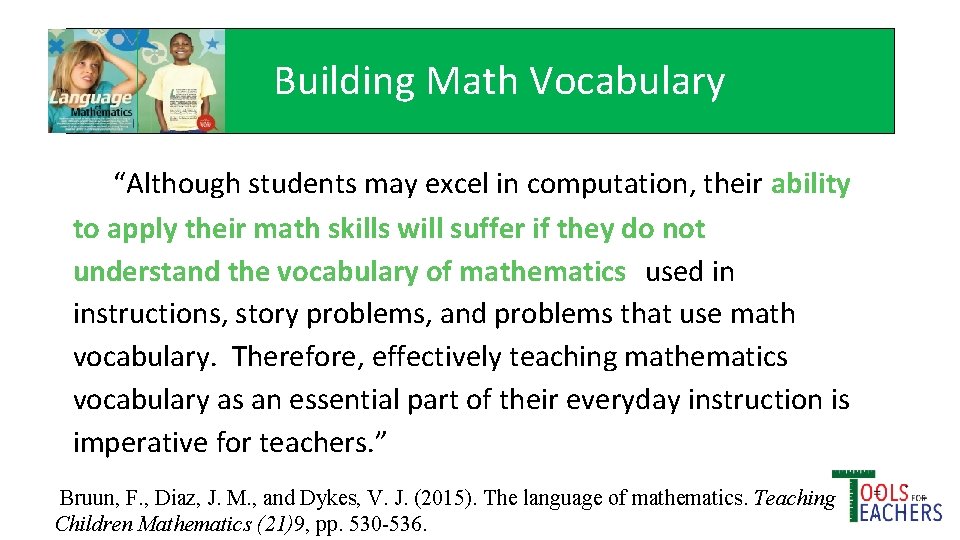
Building Math Vocabulary “Although students may excel in computation, their ability to apply their math skills will suffer if they do not understand the vocabulary of mathematics used in instructions, story problems, and problems that use math vocabulary. Therefore, effectively teaching mathematics vocabulary as an essential part of their everyday instruction is imperative for teachers. ” Bruun, F. , Diaz, J. M. , and Dykes, V. J. (2015). The language of mathematics. Teaching Children Mathematics (21)9, pp. 530 -536.
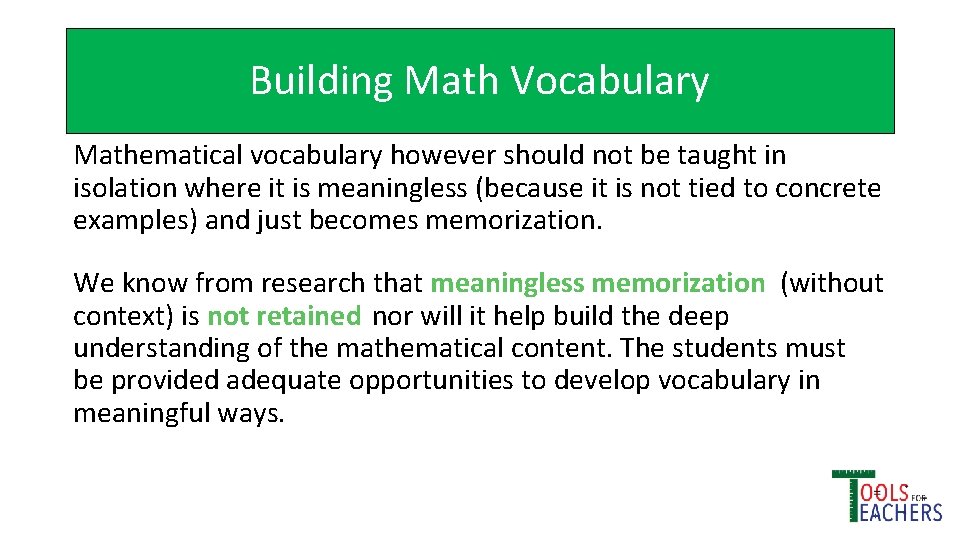
Building Math Vocabulary Mathematical vocabulary however should not be taught in isolation where it is meaningless (because it is not tied to concrete examples) and just becomes memorization. We know from research that meaningless memorization (without context) is not retained nor will it help build the deep understanding of the mathematical content. The students must be provided adequate opportunities to develop vocabulary in meaningful ways.
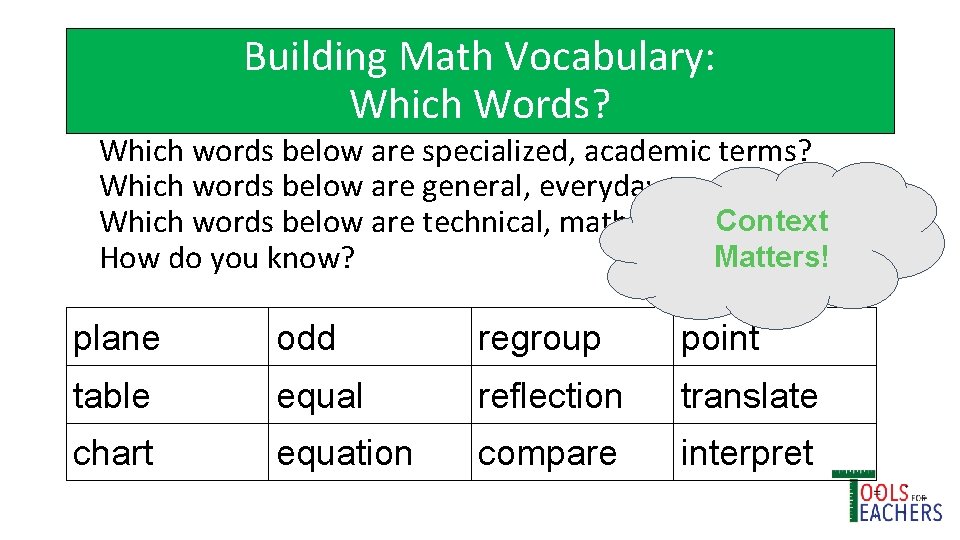
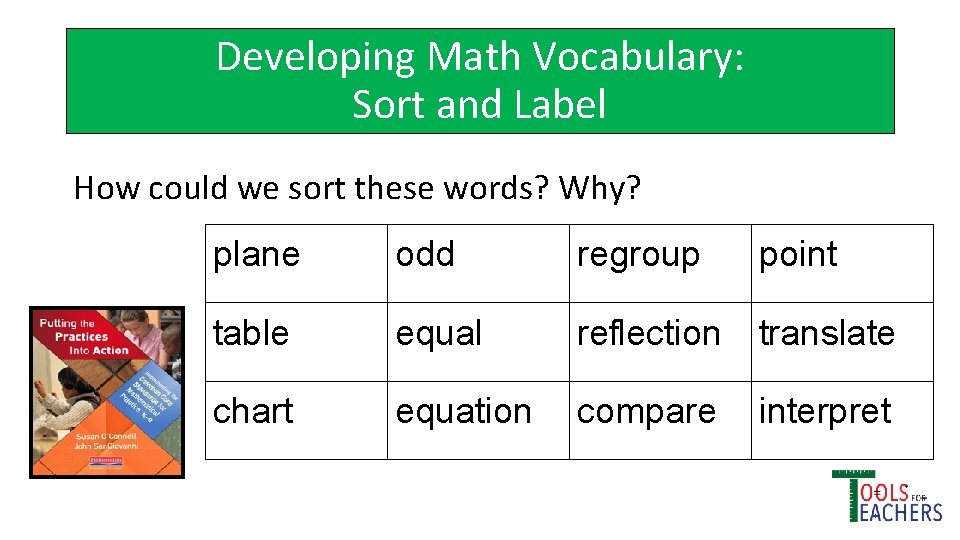
Building Math Vocabulary: Which Words? Which words below are specialized, academic terms? Which words below are general, everyday terms? Which words below are technical, math terms? Context Matters! How do you know? plane odd regroup point table equal reflection translate chart equation compare interpret
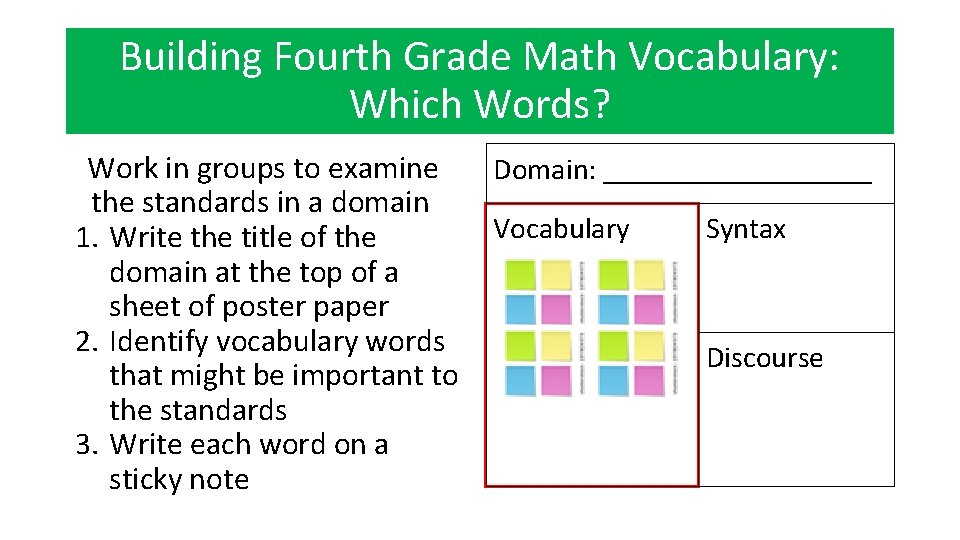
Building Fourth Grade Math Vocabulary: Which Words? Work in groups to examine the standards in a domain 1. Write the title of the domain at the top of a sheet of poster paper 2. Identify vocabulary words that might be important to the standards 3. Write each word on a sticky note Domain: _________ Vocabulary Syntax Discourse
Building Fourth Grade Math Vocabulary: Fourth Grade Vocabulary Which Words? Take a Gallery Walk! 1. Visit each table 2. Examine the words 3. Discuss: Do you agree or disagree? Would you add any words? Change any words? 4. Leave your team’s notes on a new sticky
Building Fourth Grade Math Vocabulary: Fourth Grade Vocabulary Which Words? Gallery Walk Debrief • What did you notice about the other groups’ words? • What were some of the comments you received? • What do you wonder about the vocabulary for fourth grade?
Developing Math Vocabulary: What’s My Rule? O'Connell, S. , & San. Giovanni, J. (2013). Putting the Practices Into Action: Implementing the Common Core Standards for Mathematical Practice, K-8. Portsmouth, NH: Heinemann.
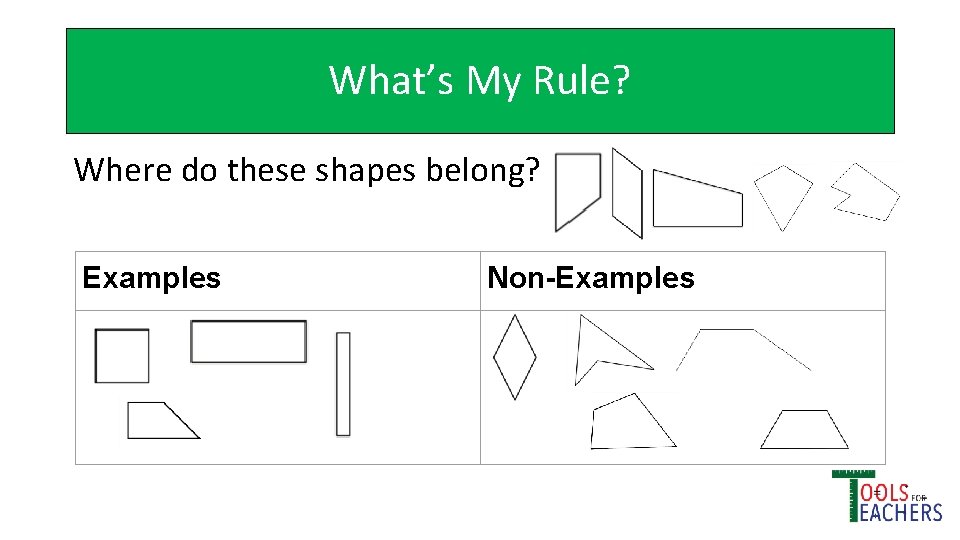
What’s My Rule? Where do these shapes belong? Examples Non-Examples
What’s My Rule? Where do these shapes belong? Examples What’s My Rule? Non-Examples
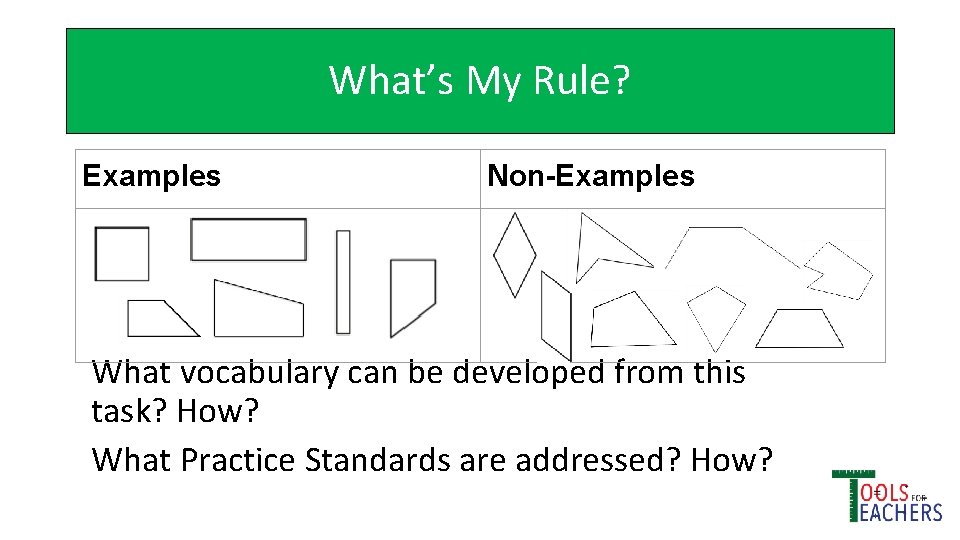
What’s My Rule? Examples Non-Examples What vocabulary can be developed from this task? How? What Practice Standards are addressed? How?
Developing Math Vocabulary: Sort and Label O'Connell, S. , & San. Giovanni, J. (2013). Putting the Practices Into Action: Implementing the Common Core Standards for Mathematical Practice, K-8. Portsmouth, NH: Heinemann.
Developing Math Vocabulary: Sort and Label How could we sort these words? Why? plane odd regroup point table equal reflection translate chart equation compare interpret
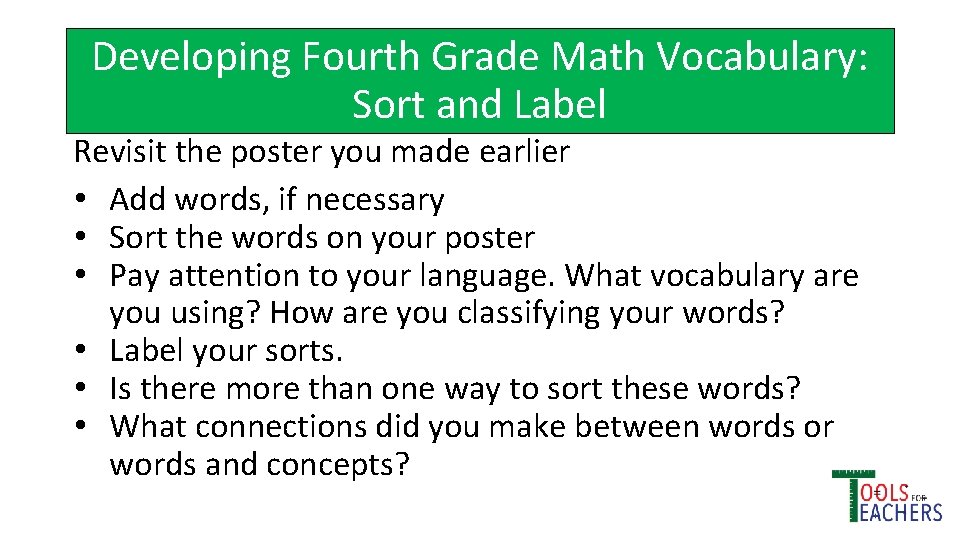
Developing Fourth Grade Math Vocabulary: Sort and Label Revisit the poster you made earlier • Add words, if necessary • Sort the words on your poster • Pay attention to your language. What vocabulary are you using? How are you classifying your words? • Label your sorts. • Is there more than one way to sort these words? • What connections did you make between words or words and concepts?
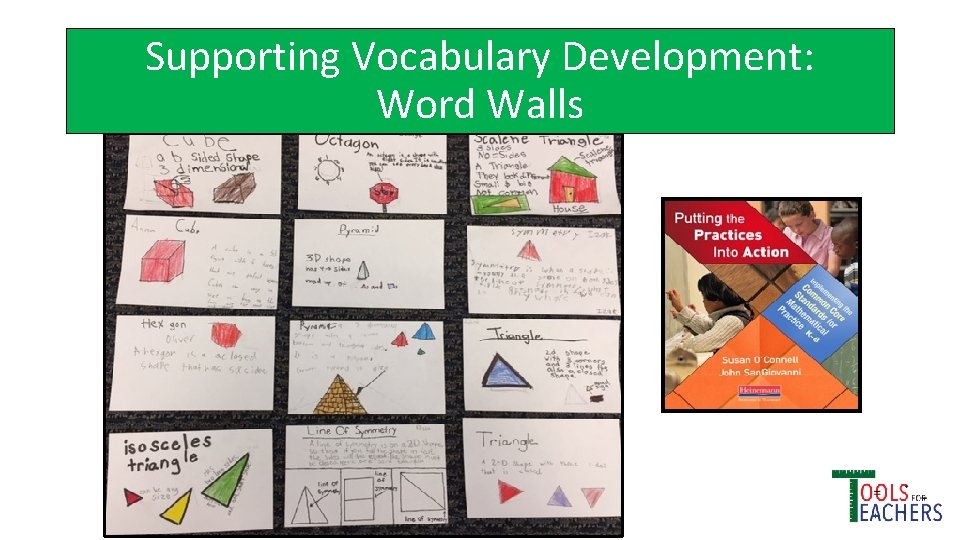
Supporting Vocabulary Development: Word Walls
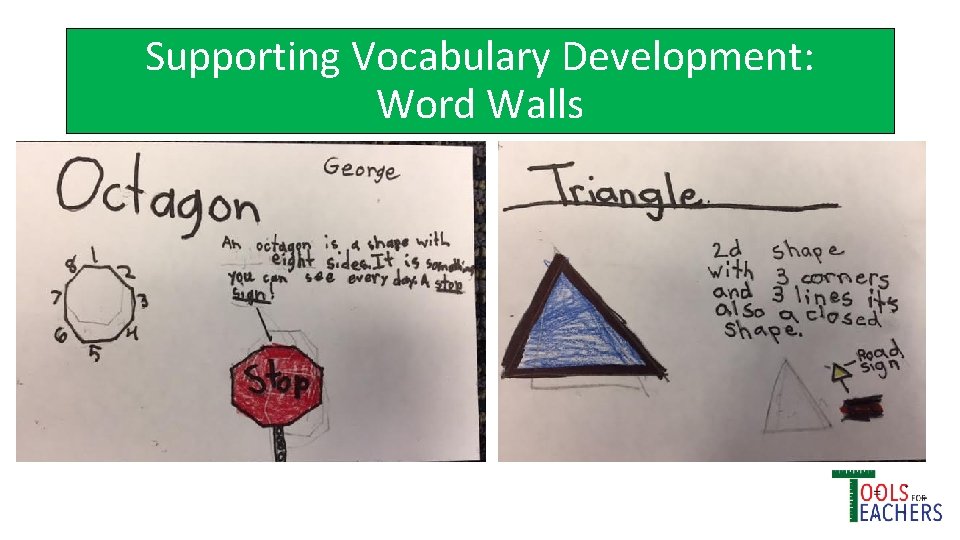
Supporting Vocabulary Development: Word Walls
Vocabulary Instruction and Assessment Teachers can instruct and assess students’ mastery of content vocabulary by asking students to use what they know to • explain a math term in their own words • translate their learning into words, pictures, numbers or examples for a term or concept • construct their own definitions
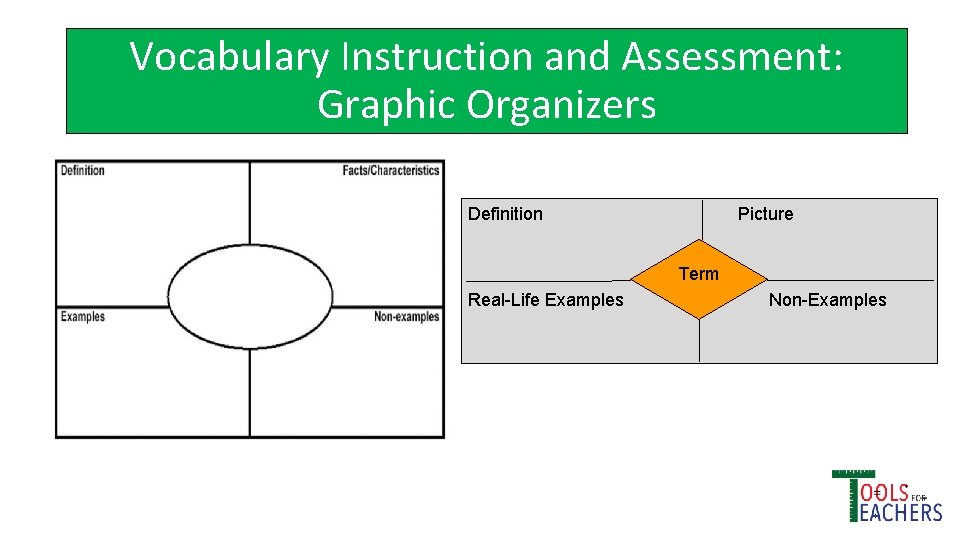
Vocabulary Instruction and Assessment: Graphic Organizers Definition Picture Term Real-Life Examples Non-Examples
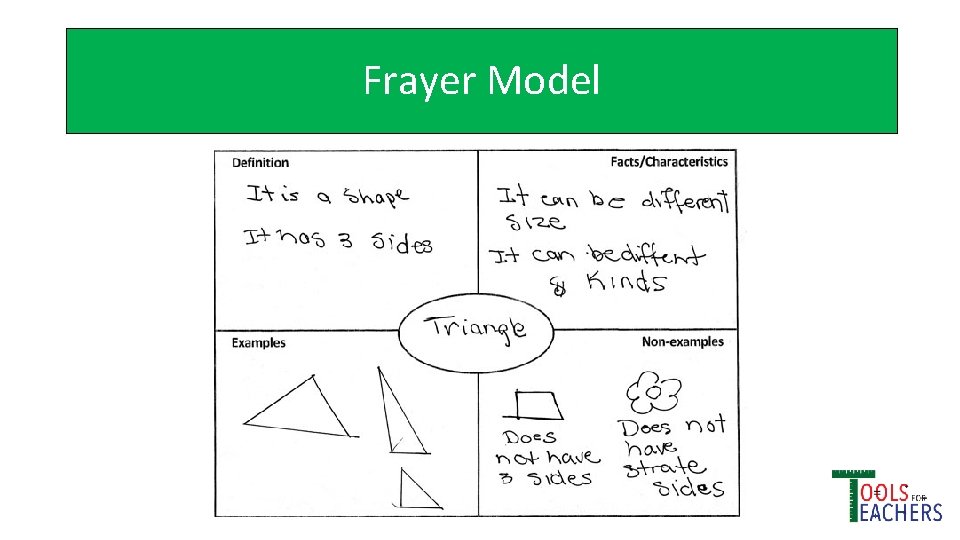
Frayer Model
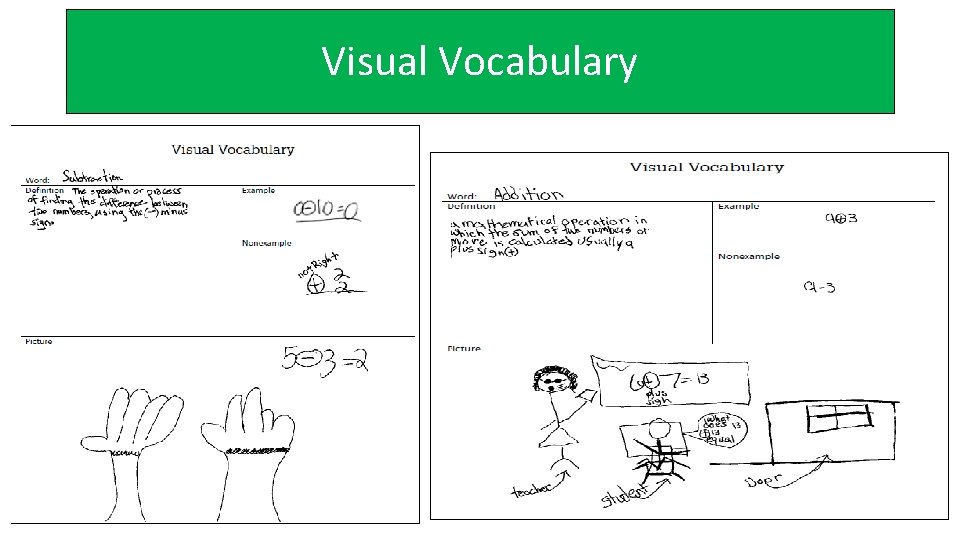
Visual Vocabulary
Word Webs angle
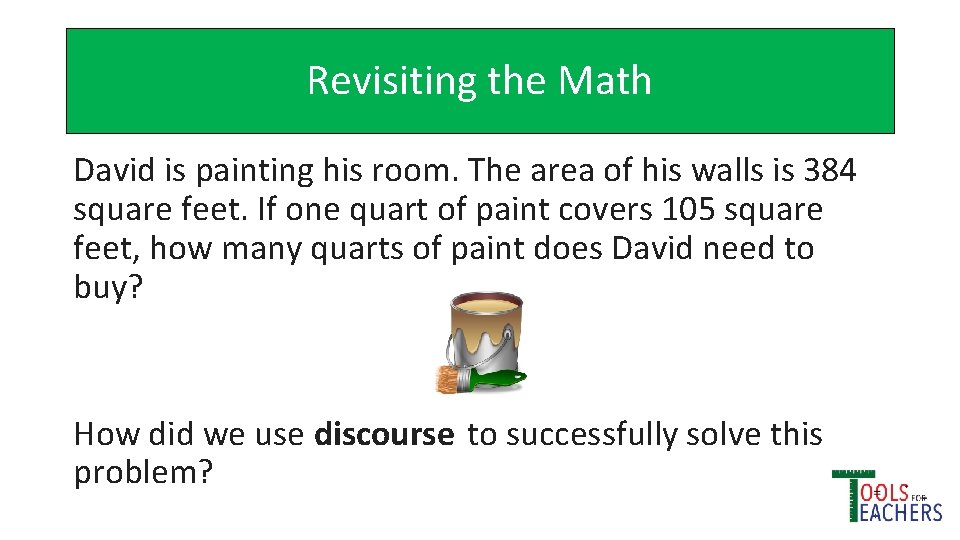
Revisiting the Math David is painting his room. The area of his walls is 384 square feet. If one quart of paint covers 105 square feet, how many quarts of paint does David need to buy? How did we use vocabulary to successfully solve this problem?
The Dimensions of Academic Language Word/Phrase Level Vocabulary - general, specialized, technical Sentence Level Syntax - forms and grammatical structures Discourse Level Organization of text or speech Coherence of ideas Adapted from Gottlieb, M. and Emst-Slavit, G. (2013). Academic Language in Diverse Classrooms: Mathematics, Grades 3– 5: Promoting Content and Language Learning. Thousand Oaks, CA: Corwin Press.
Syntax: What Does It Say? Syntax includes the rules or conventions for organizing language. How do you read these numbers, expressions, or equations? How do you know? 0. 32 1, 256 x+3 ¾ 5 + 9 = 14 2(3 - 1) + (8 x 6)
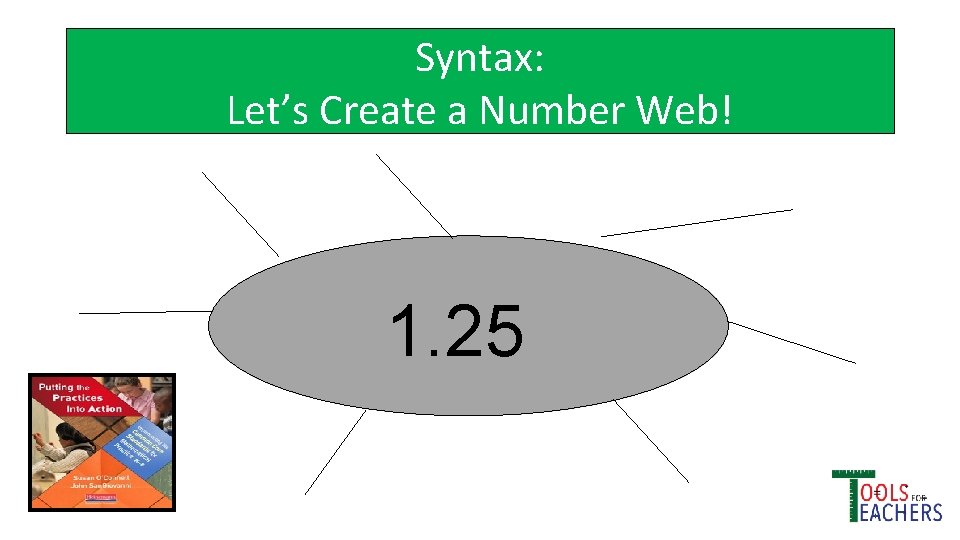
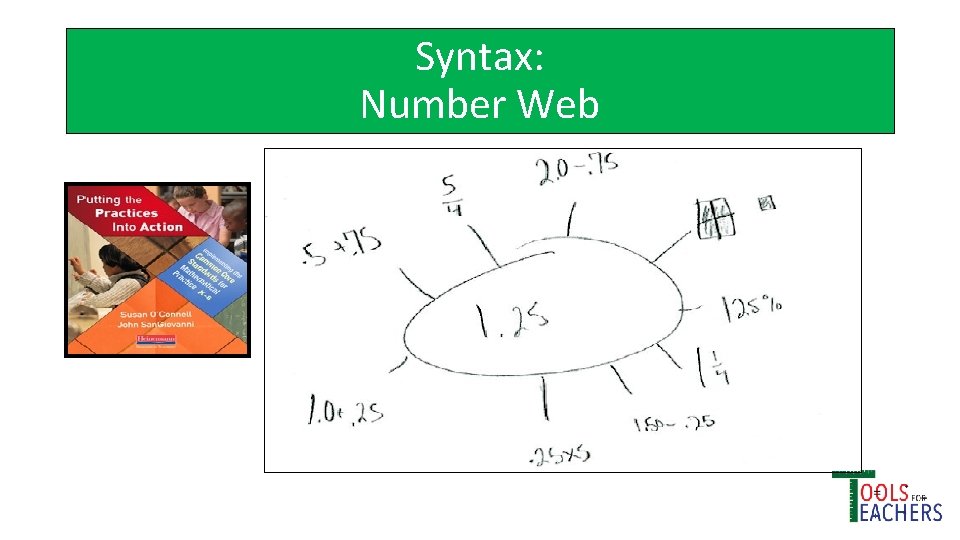
Syntax: Let’s Create a Number Web! 1. 25
Syntax: Number Web
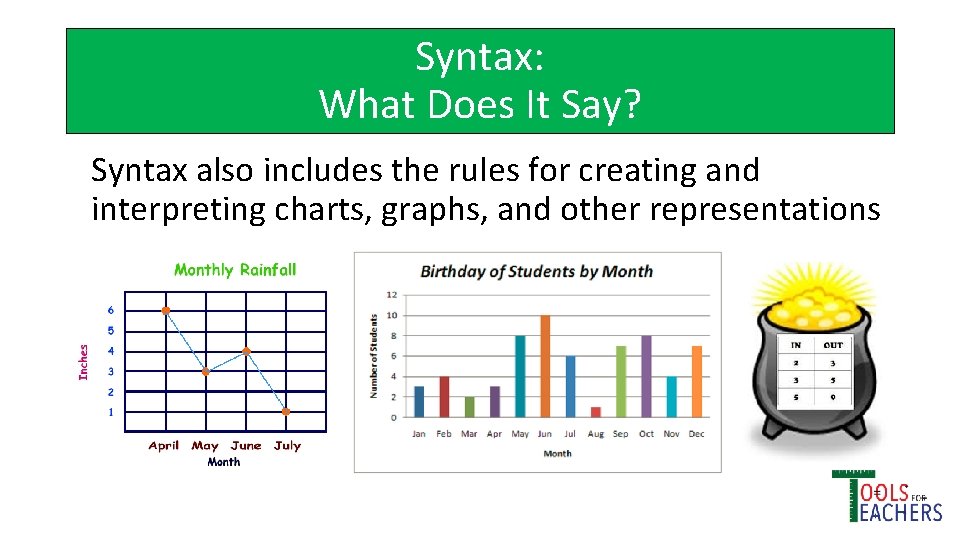
Syntax: What Does It Say? Syntax also includes the rules for creating and interpreting charts, graphs, and other representations
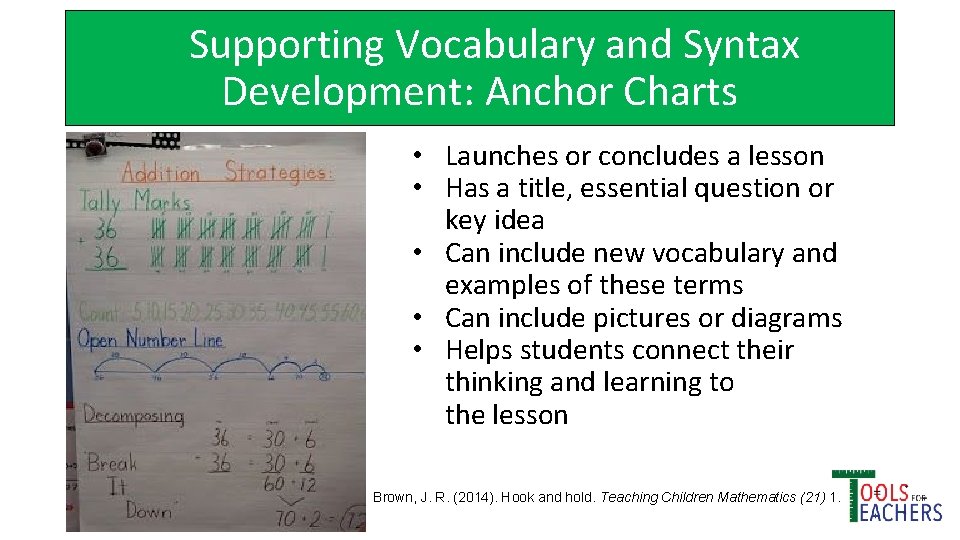
Supporting Vocabulary and Syntax Development: Anchor Charts • Launches or concludes a lesson • Has a title, essential question or key idea • Can include new vocabulary and examples of these terms • Can include pictures or diagrams • Helps students connect their thinking and learning to the lesson Brown, J. R. (2014). Hook and hold. Teaching Children Mathematics (21) 1.
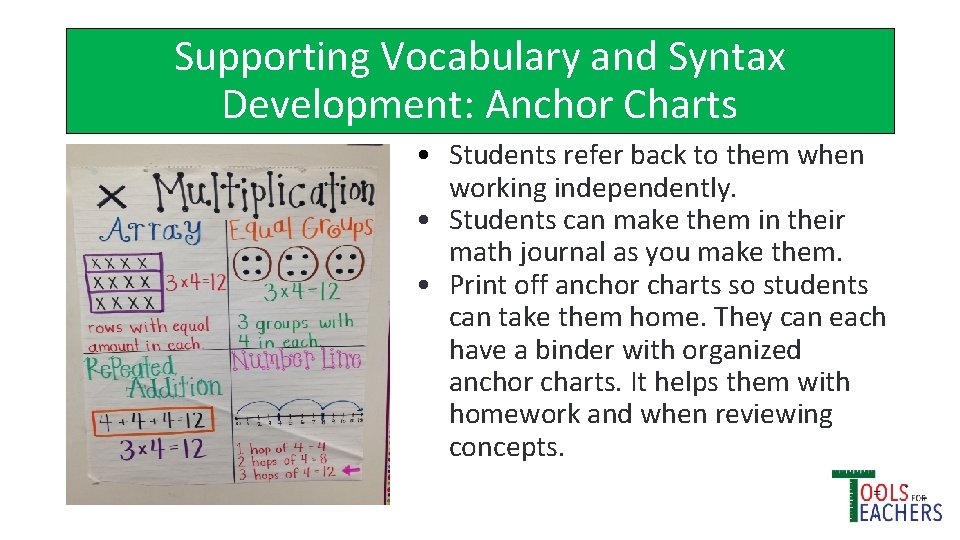
Supporting Vocabulary and Syntax Development: Anchor Charts • Students refer back to them when working independently. • Students can make them in their math journal as you make them. • Print off anchor charts so students can take them home. They can each have a binder with organized anchor charts. It helps them with homework and when reviewing concepts.
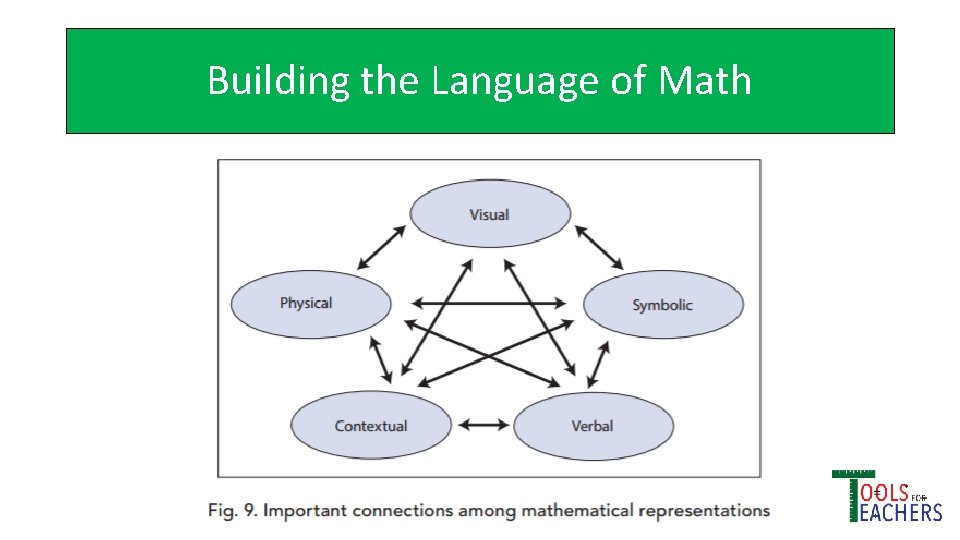
Building the Language of Math
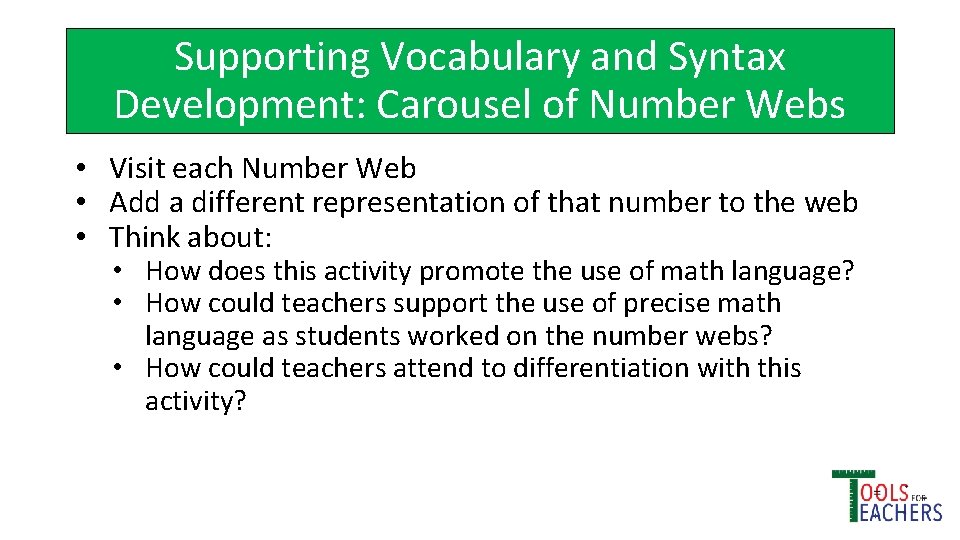
Supporting Vocabulary and Syntax Development: Carousel of Number Webs • Visit each Number Web • Add a different representation of that number to the web • Think about: • How does this activity promote the use of math language? • How could teachers support the use of precise math language as students worked on the number webs? • How could teachers attend to differentiation with this activity?
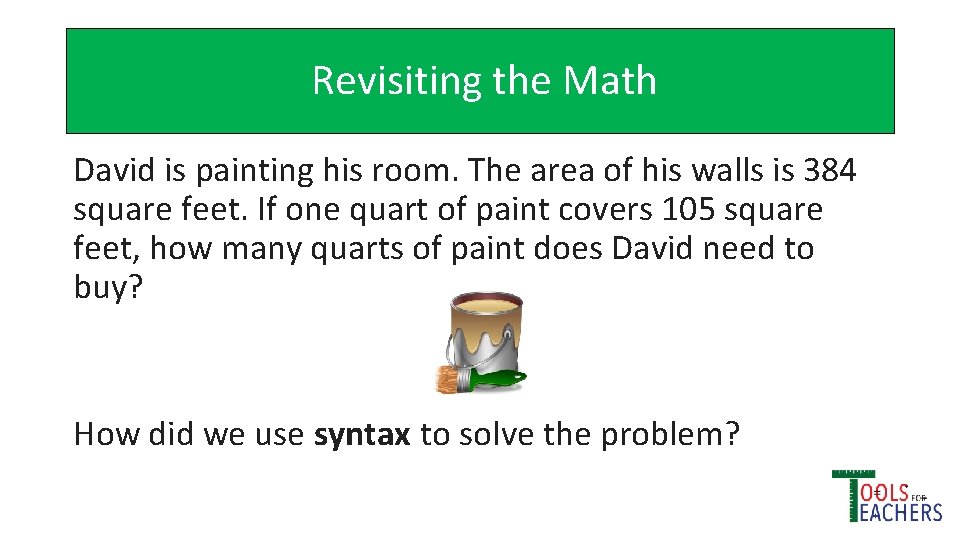
Revisiting the Math David is painting his room. The area of his walls is 384 square feet. If one quart of paint covers 105 square feet, how many quarts of paint does David need to buy? How did we use syntax to solve the problem?
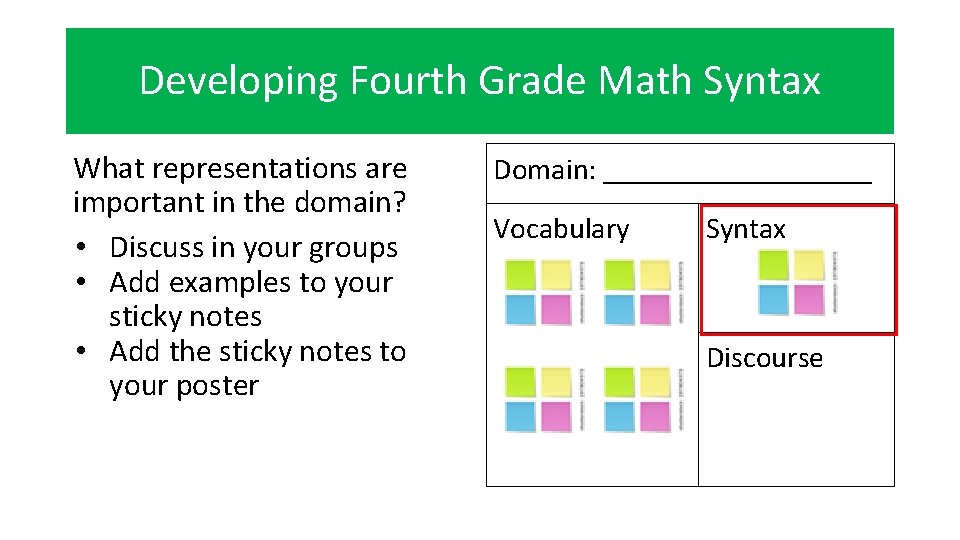
Developing Fourth Grade Math Syntax What representations are important in the domain? • Discuss in your groups • Add examples to your sticky notes • Add the sticky notes to your poster Domain: _________ Vocabulary Syntax Discourse
The Dimensions of Academic Language Word/Phrase Level Vocabulary - general, specialized, technical Sentence Level Syntax - forms and grammatical structures Discourse Level Organization of text or speech Coherence of ideas Adapted from Gottlieb, M. and Emst-Slavit, G. (2013). Academic Language in Diverse Classrooms: Mathematics, Grades 3– 5: Promoting Content and Language Learning. Thousand Oaks, CA: Corwin Press.
Building the Language of Mathematics “Students should be immersed into the mathematical language as they experience rich high-level tasks. As student communicate their thoughts, ideas, and justify the reasonableness of their solutions the mathematical language will begin to evolve. Students will then build the depth of understanding needed with mathematical vocabulary and content to empower them to be successful in mathematics. ”
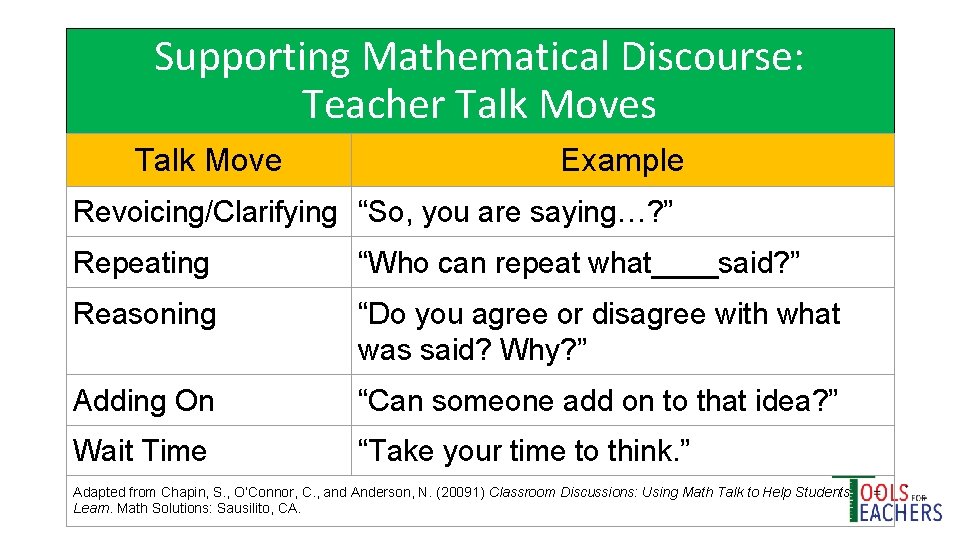
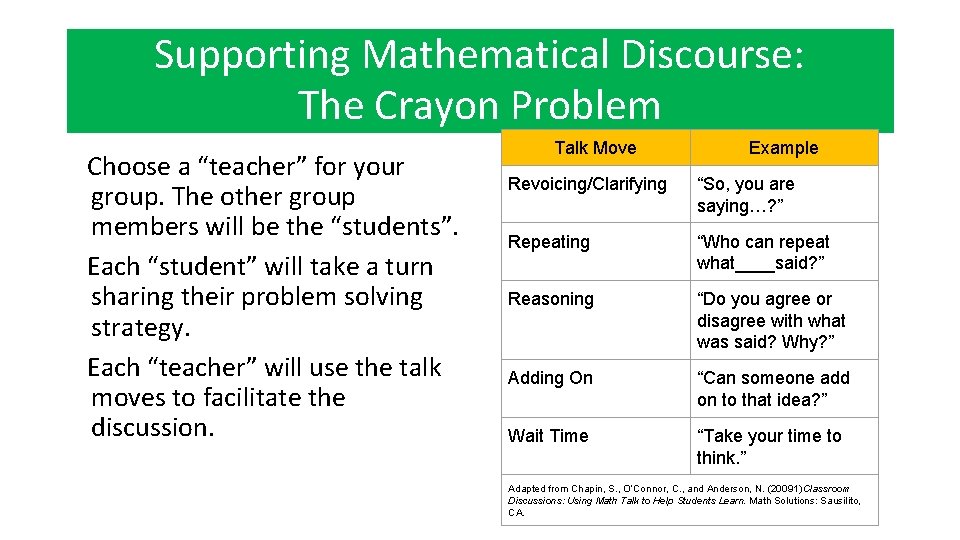
Supporting Mathematical Discourse: Teacher Talk Moves Talk Move Example Revoicing/Clarifying “So, you are saying…? ” Repeating “Who can repeat what____said? ” Reasoning “Do you agree or disagree with what was said? Why? ” Adding On “Can someone add on to that idea? ” Wait Time “Take your time to think. ” Adapted from Chapin, S. , O’Connor, C. , and Anderson, N. (20091) Classroom Discussions: Using Math Talk to Help Students Learn. Math Solutions: Sausilito, CA.
Mathematical Syntax: Talk Discourse: Focus. Supporting on the. Teacher Language of Moves: Mathematics: The What Crayon Does Problem It Say? Crayon Video Solve this problem silently: Sawyer has 30 crayons. He wants to put them in boxes with 5 crayons in each box. How many boxes does he need?
Mathematical Discourse: Focus. Supporting on the Language of Mathematics: Crayon Video. The Crayon Problem Choose a “teacher” for your group. The other group members will be the “students”. Each “student” will take a turn sharing their problem solving strategy. Each “teacher” will use the talk moves to facilitate the discussion. Talk Move Example Revoicing/Clarifying “So, you are saying…? ” Repeating “Who can repeat what____said? ” Reasoning “Do you agree or disagree with what was said? Why? ” Adding On “Can someone add on to that idea? ” Wait Time “Take your time to think. ” Adapted from Chapin, S. , O’Connor, C. , and Anderson, N. (20091) Classroom Discussions: Using Math Talk to Help Students Learn. Math Solutions: Sausilito, CA.
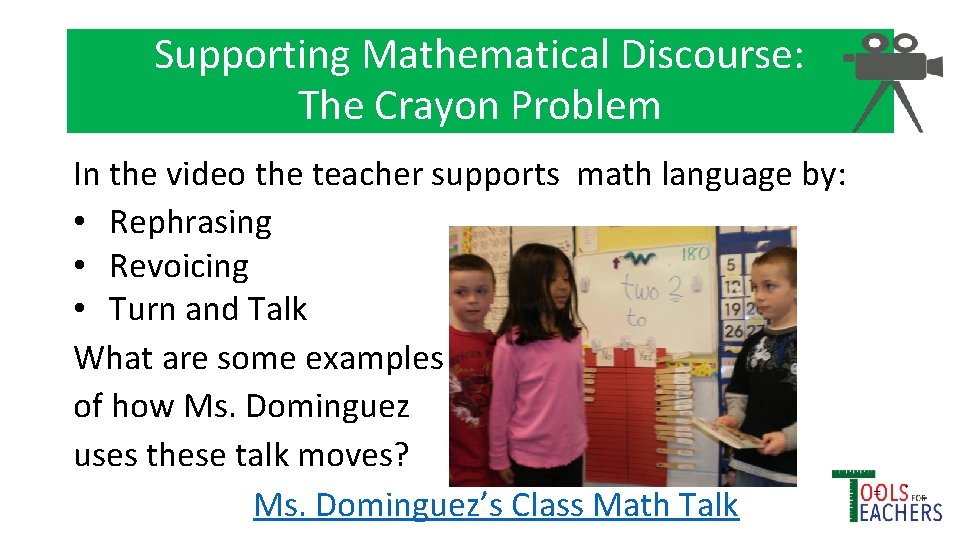
Supporting Discourse: Supporting Mathematical Language Development: The. Crayon. Video Problem In the video the teacher supports math language by: • Rephrasing • Revoicing • Turn and Talk What are some examples of how Ms. Dominguez uses these talk moves? Ms. Dominguez’s Class Math Talk
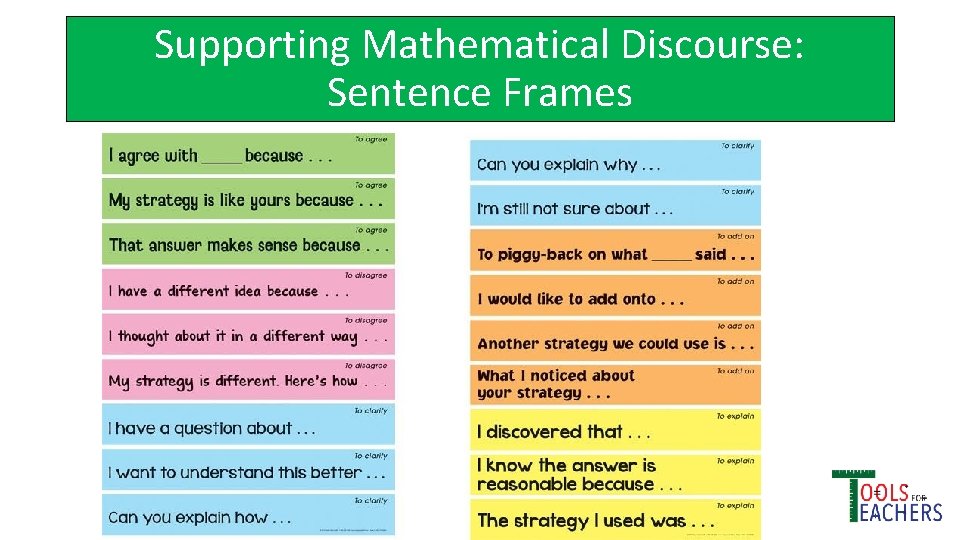
Supporting Mathematical Discourse: Sentence Frames
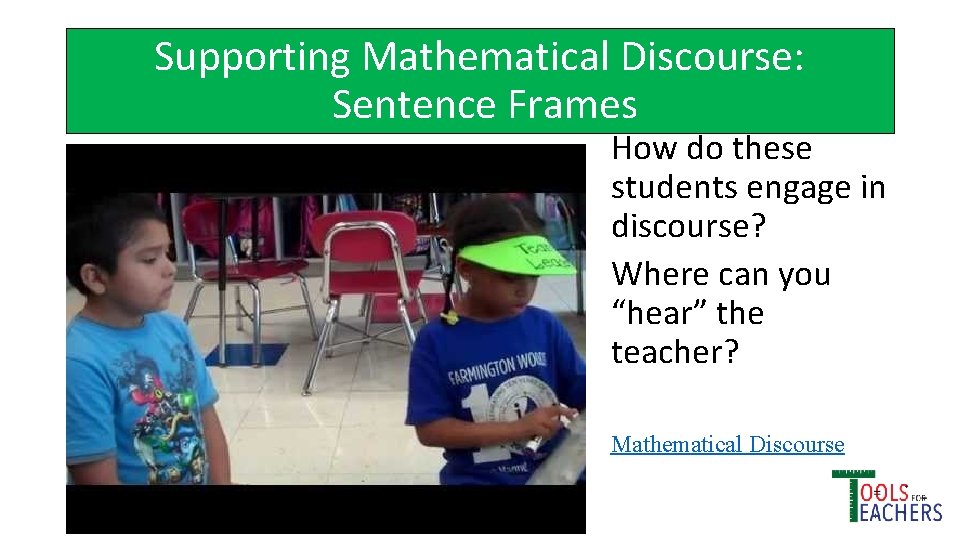
Supporting Mathematical Discourse: Sentence Frames How do these students engage in discourse? Where can you “hear” the teacher? Mathematical Discourse
Revisiting the Math David is painting his room. The area of his walls is 384 square feet. If one quart of paint covers 105 square feet, how many quarts of paint does David need to buy? How did we use discourse to successfully solve this problem?
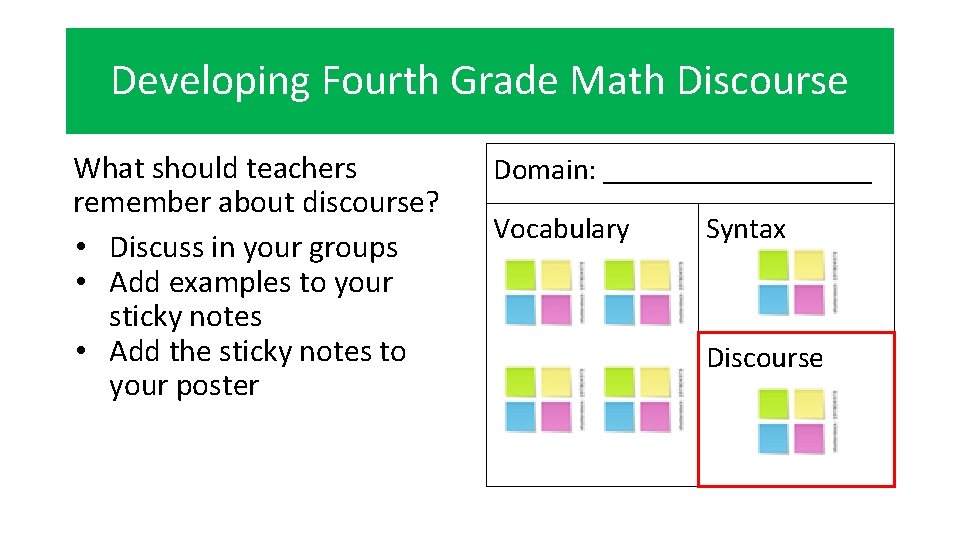
Developing Fourth Grade Math Discourse What should teachers remember about discourse? • Discuss in your groups • Add examples to your sticky notes • Add the sticky notes to your poster Domain: _________ Vocabulary Syntax Discourse
How Do Language Experiences Help Make Concepts “Stick” Forever? Concept in Isolation Concept Strengthened with Many Connections through Language
Questions to Answer Today • What are the dimensions of academic language? • How can I facilitate student use of precise language when communicating with others about math? • How do I use various models to support student use of language? • How can I provide students with opportunities to be precise?
References Apps, Connie. (2015, July 15). Math practice standard 3 in 1 st grade (student to student math talk). [Video File}. Retrieved from https: //youtu. be/Gt. Sn. LOCMIAw Brown, J. R. (2014). Hook and hold. Teaching Children Mathematics, 21(1), 46. doi: 10. 5951/teacchilmath. 21. 1. 0046 Bruun, F. , Diaz, J. M. , & Dykes, V. J. (2015). The language of mathematics. Teaching Children Mathematics, 21(9), 530. doi: 10. 5951/teacchilmath. 21. 9. 0530 Graves, M. F. (2007). Vocabulary instruction in the middle grades. Voices from the Middle, 15(1): 13 -19. National Council of Teachers of Mathematics. (2000). Principles and standards for school mathematics. Reston, VA: National Council of Teachers of Mathematics. O’Connell, S. , & San Giovanni, J. (2013). Putting the practices into action: implementing the common core standards for mathematical practice, K-8. Portsmouth, NH: Heinemann.
Grade Level Writing Teams Kindergarten: Second Grade: Fourth Grade: ● ● ● Dawne Coker Carol Midgett Leigh Belford Lynne Allen Tery Gunter Carly Morton Diane Wells Isaac Wells Ana Floyd Lisa Garrison Shelly Harris Deanna Wiles First Grade: Third Grade: Fifth Grade: ● ● ● ● ● Marta Garcia ● Brandi Newell Felisia Gulledge Martha Butler Laura Baker Danielle Long Leanne Daughtry Robin Hiatt Meg Mc. Kee Kaneka Turner ● Susan Copeland ● Rebekah Lonon
Tools for Teachers Staff • Kelly De. Long, Co-PI and Project Manager • Kayonna Pitchford, Co-PI and IHE • Janet Johnson, Outside Evaluator • Jeane Joyner, IHE and Reviewer • Katie Mawhinney, IHE and Reviewer • Drew Polly, IHE and Reviewer • Wendy Rich, K-5 Coordination and Reviewer • Catherine Schwartz, IHE and Project Liaison Please give appropriate credit to the Tools for Teachers project when using these materials.