
The Language of HIV a NHIVNA Best practice
The Language of HIV: a NHIVNA Best practice guide for nurses Angelina Namiba Associate Project Manager. Salamander Trust anamiba 15@gmail. com @angelina_namiba @4 Mproject
Declaration of interests relating to this presentation • None
The Language of HIV: A NHIVNA Best practice guide for nurses Background Aim Some stigmatizing terms Good Practice – The rules What nurses need to know Acknowledgements
The Language of HIV: A NHIVNA Best practice guide for nurses Background • Communication: an important part of existence • Language: plays a key role in how we communicate • Verbal & non-verbal communication: Essential in nursing training • Communicating well with patients & colleagues: vital to nursing helps assess, plan and evaluate care • Listening & observing body language complements verbal communication
The Language of HIV: A NHIVNA Best practice guide for nurses Background Language matters: • Power to categorise people • Impacts on how we think about ourselves & see others • Has shaped person-centred care People living with HIV have shaped the language we use & the way we discuss death, dying, sex & sexuality.
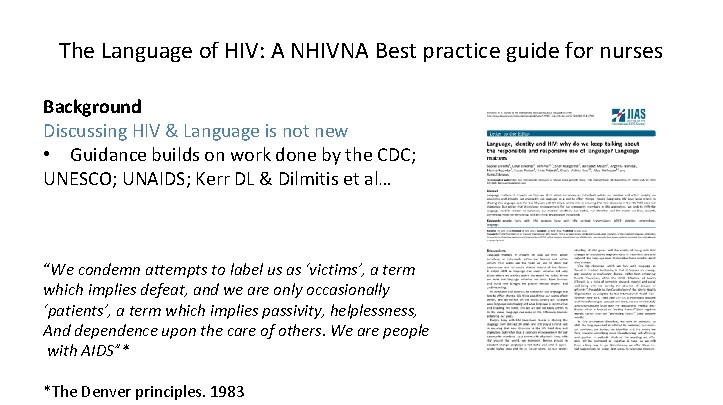
The Language of HIV: A NHIVNA Best practice guide for nurses Background Discussing HIV & Language is not new • Guidance builds on work done by the CDC; UNESCO; UNAIDS; Kerr DL & Dilmitis et al… “We condemn attempts to label us as ‘victims’, a term which implies defeat, and we are only occasionally ‘patients’, a term which implies passivity, helplessness, And dependence upon the care of others. We are people with AIDS”* *The Denver principles. 1983
The Language of HIV: A NHIVNA Best practice guide for nurses Watson S, Namiba A, Lynn V. The language of HIV: a guide for nurses. HIV Nursing 2019; 19(2) This guidance is aimed at nurses working in HIV, generic nurses and other healthcare professionals.
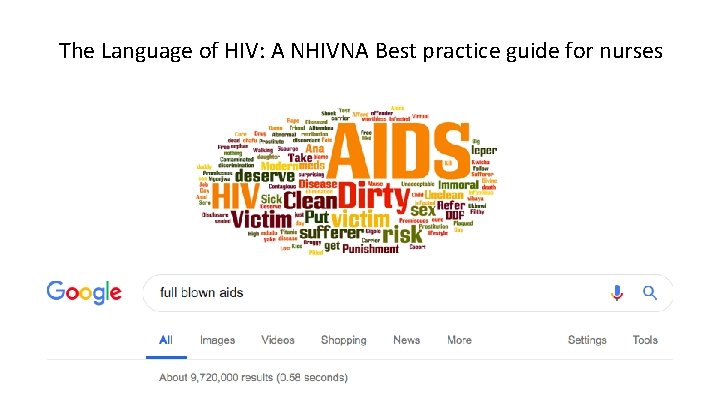
The Language of HIV: A NHIVNA Best practice guide for nurses
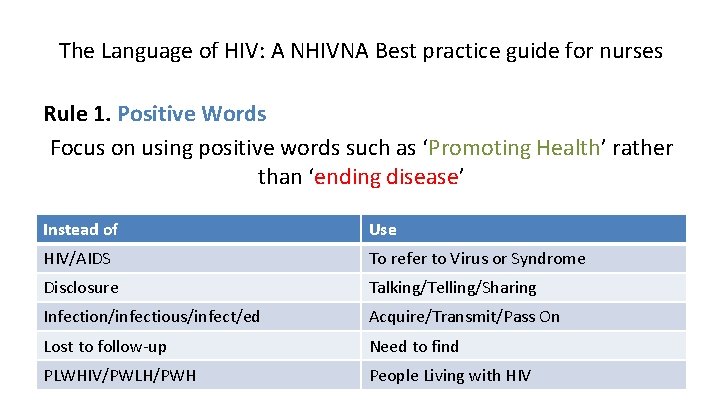
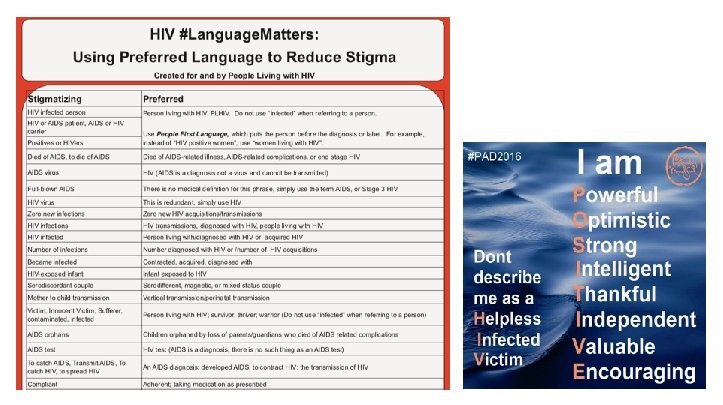
The Language of HIV: A NHIVNA Best practice guide for nurses Rule 1. Positive Words Focus on using positive words such as ‘Promoting Health’ rather than ‘ending disease’ Instead of Use HIV/AIDS To refer to Virus or Syndrome Disclosure Talking/Telling/Sharing Infection/infectious/infect/ed Acquire/Transmit/Pass On Lost to follow-up Need to find PLWHIV/PWLH/PWH People Living with HIV
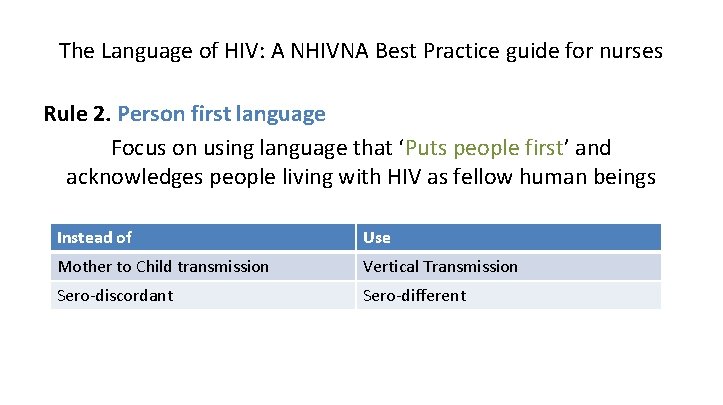
The Language of HIV: A NHIVNA Best Practice guide for nurses Rule 2. Person first language Focus on using language that ‘Puts people first’ and acknowledges people living with HIV as fellow human beings Instead of Use Mother to Child transmission Vertical Transmission Sero-discordant Sero-different
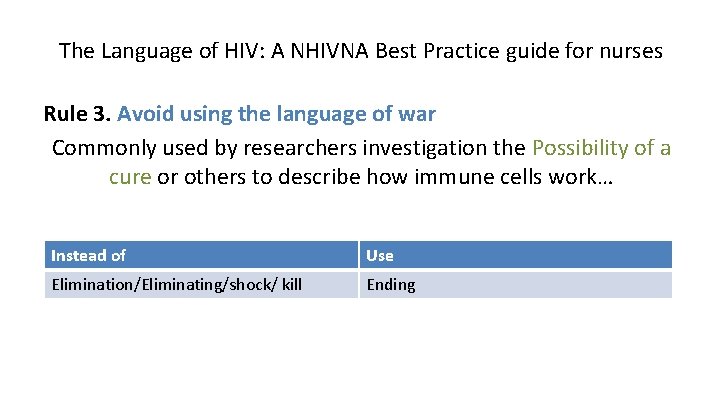
The Language of HIV: A NHIVNA Best Practice guide for nurses Rule 3. Avoid using the language of war Commonly used by researchers investigation the Possibility of a cure or others to describe how immune cells work… Instead of Use Elimination/Eliminating/shock/ kill Ending
The Language of HIV: A NHIVNA Best Practice guide for nurses Good Practice – What Nurses need to know • Keep it kind and simple: Easy to understand medically correct language • Use people-first language: Person before disease • Educate: Challenge misinformation • Think about your audience: Avoid acronyms that may stigmatise
The Language of HIV: A NHIVNA Best Practice guide for nurses Good Practice – What Nurses need to know • Use empathy: Supportive & sensitive language is critical in our goal to achieve an HIV-free generation and support those living with HIV. Eg when communicating about U=U (=U) ”Using such words or language may result in real or perceived stigma, discrimination, fear and anxiety. Which may prevent some people from getting tested or treated for HIV. We can do our part by being thoughtful when choosing our words and choosing to use supportive rather than stigmatizing – language when talking about HIV. ”* *CDC. Let’s stop HIV together: a guide to talking about HIV. (Accessed April 2019)
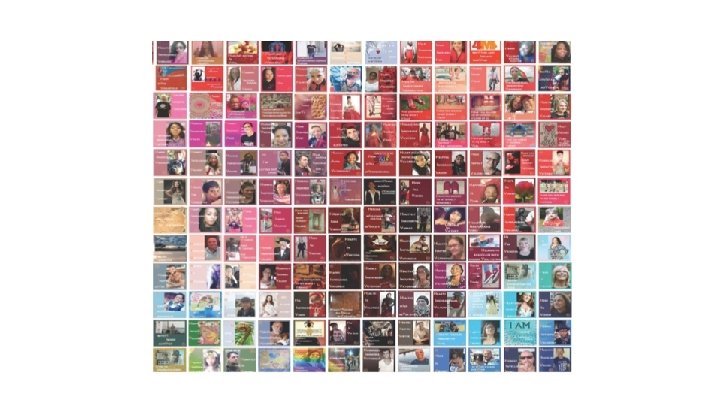
The Language of HIV: A NHIVNA Best Practice guide for nurses Thank you Shaun Watson: Clinical Nurse Specialist HIV community, Chelsea and Westminster NHS Trust. Vickie Lynn: Well Project & School of Social Work, University of Florida, USA People Living with HIV in all your diversity Watson S, Namiba A, Lynn V. The language of HIV: a guide for nurses. HIV Nursing 2019; 19(2) Available free to download from the NHIVNA Website
- Slides: 17