
The Language Centre La Estrella A brief overview
The Language Centre La Estrella A brief overview of Question words Question structure and formation. C Materials Copyright - The Language Centre La Estrella
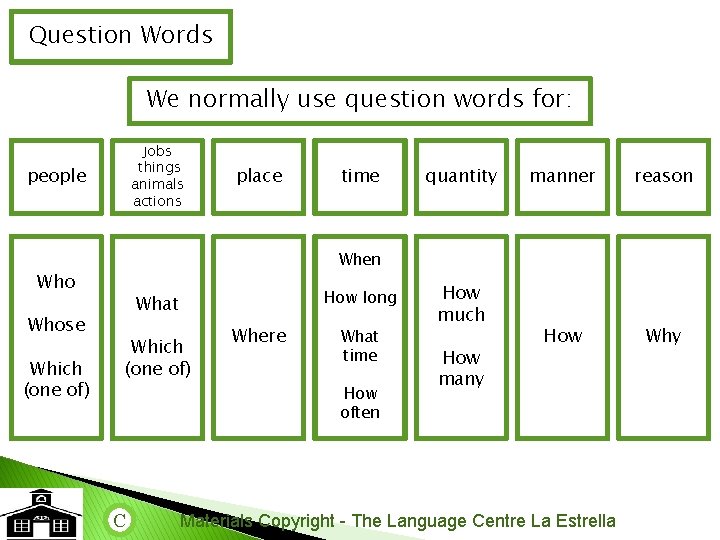
Question Words We normally use question words for: Jobs things animals actions people Which (one of) time quantity manner reason How Why When Whose place How long What Which (one of) C Where What time How often How much How many Materials Copyright - The Language Centre La Estrella

Present Simple We also use the verbs “be” “do” “have” as auxiliary verbs to make questions C be do have I am do have YOU are do have HE is does has SHE is does has IT is does has WE are do have YOU are do have THEY are do have Materials Copyright - The Language Centre La Estrella
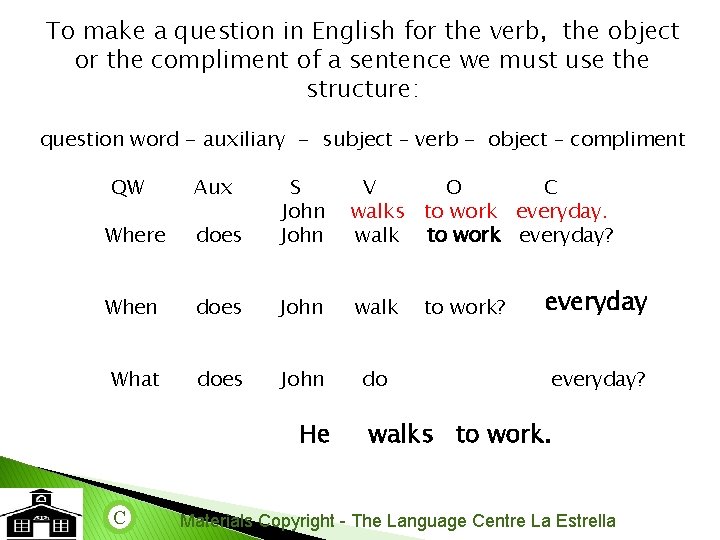
To make a question in English for the verb, the object or the compliment of a sentence we must use the structure: question word - auxiliary - subject – verb - object – compliment QW Aux Where does S John When does John walk What does John do He C V O C walks to work everyday. walk to work everyday? to work? everyday? walks to work. Materials Copyright - The Language Centre La Estrella
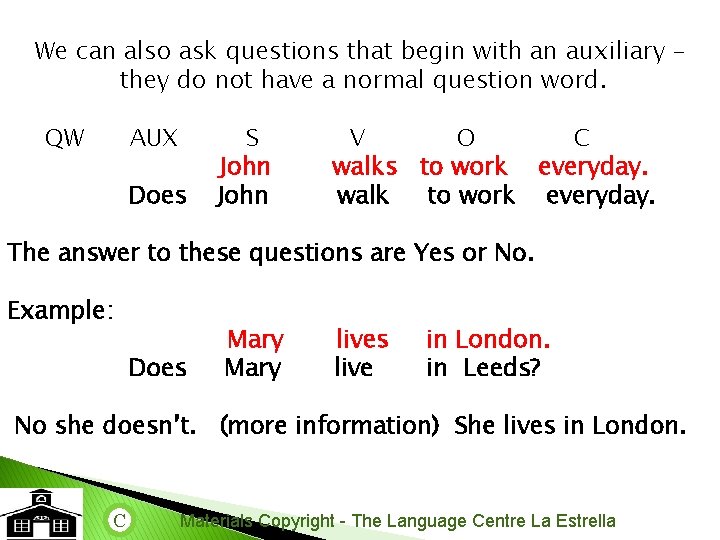
We can also ask questions that begin with an auxiliary – they do not have a normal question word. QW AUX Does S John V O C walks to work everyday. walk to work everyday. The answer to these questions are Yes or No. Example: Does Mary lives live in London. in Leeds? No she doesn’t. (more information) She lives in London. C Materials Copyright - The Language Centre La Estrella
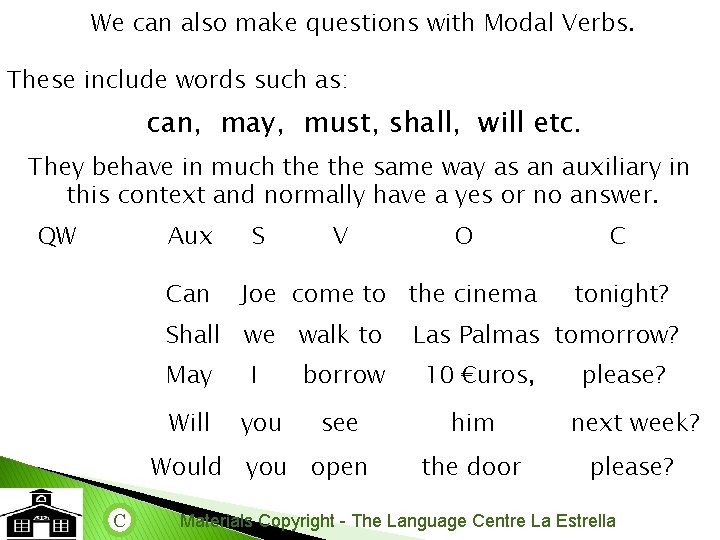
We can also make questions with Modal Verbs. These include words such as: can, may, must, shall, will etc. They behave in much the same way as an auxiliary in this context and normally have a yes or no answer. QW Aux Can S V Joe come to the cinema Shall we walk to May Will I you C tonight? Las Palmas tomorrow? borrow 10 €uros, see him next week? the door please? Would you open C O please? Materials Copyright - The Language Centre La Estrella
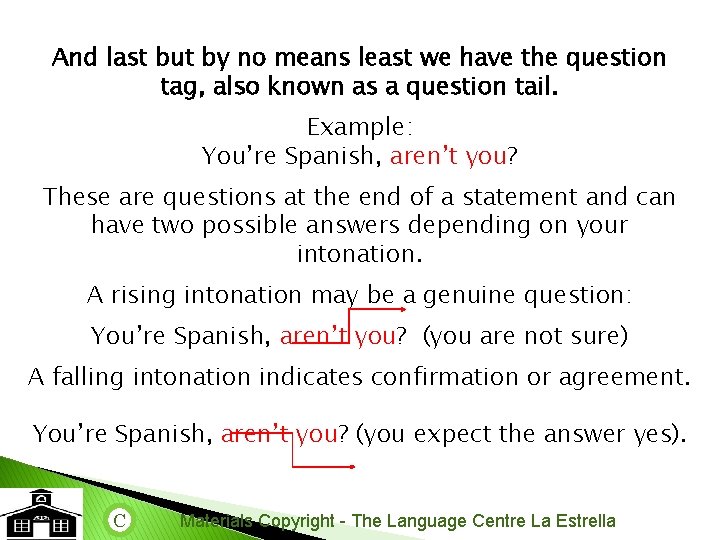
And last but by no means least we have the question tag, also known as a question tail. Example: You’re Spanish, aren’t you? These are questions at the end of a statement and can have two possible answers depending on your intonation. A rising intonation may be a genuine question: You’re Spanish, aren’t you? (you are not sure) A falling intonation indicates confirmation or agreement. You’re Spanish, aren’t you? (you expect the answer yes). C Materials Copyright - The Language Centre La Estrella
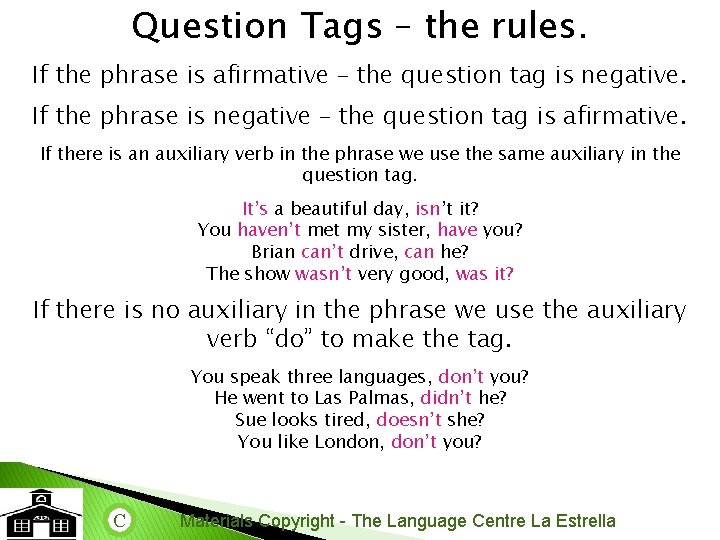
Question Tags – the rules. If the phrase is afirmative – the question tag is negative. If the phrase is negative – the question tag is afirmative. If there is an auxiliary verb in the phrase we use the same auxiliary in the question tag. It’s a beautiful day, isn’t it? You haven’t met my sister, have you? Brian can’t drive, can he? The show wasn’t very good, was it? If there is no auxiliary in the phrase we use the auxiliary verb “do” to make the tag. You speak three languages, don’t you? He went to Las Palmas, didn’t he? Sue looks tired, doesn’t she? You like London, don’t you? C Materials Copyright - The Language Centre La Estrella
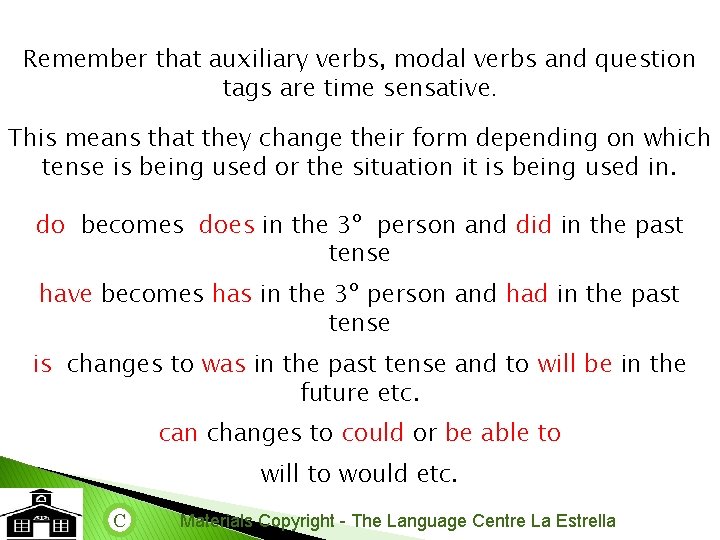
Remember that auxiliary verbs, modal verbs and question tags are time sensative. This means that they change their form depending on which tense is being used or the situation it is being used in. do becomes does in the 3º person and did in the past tense have becomes has in the 3º person and had in the past tense is changes to was in the past tense and to will be in the future etc. can changes to could or be able to will to would etc. C Materials Copyright - The Language Centre La Estrella
Now let’s practice A sample activity Remember we need SVOCA to make questions C Materials Copyright - The Language Centre La Estrella
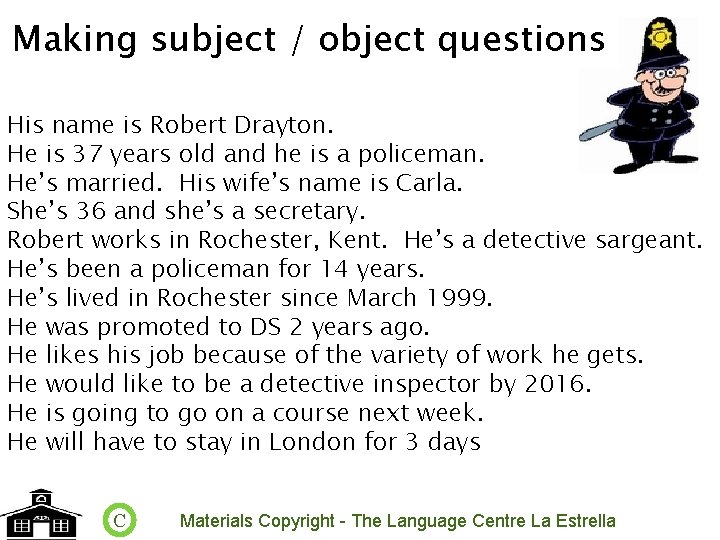
Making subject / object questions His name is Robert Drayton. He is 37 years old and he is a policeman. He’s married. His wife’s name is Carla. She’s 36 and she’s a secretary. Robert works in Rochester, Kent. He’s a detective sargeant. He’s been a policeman for 14 years. He’s lived in Rochester since March 1999. He was promoted to DS 2 years ago. He likes his job because of the variety of work he gets. He would like to be a detective inspector by 2016. He is going to go on a course next week. He will have to stay in London for 3 days C Materials Copyright - The Language Centre La Estrella
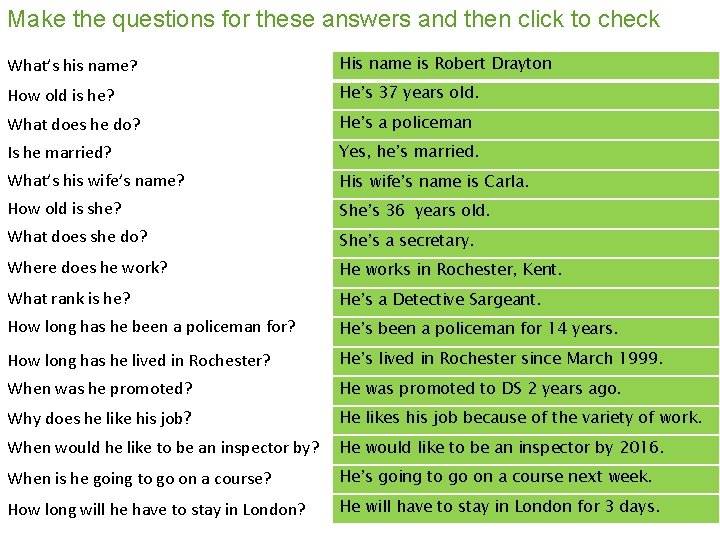
Make the questions for these answers and then click to check What’s his name? His name is Robert Drayton How old is he? He’s 37 years old. What does he do? He’s a policeman Is he married? Yes, he’s married. What’s his wife’s name? His wife’s name is Carla. How old is she? She’s 36 years old. What does she do? She’s a secretary. Where does he work? He works in Rochester, Kent. What rank is he? He’s a Detective Sargeant. How long has he been a policeman for? He’s been a policeman for 14 years. How long has he lived in Rochester? He’s lived in Rochester since March 1999. When was he promoted? He was promoted to DS 2 years ago. Why does he like his job? He likes his job because of the variety of work. When would he like to be an inspector by? He would like to be an inspector by 2016. When is he going to go on a course? He’s going to go on a course next week. How long will he have to stay in London? He will have to stay in London for 3 days.
- Slides: 12