
The Lammas Hireling Ian Duhig What is the
- Slides: 8
The Lammas Hireling Ian Duhig
What is the story? • In this dramatic monologue a farmer hires a young man to help with his cows. The new hand is uncannily good with the cattle, his affinity has a magical quality to it. A turning point occurs at the end of the first stanza, the hireling is revealed to be a warlock and the farmer kills him. After this the narrator’s luck runs out and the poem takes on the form of a confessional.
How is the story told? • Work through each stanza, what is taking place? Identify the archaic or dialect words – what effect do these have on the narrative? How do they affect the atmosphere? • What is the role of magic and superstition in the poem? • How would you describe the relationship between the narrator and the hireling? • Where are the moments of transformation? How do the sound patterns dramatize this idea? • Explore the boundaries between the real/supernatural, animal/human, male/female, guilt/innocence, life/death, sleeping/waking, and sanity/madness. • Consider the effects of the vowel sounds and the change in pronouns.
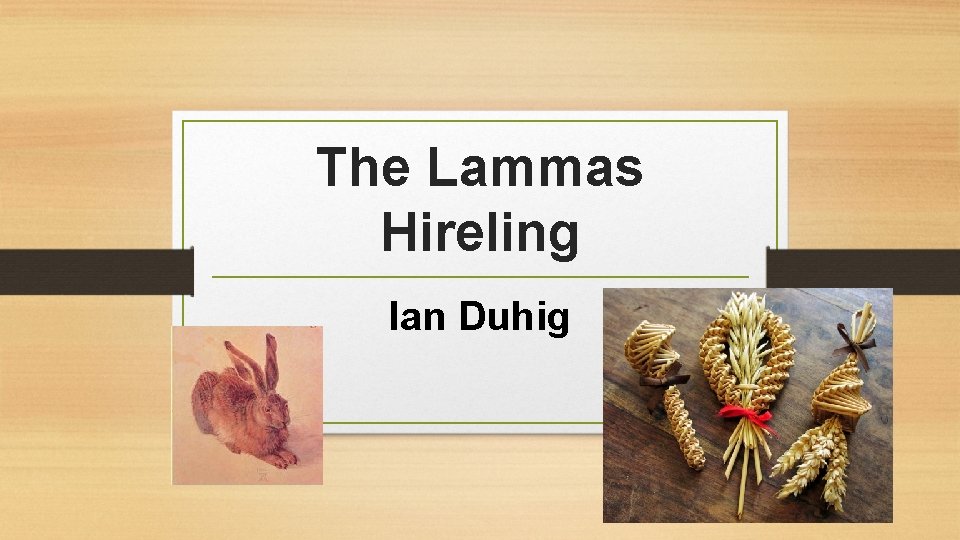
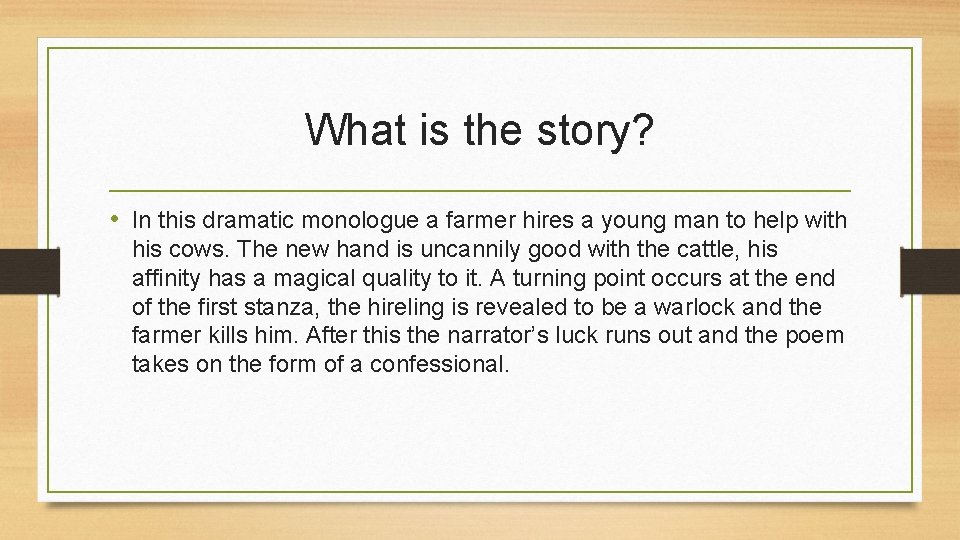
Dialect • Lammas – festival of ‘loafmass’ 1 st August, traditionally a time for hiring help with the harvest. • ‘a cow with leather horns’ – Irish riddle meaning hare – one of the most magical creatures in British folklore. • ‘muckle’ – much. • ‘elf-shot- - cursed. • ‘casting ball’ – process of making shot for a shotgun, gamekeepers often made their own.
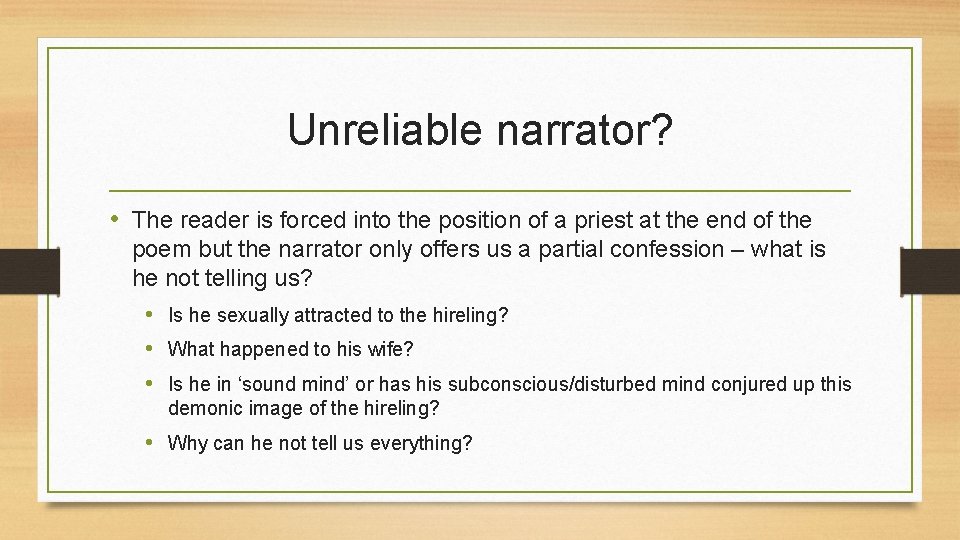
Unreliable narrator? • The reader is forced into the position of a priest at the end of the poem but the narrator only offers us a partial confession – what is he not telling us? • Is he sexually attracted to the hireling? • What happened to his wife? • Is he in ‘sound mind’ or has his subconscious/disturbed mind conjured up this demonic image of the hireling? • Why can he not tell us everything?
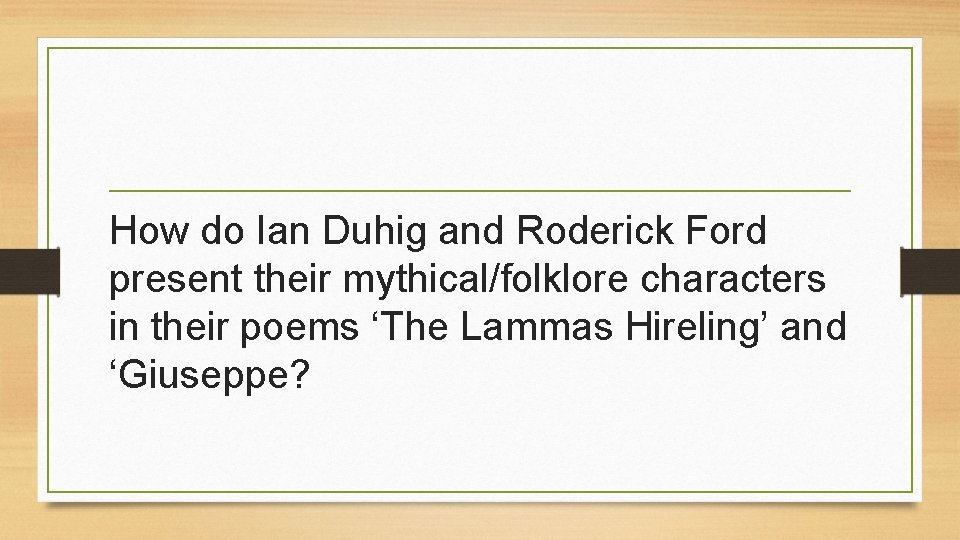
How do Ian Duhig and Roderick Ford present their mythical/folklore characters in their poems ‘The Lammas Hireling’ and ‘Giuseppe?
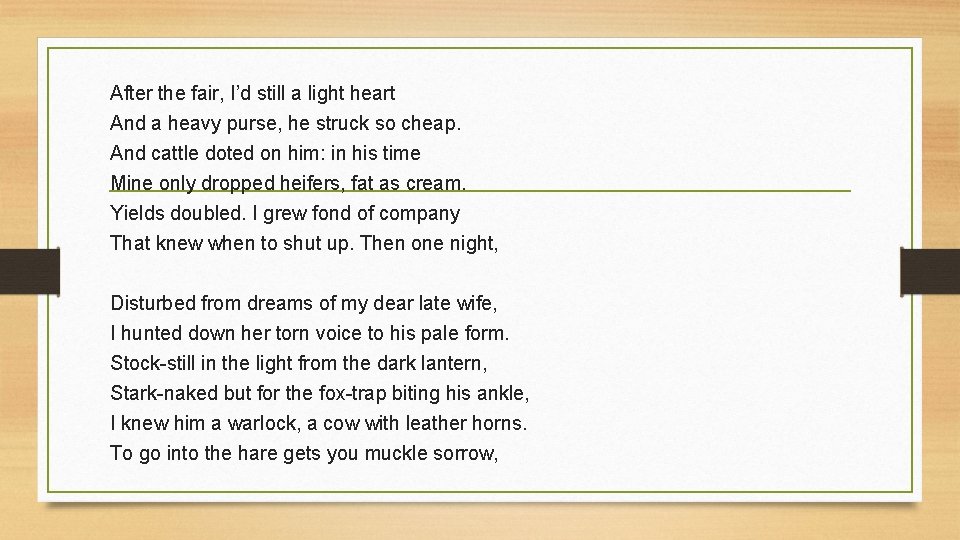
After the fair, I’d still a light heart And a heavy purse, he struck so cheap. And cattle doted on him: in his time Mine only dropped heifers, fat as cream. Yields doubled. I grew fond of company That knew when to shut up. Then one night, Disturbed from dreams of my dear late wife, I hunted down her torn voice to his pale form. Stock-still in the light from the dark lantern, Stark-naked but for the fox-trap biting his ankle, I knew him a warlock, a cow with leather horns. To go into the hare gets you muckle sorrow,
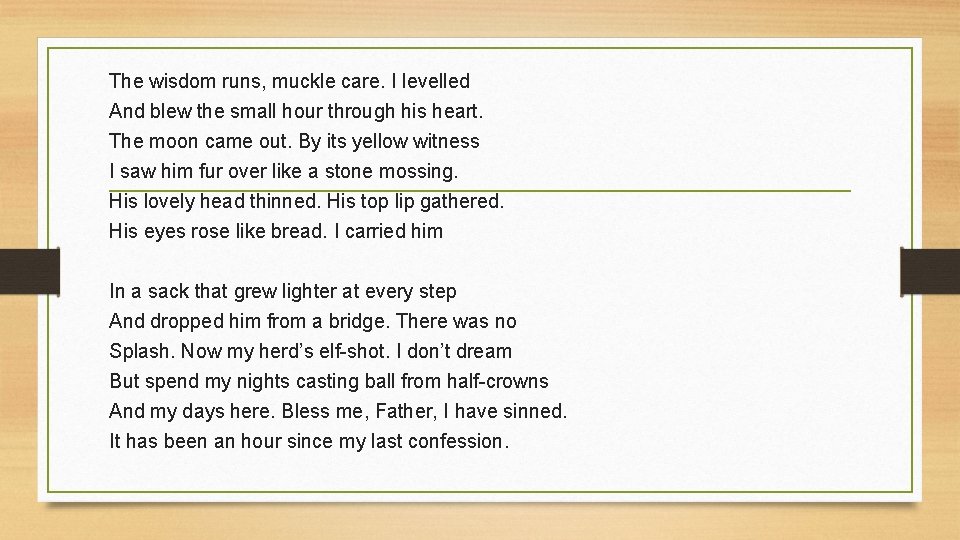
The wisdom runs, muckle care. I levelled And blew the small hour through his heart. The moon came out. By its yellow witness I saw him fur over like a stone mossing. His lovely head thinned. His top lip gathered. His eyes rose like bread. I carried him In a sack that grew lighter at every step And dropped him from a bridge. There was no Splash. Now my herd’s elf-shot. I don’t dream But spend my nights casting ball from half-crowns And my days here. Bless me, Father, I have sinned. It has been an hour since my last confession.