
The Lamb shift proton charge radius puzzle etc
The Lamb shift, `proton charge radius puzzle' etc. Savely Karshenboim Pulkovo Observatory (ГАО РАН) (St. Petersburg) & Max-Planck-Institut für Quantenoptik (Garching)
Outline ¢ Different methods to determine the proton charge radius l l l ¢ spectroscopy of hydrogen (and deuterium) the Lamb shift in muonic hydrogen electron-proton scattering The proton radius: the state of the art l l electric charge radius magnetic radius
Electromagnetic interaction and structure of the proton Quantum electrodynamics: ¢ kinematics of photons; ¢ kinematics, structure and dynamics of leptons; ¢ hadrons as compound objects: ¢ hadron structure l affects details of interactions; l not calculable, to be measured; l space distribution of charge and magnetic moment; l form factors (in momentum space).
Atomic energy levels and the proton radius ¢ Proton structure affects l l the Lamb shift the hyperfine splitting ¢ The Lamb shift in hydrogen and muonic hydrogen l l l splits 2 s 1/2 & 2 p 1/2 The proton finite size contribution ~ (Za) Rp 2 |Y(0)|2 shifts all s states
Different methods to determine the proton charge radius ¢ ¢ Spectroscopy of hydrogen (and deuterium) The Lamb shift in muonic hydrogen Spectroscopy produces a model-independent result, but involves a lot of theory and/or a bit of modeling. ¢ Electron-proton scattering Studies of scattering need theory of radiative corrections, estimation of two-photon effects; the result is to depend on model applied to extrapolate to zero momentum transfer.

Different methods to determine the proton charge radius ¢ ¢ Spectroscopy of hydrogen (and deuterium) The Lamb shift in muonic hydrogen Spectroscopy produces a model-independent result, but involves a lot of theory and/or a bit of modeling. ¢ Electron-proton scattering Studies of scattering need theory of radiative corrections, estimation of two-photon effects; the result is to depend on model applied to extrapolate to zero momentum transfer.
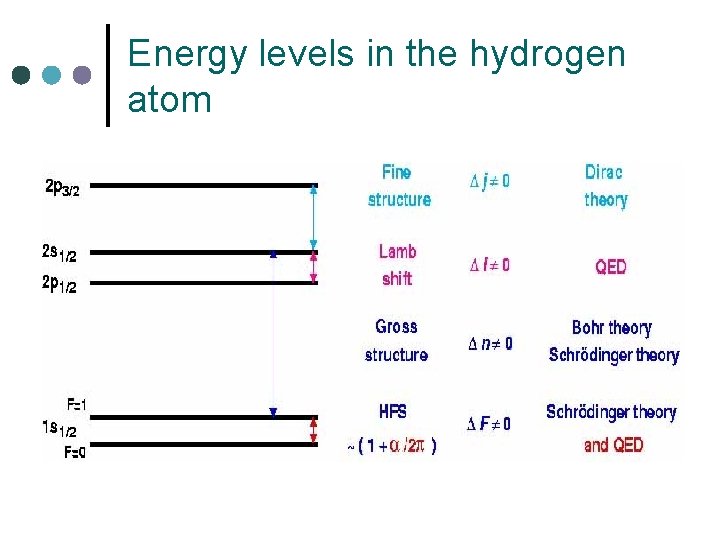
Energy levels in the hydrogen atom
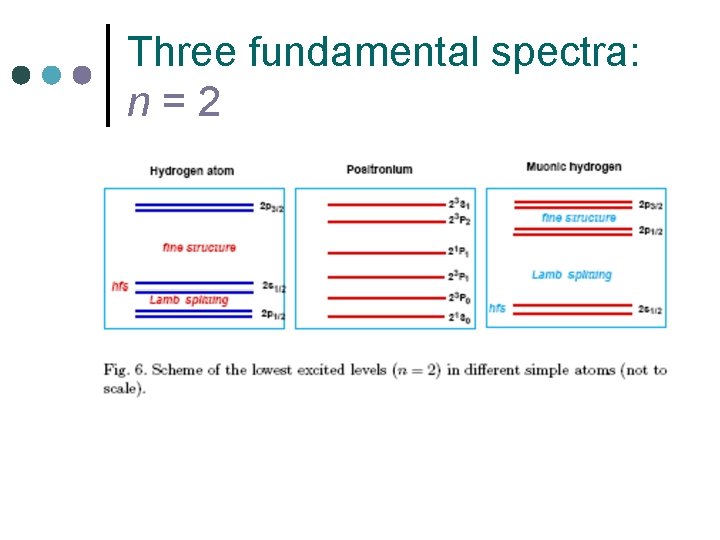
Three fundamental spectra: n=2
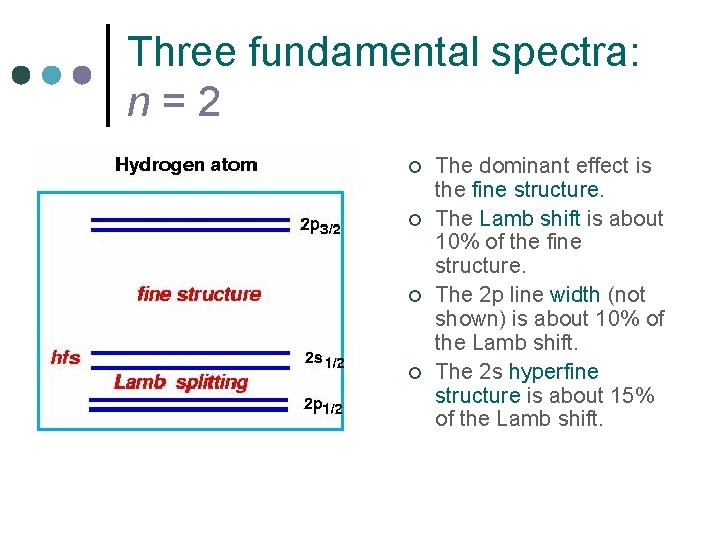
Three fundamental spectra: n=2 ¢ ¢ The dominant effect is the fine structure. The Lamb shift is about 10% of the fine structure. The 2 p line width (not shown) is about 10% of the Lamb shift. The 2 s hyperfine structure is about 15% of the Lamb shift.
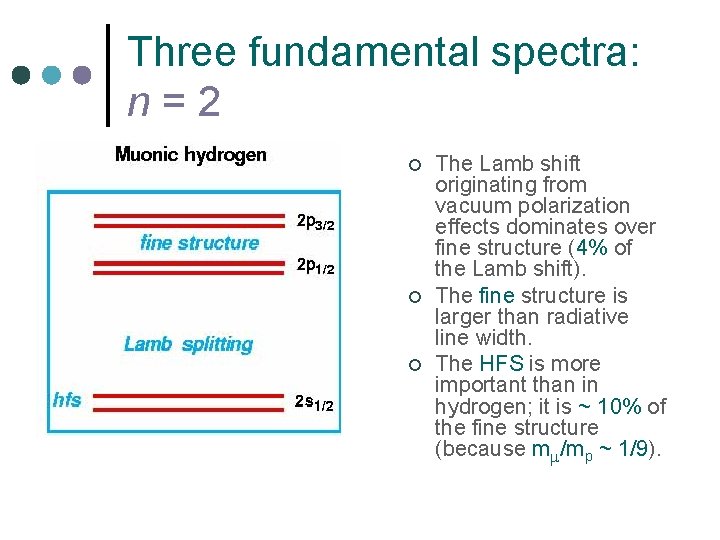
Three fundamental spectra: n=2 ¢ ¢ ¢ The Lamb shift originating from vacuum polarization effects dominates over fine structure (4% of the Lamb shift). The fine structure is larger than radiative line width. The HFS is more important than in hydrogen; it is ~ 10% of the fine structure (because mm/mp ~ 1/9).
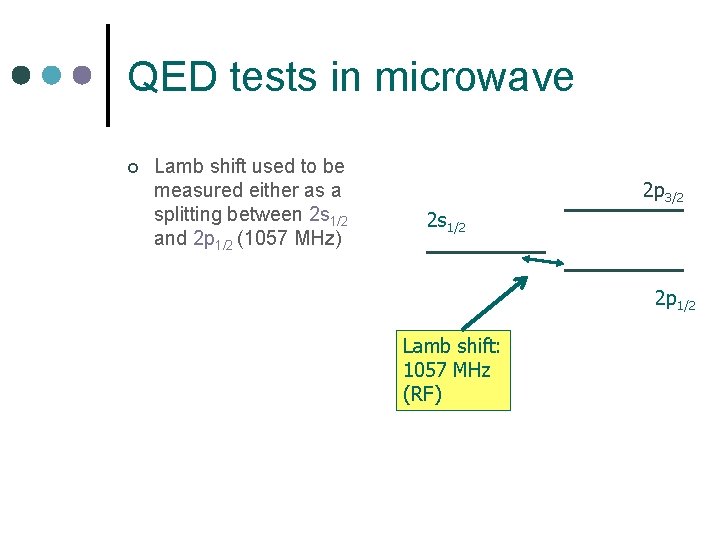
QED tests in microwave ¢ Lamb shift used to be measured either as a splitting between 2 s 1/2 and 2 p 1/2 (1057 MHz) 2 p 3/2 2 s 1/2 2 p 1/2 Lamb shift: 1057 MHz (RF)
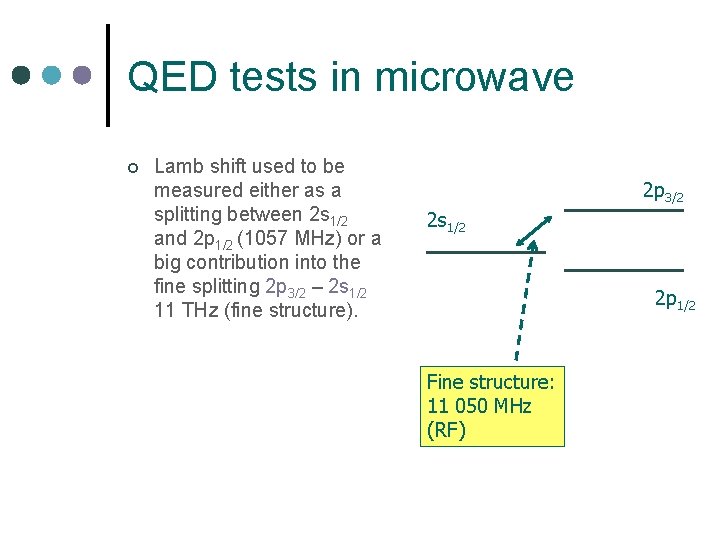
QED tests in microwave ¢ Lamb shift used to be measured either as a splitting between 2 s 1/2 and 2 p 1/2 (1057 MHz) or a big contribution into the fine splitting 2 p 3/2 – 2 s 1/2 11 THz (fine structure). 2 p 3/2 2 s 1/2 2 p 1/2 Fine structure: 11 050 MHz (RF)
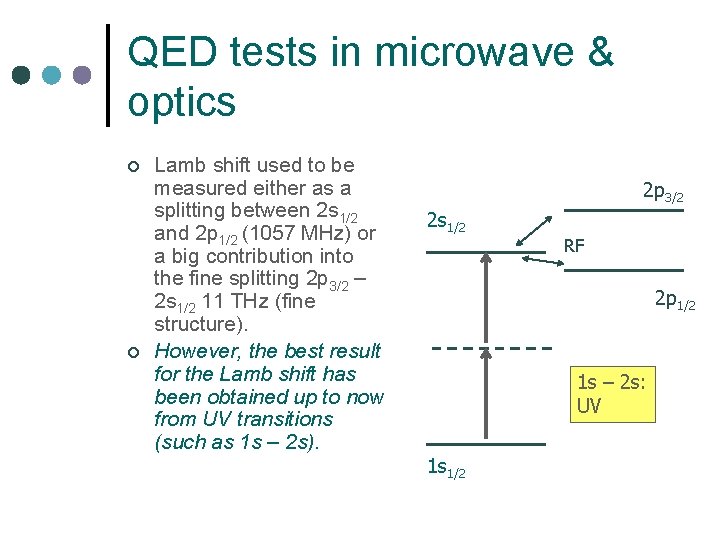
QED tests in microwave & optics ¢ ¢ Lamb shift used to be measured either as a splitting between 2 s 1/2 and 2 p 1/2 (1057 MHz) or a big contribution into the fine splitting 2 p 3/2 – 2 s 1/2 11 THz (fine structure). However, the best result for the Lamb shift has been obtained up to now from UV transitions (such as 1 s – 2 s). 2 p 3/2 2 s 1/2 RF 2 p 1/2 1 s – 2 s: UV 1 s 1/2
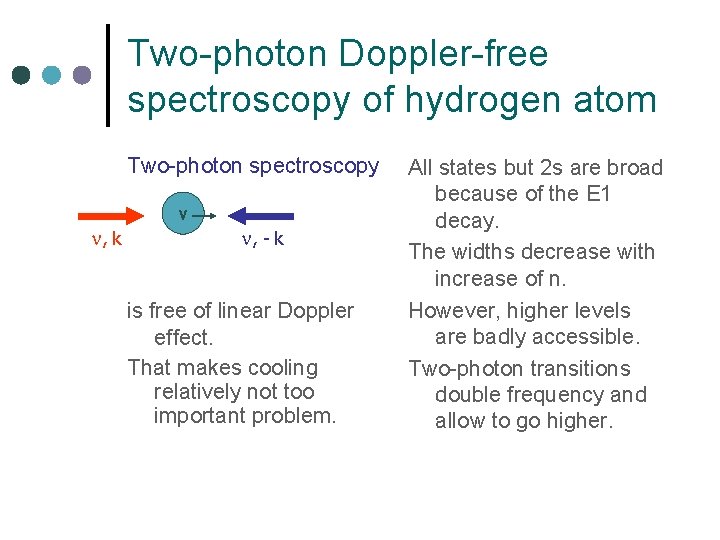
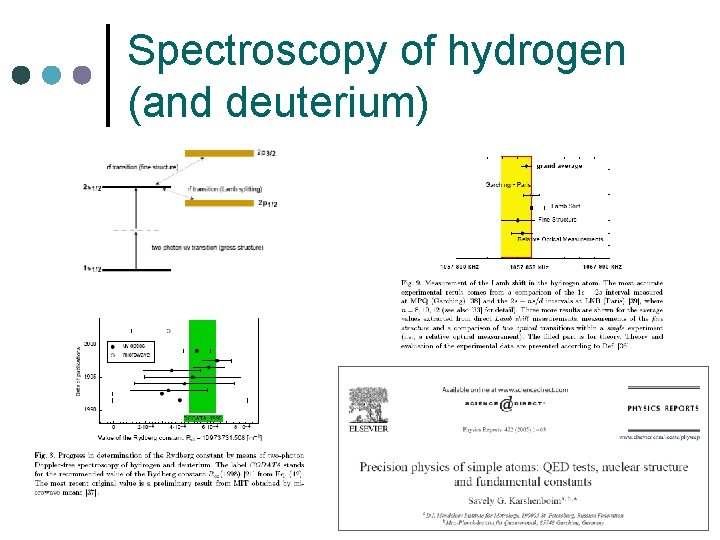
Two-photon Doppler-free spectroscopy of hydrogen atom Two-photon spectroscopy v n, k n, - k is free of linear Doppler effect. That makes cooling relatively not too important problem. All states but 2 s are broad because of the E 1 decay. The widths decrease with increase of n. However, higher levels are badly accessible. Two-photon transitions double frequency and allow to go higher.
Spectroscopy of hydrogen (and deuterium) Two-photon spectroscopy involves a number of levels strongly affected by QED. In “old good time” we had to deal only with 2 s Lamb shift. Theory for p states is simple since their wave functions vanish at r=0. Now we have more data and more unknown variables.
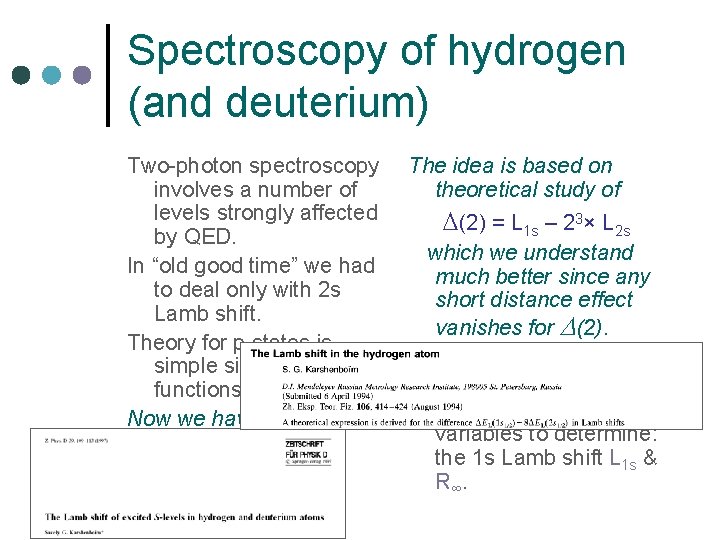
Spectroscopy of hydrogen (and deuterium) Two-photon spectroscopy involves a number of levels strongly affected by QED. In “old good time” we had to deal only with 2 s Lamb shift. Theory for p states is simple since their wave functions vanish at r=0. Now we have more data and more unknown variables. The idea is based on theoretical study of D(2) = L 1 s – 23× L 2 s which we understand much better since any short distance effect vanishes for D(2). Theory of p and d states is also simple. That leaves only two variables to determine: the 1 s Lamb shift L 1 s & R∞.
Spectroscopy of hydrogen (and deuterium) Two-photon spectroscopy involves a number of levels strongly affected by QED. In “old good time” we had to deal only with 2 s Lamb shift. Theory for p states is simple since their wave functions vanish at r=0. Now we have more data and more unknown variables. The idea is based on theoretical study of D(2) = L 1 s – 23× L 2 s which we understand much better since any short distance effect vanishes for D(2). Theory of p and d states is also simple. That leaves only two variables to determine: the 1 s Lamb shift L 1 s & R∞.
Spectroscopy of hydrogen (and deuterium)
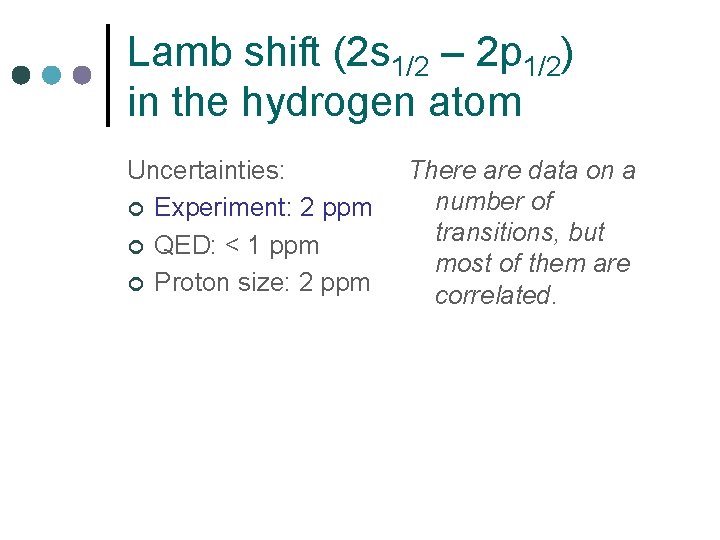
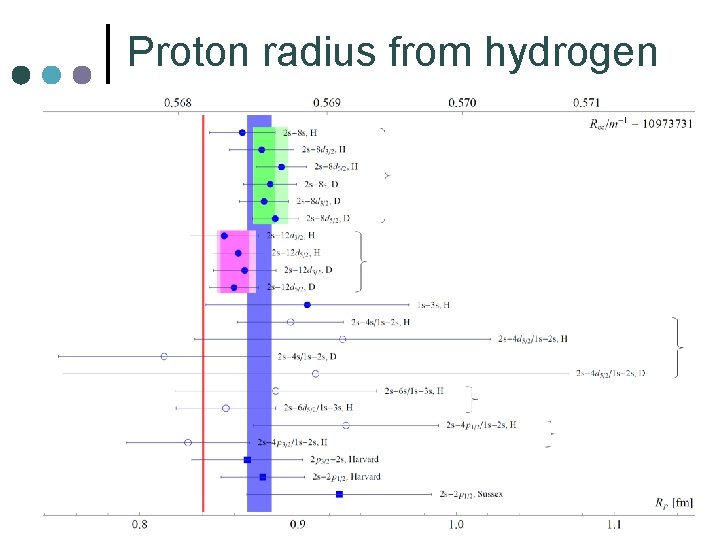
Lamb shift (2 s 1/2 – 2 p 1/2) in the hydrogen atom Uncertainties: ¢ Experiment: 2 ppm ¢ QED: < 1 ppm ¢ Proton size: 2 ppm There are data on a number of transitions, but most of them are correlated.
Proton radius from hydrogen
Proton radius from hydrogen
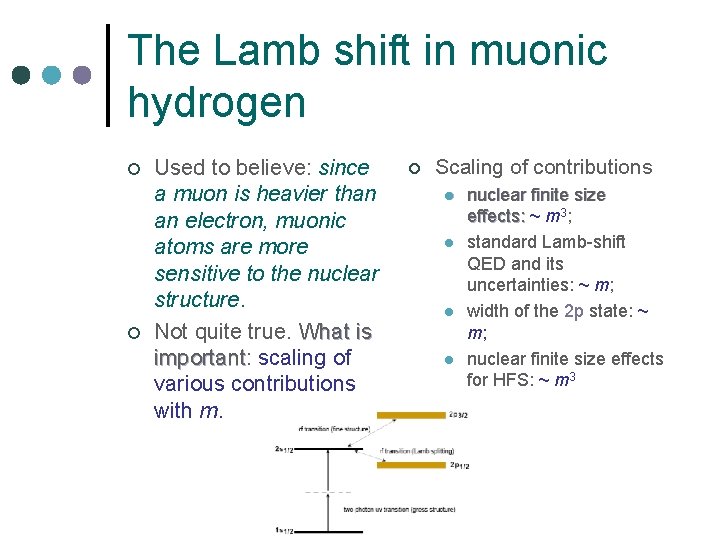
The Lamb shift in muonic hydrogen ¢ ¢ Used to believe: since a muon is heavier than an electron, muonic atoms are more sensitive to the nuclear structure. Not quite true. What is important: important scaling of various contributions with m. ¢ Scaling of contributions l l nuclear finite size effects: ~ m 3; standard Lamb-shift QED and its uncertainties: ~ m; width of the 2 p state: ~ m; nuclear finite size effects for HFS: ~ m 3
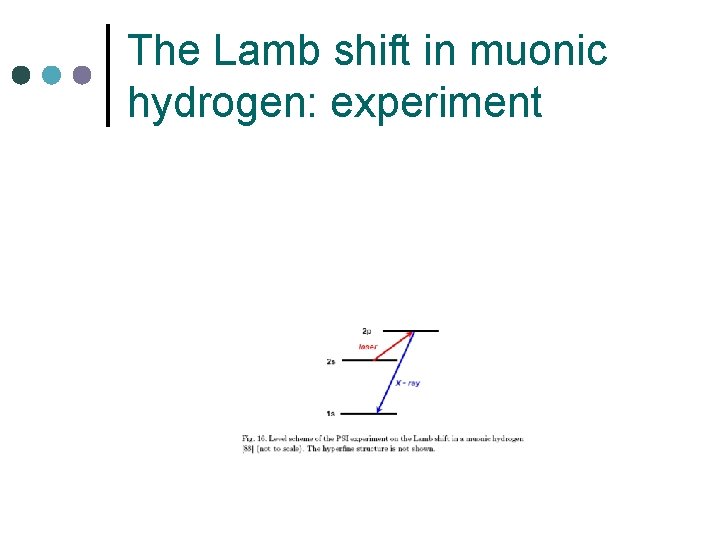
The Lamb shift in muonic hydrogen: experiment
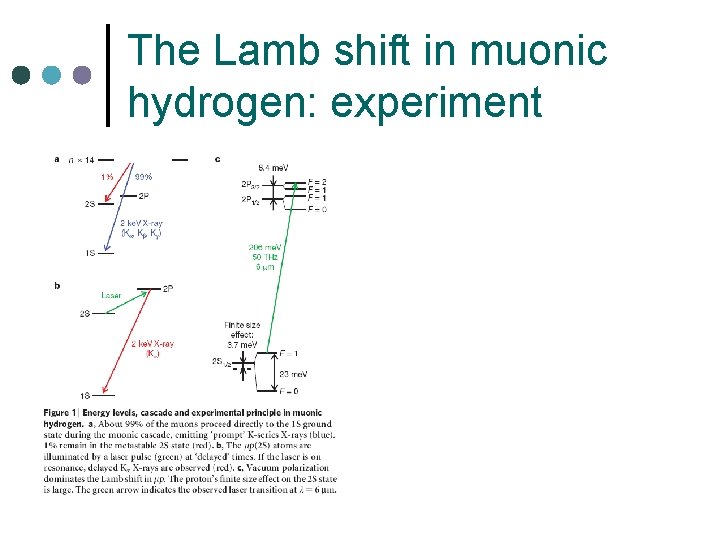
The Lamb shift in muonic hydrogen: experiment
The Lamb shift in muonic hydrogen: experiment
The Lamb shift in muonic hydrogen: theory
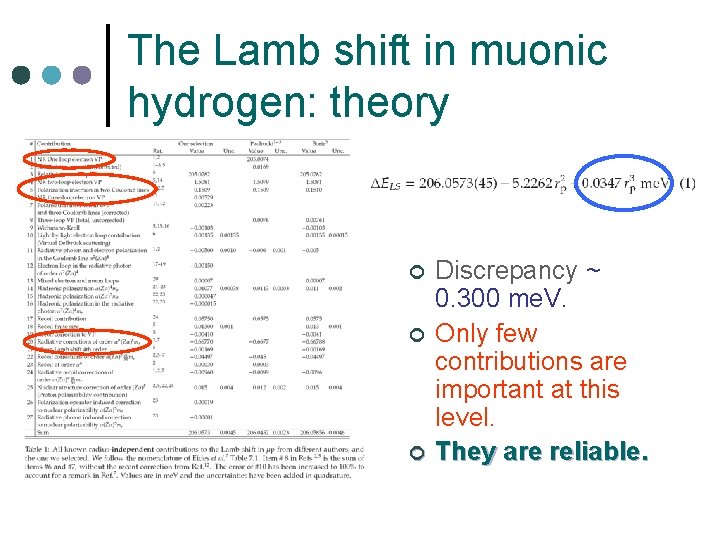
The Lamb shift in muonic hydrogen: theory ¢ ¢ ¢ Discrepancy ~ 0. 300 me. V. Only few contributions are important at this level. They are reliable.
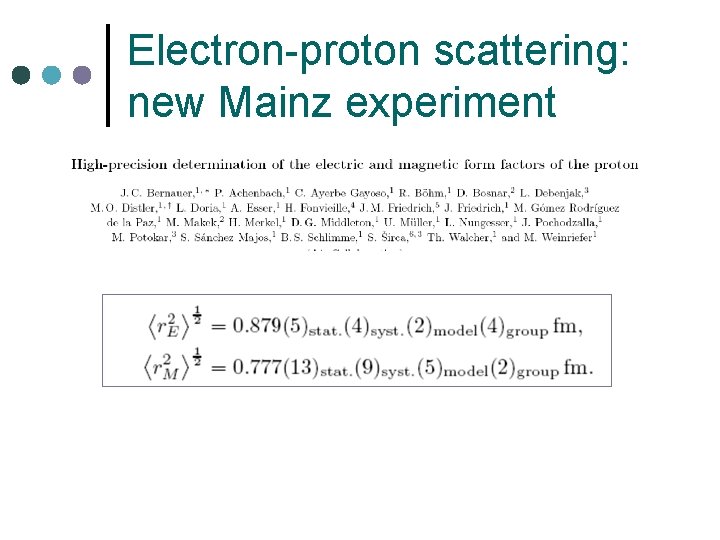
Electron-proton scattering: new Mainz experiment
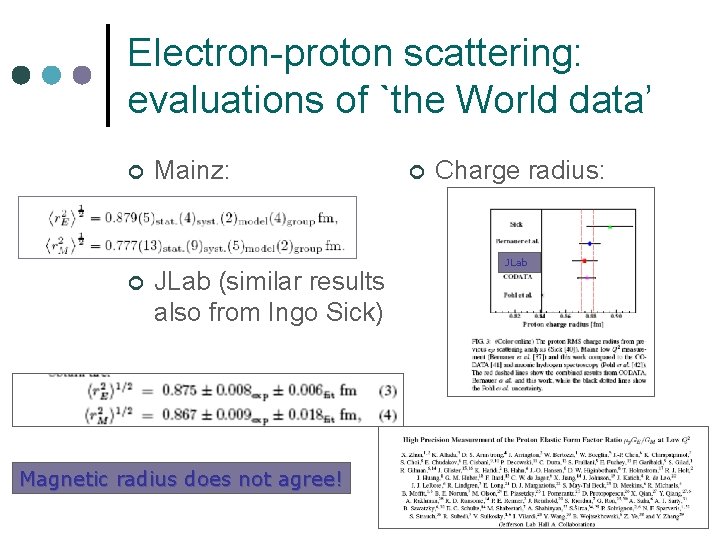
Electron-proton scattering: evaluations of `the World data’ ¢ ¢ Mainz: JLab (similar results also from Ingo Sick) Magnetic radius does not agree! ¢ Charge radius: JLab
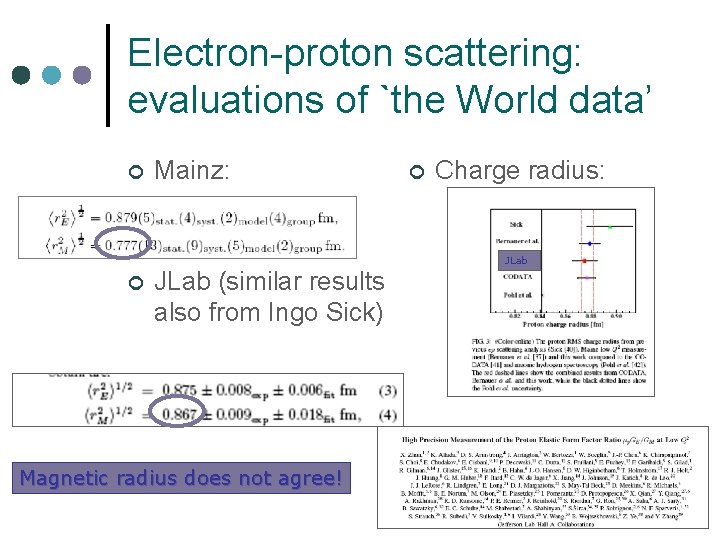
Electron-proton scattering: evaluations of `the World data’ ¢ Mainz: ¢ Charge radius: JLab ¢ JLab (similar results also from Ingo Sick) Magnetic radius does not agree!
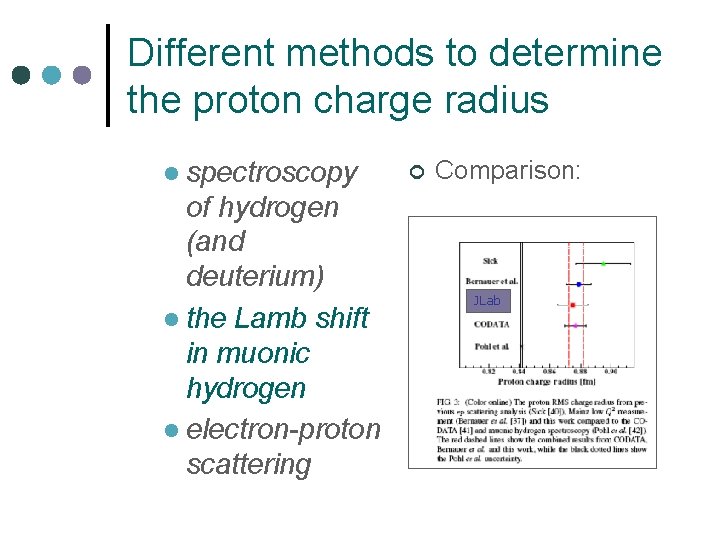
Different methods to determine the proton charge radius l spectroscopy of hydrogen (and deuterium) l the Lamb shift in muonic hydrogen l electron-proton scattering ¢ Comparison: JLab
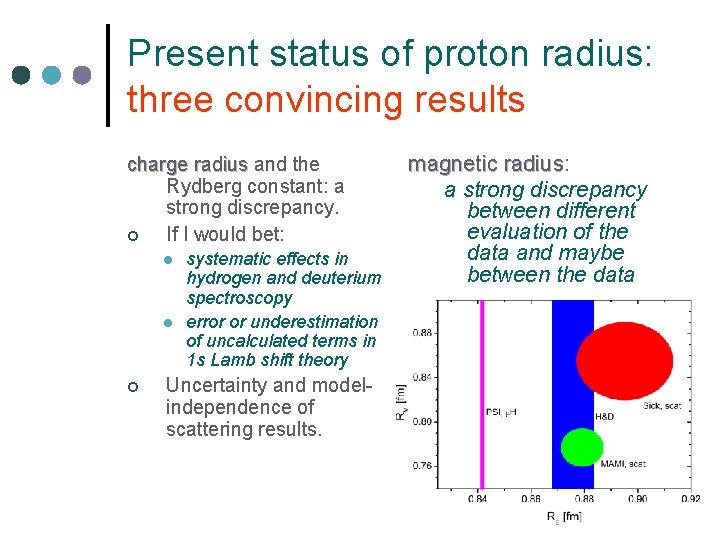
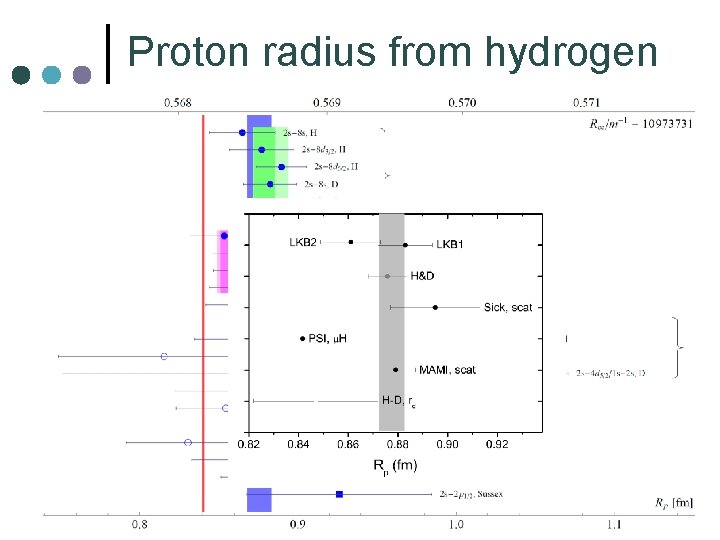
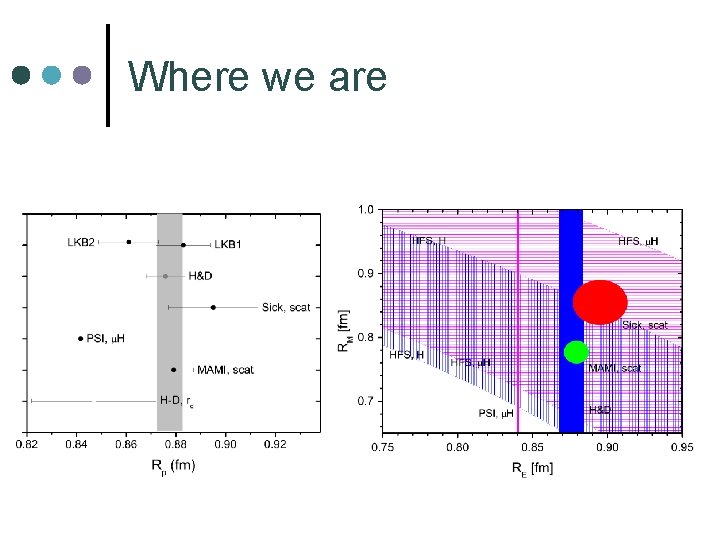
Present status of proton radius: three convincing results charge radius and the Rydberg constant: a strong discrepancy. ¢ If I would bet: l l ¢ systematic effects in hydrogen and deuterium spectroscopy error or underestimation of uncalculated terms in 1 s Lamb shift theory Uncertainty and modelindependence of scattering results. magnetic radius: radius a strong discrepancy between different evaluation of the data and maybe between the data
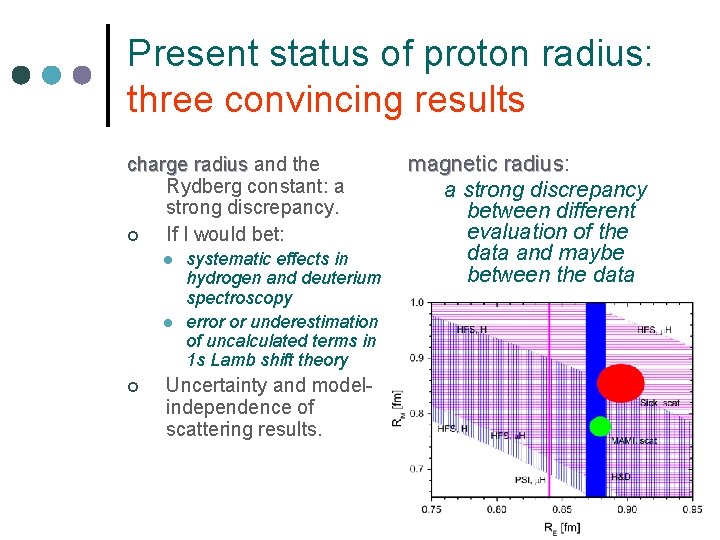
Present status of proton radius: three convincing results charge radius and the Rydberg constant: a strong discrepancy. ¢ If I would bet: l l ¢ systematic effects in hydrogen and deuterium spectroscopy error or underestimation of uncalculated terms in 1 s Lamb shift theory Uncertainty and modelindependence of scattering results. magnetic radius: radius a strong discrepancy between different evaluation of the data and maybe between the data
What is next? ¢ ¢ new evaluations of scattering data (old and new) new spectroscopic experiments on hydrogen and deuterium evaluation of data on the Lamb shift in muonic deuterium (from PSI) and new value of the Rydberg constant systematic check on muonic hydrogen and deuterium theory
Where we are
- Slides: 35