
The Ladybug Picture Book Award and Public Libraries
The Ladybug Picture Book Award and Public Libraries Karen Landsman - Library Media Tech Integration Specialist Fred C. Underhill School-Hooksett Deborah Dutcher - Youth Services Librarian NH State Library
How well do you know the 2018 Ladybug Nominees? https: //play. kahoot. it/#/? quiz. Id=0 dfc 1 779 -a 516 -4 cd 9 -94 a 2 -db 0 a 8 b 537259
The Ladybug Picture Book Award was one of the first programs started by the Center of the Book at the New Hampshire State Library in 2003. History This award promotes awareness and appreciation of the best in recent children’s picture books. It provides a wonderful opportunity for New Hampshire Librarians to introduce children and adults to the rich readaloud world of literature and art. The award also introduces children to voting, one of the greatest American rights here in the First in the Nation New Hampshire. http: //nhbookcenter. blogspot. com/ https: //www. nh. gov/nhsl/bookcenter/pr ograms/ladybug. html
The Committee & Timeline The committee is mix of public and school librarians from around the state. JAN/FEB: Picture book nominations are made and 10 final books selected. MARCH: Final 10 nominees are announced. NOVEMBER: Voting--New Hampshire children from preschoolers to third grade choose the winner. It is highly recommended that public librarians work closely with their local school librarians in holding voting events to prevent double voting. Votes are tallied and the winning book is announced at the END OF THE YEAR.
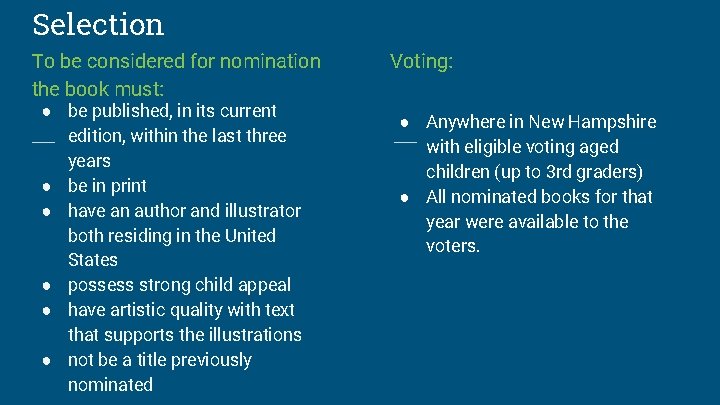
Selection To be considered for nomination the book must: ● be published, in its current edition, within the last three years ● be in print ● have an author and illustrator both residing in the United States ● possess strong child appeal ● have artistic quality with text that supports the illustrations ● not be a title previously nominated Voting: ● Anywhere in New Hampshire with eligible voting aged children (up to 3 rd graders) ● All nominated books for that year were available to the voters.
How can Public Libraries Get Involved? ● ● ● ● Purchase a complete set of the Ladybug Book Award nominees. Use the books in storytimes. Booktalk them to homeschool groups. Read a-loud lunches at the school. Special afterschool storytimes for younger students. Perhaps older students could help with reading? Share in outreach to daycares and Headstart. Advertise the book award with a special display. ● ● Hold a series of evening programs for parents. Make it a family event. Have resource sheets available for parents/caregivers to use at home. Hold “Art of the Picture Book” workshops for primary teachers. WORK WITH your school librarians and teachers to coordinate your efforts.
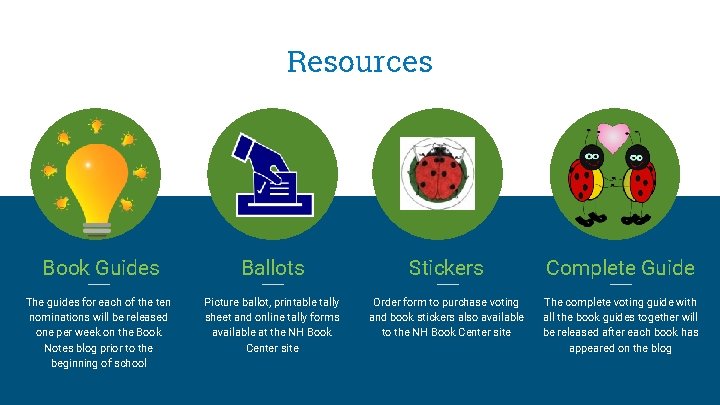
Resources Book Guides Ballots Stickers Complete Guide The guides for each of the ten nominations will be released one per week on the Book Notes blog prior to the beginning of school Picture ballot, printable tally sheet and online tally forms available at the NH Book Center site Order form to purchase voting and book stickers also available to the NH Book Center site The complete voting guide with all the book guides together will be released after each book has appeared on the blog
Online Resources Center for the Book at the New Hampshire State Library: https: //www. nh. gov/nhsl/bookcenter/programs/ladybug. html Book Notes NH: http: //nhbookcenter. blogspot. com/ Ladybug sticker order form: https: //www. nh. gov/nhsl/bookcenter/programs/documents/sticker_order_form. pdf NH State Library - Youth & Adult Services Blog: http: //nhlibraries. org/youthservices/
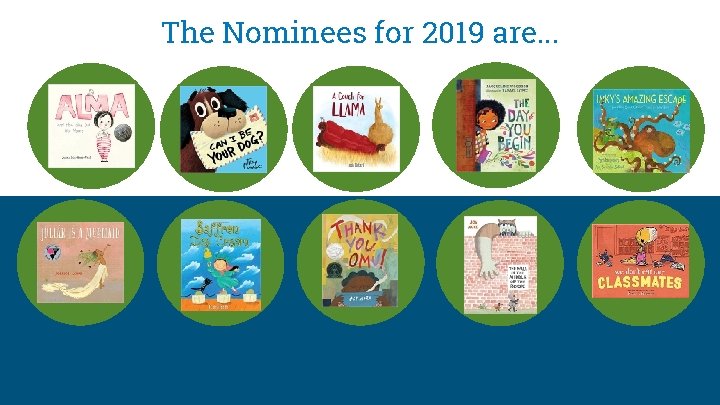
The Nominees for 2019 are. . .
Supercharge your Storytimes! Eight early literacy concepts ★ ★ ★ ★ Alphabetic Knowledge: Exploring with Letters Communication: How to Talk & Share Comprehension: Understanding Stories, etc. Language Use: How to Use Words Phonological Awareness: Playing with Sounds Print Concepts: Connecting with Stories Vocabulary: Understanding & Using Words Writing Concepts: Writing http: //views 2. ischool. uw. edu/resources/ “Librarians and educators need to embrace every opportunity to make the most of their informal learning environments. Working with early literacy concepts can increase your contributions to strengthening a child’s neural connections, ensuring you make the most of the time you spend with your storytime attendees. ” ~ Early Learning that Work Successfully (VIEWS 2)

“Your practice will be powerful and effective when, by using the VIEWS 2 Planning Tool, you purposefully incorporate the early literacy skills from the VIEWS 2 domains into the five practices of ECRR 2. ” ~ VIEWS 2 Research Team VIEWS 2 Domains ECRR 2 Practices VIEWS 2 Plannin g Tool
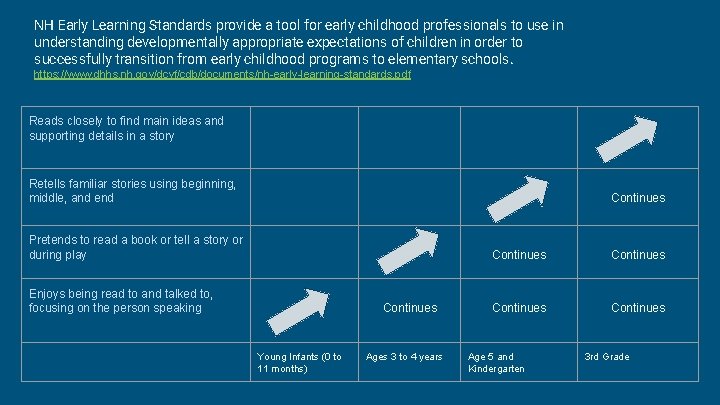
NH Early Learning Standards provide a tool for early childhood professionals to use in understanding developmentally appropriate expectations of children in order to successfully transition from early childhood programs to elementary schools. https: //www. dhhs. nh. gov/dcyf/cdb/documents/nh-early-learning-standards. pdf Reads closely to find main ideas and supporting details in a story Retells familiar stories using beginning, middle, and end Continues Pretends to read a book or tell a story or during play Enjoys being read to and talked to, focusing on the person speaking Continues Young Infants (0 to 11 months) Ages 3 to 4 years Continues Age 5 and Kindergarten 3 rd Grade
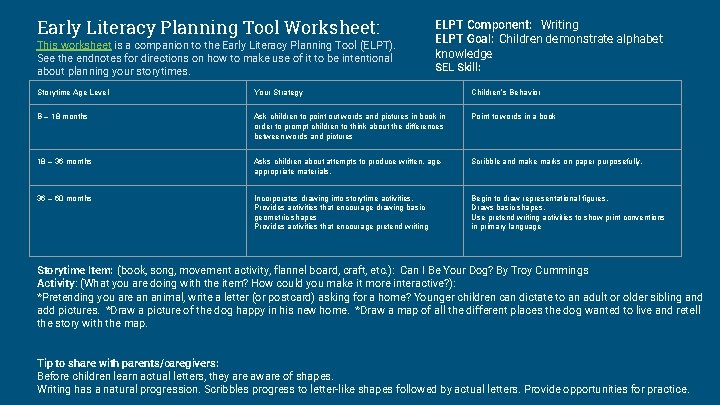
Early Literacy Planning Tool Worksheet: This worksheet is a companion to the Early Literacy Planning Tool (ELPT). See the endnotes for directions on how to make use of it to be intentional about planning your storytimes. ELPT Component: Writing ELPT Goal: Children demonstrate alphabet knowledge SEL Skill: Storytime Age Level Your Strategy Children’s Behavior B – 18 months Ask children to point out words and pictures in book in order to prompt children to think about the differences between words and pictures Point to words in a book 18 – 36 months Asks children about attempts to produce written, ageappropriate materials. Scribble and make marks on paper purposefully. 36 – 60 months Incorporates drawing into storytime activities. Provides activities that encourage drawing basic geometric shapes Provides activities that encourage pretend writing Begin to draw representational figures. Draws basic shapes. Use pretend writing activities to show print conventions in primary language Storytime Item: (book, song, movement activity, flannel board, craft, etc. ): Can I Be Your Dog? By Troy Cummings Activity: (What you are doing with the item? How could you make it more interactive? ): *Pretending you are an animal, write a letter (or postcard) asking for a home? Younger children can dictate to an adult or older sibling and add pictures. *Draw a picture of the dog happy in his new home. *Draw a map of all the different places the dog wanted to live and retell the story with the map. Tip to share with parents/caregivers: Before children learn actual letters, they are aware of shapes. Writing has a natural progression. Scribbles progress to letter-like shapes followed by actual letters. Provide opportunities for practice.
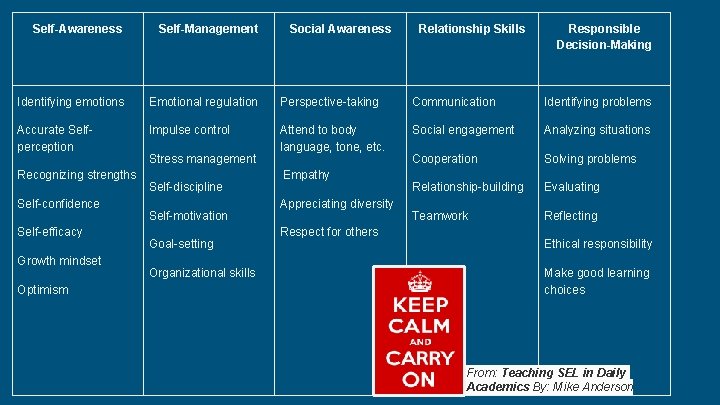
Self-Awareness Self-Management Identifying emotions Emotional regulation Perspective-taking Communication Identifying problems Accurate Selfperception Impulse control Attend to body language, tone, etc. Social engagement Analyzing situations Cooperation Solving problems Relationship-building Evaluating Teamwork Reflecting Recognizing strengths Self-confidence Self-efficacy Growth mindset Optimism Stress management Self-discipline Self-motivation Goal-setting Organizational skills Social Awareness Empathy Appreciating diversity Respect for others Relationship Skills Responsible Decision-Making Ethical responsibility Make good learning choices From: Teaching SEL in Daily Academics By: Mike Anderson
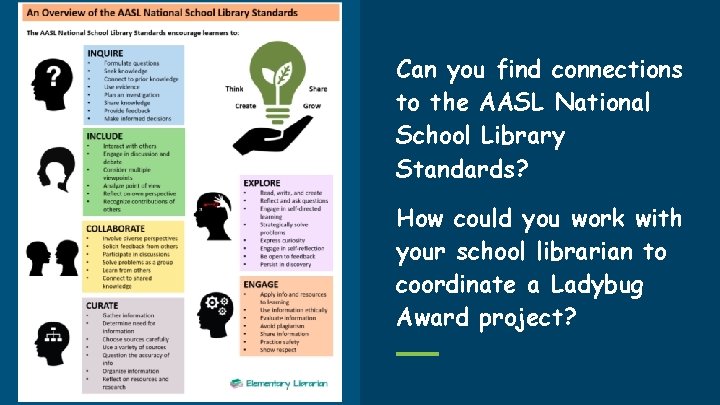
Can you find connections to the AASL National School Library Standards? How could you work with your school librarian to coordinate a Ladybug Award project?
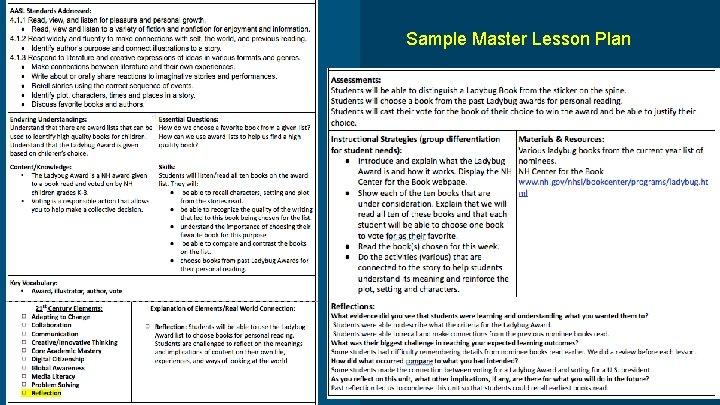
Sample Master Lesson Plan
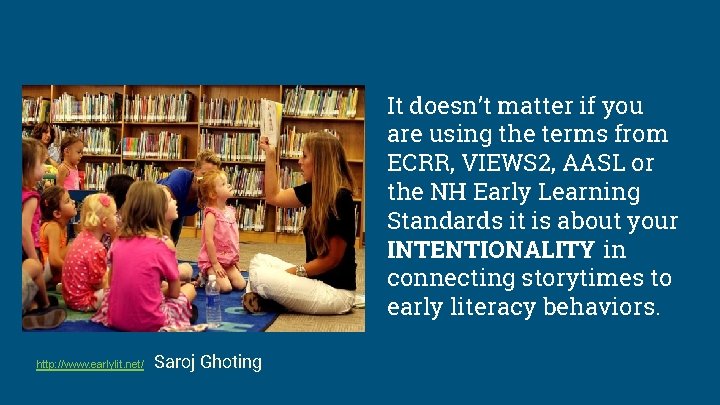
It doesn’t matter if you are using the terms from ECRR, VIEWS 2, AASL or the NH Early Learning Standards it is about your INTENTIONALITY in connecting storytimes to early literacy behaviors. http: //www. earlylit. net/ Saroj Ghoting
Discussion for ANY picture book Introduce these great vocabulary words in your picture book discussions: ➢ What is the genre of this book and what is it about the story or pictures that supports that idea? ➢ Where does the story take place or what is the setting ? Is there more than one setting? Does the story take place in the past, now or in the future? How much time goes by in the story? ➢ What is the plot? What is the problem and if it is solved--when and how. ➢ Who is the narrator of the story? How would the story change if the author had chosen a different person to be the narrator? ➢ Talk about the characters. Who is the main character and how can you tell? ➢ What is the overall message of the story? Can you associate it with something in your life or something happening in the world?
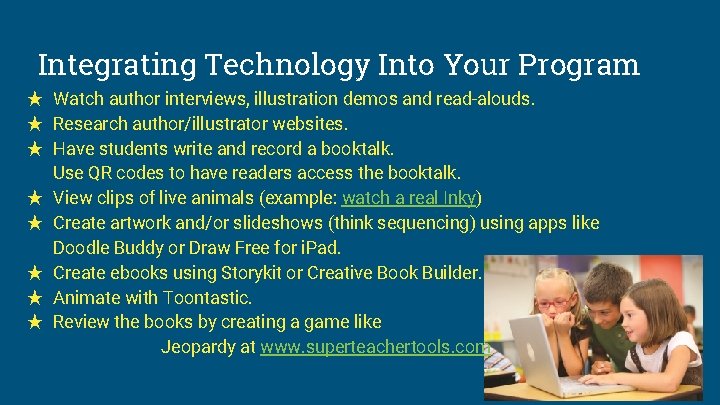
Integrating Technology Into Your Program ★ Watch author interviews, illustration demos and read-alouds. ★ Research author/illustrator websites. ★ Have students write and record a booktalk. Use QR codes to have readers access the booktalk. ★ View clips of live animals (example: watch a real Inky) ★ Create artwork and/or slideshows (think sequencing) using apps like Doodle Buddy or Draw Free for i. Pad. ★ Create ebooks using Storykit or Creative Book Builder. ★ Animate with Toontastic. ★ Review the books by creating a game like Jeopardy at www. superteachertools. com
Teaching kids about voting ● How to make an informed decision ● Advocate for your choice ● Teach respectful disagreement ● Use math to explain results Make it fun--Hold a voting party!
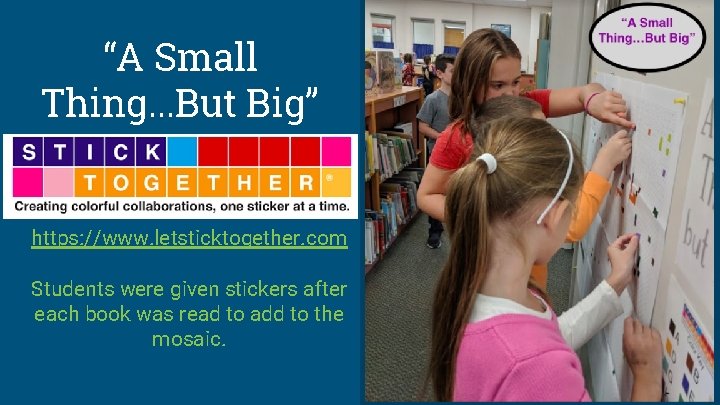
“A Small Thing. . . But Big” https: //www. letsticktogether. com Students were given stickers after each book was read to add to the mosaic.
Sample Activities for Inky’s Amazing Escape by Sy Montgomery Examples of how one book can be used for many subjects ● Creatures of the Sea In a Scramble ● Art: How to Draw an Octopus ● Science: No Bones About It ● Research: Nat Geo Kids - All About the Octopus ● Video of Octopus Escaping
Thank you for attending our presentation! Karen and Deb
- Slides: 24