
The Labour Market Wage elasticity of demand for
The Labour Market Wage elasticity of demand for labour
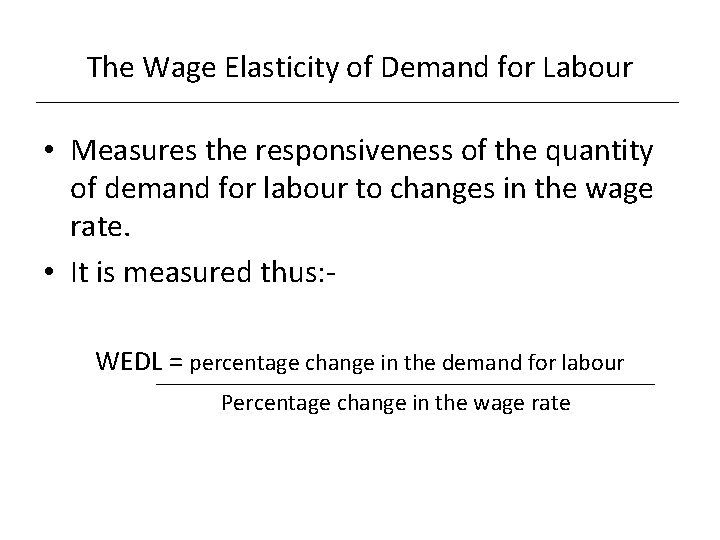
The Wage Elasticity of Demand for Labour • Measures the responsiveness of the quantity of demand for labour to changes in the wage rate. • It is measured thus: WEDL = percentage change in the demand for labour Percentage change in the wage rate
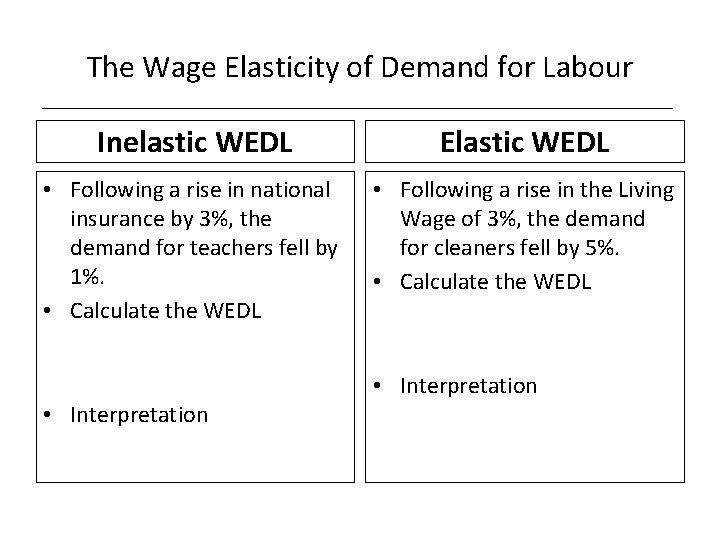
The Wage Elasticity of Demand for Labour Inelastic WEDL Elastic WEDL • Following a rise in national insurance by 3%, the demand for teachers fell by 1%. • Calculate the WEDL • Following a rise in the Living Wage of 3%, the demand for cleaners fell by 5%. • Calculate the WEDL • Interpretation
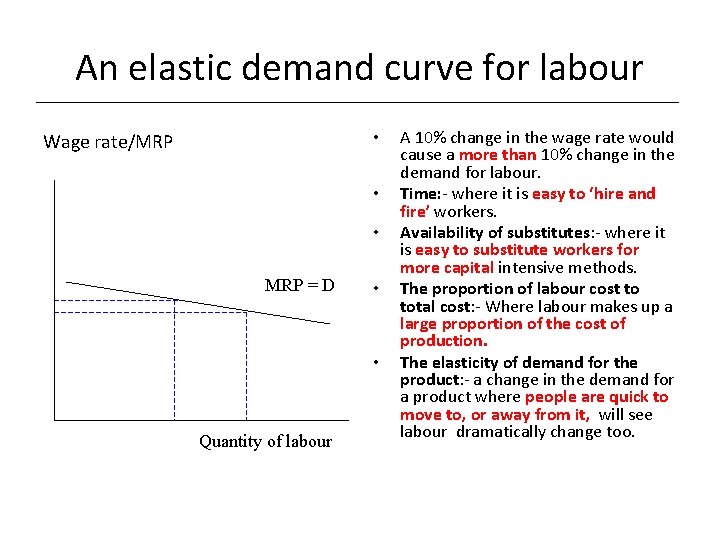
An elastic demand curve for labour • Wage rate/MRP • • MRP = D • • Quantity of labour A 10% change in the wage rate would cause a more than 10% change in the demand for labour. Time: - where it is easy to ‘hire and fire’ workers. Availability of substitutes: - where it is easy to substitute workers for more capital intensive methods. The proportion of labour cost to total cost: - Where labour makes up a large proportion of the cost of production. The elasticity of demand for the product: - a change in the demand for a product where people are quick to move to, or away from it, will see labour dramatically change too.
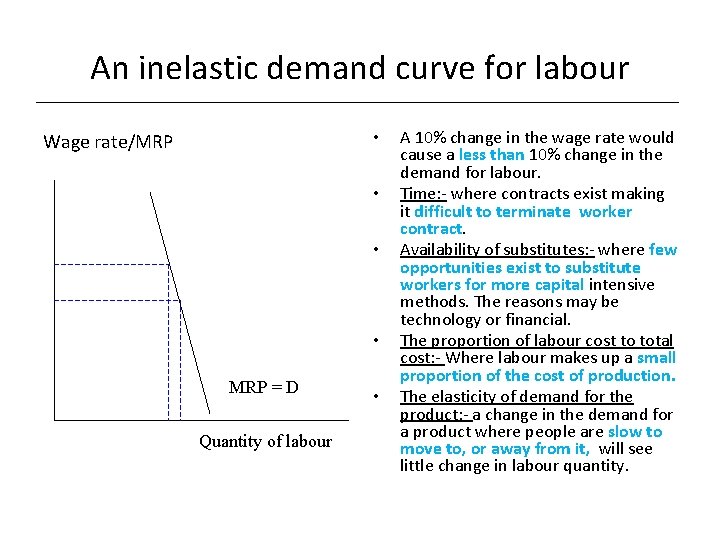
An inelastic demand curve for labour • Wage rate/MRP • • • MRP = D Quantity of labour • A 10% change in the wage rate would cause a less than 10% change in the demand for labour. Time: - where contracts exist making it difficult to terminate worker contract. Availability of substitutes: - where few opportunities exist to substitute workers for more capital intensive methods. The reasons may be technology or financial. The proportion of labour cost to total cost: - Where labour makes up a small proportion of the cost of production. The elasticity of demand for the product: - a change in the demand for a product where people are slow to move to, or away from it, will see little change in labour quantity.
- Slides: 5