
THE KOREAN FIELD MOUSE APODEMUS PENINSULAE RODENTIA AS

- Slides: 16
THE KOREAN FIELD MOUSE APODEMUS PENINSULAE (RODENTIA) AS A MODEL STUDY OF B CHROMOSOME POLYMORPHISM IN MAMMALIA Galina V. Roslik, Irina V. Kartavtseva Institute of Biology & Soil Science, FEB RAS, Vladivostok, (Russia)
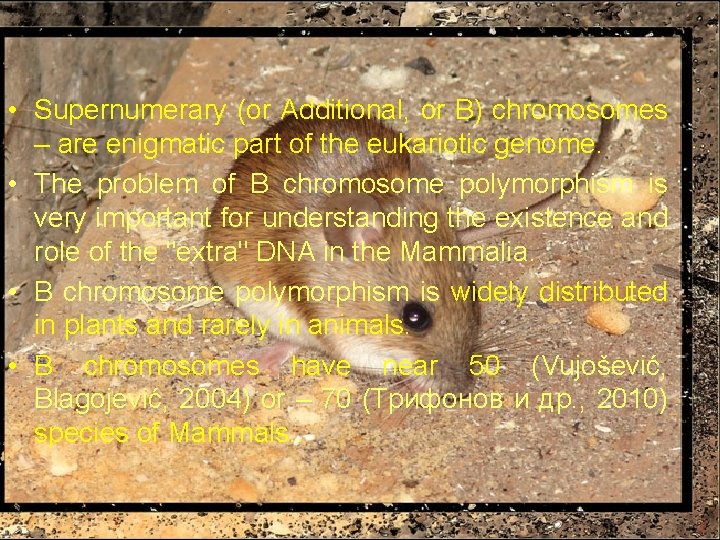
• Supernumerary (or Additional, or B) chromosomes – are enigmatic part of the eukariotic genome. • The problem of B chromosome polymorphism is very important for understanding the existence and role of the "extra" DNA in the Mammalia. • B chromosome polymorphism is widely distributed in plants and rarely in animals. • B chromosomes have near 50 (Vujošević, Blagojević, 2004) or – 70 (Трифонов и др. , 2010) species of Mammals. .
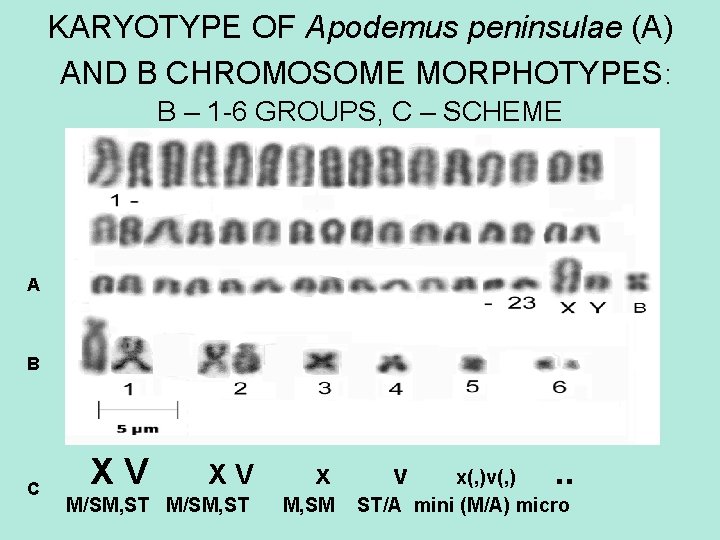
The standard chromosome set of the Korean field mouse, Apodemus peninsulae contains 48 acrocentric chromosomes , and supernumerary chromosomes varying in number from 0 to 30 - in Siberia and from 0 to 7 in the Russian Far East. The B chromosome morphotypes are different in size (vary from big to small) and morphology (vary from macro to micro Bs, more frequently meta-, submetacentrics and micro Bs and rare subtelo-, acrocentrics and mini Bs).
THE AIM OF THE WORK WAS: • To analyse B chromosome polymorphism of the Korean field mouse Apodemus peninsulae Thomas 1906 using different cytogenetic methods and approaches
Routine methods: • - the total number of chromosomes and identify as A and B chromosomes • - the diversity of their size and morphology (morphotype) of B chromosomes • - the nature of mosaicism (cellular clones)
KARYOTYPE OF Apodemus peninsulae (A) AND B CHROMOSOME MORPHOTYPES: B – 1 -6 GROUPS, C – SCHEME A B C XV XV x M/SM, ST M, SM v . . x(, )v(, ) ST/A mini (M/A) micro
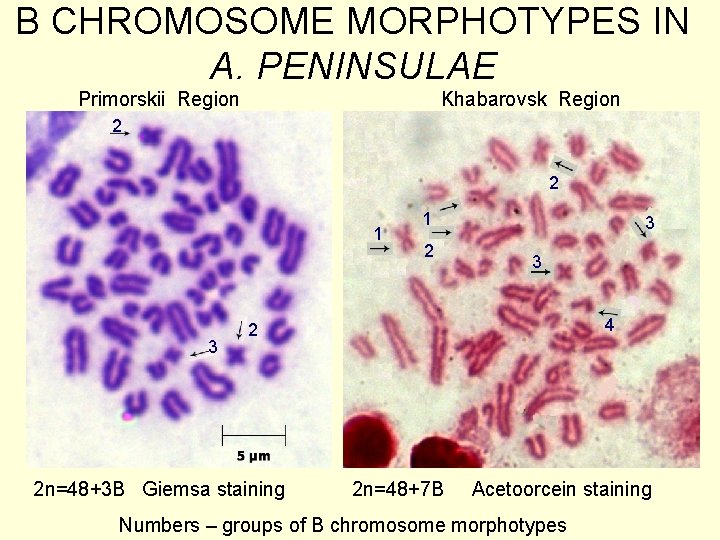
B CHROMOSOME MORPHOTYPES IN A. PENINSULAE Primorskii Region Khabarovsk Region 2 2 1 3 1 2 3 3 4 2 2 n=48+3 B Giemsa staining 2 n=48+7 B Acetoorcein staining Numbers – groups of B chromosome morphotypes
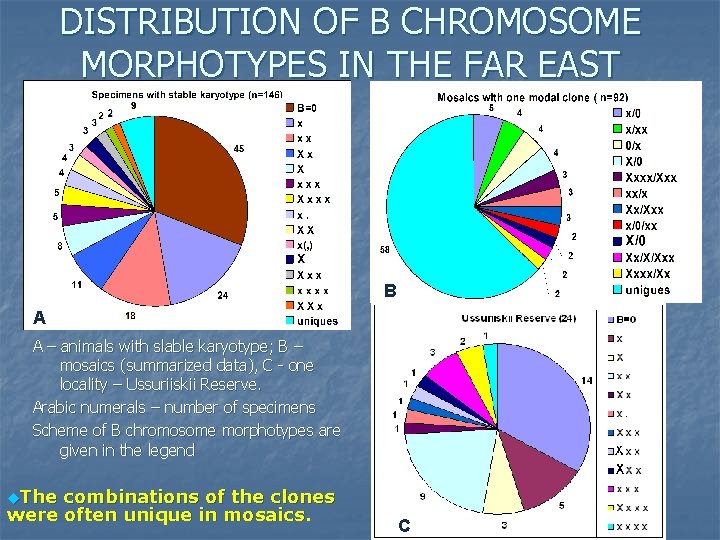
DISTRIBUTION OF B CHROMOSOME MORPHOTYPES IN THE FAR EAST Aa A B A – animals with slable karyotype; B – mosaics (summarized data), C - one locality – Ussuriiskii Reserve. Arabic numerals – number of specimens Scheme of B chromosome morphotypes are given in the legend u. The combinations of the clones were often unique in mosaics. C C
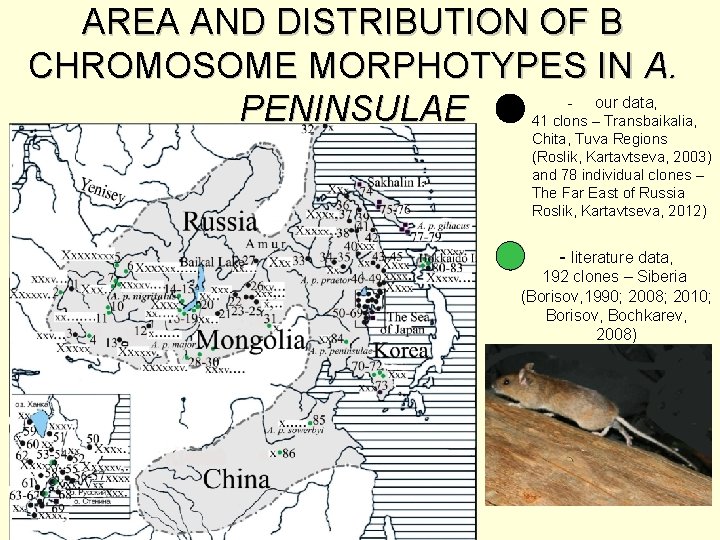
AREA AND DISTRIBUTION OF B CHROMOSOME MORPHOTYPES IN A. - our data, PENINSULAE 41 clons – Transbaikalia, Chita, Tuva Regions (Roslik, Kartavtseva, 2003) and 78 individual clones – The Far East of Russia Roslik, Kartavtseva, 2012) - literature data, 192 clones – Siberia (Borisov, 1990; 2008; 2010; Borisov, Bochkarev, 2008)
DIFFERENTIAL METHODS: • the autosomic pairs, • sex chromosomes, • the peculiarities and patterns of structural organization of A and B chromosomes
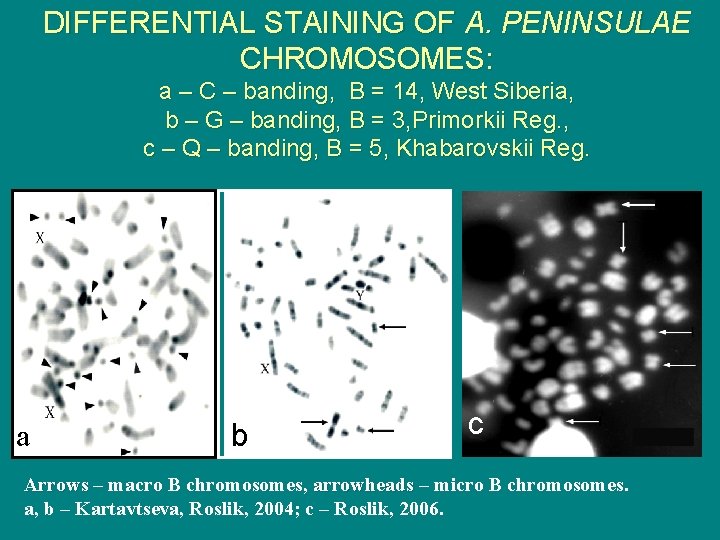
DIFFERENTIAL STAINING OF A. PENINSULAE CHROMOSOMES: a – С – banding, В = 14, West Siberia, b – G – banding, В = 3, Primorkii Reg. , c – Q – banding, В = 5, Khabarovskii Reg. a бb c Arrows – macro B chromosomes, arrowheads – micro B chromosomes. a, b – Kartavtseva, Roslik, 2004; c – Roslik, 2006.
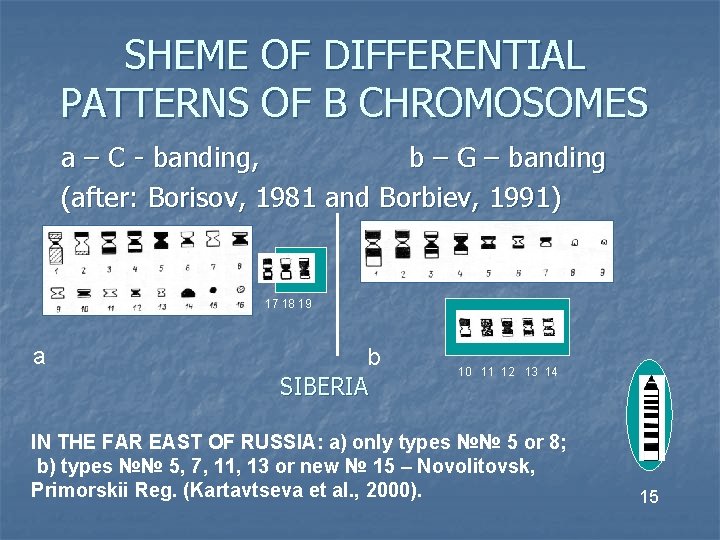
SHEME OF DIFFERENTIAL PATTERNS OF В CHROMOSOMES а – С - banding, b – G – banding (after: Borisov, 1981 and Borbiev, 1991) 17 18 19 a b SIBERIA 10 11 12 13 14 IN THE FAR EAST OF RUSSIA: a) only types №№ 5 or 8; b) types №№ 5, 7, 11, 13 or new № 15 – Novolitovsk, Primorskii Reg. (Kartavtseva et al. , 2000). 15
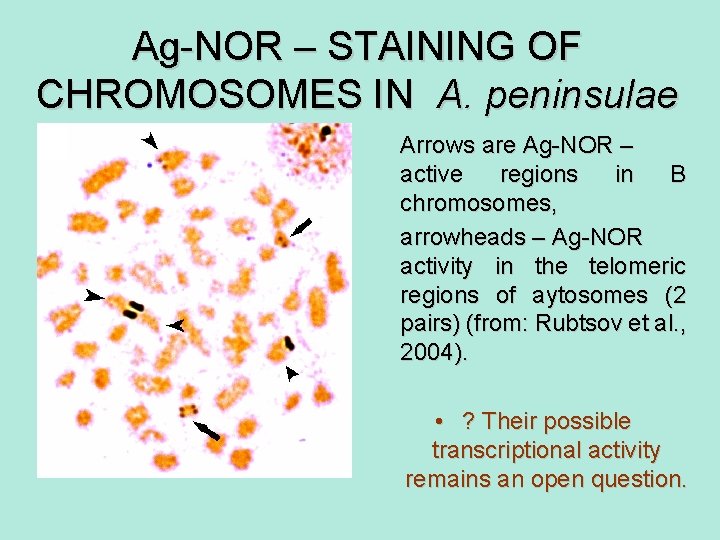
Ag-NOR – STAINING OF CHROMOSOMES IN A. peninsulae Arrows are Ag-NOR – active regions in В chromosomes, arrowheads – Ag-NOR activity in the telomeric regions of aytosomes (2 pairs) (from: Rubtsov et al. , 2004). • ? Their possible transcriptional activity remains an open question.
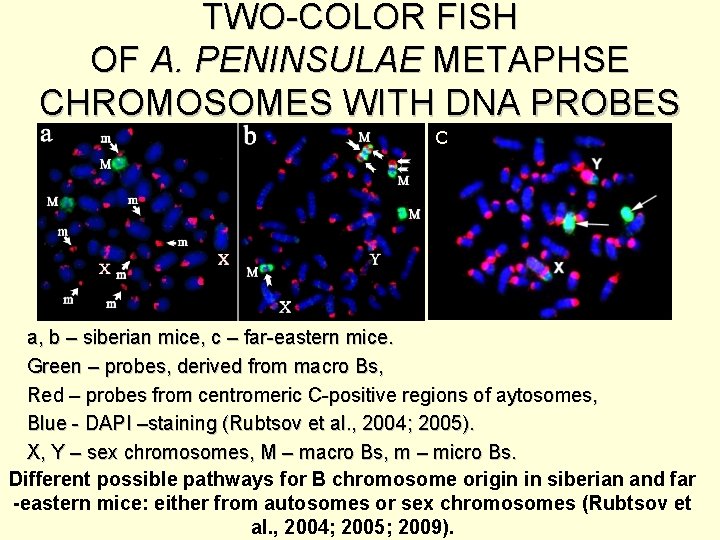
TWO-COLOR FISH OF A. PENINSULAE METAPHSE CHROMOSOMES WITH DNA PROBES c M M a, b – siberian mice, c – far-eastern mice. Green – probes, derived from macro Bs, Red – probes from centromeric C-positive regions of aytosomes, Blue - DAPI –staining (Rubtsov et al. , 2004; 2005). X, Y – sex chromosomes, M – macro Bs, m – micro Bs. Different possible pathways for B chromosome origin in siberian and far -eastern mice: either from autosomes or sex chromosomes (Rubtsov et al. , 2004; 2005; 2009).
CONCLUSIONS: n n n The significance of cytogenetic methods for the comprehensive study on B chromosome polymorphism in Apodemus peninsulae have been shown. So, each method makes a several contribution to the analysis of mice karyotypes, making in whole, an integrated picture of the B chromosome study. Thus, it appears that altogether cytogenetic methods and approaches (routine and differential) were very relevant in the study of B chromosome polymorphism in Mammalia.
This work was partly supported by DVO grant 12 -II-СО-06 -018.