
THE KNEE BONES Femur tibia patella sesamoid Primary
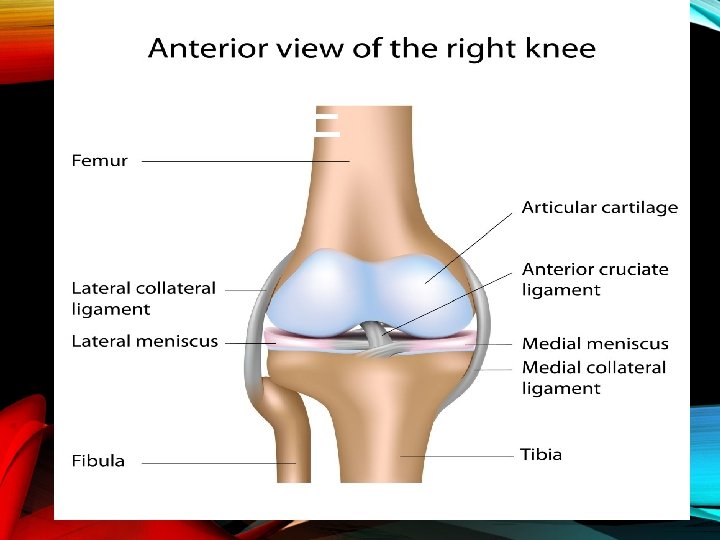
THE KNEE
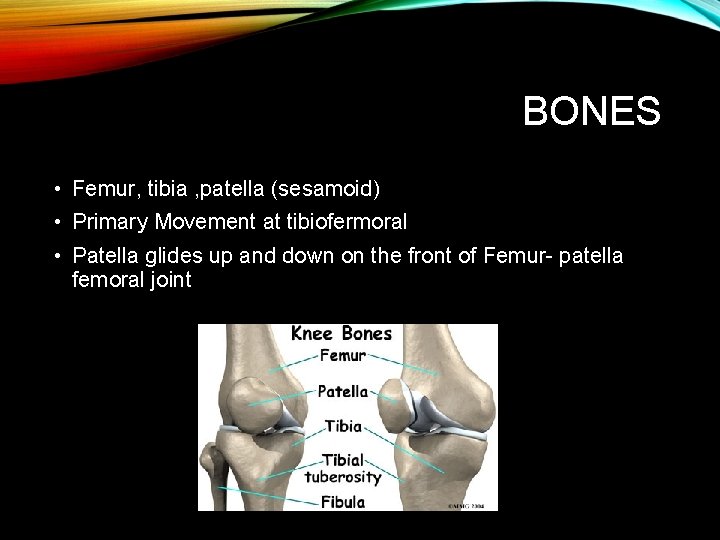
BONES • Femur, tibia , patella (sesamoid) • Primary Movement at tibiofermoral • Patella glides up and down on the front of Femur- patella femoral joint
CARTILAGE • Ends of tibia and femur covered and cushioned by menisci which is tough cartilage tissue • Stops bones from rubbing against each other & stabilizes joints • Attached to the top of tibia • C-shaped • Only outer portion receives blood supply about 4/5 is avascular (no blood supply) • That’s why surgery is need because tears cannot be healed by the body
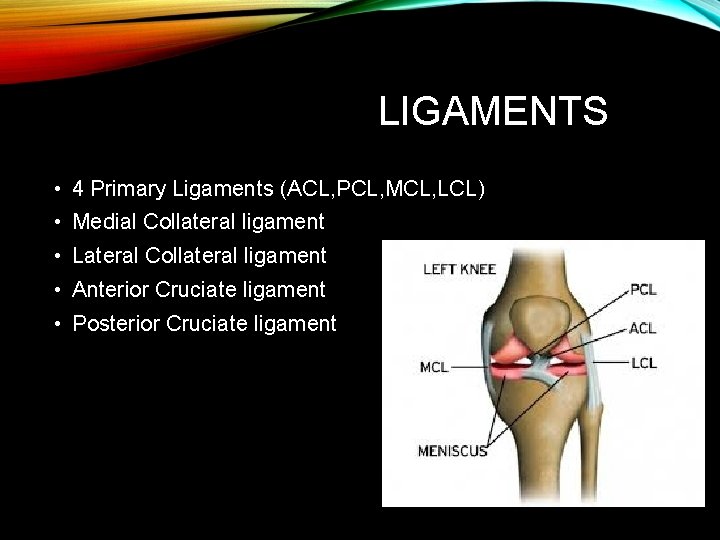
LIGAMENTS • 4 Primary Ligaments (ACL, PCL, MCL, LCL) • Medial Collateral ligament • Lateral Collateral ligament • Anterior Cruciate ligament • Posterior Cruciate ligament
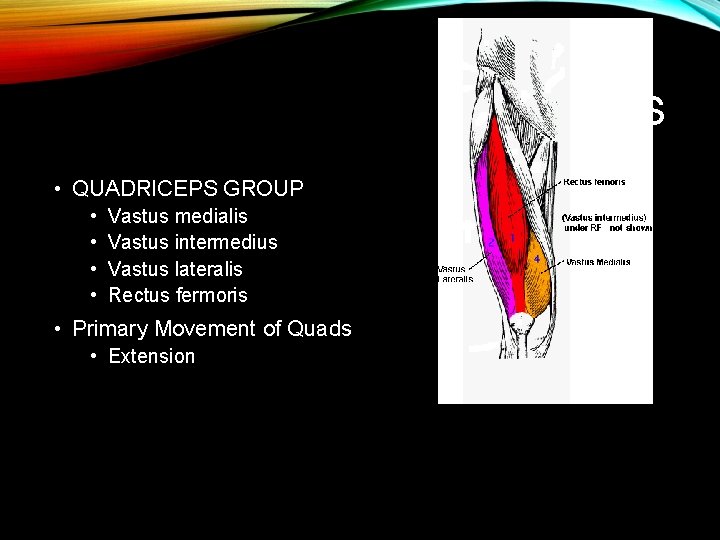
MUSCLES • QUADRICEPS GROUP • • Vastus medialis Vastus intermedius Vastus lateralis Rectus fermoris • Primary Movement of Quads • Extension
HAMSTRING GROUP • Biceps femoris (long and short head) • Semimembranosus • Semitendinosus • Primary movement of hamstring is knee flexion
ACCESSORY MUSCLES • Sartorius • Gracilis • Gastrocnemius
KNEE INJURIES Ligaments sprains are most common injuries
ACL-KEEPS TIBIA FROM MOVING FORWARD ON FEMUR • MOI: can be non contact (changing directions, twisting)or contact (direct blow to anterior or leg) HYPEREXTENSION • C/O: pain, swelling, inability to straighten leg, popping, collapsing of knee • Tx: RICE, refers to orthopedist for MRI, surgery/rehab • Reconstructed arthroscopically by cadaever tendon, patellar tendon, or hamstring tendon • Return to activities after surgery is 3 -6 months; bracing optional
PCL-PREVENTS POSTERIOR TIBIAL MOVEMENT ON FEMUR • MOI: a fall when the bent knee bears full weight, forceful hyper flexed • C/O: hearing a “pop” • Tx. : refers to orthopedic, rehab program focusing on the ROM and quad strength; usually non-surgical
MCL- PREVENTS VALGUS STRESS (KNEE BENDS INWARD • MOI: blow to outside (lateral) knee • C/O: medial joint pain, swelling determined by severity of sprain, discomfort, joint laxity (stretch ligaments ) Loss of ROM • Tx: RICE, Rehab , R/O meniscus injury; usually nonsurgically
LCL-PREVENTS VARUS STRESS (KNEE BENDS OUTWARD) • MOI: blow to inside of knee (medial) • C/O: decrease in ROM • Rehab focus on lateral thigh and hamstring strengthening
MUSCLE AND TENDON INJURIES
QUAD AND HAMSTRING STRAIN • MOI: overuse Excessive force/stretching • C/O pain/soreness Lack of ROM • Tx: ice , stim compression wrap for activities, stretch to the point of no pain
PATELLAR TENDINITIS (JUMPERS KNEE) • MOI: excessive jumping • C/O pain swelling • Tx: ice patellar strap for counterforce
BONE INJURIES

PATELLAR FEMORAL SYNDROME (PATELLAR TRACKING PROBLEMS) • MOI: patella not moving smoothly, weak quadriceps muscles • C/O: pain around the knee discomfort • Cartilage wears away from underside of patella known as chondromalacia • Grinding senstation • Tx: correct patellar tracking
PATELLA DISLOCATION • MOI: patella forced laterally. Occurs when knee is bent and twisted inward • C/O: obvious deformity; pain • Tx: Immobilize; reduce dislocation; rehab
MENISCAL INJURIES • Meniscal tear can be on outer edge middle or inside edge or on the ends
- Slides: 19