
The Kjell Henriksen Observatory KHO 2014 2015 Fred

The Kjell Henriksen Observatory (KHO) 2014 - 2015 Fred Sigernes, Lisa Baddeley, Dag Lorentzen, Margit Dyrland, Silje Eriksen Holmen, Xiangcai Chen, Pål Gunnar Ellingsen, Noora Partamies and Mikko Syrjäsuo The University Centre in Svalbard (UNIS), N-9171 Longyearbyen, Norway Birkeland Centre for Space Science (BCSS), Bergen, Norway Abstract: The following is a summary for the activity at the Kjell Henriksen Observatory (KHO) for the 2014 -2015 season. The current active personnel of the observatory are presented together with the operational instruments. A brief summary of the progress of the new Super Dual Auroral Radar Network (Super. DARN) radar is given in addition to project highlights from the Cusp Region EXperiment (C-REX) rocket mission and the Total Solar Eclipse campaign. 6 th Birkeland Centre for Space Science (BCSS) meeting, 30. 08 -01. 09. 2015.
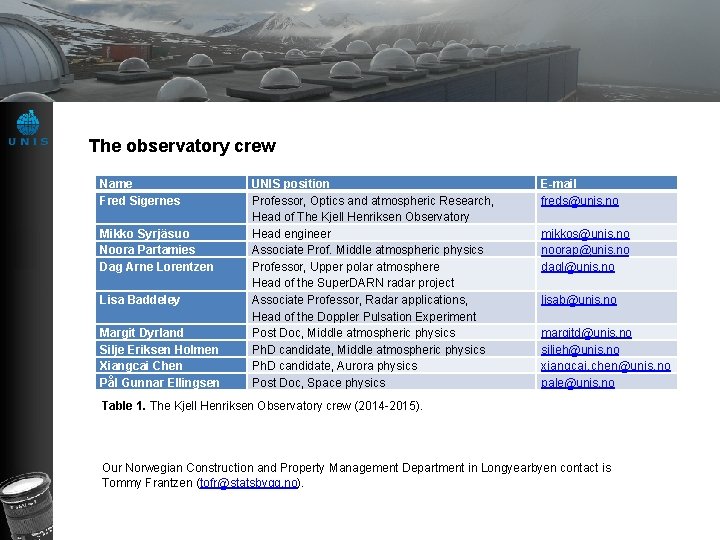
The observatory crew Name Fred Sigernes Mikko Syrjäsuo Noora Partamies Dag Arne Lorentzen Lisa Baddeley Margit Dyrland Silje Eriksen Holmen Xiangcai Chen Pål Gunnar Ellingsen UNIS position Professor, Optics and atmospheric Research, Head of The Kjell Henriksen Observatory Head engineer Associate Prof. Middle atmospheric physics Professor, Upper polar atmosphere Head of the Super. DARN radar project Associate Professor, Radar applications, Head of the Doppler Pulsation Experiment Post Doc, Middle atmospheric physics Ph. D candidate, Aurora physics Post Doc, Space physics E-mail freds@unis. no mikkos@unis. no noorap@unis. no dagl@unis. no lisab@unis. no margitd@unis. no siljeh@unis. no xiangcai. chen@unis. no pale@unis. no Table 1. The Kjell Henriksen Observatory crew (2014 -2015). Our Norwegian Construction and Property Management Department in Longyearbyen contact is Tommy Frantzen (tofr@statsbygg. no).
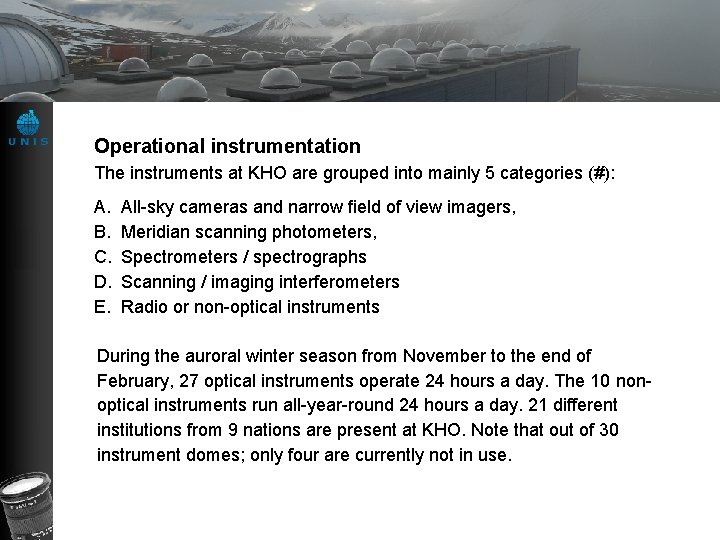
Operational instrumentation The instruments at KHO are grouped into mainly 5 categories (#): A. B. C. D. E. All-sky cameras and narrow field of view imagers, Meridian scanning photometers, Spectrometers / spectrographs Scanning / imaging interferometers Radio or non-optical instruments During the auroral winter season from November to the end of February, 27 optical instruments operate 24 hours a day. The 10 nonoptical instruments run all-year-round 24 hours a day. 21 different institutions from 9 nations are present at KHO. Note that out of 30 instrument domes; only four are currently not in use.
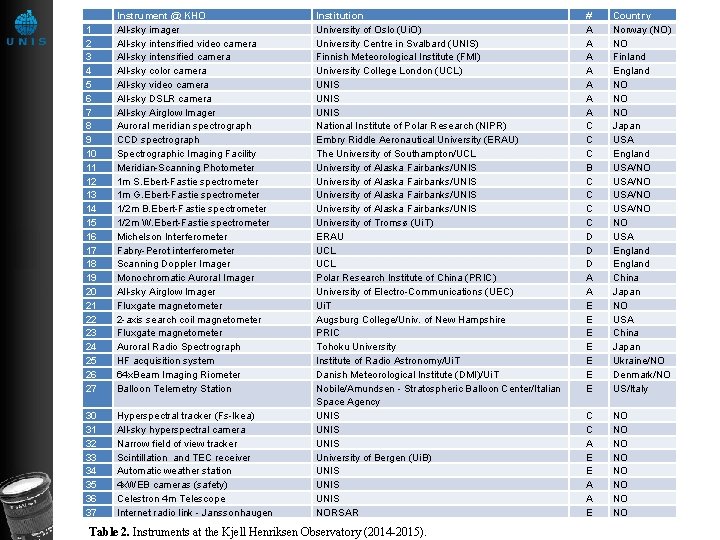
1 2 3 4 5 6 7 8 9 10 11 12 13 14 15 16 17 18 19 20 21 22 23 24 25 26 27 Instrument @ KHO All-sky imager All-sky intensified video camera All-sky intensified camera All-sky color camera All-sky video camera All-sky DSLR camera All-sky Airglow Imager Auroral meridian spectrograph CCD spectrograph Spectrographic Imaging Facility Meridian-Scanning Photometer 1 m S. Ebert-Fastie spectrometer 1 m G. Ebert-Fastie spectrometer 1/2 m B. Ebert-Fastie spectrometer 1/2 m W. Ebert-Fastie spectrometer Michelson Interferometer Fabry-Perot interferometer Scanning Doppler Imager Monochromatic Auroral Imager All-sky Airglow Imager Fluxgate magnetometer 2 -axis search coil magnetometer Fluxgate magnetometer Auroral Radio Spectrograph HF acquisition system 64 x. Beam Imaging Riometer Balloon Telemetry Station 30 31 32 33 34 35 36 37 Hyperspectral tracker (Fs-Ikea) All-sky hyperspectral camera Narrow field of view tracker Scintillation and TEC receiver Automatic weather station 4 x. WEB cameras (safety) Celestron 4 m Telescope Internet radio link - Janssonhaugen Institution University of Oslo (Ui. O) University Centre in Svalbard (UNIS) Finnish Meteorological Institute (FMI) University College London (UCL) UNIS National Institute of Polar Research (NIPR) Embry Riddle Aeronautical University (ERAU) The University of Southampton/UCL University of Alaska Fairbanks/UNIS University of Tromsø (Ui. T) ERAU UCL Polar Research Institute of China (PRIC) University of Electro-Communications (UEC) Ui. T Augsburg College/Univ. of New Hampshire PRIC Tohoku University Institute of Radio Astronomy/Ui. T Danish Meteorological Institute (DMI)/Ui. T Nobile/Amundsen - Stratospheric Balloon Center/Italian Space Agency UNIS University of Bergen (Ui. B) UNIS NORSAR Table 2. Instruments at the Kjell Henriksen Observatory (2014 -2015). # A A A A C C C B C C D D D A A E E E E Country Norway (NO) NO Finland England NO NO NO Japan USA England USA/NO NO USA England China Japan NO USA China Japan Ukraine/NO Denmark/NO US/Italy C C A E E A A E NO NO
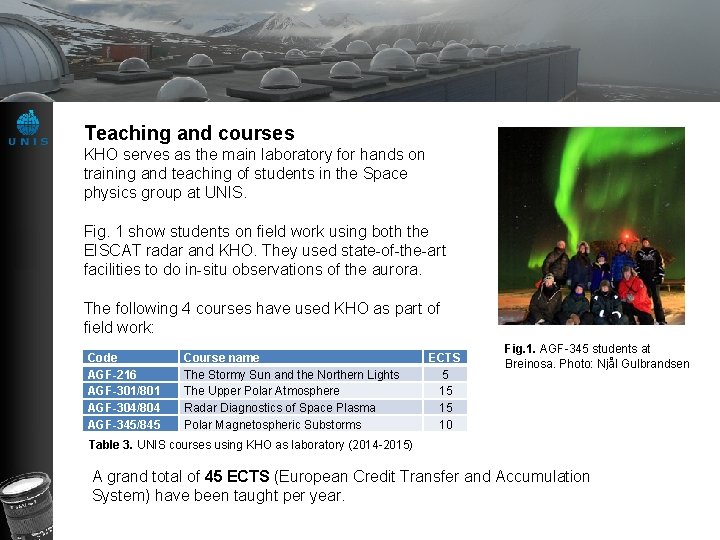
Teaching and courses KHO serves as the main laboratory for hands on training and teaching of students in the Space physics group at UNIS. Fig. 1 show students on field work using both the EISCAT radar and KHO. They used state-of-the-art facilities to do in-situ observations of the aurora. The following 4 courses have used KHO as part of field work: Code AGF-216 AGF-301/801 AGF-304/804 AGF-345/845 Course name The Stormy Sun and the Northern Lights The Upper Polar Atmosphere Radar Diagnostics of Space Plasma Polar Magnetospheric Substorms ECTS 5 15 15 10 Fig. 1. AGF-345 students at Breinosa. Photo: Njål Gulbrandsen Table 3. UNIS courses using KHO as laboratory (2014 -2015) A grand total of 45 ECTS (European Credit Transfer and Accumulation System) have been taught per year.
Graduated students (1) Dr. Holmes, I presume? A new protonic is born! Jeff Morgan Holmes has defended at the University of Oslo (Ui. O) his Ph. D titled: The Protonics project: distributed observations of auroral dayside Doppler-shifted hydrogen emissions. KHO salute you! (2) Master Kinga Congratulation to Master Kinga Albert! The thesis is called: Svalpoint: A multi-track optical pointing system. It enables us at KHO to track any object on the night sky with multiple instruments, simultaneously. Her work opens new opportunities for us and we really look forward to start using the system.

The Svalbard Super. DARN (Super Dual Auroral Radar Network) HF Radar Status • Masts raised • Power / data fiber installed • Antennas mounted All as planned! Fig. 2. The Super. DARN radar under construction. Photo: Mikko Syrjäsuo/UNIS. The transmitter units will arrive soon and will be connected at the site in September. Super. DARN will be operational in October 2015!.

The Cusp Region EXperiment (C-REX) KHO was a central part of the Cusp Region EXperiment (C-REX), a NASA sounding rocket mission that released a large constellation of artificial clouds into the ionosphere above the Greenland Sea. The rocket was launched from Andøya Space Centre at 08: 05 UT on 24 th of November, 2014. Fig. 3. NORUSCA II all-sky color composite images from KHO, 24. 11. 2014. The Red, Green and Blue color channels are from center wavelengths 6300, 5577 and 4861 Å, respectively. Labels (A) to (D) represent time from 08: 14 to 08: 17 UT. Jupiter is marked with arrow (1) in panel (A). Arrow (2) in panel (B) marks the first releases of the artificial clouds from the C-REX rocket. Fig. 4. Launch of the C-REX rocket from Andøya. Photo: Brea Reeves.
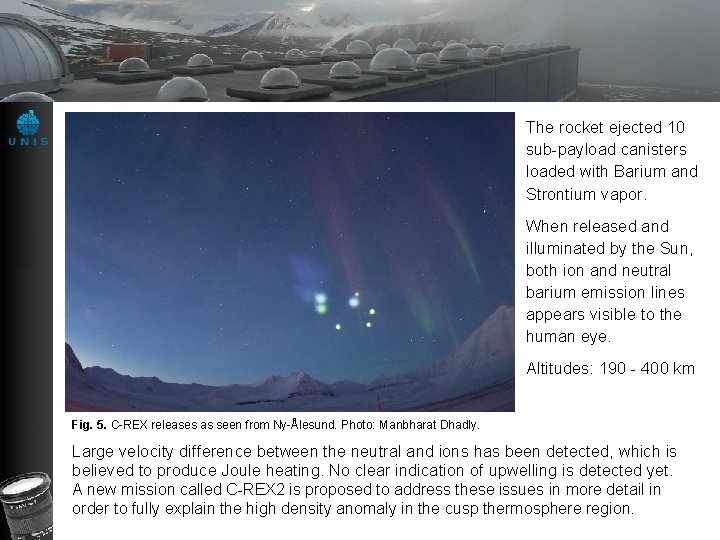
The rocket ejected 10 sub-payload canisters loaded with Barium and Strontium vapor. When released and illuminated by the Sun, both ion and neutral barium emission lines appears visible to the human eye. Altitudes: 190 - 400 km Fig. 5. C-REX releases as seen from Ny-Ålesund. Photo: Manbharat Dhadly. Large velocity difference between the neutral and ions has been detected, which is believed to produce Joule heating. No clear indication of upwelling is detected yet. A new mission called C-REX 2 is proposed to address these issues in more detail in order to fully explain the high density anomaly in the cusp thermosphere region.
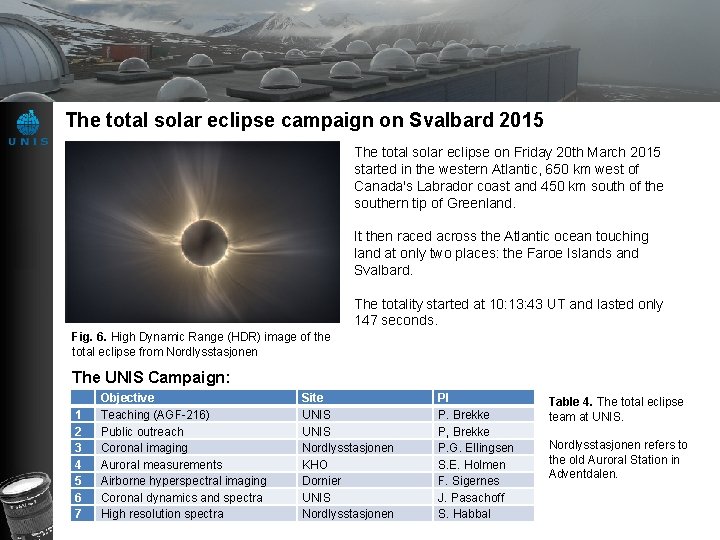
The total solar eclipse campaign on Svalbard 2015 The total solar eclipse on Friday 20 th March 2015 started in the western Atlantic, 650 km west of Canada's Labrador coast and 450 km south of the southern tip of Greenland. It then raced across the Atlantic ocean touching land at only two places: the Faroe Islands and Svalbard. The totality started at 10: 13: 43 UT and lasted only 147 seconds. Fig. 6. High Dynamic Range (HDR) image of the total eclipse from Nordlysstasjonen The UNIS Campaign: 1 2 3 4 5 6 7 Objective Teaching (AGF-216) Public outreach Coronal imaging Auroral measurements Airborne hyperspectral imaging Coronal dynamics and spectra High resolution spectra Site UNIS Nordlysstasjonen KHO Dornier UNIS Nordlysstasjonen PI P. Brekke P, Brekke P. G. Ellingsen S. E. Holmen F. Sigernes J. Pasachoff S. Habbal Table 4. The total eclipse team at UNIS. Nordlysstasjonen refers to the old Auroral Station in Adventdalen.
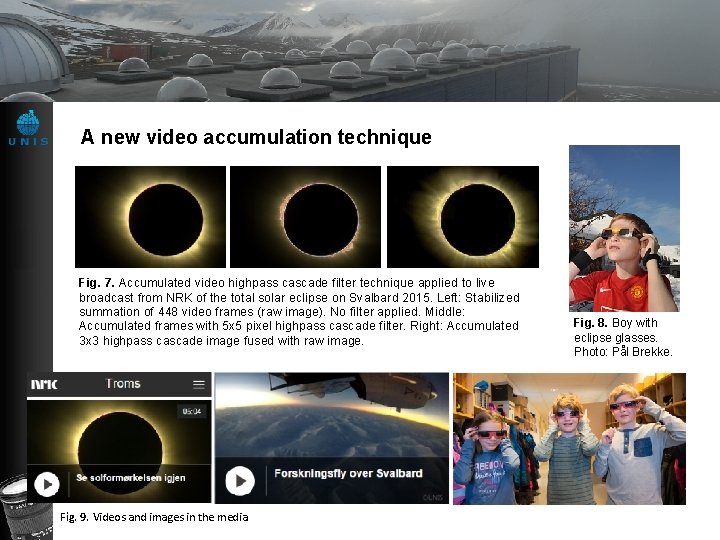
A new video accumulation technique Fig. 7. Accumulated video highpass cascade filter technique applied to live broadcast from NRK of the total solar eclipse on Svalbard 2015. Left: Stabilized summation of 448 video frames (raw image). No filter applied. Middle: Accumulated frames with 5 x 5 pixel highpass cascade filter. Right: Accumulated 3 x 3 highpass cascade image fused with raw image. Fig. 9. Videos and images in the media Fig. 8. Boy with eclipse glasses. Photo: Pål Brekke.
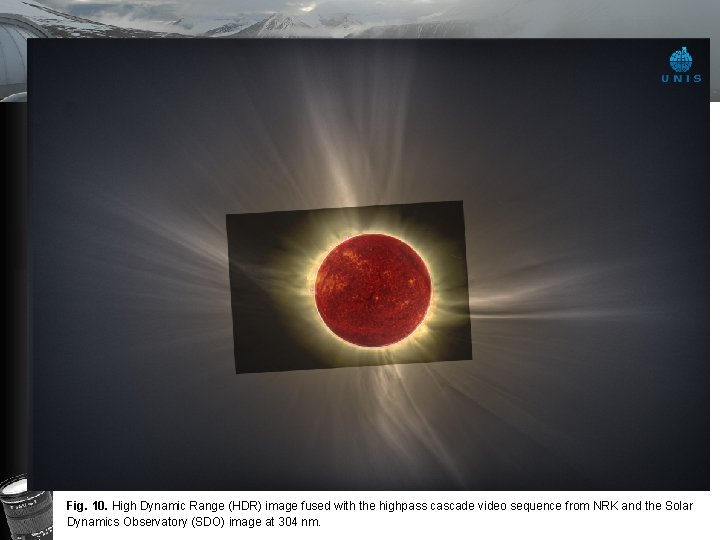
Fig. 10. High Dynamic Range (HDR) image fused with the highpass cascade video sequence from NRK and the Solar Dynamics Observatory (SDO) image at 304 nm.
10 x Other highlights … • • • UNIS held Norway’s first international Super. DARN meeting in May 2014. Her Royal Majesty Queen Sonja of Norway revisited KHO 5 th of February, 2015. AGF-304/804 Master and Ph. D students provided radar support for the University of Oslo sounding rocket named ICI-4 that was launched successfully from Andøya Space Centre at 23. 06 LT on 20 th of February, 2015 The Nordic optical intercalibration workshops in Sodankylä, September 2015 A new HF transmitter is deployed to Hornsund to study small scale ionospheric and gravity waves. The receiver will be deployed at KHO this fall. The 42 nd Annual European Meeting on Atmospheric Studies by Optical Methods (42 AM), Hermanus, Western Cape, South Africa, September 14 -18, 2015. The Russian NORUSCA camera goes back to Barentsburg in September 2015. KHO supports the RENU 2 (Rocket Experiment for Neutral Upwelling 2) fall 2015. New rocket proposals: VISION 2 and C-REX 2 Publications and presentations (talks) numbers are sofar 10 and 27 for the time period 2014 – 2015, respectively.
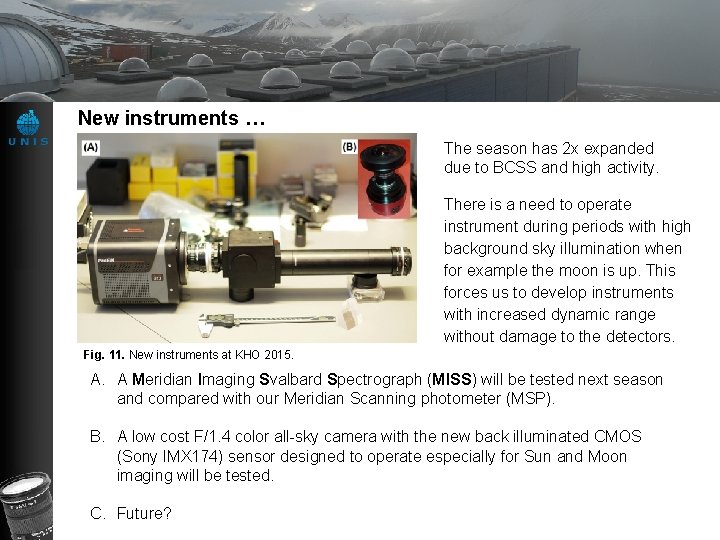
New instruments … The season has 2 x expanded due to BCSS and high activity. There is a need to operate instrument during periods with high background sky illumination when for example the moon is up. This forces us to develop instruments with increased dynamic range without damage to the detectors. Fig. 11. New instruments at KHO 2015. A. A Meridian Imaging Svalbard Spectrograph (MISS) will be tested next season and compared with our Meridian Scanning photometer (MSP). B. A low cost F/1. 4 color all-sky camera with the new back illuminated CMOS (Sony IMX 174) sensor designed to operate especially for Sun and Moon imaging will be tested. C. Future?
- Slides: 14