
The Khilji Khalji Dynasty Problems of succession and
The Khilji (Khalji) Dynasty Problems of succession and power transfers Qumar Rabani Assistant Professor (History ) Govt. PG College Rajouri
Death of Balban-emergence of Khalji power • Economy stabilizes, market towns increase in number— due to increased migration from Afghanistan and Persia • Mongols contained on NW border • Power of chehelgan reduced, through iqta reform and garrison towns, but they become more hostile to centralized rule • Balban’s severe punishments and killings greatly reduce the number of qualified officers and generals, independent action discouraged and sycophancy encouraged • No competent successor remains when Mohammad, the older son is dies in 1285.
Death of Balban-emergence of Khalji power • Economy stabilizes, market towns increase in number— due to increased migration from Afghanistan and Persia • Mongols contained on NW border • Power of chehelgan reduced, through iqta reform and garrison towns, but they become more hostile to centralized rule • Balban’s severe punishments and killings greatly reduce the number of qualified officers and generals, independent action discouraged and sycophancy encouraged • No competent successor remains when Mohammad, the older son is dies in 1285.
Death of Balban-emergence of Khalji power • Economy stabilizes, market towns increase in number— due to increased migration from Afghanistan and Persia • Mongols contained on NW border • Power of chehelgan reduced, through iqta reform and garrison towns, but they become more hostile to centralized rule • Balban’s severe punishments and killings greatly reduce the number of qualified officers and generals, independent action discouraged and sycophancy encouraged • No competent successor remains when Mohammad, the older son is dies in 1285.
Death of Balban-emergence of Khalji power • Economy stabilizes, market towns increase in number— due to increased migration from Afghanistan and Persia • Mongols contained on NW border • Power of chahalgani reduced, through iqta reform and garrison towns, but they become more hostile to centralized rule • Balban’s severe punishments and killings greatly reduce the number of qualified officers and generals, independent action discouraged and sycophancy encouraged • No competent successor remains when Mohammad, the older son died in 1285.
Problems of succession • Turkish custom did not favor primogeniture • The nobility had some say in the selection of the next ruler if sultan did not appoint an heir • Balban’s attempt to create a succession failed – Younger son Bughra Khan resented and feared his father since 1275 events in Bengal – Muhammad’s son Kaykhusrau was designated heir after Mohammad’s death in 1285 but opposed by amirs – Bughar Khan’s son Kayqabad and his son Kayumars both had short reigns while the chehelgan attempted to use them as puppet rulers, Bughra stayed far away from Delhi

The Khaljis • A tribe of mixed Afghani/Turkish descent • Benefited from Balban’s reforms, had greater cohesion than other groups, unite and nominate their senior chief, Jalal-uddin Khilji as ruler (r. 1290 -96) – His generosity had won support, but is later criticized – Growing evidence of his lack of desire from confrontation makes Khaljis nervous – His nephew Ala-ud-din Khalji demonstrates superior military and leadership skills, particularly in the raid on Deogiri (1293 -95), Khaljis begin to support him instead • Jalal ud-din is assassinated on his nephew’s orders in 1296
Ala-ud-din Khalji’s Campaigns • Suppresses several attempts by mongols and secures NW borders b/w 1296 -1306 • 1299—Gujarat (important for sea trade) and Ranthambor annexed • 1302 -3—Orrisa and Bengal campaign unsuccessful • 1303 Chittor and Central India • Malik Kafur’s expeditions – – Campaign against the Yadavs (Devgiri) 1306 -07 Against the Kakatiyas of Warrangal 1309 -1310 Against the Hoysalas of Dvarsamudra 1310 Against the Pandyas (southernmost) 1311
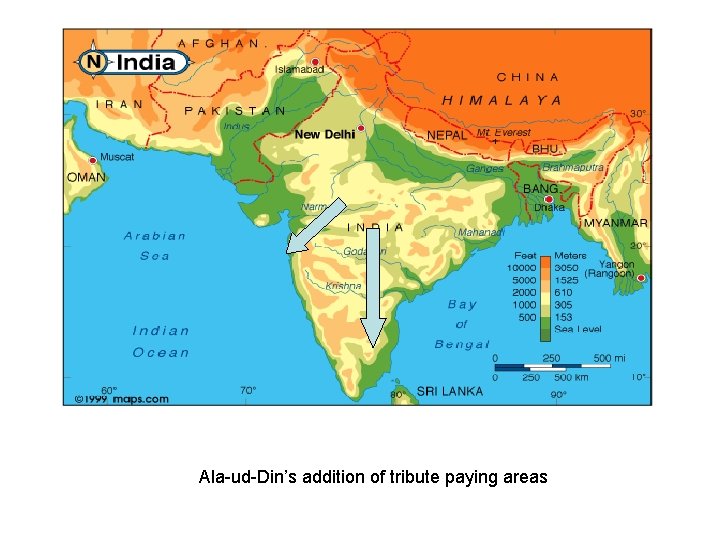
Ala-ud-Din’s addition of tribute paying areas
Khilji reforms-military • Treasure from raids and economic reforms funds Military improvements – Branding and registration of horses – Role calls for soldiers – Regulation of horse trade – Fixed and regular cash salaries for soldiers reduces reliance on iqtas – Ample supplies assured through economic reforms
Iqta Reforms • Iqtas accessed and registered to reduce fraud and corruption • Not hereditary, but assigned for a limited use, revert to treasure at end of appointment period • Sizes kept small, holdings scattered to reduce influence of iqta holders • Share of taxes from Iqtas reduced for chahalgani, other nobility and headmen, reducing their income, increasing the share of the treasury
Market Reforms • Grain prices in cities and towns regulated to prevent excessive profits and ensure regular supply even in times of scarcity • Markets for different goods created, regulated by officers inspecting goods for quality, weights, and measures • Safety along trade routes increases, market towns proliferate starting in this period • Registration of Merchants, advances made for certain trade goods from treasury
Controls over Chahalgani • Reduced income from reforms, control over army also reduced • More dependent on king for salaries and assignments • Prohibited from forming alliances through marriages or under cover of parties • Increased surveillance of activities, audits of wealth and tax collections
South Asia at the time of Khilji’s death, 1316 • Long period of stability, furthest extent of Sultanate empire • Power of Chahalgani greatly reduced, that of new groups such as Afghans and some Rajputs increases—this too has some drawbacks • Economic gains continue into the later sultanate dynasties • Royal patronage leads to greater interest in architecture, patronage of literature, founding of schools (madrasas) • Relative prosperity of Indian Sultante leads to greater migration of scholars, Sufis, from Iran and Afghanistan as Mongal invasions continue (cont. next slide)
Cont. • Greater period of Urbanization, Muslims mainly to be found in Urban areas—both rich and poor • Urban poor, certain peasants, new migrants • favor Sultan—as do some ulema and sufis who gain patronage • The Urban rich (Nobility, some merchants) antagonized. • Some Sufis such as the Chistis critical of growing power of Sultan. • Reaction of Peasants mixed—due to market reforms
End of Khilji rule: Problems of Succession • Ala-ud-din Khilji was bed-ridden and ill during his last year, Malik Kafur, his general, was in a much stronger position to grab the throne than his teenage sons. • During a bloody coup, many of the Khilji princes were killed, but their body-gaurds were able to resist Kafur and kill him. • Mubark Shah succeeded as Khilji king, however, he delegated much of his authority to his generals.
The last Khilji Sultan • By the early 14 th century, the Khilji army had large numbers of Hindu soldiers working for various emirs—Hindu and Muslim • Khusrau Khan, a recent convert, was the general and using his power base in the army killed Mubarak Shah in a coup in 1320. • Only the opposition of the Turkish emirs stopped Khusrau Khan from ruling—the last of the important Sultanates, the Tughlaqs, would replace him.

THANK YOU
- Slides: 18