
The Keynesian Model in Action 1 What is

- Slides: 55
The Keynesian Model in Action 1
What is the purpose of this chapter? To complete the Keynesian model by adding the government (G) and the foreign sector (net exports – XM) 2
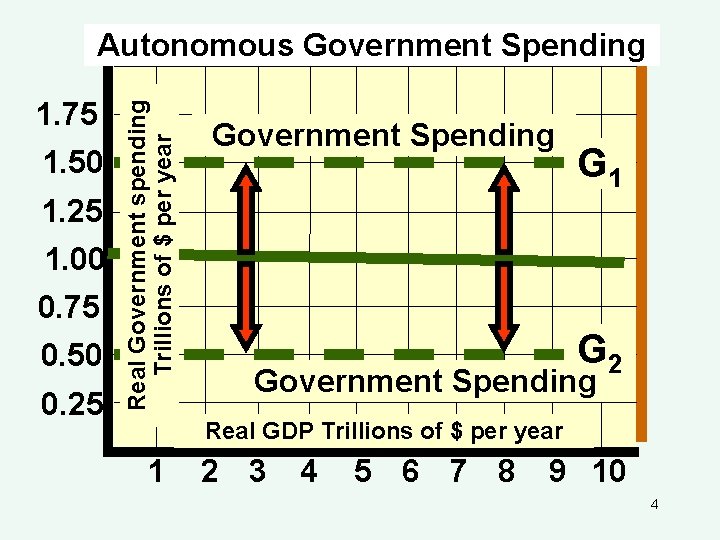
Why is government spending an autonomous expenditure? Government spending can be the result of political decisions regardless of national output 3
1. 75 1. 50 1. 25 1. 00 0. 75 0. 50 0. 25 Real Government spending Trillions of $ per year Autonomous Government Spending G 1 G 2 Government Spending Real GDP Trillions of $ per year 1 2 3 4 5 6 7 8 9 10 4
Why is net exports assumed to be negative? Spending for imports usually exceeds the value of exports 5
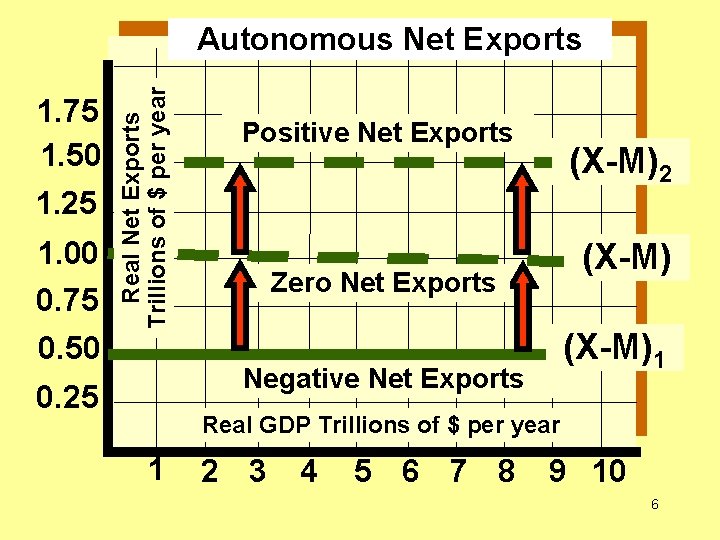
1. 75 1. 50 1. 25 1. 00 0. 75 Real Net Exports Trillions of $ per year Autonomous Net Exports 0. 50 Positive Net Exports (X-M)2 (X-M) Zero Net Exports (X-M)1 Negative Net Exports 0. 25 Real GDP Trillions of $ per year 1 2 3 4 5 6 7 8 9 10 6
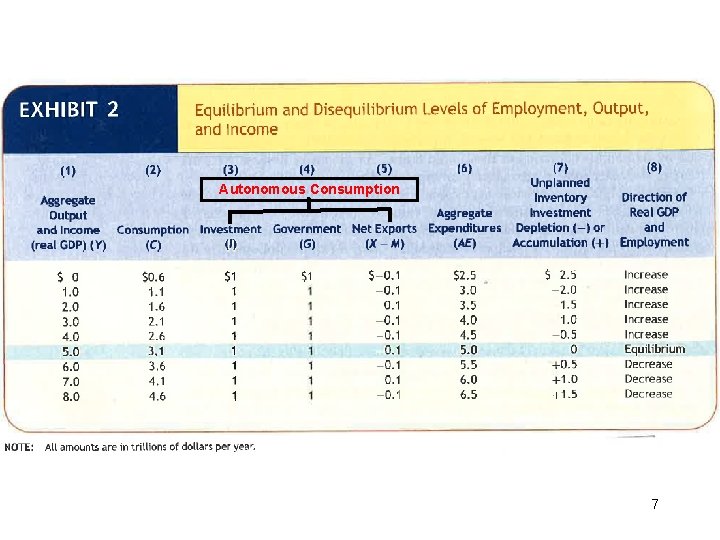
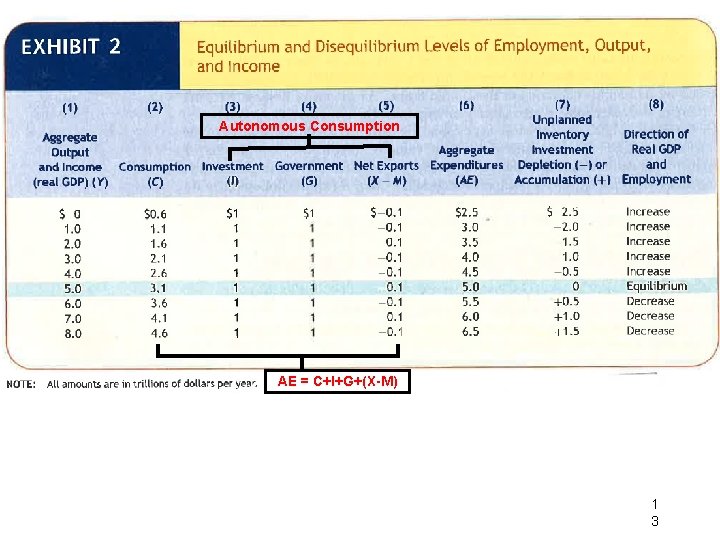
Autonomous Consumption 7
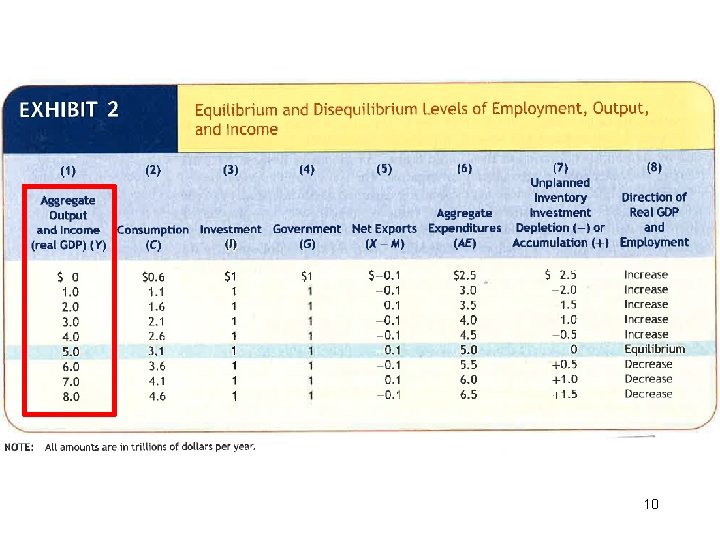
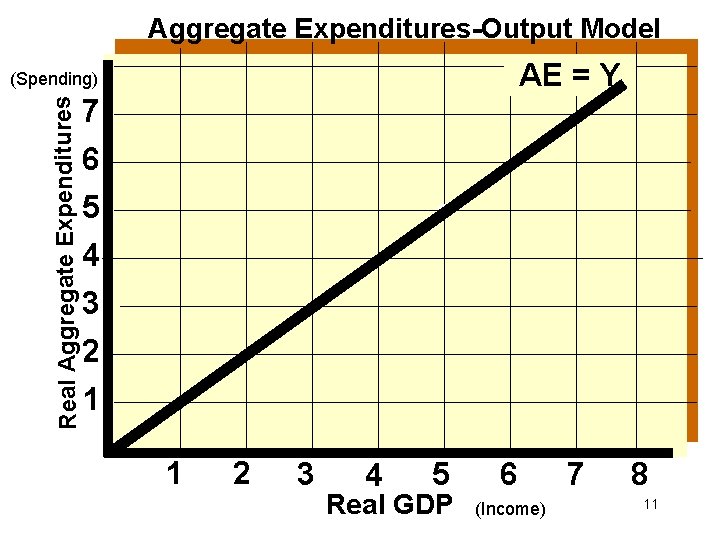
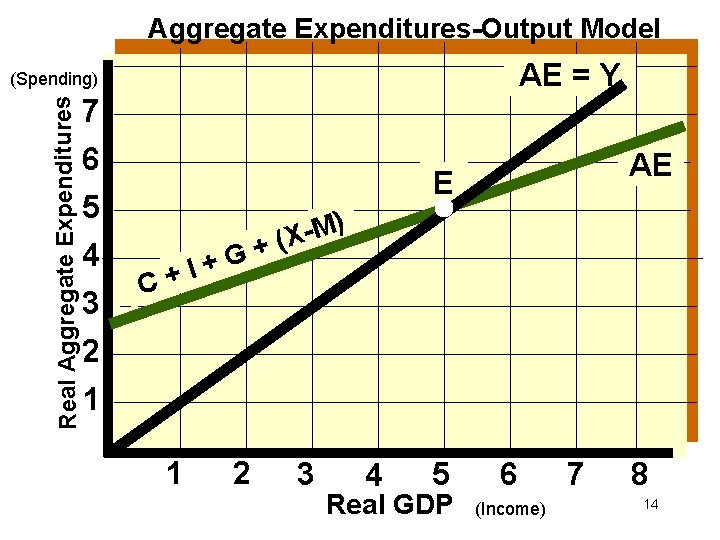
In the Keynesian model, where is the equilibrium level of GDP? It is where the value of goods and services produced (Real GDP) is equal to the spending for these goods and services (Aggregate Expenditures) 8
What does Real GDP mean? Aggregate output and income (Y) 9
10
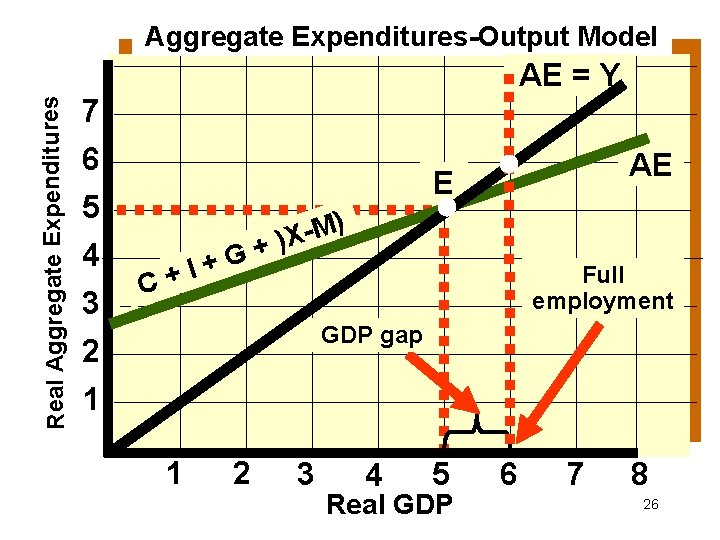
Aggregate Expenditures-Output Model AE = Y Real Aggregate Expenditures (Spending) 7 6 5 4 3 2 1 1 2 3 4 5 Real GDP 6 (Income) 7 8 11
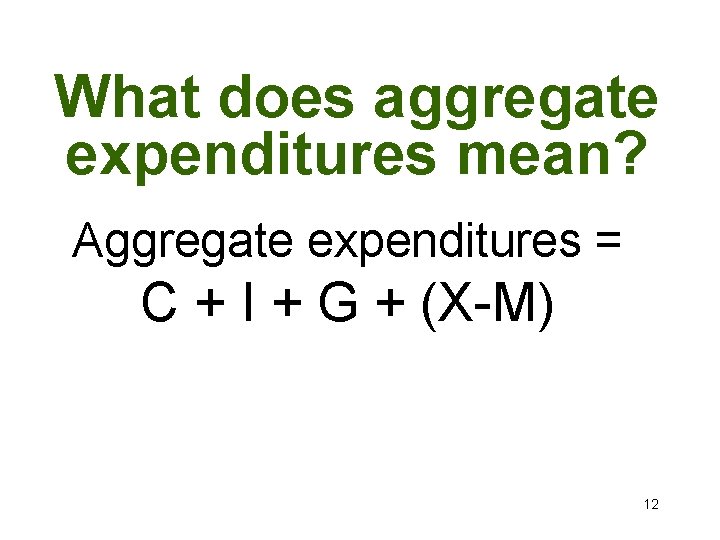
What does aggregate expenditures mean? Aggregate expenditures = C + I + G + (X-M) 12
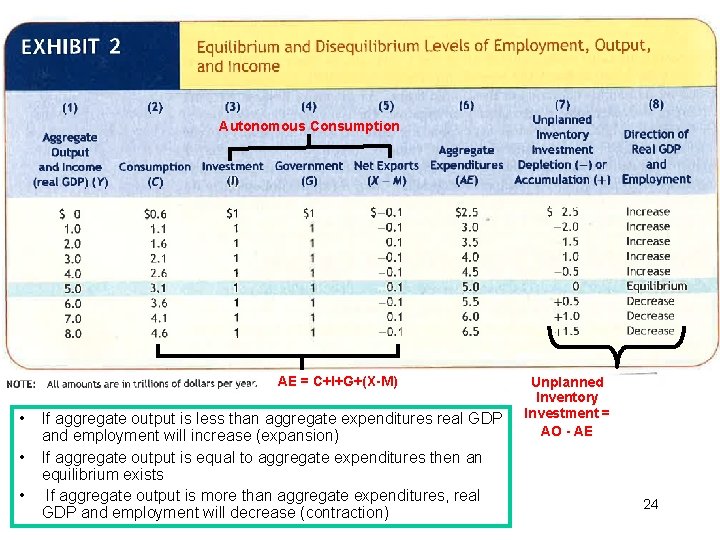
Autonomous Consumption AE = C+I+G+(X-M) 1 3
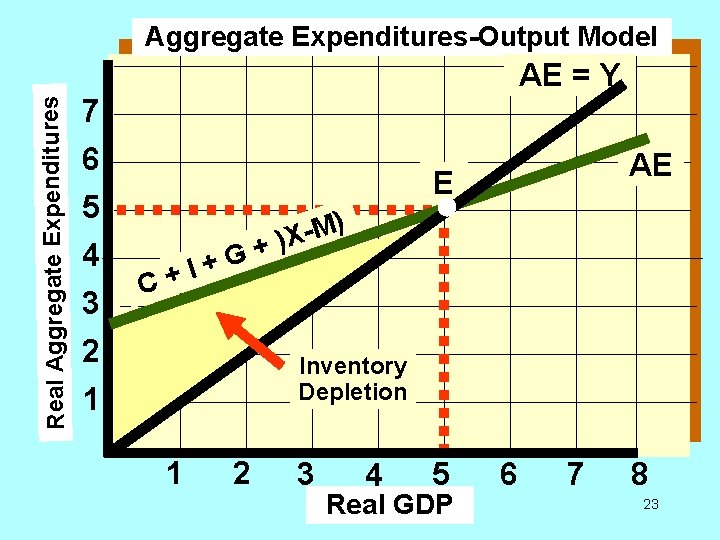
Aggregate Expenditures-Output Model AE = Y Real Aggregate Expenditures (Spending) 7 6 E 5 4 3 AE C+ + G I+ ) M (X 2 1 1 2 3 4 5 Real GDP 6 (Income) 7 8 14
How do aggregate expenditures affect the economy? They pull aggregate output (Y) either higher or lower toward equilibrium 15
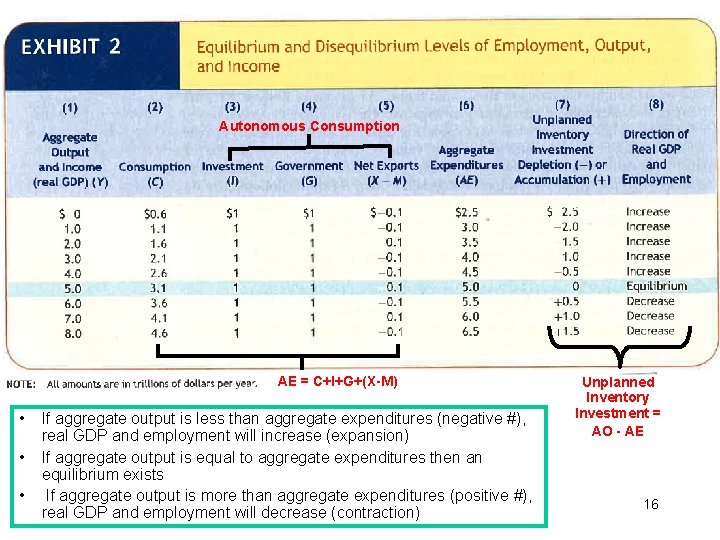
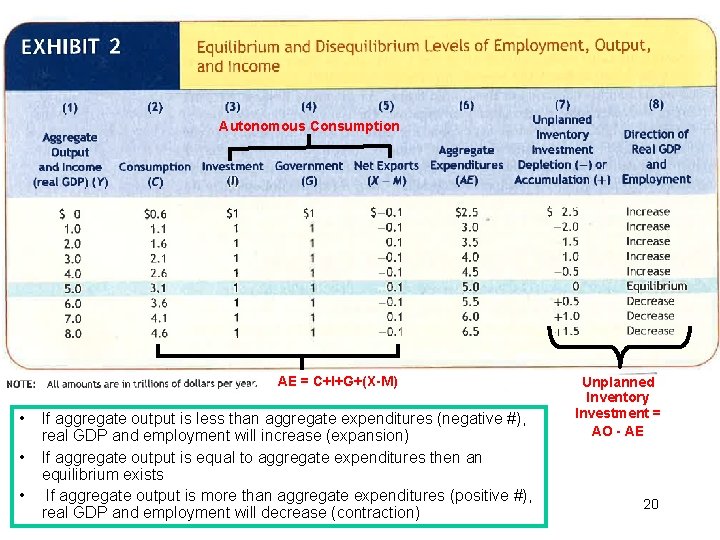
Autonomous Consumption AE = C+I+G+(X-M) • • • If aggregate output is less than aggregate expenditures (negative #), real GDP and employment will increase (expansion) If aggregate output is equal to aggregate expenditures then an equilibrium exists If aggregate output is more than aggregate expenditures (positive #), real GDP and employment will decrease (contraction) Unplanned Inventory Investment = AO - AE 16
What causes a decrease in real GDP and employment? Excessive inventories (+) Aggregate Expenditures is greater than Aggregate Output therefore business cut output by spending less (ex. cut jobs) 17
Why do excessive inventories cause unemployment? Firms will cut back production and lay off workers in order not to add to inventories excessively 18
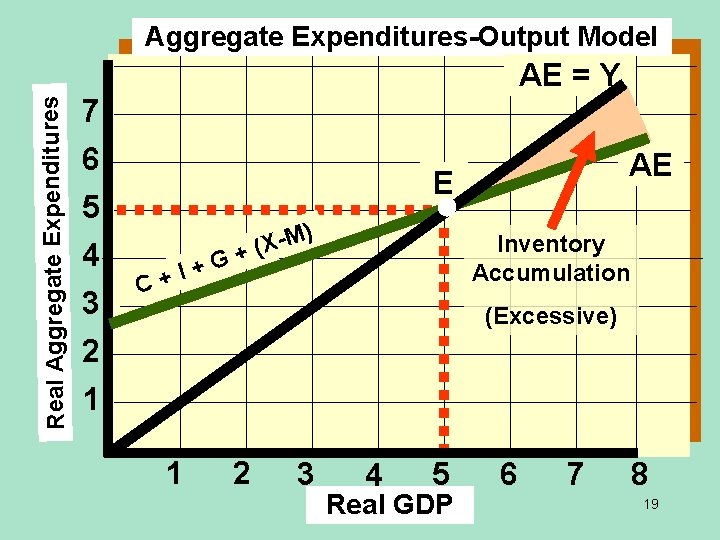
Aggregate Expenditures-Output Model Real Aggregate Expenditures AE = Y 7 6 E 5 4 3 AE I+ + C G+ ) M (X Inventory Accumulation (Excessive) 2 1 1 2 3 4 5 Real GDP 6 7 8 19
Autonomous Consumption AE = C+I+G+(X-M) • • • If aggregate output is less than aggregate expenditures (negative #), real GDP and employment will increase (expansion) If aggregate output is equal to aggregate expenditures then an equilibrium exists If aggregate output is more than aggregate expenditures (positive #), real GDP and employment will decrease (contraction) Unplanned Inventory Investment = AO - AE 20
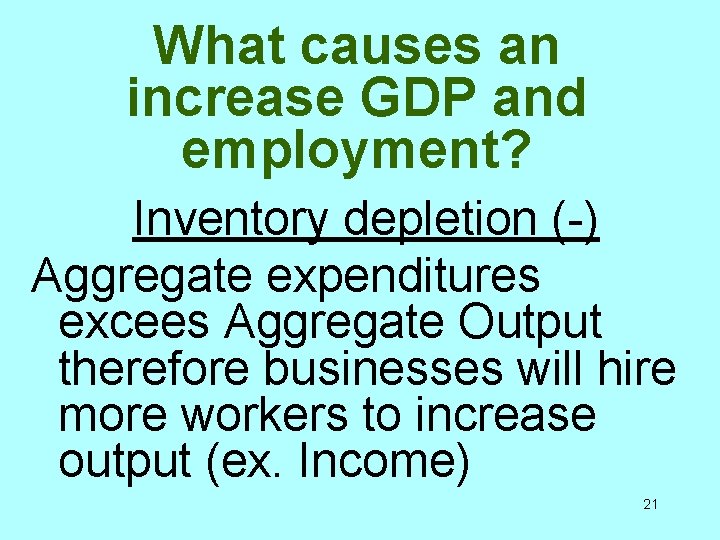
What causes an increase GDP and employment? Inventory depletion (-) Aggregate expenditures excees Aggregate Output therefore businesses will hire more workers to increase output (ex. Income) 21
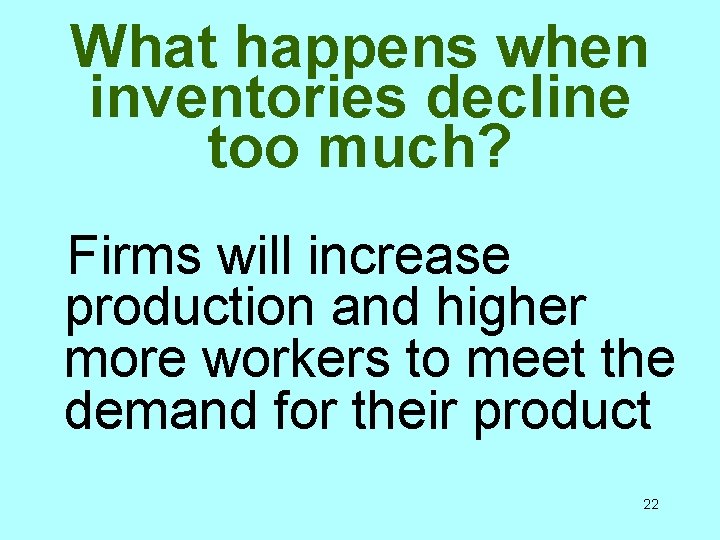
What happens when inventories decline too much? Firms will increase production and higher more workers to meet the demand for their product 22
Aggregate Expenditures-Output Model Real Aggregate Expenditures AE = Y 7 6 E 5 4 3 AE C+ + G I+ 2 ) M )X Inventory Depletion 1 1 2 3 4 5 Real GDP 6 7 8 23
Autonomous Consumption AE = C+I+G+(X-M) • • • If aggregate output is less than aggregate expenditures real GDP and employment will increase (expansion) If aggregate output is equal to aggregate expenditures then an equilibrium exists If aggregate output is more than aggregate expenditures, real GDP and employment will decrease (contraction) Unplanned Inventory Investment = AO - AE 24
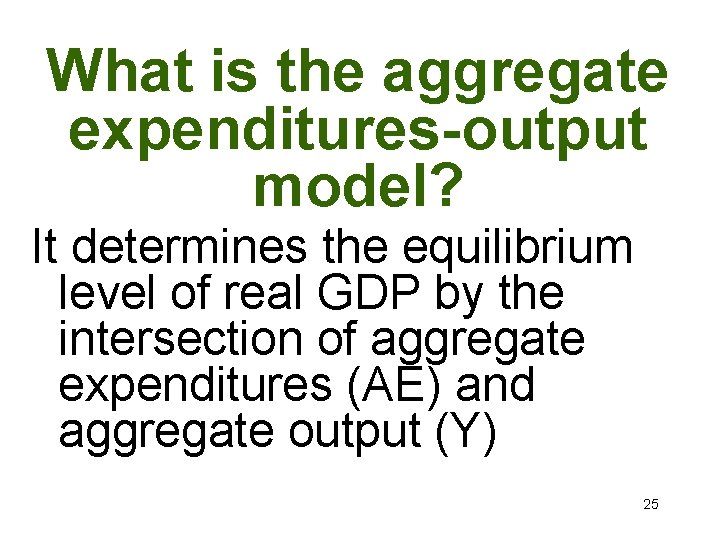
What is the aggregate expenditures-output model? It determines the equilibrium level of real GDP by the intersection of aggregate expenditures (AE) and aggregate output (Y) 25
Aggregate Expenditures-Output Model Real Aggregate Expenditures AE = Y 7 6 E 5 4 3 AE C+ + G I+ ) M )X Full employment GDP gap 2 1 1 2 3 4 5 Real GDP 6 7 8 26
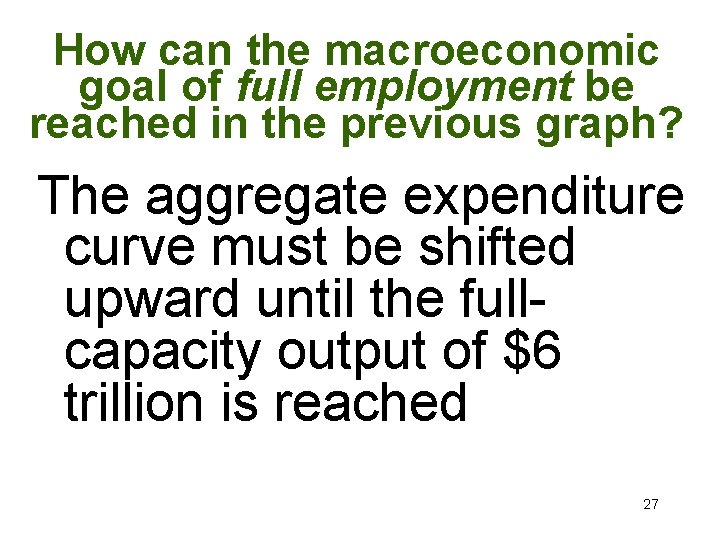
How can the macroeconomic goal of full employment be reached in the previous graph? The aggregate expenditure curve must be shifted upward until the fullcapacity output of $6 trillion is reached 27
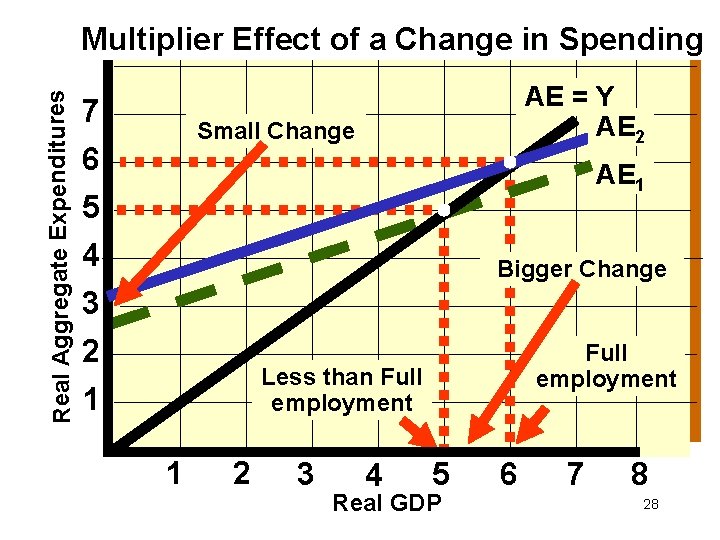
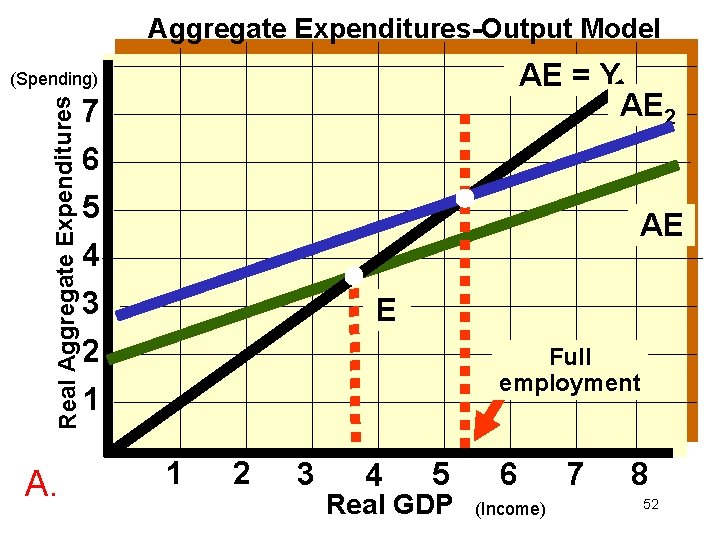
Real Aggregate Expenditures Multiplier Effect of a Change in Spending 7 AE = Y AE 2 Small Change 6 AE 1 5 4 Bigger Change 3 2 Full employment Less than Full employment 1 1 2 3 4 5 Real GDP 6 7 8 28
What is the Keynesian multiplier? Any initial increase in spending will lead to a multiple increase in GDP 29
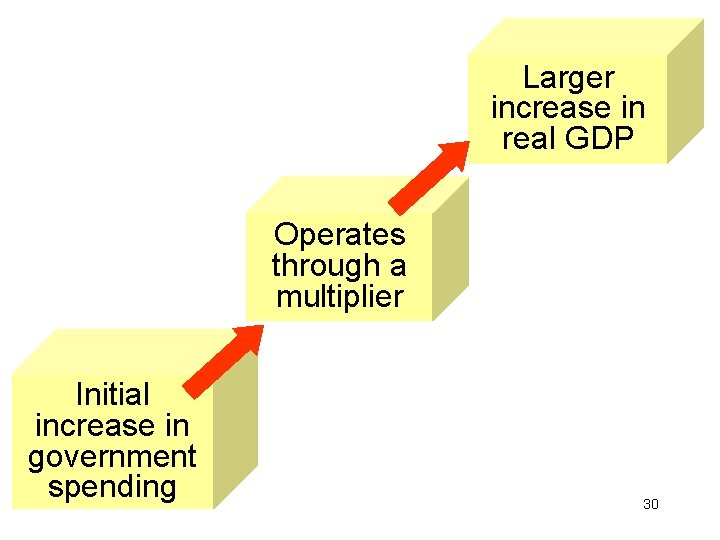
Larger increase in real GDP Operates through a multiplier Initial increase in government spending 30
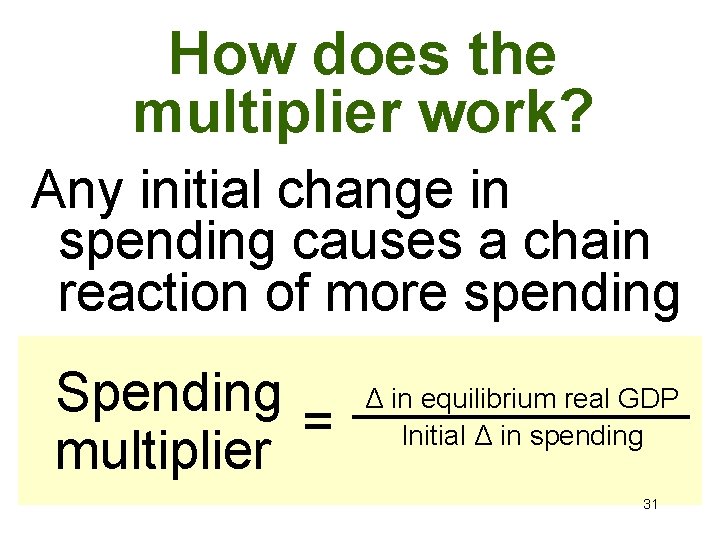
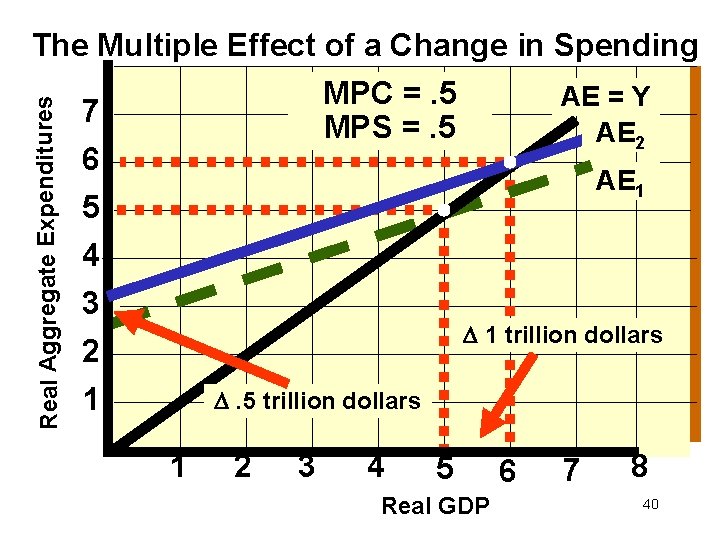
How does the multiplier work? Any initial change in spending causes a chain reaction of more spending Spending = multiplier Δ in equilibrium real GDP Initial Δ in spending 31
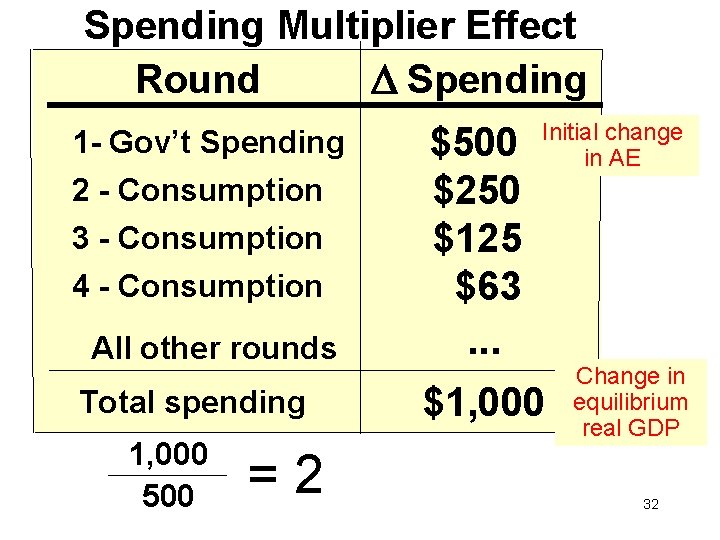
Spending Multiplier Effect Round Spending 1 - Gov’t Spending 2 - Consumption 3 - Consumption 4 - Consumption All other rounds Total spending 1, 000 500 =2 $500 $250 $125 $63. . . Initial change in AE $1, 000 Change in equilibrium real GDP 32
What is the Marginal Propensity to Consume? MPC is the change in consumption spending resulting form a given change in income 33
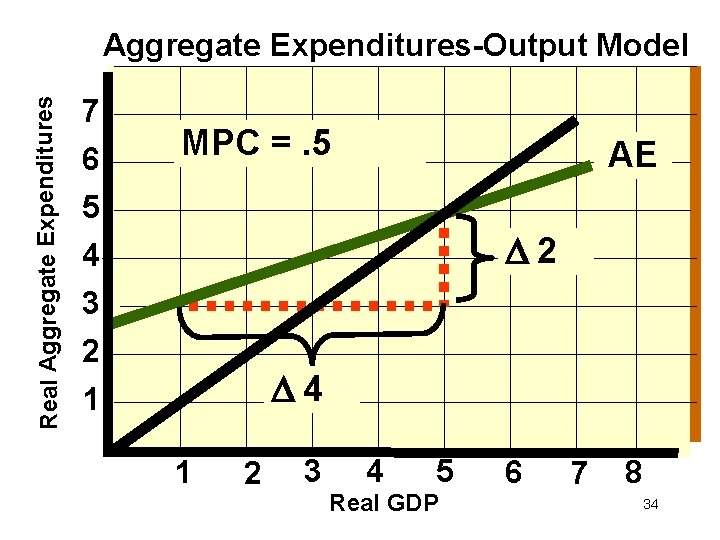
Real Aggregate Expenditures-Output Model 7 6 MPC =. 5 AE 5 2 4 3 2 4 1 1 2 3 4 5 Real GDP 6 7 8 34
What is the Marginal Propensity to Save? MPS is the fraction of any change in real disposable income that households save 35
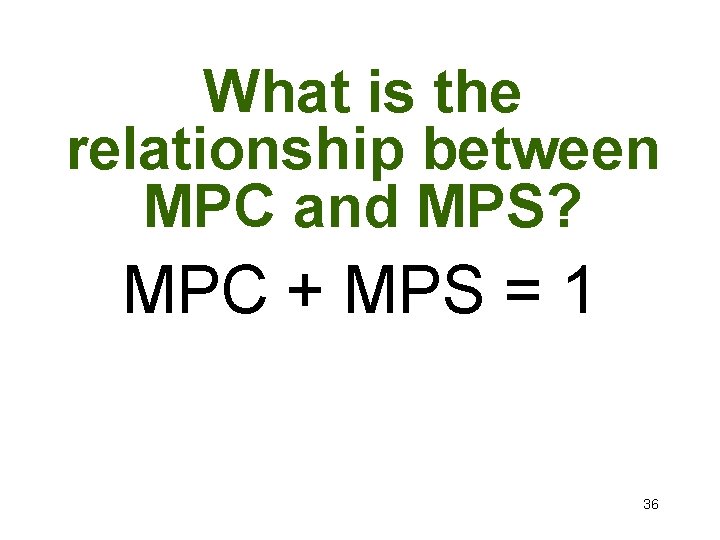
What is the relationship between MPC and MPS? MPC + MPS = 1 36
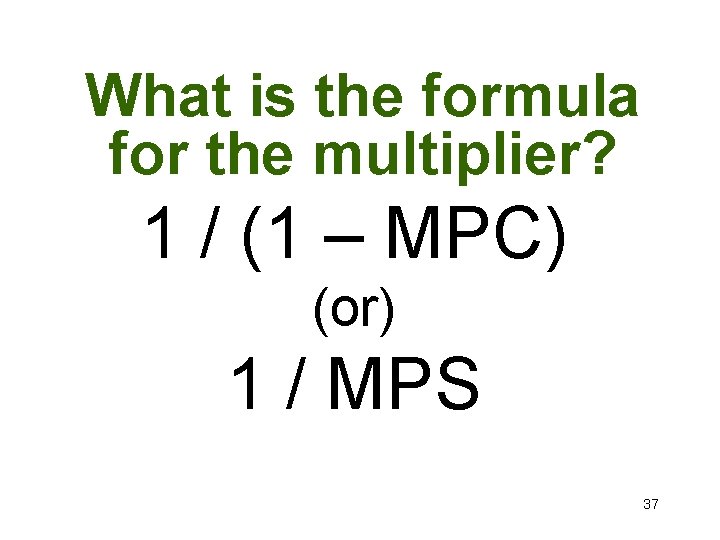
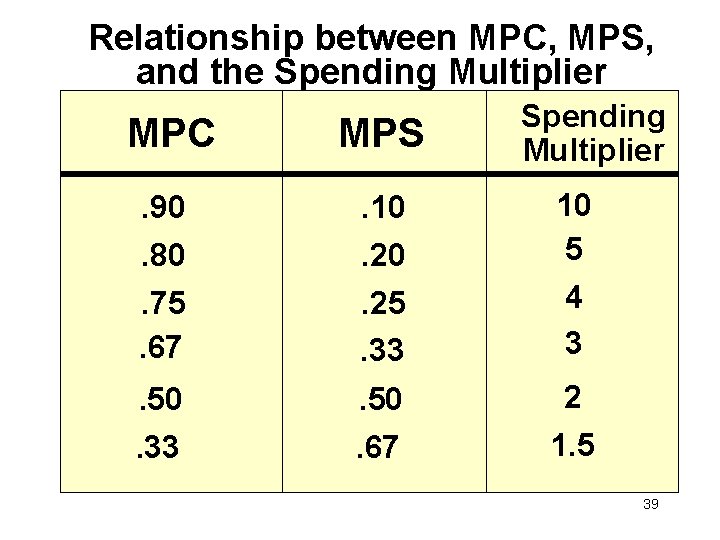
What is the formula for the multiplier? 1 / (1 – MPC) (or) 1 / MPS 37
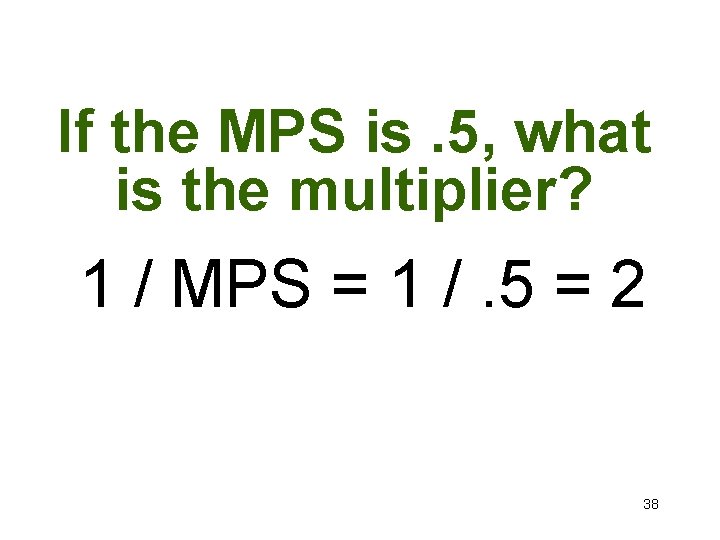
If the MPS is. 5, what is the multiplier? 1 / MPS = 1 /. 5 = 2 38
Relationship between MPC, MPS, and the Spending Multiplier MPC MPS . 90. 80. 75. 67 . 10. 25. 33 10 5 4 3 . 50. 33 . 50. 67 2 1. 5 39
Real Aggregate Expenditures The Multiple Effect of a Change in Spending MPC =. 5 AE = Y 7 MPS =. 5 AE 2 6 AE 1 5 4 3 1 trillion dollars 2 1 . 5 trillion dollars 1 2 3 4 5 Real GDP 6 7 8 40
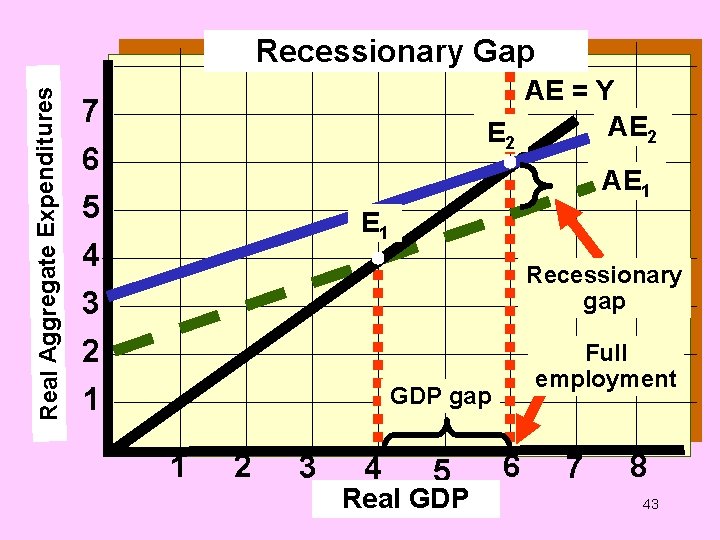
What is the GDP gap? The difference between full employment real GDP and actual real GDP 41
What is the recessionary gap? The amount by which aggregate expenditures fall short of the amount required to achieve full employment equilibrium 42
Real Aggregate Expenditures Recessionary Gap AE = Y AE 2 7 6 AE 1 5 E 1 4 Recessionary gap 3 2 1 Full employment GDP gap 1 2 3 4 5 Real GDP 6 7 8 43
What is the Keynesian remedy for a recessionary gap? Increase autonomous spending by the amount of the recessionary gap 44
What can the government do to close a recessionary gap? • Increase government spending • Lower taxes • Raise transfer payments 45
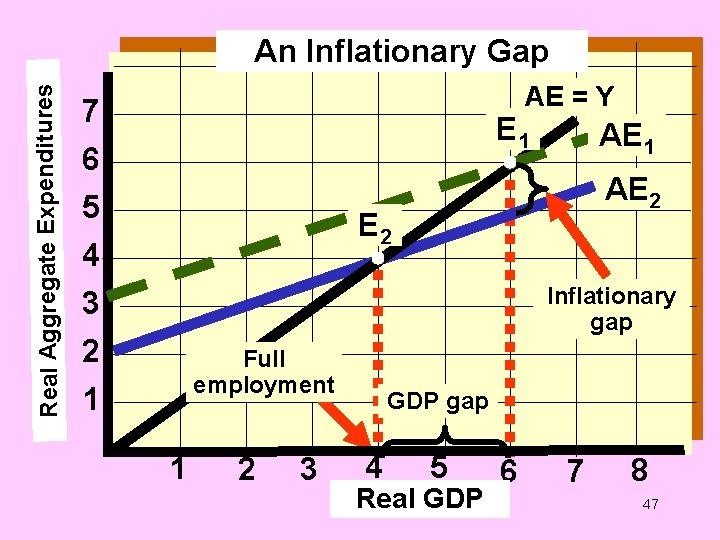
What is an inflationary gap? The amount by which aggregate expenditures exceed the amount required to achieve full employment equilibrium 46
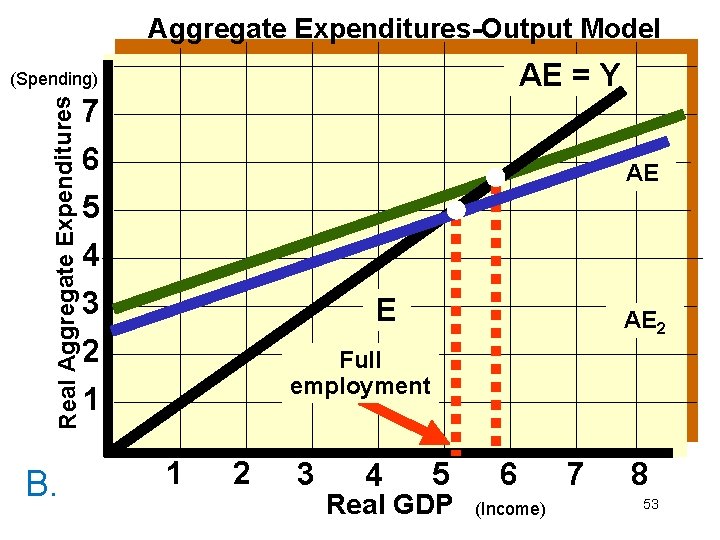
Real Aggregate Expenditures An Inflationary Gap AE = Y 7 E 1 6 5 AE 1 AE 2 4 Inflationary gap 3 2 Full employment 1 1 2 3 GDP gap 4 5 Real GDP 6 7 8 47
What is the Keynesian remedy for an inflationary gap? Reduce spending by the amount of the inflationary gap 48
How can the government close an inflationary gap? • Cut government spending • Increase taxes • Reduce transfer payments 49
END 50
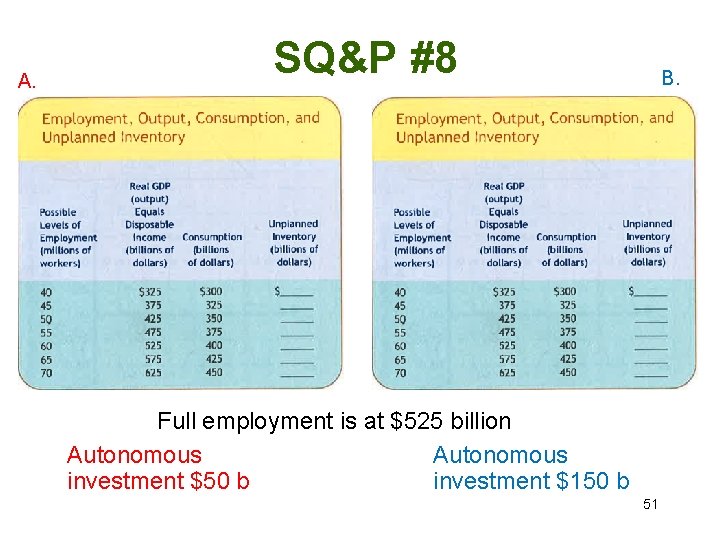
A. SQ&P #8 B. Full employment is at $525 billion Autonomous investment $50 b investment $150 b 51
Aggregate Expenditures-Output Model AE = Y AE 2 Real Aggregate Expenditures (Spending) A. 7 6 5 AE 4 3 E 2 Full employment 1 1 2 3 4 5 Real GDP 6 (Income) 7 8 52
Aggregate Expenditures-Output Model AE = Y Real Aggregate Expenditures (Spending) B. 7 6 AE 5 4 3 E 2 AE 2 Full employment 1 1 2 3 4 5 Real GDP 6 (Income) 7 8 53
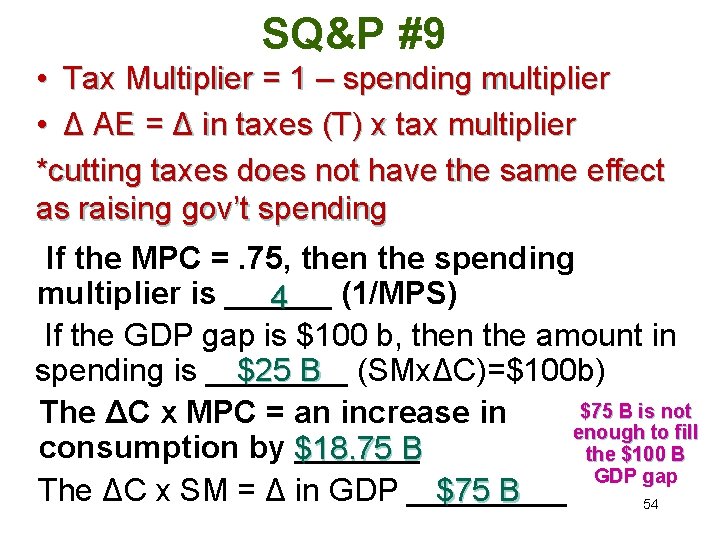
SQ&P #9 • Tax Multiplier = 1 – spending multiplier • Δ AE = Δ in taxes (T) x tax multiplier *cutting taxes does not have the same effect as raising gov’t spending If the MPC =. 75, then the spending multiplier is ______ (1/MPS) 4 If the GDP gap is $100 b, then the amount in spending is ____ $25 B (SMxΔC)=$100 b) $75 B is not The ΔC x MPC = an increase in enough to fill consumption by $18. 75 _______ B the $100 B GDP gap The ΔC x SM = Δ in GDP _____ $75 B 54
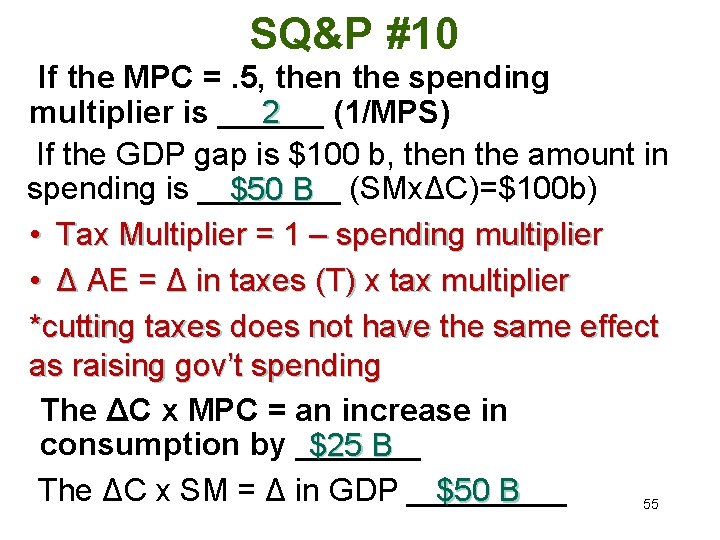
SQ&P #10 If the MPC =. 5, then the spending multiplier is ______ (1/MPS) 2 If the GDP gap is $100 b, then the amount in spending is ____ $50 B (SMxΔC)=$100 b) • Tax Multiplier = 1 – spending multiplier • Δ AE = Δ in taxes (T) x tax multiplier *cutting taxes does not have the same effect as raising gov’t spending The ΔC x MPC = an increase in consumption by _______ $25 B The ΔC x SM = Δ in GDP _____ $50 B 55