
The Key Vocabulary Routine Big Ideas Power Point
The Key Vocabulary Routine Big Ideas Power. Point By Joan Sedita, M. Ed. www. keystoliteracy. com ©Joan Sedita, www. keystoliteracy. net

Big Idea #1 What is the Key Vocabulary Routine? ©Joan Sedita, www. keystoliteracy. net
What is The Key Vocabulary Routine? • Embedded in content instruction • Research-based • Foundational “routine” that provides consistency from grade to grade, and from class to class ©Joan Sedita, www. keystoliteracy. com
The Routine 1. Preview for difficult vocabulary 2. Use activities that connect vocabulary to background knowledge and related words 3. Select specific words to teach in-depth 4. Identify opportunities to teach word learning strategies 5. Promote word consciousness ©Joan Sedita, www. keystoliteracy. net
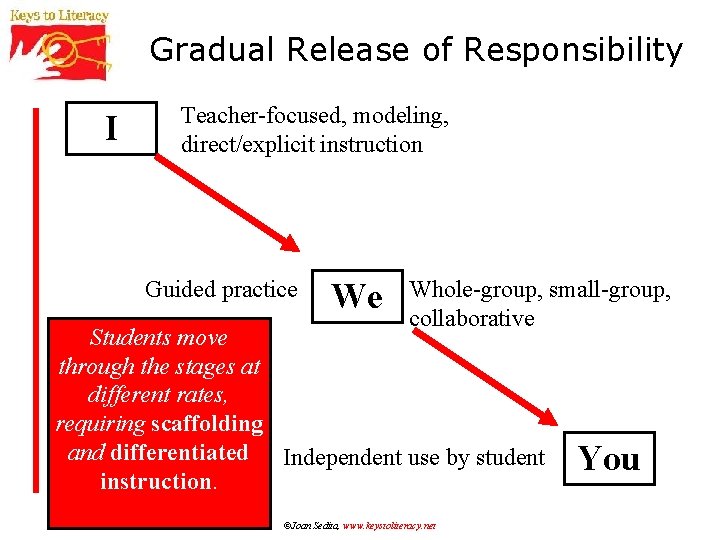
Gradual Release of Responsibility I Teacher-focused, modeling, direct/explicit instruction Guided practice We Whole-group, small-group, collaborative Students move through the stages at different rates, requiring scaffolding and differentiated Independent use by student instruction. ©Joan Sedita, www. keystoliteracy. net You

Step 1: Preview for difficult vocabulary ©Joan Sedita, www. keystoliteracy. net

Why Preview Vocabulary? • Activate prior knowledge • Clear up misconceptions about a word’s meaning • Clarify meaning of known words with multiple meanings • Provide some familiarity with unknown words Previewing is more of a comprehension strategy than it is direct teaching of specific words. ©Joan Sedita, www. keystoliteracy. net
Goal of Previewing • Goal: to offer temporary, basic familiarity with the meaning of the words in text to be read – Graves: “Introduce the word so that students won’t stumble over it when they see it in an upcoming passage. ” • It is more about attaching some meaning to a new word than enabling deep learning of words ©Joan Sedita, www. keystoliteracy. com
What to Preview • Words or phrases critical to making meaning from the text • Words with multiple meanings - focus on the meaning used in the text • Figurative language Consider having students identify unfamiliar words to preview ©Joan Sedita, www. keystoliteracy. com
Ways to Preview • Provide a list of preview words with user friendly definitions or synonyms • Photocopy the text and write in synonyms or short definitions next to unfamiliar words • Provide a visual or illustration with labels of unfamiliar vocabulary • Have a quick class discussion about some of the preview words – make links to their background knowledge ©Joan Sedita, www. keystoliteracy. com
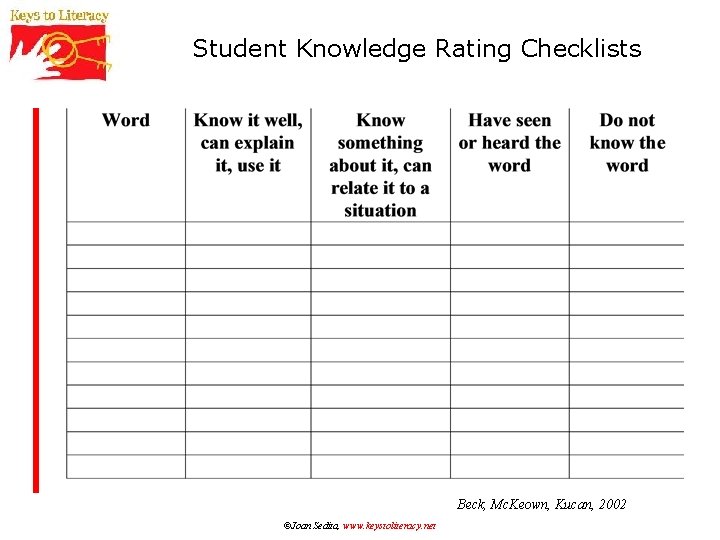
Student Knowledge Rating Checklists Beck, Mc. Keown, Kucan, 2002 ©Joan Sedita, www. keystoliteracy. net
Step 2: Use activities to connect vocabulary ©Joan Sedita, www. keystoliteracy. net
Why Teach Word Relationships? • Schema: mental structure that represents and organizes one’s understanding of a particular topic • Vocabulary words are used to represent that knowledge • Word learning is most efficient when a connection to existing schema and words can be made ©Joan Sedita, www. keystoliteracy. net
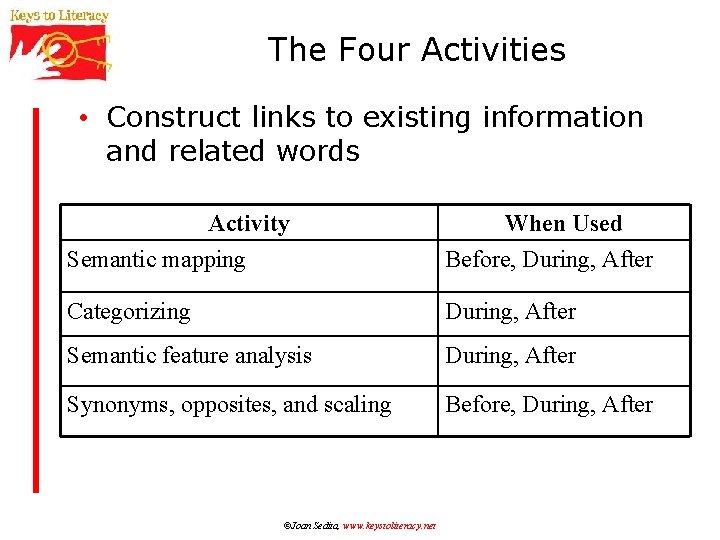
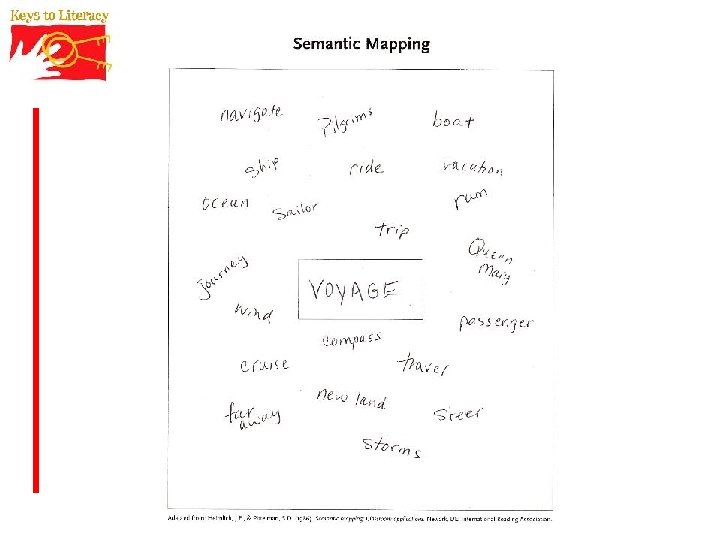
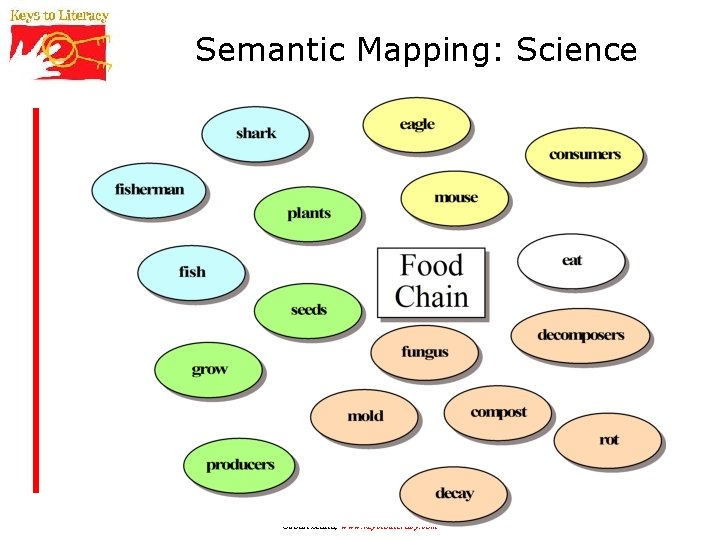
The Four Activities • Construct links to existing information and related words Activity Semantic mapping When Used Before, During, After Categorizing During, After Semantic feature analysis During, After Synonyms, opposites, and scaling Before, During, After ©Joan Sedita, www. keystoliteracy. net
Using the 4 Activities • Make connections between new and known words • Make connections between background knowledge and essential concept words • Offer opportunities for rich discussion about words • Push students to go beyond memorizing definitions ©Joan Sedita, www. keystoliteracy. com
1. Semantic Mapping • When to use • Benefits • How it is done • Variations ©Joan Sedita, www. keystoliteracy. net
©Joan Sedita, www. keystoliteracy. com
Semantic Mapping: Science ©Joan Sedita, www. keystoliteracy. com
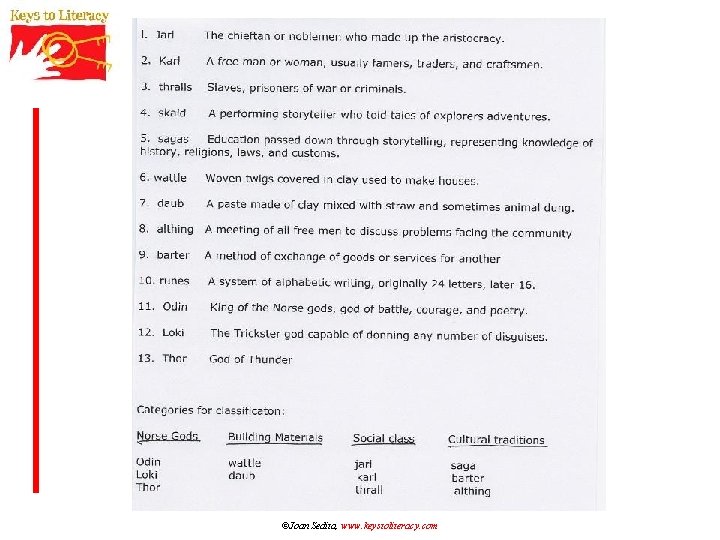
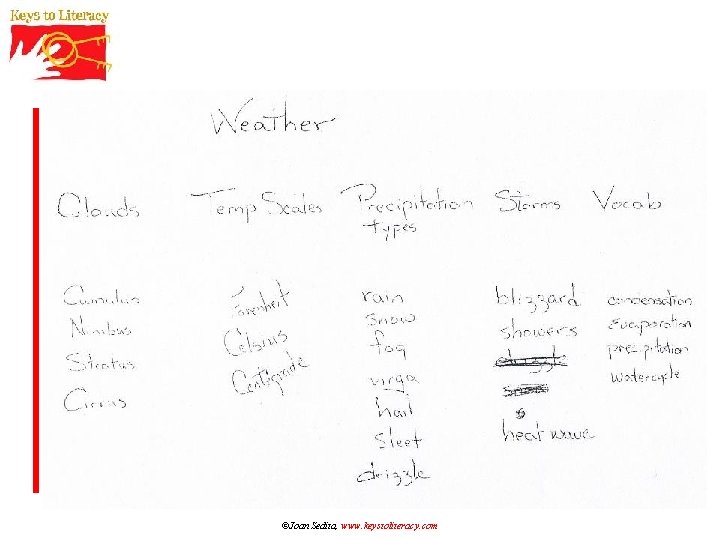
2. Categorizing • When to use • Benefits • How it is done • Variations Be ready to share your categories. ©Joan Sedita, www. keystoliteracy. net
©Joan Sedita, www. keystoliteracy. com
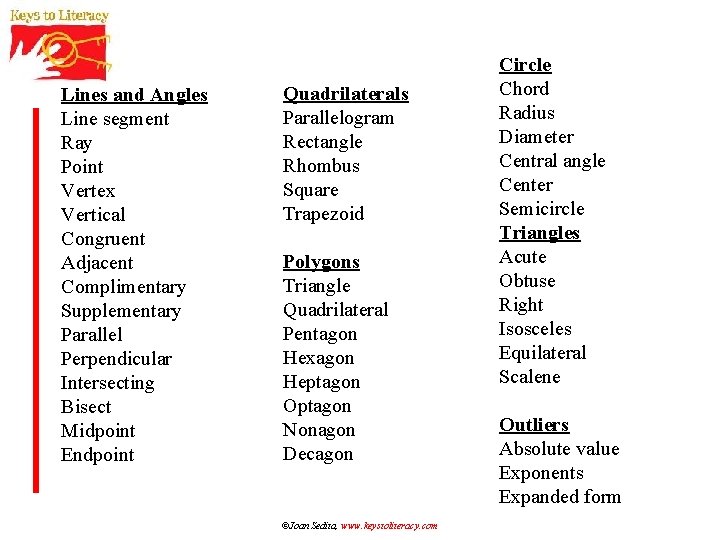
Lines and Angles Line segment Ray Point Vertex Vertical Congruent Adjacent Complimentary Supplementary Parallel Perpendicular Intersecting Bisect Midpoint Endpoint Quadrilaterals Parallelogram Rectangle Rhombus Square Trapezoid Polygons Triangle Quadrilateral Pentagon Hexagon Heptagon Optagon Nonagon Decagon ©Joan Sedita, www. keystoliteracy. com Circle Chord Radius Diameter Central angle Center Semicircle Triangles Acute Obtuse Right Isosceles Equilateral Scalene Outliers Absolute value Exponents Expanded form
©Joan Sedita, www. keystoliteracy. com
3. Semantic Feature Analysis • When to use • Benefits • How it is done • Variations ©Joan Sedita, www. keystoliteracy. net
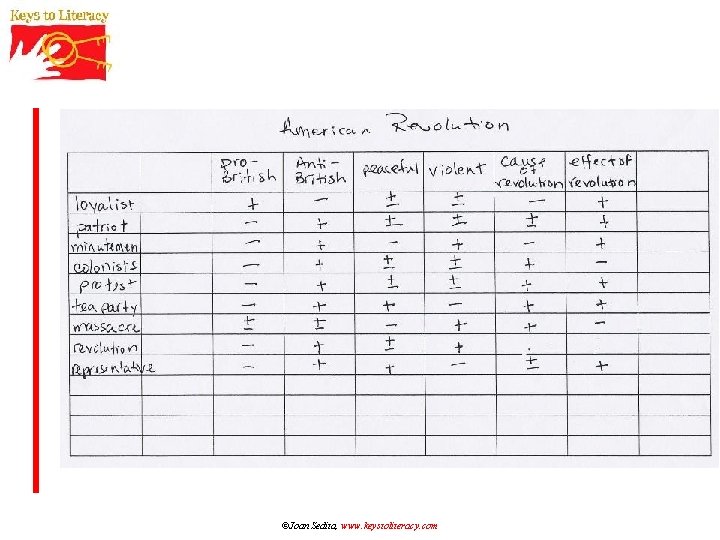
©Joan Sedita, www. keystoliteracy. com
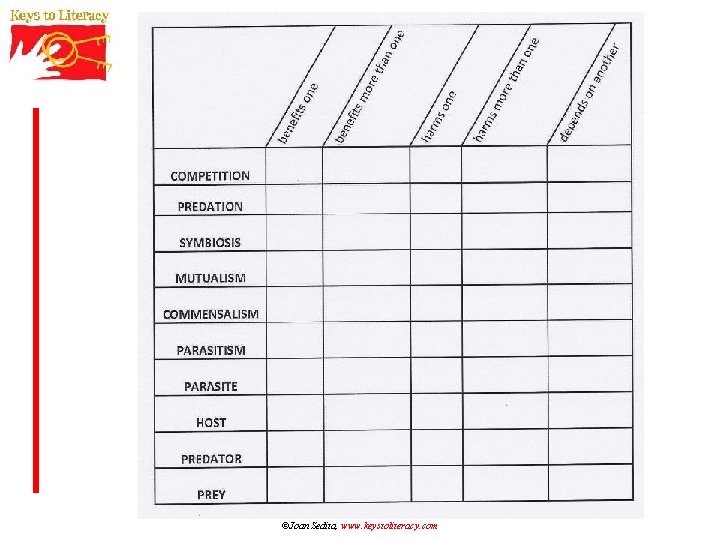
©Joan Sedita, www. keystoliteracy. com
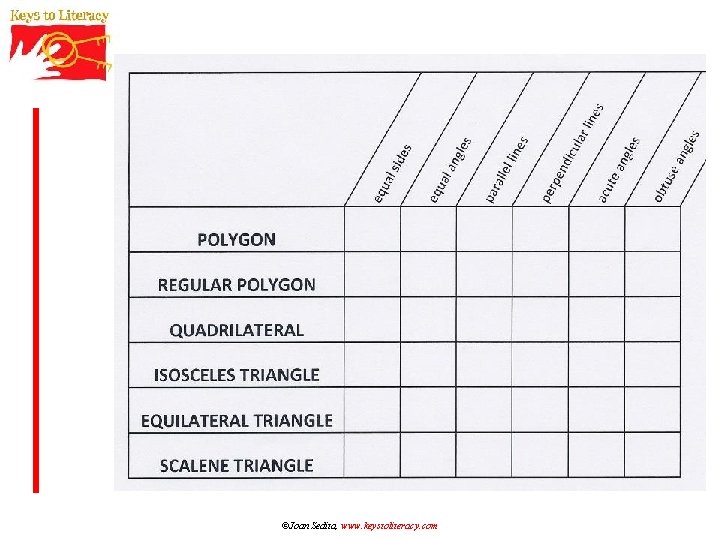
©Joan Sedita, www. keystoliteracy. com
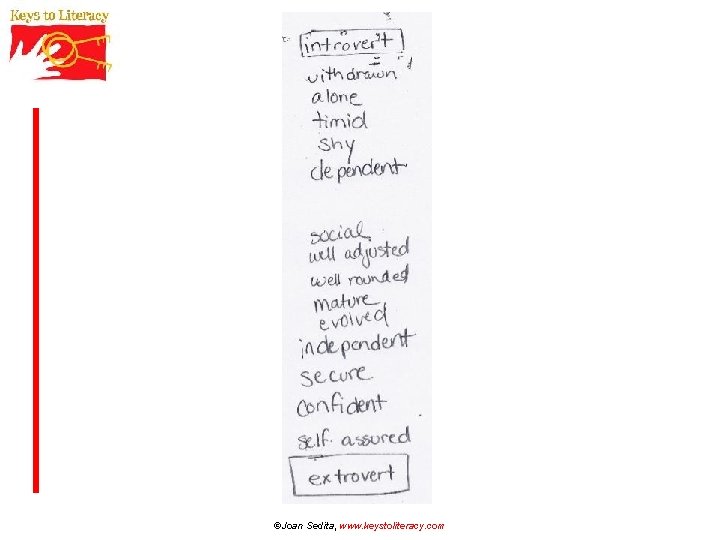
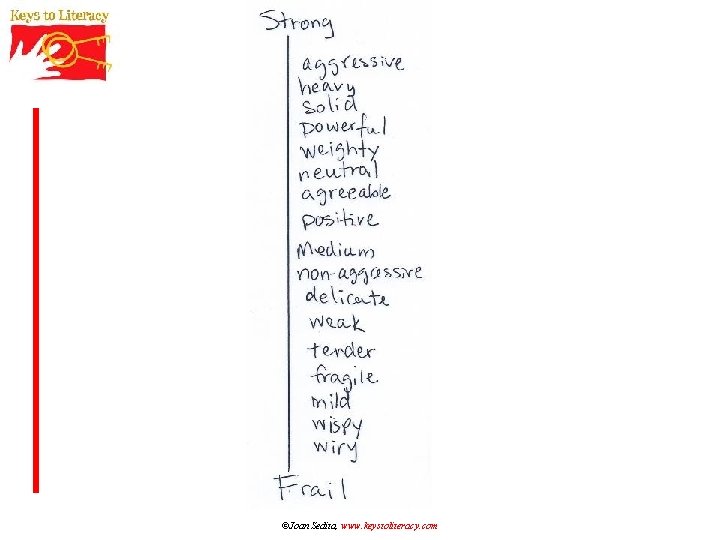
4. Synonyms, Opposites and Scaling • When to use • Benefits • How it is done • Variations ©Joan Sedita, www. keystoliteracy. net
©Joan Sedita, www. keystoliteracy. com
©Joan Sedita, www. keystoliteracy. com
Step 3: Select specific words to teach in-depth ©Joan Sedita, www. keystoliteracy. net
Why Teach Some Words In-Depth? • Previewing vocabulary is different from directly teaching specific words • Essential content words must be taught in-depth • Children with weak vocabularies especially benefit from in-depth instruction for some words ©Joan Sedita, www. keystoliteracy. com
Selecting Words • Factors to consider: – Words essential to understanding major concepts of the content topic – Words that are practical to know – Words that students are likely to encounter again as they learn more about the content topic • Different selections for different groups of students ©Joan Sedita, www. keystoliteracy. com
Suggestions from The Key Vocabulary Routine • Words essential to instructional goal • Concept words to build schema • Words frequently encountered in other content • Words unlikely to be learned independently through context or word parts • Words that provide opportunities to practice use of context and word parts • Words that are unique and increase student curiosity ©Joan Sedita, www. keystoliteracy. com
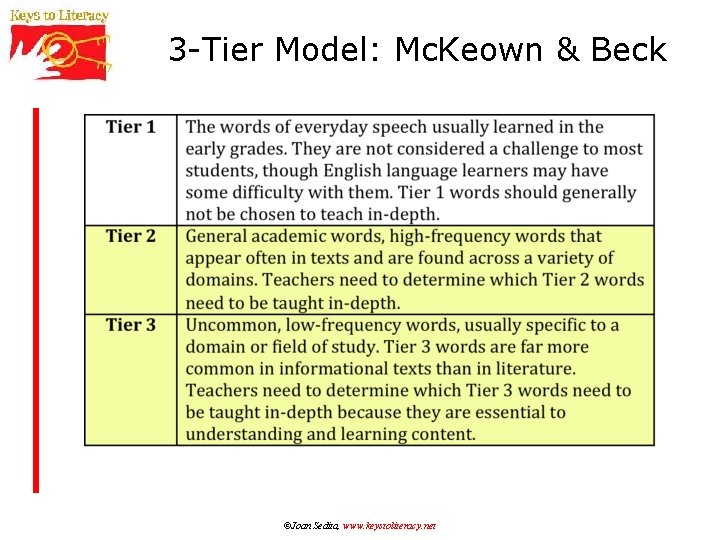
3 -Tier Model: Mc. Keown & Beck ©Joan Sedita, www. keystoliteracy. net
Teach Everything About A Word • Include: – spelling and phonemes – syllables – opposite/antonyms – synonyms – category/related words – examples/non-examples – multiple meanings – illustration – use in sentence or context ©Joan Sedita, www. keystoliteracy. net
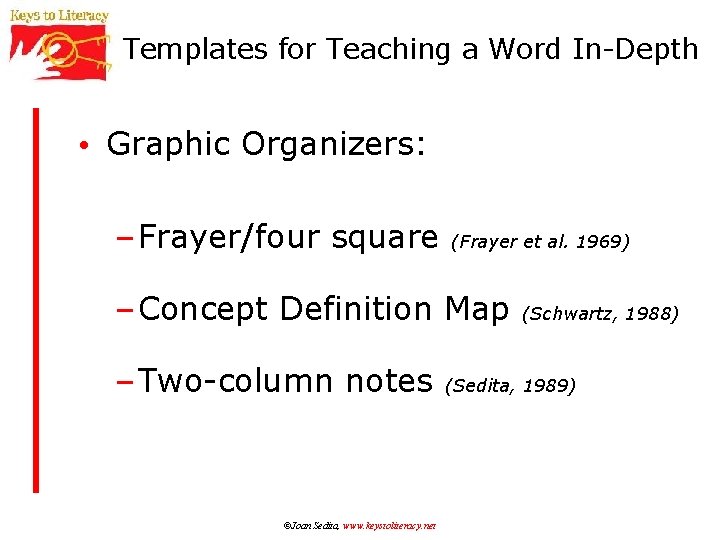
Templates for Teaching a Word In-Depth • Graphic Organizers: – Frayer/four square (Frayer et al. 1969) – Concept Definition Map – Two-column notes ©Joan Sedita, www. keystoliteracy. net (Schwartz, 1988) (Sedita, 1989)
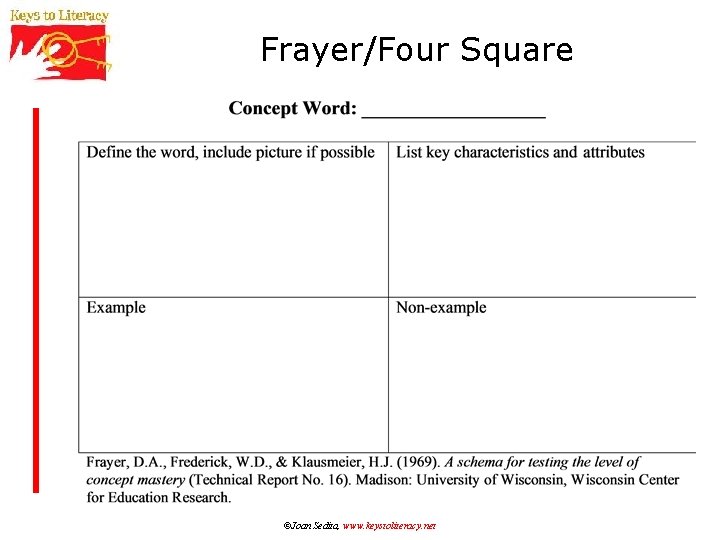
Frayer/Four Square ©Joan Sedita, www. keystoliteracy. net
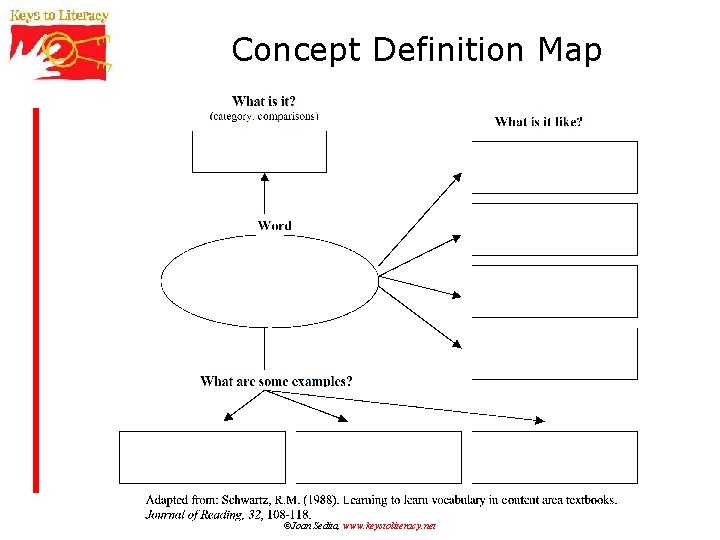
Concept Definition Map ©Joan Sedita, www. keystoliteracy. net
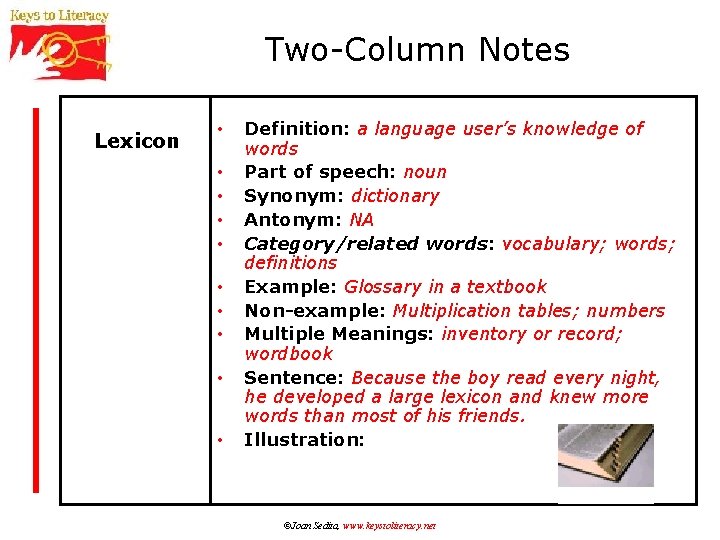
Two-Column Notes Lexicon • • • Definition: a language user’s knowledge of words Part of speech: noun Synonym: dictionary Antonym: NA Category/related words: vocabulary; words; definitions Example: Glossary in a textbook Non-example: Multiplication tables; numbers Multiple Meanings: inventory or record; wordbook Sentence: Because the boy read every night, he developed a large lexicon and knew more words than most of his friends. Illustration: ©Joan Sedita, www. keystoliteracy. net
Dictionary Definitions • Conventional definitions are difficult to understand • Asking students to look up definitions and write them in sentences is NOT effective (Scott & Nagy, 1997; Miller & Gildea (1987) • What to teach about dictionary definitions – How to look up words – How to use different parts of an entry – The need to select appropriate meaning for the context • Alternative dictionaries ©Joan Sedita, www. keystoliteracy. com
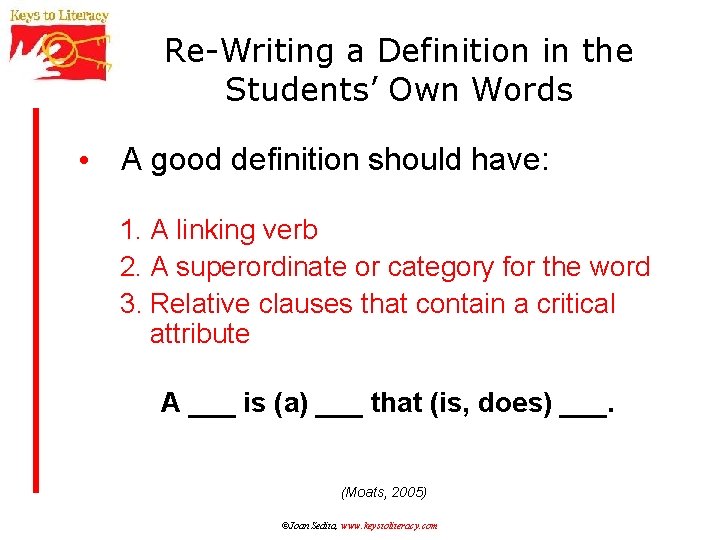
Re-Writing a Definition in the Students’ Own Words • A good definition should have: 1. A linking verb 2. A superordinate or category for the word 3. Relative clauses that contain a critical attribute A ___ is (a) ___ that (is, does) ___. (Moats, 2005) ©Joan Sedita, www. keystoliteracy. com
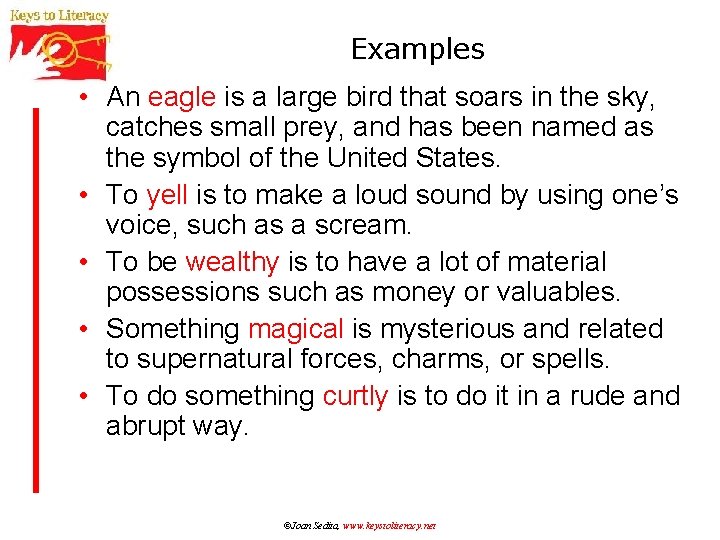
Examples • An eagle is a large bird that soars in the sky, catches small prey, and has been named as the symbol of the United States. • To yell is to make a loud sound by using one’s voice, such as a scream. • To be wealthy is to have a lot of material possessions such as money or valuables. • Something magical is mysterious and related to supernatural forces, charms, or spells. • To do something curtly is to do it in a rude and abrupt way. ©Joan Sedita, www. keystoliteracy. net
Step 4: Identify opportunities to teach word learning strategies • Use of context to determine word meaning • Use of word parts to determine word meaning ©Joan Sedita, www. keystoliteracy. net
Teaching Use of Context • Provide direct instruction in how to use the context • Provide many examples from reading • Teach students that the context does not always work ©Joan Sedita, www. keystoliteracy. net
How to Teach Context • Graves’ 4 steps • Types of context clues – Definition – Description – Synonym – Comparison – Contrast – Example ©Joan Sedita, www. keystoliteracy. net
Teach Word Parts • Large percentage of words learned after grade 3 are derived from Greek or Latin roots (Carlisle, 2007) • 60% of unfamiliar words in middle school books are derived words that can be figured out by word parts and context (Nagy & Anderson, 1984) ©Joan Sedita, www. keystoliteracy. net
Word Parts BASE/ROOT WORDS + SUFFIXES/PREFIXES Undeniable (un - deny - able) Morphemes: the smallest units of language that convey or modulate meaning Bound morphemes: cannot stand alone (s, ed, ment) Free morphemes: can stand alone (cat, walk, govern) ©Joan Sedita, www. keystoliteracy. com
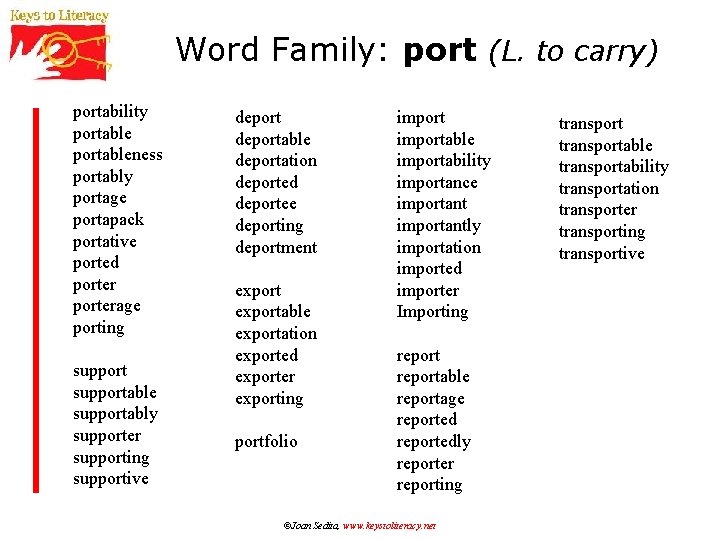
Word Family: port (L. to carry) portability portableness portably portage portapack portative ported porterage porting supportable supportably supporter supporting supportive deportable deportation deported deportee deporting deportment exportable exportation exported exporter exporting portfolio importable importability importance importantly importation imported importer Importing reportable reportage reportedly reporter reporting ©Joan Sedita, www. keystoliteracy. net transportable transportability transportation transporter transporting transportive
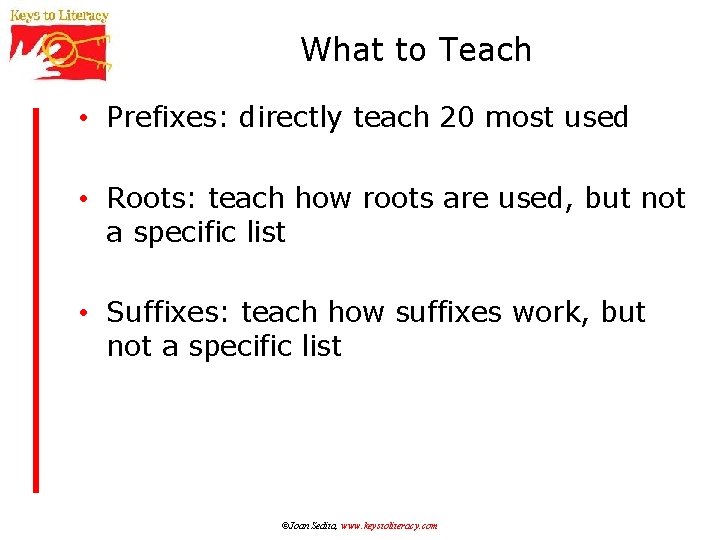
What to Teach • Prefixes: directly teach 20 most used • Roots: teach how roots are used, but not a specific list • Suffixes: teach how suffixes work, but not a specific list ©Joan Sedita, www. keystoliteracy. com
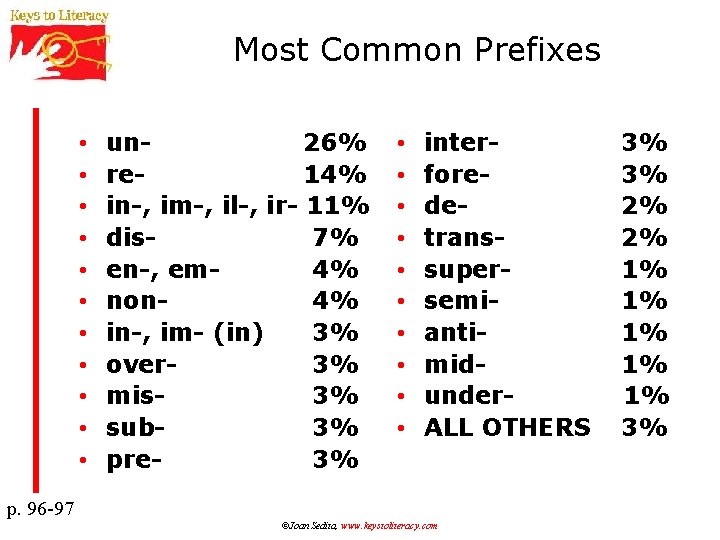
Most Common Prefixes • • • un 26% re 14% in-, im-, il-, ir- 11% dis 7% en-, em 4% non 4% in-, im- (in) 3% over 3% mis 3% sub 3% pre 3% • • • interforedetranssupersemiantimidunder. ALL OTHERS p. 96 -97 ©Joan Sedita, www. keystoliteracy. com 3% 3% 2% 2% 1% 1% 1% 3%
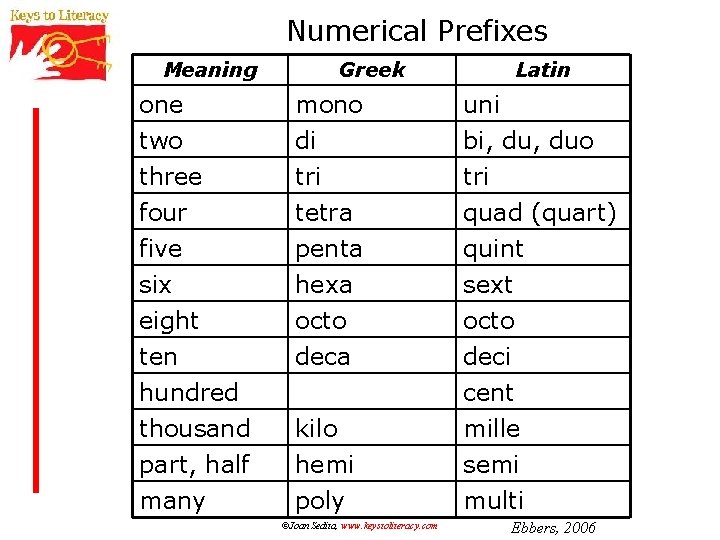
Numerical Prefixes Meaning Greek Latin one mono uni two di bi, duo three tri four tetra quad (quart) five penta quint six hexa sext eight octo ten deca deci hundred cent thousand kilo mille part, half hemi semi many poly multi ©Joan Sedita, www. keystoliteracy. com Ebbers, 2006
Step 5: Identify opportunities to promote word consciousness ©Joan Sedita, www. keystoliteracy. net
Developing an Interest in Words “Teachers should encourage children to become WORD COLLECTORS, people who notice new words and scoop them up for their personal collections when they hear, see or read them. ” National Center on Education and the Economy, 2001 ©Joan Sedita, www. keystoliteracy. com
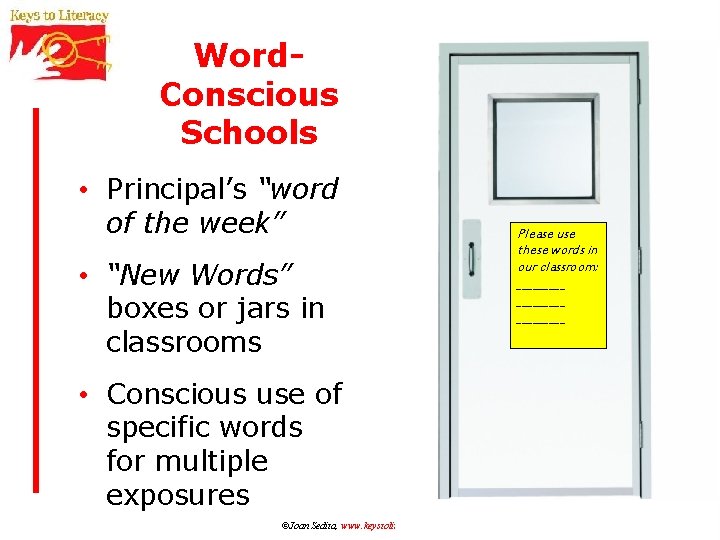
Word. Conscious Schools • Principal’s “word of the week” • “New Words” boxes or jars in classrooms • Conscious use of specific words for multiple exposures ©Joan Sedita, www. keystoliteracy. com Please use these words in our classroom: _________
Word Play “Words and phrases can simultaneously feel good on the tongue, sound good to the ear, and incite a riot of laughter in the belly. Verbal phenomena such as homophones and homographs; idioms, clichés, and puns; and onomastics (the story of names) offer myriad opportunities for investigating language. ” (Graves, 2006) ©Joan Sedita, www. keystoliteracy. com
Word Play § Homophones and homographs § Word puns, jokes and riddles § Word games (Scattergories, Outburst, Pictionary, Charades, Password, Scrabble, Boggle) § Word manipulations (anagrams, palindromes) § Word expressions (idioms, proverbs, slang) ©Joan Sedita, www. keystoliteracy. com
Vocabulary Word Walls • Choose words from content • Update frequently • Refer to them on a regular basis ©Joan Sedita, www. keystoliteracy. com
Classroom Reading Materials • Wide reading: a lot of reading and a lot of topics • Word conscious classrooms need a wide variety of books and material to read • Provide opportunities for students to take home books ©Joan Sedita, www. keystoliteracy. net
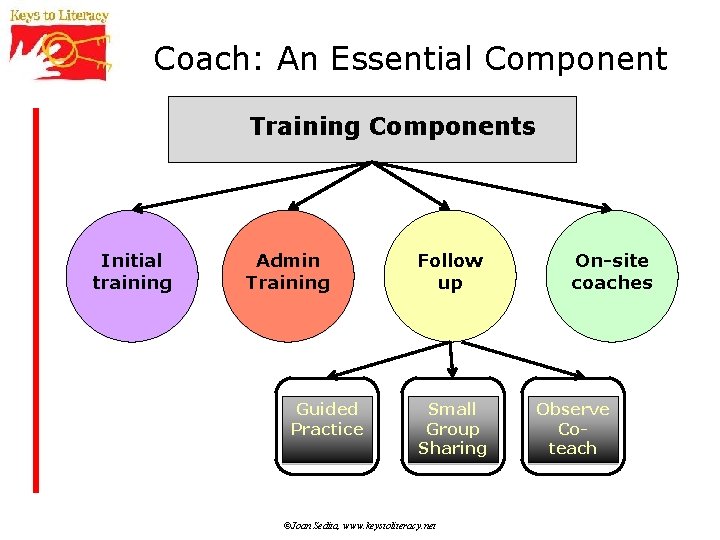
Coach: An Essential Component Training Components Initial training Admin Training Guided Practice Follow up Small Group Sharing ©Joan Sedita, www. keystoliteracy. net On-site coaches Observe Coteach
Professional development topics and instructional materials available: • • • The Key Comprehension Routine The Key Vocabulary Routine The ANSWER Key to Open Response Writing Keys to Learning Literacy Planning K-12 www. keystoliteracy. com 978 -948 -8511 ©Joan Sedita, www. keystoliteracy. net
- Slides: 60