
THE KENYA NATIONAL EXAMINATIONS COUNCIL Monitoring Learner Progress

- Slides: 10
THE KENYA NATIONAL EXAMINATIONS COUNCIL Monitoring Learner Progress (MLP) Authentic Tools for SNE Stage Based Pathway 2019
Learning Areas in the SNE Pathway Communication, social, and pre-literacy skills Activities of daily living skills and religious education Sensory motor and creative activities Orientation and mobility skills Pre-numeracy activities
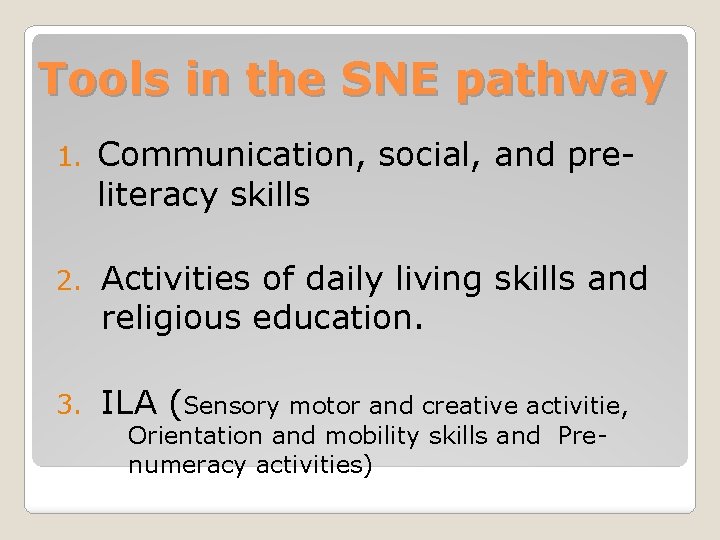
Tools in the SNE pathway 1. Communication, social, and preliteracy skills 2. Activities of daily living skills and religious education. 3. ILA (Sensory motor and creative activitie, Orientation and mobility skills and Prenumeracy activities)
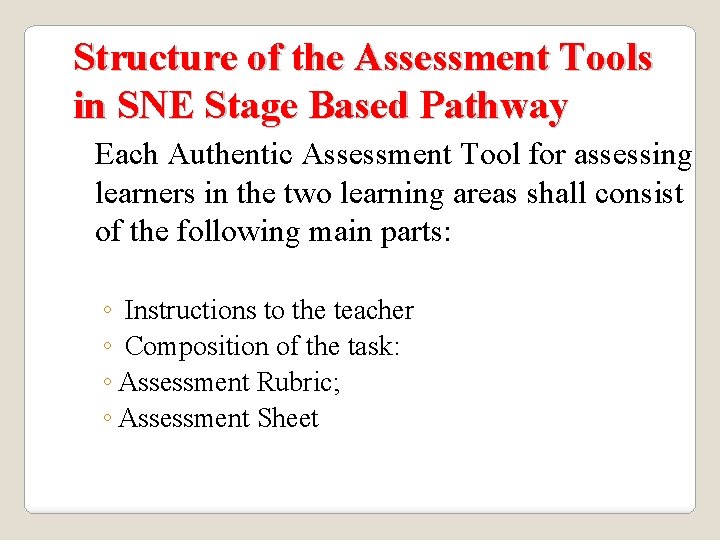
Structure of the Assessment Tools in SNE Stage Based Pathway Each Authentic Assessment Tool for assessing learners in the two learning areas shall consist of the following main parts: ◦ Instructions to the teacher ◦ Composition of the task: ◦ Assessment Rubric; ◦ Assessment Sheet
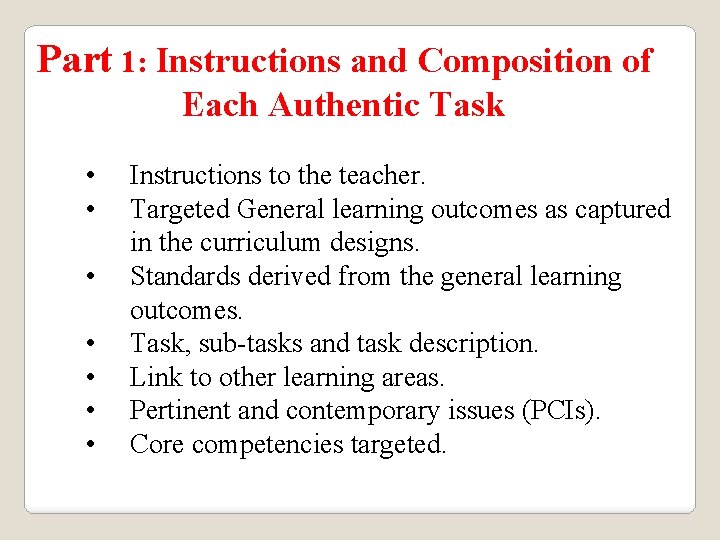
Part 1: Instructions and Composition of Each Authentic Task • • Instructions to the teacher. Targeted General learning outcomes as captured in the curriculum designs. Standards derived from the general learning outcomes. Task, sub-tasks and task description. Link to other learning areas. Pertinent and contemporary issues (PCIs). Core competencies targeted.
Part 2: Assessment Rubrics Comprehensive Assessment Rubrics consisting of the following parts in tabular form: Performance levels Namely; 4. Exceeding, 3. Meeting, 2. Approaching and 4. Below Expectations. Criteria Demand put to the learner for performance. Descriptors; Descriptive statement(s) of what the learner is able to demonstrate at each level of performance.
Part 3: Assessment Sheets shall be availed by KNEC consisting of the following five main parts presented in tabular form: i. Criteria; The demand put to the learner for performance on top row. ii. Performance levels 4. Exceeding, 3. Meeting, 2. Approaching and 4. Below Expectations. Names/ Identity of the learner(s); This is to be filled alongside the first column.
Part 3: Assessment Sheets Cont’d iv. Teacher’s comment on learner Performance in which the teacher will tick to indicate the level of performance for each learner. Evidence of performance, strengths, weaknesses and suggested strategies for improvement
Part 4: Reporting Instruments templates for reporting the performance of learners shall be availed through the website. The reporting instruments or forms shall include the following: i. A format for uploading learner’s performance to KNEC website ii. The School Year Report (SYR) in which the teacher will capture the performance of each learner in various competences and the same be availed to the parents/ guardians
End Reactions