
The Kentucky Department of Revenue presented the following

- Slides: 22
The Kentucky Department of Revenue presented the following information at the annual 2019 Ky. CPA State Tax Conference on December 5, 2019. This presentation covered a basic overview of recent statute and regulation changes as well as changes to the regulation promulgation process. The information in this presentation was prepared from information the Department of Revenue possessed and believed to be accurate and relevant on the date of the meeting. This information does not constitute a final ruling, order, or determination of the Department of Revenue and cannot be appealed.
S TATE T AX C ONFERENCE Kentucky Society of CPAs Presentation Date: December 5, 2019 Kentucky Department of Revenue 501 High Street Frankfort, KY 40601 (502) 564 -4581
Introduction Daniel P. Bork, CPA Commissioner Kentucky Department of Revenue
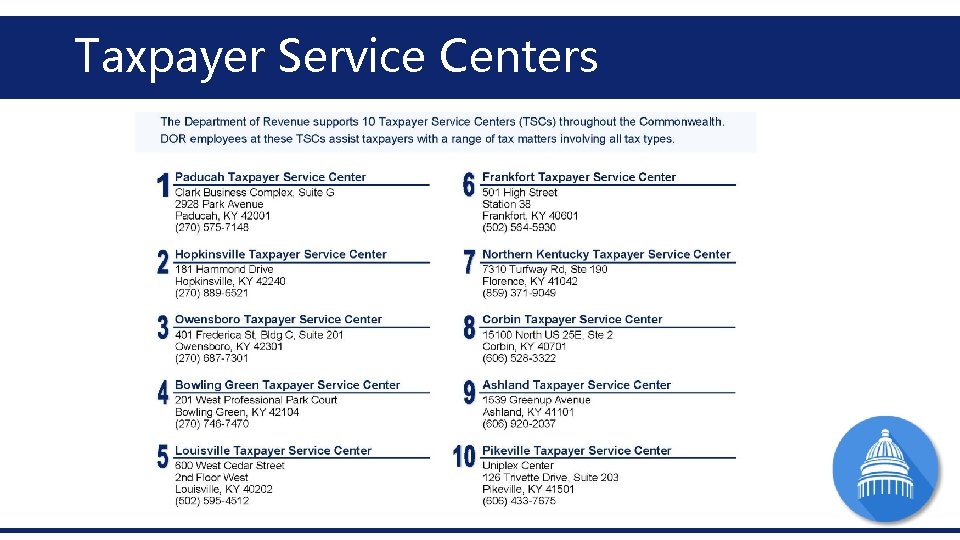
Taxpayer Service Centers
Outside Organizations • Federation of Tax Administrators (FTA) • Southeast Association of Tax Administrators (SEATA) • Streamlined Sales Tax Governing Board (SSUTA) • Multistate Tax Commission (MTC)
Major KDOR Initiatives • Integrated Tax System (ITS) • Moves KDOR from 150+ applications to 1 system • Will allow taxpayer account access online • “One Department One Team” • Culture shift away from “silo” mentality • More consistent responses from all KDOR areas • Tax Guidance • KRS 131. 130(8) allows KDOR to issue non-binding guidance setting forth its interpretation of statutes and regulations
Emerging Tax Issues • • Vaping Marijuana Sports Betting Historical Racing Software-as-a-Service Wayfair and Corporate Tax Nexus Cryptocurrencies
Sales Tax Updates Richard Dobson Executive Director Office of Sales & Excise Taxes
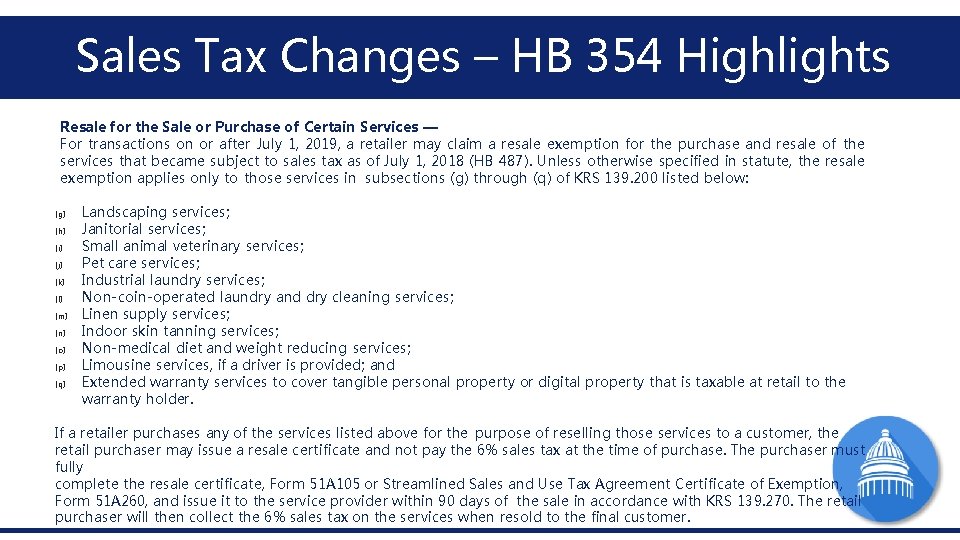
Sales Tax Changes – HB 354 Highlights Resale for the Sale or Purchase of Certain Services — For transactions on or after July 1, 2019, a retailer may claim a resale exemption for the purchase and resale of the services that became subject to sales tax as of July 1, 2018 (HB 487). Unless otherwise specified in statute, the resale exemption applies only to those services in subsections (g) through (q) of KRS 139. 200 listed below: (g) (h) (i) (j) (k) (l) (m) (n) (o) (p) (q) Landscaping services; Janitorial services; Small animal veterinary services; Pet care services; Industrial laundry services; Non-coin-operated laundry and dry cleaning services; Linen supply services; Indoor skin tanning services; Non-medical diet and weight reducing services; Limousine services, if a driver is provided; and Extended warranty services to cover tangible personal property or digital property that is taxable at retail to the warranty holder. If a retailer purchases any of the services listed above for the purpose of reselling those services to a customer, the retail purchaser may issue a resale certificate and not pay the 6% sales tax at the time of purchase. The purchaser must fully complete the resale certificate, Form 51 A 105 or Streamlined Sales and Use Tax Agreement Certificate of Exemption, Form 51 A 260, and issue it to the service provider within 90 days of the sale in accordance with KRS 139. 270. The retail purchaser will then collect the 6% sales tax on the services when resold to the final customer.
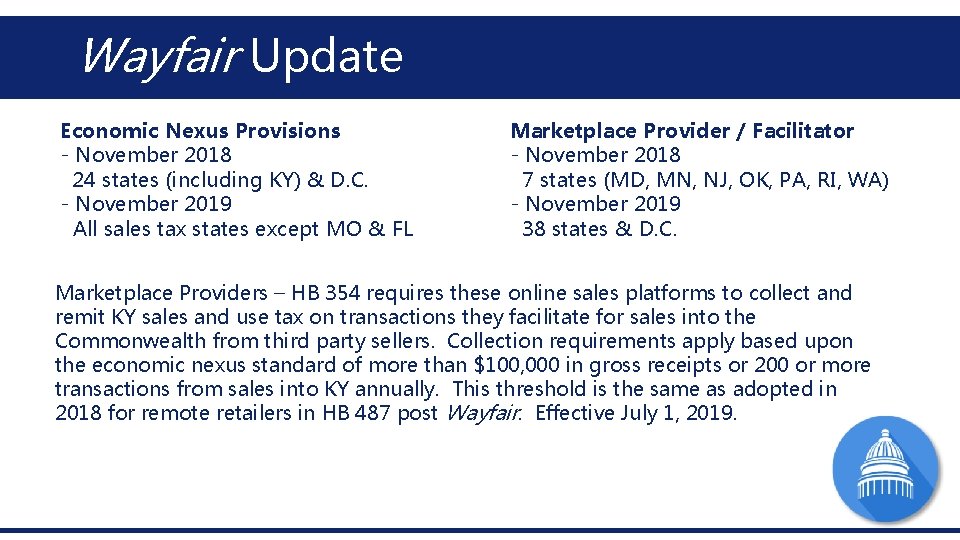
Wayfair Update Economic Nexus Provisions - November 2018 24 states (including KY) & D. C. - November 2019 All sales tax states except MO & FL Marketplace Provider / Facilitator - November 2018 7 states (MD, MN, NJ, OK, PA, RI, WA) - November 2019 38 states & D. C. Marketplace Providers – HB 354 requires these online sales platforms to collect and remit KY sales and use tax on transactions they facilitate for sales into the Commonwealth from third party sellers. Collection requirements apply based upon the economic nexus standard of more than $100, 000 in gross receipts or 200 or more transactions from sales into KY annually. This threshold is the same as adopted in 2018 for remote retailers in HB 487 post Wayfair. Effective July 1, 2019.
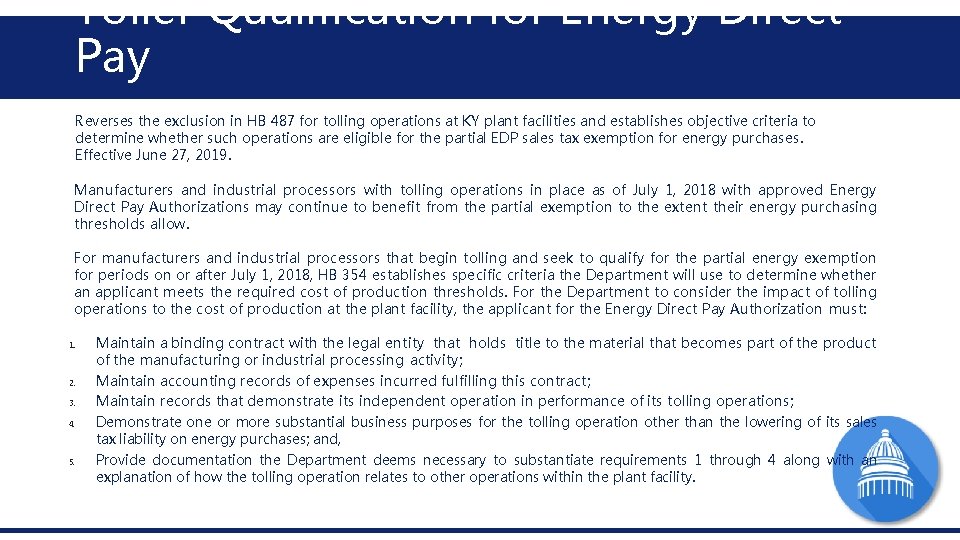
Toller Qualification for Energy Direct Pay Reverses the exclusion in HB 487 for tolling operations at KY plant facilities and establishes objective criteria to determine whether such operations are eligible for the partial EDP sales tax exemption for energy purchases. Effective June 27, 2019. Manufacturers and industrial processors with tolling operations in place as of July 1, 2018 with approved Energy Direct Pay Authorizations may continue to benefit from the partial exemption to the extent their energy purchasing thresholds allow. For manufacturers and industrial processors that begin tolling and seek to qualify for the partial energy exemption for periods on or after July 1, 2018, HB 354 establishes specific criteria the Department will use to determine whether an applicant meets the required cost of production thresholds. For the Department to consider the impact of tolling operations to the cost of production at the plant facility, the applicant for the Energy Direct Pay Authorization must: 1. 2. 3. 4. 5. Maintain a binding contract with the legal entity that holds title to the material that becomes part of the product of the manufacturing or industrial processing activity; Maintain accounting records of expenses incurred fulfilling this contract; Maintain records that demonstrate its independent operation in performance of its tolling operations; Demonstrate one or more substantial business purposes for the tolling operation other than the lowering of its sales tax liability on energy purchases; and, Provide documentation the Department deems necessary to substantiate requirements 1 through 4 along with an explanation of how the tolling operation relates to other operations within the plant facility.
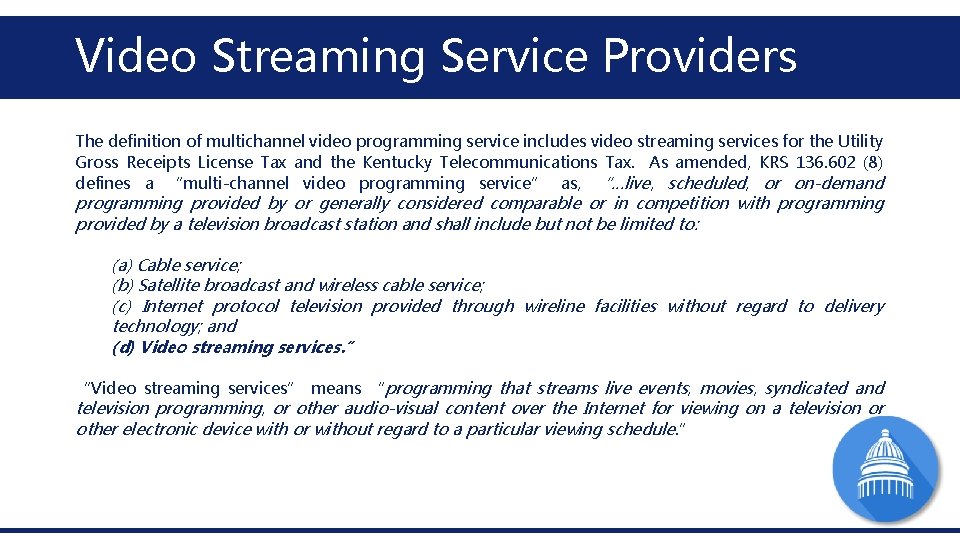
Video Streaming Service Providers The definition of multichannel video programming service includes video streaming services for the Utility Gross Receipts License Tax and the Kentucky Telecommunications Tax. As amended, KRS 136. 602 (8) defines a “multi-channel video programming service” as, “…live, scheduled, or on-demand programming provided by or generally considered comparable or in competition with programming provided by a television broadcast station and shall include but not be limited to: (a) Cable service; (b) Satellite broadcast and wireless cable service; (c) Internet protocol television provided through wireline facilities without regard to delivery technology; and (d) Video streaming services. ” “Video streaming services” means “programming that streams live events, movies, syndicated and television programming, or other audio-visual content over the Internet for viewing on a television or other electronic device with or without regard to a particular viewing schedule. ”
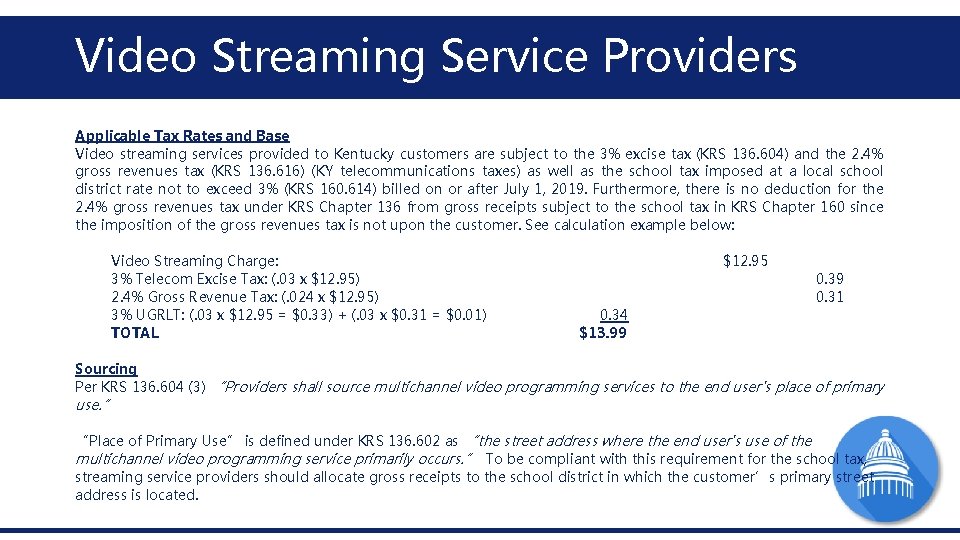
Video Streaming Service Providers Applicable Tax Rates and Base Video streaming services provided to Kentucky customers are subject to the 3% excise tax (KRS 136. 604) and the 2. 4% gross revenues tax (KRS 136. 616) (KY telecommunications taxes) as well as the school tax imposed at a local school district rate not to exceed 3% (KRS 160. 614) billed on or after July 1, 2019. Furthermore, there is no deduction for the 2. 4% gross revenues tax under KRS Chapter 136 from gross receipts subject to the school tax in KRS Chapter 160 since the imposition of the gross revenues tax is not upon the customer. See calculation example below: Video Streaming Charge: 3% Telecom Excise Tax: (. 03 x $12. 95) 2. 4% Gross Revenue Tax: (. 024 x $12. 95) 3% UGRLT: (. 03 x $12. 95 = $0. 33) + (. 03 x $0. 31 = $0. 01) TOTAL $12. 95 0. 34 $13. 99 0. 31 Sourcing Per KRS 136. 604 (3) “Providers shall source multichannel video programming services to the end user's place of primary use. ” “Place of Primary Use” is defined under KRS 136. 602 as “the street address where the end user's use of the multichannel video programming service primarily occurs. ” To be compliant with this requirement for the school tax, streaming service providers should allocate gross receipts to the school district in which the customer’s primary street address is located.
Regulatory Matters J. Todd Renner, CPA, CGMA Executive Director Office of Tax Policy & Regulation
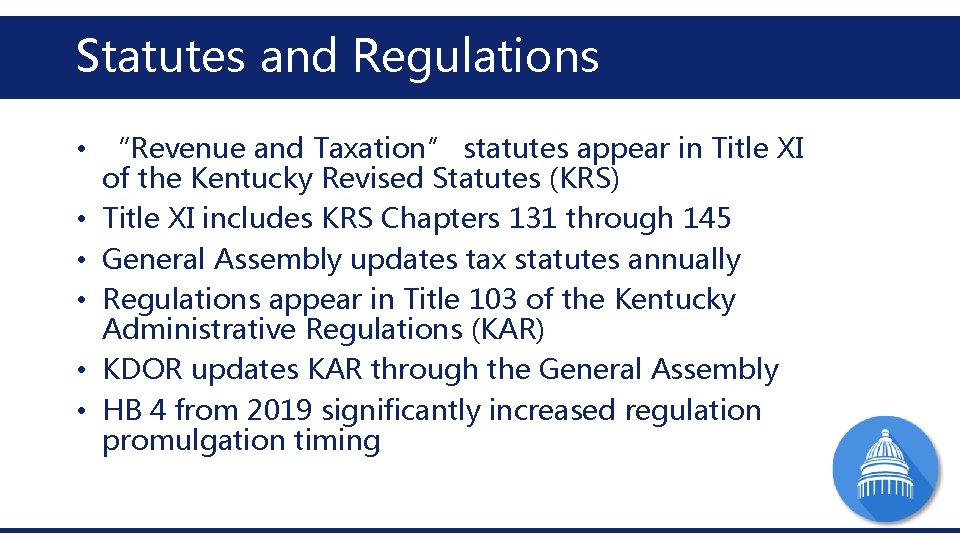
Statutes and Regulations • “Revenue and Taxation” statutes appear in Title XI of the Kentucky Revised Statutes (KRS) • Title XI includes KRS Chapters 131 through 145 • General Assembly updates tax statutes annually • Regulations appear in Title 103 of the Kentucky Administrative Regulations (KAR) • KDOR updates KAR through the General Assembly • HB 4 from 2019 significantly increased regulation promulgation timing
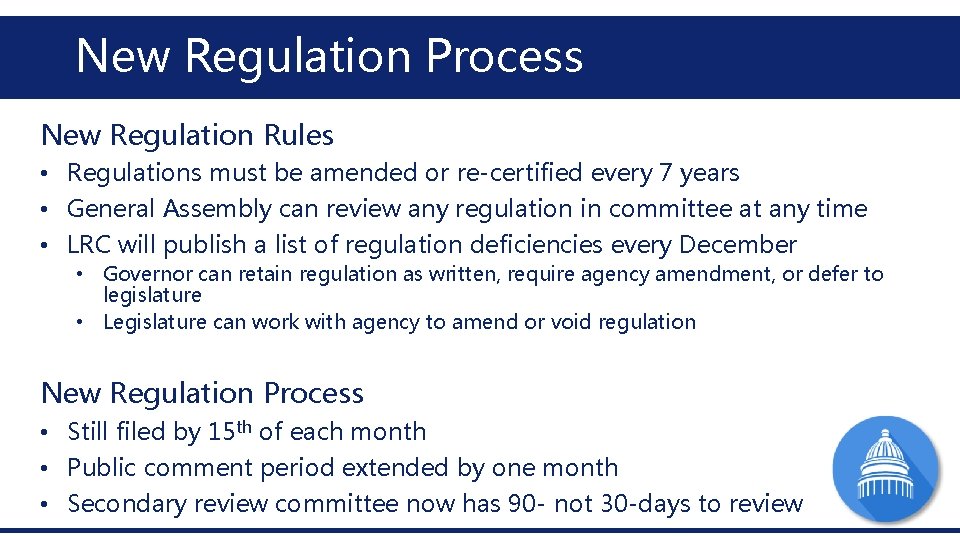
New Regulation Process New Regulation Rules • Regulations must be amended or re-certified every 7 years • General Assembly can review any regulation in committee at any time • LRC will publish a list of regulation deficiencies every December • Governor can retain regulation as written, require agency amendment, or defer to legislature • Legislature can work with agency to amend or void regulation New Regulation Process • Still filed by 15 th of each month • Public comment period extended by one month • Secondary review committee now has 90 - not 30 -days to review
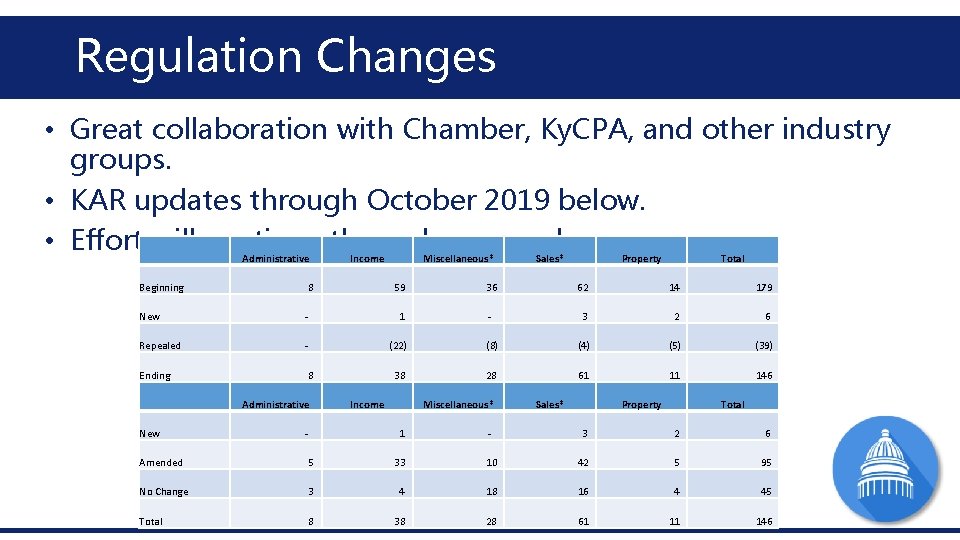
Regulation Changes • Great collaboration with Chamber, Ky. CPA, and other industry groups. • KAR updates through October 2019 below. • Effort will continue through year end. Administrative Beginning 8 New Income Miscellaneous* Sales* Property Total 59 36 62 14 179 - 1 - 3 2 6 Repealed - (22) (8) (4) (5) (39) Ending 8 38 28 61 11 146 Administrative New - Amended Income Miscellaneous* Sales* Property Total 1 - 3 2 6 5 33 10 42 5 95 No Change 3 4 18 16 4 45 Total 8 38 28 61 11 146
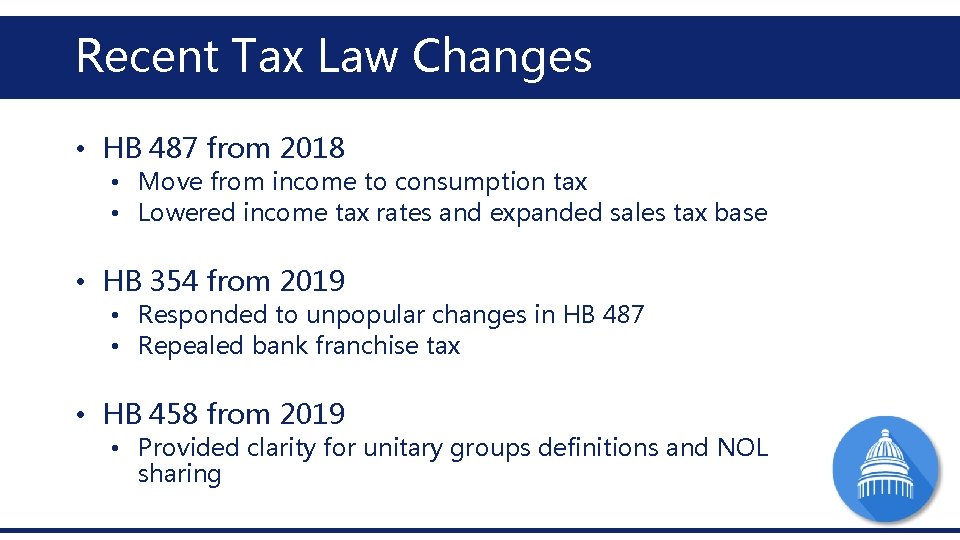
Recent Tax Law Changes • HB 487 from 2018 • Move from income to consumption tax • Lowered income tax rates and expanded sales tax base • HB 354 from 2019 • Responded to unpopular changes in HB 487 • Repealed bank franchise tax • HB 458 from 2019 • Provided clarity for unitary groups definitions and NOL sharing
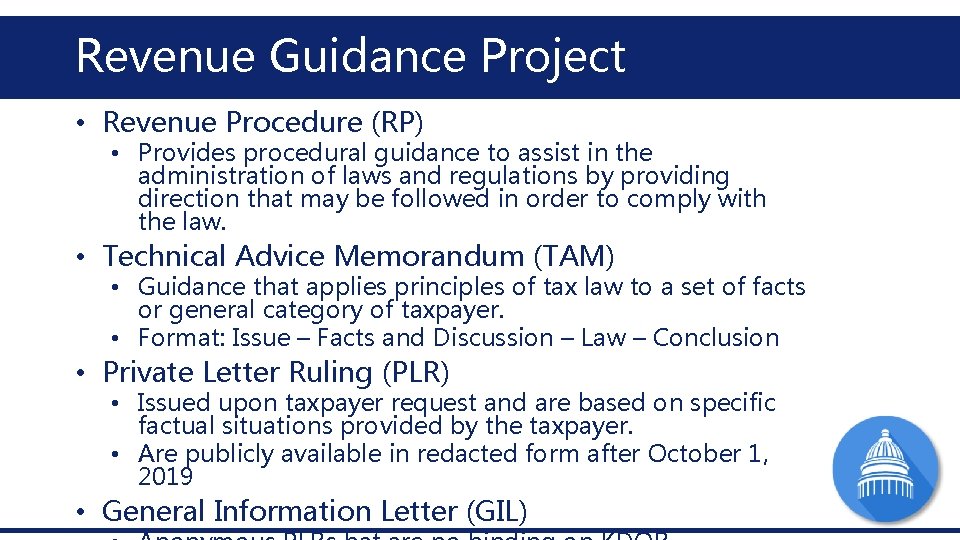
Revenue Guidance Project • Revenue Procedure (RP) • Provides procedural guidance to assist in the administration of laws and regulations by providing direction that may be followed in order to comply with the law. • Technical Advice Memorandum (TAM) • Guidance that applies principles of tax law to a set of facts or general category of taxpayer. • Format: Issue – Facts and Discussion – Law – Conclusion • Private Letter Ruling (PLR) • Issued upon taxpayer request and are based on specific factual situations provided by the taxpayer. • Are publicly available in redacted form after October 1, 2019 • General Information Letter (GIL)
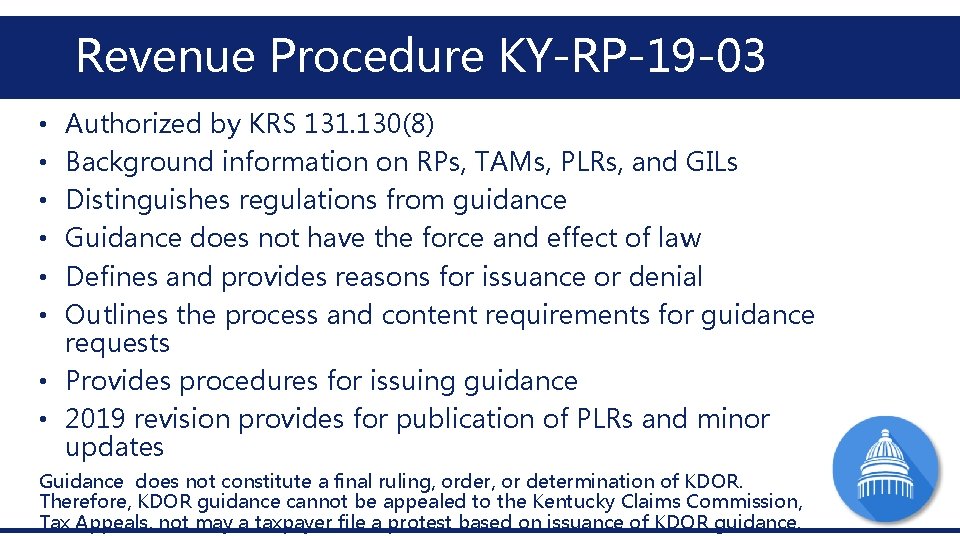
Revenue Procedure KY-RP-19 -03 Authorized by KRS 131. 130(8) Background information on RPs, TAMs, PLRs, and GILs Distinguishes regulations from guidance Guidance does not have the force and effect of law Defines and provides reasons for issuance or denial Outlines the process and content requirements for guidance requests • Provides procedures for issuing guidance • 2019 revision provides for publication of PLRs and minor updates • • • Guidance does not constitute a final ruling, order, or determination of KDOR. Therefore, KDOR guidance cannot be appealed to the Kentucky Claims Commission, Tax Appeals, not may a taxpayer file a protest based on issuance of KDOR guidance.
State Tax Conference Daniel P. Bork, Commissioner Dan. Bork@ky. gov (502) 564 -3226 The information in this presentation is for educational and informational purposes only and does not constitute legal advice. Information is presented as an overall review that is subject to law changes and may not apply to all states. For accurate information on issues related to the Kentucky Department of Revenue, please reference KRS Title XI and KAR Chapter 103. Information in this presentation is believed to be accurate as of the date of publication. In the event that any information in this presentation is later determined to be in error, this presentation cannot be used by taxpayers in supporting a specific position or issue before the Department of Revenue, as it does not have the statutory or regulatory authority. Kentucky Department of Revenue 501 High Street Frankfort, KY 40601 (502) 564 -4581