
The K12 System A Schematic Overview Production Processes
- Slides: 21
The K-12 System: A Schematic Overview Production Processes, Governance, and Accountability
The Learners: (The Task Environment) • Defined in Terms of Age – Not Desire for Education – Not Ability to Pay – Not Capacity to Use Education for Individual and Social Welfare • Learners Vary on Many Different Dimensions – Different Levels of Desire, Commitment and Capacity – Different Kinds of Claims on Collective (Desires, Needs, Rights) – Tensions Among Goals of Equal Access, Individualization, and Equal Outcomes • Learners Have Different Levels of Support from Caretakers – Past Contributions from Caretakers – Current Capacity and Commitment of Caretakers
Education Service Providers: (I) • Start with Schools as Education Service Providers • Dominant Form: Public School – – Publicly Owned and Operated Publicly Financed Through Tax Appropriations Organized in Local School Districts Staffed by Public Employees (Often Unionized) • Other Forms: – – Charter Schools (Sometimes Organized in Networks) Parochial Schools (Often Organized by Churches) Independent Private Schools (Organized in Associations) Home Schooling (Organized in Associations)
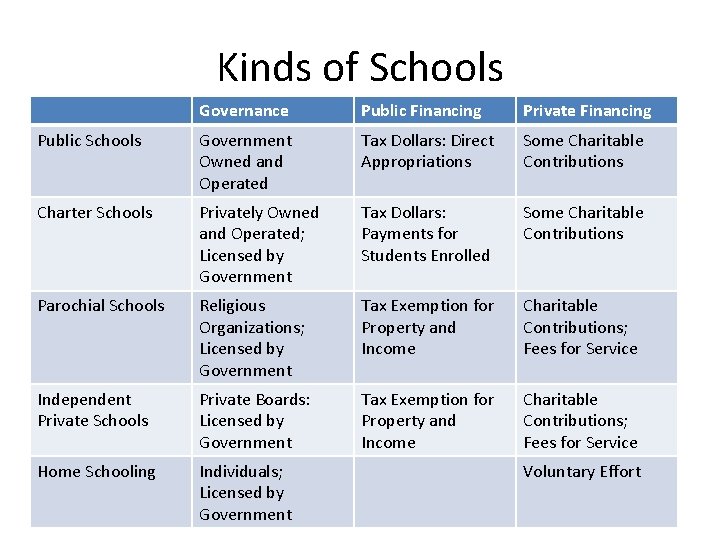
Kinds of Schools Governance Public Financing Private Financing Public Schools Government Owned and Operated Tax Dollars: Direct Appropriations Some Charitable Contributions Charter Schools Privately Owned and Operated; Licensed by Government Tax Dollars: Payments for Students Enrolled Some Charitable Contributions Parochial Schools Religious Organizations; Licensed by Government Tax Exemption for Property and Income Charitable Contributions; Fees for Service Independent Private Schools Private Boards: Licensed by Government Tax Exemption for Property and Income Charitable Contributions; Fees for Service Home Schooling Individuals; Licensed by Government Voluntary Effort
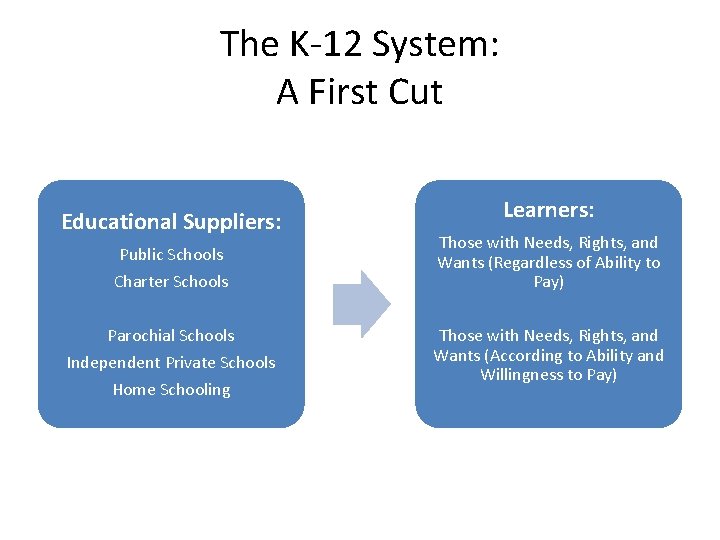
The K-12 System: A First Cut Educational Suppliers: Learners: Public Schools Charter Schools Those with Needs, Rights, and Wants (Regardless of Ability to Pay) Parochial Schools Independent Private Schools Home Schooling Those with Needs, Rights, and Wants (According to Ability and Willingness to Pay)
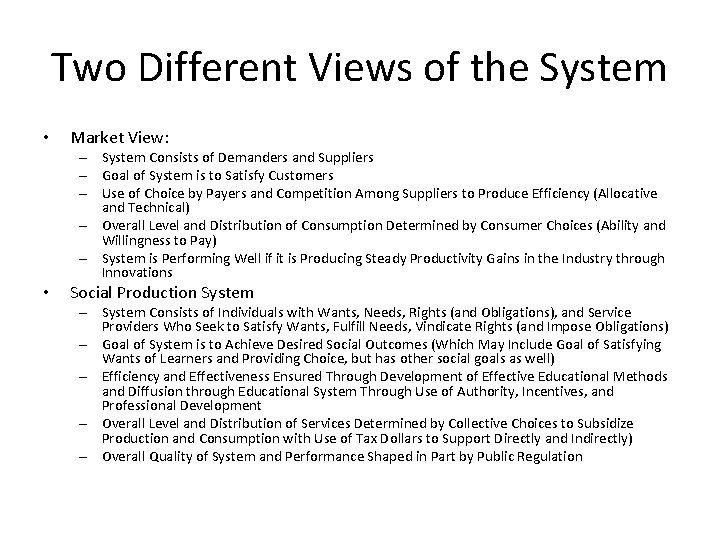
Two Different Views of the System • Market View: – System Consists of Demanders and Suppliers – Goal of System is to Satisfy Customers – Use of Choice by Payers and Competition Among Suppliers to Produce Efficiency (Allocative and Technical) – Overall Level and Distribution of Consumption Determined by Consumer Choices (Ability and Willingness to Pay) – System is Performing Well if it is Producing Steady Productivity Gains in the Industry through Innovations • Social Production System – System Consists of Individuals with Wants, Needs, Rights (and Obligations), and Service Providers Who Seek to Satisfy Wants, Fulfill Needs, Vindicate Rights (and Impose Obligations) – Goal of System is to Achieve Desired Social Outcomes (Which May Include Goal of Satisfying Wants of Learners and Providing Choice, but has other social goals as well) – Efficiency and Effectiveness Ensured Through Development of Effective Educational Methods and Diffusion through Educational System Through Use of Authority, Incentives, and Professional Development – Overall Level and Distribution of Services Determined by Collective Choices to Subsidize Production and Consumption with Use of Tax Dollars to Support Directly and Indirectly) – Overall Quality of System and Performance Shaped in Part by Public Regulation
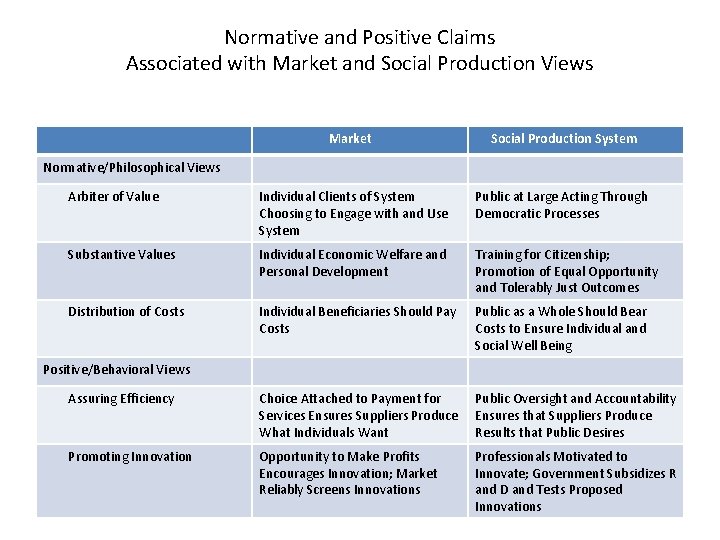
Normative and Positive Claims Associated with Market and Social Production Views Market Social Production System Arbiter of Value Individual Clients of System Choosing to Engage with and Use System Public at Large Acting Through Democratic Processes Substantive Values Individual Economic Welfare and Personal Development Training for Citizenship; Promotion of Equal Opportunity and Tolerably Just Outcomes Distribution of Costs Individual Beneficiaries Should Pay Costs Public as a Whole Should Bear Costs to Ensure Individual and Social Well Being Assuring Efficiency Choice Attached to Payment for Services Ensures Suppliers Produce What Individuals Want Public Oversight and Accountability Ensures that Suppliers Produce Results that Public Desires Promoting Innovation Opportunity to Make Profits Encourages Innovation; Market Reliably Screens Innovations Professionals Motivated to Innovate; Government Subsidizes R and D and Tests Proposed Innovations Normative/Philosophical Views Positive/Behavioral Views
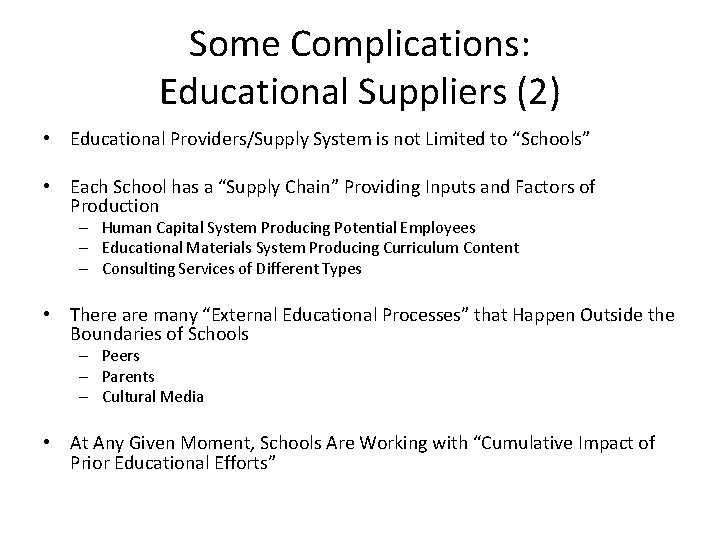
Some Complications: Educational Suppliers (2) • Educational Providers/Supply System is not Limited to “Schools” • Each School has a “Supply Chain” Providing Inputs and Factors of Production – Human Capital System Producing Potential Employees – Educational Materials System Producing Curriculum Content – Consulting Services of Different Types • There are many “External Educational Processes” that Happen Outside the Boundaries of Schools – Peers – Parents – Cultural Media • At Any Given Moment, Schools Are Working with “Cumulative Impact of Prior Educational Efforts”
Schematic View: (2) Supply Chains Schools Learners
Implications of More Complex View of Educational Supplier/Production System • Schools (as structural units) operate in the midst of other social structures and processes that affect their operations, and their ability to achieve results. – Choices as to methods for engaging learners may be limited by suppliers – Potential to achieve may be limited by cumulative impact of what has come before – Ability to achieve results may be helped or hindered by other structures and processes that competing for the attention and commitment of learners, and help or hurt school goals. • External structures and processes are only imperfectly under the control of schools. – Schools may be controlled by other structures and forces, and restrained from challenging them – Can seek to influence these other factors either from inside or outside school • NOTA BENE: not different from medical practices/hospitals; child protective services; job placement programs; or police and juvenile justice system
Governance of K-12 System: Uses of Authority To Shape Structure and Conduct of Schools • The Idea of Governance: – Formal Structure Having Authority Over Social Actors and Purposes of its Own – Formal Structure Allocating Rights and Responsibilities to Other Actors and Settling Disputes, but no Substantive Purposes – Impersonal Forces Reliably and Predictably Shaping Performance of a Social System • Two Different Levels of Governance: – Social Level Governance – Firm Level Governance • Social Level Governance: Use of Formal Government Authority to Shape Structure and Conduct of System – Distribute Rights and Responsibilities to Actors involved in Market or Social Production System – Insist on Development and Publication of Information to Allow – Referee Disputes Enforce Rules – – – Articulate Substantive Purposes to Be Achieved Use Authority and Money to Pursue Purposes Indirectly or Directly Call Social Actors to Account for Performance • Firm Level Governance – Authorization/Identity/Ownership – Operational Control – Accountability and Liability • Government Acts as both Social Level and as Firm Level Governor of Schools • Government is Not a Monolith: Different Levels, Different Branches
History of Government as System Level Manager of K-12 System • Early History: Creation of Rights and Responsibilities for Education at State Level in Constitutions and Law • Late 1800’s/Early 1900’s: – Growth in Public Expenditures to Support K-12 Schooling – Continuation/Growth of Parochial and Private Schools • Mid-1900’s: Federal Challenges to State and Local Control – De-Segregation – Federal Funding for Disadvantaged Schools • Late 1900’s: Authorization of Charter Schools
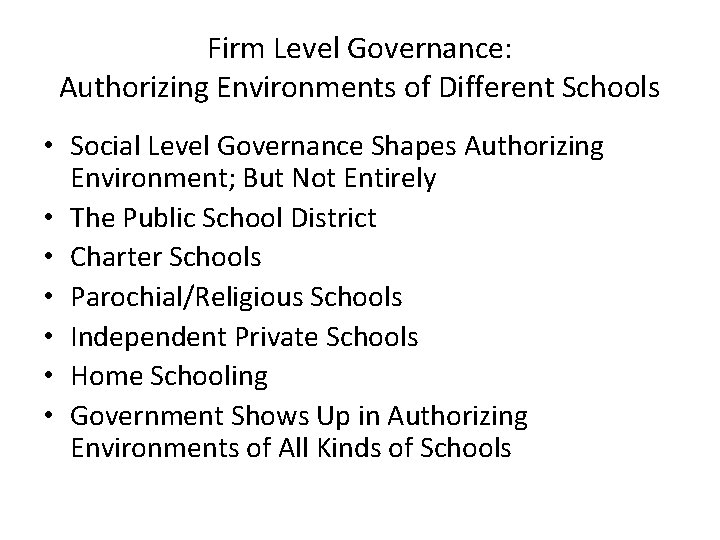
Firm Level Governance: Authorizing Environments of Different Schools • Social Level Governance Shapes Authorizing Environment; But Not Entirely • The Public School District • Charter Schools • Parochial/Religious Schools • Independent Private Schools • Home Schooling • Government Shows Up in Authorizing Environments of All Kinds of Schools
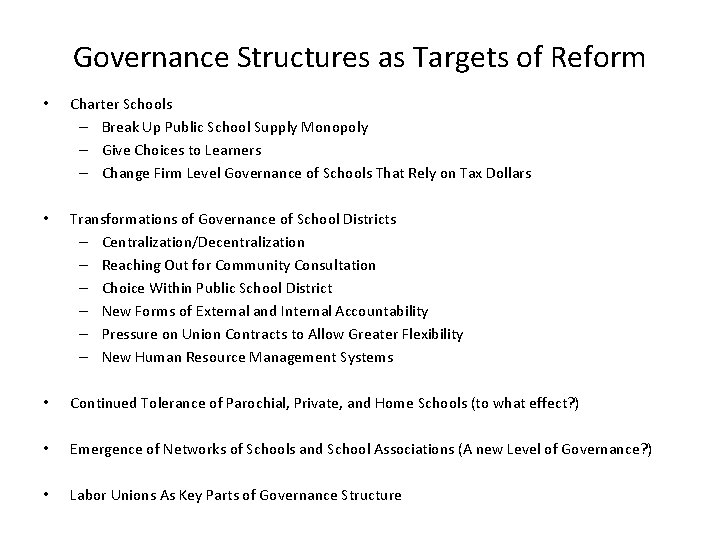
Governance Structures as Targets of Reform • Charter Schools – Break Up Public School Supply Monopoly – Give Choices to Learners – Change Firm Level Governance of Schools That Rely on Tax Dollars • Transformations of Governance of School Districts – Centralization/Decentralization – Reaching Out for Community Consultation – Choice Within Public School District – New Forms of External and Internal Accountability – Pressure on Union Contracts to Allow Greater Flexibility – New Human Resource Management Systems • Continued Tolerance of Parochial, Private, and Home Schools (to what effect? ) • Emergence of Networks of Schools and School Associations (A new Level of Governance? ) • Labor Unions As Key Parts of Governance Structure
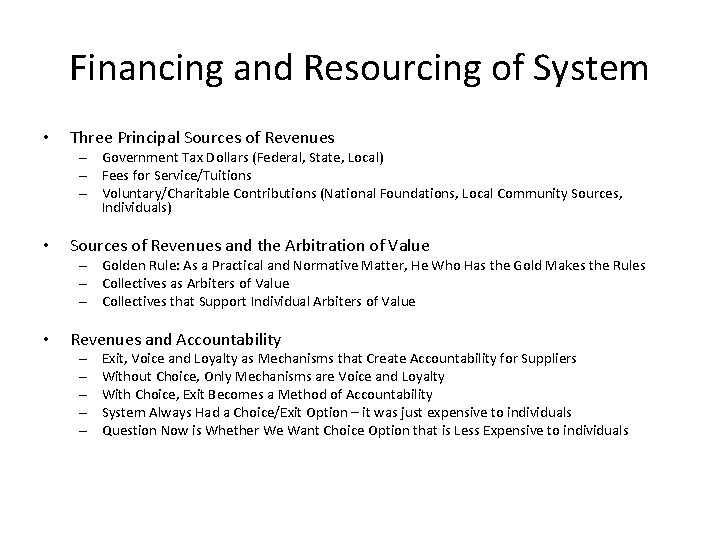
Financing and Resourcing of System • Three Principal Sources of Revenues – Government Tax Dollars (Federal, State, Local) – Fees for Service/Tuitions – Voluntary/Charitable Contributions (National Foundations, Local Community Sources, Individuals) • Sources of Revenues and the Arbitration of Value – Golden Rule: As a Practical and Normative Matter, He Who Has the Gold Makes the Rules – Collectives as Arbiters of Value – Collectives that Support Individual Arbiters of Value • Revenues and Accountability – – – Exit, Voice and Loyalty as Mechanisms that Create Accountability for Suppliers Without Choice, Only Mechanisms are Voice and Loyalty With Choice, Exit Becomes a Method of Accountability System Always Had a Choice/Exit Option – it was just expensive to individuals Question Now is Whether We Want Choice Option that is Less Expensive to individuals
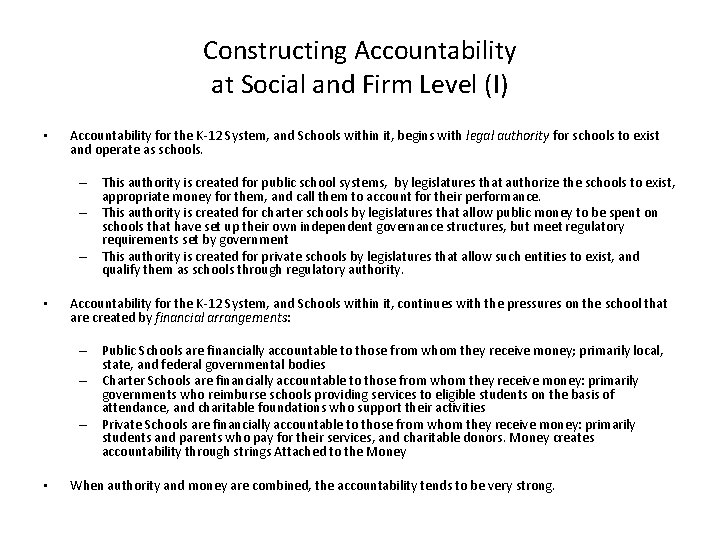
Constructing Accountability at Social and Firm Level (I) • Accountability for the K-12 System, and Schools within it, begins with legal authority for schools to exist and operate as schools. – This authority is created for public school systems, by legislatures that authorize the schools to exist, appropriate money for them, and call them to account for their performance. – This authority is created for charter schools by legislatures that allow public money to be spent on schools that have set up their own independent governance structures, but meet regulatory requirements set by government – This authority is created for private schools by legislatures that allow such entities to exist, and qualify them as schools through regulatory authority. • Accountability for the K-12 System, and Schools within it, continues with the pressures on the school that are created by financial arrangements: – Public Schools are financially accountable to those from whom they receive money; primarily local, state, and federal governmental bodies – Charter Schools are financially accountable to those from whom they receive money: primarily governments who reimburse schools providing services to eligible students on the basis of attendance, and charitable foundations who support their activities – Private Schools are financially accountable to those from whom they receive money: primarily students and parents who pay for their services, and charitable donors. Money creates accountability through strings Attached to the Money • When authority and money are combined, the accountability tends to be very strong.
Constructing Accountability (II): Accountability Agents and Social and Moral Legitimacy • Accountability Created Through State Authority or Through Financial Dependence is not the only accountability that exists in a market or a social production system. • Social actors with no formal authority to demand even an accounting, let alone responsiveness to their claims, often demand accountability on moral grounds rather than legal or financial when they think their interests, or some important public value has been sacrificed. • Such actors can be described as self-appointed accountability agents. They include almost anyone who has an interest in the operations of a market or a social production system but typically include the media, interest groups, and freelancing politicians. • For the most part, the claims of such accountability agents will be brushed aside. But when they align with some widespread public view of what constitutes good or appropriate conduct, they can mobilize some significant social pressure that acts as a kind of accountability for educational suppliers.
Constructing Accountability (III): Authorizers and Agents of Accountability • As a practical matter, those who lead school systems, or schools, are pressed on all sides by those who would like to make claims on the actions of educational service providers. • The particular substantive claims they can and do make can vary a great deal. – Some focus on individual students, others on broader classes – Some focus on ends, some on means – Some focus on educational objectives, others on issues of cultural identity • Leaders and managers have to juggle these external claims
Constructing Accountability (IV): Accountability Regimes • At any given moment, a manager is accountable to an existing accountability regime that has been constructed over time from legal, financial, and moral relationships Some way of assessing or determining what has been done • That accountability regime gains force when it can reward or punish those subject to it in ways that matter to those individuals. (Sanctions) • It also gains force when there is some method of determining whether a person subject to that accountability system is performing well or badly. (Performance Measurement) • It also gains force when the regime is widely seen as legitimate both because the “right” arbiters of value are making the important value decisions, and because the decisions they make seem appropriate. (Legal, Moral, and Political Legitimacy)
Why Accountability Regimes Matter and What is Happening to Them • Accountability Systems Have a Very Big Impact on What is Produced – particularly when there are measures, powerful sanctions, and widespread legitimacy. – – Much of What is Currently being produced is the result of existing negotiated systems of accountability Change often requires significant shift in formal and informal system of accountability: trying to substitute a new or adjusted accountability system for the old. • General demand for accountability is relatively permanent and intense; but focus and character of that accountability may be more fluid • Current policies are changing accountability regimes in the K-12 system – – – Viewed from one perspective, accountability is shifting at the margin from local school districts to the federal government Viewed from another perspective, accountability is shifting from collective units (e. g. government) to individual clients Fed presents itself as advocate of individual clients, but shows up as force with its own idea of what constitutes value, and uses its money and authority to shape, and to change location of public discussion about education. Reformers argue for individual choice, but cannot escape the collective. They then choose the government body that seems most supportive of choice. But they find that they need significant social and political influence to wrest authority from local governments that raise money, make spending decisions, and operate public schools. Over the long run, dominance of local districts in governing schools may be undermined by facilitate exits from the system, and loss of both political and client support for the public schools as they now exist
Strategic Uses of Accountability: From Positions Inside and Outside • Accountability Regimes Are Always Present • They are problems when they focus the assets and activities of schools on wasteful, ineffective or harmful activities • They are helpful when they focus the assets and activities of schools on purposes that are good and just, and that enable learning. • If one is trying to make change from a position of authority within the system, one can make strategic use of changes in existing accountability systems. • If one is trying to make changes from positions outside the system, on can do so by trying to transform the accountability system which is now guiding the actions of those in formal positions inside the system.