
The K12 Literacy Model and You Literacy Through
- Slides: 23
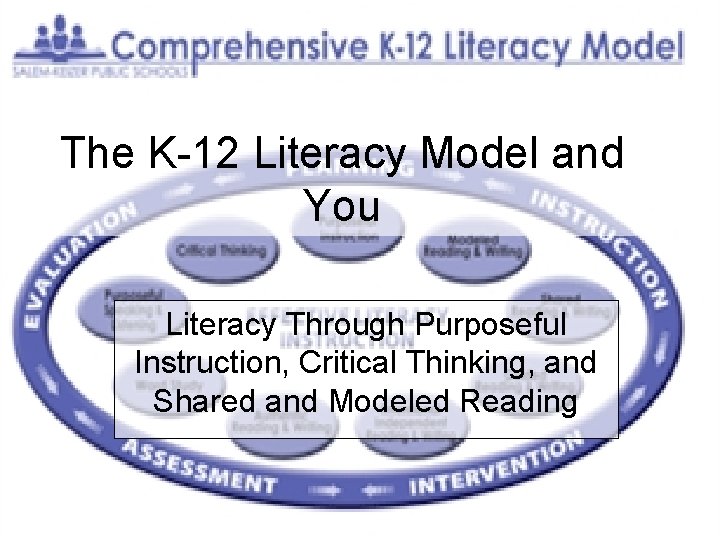
The K-12 Literacy Model and You Literacy Through Purposeful Instruction, Critical Thinking, and Shared and Modeled Reading
We are all teachers of reading… What does that mean in my classroom?
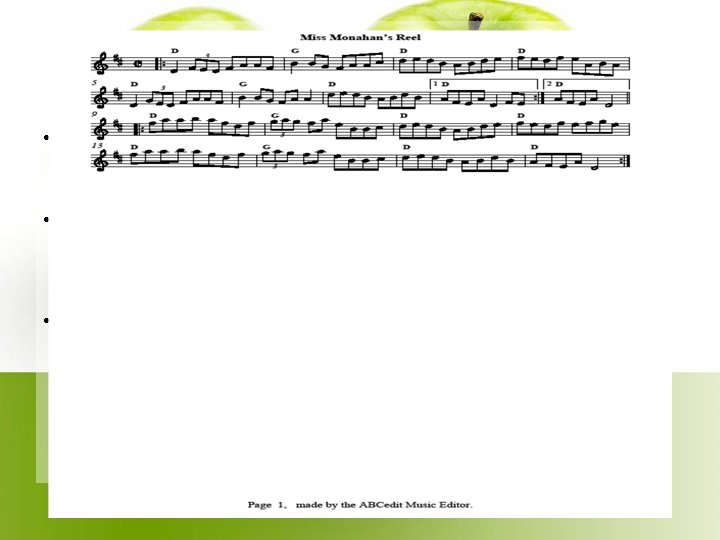
Did you know? • 40% of the state reading test is reading for information— – Non-fiction text and deciding the main idea – Looking at charts, graphs, maps, and tables and deciding what it’s telling you – Interpreting symbols on paper in the form of music, playbooks, sports statistics
Results of Reading Testing of TAG students at Leslie • 50% struggled with reading “ 1/50, 000 of an inch” • 25% struggled with “ 1, 000”—reading this as “one hundred thousand” makes a big difference and impacts comprehension • Most did not understand the time relation of the Civil War and now • 99% lacked academic vocabulary to perform above grade level in content areas outside of literature
District Mandates • K-12 Literacy Model • TAG corrective action • Core standards • Formative Assessment
Did you ever want to scream… Just give me a moment and let me think!!!! • Sometimes, that’s just what we all need:
Introducing Think-Aloud Strategies for Improved Comprehension
Why teach Think-Alouds? • Provides students with endurance, leverage, and readiness for the next level of learning – Endurance: Goes beyond the standardized test date – Leverage: Provides knowledge that will be of value in multiple disciplines – Readiness for the next level of learning: (this one is self-explanatory) • One strategy in the K-12 Literacy Model that covers 4 areas
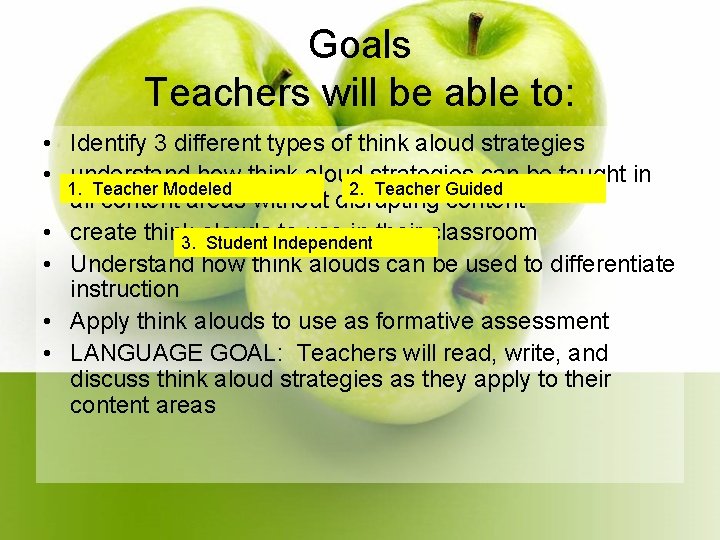
Goals Teachers will be able to: • Identify 3 different types of think aloud strategies • Understand how think aloud strategies can be taught in all content areas without hindering content coverage • Create think alouds to use in their classroom • Understand how think alouds can be used to differentiate instruction • Apply think alouds to use as formative assessment • LANGUAGE GOAL: Teachers will read, write, and discuss think aloud strategies as they apply to their content areas
What is a think aloud strategy? • It is a way of making the invisible thought process Visible
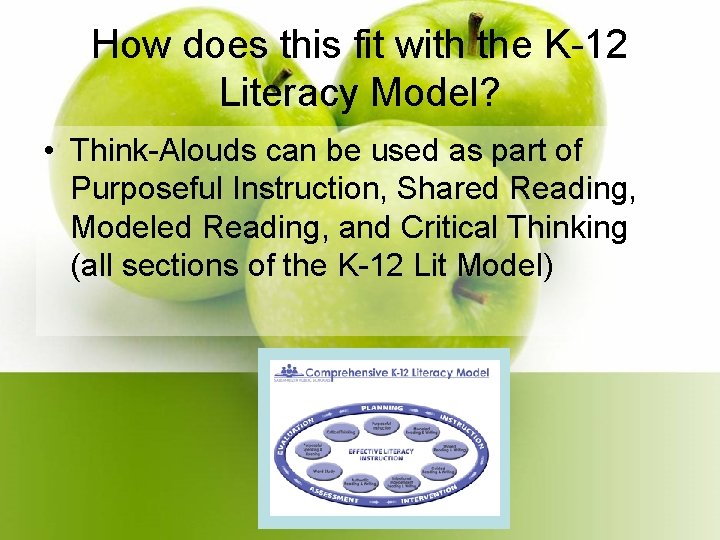
How does this fit with the K-12 Literacy Model? • Think-Alouds can be used as part of Purposeful Instruction, Shared Reading, Modeled Reading, and Critical Thinking (all sections of the K-12 Lit Model)
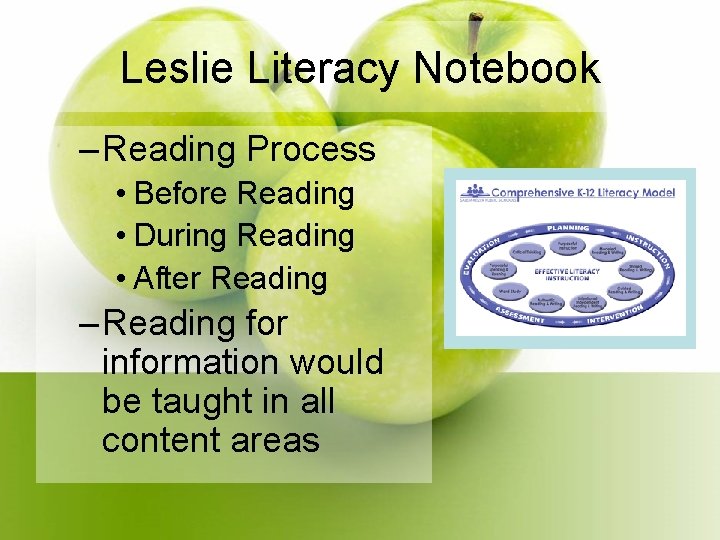
Leslie Literacy Notebook – Reading Process • Before Reading • During Reading • After Reading – Reading for information would be taught in all content areas
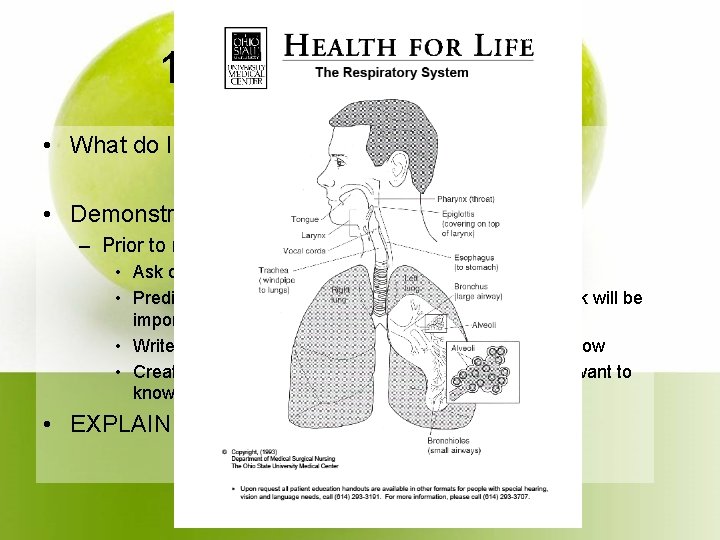
1. Teacher Modeled • What do I do? • Demonstrate prereading strategy – Prior to reading scan titles, schematics, pictures, etc. • Ask questions aloud to yourself • Predict what you think will be covered and what you think will be important—and say the why!! • Write down information that you think you will need to know • Create questions regarding anything you don’t know or want to know, or think you will need to know • EXPLAIN WHY
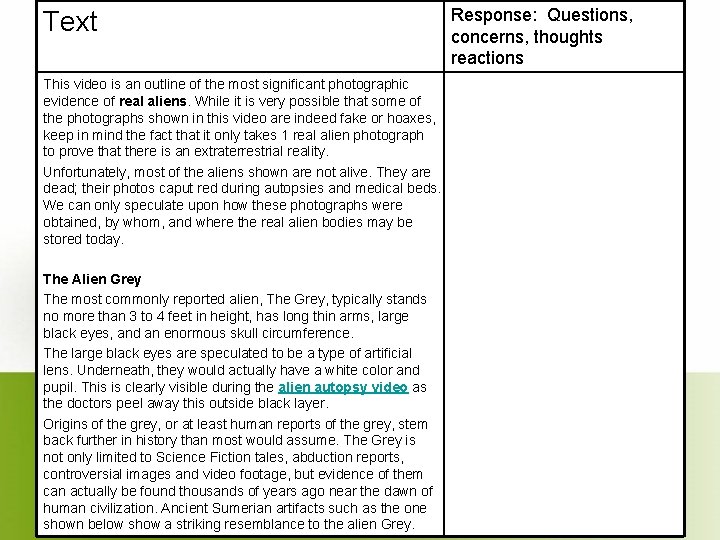
Text Response: Questions, concerns, thoughts reactions 1. Teacher Modeled This video is an outline of the most significant photographic evidence of real aliens. While it is very possible that some of the photographs shown in this video are indeed fake or hoaxes, keep in minddo the. I fact • What do? that it only takes 1 real alien photograph to prove that there is an extraterrestrial reality. Unfortunately, most of the aliens shown are not alive. They are • dead; Demonstrate during “reading” their photos caput red during autopsies and medical beds. strategy We can only speculate upon how these photographs were – Ask questions aloudthetoreal yourself obtained, by whom, and where alien bodies may be Write down information that you stored–today. think you will need to know – Talk The Alien Greyabout things you disagree with and why The most commonly reported alien, The Grey, typically stands – Make connections to other no more than 3 to 4 feet in height, knowledge you have has long thin arms, large black eyes, and an enormous skull circumference. – Point out propaganda or bias you The largedetect black eyes are speculated to be a type of artificial lens. Underneath, theythe would actually have a white color and – Challenge author’s viewpoints, pupil. Thisetc. is clearly visible during the alien autopsy video as the doctors peel away this outside black layer. – Evaluate the diagram or picture Origins ofbased the grey, at least human reports of the grey, stem onorcomposition, back further in history than information, etc. most would assume. The Grey is not only to Science Fiction tales, abduction reports, – limited EXPLAIN WHY!!!! controversial images and video footage, but evidence of them can actually be found thousands of years ago near the dawn of human civilization. Ancient Sumerian artifacts such as the one shown below show a striking resemblance to the alien Grey. Video
1. Teacher Modeled • What do I do? • Demonstrate post strategy – Answer any questions you found answers for during reading – Correct any mistakes you had during your predicting – Go back to the notes you made and see if you were right, wrong, or changed your mind – Ask what more you might need to know on this subject and talk about where you would find the information – Revisit what you thought was important and rate it – EXPLAIN WHY!!!!
2. Teacher Guided • Like Teacher Modeled, this can be done before reading, during reading, or after reading—or all 3 • Teacher poses a question or series of questions and asks students to respond based on information in the text (either orally or written) • Responses are written on the board and discussed. – Students may help each other support an idea. – Teacher can ask clarifying questions. – Everyone works together
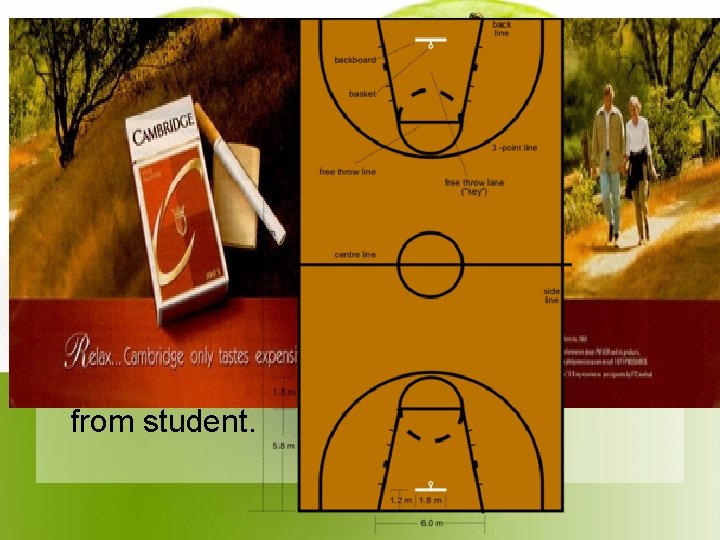
3. Independent Student • 2 strategies • Teacher can give guiding question— – Example: Where in the text can you find propaganda? What position do you think the writer is coming from? Give examples supporting your opinions. • Teacher can allow free flow of thoughts from student.
How this can be used as formative assessment • If you have been focusing on a specific strategy, choose questions that will reveal students’ mastery of that concept. • Examples: Crescendo and decrescendo in a music class, event sequencing in a social studies class, literal comprehension in a science class
Formative Assessment Cont. 1. 2. 3. 4. Pretest reveals lack of knowledge Teacher teaches the skill Think aloud used by teacher as a model Next students are asked to help in a teacher guided 5. students demonstrate on their own—written and orally—teacher either formally or informally assesses mastery 6. Teacher chooses to reteach to whole class, small group, or move on because class has reached 100% concept mastery
Where in Unit can it be used as formative assessment • Beginning, middle, or end • If you have students create a written document, then you can use that as a formal assessment • If you have students do think alouds orally with partners, then it is an informal assessment • As long as you use it to plan instruction it is a formative assessment
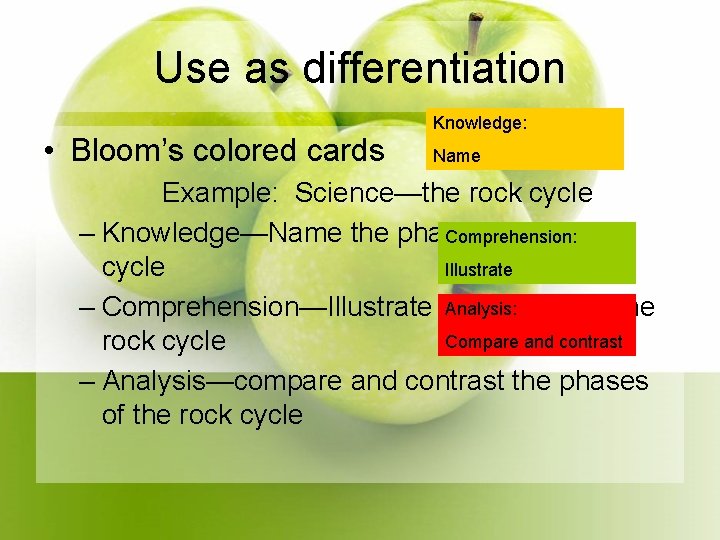
Use as differentiation • Bloom’s colored cards Knowledge: Name Example: Science—the rock cycle – Knowledge—Name the phases of the rock Comprehension: Illustrate cycle Analysis: – Comprehension—Illustrate the phases of the Compare and contrast rock cycle – Analysis—compare and contrast the phases of the rock cycle
Goals Teachers will be able to: • Identify 3 different types of think aloud strategies • understand how think aloud strategies can be taught in 1. Teacher Modeled 2. Teacher Guided all content areas without disrupting content • create think alouds to use in their classroom 3. Student Independent • Understand how think alouds can be used to differentiate instruction • Apply think alouds to use as formative assessment • LANGUAGE GOAL: Teachers will read, write, and discuss think aloud strategies as they apply to their content areas
Your Tasks • Each data team group has a folder – Either as a group or individually design a lesson that “To teach implement thecovering Think-your teaches the and Think-Aloud strategy while subjectpiece of the K-12 Literacy Aloud • Write it on the planning form Model will need to/need help – Fill out Iplanning form on how you will teach the thinkaloud strategy in your class and how you will use it in with…” subsequent lessons • After creating your Think-Aloud lesson, fill out “Chalk Talk”on the yellow paper on your tables