
The Judicial Branch Separation of Powers The Judicial
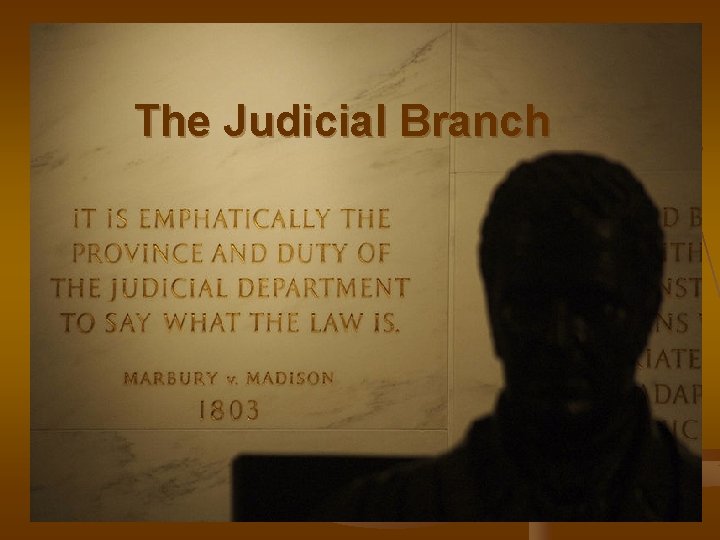
The Judicial Branch
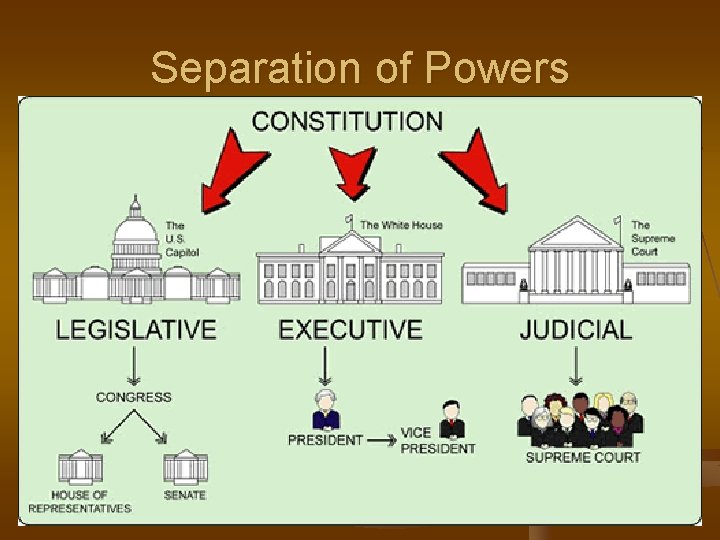
Separation of Powers
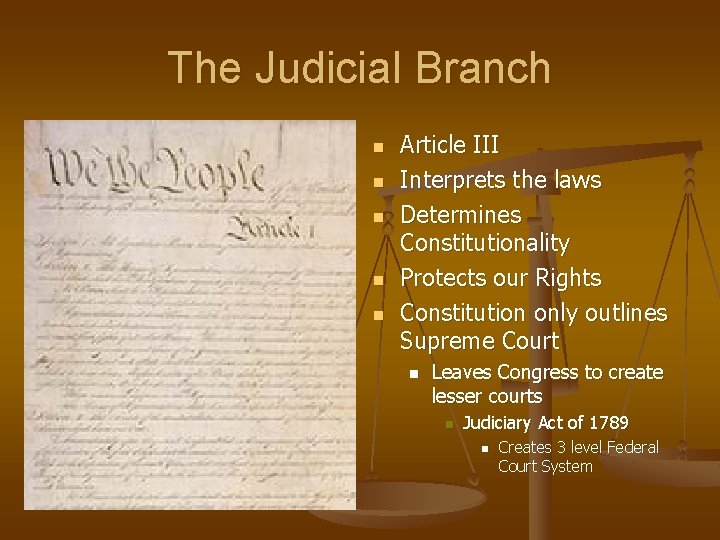
The Judicial Branch n n n Article III Interprets the laws Determines Constitutionality Protects our Rights Constitution only outlines Supreme Court n Leaves Congress to create lesser courts n Judiciary Act of 1789 n Creates 3 level Federal Court System
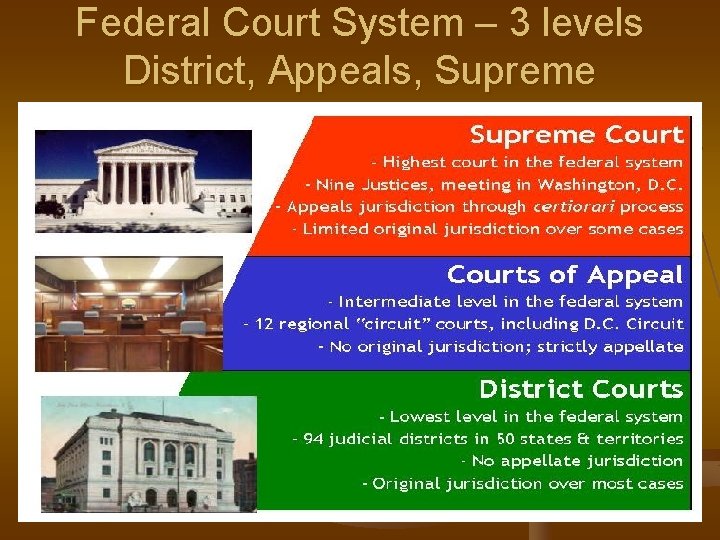
Federal Court System – 3 levels District, Appeals, Supreme
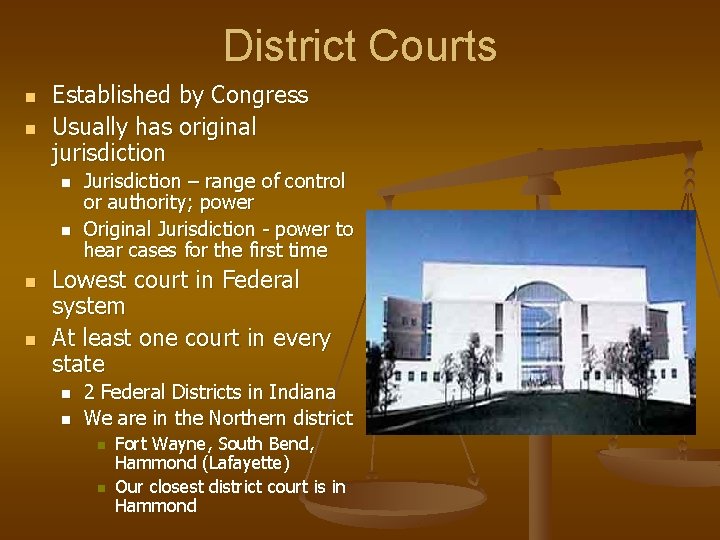
District Courts n n Established by Congress Usually has original jurisdiction n n Jurisdiction – range of control or authority; power Original Jurisdiction - power to hear cases for the first time Lowest court in Federal system At least one court in every state n n 2 Federal Districts in Indiana We are in the Northern district n n Fort Wayne, South Bend, Hammond (Lafayette) Our closest district court is in Hammond
Courts of Appeals n n n Established by Congress Appeal – to challenge Sometimes a person believes that justice was not served in their District Court because: n n n They could then appeal the verdict in a Court of Appeals US citizens have the right to a fair trial n n n His/her rights were violated A rule of law was not properly followed All the evidence was not available 7 th amendment The appeals process is set up to ensure that people have as fair a trial as possible 13 appellate courts in Nation n We are in the 7 th circuit n n Includes Indiana, Illinois, Wisconsin Court office located in Chicago
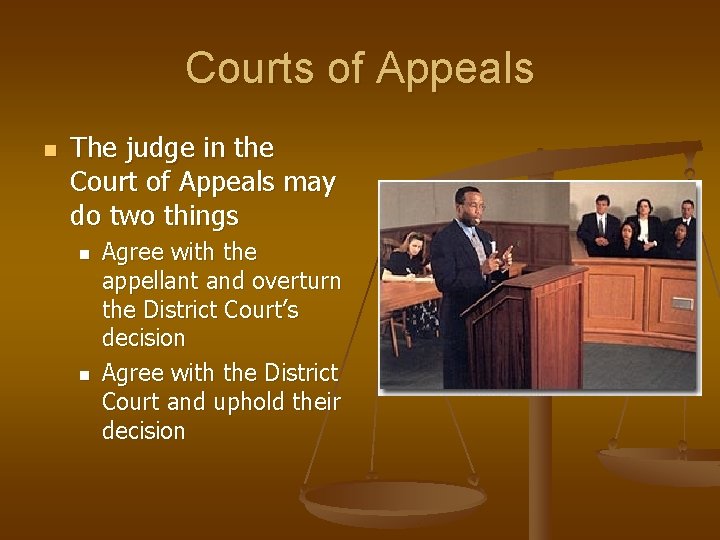
Courts of Appeals n The judge in the Court of Appeals may do two things n n Agree with the appellant and overturn the District Court’s decision Agree with the District Court and uphold their decision
Appealing to the Supreme Court n If you still believe that justice was not served, you can appeal to the Supreme Court. However, it probably will not hear your case because… n n It is very busy and needs to give sufficient time to each of its cases It may decide in a preliminary review that the lower court made the right decision
The Supreme Court n Court receives approximately 7, 000 petitions per year n n Only about 150 cases are heard by the Court Petitions are sifted through by law clerks and then voted on by Justices themselves n n 4 votes are required to hear the case In deciding whether to review a case, the Court considers: n n n whether the legal question was decided differently by two lower courts and needs resolution by a higher court whether a lower court decision conflicts with an existing Supreme Court ruling whether the issue could have broader social significance beyond the interests of the two parties involved
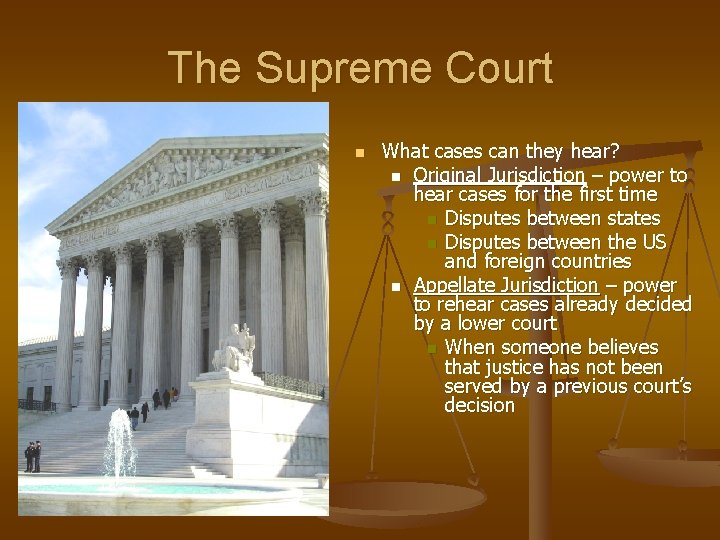
The Supreme Court n What cases can they hear? n Original Jurisdiction – power to hear cases for the first time n Disputes between states n Disputes between the US and foreign countries n Appellate Jurisdiction – power to rehear cases already decided by a lower court n When someone believes that justice has not been served by a previous court’s decision
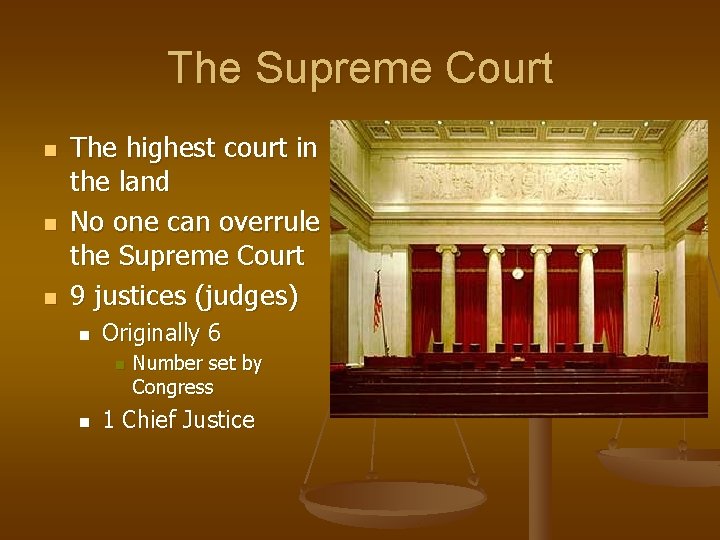
The Supreme Court n n n The highest court in the land No one can overrule the Supreme Court 9 justices (judges) n Originally 6 n n Number set by Congress 1 Chief Justice
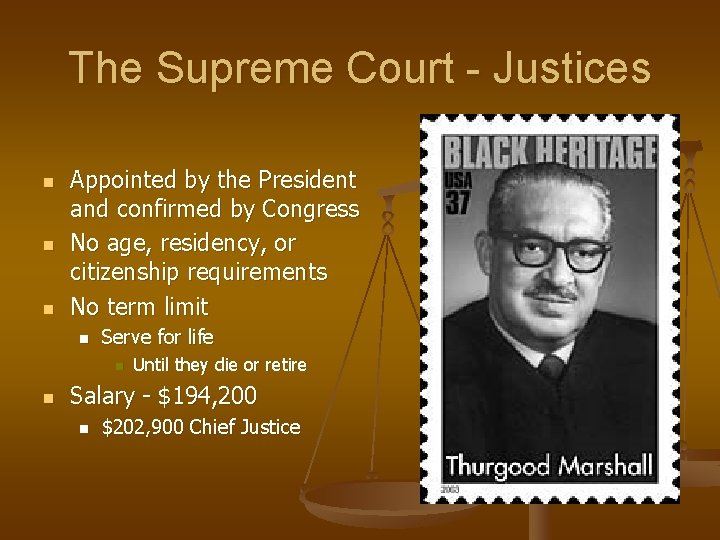
The Supreme Court - Justices n n n Appointed by the President and confirmed by Congress No age, residency, or citizenship requirements No term limit n Serve for life n n Until they die or retire Salary - $194, 200 n $202, 900 Chief Justice

The Supreme Court n n Serve under “good behavior” Can be impeached by Congress n n President Bush announcing new Chief Justice John Roberts Samuel Chase only Justice to be impeached No Supreme Court justice has ever been removed n Only a handful of Federal judges
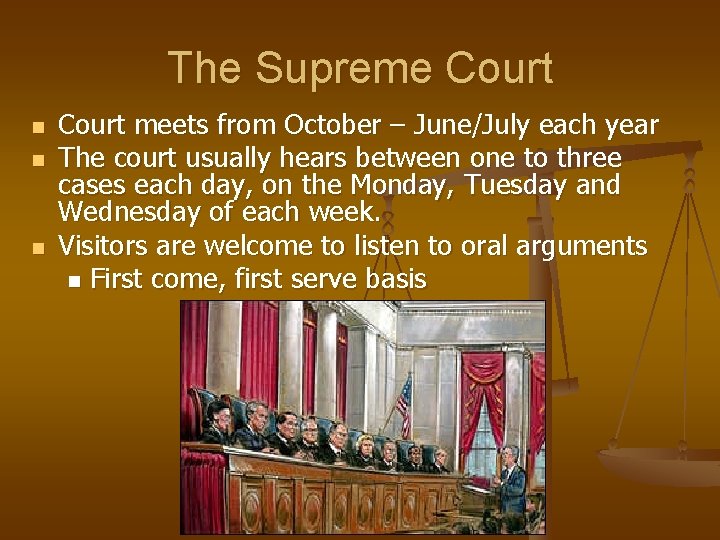
The Supreme Court n n n Court meets from October – June/July each year The court usually hears between one to three cases each day, on the Monday, Tuesday and Wednesday of each week. Visitors are welcome to listen to oral arguments n First come, first serve basis
The Supreme Court n n Each lawyer will get 30 minutes to argue before the court n They are faced with questions from justices Justices then meet in conference to discuss the arguments n n n After discussion, justices vote n Sometimes several rounds of voting The Chief Justice (or most senior justice) on the majority side writes (or assigns) majority opinion n Likewise for the minority A draft opinion is circulated throughout the justices n Justices may suggest revisions or additions n Justices may change their opinion during this time n n Justices may change their mind anytime before the courts decision is handed down Usually at the end of the session (May/June/July)
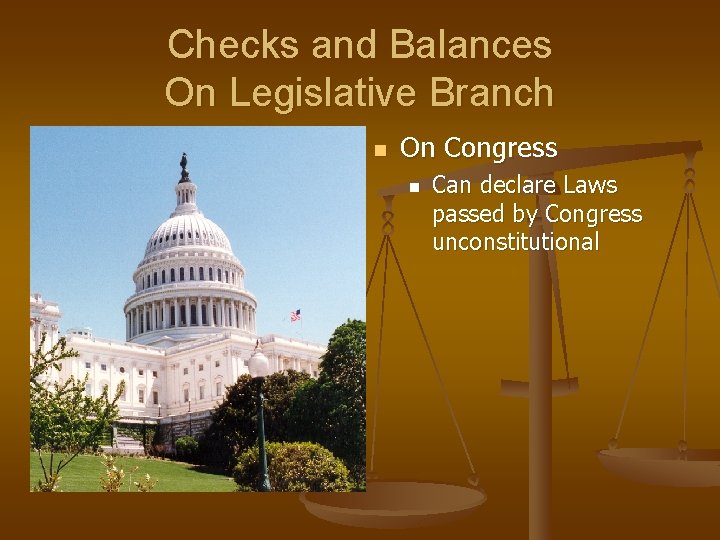
Checks and Balances On Legislative Branch n On Congress n Can declare Laws passed by Congress unconstitutional
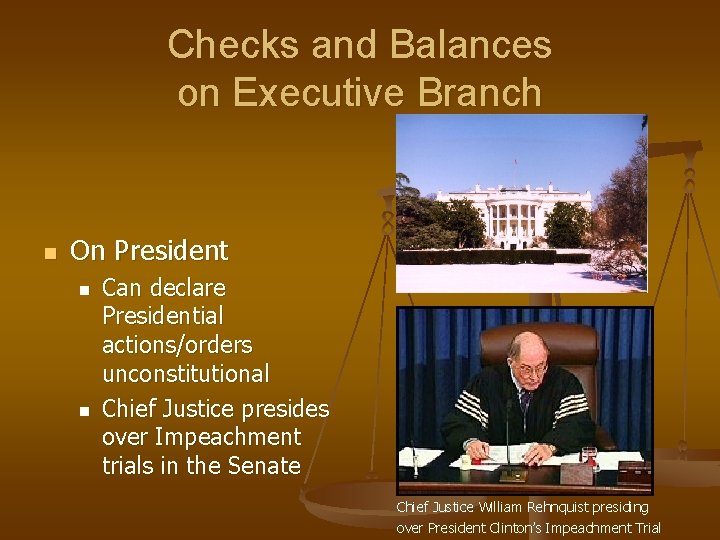
Checks and Balances on Executive Branch n On President n n Can declare Presidential actions/orders unconstitutional Chief Justice presides over Impeachment trials in the Senate Chief Justice William Rehnquist presiding over President Clinton’s Impeachment Trial
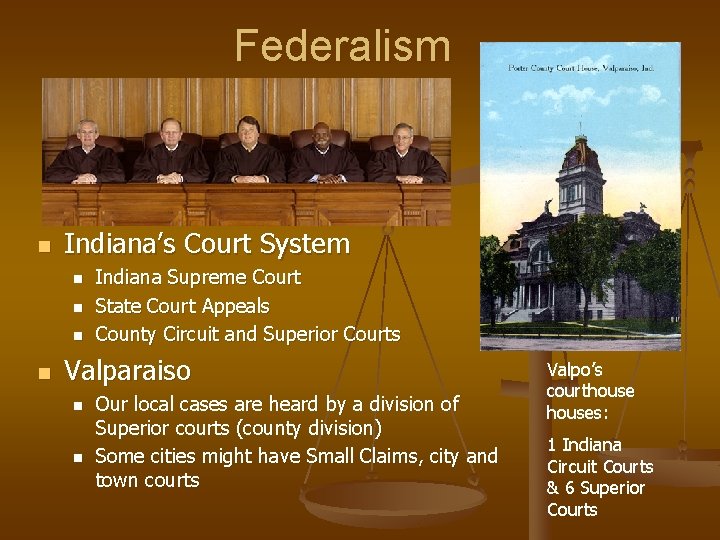
Federalism n Indiana’s Court System n n Indiana Supreme Court State Court Appeals County Circuit and Superior Courts Valparaiso n n Our local cases are heard by a division of Superior courts (county division) Some cities might have Small Claims, city and town courts Valpo’s courthouses: 1 Indiana Circuit Courts & 6 Superior Courts
- Slides: 18