
The Judicial Branch American Government Notes Dual Court
The Judicial Branch American Government Notes
Dual Court System n The U. S. has a dual court system, which means that we have federal and state courts that work side-by-side

State Courts Federal Courts
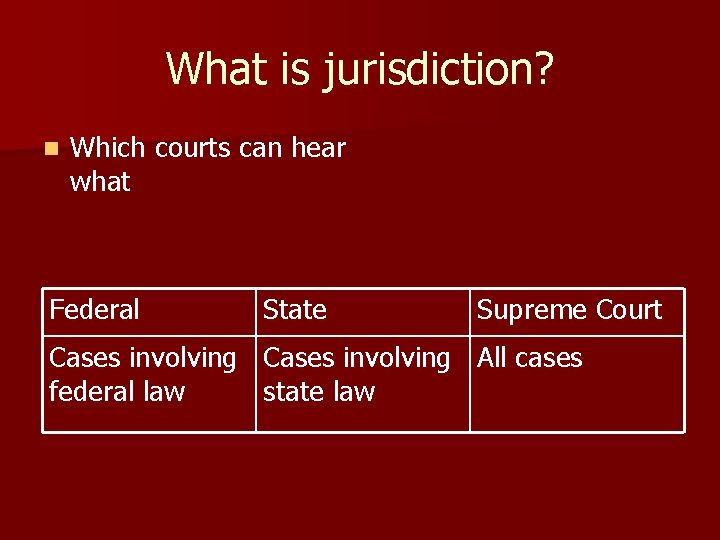
What is jurisdiction? n Which courts can hear what Federal State Supreme Court Cases involving All cases federal law state law
Marbury v. Madison n Establishes judicial review n The Supreme Court can declare acts of Congress unconstitutional n Makes Supreme Court an independent and equal branch of government
How does the Supreme Court decide cases? n The Supreme Court has both original and appellate jurisdiction BUT most cases are appeals from lower courts
Writ of certiorari n The party that lost an appeal in a lower court explains why the Supreme Court should hear the case n 4 out of the 9 justices must agree to hear the case. If not, the decision of the lower court stands.

Decisions of the Supreme Court n Majority opinion – Chief justice (or senior justice in the majority) explains ruling n Dissenting opinion – explains the argument of the minority n Concurring opinion – explains any differing arguments for the majority opinion
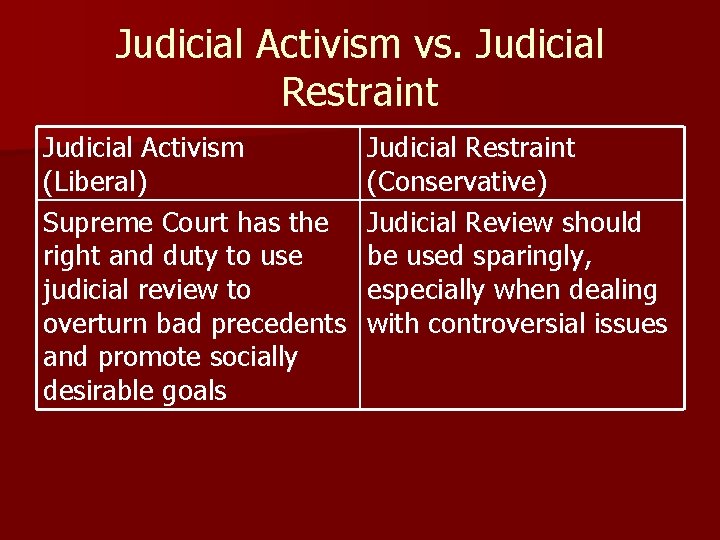
Judicial Activism vs. Judicial Restraint Judicial Activism (Liberal) Supreme Court has the right and duty to use judicial review to overturn bad precedents and promote socially desirable goals Judicial Restraint (Conservative) Judicial Review should be used sparingly, especially when dealing with controversial issues
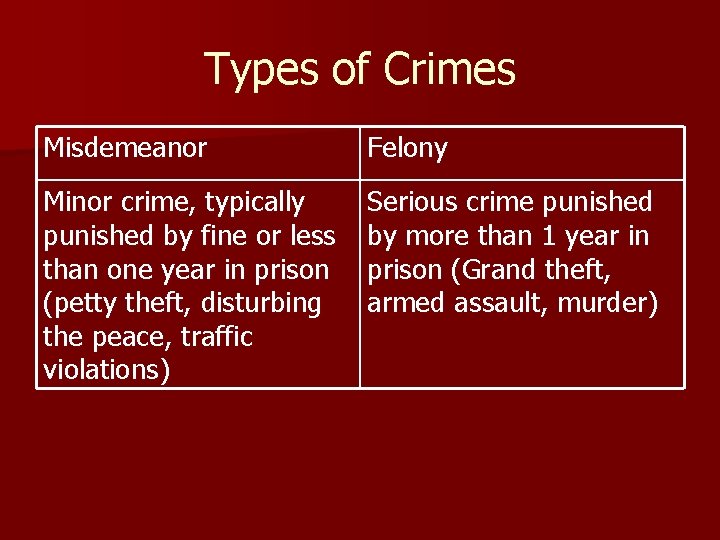
Types of Crimes Misdemeanor Felony Minor crime, typically punished by fine or less than one year in prison (petty theft, disturbing the peace, traffic violations) Serious crime punished by more than 1 year in prison (Grand theft, armed assault, murder)
Grand Jury n. A group of citizens who examine the evidence in a serious criminal case to decide whether a person accused of a crime should be indicted
Indictment n Formal accusation of criminal behavior handed down by a grand jury; means the accused will be brought to trial
Arraignment n Where person accused of crime is informed of charges and makes a plea of guilty or not guilty
Plea Bargain n Agreement in which the defendant (accused) pleas guilty for a lesser charge or sentence
Restitution n Offender pays victim for loses, damages or injuries resulting from a crime
Incarceration n Imprisonment for punishement for a crime
Due Process n The government cannot treat criminal suspects unfairly (you must be told about your charges and have right to a trial)
Miranda Rights n Miranda v. Arizona in 1966 upholds due process and protects your rights during an arrest and interrogation
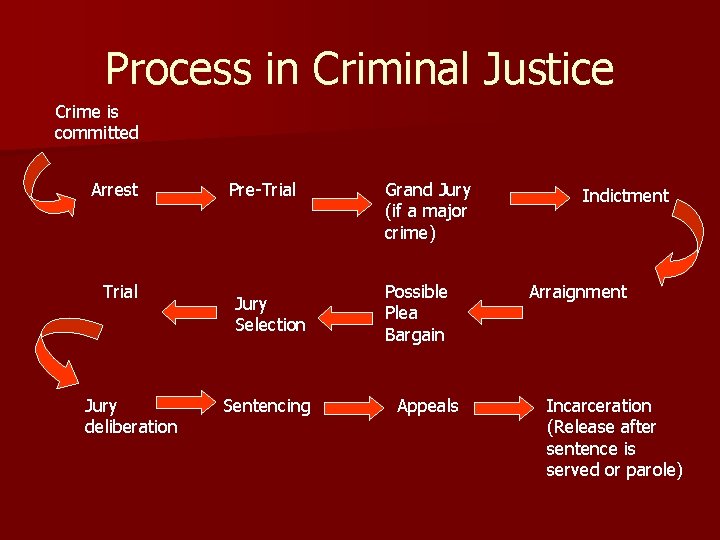
Process in Criminal Justice Crime is committed Arrest Trial Jury deliberation Pre-Trial Jury Selection Sentencing Grand Jury (if a major crime) Possible Plea Bargain Appeals Indictment Arraignment Incarceration (Release after sentence is served or parole)
- Slides: 20