
The Journey to Develop a Collaborative Leadership Model
The Journey to Develop a Collaborative Leadership Model at the Brant CAS October 13, 2011 1
The Historical Experience How & why Social Work in Child Welfare began and its Traditions…and changes � 1960’s � 1972 -2006 � Aboriginal Child Welfare-First Nations Governance � The role of counselling � Clinical Supervision � Relationship with Schools of Social Work � Best Practice and Training Developments 2
3. The Driving Force for Change Fortunately, changes arising from the Child Welfare Transformation of 2006 have revitalized this branch of the profession. What happened to support this revival? � Many long term Staff at Children’s Aid Society never lost touch with the values of Social work � Led by Bruce Rivers and two dozen seconded CAS Ministry staff they revised Child Welfare through MCYS’s “Secretariat”. Most were social workers. 3
Continued: � They were helped by the need to reduce costs including the fact that there were double children in care (19, 000) during Child Welfare Reform than there had been in 1999. � The risk focus was causing more cases to open especially in poorer communities. Something had to change. � Many long term employees along with new staff from schools of social work were having great job dissatisfaction with bureaucratic tasks and did not feel they were helping. 4
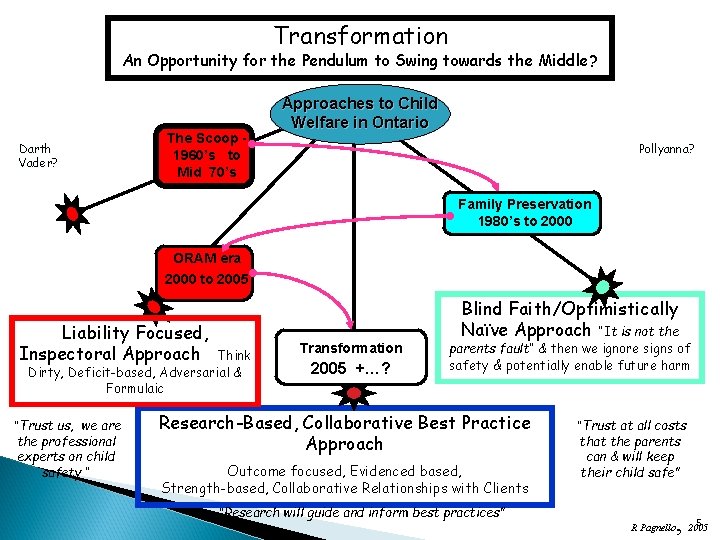
Transformation An Opportunity for the Pendulum to Swing towards the Middle? Darth Vader? The Scoop 1960’s to Mid 70’s Approaches to Child Welfare in Ontario Pollyanna? Family Preservation 1980’s to 2000 ORAM era 2000 to 2005 Liability Focused, Inspectoral Approach Think Dirty, Deficit-based, Adversarial & Formulaic “Trust us, we are the professional experts on child safety ” Transformation 2005 +…? Blind Faith/Optimistically Naïve Approach “It is not the parents fault” & then we ignore signs of safety & potentially enable future harm Research-Based, Collaborative Best Practice Approach Outcome focused, Evidenced based, Strength-based, Collaborative Relationships with Clients “Trust at all costs that the parents can & will keep their child safe” “Research will guide and inform best practices” R Pagnello , 20055
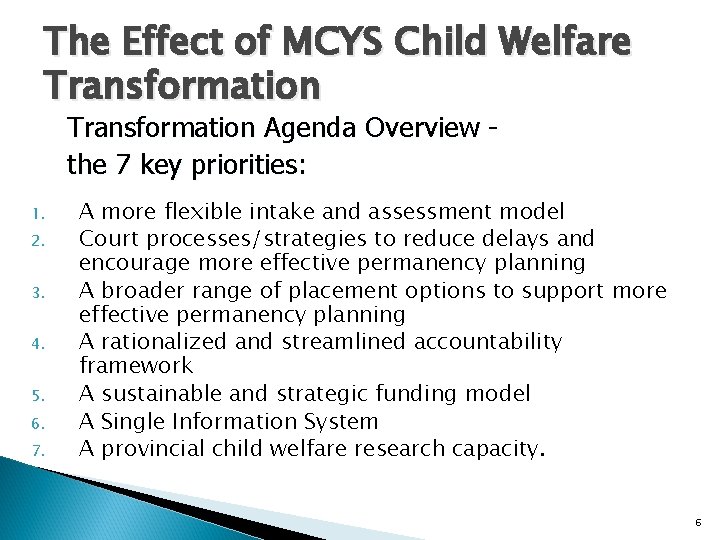
The Effect of MCYS Child Welfare Transformation Agenda Overview the 7 key priorities: 1. 2. 3. 4. 5. 6. 7. A more flexible intake and assessment model Court processes/strategies to reduce delays and encourage more effective permanency planning A broader range of placement options to support more effective permanency planning A rationalized and streamlined accountability framework A sustainable and strategic funding model A Single Information System A provincial child welfare research capacity. 6
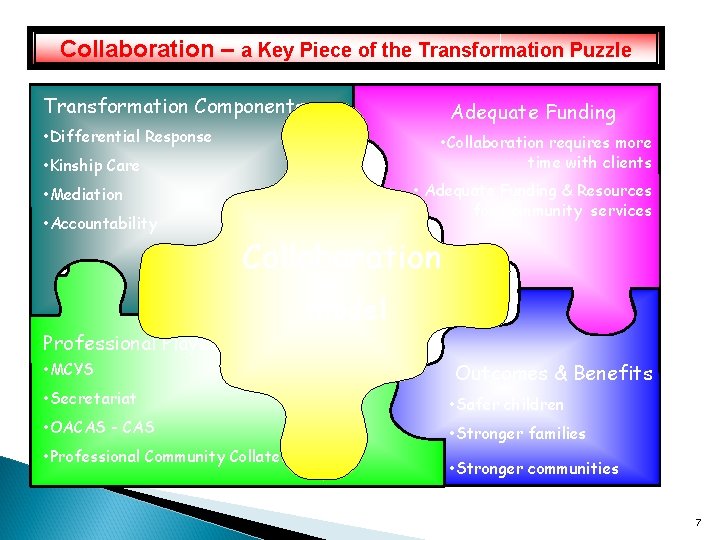
Collaboration – a Key Piece of the Transformation Puzzle Transformation Components Adequate Funding • Differential Response • Collaboration requires more time with clients • Kinship Care • Adequate Funding & Resources for Community services • Mediation • Accountability Collaboration Model Professional Players: • MCYS Outcomes & Benefits • Secretariat • Safer children • OACAS - CAS • Stronger families • Professional Community Collaterals • Stronger communities 7
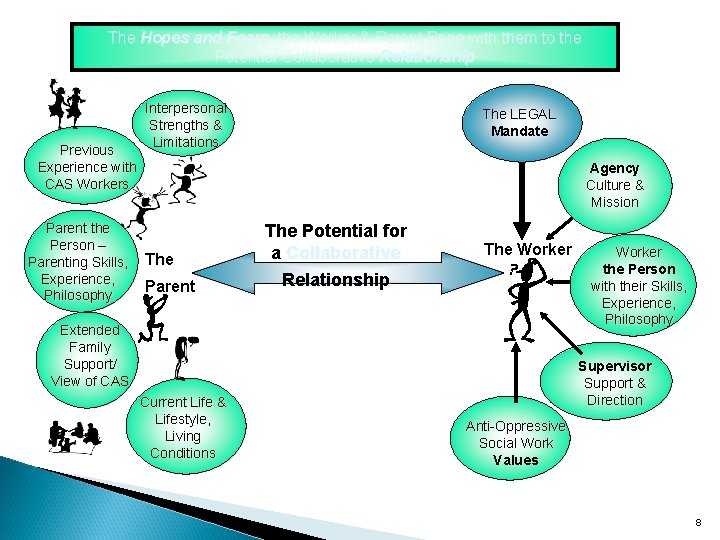
The Hopes and Fears the Worker & Parent Bring with them to the Potential Collaborative Relationship Previous Experience with CAS Workers Parent the Person – Parenting Skills, Experience, Philosophy Interpersonal Strengths & Limitations The LEGAL Mandate Agency Culture & Mission The Parent The Potential for a Collaborative Relationship The Worker Extended Family Support/ View of CAS Current Life & Lifestyle, Living Conditions Worker the Person with their Skills, Experience, Philosophy Supervisor Support & Direction Anti-Oppressive Social Work Values 8
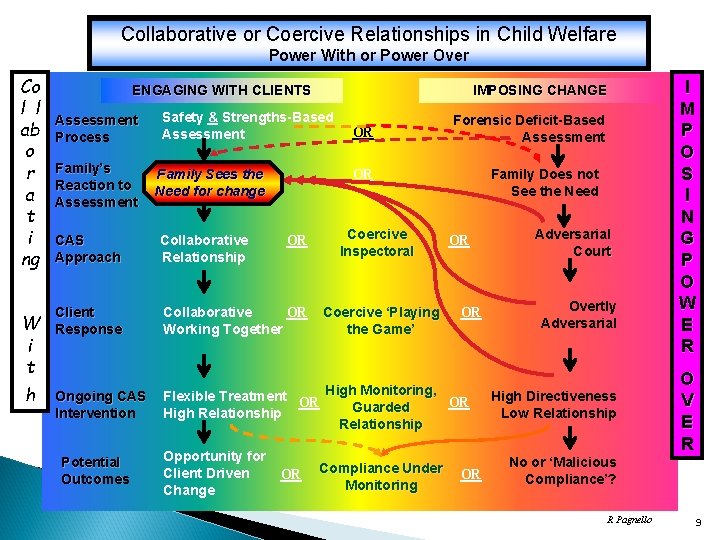
Collaborative or Coercive Relationships in Child Welfare Power With or Power Over Co l l ab o r a t i ng W i t h ENGAGING WITH CLIENTS Assessment Process Family’s Reaction to Assessment IMPOSING CHANGE Safety & Strengths-Based Assessment Family Sees the Need for change OR Forensic Deficit-Based Assessment Family Does not See the Need OR Coercive Inspectoral CAS Approach Collaborative Relationship Client Response OR Collaborative Working Together Ongoing CAS Intervention Flexible Treatment OR High Monitoring, OR Guarded High Relationship Potential Outcomes Opportunity for Client Driven Change OR OR Coercive ‘Playing the Game’ Compliance Under Monitoring OR OR OR Adversarial Court Overtly Adversarial High Directiveness Low Relationship I M P O S I N G P O W E R O V E R No or ‘Malicious Compliance’? R Pagnello 9
Where we began in 2006… The Groundswell in the field for a move back to core social work principles and values has been increasingly evident � the benefits of Reform but concerns about the mechanistic nature of Reform & ORAM � The feeling that the mechanistic & prescriptive nature of child welfare reform went too far in influencing service to be liability focused rather than outcome focused. � Needing to make changes in how workers had been trained in order to enhance a strength-based approach � 10
Vision, Values and Guiding Principles § § § Better Outcomes for children and families through collaboration vs. imposition – child safety remains our highest priority Sustainable change “A person convinced against their will is of the same opinion still” Fewer litigated interventions Fewer children & youth placed in institutional settings Higher job satisfaction for social workers 11
Continued: � Relationship – the cornerstone of the model � Collaboration – we can’t do this alone � Hopes & Fears – a key to understanding � Anti-oppression – use of power/authority � Diversity – Ontario, a diverse place to practice � Organizational culture – parallel process, servant leadership, decrease hierarchy � Continual Learning – Curriculum development needs � Research Informing Best Practices – Review of Approaches including Signs of Safety 12
The Mandated Role Today Through Section 15 (3) of the CFSA. all child welfare agencies are legislated to: � Investigate allegations of abuse and neglect; � Protect children where necessary, and provide guidance, counselling and other services to families for protecting children and for the prevention of circumstances requiring the protection of children; � Provide care or supervision for children assigned to its care; and � Place children for adoption. 13
Clinical Counselling in Child Welfare continued: Counselling modalities used as a result of a worker survey provincially: � Crisis Intervention � Cognitive Behavioural Therapy � Motivational Interviewing � Solution-Focused Therapy � Narrative Therapy � Miiyowbin (Wraparound) Process
Clinical Counselling in Child Welfare Has to be…. . � Strengths-based � Empowerment focused � Client-centered � Evidence-based � Brief � Commonly used � Change-oriented � Culturally sensitive
Aboriginal Focus Group Input on Collaboration § Workers need to know…“Need to have workers aware of the history of child welfare and First Nations”…each community is unique & requires different methods due to unique teachings in that community. ” “Importance of extended family & community. ” § Skills needed …“Open minded – empathy; focus on the positive –not just weaknesses; respectfulness; humour; build trust-advocacy; relationship-building; 7 Sacred Gifts; recognize you are a guest in someone’s home” 16
Aboriginal Focus Group Survey Themes §The impact of history/colonization on First Nations People – themes of multigenerational problems inherent in the community level; weakening & destruction of traditional values & practices; oppression; racism; prejudice & poverty. §The history of child welfare and Aboriginal people – a pervasive lack of trust of the child welfare system; the imposition of western standards and euro centric values on Aboriginal people and communities. §First Nations as equal partners – society must understand the role of First Nations and rights & responsibilities of Part X of the CFSA; 127 First nations communities each being an individual & unique entity. ; responsibility exits to understand each community, its values and ways of living; urban vs. traditional way of living and belief system. 17
Diversity §Engage in critical self-reflective practice as a way to build better communication links with clients and this will build better respect for clients and their culture, as workers aim to demonstrate patience and humility in their everyday work §Use an anti-racism/anti-oppression approach to practice in order to break down the barriers in building effective working relationships. §June Ying Yee, Associate Professor, School of Social Work, Ryerson University §Emmanuel Antwi, Michael Ansu, Greta Liupakka Judith Wong, Peel Children’s Aid Society 18
Diversity continued: § § Do more advocacy for social justice as many of the clients come from oppressed and marginalized communities with race, class, gender and ability/disability issues mediating their personal experiences Seek help from community based organizations such as churches, temples, mosques as there are strengths within communities and families that can be capitalized upon 19
Questions? 20
- Slides: 20