
The Joint Research Centre and the power of

- Slides: 20
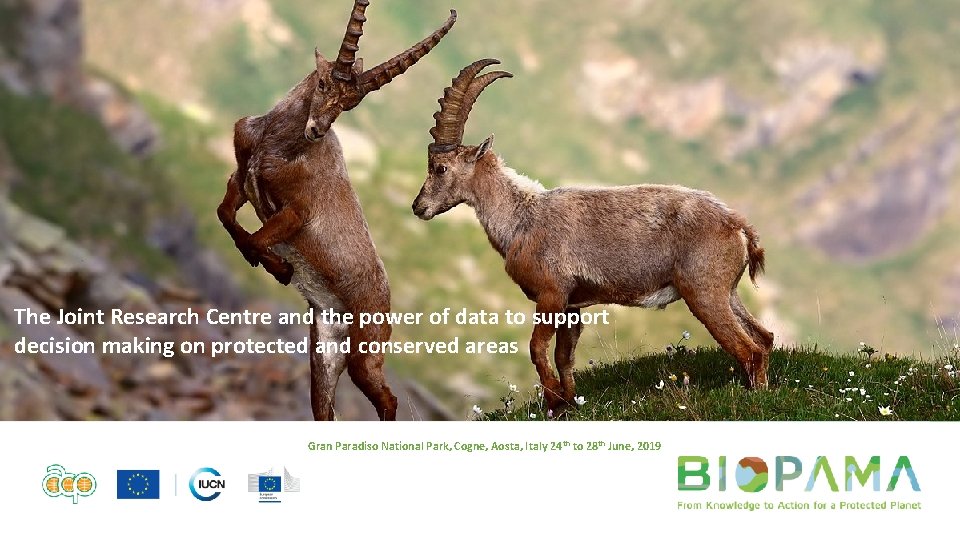
The Joint Research Centre and the power of data to support decision making on protected and conserved areas Gran Paradiso National Park, Cogne, Aosta, Italy 24 th to 28 th June, 2019
Achieving Fair and Effective Protected Areas - A Global Workshop Gran Paradiso National Park, Cogne, 24 th to 28 th June, 2019 The Joint Research Centre and the power of data to support decision making on protected and conserved areas 1. What is the Joint Research Centre? 2. JRC and Knowledge Management for biodiversity conservation 3. Focus on BIOPAMA 4. A central role for the users and for the BIOPAMA Regional Observatories 5. Our expectations for this workshop
1. What is the JRC?
JRC – the European Commission Joint Research Centre: who we are, what we do As the science and knowledge service of the Commission our mission is to support EU policies with independent evidence throughout the whole policy cycle • Make accessible data and information for better decisions • Show the value and the power of data and of their visualisation • Promote clear data standards, data sharing and open access tools • Work with partners, engage with people, learn from experiences
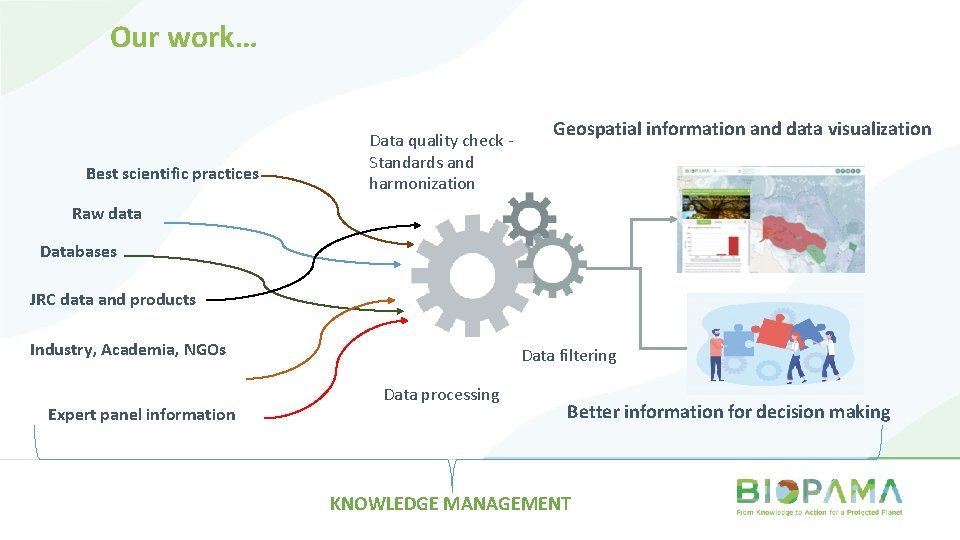
Our work… Best scientific practices Data quality check Standards and harmonization Geospatial information and data visualization Raw data Databases JRC data and products Industry, Academia, NGOs Expert panel information Data filtering Data processing Better information for decision making KNOWLEDGE MANAGEMENT
po li ng pp o su ng • GMES&Africa and the e-Station s ion cis de ce • Water Surface Tool ivi dr rti JRC and BIODIVERSITY ge ien led ow Sc The Digital Observatory for Protected Areas (DOPA) • Copernicus and the Global Land Service: Vegetation, Energy, Water, Cryosphere, Hot spots ground based, … Kn cy 2. JRC and Knowledge Management for biodiversity conservation • World leader in geospatial applications for policy • Biodiversity and Protected Area Management Programme - BIOPAMA
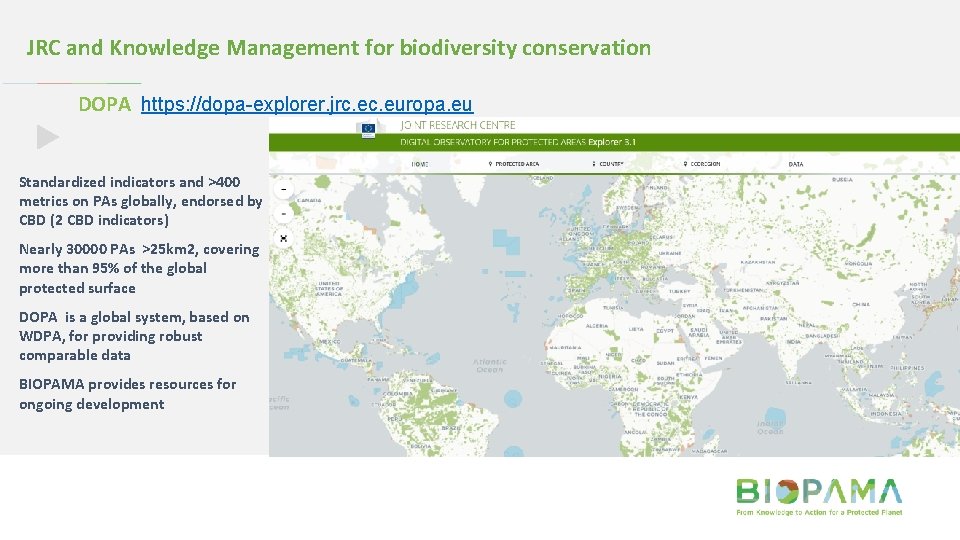
JRC and Knowledge Management for biodiversity conservation DOPA https: //dopa-explorer. jrc. europa. eu Standardized indicators and >400 metrics on PAs globally, endorsed by CBD (2 CBD indicators) Nearly 30000 PAs >25 km 2, covering more than 95% of the global protected surface DOPA is a global system, based on WDPA, for providing robust comparable data BIOPAMA provides resources for ongoing development
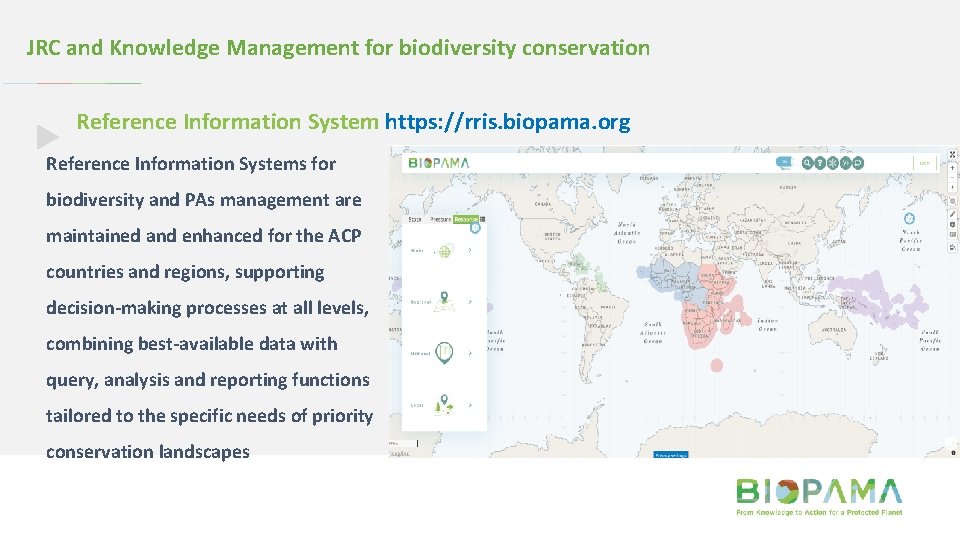
JRC and Knowledge Management for biodiversity conservation Reference Information System https: //rris. biopama. org Reference Information Systems for biodiversity and PAs management are maintained and enhanced for the ACP countries and regions, supporting decision-making processes at all levels, combining best-available data with query, analysis and reporting functions tailored to the specific needs of priority conservation landscapes
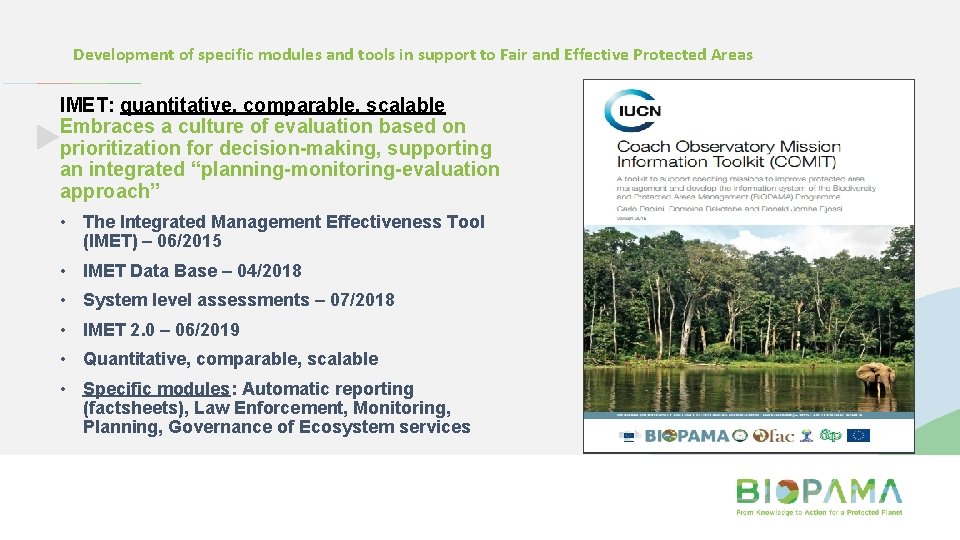
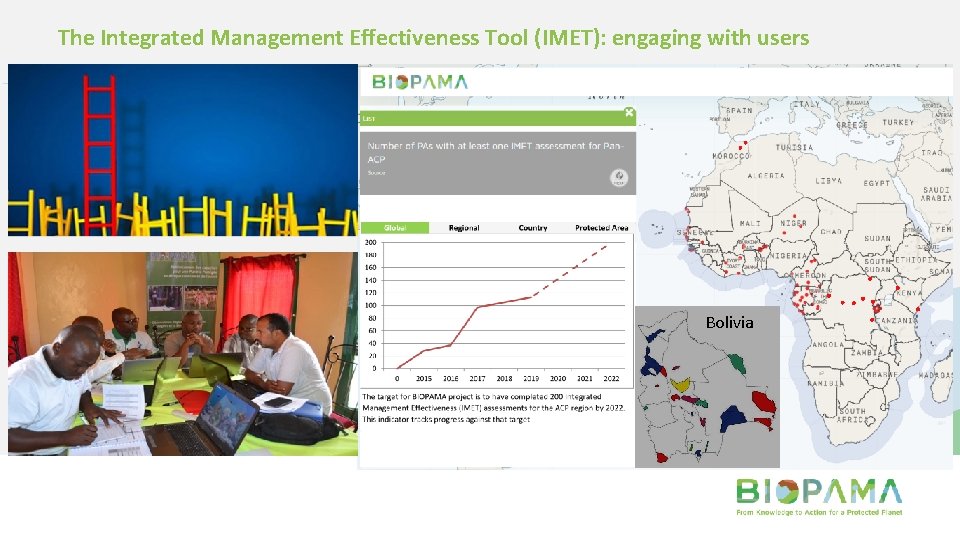
Development of specific modules and tools in support to Fair and Effective Protected Areas IMET: quantitative, comparable, scalable Embraces a culture of evaluation based on prioritization for decision-making, supporting an integrated “planning-monitoring-evaluation approach” • The Integrated Management Effectiveness Tool (IMET) – 06/2015 • IMET Data Base – 04/2018 • System level assessments – 07/2018 • IMET 2. 0 – 06/2019 • Quantitative, comparable, scalable • Specific modules: Automatic reporting (factsheets), Law Enforcement, Monitoring, Planning, Governance of Ecosystem services
3. Focus on the Biodiversity and Protected Areas Management Programme (BIOPAMA)
BIOPAMA: from BIOPAMA 1 to BIOPAMA 2… • Reinvigorating concepts and importance of Governance and Management • Integrating the best available data, tools, standards and practices to better analyze and support fair and effective PAs, from diagnosis to action • Recognizing the importance of structured datasets and the need for new assessments to “feed” the Regional Observatories • Reassertion of a central role for the Regional Observatories and for the interaction with the users • Regional management effectiveness reviews: Caribbean, 2018 – E&SA and Pacific, 2019; W&CA, strong emphasis on IMET from 2016 • Strong focus on ownership and capacity building (the example of C&WA)
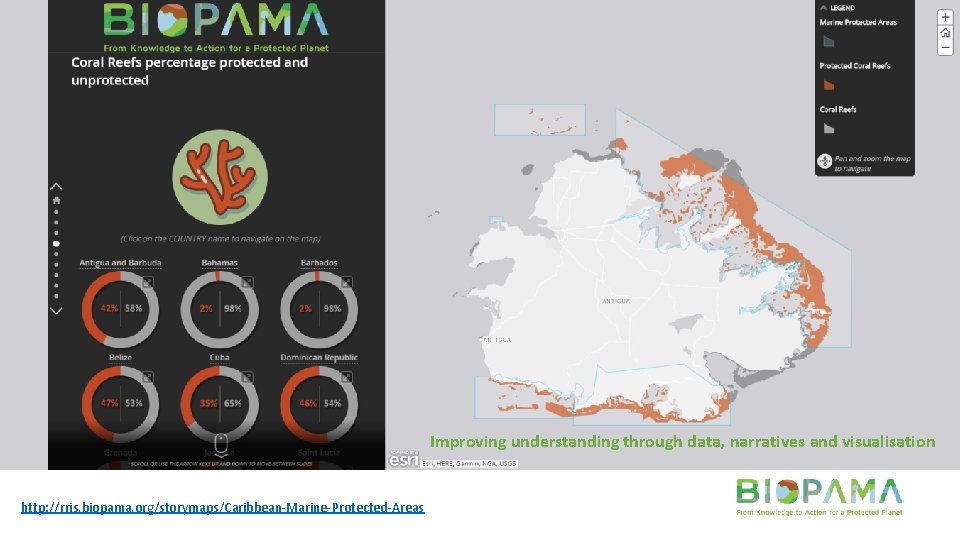
Improving understanding through data, narratives and visualisation http: //rris. biopama. org/storymaps/Caribbean-Marine-Protected-Areas
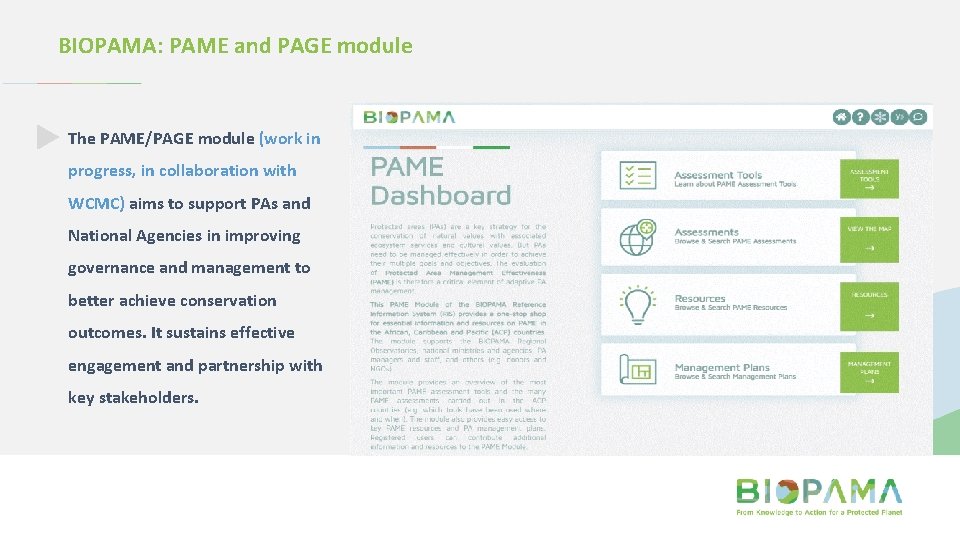
BIOPAMA: PAME and PAGE module The PAME/PAGE module (work in progress, in collaboration with WCMC) aims to support PAs and National Agencies in improving governance and management to better achieve conservation outcomes. It sustains effective engagement and partnership with key stakeholders.
The Integrated Management Effectiveness Tool (IMET): engaging with users Bolivia
4. A central role for the users and for the BIOPAMA Regional Observatories
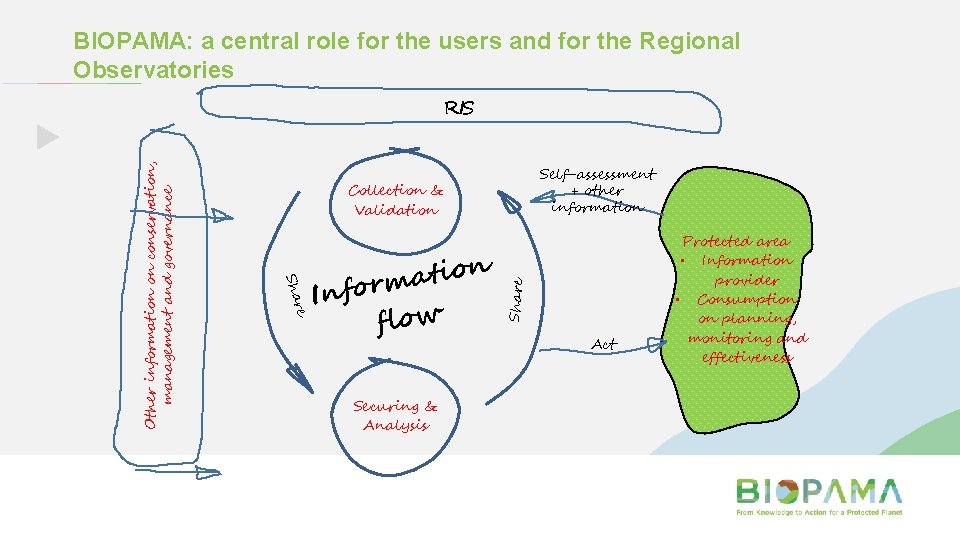
BIOPAMA: a central role for the users and for the Regional Observatories üTo establish and maintain a gateway to data and tools for managers and policy-makers üTo provide an update for the regional actors and partners towards capacity building üTo support decision-makers for more effective protected area management and biodiversity conservation in the ACP regions, through analytical products and Decision Support Systems (DSS)
BIOPAMA: a central role for the users and for the Regional Observatories Self-assessment + other information e on i t a m Infor flow Securing & Analysis Share Collection & Validation r Sha Other information on conservation, management and governance RIS Act Protected area • Information provider • Consumption on planning, monitoring and effectiveness
5. Our expectations for this workshop
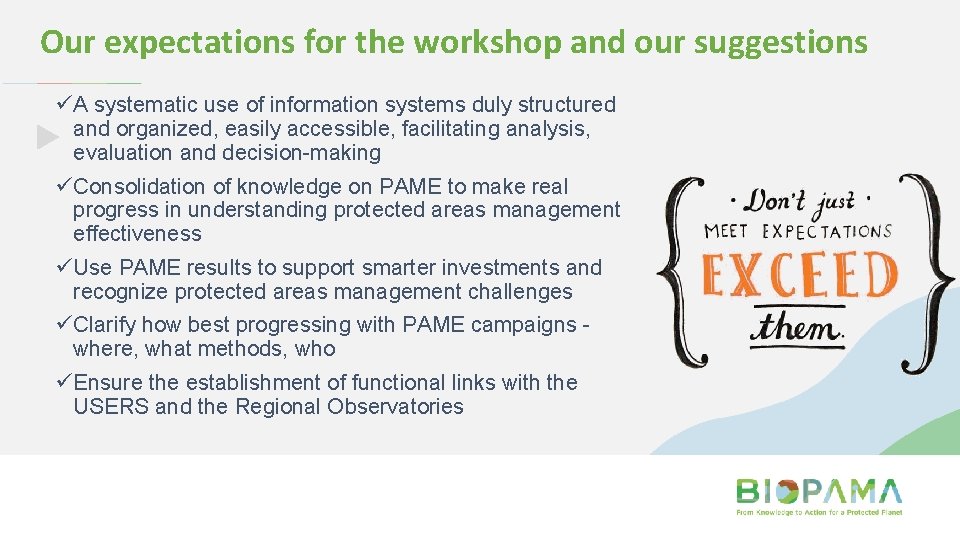
Our expectations for the workshop and our suggestions üA systematic use of information systems duly structured and organized, easily accessible, facilitating analysis, evaluation and decision-making üConsolidation of knowledge on PAME to make real progress in understanding protected areas management effectiveness üUse PAME results to support smarter investments and recognize protected areas management challenges üClarify how best progressing with PAME campaigns where, what methods, who üEnsure the establishment of functional links with the USERS and the Regional Observatories
The Biodiversity and Protected Areas Management Programme (BIOPAMA) is an initiative of the ACP Group of States financed by the European Union's 11 th EDF.