
The Joint Commission Community Based Palliative Care Certification
The Joint Commission Community Based Palliative Care Certification Presented by: Julia S. Finken, BSN, MBA, CPHQ, CSSBB Assoc. Director, Business Dev. 630 -792 -5283 jfinken@jointcommission. org 1
Objectives • Define important tenants of Community Based Palliative Care Services • Outline key milestones in the development of the Joint Commission Community Based Palliative Certification program. • Highlight the key elements of the Community Based Palliative Certification survey process • List critical Community Based Palliative Care Certification Standards • State important lessons learned during the Community Based Palliative Care Certification pilot surveys and completed organization surveys 2
Background • Growth of Palliative Care Services • TJC Advanced Palliative Care Certification Program • Inception of Community Based Palliative Care Certification Program 3
Development Process • • • Call to Action Industry Survey Discussions with Key Industry Stakeholders Focus Surveys with Key Palliative Care Services Providers TJC Program Approval Process TAP Committee Development of CBPC Certification Standards Key Stakeholder Standards Review and Revisions Site Visits Pilot Surveys 4

Program Design Options Community-based Palliative Care Independent organization Provided along with HH care Separate service line of HH or Hospice Affiliated with a hospital or health system Affiliated with physician/ practice
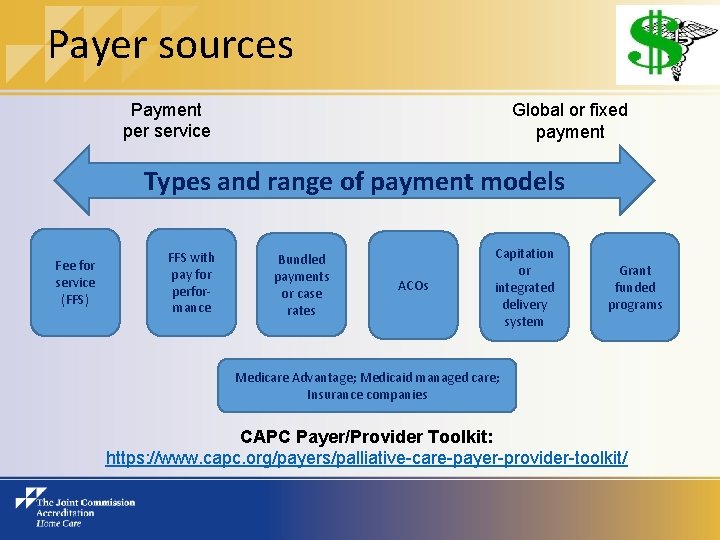
Payer sources Payment per service Global or fixed payment Types and range of payment models Fee for service (FFS) FFS with pay for performance Bundled payments or case rates ACOs Capitation or integrated delivery system Grant funded programs Medicare Advantage; Medicaid managed care; Insurance companies CAPC Payer/Provider Toolkit: https: //www. capc. org/payers/palliative-care-payer-provider-toolkit/
TJC Regulatory and Payer Advocacy • HR 3119: Palliative Care and Hospice Education and Training Act; Introduced by Rep. Eliot Engel (D-NY) • S 1549: The Care Planning Act of 2015; Introduced by Senator Mark Warner (D-VA) • S 1574: The CARE Act (Companion to House Bill); Introduced by Senator Jeff Merkley (D-OR) • 8 additional bills with some relevance to Palliative Care 7
Payer and Regulatory Resources • Aetna – www. aetna. com • Excellus Blue Cross Blue Shield www. excellusbcbs. com • Highmark Inc. - www. highmark. com • Robert Wood Johnson Foundation - www. rwjf. org • CMS Innovation Center – www. innovation. cms. gov • Gov Track https: //www. govtrack. us/congress/bills/114/hr 220 8
The Joint Commission Community Based Palliative Care Certification for Home Care Eligibility Requirements • Home Health and/or Hospice organizations that elect to apply for CBPC Certification must meet the following: § All General Eligibility Requirements currently in the Home Care manual (ACC chapter) § All new CBPC Eligibility Requirements
Eligibility Requirements (cont'd. ) New: A Home Health or Hospice organization qualifies for Home Care Community Based Palliative Care Certification under the following conditions: • Org is TJC Home Care accredited (HH and/or Hospice) • Able to provide CBPC services 24/7 as needed • Had 5 CBPC patients/last 12 months; 3 active on survey • CBPC services provided in patient's residence • Org utilizes clinical practice guidelines to provide CBPC services https: //www. jointcommission. org/accreditation/home_care_accreditation. aspx
Examples of Eligible Organizations • HH and/or Hospice organization seeking initial accreditation may also include CBPC Certification in their initial survey • HH and/or Hospice organization may include CBPC Certification in their triennial survey • HH and/or Hospice accredited organization may choose to schedule a CBPC Certification Extension survey prior to their next triennial survey
Lessons learned: Tips for Certification Success If your organization is considering becoming certified in CBPC: • Take time to build your program (if not already in place); organizations that have been providing CBPC services for at least 6 -12 months or longer are more likely to do well on the survey. • Review the eligibility criteria prior to applying • Compare your program/policies to the Certification requirements to be sure you are in compliance • Each organization’s CBPC program is different – that’s ok! • When you apply, complete the CBPC Organization Self. Assessment tool, to be sure you are “ready” for the survey

CBPC Certification Standards Chapters in the Home Care manual with CBPC Certification standards: Accreditation Participation Requirements (APR) Human Resources (HR) Information Management (IM) Leadership (LD) Provision of Care (PC) Performance Improvement (PI) Record of Care (RC) Rights and Responsibilities (RI)
Human Resources - IDT HR. 01. 02. 07, EP 10 For organizations that elect The Joint Commission Community-Based Palliative Care Certification option: The program’s core interdisciplinary team is comprised of the following: - Physician(s) (doctor of medicine or osteopathy) who has specialized training in palliative care and/or hospice care; clinical experience in palliative medicine and/or hospice care; or is board-certified or boardeligible for certification in Hospice and Palliative Medicine - Registered nurse(s) or advanced practice nurse(s) who has training in palliative care and/or hospice care; clinical experience in hospice or palliative care; or one who has, or is eligible for, palliative care certification - Chaplain(s) who has training in palliative care and/or hospice care; experience in hospice or palliative care; or one who has or is eligible for board certification; or, a spiritual care professional(s)* who has training in palliative care and/or hospice care or experience in hospice or palliative care Note: The program may choose to have a full- or part-time chaplain or spiritual care provider on staff; they may utilize a chaplain from another program within the organization, such as the hospital or hospice; or, they may utilize chaplains and/or spiritual care providers from other organizations in the local community, including parish nurses. The patient also has the right to involve his or her personal spiritual care provider (such as a pastor, priest, rabbi, or religious leader) rather than the program's chaplain.
Human Resources - IDT (cont'd) HR. 01. 02. 07, EP 10 (cont'd) - Social worker(s) who has training in palliative care and/or hospice care; experience in hospice or palliative care; or one who has, or is eligible for, palliative care certification Note: The program may choose to have a full- or part-time social worker on staff; they may utilize a social worker from another program within the organization, such as the hospital or hospice; or, they may utilize social workers from other organizations in the community if they are available. Footnote *: Spiritual care professionals are recognized as specialists who provide spiritual counseling. Source: Dahlin, C. , editor, The National Consensus Project for Quality Palliative Care Clinical Practice Guidelines for Quality Palliative Care, 3 rd edition, 2013, p. 26.

Critical Standards/EPs for CBPC HR. 01. 02. 01, EP 27 -29 Staff with PC education/ experience HR. 01. 02. 07, EP 12 IDT responsibilities in writing HR. 01. 04. 01, EP 24 Staff orientation - content for PC HR. 01. 06. 01, EP 27 Competency in providing PC LD. 04. 03, EP 34 Process to refer patients to hospice LD. 04. 01, EP 27 Written PI plan LD. 04. 09, EP 7 Use of CPGs PC. 01. 01, EP 49 Process to identify CBPC patients PC. 01. 02. 01, EPs 46 -52 Initial assessments by IDT members RI. 01. 05. 01, EP 23 Advance care planning discussions
Deciding to pursue CBPC Certification Organizations that decide to pursue CBPC Certification can do so in one of three ways: • Include CBPC on your Initial application for Home Health and/or Hospice Accreditation • Update the e-App to add CBPC at the time of your next on-site survey (one day will be added to the onsite survey) • Update the e-App for a one-day extension survey to be done between accreditation surveys • Call your account executive for assistance
Resources Clinical Practice Guidelines: Dahlin, C. , editor, The National Consensus Project for Quality Palliative Care Clinical Practice Guidelines for Quality Palliative Care, 3 rd edition, 2013 National Hospice and Palliative Care Organization (NHPCO), Standards of Practice for Pediatric Palliative Care and Hospice, 2010 Books/Article: Leff, B. , Carlson, C. , Saliba, D. , Ritchie, C. The invisible homebound: Setting quality of care standards for home-based primary and palliative care. Health Affairs 2015, 34 (1), p. 21 -29. Bookbinder, M and Mc. Hugh, M. (2010). Symptom Management in Palliative Care and End-of-Life Care. Margaret M. Mahon (ed) in Nurs Clin N Amer 45: 271 -327. Supplement. Bullock, K. . (2011). Advance Directives from a Social Work Perspective: Influence of Culture and Family Dynamics. In Oxford Textbook of Palliative Social Work. Eds. Terry Altilio and Shirley Otis-Green. Oxford: Oxford University Press, pp. 625 -636. Professional Organizations: American Academy of Hospice and Palliative Medicine (AAHPM) www. aahpm. org Center to Advance Palliative Care (CAPC) www. capc. org Hospice and Palliative Nurses Association (HPNA) www. hpna. org National Hospice and Palliative Care Organization (NHPCO) www. nhpco. org CAPC Payer/Provider Toolkit: https: //www. capc. org/payers/palliative-care-payer-provider-toolkit/ Information about Joint Commission CBPC Certification for Home Care: https: //www. jointcommission. org/accreditation/home_care_accreditation. aspx
Resources for CBPC quality measures Websites: http: //aahpm. org/quality/measuring-what-matters http: //www. qualityforum. org/News_And_Resources/Press_Releases/201 2/NQF_Endorses_Palliative_and_End-of-Life_Care_Measures. aspx http: //www. nhpco. org/performancemeasures https: //www. jointcommission. org/new_perf_measures_adv_certification _palliative_care/
CBPC Program Framework and Survey Requirements
Define Palliative Care Population • Establish your CBPC patient eligibility criteria • Acknowledge patients receiving CBPC services • Ability to generate a patient list
Operations • Program should be fully operational for at least 6 months to one year prior to survey • Palliative Care Clinical Practice Guidelines (CPG) identified & utilized • Identified staff who participate/provide palliative care services • IDT established and core members are actively involved with care of designated CBPC patients • 24/7 on call support available/ functional
Staff Development • Orientation to CBPC program • Education about CPG • Competency assessment of CBPC staff • Considerations: • Designated team • All staff • Documentation available for surveyor
CBPC Data • Data Elements identified • Four measures required (survey) ü Two clinical measures ü Two non clinical measures • Four months of data history required (on initial CBPC survey) • Data collection • Data analysis • Improvements initiated • Data available at time of survey
CBPC data • Examples of non-clinical data to collect and monitor (use what you already collect!) • Referrals and admissions • Types and totals of visits • Diagnoses • Readmission rate • Number of ED visits, reason for visits • Patient/caregiver satisfaction • Number of patients transitioned to hospice • Discharge/transfer disposition
CBPC clinical quality measures • Examples of quality measures for CBPC: • Pain screening and assessment • Pain improvement • Dyspnea screening • Dyspnea improvement • Discussion of advance care planning (treatment preferences)
Patient Care Requirements • CPG identified and utilized • Patient education materials developed and utilized • CBPC plan of care • This may be separate or inclusive with the home health plan of care • If embedded, it must: üSpecify palliative care needs or interventions üHave specific measurable CBPC goals
CBPC and the Deemed Survey Palliative Care patients managed within a Medicare certified program • Home Health organizations • Comply with Co. Ps • CBPC requirements are additional component • Hospice organizations • Verify the CBPC patient is separately managed NOT a hospice patient
Survey Process: What Will it Look Like? On-site full survey for a HH and/or Hospice organization that choose the CBPC Certification option: • Agenda similar to current agenda surveyor(s) will evaluate all services including CBPC throughout the survey • Orientation to the organization will include time for the organization to explain their CBPC program/services • All services (including CBPC) will be addressed in system sessions, including Leadership, Emergency Management, Environment of Care, Infection Control, Medication Management; the Data System Tracer will allow time for the organization to present Performance Improvement data and information for CBPC • Session re: Credentialing of LIPs will be added to the Competency session • Time will be allotted to meet with the IDT members • Time will be allotted for CBPC patient tracers/ home visits
Survey Requirements Documentation of specific CBPC activities available for review at time of survey • CBPC program criteria and CPG • Patient List • Plan of care for each patient • IDT activities • HR file documentation • Performance measures and data analysis
Tips for Program Implementation • Decision whether to start small; control volume; tailor criteria • Education (initial and on-going); Hospice/Palliative Care experts participate in training. • Structure for IDT; core team members; frequency • Modifications to Home care electronic medical record, including IDT Template. • Review current policies/tailor as needed including: admission policies; on-call policies; pain management; assessment/reassessment policy.
Some Potential Tools • Redefinition of the plan of care for CBPC; create an IDT Collaboration Note which pulls electronically to Plan of Care • Modification of the problem file in EMR; create problem file specific to palliative care, example spiritual distress • Adjust criteria for IDT presentation; initial and ongoing • Develop patient satisfaction survey specific to CBPC; separate from HHCAHPS • Welcome letter summarizing program to be sent to primary physicians.
Potential Measurement of Outcomes Develop a monitoring tool specific to CBPC with focus on: • Symptom management protocols • Re-hospitalizations/emergent care • Advance directives • Adherence to IDT criteria • Timely referrals to hospice and/or specialistlevel Palliative Care • Patient Perception of Care

Time for Your Questions!
Home Care Team Contacts Joint Commission Home Care Program Help Desk: 630 -792 -5070 or homecare@jointcommission. org www. jointcommission. org/accreditation/home_care. aspx Margherita Labson BSN, MSHSA, CPHQ, CCM, CGB Executive Director 630 -792 -5284 or mlabson@jointcommission. org Brenda Lamberti, BS Senior Business Development Specialist 630 -792 -5252 or blamberti@jointcommission. org Julia Finken BSN, MBA, CPHQ, CSSBB Associate Director 630 -792 -5283 or jfinken@jointcommission. org Cynthia Cook BSN, RN Associate Director 630 -792 -5121 or. ccook@jointcommission. org Account Executive: 630 -792 -3007 Standards Interpretation Group: 630 -792 -5900
- Slides: 35