
The JFET The Junction Field Effect Transistor is
- Slides: 10
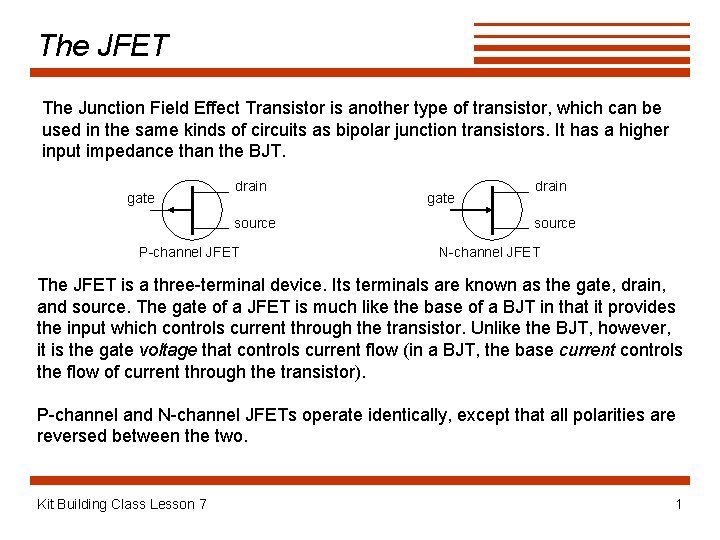
The JFET The Junction Field Effect Transistor is another type of transistor, which can be used in the same kinds of circuits as bipolar junction transistors. It has a higher input impedance than the BJT. gate drain source P-channel JFET gate drain source N-channel JFET The JFET is a three-terminal device. Its terminals are known as the gate, drain, and source. The gate of a JFET is much like the base of a BJT in that it provides the input which controls current through the transistor. Unlike the BJT, however, it is the gate voltage that controls current flow (in a BJT, the base current controls the flow of current through the transistor). P-channel and N-channel JFETs operate identically, except that all polarities are reversed between the two. Kit Building Class Lesson 7 1
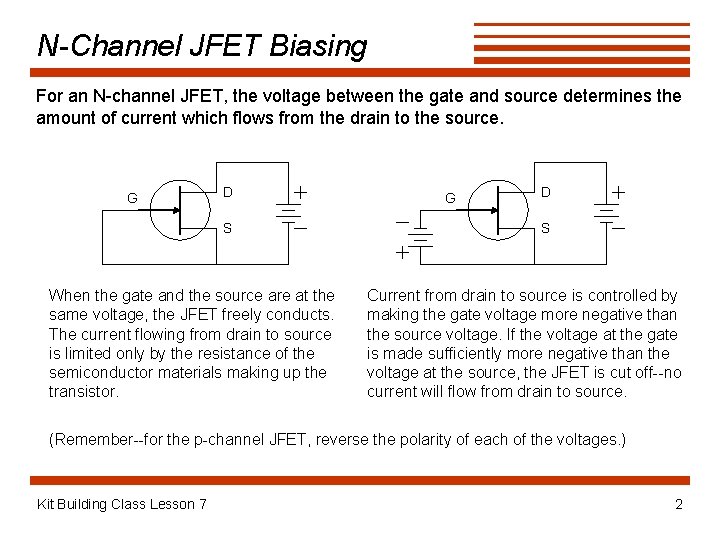
N-Channel JFET Biasing For an N-channel JFET, the voltage between the gate and source determines the amount of current which flows from the drain to the source. G D S When the gate and the source are at the same voltage, the JFET freely conducts. The current flowing from drain to source is limited only by the resistance of the semiconductor materials making up the transistor. G D S Current from drain to source is controlled by making the gate voltage more negative than the source voltage. If the voltage at the gate is made sufficiently more negative than the voltage at the source, the JFET is cut off--no current will flow from drain to source. (Remember--for the p-channel JFET, reverse the polarity of each of the voltages. ) Kit Building Class Lesson 7 2
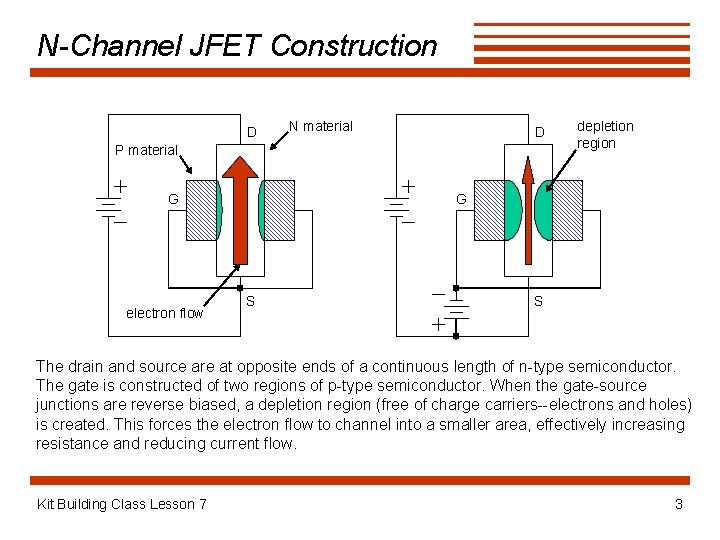
N-Channel JFET Construction D N material D P material G electron flow depletion region G S S The drain and source are at opposite ends of a continuous length of n-type semiconductor. The gate is constructed of two regions of p-type semiconductor. When the gate-source junctions are reverse biased, a depletion region (free of charge carriers--electrons and holes) is created. This forces the electron flow to channel into a smaller area, effectively increasing resistance and reducing current flow. Kit Building Class Lesson 7 3
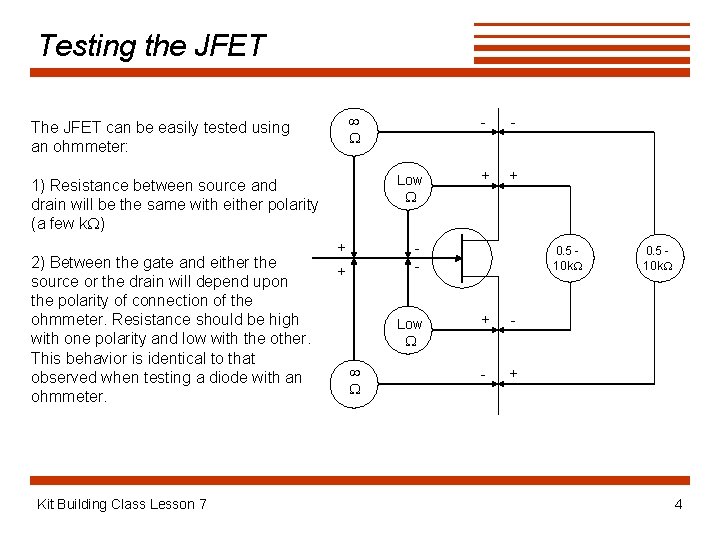
Testing the JFET ¥ W The JFET can be easily tested using an ohmmeter: Low W 1) Resistance between source and drain will be the same with either polarity (a few k. W) 2) Between the gate and either the source or the drain will depend upon the polarity of connection of the ohmmeter. Resistance should be high with one polarity and low with the other. This behavior is identical to that observed when testing a diode with an ohmmeter. Kit Building Class Lesson 7 + - - + + - + Low W ¥ W 0. 5 10 k. W + - - + 0. 5 10 k. W 4
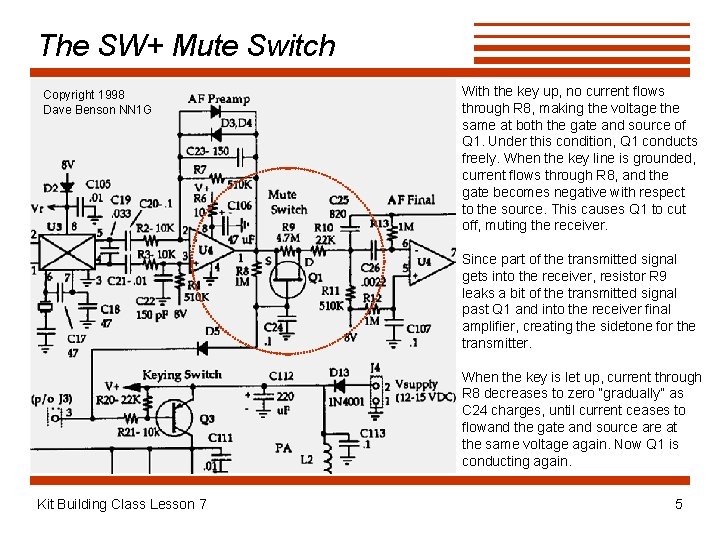
The SW+ Mute Switch Copyright 1998 Dave Benson NN 1 G With the key up, no current flows through R 8, making the voltage the same at both the gate and source of Q 1. Under this condition, Q 1 conducts freely. When the key line is grounded, current flows through R 8, and the gate becomes negative with respect to the source. This causes Q 1 to cut off, muting the receiver. Since part of the transmitted signal gets into the receiver, resistor R 9 leaks a bit of the transmitted signal past Q 1 and into the receiver final amplifier, creating the sidetone for the transmitter. When the key is let up, current through R 8 decreases to zero “gradually” as C 24 charges, until current ceases to flowand the gate and source are at the same voltage again. Now Q 1 is conducting again. Kit Building Class Lesson 7 5
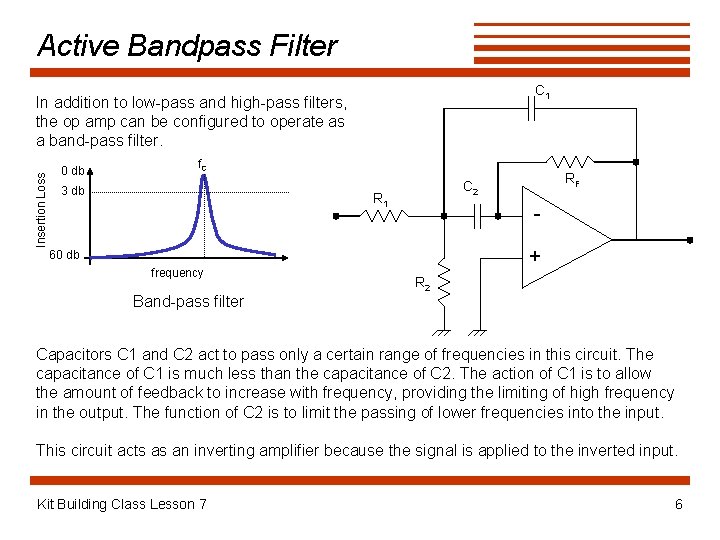
Active Bandpass Filter C 1 Insertion Loss In addition to low-pass and high-pass filters, the op amp can be configured to operate as a band-pass filter. 0 db f. C 3 db R 1 + 60 db frequency RF C 2 R 2 Band-pass filter Capacitors C 1 and C 2 act to pass only a certain range of frequencies in this circuit. The capacitance of C 1 is much less than the capacitance of C 2. The action of C 1 is to allow the amount of feedback to increase with frequency, providing the limiting of high frequency in the output. The function of C 2 is to limit the passing of lower frequencies into the input. This circuit acts as an inverting amplifier because the signal is applied to the inverted input. Kit Building Class Lesson 7 6
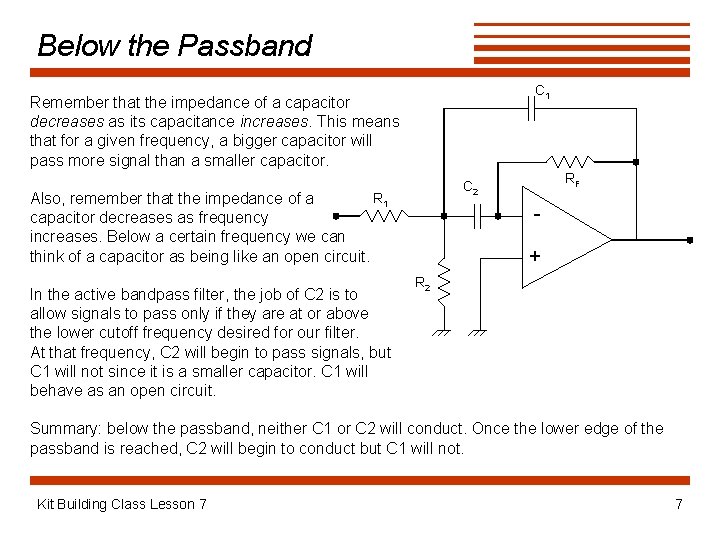
Below the Passband C 1 Remember that the impedance of a capacitor decreases as its capacitance increases. This means that for a given frequency, a bigger capacitor will pass more signal than a smaller capacitor. R 1 Also, remember that the impedance of a capacitor decreases as frequency increases. Below a certain frequency we can think of a capacitor as being like an open circuit. In the active bandpass filter, the job of C 2 is to allow signals to pass only if they are at or above the lower cutoff frequency desired for our filter. At that frequency, C 2 will begin to pass signals, but C 1 will not since it is a smaller capacitor. C 1 will behave as an open circuit. RF C 2 + R 2 Summary: below the passband, neither C 1 or C 2 will conduct. Once the lower edge of the passband is reached, C 2 will begin to conduct but C 1 will not. Kit Building Class Lesson 7 7
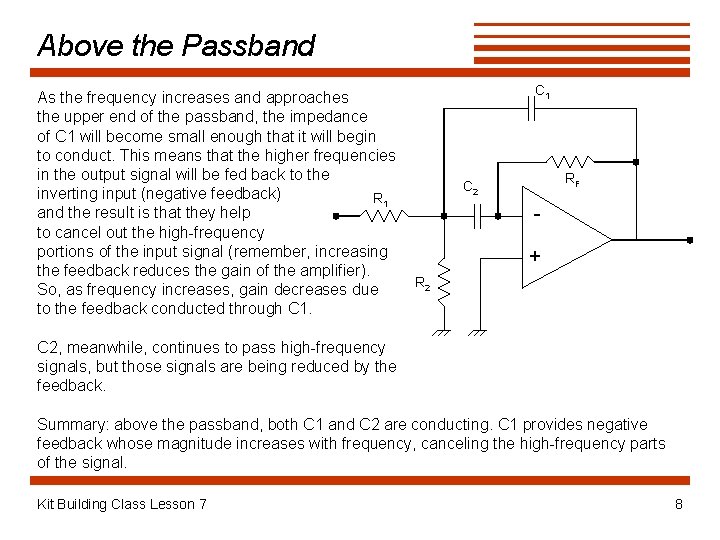
Above the Passband As the frequency increases and approaches the upper end of the passband, the impedance of C 1 will become small enough that it will begin to conduct. This means that the higher frequencies in the output signal will be fed back to the inverting input (negative feedback) R 1 and the result is that they help to cancel out the high-frequency portions of the input signal (remember, increasing the feedback reduces the gain of the amplifier). So, as frequency increases, gain decreases due to the feedback conducted through C 1 RF C 2 + R 2 C 2, meanwhile, continues to pass high-frequency signals, but those signals are being reduced by the feedback. Summary: above the passband, both C 1 and C 2 are conducting. C 1 provides negative feedback whose magnitude increases with frequency, canceling the high-frequency parts of the signal. Kit Building Class Lesson 7 8
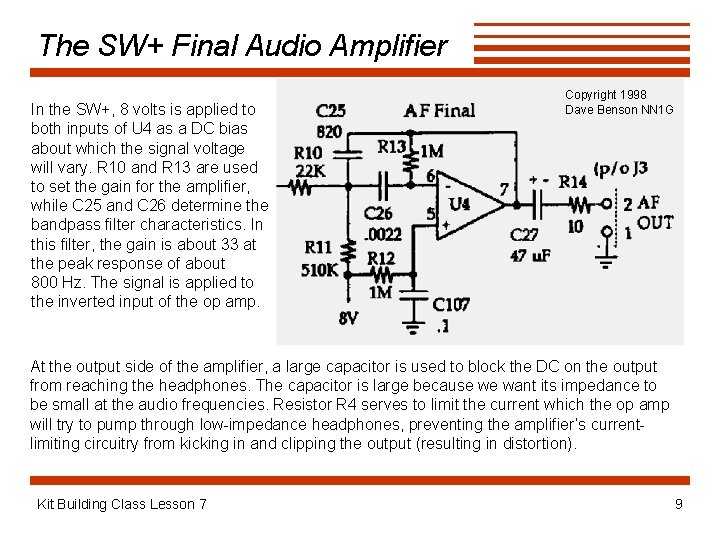
The SW+ Final Audio Amplifier In the SW+, 8 volts is applied to both inputs of U 4 as a DC bias about which the signal voltage will vary. R 10 and R 13 are used to set the gain for the amplifier, while C 25 and C 26 determine the bandpass filter characteristics. In this filter, the gain is about 33 at the peak response of about 800 Hz. The signal is applied to the inverted input of the op amp. Copyright 1998 Dave Benson NN 1 G At the output side of the amplifier, a large capacitor is used to block the DC on the output from reaching the headphones. The capacitor is large because we want its impedance to be small at the audio frequencies. Resistor R 4 serves to limit the current which the op amp will try to pump through low-impedance headphones, preventing the amplifier’s currentlimiting circuitry from kicking in and clipping the output (resulting in distortion). Kit Building Class Lesson 7 9
Construction • Install the following components: – – R 6, R 8 -R 14 D 5 Q 1 C 24 -C 27, C 106, C 107 Kit Building Class Lesson 7 • Test: – connect the tuning pot, gain pot, power connector, and headphone jack to the board – connect headphones and a key – turn the gain all the way up – attach a temporary antenna to the side of C 40 which does not connect to diodes D 7 -D 10 (10 or more feet of wire should do) – connect power – tune and listen for signals. Adjust T 1 for maximum background noise. If T 1 doesn’t peak, change C 1 to a higher value (try 68 p. F) – key the rig and listen for sidetone 10