
The Japanese that the Japanese Dont Know Michael
- Slides: 40
にほんじんのしらないにほんご (The Japanese that the Japanese Don’t Know!) Michael Murphy Japanese III Period 1
Episode 1
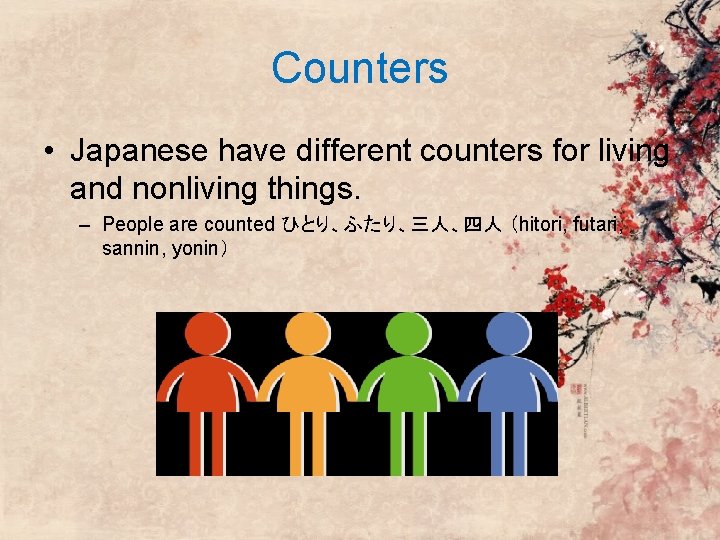
Counters • Japanese have different counters for living and nonliving things. – People are counted ひとり、ふたり、三人、四人 (hitori, futari, sannin, yonin)
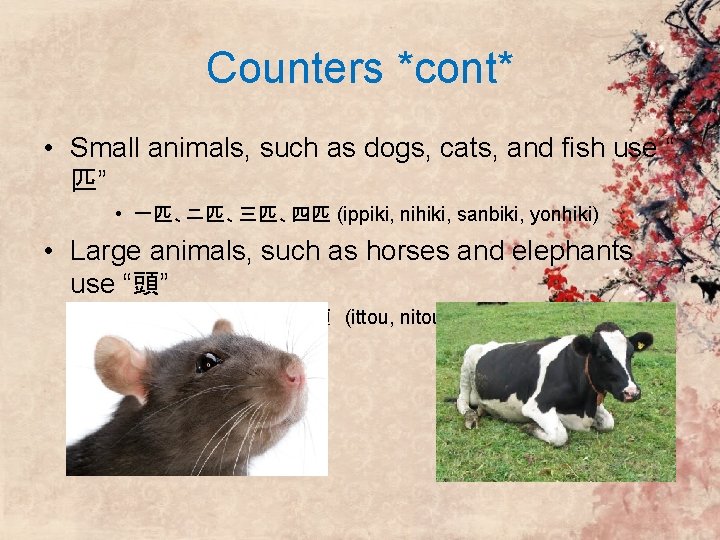
Counters *cont* • Small animals, such as dogs, cats, and fish use “ 匹” • 一匹、ニ匹、三匹、四匹 (ippiki, nihiki, sanbiki, yonhiki) • Large animals, such as horses and elephants use “頭” • 一頭、ニ頭、三頭、四頭 (ittou, nitou, santou, yontou)
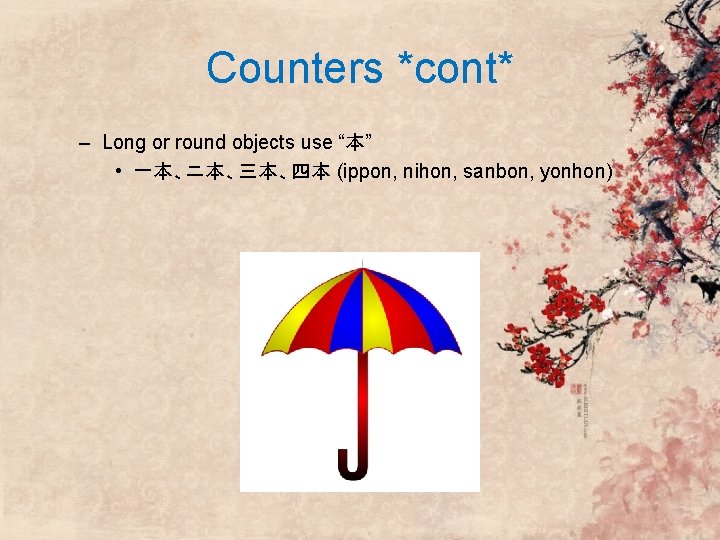
Counters *cont* – Long or round objects use “本” • 一本、ニ本、三本、四本 (ippon, nihon, sanbon, yonhon)
Japanese vs. Chinese Kanji • When the Japanese incorporated the Chinese characters into their own, they interpreted the kanji differently. Translations between the two are not always the same. –鮪 – • Chinese: sturgeon • Japanese: tuna
Sources • • • http: //www. learn-japanese-adventure. com/japanese-numbers-counters. html https: //images. search. yahoo. com/yhs/search; _ylt=A 86. J 3 Vr. Q_l. V_1 c. Axz 4 Px. Qt. ; _ylu=X 3 o. DMTBy. NWU 4 c. Gh 1 BGNvb. G 8 DZ 3 Ex. BHBvcw. Mx. BHZ 0 a. WQDBHNl. Yw. Nz. Yw--? p=Rat&fr=yhs-avgfh_lsonswrow&hspart=avg&hsimp=yhs-fh_lsonswrow https: //images. search. yahoo. com/images/view; _ylt=Awr. Tc. Xqu. Q_l. Vd 9 o. As. U 82 n. Il. Q; _ylu=X 3 o. DMTIyb. TJucm. Z 2 BHNl. Yw. Nzcg. Rzb. Gs. Da. W 1 n. BG 9 p. ZAM 0 MWMy. OWY 1 ODJj. ZWUw. Nm. Q 1 Zj. Jk. Nj. Ux OTI 2 Nj. Mx. YTBi. YQRnc. G 9 z. Az. YEa. XQDYmlu. Zw--? . origin=&back=https%3 A%2 F%2 Fimages. search. yahoo. com%2 Fyhs%2 Fsearch%3 Fp%3 Dumbrella%26 type%3 Dch. 32. w 81. dsp. 0302. gu. avg. _. _%26 fr%3 Dyhs-avg-fh_lsonswrow%26 fr 2%3 Dpiv-web%26 hsimp%3 Dyhsfh_lsonswrow%26 hspart%3 Davg%26 tab%3 Dorganic%26 ri%3 D 6&w=800&h=800&imgurl=myctrring. com%2 Fwpcontent%2 Fuploads%2 F 2008%2 F 12%2 Fumbrella. jpg&rurl=http%3 A%2 F%2 Fmyctrring. com%2 Fclip-art%2 Fgeneral-clipart%2 F&size=89. 0 KB&name=%3 Cb%3 EUmbrella%3 C%2 Fb%3 E&p=umbrella&oid=41 c 29 f 582 cee 06 d 5 f 2 d 651926631 a 0 ba&fr 2=piv-web&fr=yhs-avgfh_lsonswrow&tt=%3 Cb%3 EUmbrella%3 C%2 Fb%3 E&b=0&ni=21&no=6&ts=&tab=organic&sigr=11 fl 4 uaq 0&sigb=15 gqf 46 o 1&sigi=11 l 6 vq 21 o&sigt=10 frd 2 rl 9&sign=10 frd 2 rl 9&. crumb=1 n 8. ZKRTh. EI&fr=yhs-avg-fh_lsonswrow&fr 2=piv-web&hsimp=yhs-fh_lsonswrow&hspart=avg&type=ch. 32. w 81. dsp. 03 -02. gu. avg. _. _
Episode 2
Episode 3
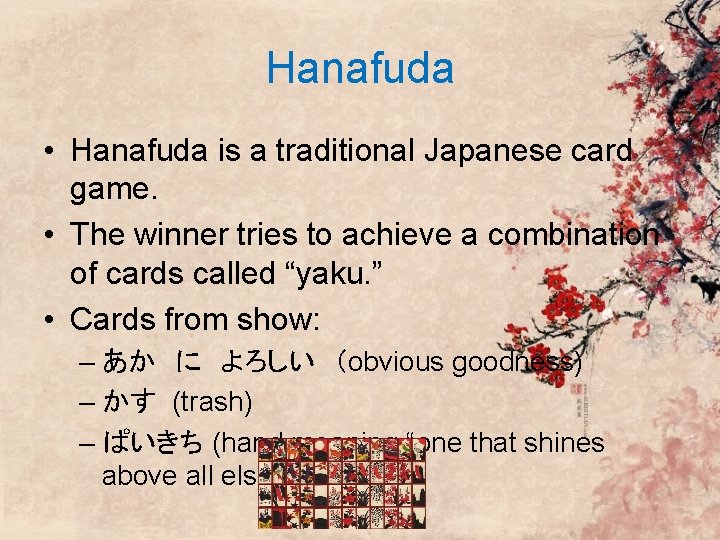
Hanafuda • Hanafuda is a traditional Japanese card game. • The winner tries to achieve a combination of cards called “yaku. ” • Cards from show: – あか に よろしい (obvious goodness) – かす (trash) – ぱいきち (hand meaning “one that shines above all else.
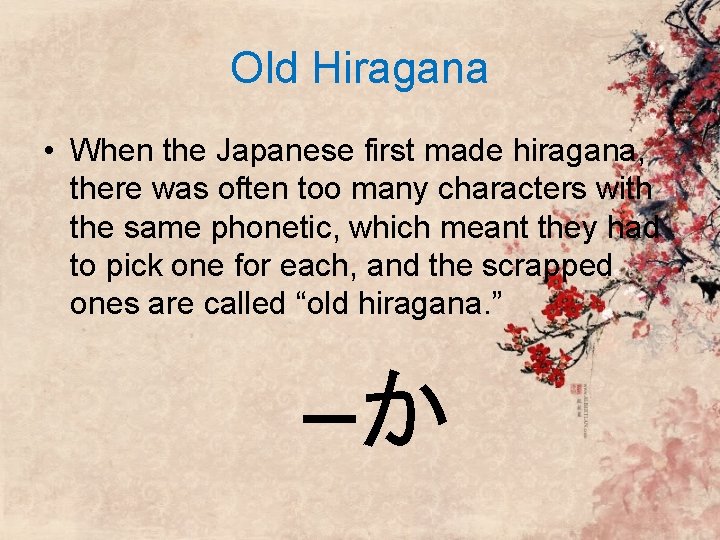
Old Hiragana • When the Japanese first made hiragana, there was often too many characters with the same phonetic, which meant they had to pick one for each, and the scrapped ones are called “old hiragana. ” –か
Sources • • • https: //en. wikipedia. org/wiki/Hiragana http: //www. gamedesign. jp/flash/hanafuda_e. html http: //www. asahi-net. or. jp/~rp 9 h-tkhs/dg_hanafuda. htm
Episode 4
Standard Japanese • People rarely use “standard Japanese” in modern times • Uses “私, あなた, ます, ” and “です. ” • Originating from the Tokyo area during the Edo period and used the most in the Tokyo area today. • Thought of as colder and less personal than common Japanese, but it is also more respectful and the most understood. • Uses “keigo” with “zamasu”
Common Japanese • This is the modern Japanese people speak. • It is a combination of standard Japanese and other, less formal dialects. • Simply uses informal verb conjugations and also combines some vocabulary from other areas of Japan.
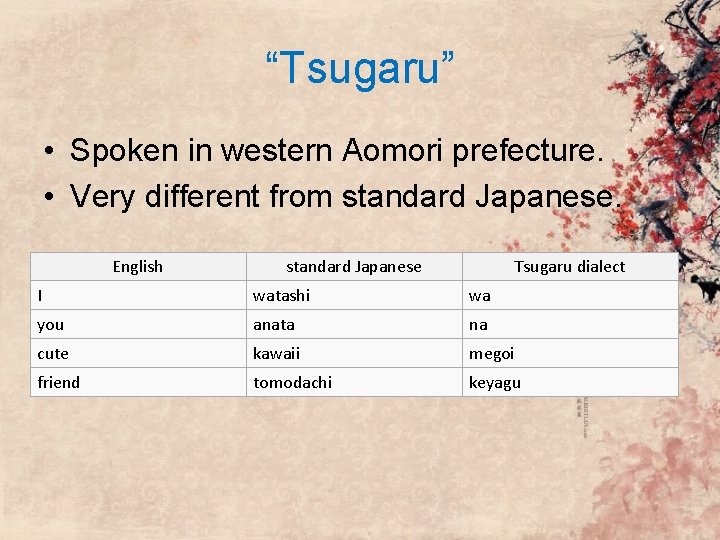
“Tsugaru” • Spoken in western Aomori prefecture. • Very different from standard Japanese. English standard Japanese Tsugaru dialect I watashi wa you anata na cute kawaii megoi friend tomodachi keyagu
Sources • https: //en. wikipedia. org/wiki/Tsugaru_dialect
Episodes 5 & 6
ぞっとする & ぞっとしない • ぞっとする- shiver out of fear; usually comes with strange or strong feelings • ぞっとしない- to not be satisfied or impressed by something; also an expression of denial
Kanji Theories • 取 – take; has the kanji for ear (耳) and hand because ears that were cut off are used as proof of killing your enemy • 道- road; contains kanji for neck (首) because severed heads were used in exorcisms • 県- prefecture; has a severed head again in the form of “kyou”
Animal Figure Offerings • Japanese make various figures of vegetables, such as horses and cows as offerings to ancestors that they would use as a vessel to go to the other plane
Different Frequencies • • • いつも = always たいてい = generally よく = often ときどき = sometimes ぜんぜん = never
たのしい vs. うれしい • “たのしい” usually refers to a longer period of happiness than “うれしい. ” Both can be seen as to be happy or pleased.
Sources • https: //www. google. com/search? q=kanji+with+mimi&biw=1366&bih=667&source=lnms&tbm=isch&sa=X&ved=0 ah. UKEwio 35 zuvb. XJAh. VTK 4 g. KHW 8 DCy 0 Q_AUIBig. B#imgrc=M 6 kg 4 Xk. NRk 0 t. CM%3 A
Episodes 7 & 8
Colors • 色 – (iro) used for colors • There are colors, but colors can have different shades – 赤 (aka) = red -真紅 (shinku) = crimson - 緋色 (hi iro) = scarlet - 朱色 (shu iro) = vermillion
Colors cont. • There are characters 青 (blue) and 緑 (green) now, "ao" (blue) was once used for many kinds of colors, including shades of green. • 青 (ao) = blue - 群青色 (gunjou iro) = ultramarine - 青磁色 (seiji iro) = celadon
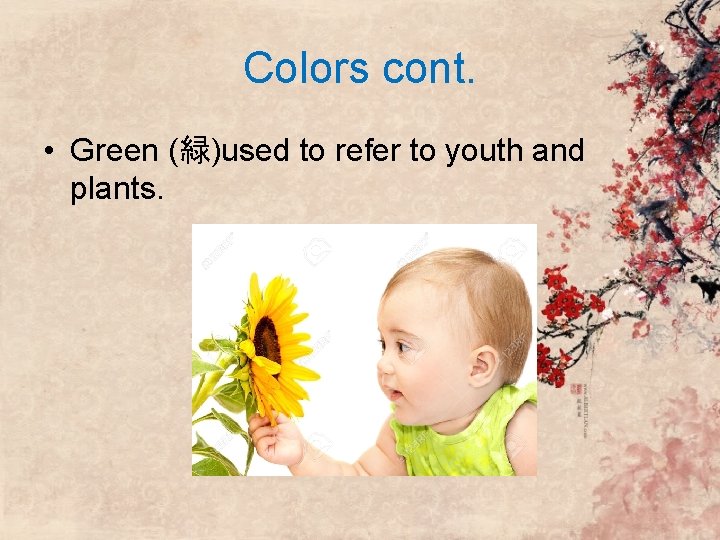
Colors cont. • Green (緑)used to refer to youth and plants.
Keigo (敬語) • 1: Use passive voice. - Ex: 課長がご飯を「食べられます」。 - The section chief eats. • 2: Add "になります" (ni narimasu) to the verb - Ex: 部長がご飯を「お食べになります」。 - The department head eats. • 3: Use the special form of the verb - Ex: 社長がご飯を「召し上がります」。 - The president eats.
Keigo cont. • Some verbs change slightly when you want to make them respectful • Ex. : • いる、行く、来る - becomes いっらっしゃる, etc.
Keigo cont. • "Osore irimasu ga" = Sorry to impose - Lowers your status, but it's like a command; implies that the partner should give a certain answer
Episodes 9 & 10
Vague Expressions • Certain words or expressions end up having confusing or multiple meanings, similar to homophones in English. • Ex. : • はし can mean bridge, chopsticks, or edge, depending on how it is pronounced • いい can mean good or bad in certain contexts
“P” Characters and Sounds • It was the Portuguese who got the Japanese to use the small circle to indicate the “p” sounds because Japanese originally had no way to distinguish p’s unless they said the words.
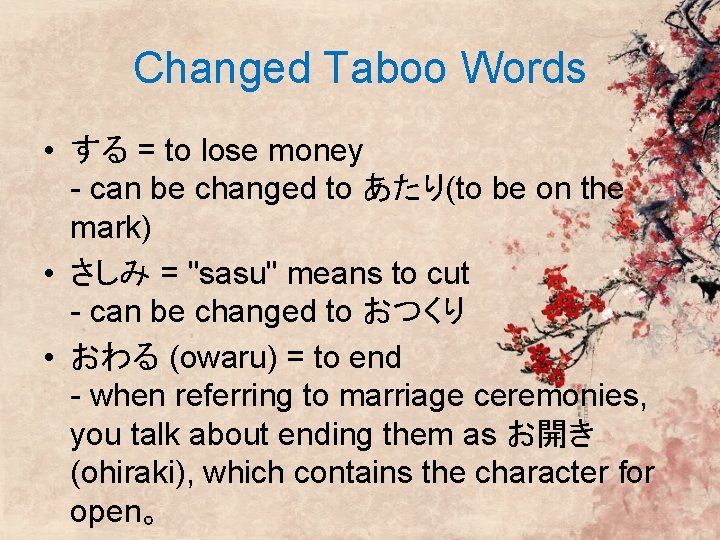
Changed Taboo Words • する = to lose money - can be changed to あたり(to be on the mark) • さしみ = "sasu" means to cut - can be changed to おつくり • おわる (owaru) = to end - when referring to marriage ceremonies, you talk about ending them as お開き (ohiraki), which contains the character for open。
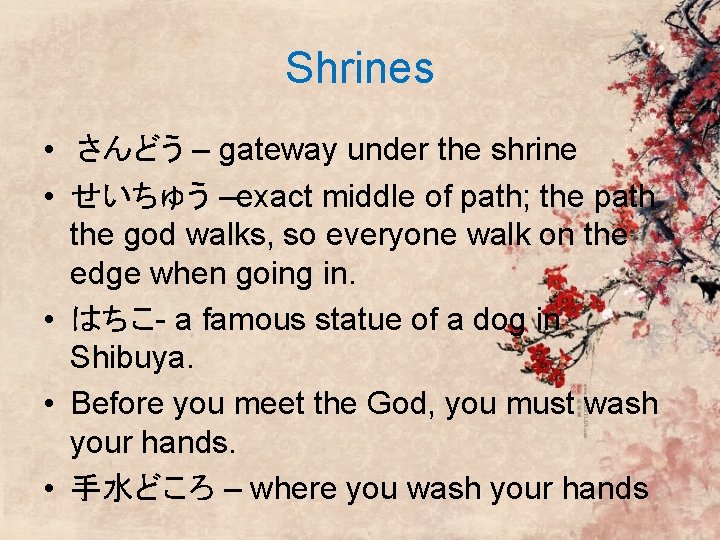
Shrines • さんどう – gateway under the shrine • せいちゅう –exact middle of path; the path the god walks, so everyone walk on the edge when going in. • はちこ- a famous statue of a dog in Shibuya. • Before you meet the God, you must wash your hands. • 手水どころ – where you wash your hands
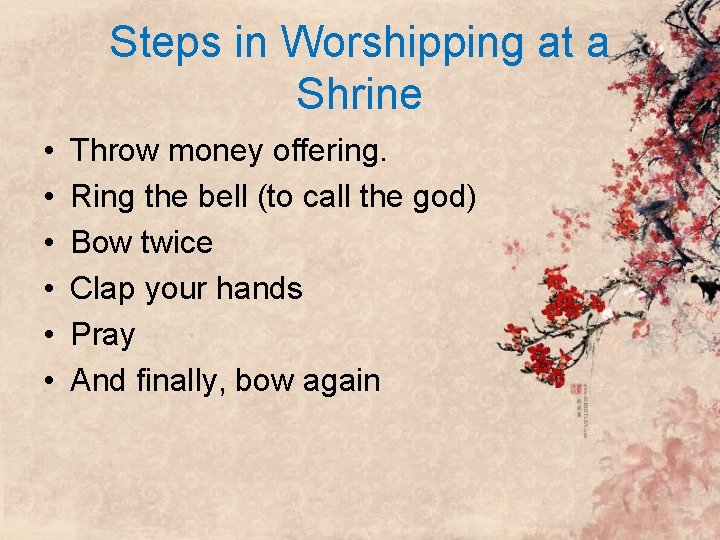
Steps in Worshipping at a Shrine • • • Throw money offering. Ring the bell (to call the god) Bow twice Clap your hands Pray And finally, bow again
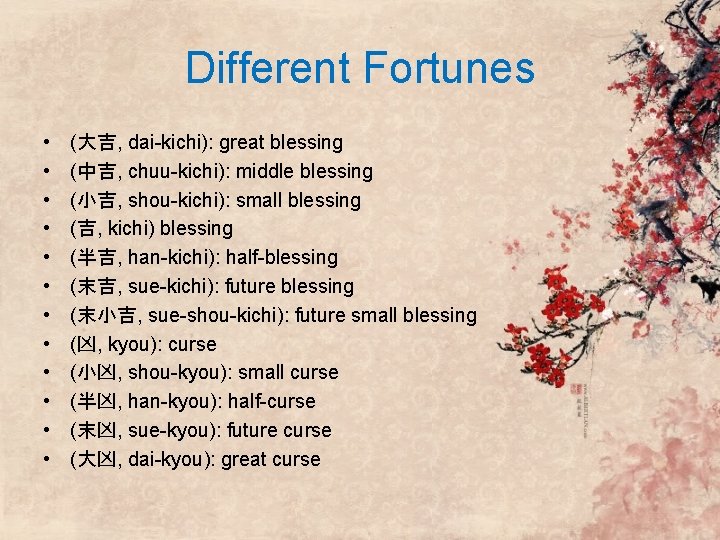
Different Fortunes • • • (大吉, dai-kichi): great blessing (中吉, chuu-kichi): middle blessing (小吉, shou-kichi): small blessing (吉, kichi) blessing (半吉, han-kichi): half-blessing (末吉, sue-kichi): future blessing (末小吉, sue-shou-kichi): future small blessing (凶, kyou): curse (小凶, shou-kyou): small curse (半凶, han-kyou): half-curse (末凶, sue-kyou): future curse (大凶, dai-kyou): great curse