
The Italian law on building acoustics DPCM 5121997
The Italian law on building acoustics DPCM 5/12/1997 Angelo Farina Dip. di Ingegneria Industriale – Università di Parma Parco Area delle Scienze 181/A, 43100 Parma – Italy farina@aidasrl. it 23 November 2012 DPCM 5/12/1997 1
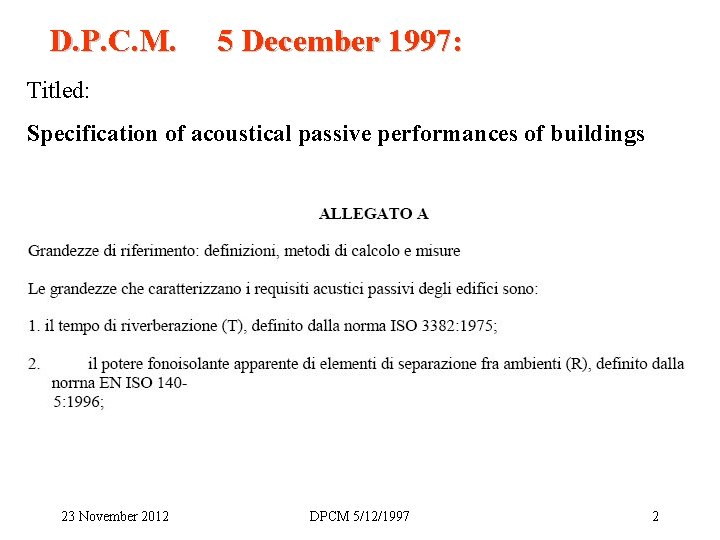
D. P. C. M. 5 December 1997: Titled: Specification of acoustical passive performances of buildings 23 November 2012 DPCM 5/12/1997 2
D. P. C. M. 23 November 2012 5 December 1997: DPCM 5/12/1997 3
D. P. C. M. 23 November 2012 5 December 1997: DPCM 5/12/1997 4
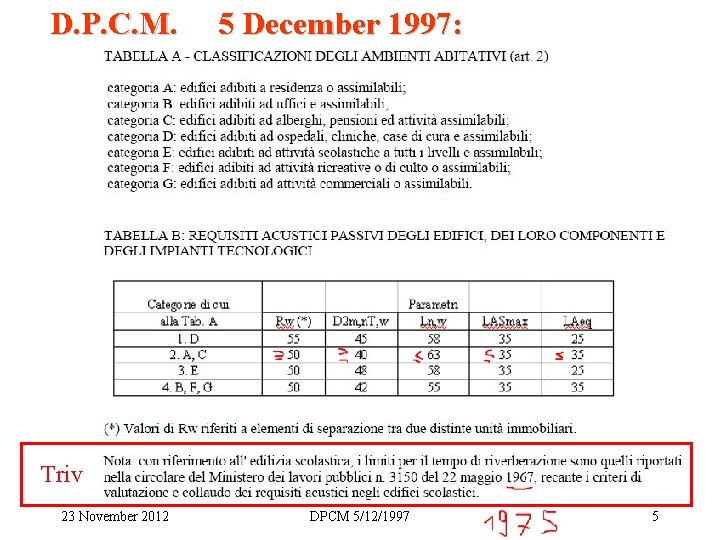
D. P. C. M. 5 December 1997: Triv 23 November 2012 DPCM 5/12/1997 5
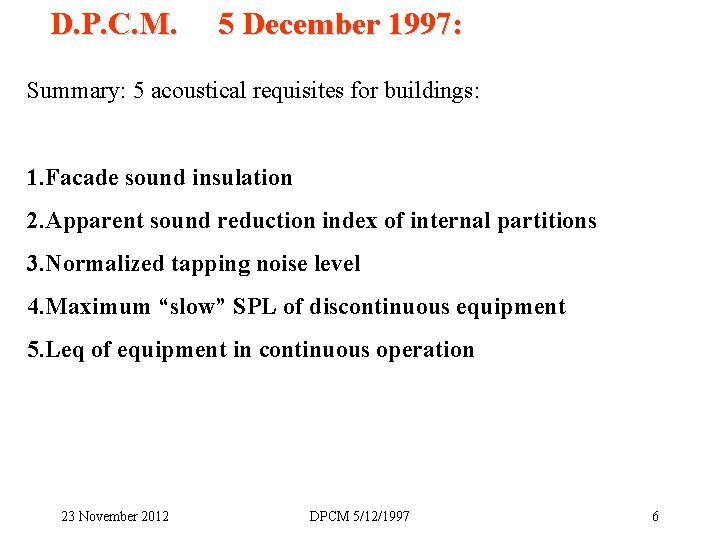
D. P. C. M. 5 December 1997: Summary: 5 acoustical requisites for buildings: 1. Facade sound insulation 2. Apparent sound reduction index of internal partitions 3. Normalized tapping noise level 4. Maximum “slow” SPL of discontinuous equipment 5. Leq of equipment in continuous operation 23 November 2012 DPCM 5/12/1997 6
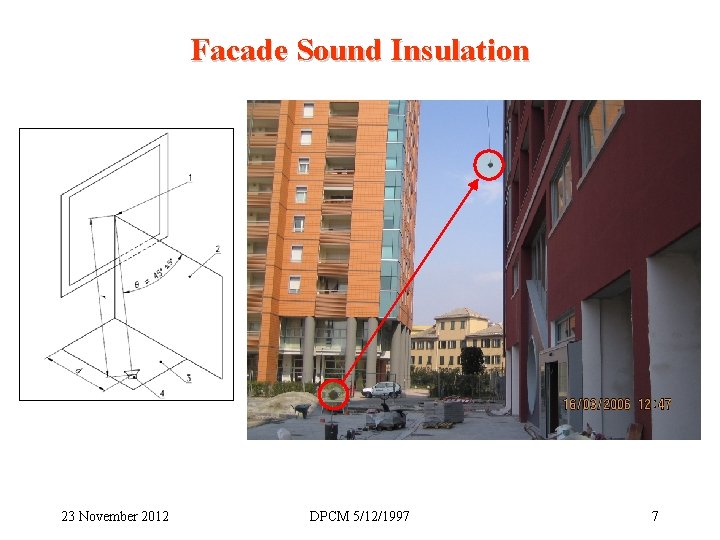
Facade Sound Insulation 23 November 2012 DPCM 5/12/1997 7
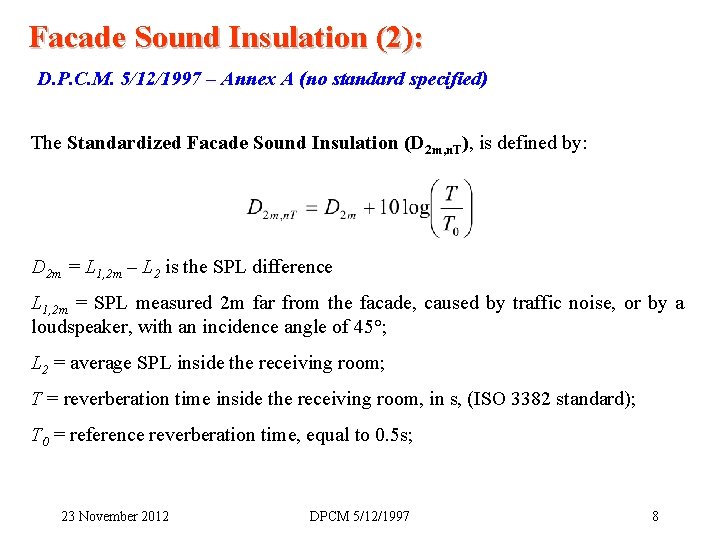
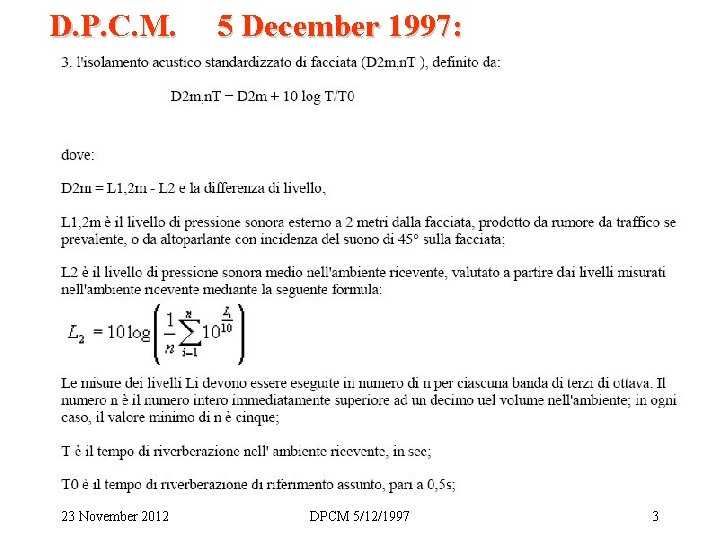
Facade Sound Insulation (2): D. P. C. M. 5/12/1997 – Annex A (no standard specified) The Standardized Facade Sound Insulation (D 2 m, n. T), is defined by: D 2 m = L 1, 2 m – L 2 is the SPL difference L 1, 2 m = SPL measured 2 m far from the facade, caused by traffic noise, or by a loudspeaker, with an incidence angle of 45°; L 2 = average SPL inside the receiving room; T = reverberation time inside the receiving room, in s, (ISO 3382 standard); T 0 = reference reverberation time, equal to 0. 5 s; 23 November 2012 DPCM 5/12/1997 8
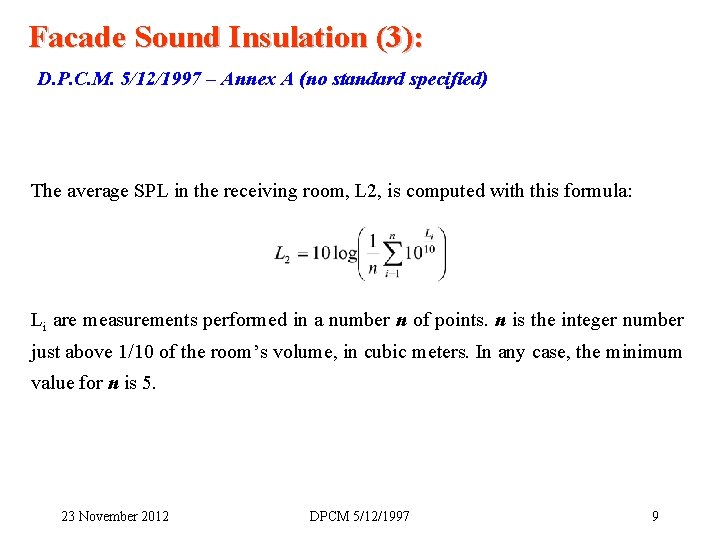
Facade Sound Insulation (3): D. P. C. M. 5/12/1997 – Annex A (no standard specified) The average SPL in the receiving room, L 2, is computed with this formula: Li are measurements performed in a number n of points. n is the integer number just above 1/10 of the room’s volume, in cubic meters. In any case, the minimum value for n is 5. 23 November 2012 DPCM 5/12/1997 9
Facade Sound Insulation (4): D. P. C. M. 5/12/1997 – Annex A (no standard specified) NOTES: a. The ISO 3382 -1975 standard (reverberation time) was subsequently updated in 1997 and in 2008; b. The DPCM does not specify that the volume of the receiving room has to be expressed in cubic meters; c. The quantity denoted D 2 m, n. T is defined in UNI EN ISO 140 -5 as normalized facade insulation (and not “standardized”); d. The UNI 8270 -7 standard, defining the single-number rating of facade insulation, has been superseded by UNI EN ISO 717/1. 23 November 2012 DPCM 5/12/1997 10
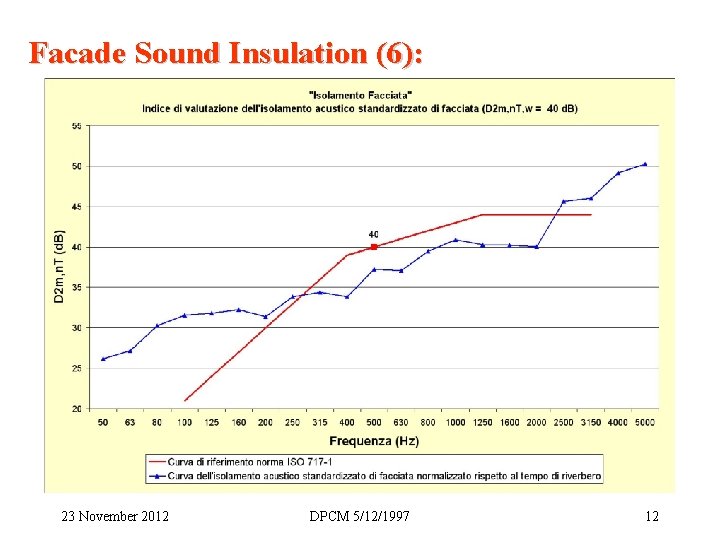
Facade Sound Insulation (5): D. P. C. M. 5/12/1997 – Annex A (no standard specified) Single-number rating For getting a single number giving the weighted normalized facade insulation, D 2 m, n. T, w, the following procedure must be followed. The ISO 717 reference spectrum must be moved down, with 1 d. B steps, over the measured spectrum of D 2 m, n. T. At each step, the sum of unfavorable deviations is computed (an unfavorable deviation occurs when the measured value, at a frequency band, is below the corresponding vale on the reference curve). When the sum of unfavorable deviations becomes smaller than 32, the reference curve is properly positioned. The weighted normalized facade insulation, D 2 m, n. T, w is defined as the value of the reference curve at the frequency of 500 Hz. 23 November 2012 DPCM 5/12/1997 11
Facade Sound Insulation (6): 23 November 2012 DPCM 5/12/1997 12
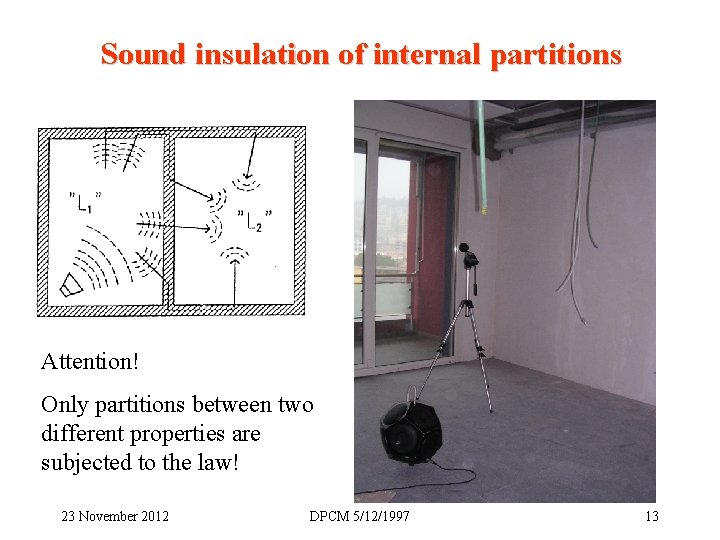
Sound insulation of internal partitions Attention! Only partitions between two different properties are subjected to the law! 23 November 2012 DPCM 5/12/1997 13
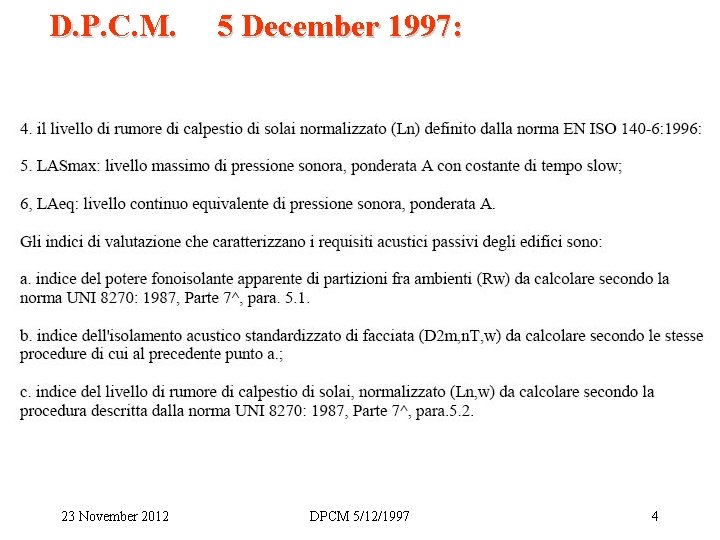
Sound insulation of internal partitions (2): D. P. C. M. 5/12/1997 – Allegato A NOTES: a. The apparent sound reduction index R’ is defined by the UNI 8270 -4 standard (and NOT by EN ISO 140 -5: 1996, as incorrectly written in the DPCM). The latter standardis for Facade insulation, . b. The UNI 8270 -7 standard, defining the single-number rating of facade insulation, has been superseded by UNI EN ISO 717/1. 23 November 2012 DPCM 5/12/1997 14
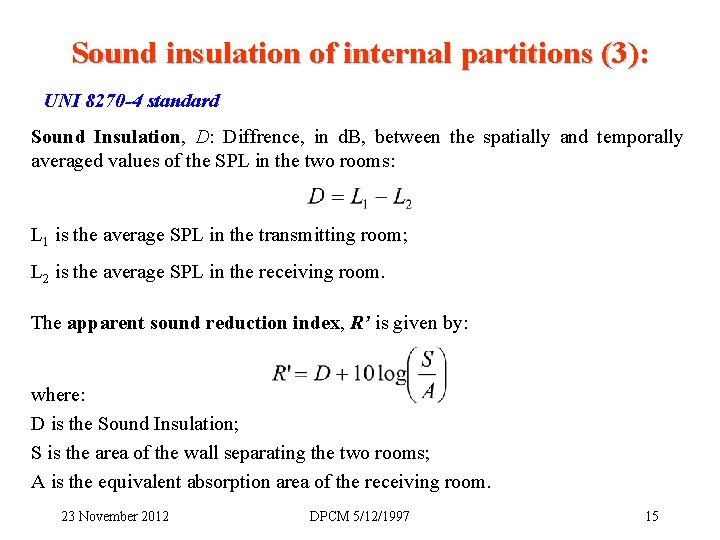
Sound insulation of internal partitions (3): UNI 8270 -4 standard Sound Insulation, D: Diffrence, in d. B, between the spatially and temporally averaged values of the SPL in the two rooms: L 1 is the average SPL in the transmitting room; L 2 is the average SPL in the receiving room. The apparent sound reduction index, R’ is given by: where: D is the Sound Insulation; S is the area of the wall separating the two rooms; A is the equivalent absorption area of the receiving room. 23 November 2012 DPCM 5/12/1997 15
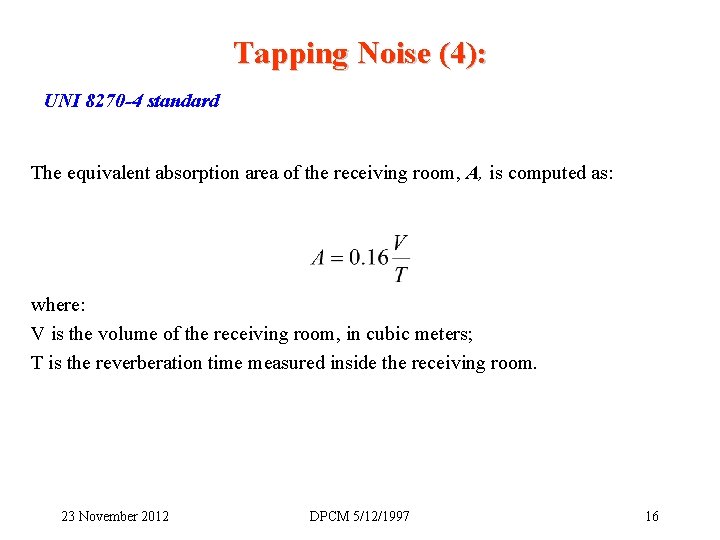
Tapping Noise (4): UNI 8270 -4 standard The equivalent absorption area of the receiving room, A, is computed as: where: V is the volume of the receiving room, in cubic meters; T is the reverberation time measured inside the receiving room. 23 November 2012 DPCM 5/12/1997 16
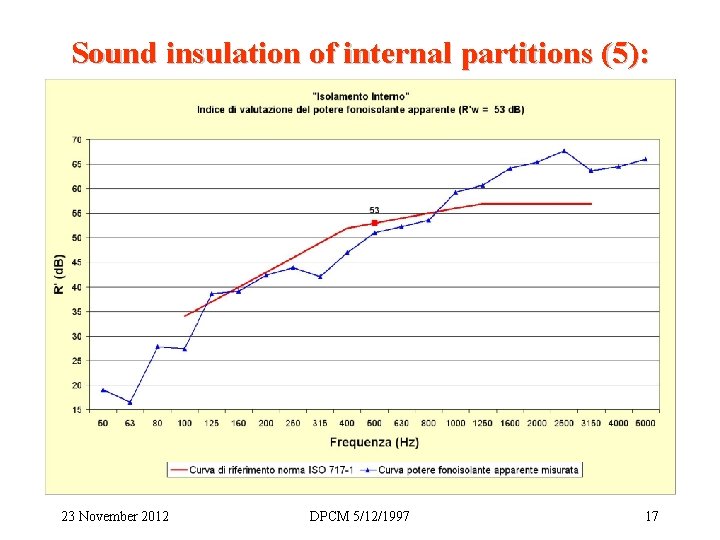
Sound insulation of internal partitions (5): 23 November 2012 DPCM 5/12/1997 17
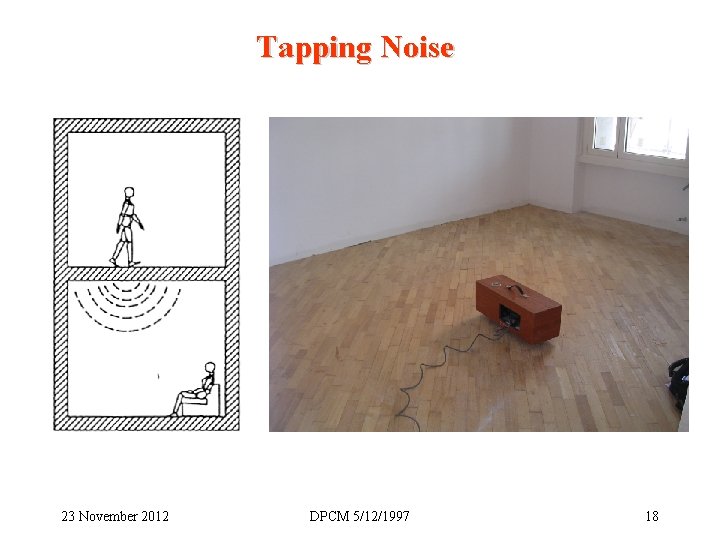
Tapping Noise 23 November 2012 DPCM 5/12/1997 18
Tapping Noise (2): UNI 8270 -4 standard NOTES: a. The normalized tapping noise level (L’n), is defined by the UNI 8270 -4 standard, instead of EN ISO 140 -6: 1996, as erronously written in the DPCM. The latter is for laboratory measurments, whilst the DPCM is referring to “in situ” measurments. b. The UNI 8270 standard, defining the single-number rating of normalized tapping noise level, has been superseded by UNI EN ISO 717/2. 23 November 2012 DPCM 5/12/1997 19
Tapping Noise (3): UNI 8270 -4 standard Average tapping noise level, Li: is the average SPL measured inside the receiving room when the standardized tapping machine is operating inside the adjacent room. Normalized tapping noise level, L’n: it is the average tapping noise level corrected by a term taking into account the reverberation time of the receiving room, with reference to a standard reverberation time T 0: where: T 0 = 0. 5 s. 23 November 2012 DPCM 5/12/1997 20
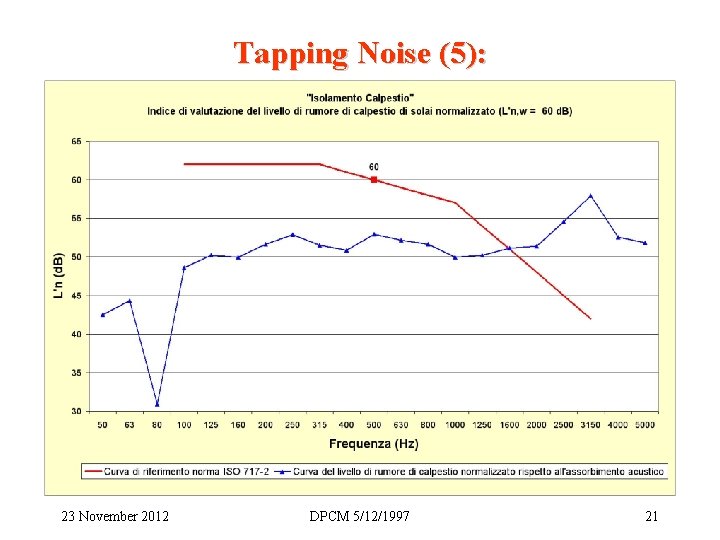
Tapping Noise (5): 23 November 2012 DPCM 5/12/1997 21
HVAC and plumbing noise • The measurement is to be performed inside a different room (of a different owner) than the one where the equipment is operating • An explanation from the Ministry clarifies that the limit values are those reported in table B, and not the generic ones introduced earlier. • Hence the “general limits” of 35 e 25 d. B(A) contained in the descriptive part of the DPCM are just a “lapsus calami” and are valueless. • The noise produced by common (condominial) equipment are NOT subjected to the differential limits given by DPCM 14/11/1997 “Determinazione dei valori limite delle sorgenti sonore” 23 November 2012 DPCM 5/12/1997 22
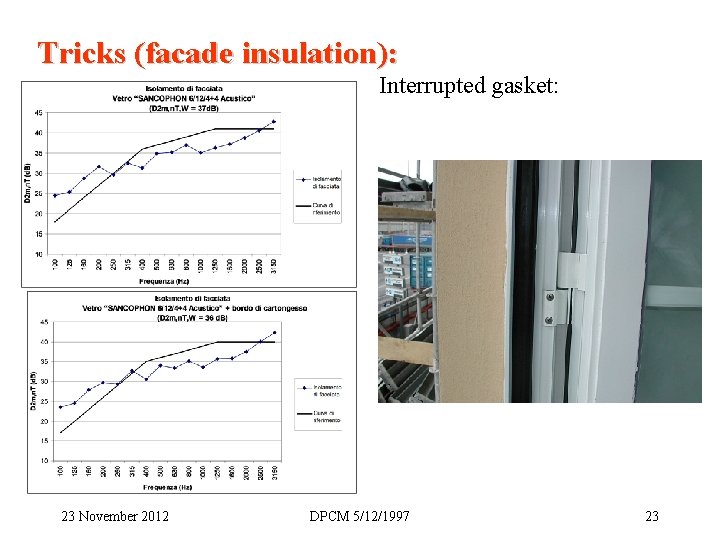
Tricks (facade insulation): Interrupted gasket: 23 November 2012 DPCM 5/12/1997 23
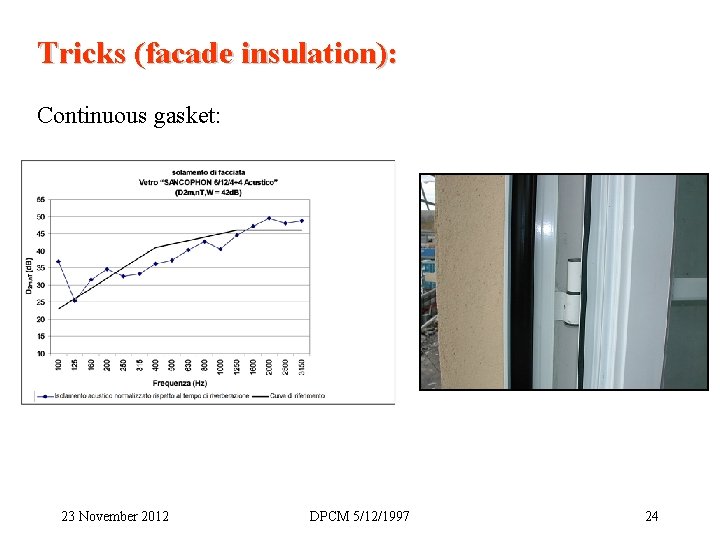
Tricks (facade insulation): Continuous gasket: 23 November 2012 DPCM 5/12/1997 24
Tricks (facade insulation): Bad sealing around the frame of the window: 23 November 2012 DPCM 5/12/1997 D 2 m, n. T, w = 37 d. B 25
Tricks (facade insulation): Good sealing around the frame of the window: 23 November 2012 DPCM 5/12/1997 D 2 m, n. T, w = 41 d. B 26
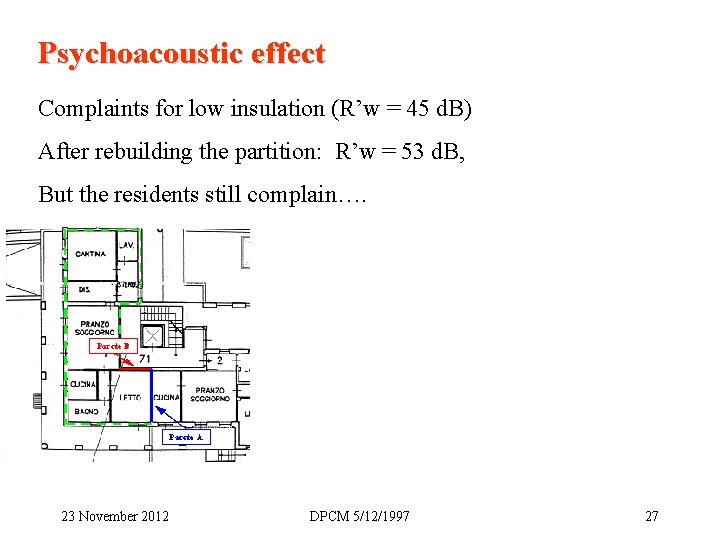
Psychoacoustic effect Complaints for low insulation (R’w = 45 d. B) After rebuilding the partition: R’w = 53 d. B, But the residents still complain…. 23 November 2012 DPCM 5/12/1997 27
- Slides: 27