
The Islamic University Of Gaza Faculty of Arts

- Slides: 22
The Islamic University Of Gaza Faculty of Arts English Department ied Linguistics & Translation Contrastive Linguistics Clipping in English and Arabic Prepared by/ Hussni M. El-Salahat Supervised by/ Prof. Dr. Walid Mohammad Amer
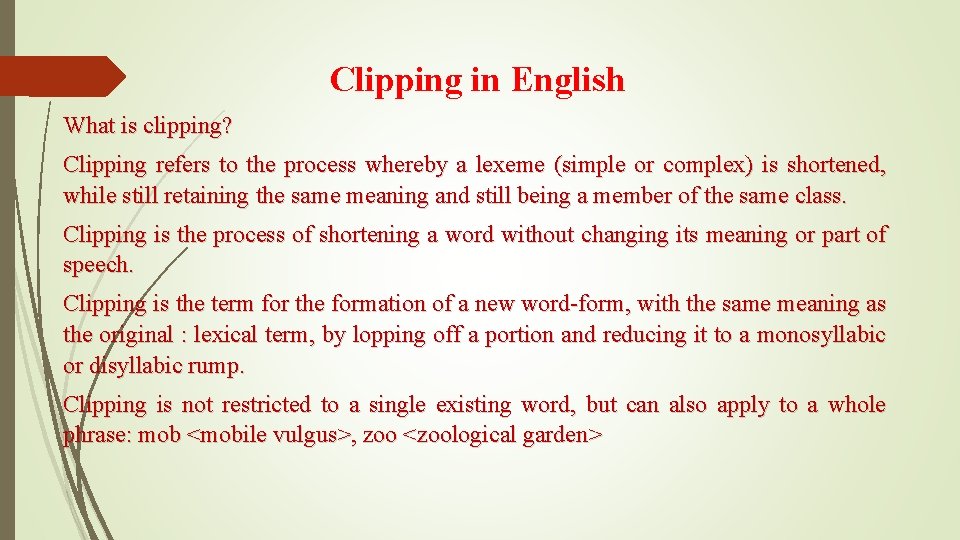
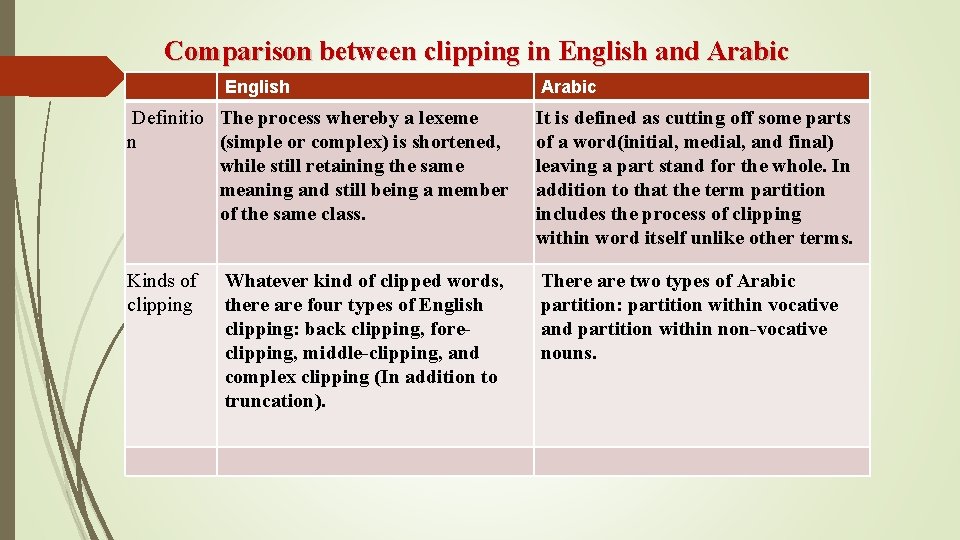
Clipping in English What is clipping? Clipping refers to the process whereby a lexeme (simple or complex) is shortened, while still retaining the same meaning and still being a member of the same class. Clipping is the process of shortening a word without changing its meaning or part of speech. Clipping is the term for the formation of a new word-form, with the same meaning as the original : lexical term, by lopping off a portion and reducing it to a monosyllabic or disyllabic rump. Clipping is not restricted to a single existing word, but can also apply to a whole phrase: mob ˂mobile vulgus˃, zoo ˂zoological garden˃
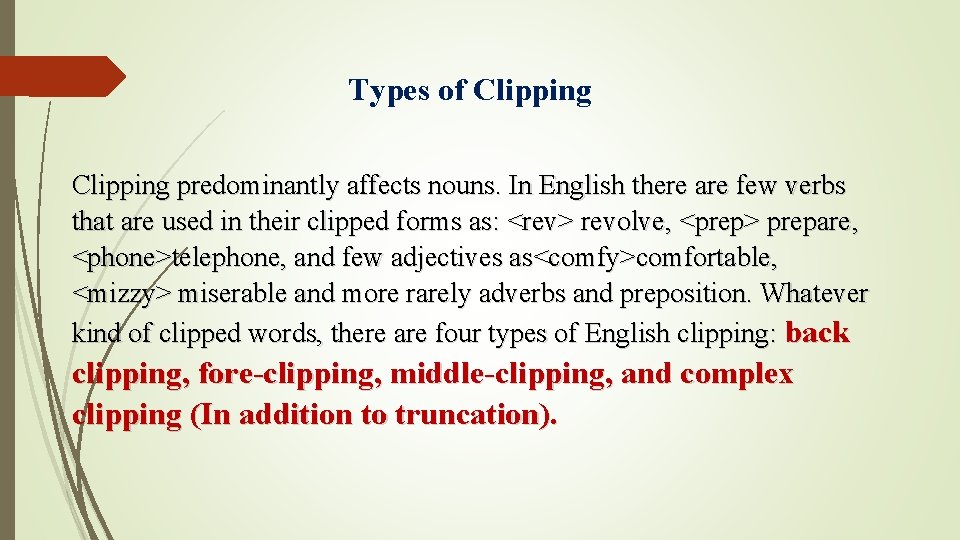
Types of Clipping predominantly affects nouns. In English there are few verbs that are used in their clipped forms as: <rev> revolve, <prep> prepare, <phone>telephone, and few adjectives as<comfy>comfortable, <mizzy> miserable and more rarely adverbs and preposition. Whatever kind of clipped words, there are four types of English clipping: back clipping, fore-clipping, middle-clipping, and complex clipping (In addition to truncation).
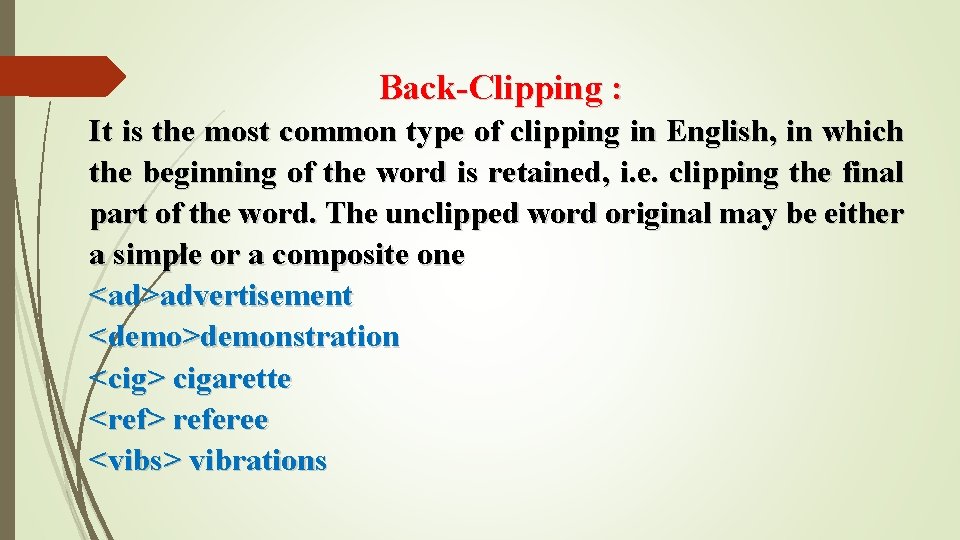
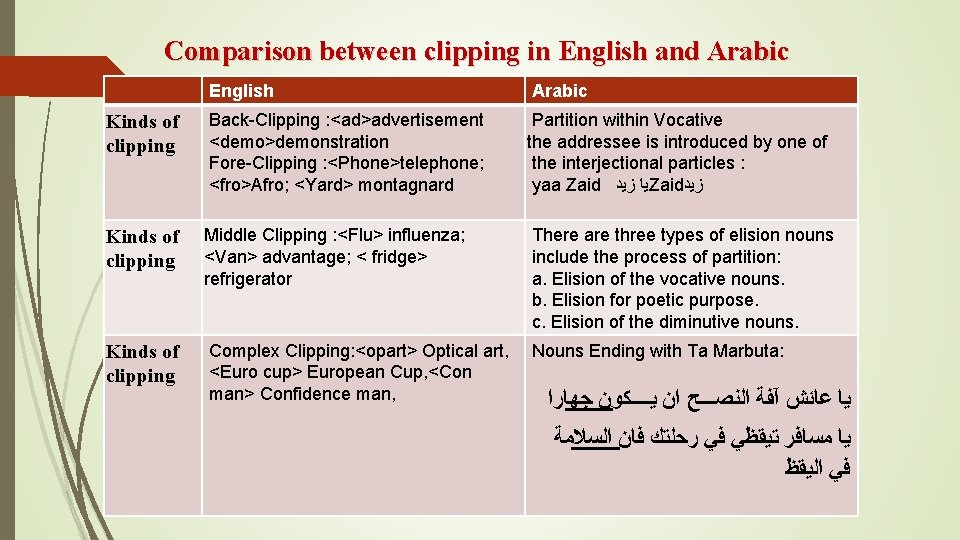
Back-Clipping : It is the most common type of clipping in English, in which the beginning of the word is retained, i. e. clipping the final part of the word. The unclipped word original may be either a simple or a composite one <ad>advertisement <demo>demonstration <cig> cigarette <ref> referee <vibs> vibrations
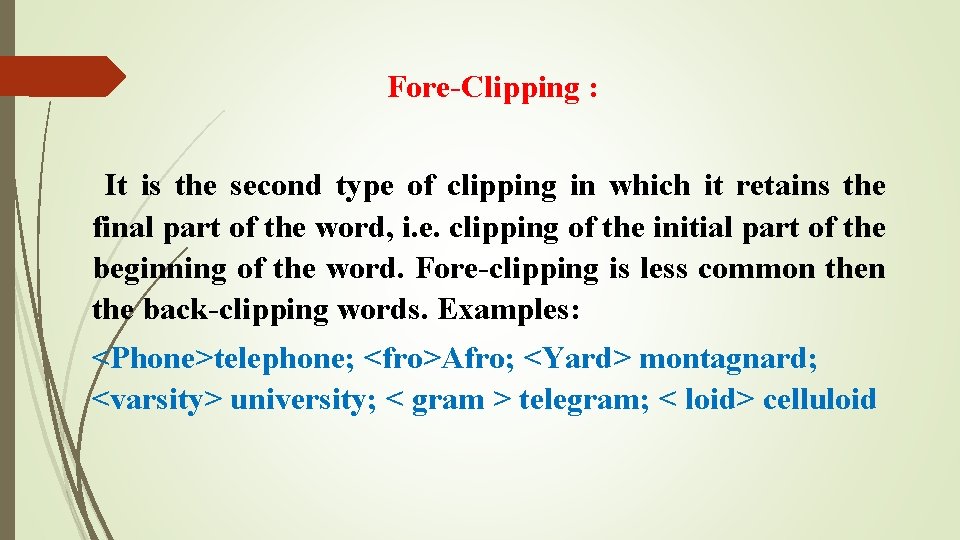
Fore-Clipping : It is the second type of clipping in which it retains the final part of the word, i. e. clipping of the initial part of the beginning of the word. Fore-clipping is less common the back-clipping words. Examples: <Phone>telephone; ˂fro>Afro; <Yard> montagnard; <varsity> university; < gram > telegram; < loid> celluloid
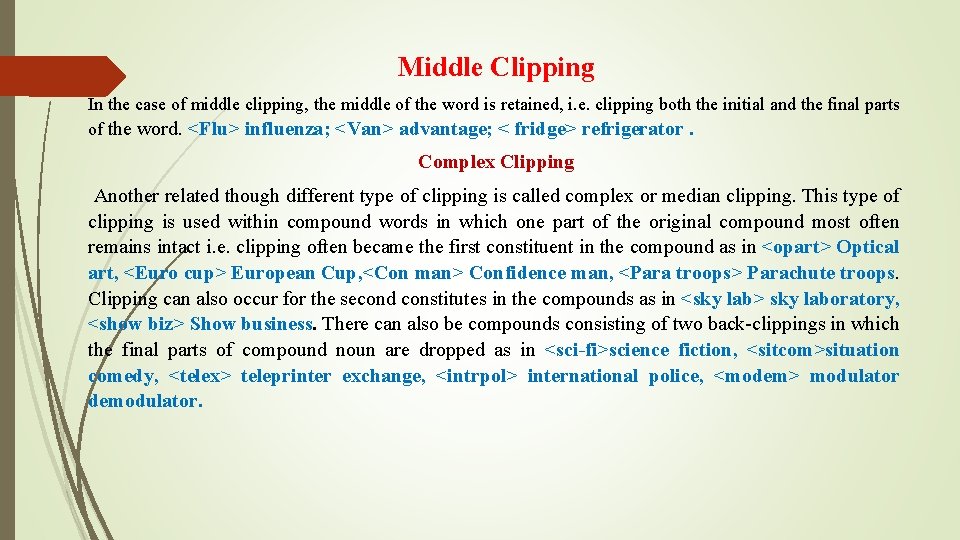
Middle Clipping In the case of middle clipping, the middle of the word is retained, i. e. clipping both the initial and the final parts of the word. <Flu> influenza; <Van> advantage; ˂ fridge˃ refrigerator. Complex Clipping Another related though different type of clipping is called complex or median clipping. This type of clipping is used within compound words in which one part of the original compound most often remains intact i. e. clipping often became the first constituent in the compound as in <opart> Optical art, <Euro cup> European Cup, <Con man> Confidence man, <Para troops> Parachute troops. Clipping can also occur for the second constitutes in the compounds as in <sky lab> sky laboratory, <show biz> Show business. There can also be compounds consisting of two back-clippings in which the final parts of compound noun are dropped as in <sci-fi>science fiction, <sitcom>situation comedy, <telex> teleprinter exchange, <intrpol> international police, <modem> modulator demodulator.
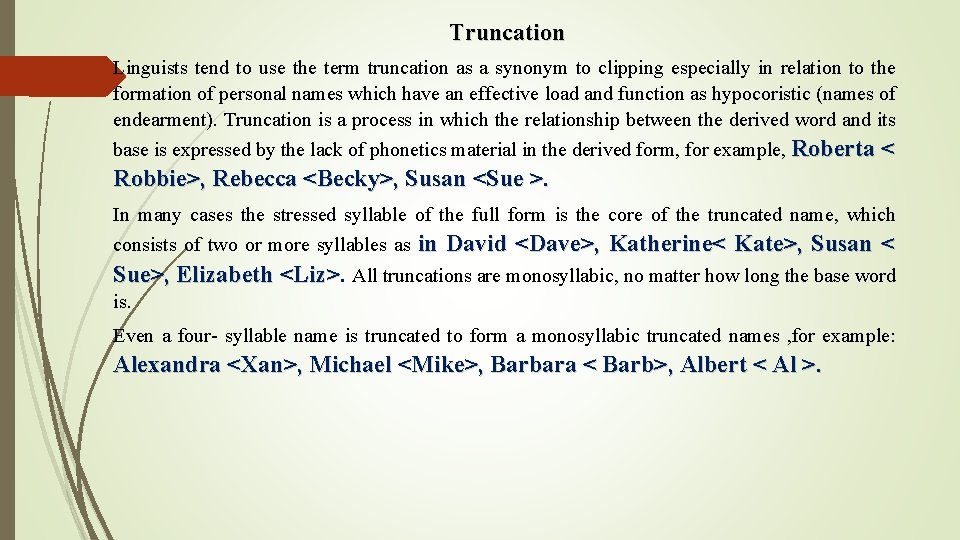
Truncation Linguists tend to use the term truncation as a synonym to clipping especially in relation to the formation of personal names which have an effective load and function as hypocoristic (names of endearment). Truncation is a process in which the relationship between the derived word and its base is expressed by the lack of phonetics material in the derived form, for example, Roberta ˂ Robbie˃, Rebecca ˂Becky˃, Susan ˂Sue ˃. In many cases the stressed syllable of the full form is the core of the truncated name, which consists of two or more syllables as in David ˂Dave˃, Katherine˂ Kate˃, Susan ˂ Sue˃, Elizabeth ˂Liz˃ All truncations are monosyllabic, no matter how long the base word is. Even a four- syllable name is truncated to form a monosyllabic truncated names , for example: Alexandra ˂Xan˃, Michael ˂Mike˃, Barbara ˂ Barb˃, Albert ˂ Al ˃.
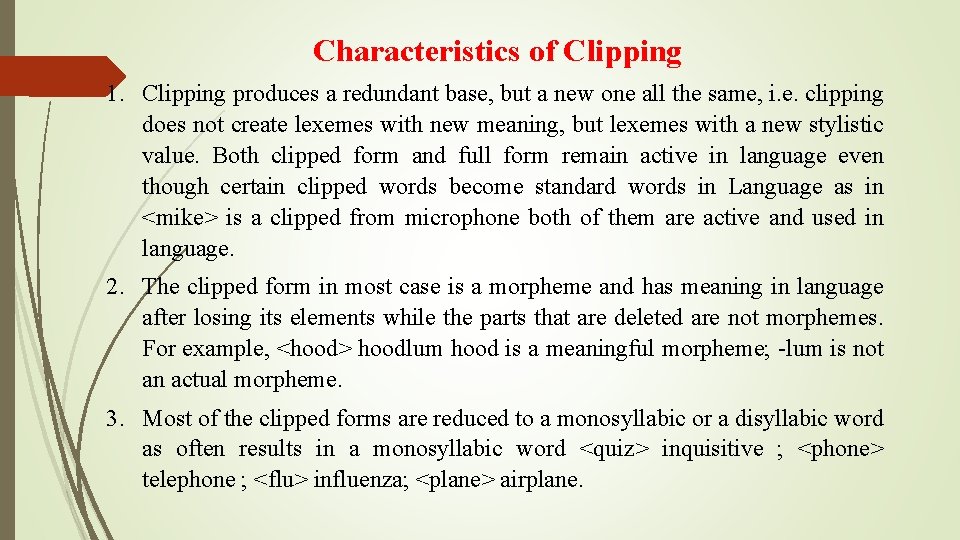
Characteristics of Clipping 1. Clipping produces a redundant base, but a new one all the same, i. e. clipping does not create lexemes with new meaning, but lexemes with a new stylistic value. Both clipped form and full form remain active in language even though certain clipped words become standard words in Language as in ˂mike˃ is a clipped from microphone both of them are active and used in language. 2. The clipped form in most case is a morpheme and has meaning in language after losing its elements while the parts that are deleted are not morphemes. For example, ˂hood˃ hoodlum hood is a meaningful morpheme; -lum is not an actual morpheme. 3. Most of the clipped forms are reduced to a monosyllabic or a disyllabic word as often results in a monosyllabic word ˂quiz˃ inquisitive ; ˂phone˃ telephone ; ˂flu˃ influenza; ˂plane˃ airplane.
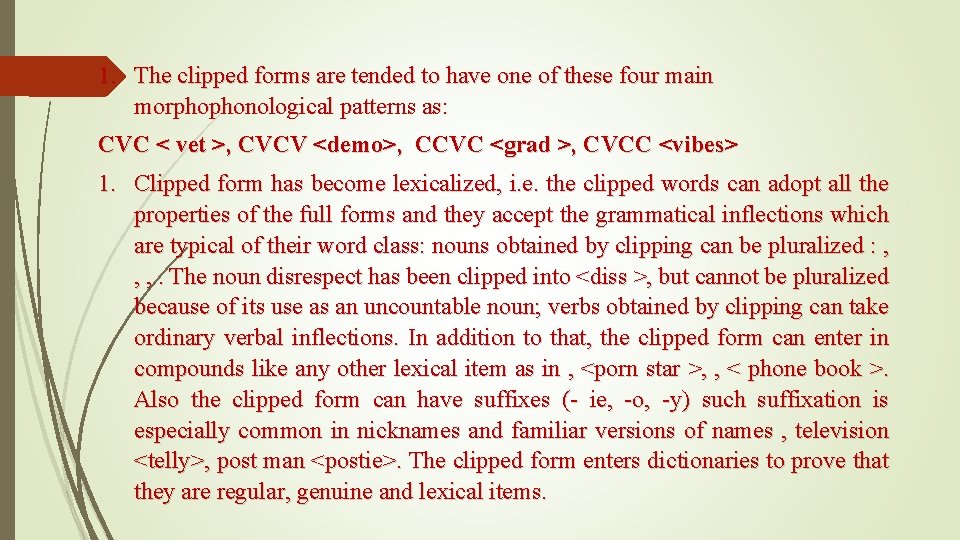
1. The clipped forms are tended to have one of these four main morphophonological patterns as: CVC ˂ vet ˃, CVCV ˂demo˃, CCVC ˂grad ˃, CVCC ˂vibes˃ 1. Clipped form has become lexicalized, i. e. the clipped words can adopt all the properties of the full forms and they accept the grammatical inflections which are typical of their word class: nouns obtained by clipping can be pluralized : , , , . The noun disrespect has been clipped into ˂diss ˃, but cannot be pluralized because of its use as an uncountable noun; verbs obtained by clipping can take ordinary verbal inflections. In addition to that, the clipped form can enter in compounds like any other lexical item as in , ˂porn star ˃, , ˂ phone book ˃. Also the clipped form can have suffixes (- ie, -o, -y) such suffixation is especially common in nicknames and familiar versions of names , television ˂telly˃, post man ˂postie˃. The clipped form enters dictionaries to prove that they are regular, genuine and lexical items.
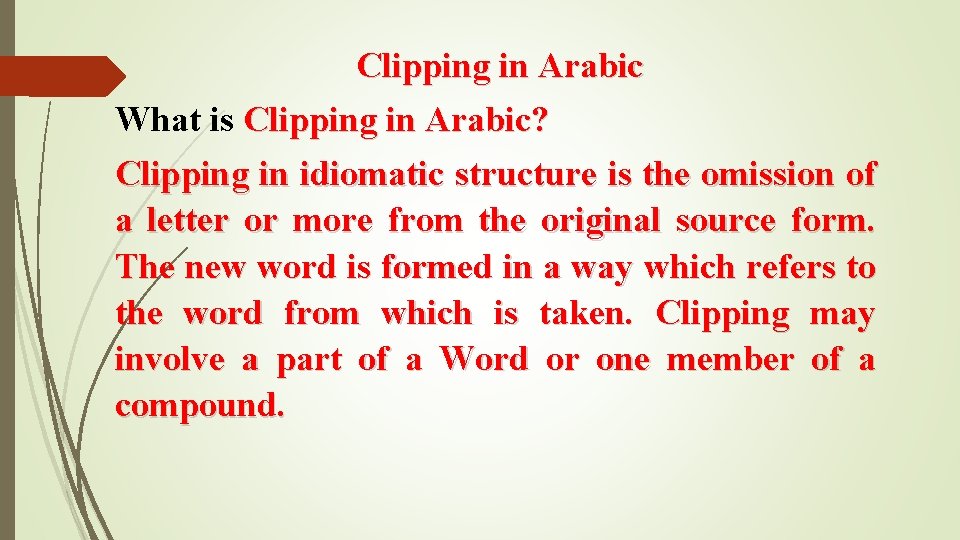
Clipping in Arabic What is Clipping in Arabic? Clipping in idiomatic structure is the omission of a letter or more from the original source form. The new word is formed in a way which refers to the word from which is taken. Clipping may involve a part of a Word or one member of a compound.
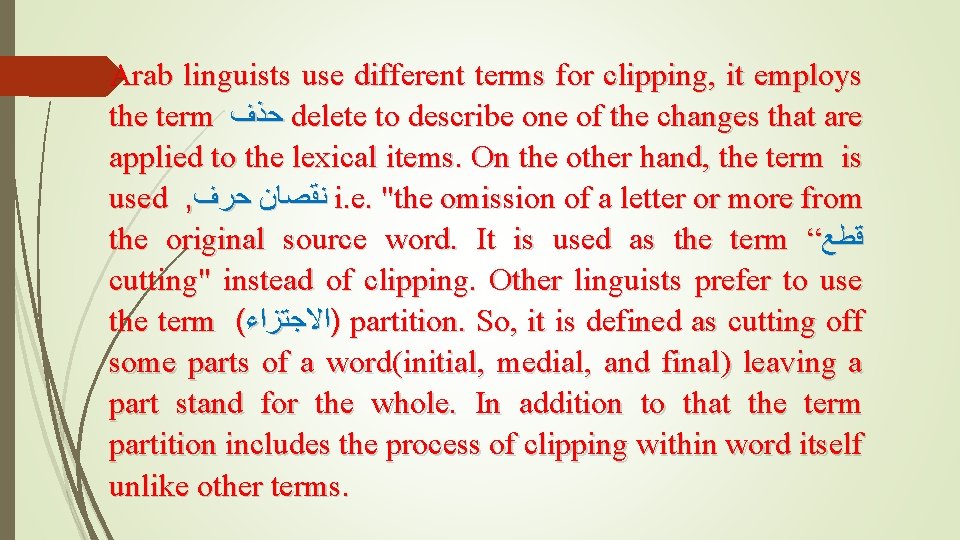
Arab linguists use different terms for clipping, it employs the term ﺣﺬﻑ delete to describe one of the changes that are applied to the lexical items. On the other hand, the term is used , ﻧﻘﺼﺎﻥ ﺣﺮﻑ i. e. "the omission of a letter or more from the original source word. It is used as the term “ ﻗﻄﻊ cutting" instead of clipping. Other linguists prefer to use the term ( )ﺍﻻﺟﺘﺰﺍﺀ partition. So, it is defined as cutting off some parts of a word(initial, medial, and final) leaving a part stand for the whole. In addition to that the term partition includes the process of clipping within word itself unlike other terms.
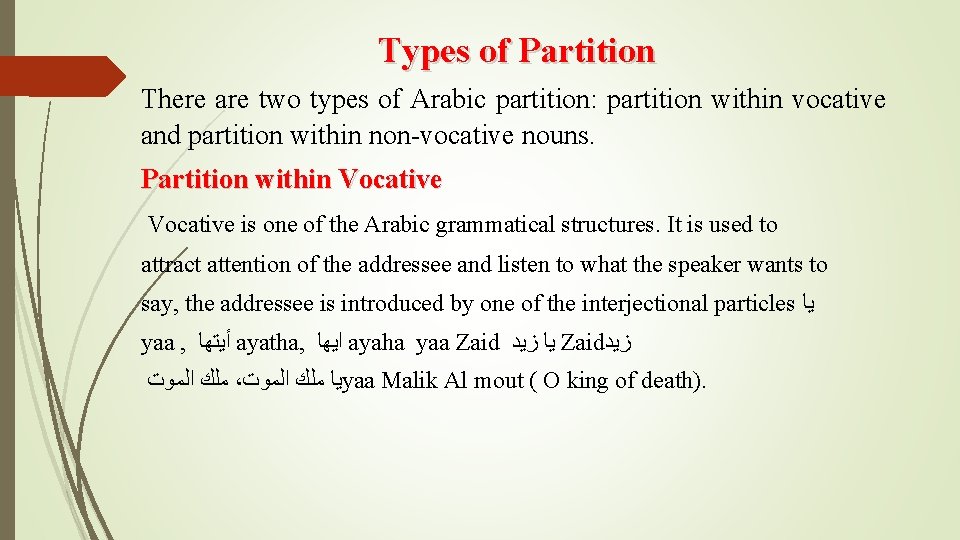
Types of Partition There are two types of Arabic partition: partition within vocative and partition within non-vocative nouns. Partition within Vocative is one of the Arabic grammatical structures. It is used to attract attention of the addressee and listen to what the speaker wants to say, the addressee is introduced by one of the interjectional particles ﻳﺎ yaa , ﺃﻴﺘﻬﺎ ayatha, ﺍﻳﻬﺎ ayaha yaa Zaid ﻳﺎ ﺯﻳﺪ Zaid ﺯﻳﺪ ﻣﻠﻚ ﺍﻟﻤﻮﺕ ، ﻳﺎ ﻣﻠﻚ ﺍﻟﻤﻮﺕ yaa Malik Al mout ( O king of death).
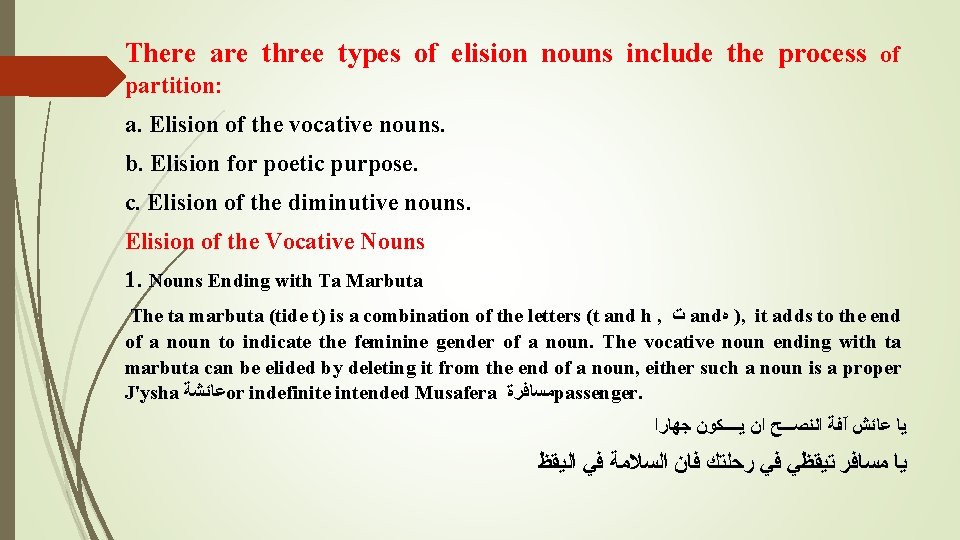
There are three types of elision nouns include the process of partition: a. Elision of the vocative nouns. b. Elision for poetic purpose. c. Elision of the diminutive nouns. Elision of the Vocative Nouns 1. Nouns Ending with Ta Marbuta The ta marbuta (tide t) is a combination of the letters (t and h , ﺕ and ) ﻩ , it adds to the end of a noun to indicate the feminine gender of a noun. The vocative noun ending with ta marbuta can be elided by deleting it from the end of a noun, either such a noun is a proper J'ysha ﻋﺎﺋﺸﺔ or indefinite intended Musafera ﻣﺴﺎﻓﺮﺓ passenger. ﻳﺎ ﻋﺎﺋﺶ آﻔﺔ ﺍﻟﻨﺼـــﺢ ﺍﻥ ﻳــــﻜﻮﻥ ﺟﻬﺎﺭﺍ ﻳﺎ ﻣﺴﺎﻓﺮ ﺗﻴﻘﻈﻲ ﻓﻲ ﺭﺣﻠﺘﻚ ﻓﺎﻥ ﺍﻟﺴﻼﻣﺔ ﻓﻲ ﺍﻟﻴﻘﻆ
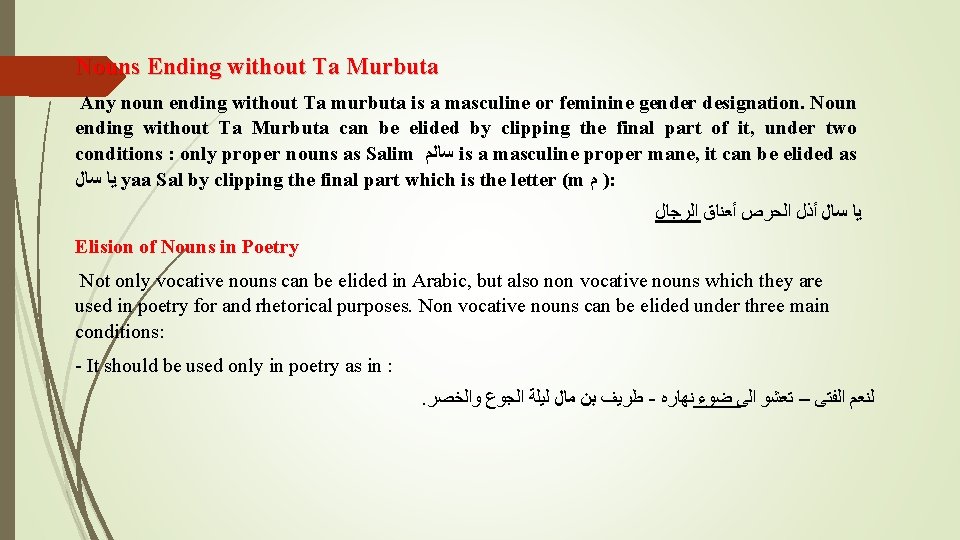
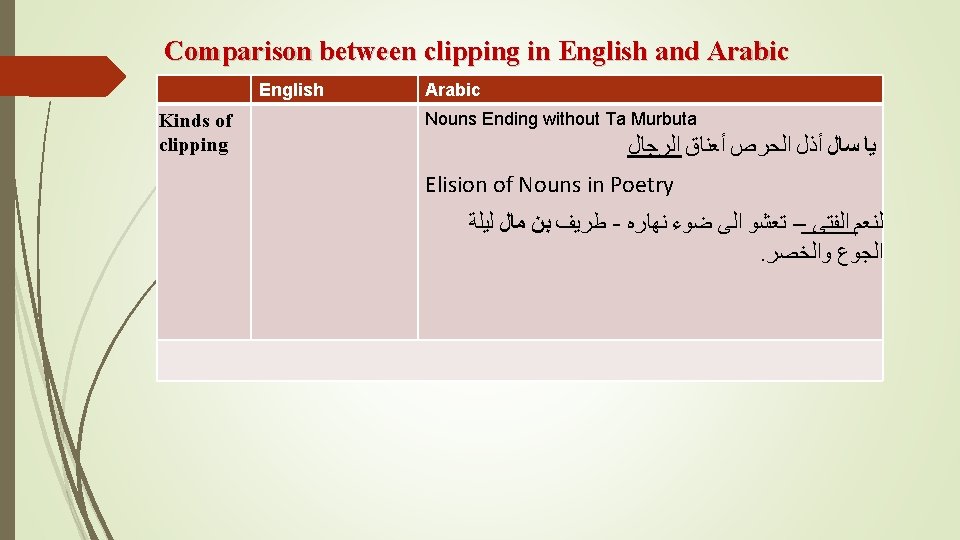
Nouns Ending without Ta Murbuta Any noun ending without Ta murbuta is a masculine or feminine gender designation. Noun ending without Ta Murbuta can be elided by clipping the final part of it, under two conditions : only proper nouns as Salim ﺳﺎﻟﻢ is a masculine proper mane, it can be elided as ﻳﺎ ﺳﺎﻝ yaa Sal by clipping the final part which is the letter (m ) ﻡ : ﻳﺎ ﺳﺎﻝ ﺃﺬﻝ ﺍﻟﺤﺮﺹ ﺃﻌﻨﺎﻕ ﺍﻟﺮﺟﺎﻝ Elision of Nouns in Poetry Not only vocative nouns can be elided in Arabic, but also non vocative nouns which they are used in poetry for and rhetorical purposes. Non vocative nouns can be elided under three main conditions: - It should be used only in poetry as in : . ﻃﺮﻳﻒ ﺑﻦ ﻣﺎﻝ ﻟﻴﻠﺔ ﺍﻟﺠﻮﻉ ﻭﺍﻟﺨﺼﺮ - ﻟﻨﻌﻢ ﺍﻟﻔﺘﻰ – ﺗﻌﺸﻮ ﺍﻟﻰ ﺿﻮﺀ ﻧﻬﺎﺭﻩ
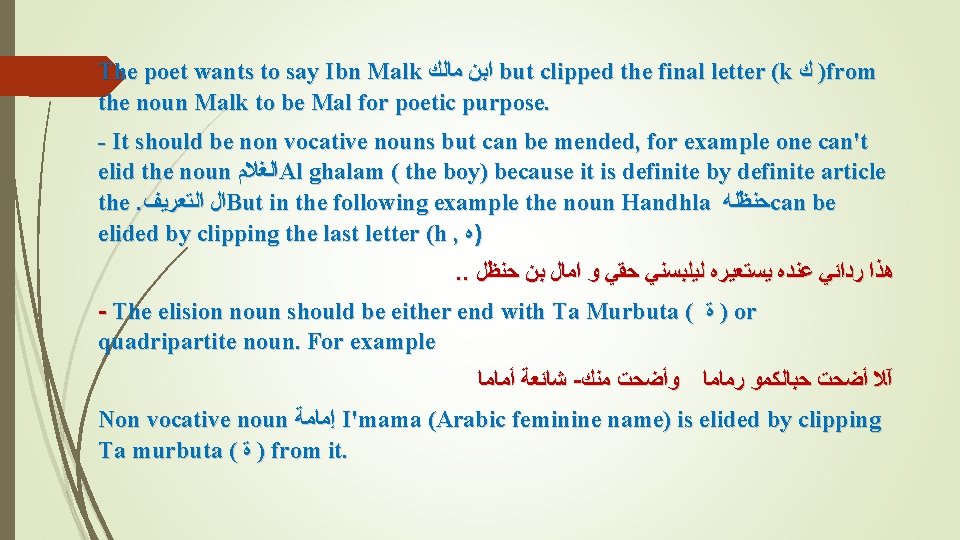
The poet wants to say Ibn Malk ﺍﺑﻦ ﻣﺎﻟﻚ but clipped the final letter (k ) ﻙ from the noun Malk to be Mal for poetic purpose. - It should be non vocative nouns but can be mended, for example one can't elid the noun ﺍﻟﻐﻼﻡ Al ghalam ( the boy) because it is definite by definite article the. ﺍﻝ ﺍﻟﺘﻌﺮﻳﻒ But in the following example the noun Handhla ﺣﻨﻈﻠﻪ can be elided by clipping the last letter (h , )ﻩ . . ﻫﺬﺍ ﺭﺩﺍﺋﻲ ﻋﻨﺪﻩ ﻳﺴﺘﻌﻴﺮﻩ ﻟﻴﻠﺒﺴﻨﻲ ﺣﻘﻲ ﻭ ﺍﻣﺎﻝ ﺑﻦ ﺣﻨﻈﻞ - The elision noun should be either end with Ta Murbuta ( ) ﺓ or quadripartite noun. For example ﺷﺎﺋﻌﺔ ﺃﻤﺎﻣﺎ - آﻼ ﺃﻀﺤﺖ ﺣﺒﺎﻟﻜﻤﻮ ﺭﻣﺎﻣﺎ ﻭﺃﻀﺤﺖ ﻣﻨﻚ Non vocative noun ﺇﻣﺎﻣﺔ I'mama (Arabic feminine name) is elided by clipping Ta murbuta ( ) ﺓ from it.
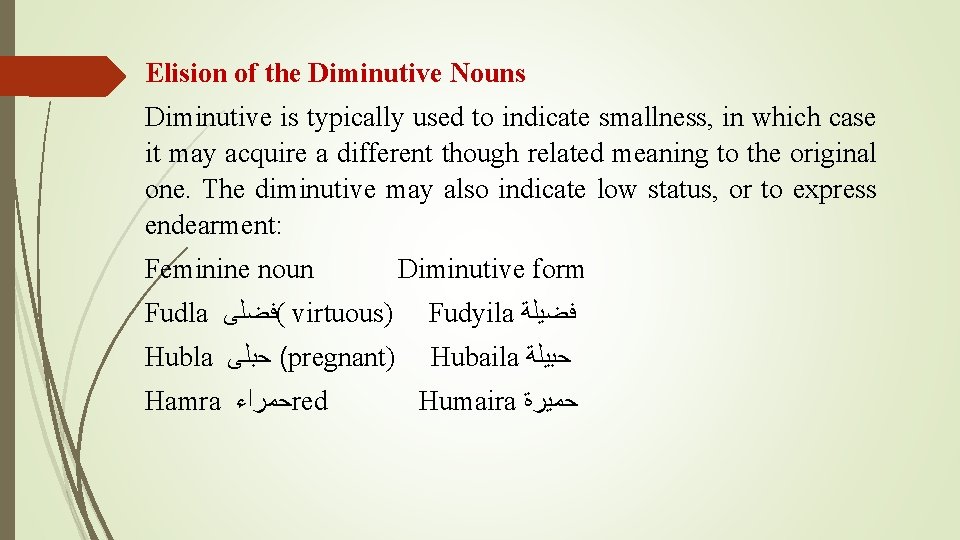
Elision of the Diminutive Nouns Diminutive is typically used to indicate smallness, in which case it may acquire a different though related meaning to the original one. The diminutive may also indicate low status, or to express endearment: Feminine noun Diminutive form Fudla (ﻓﻀﻠﻰ virtuous) Fudyila ﻓﻀﻴﻠﺔ Hubla ( ﺣﺒﻠﻰ pregnant) Hubaila ﺣﺒﻴﻠﺔ Hamra ﺣﻤﺮﺍﺀ red Humaira ﺣﻤﻴﺮﺓ
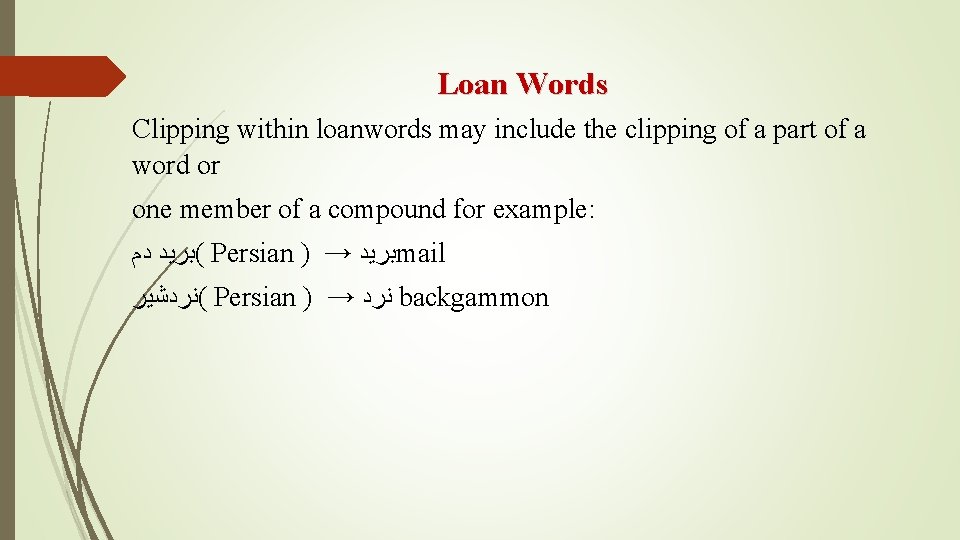
Loan Words Clipping within loanwords may include the clipping of a part of a word or one member of a compound for example: (ﺑﺮﻳﺪ ﺩﻡ Persian ) → ﺑﺮﻳﺪ mail (ﻧﺮﺩﺷﻴﺮ Persian ) → ﻧﺮﺩ backgammon
Comparison between clipping in English and Arabic English Arabic Definitio The process whereby a lexeme n (simple or complex) is shortened, while still retaining the same meaning and still being a member of the same class. It is defined as cutting off some parts of a word(initial, medial, and final) leaving a part stand for the whole. In addition to that the term partition includes the process of clipping within word itself unlike other terms. Kinds of clipping There are two types of Arabic partition: partition within vocative and partition within non-vocative nouns. Whatever kind of clipped words, there are four types of English clipping: back clipping, foreclipping, middle-clipping, and complex clipping (In addition to truncation).
Comparison between clipping in English and Arabic English Arabic Kinds of clipping Back-Clipping : <ad>advertisement <demo>demonstration Fore-Clipping : <Phone>telephone; ˂fro>Afro; <Yard> montagnard Partition within Vocative the addressee is introduced by one of the interjectional particles : yaa Zaid ﻳﺎ ﺯﻳﺪ Zaid ﺯﻳﺪ Kinds of clipping Middle Clipping : <Flu> influenza; <Van> advantage; ˂ fridge˃ refrigerator There are three types of elision nouns include the process of partition: a. Elision of the vocative nouns. b. Elision for poetic purpose. c. Elision of the diminutive nouns. Kinds of clipping Complex Clipping: <opart> Optical art, <Euro cup> European Cup, <Con man> Confidence man, Nouns Ending with Ta Marbuta: ﻳﺎ ﻋﺎﺋﺶ آﻔﺔ ﺍﻟﻨﺼـــﺢ ﺍﻥ ﻳــــﻜﻮﻥ ﺟﻬﺎﺭﺍ ﻳﺎ ﻣﺴﺎﻓﺮ ﺗﻴﻘﻈﻲ ﻓﻲ ﺭﺣﻠﺘﻚ ﻓﺎﻥ ﺍﻟﺴﻼﻣﺔ ﻓﻲ ﺍﻟﻴﻘﻆ
Comparison between clipping in English and Arabic English Kinds of clipping Arabic Nouns Ending without Ta Murbuta ﻳﺎ ﺳﺎﻝ ﺃﺬﻝ ﺍﻟﺤﺮﺹ ﺃﻌﻨﺎﻕ ﺍﻟﺮﺟﺎﻝ Elision of Nouns in Poetry ﻃﺮﻳﻒ ﺑﻦ ﻣﺎﻝ ﻟﻴﻠﺔ - ﻟﻨﻌﻢ ﺍﻟﻔﺘﻰ – ﺗﻌﺸﻮ ﺍﻟﻰ ﺿﻮﺀ ﻧﻬﺎﺭﻩ . ﺍﻟﺠﻮﻉ ﻭﺍﻟﺨﺼﺮ
References : Fargai, M. A. & Jaber, A. F. (2010): Vocabulary. Q. O. U. Pub: Um Summaq, Amman, Jordan. Muqattash, L. (2010): Introduction to Linguistics. Q. O. U. Pub: Um Summaq, Amman, Jordan.
Thank You