
The ISIS Facility John Thomason Synchrotron Group Leader
- Slides: 33
The ISIS Facility John Thomason Synchrotron Group Leader ISIS Department Rutherford Appleton Laboratory / STFC (With thanks to David Findlay) Fermilab, 13 January 2012
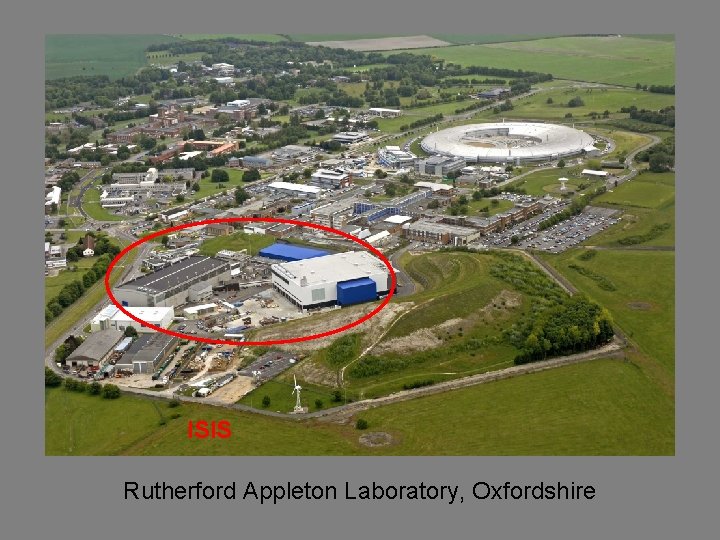
ISIS Rutherford Appleton Laboratory, Oxfordshire
ISIS World’s most productive spallation neutron source (if no longer highest pulsed beam power) Flagship STFC facility [Science & Technology Facilities Council] Driven by UK’s high-power proton accelerators UK has largest national neutron user community of any country Accelerator physics necessary for continuing operational development - and also for enabling entire programmes on materials R&D Need to plan for upgrades 3
ISIS science World-leading centre for research in the physical and life sciences Neutron and muon instruments for properties of materials in terms of molecular structure National and international community of >2000 scientists Research fields include clean energy, the environment, pharmaceuticals and health care, nanotechnology, materials engineering and IT ~450 publications/year (~9000 total over 26 years) MICE (Muon Ionisation Cooling Experiment) 4
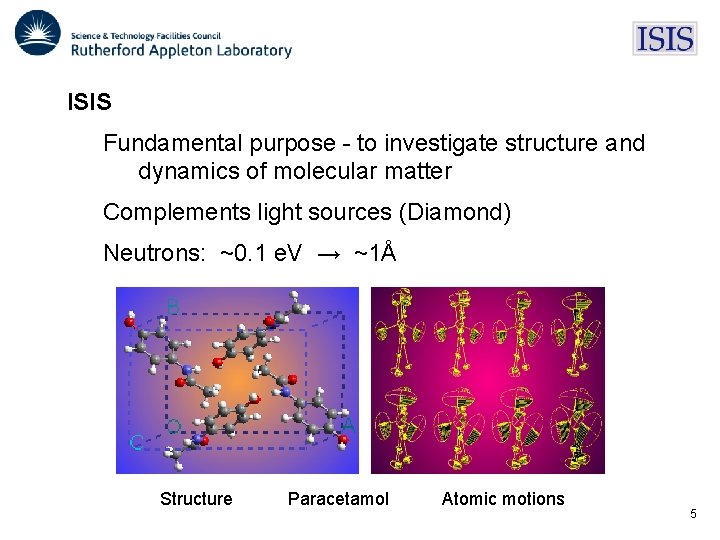
ISIS Fundamental purpose - to investigate structure and dynamics of molecular matter Complements light sources (Diamond) Neutrons: ~0. 1 e. V → ~1Å Structure Paracetamol Atomic motions 5
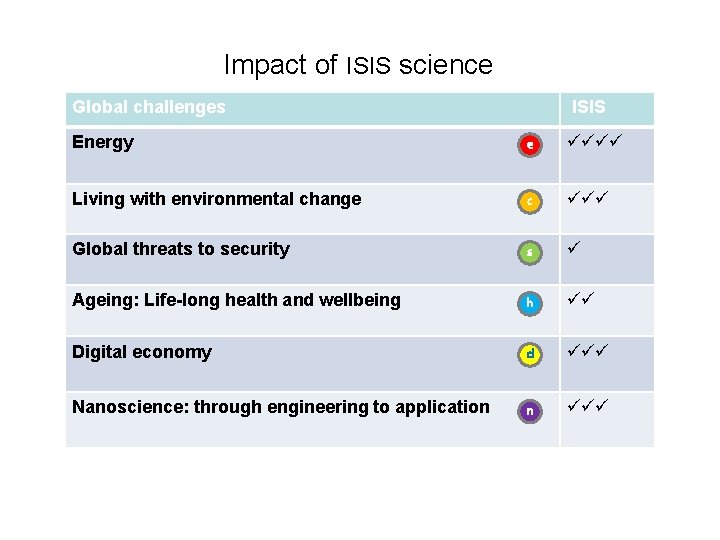
Impact of ISIS science Global challenges ISIS Energy e Living with environmental change c Global threats to security s Ageing: Life-long health and wellbeing h Digital economy d Nanoscience: through engineering to application n
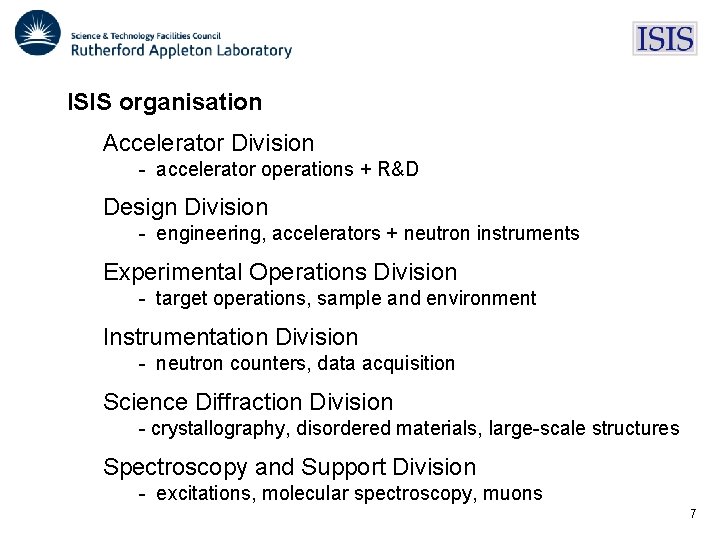
ISIS organisation Accelerator Division - accelerator operations + R&D Design Division - engineering, accelerators + neutron instruments Experimental Operations Division - target operations, sample and environment Instrumentation Division - neutron counters, data acquisition Science Diffraction Division - crystallography, disordered materials, large-scale structures Spectroscopy and Support Division - excitations, molecular spectroscopy, muons 7
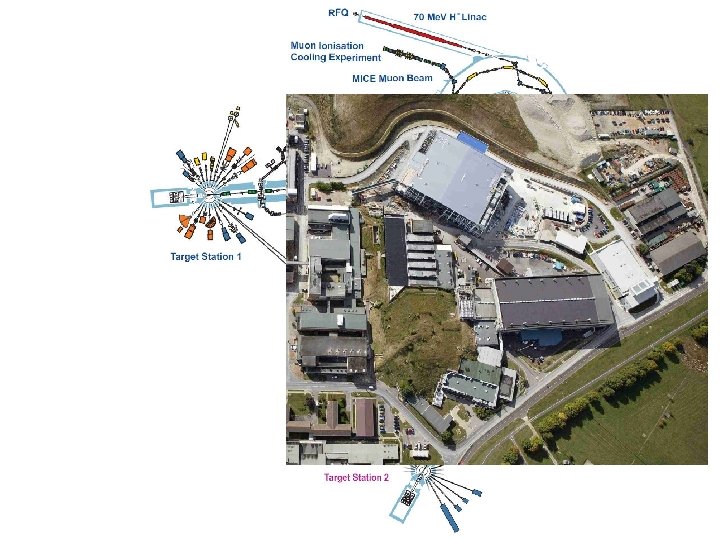
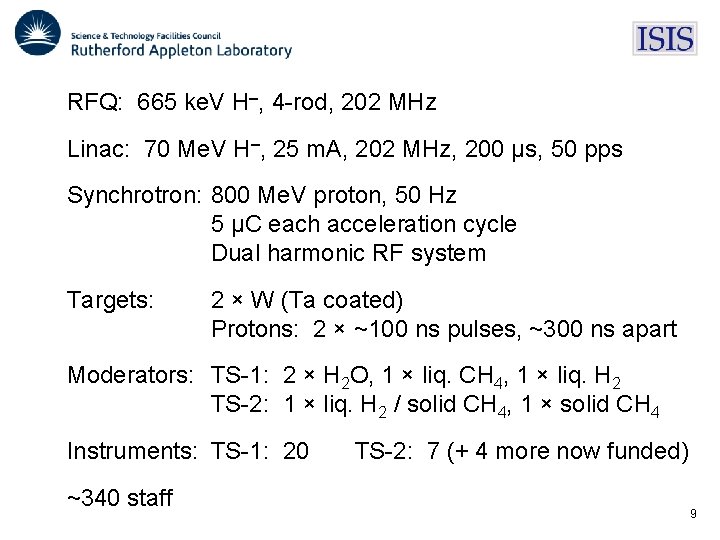
RFQ: 665 ke. V H–, 4 -rod, 202 MHz Linac: 70 Me. V H–, 25 m. A, 202 MHz, 200 µs, 50 pps Synchrotron: 800 Me. V proton, 50 Hz 5 µC each acceleration cycle Dual harmonic RF system Targets: 2 × W (Ta coated) Protons: 2 × ~100 ns pulses, ~300 ns apart Moderators: TS-1: 2 × H 2 O, 1 × liq. CH 4, 1 × liq. H 2 TS-2: 1 × liq. H 2 / solid CH 4, 1 × solid CH 4 Instruments: TS-1: 20 ~340 staff TS-2: 7 (+ 4 more now funded) 9
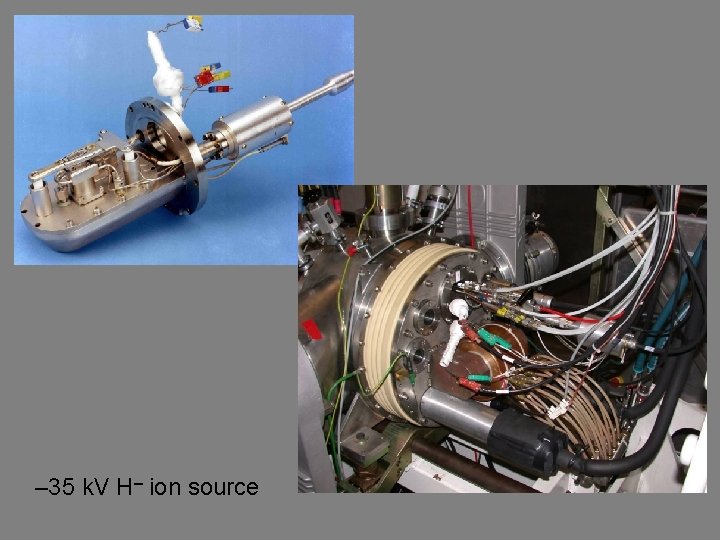
– 35 k. V H– ion source
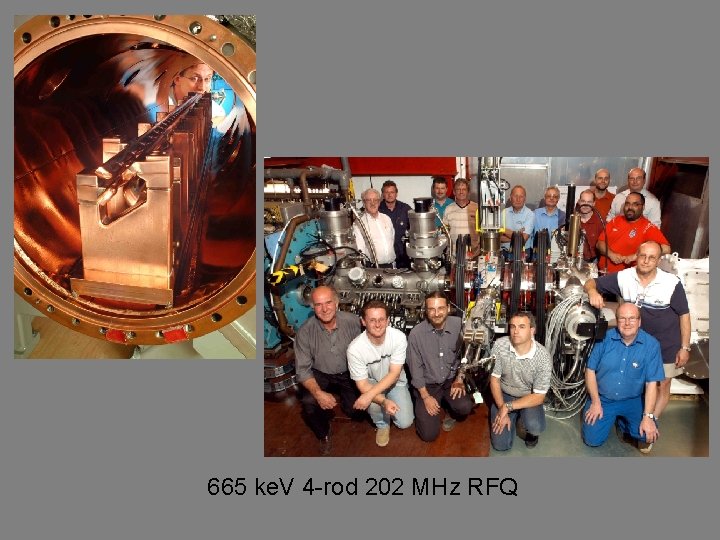
665 ke. V 4 -rod 202 MHz RFQ
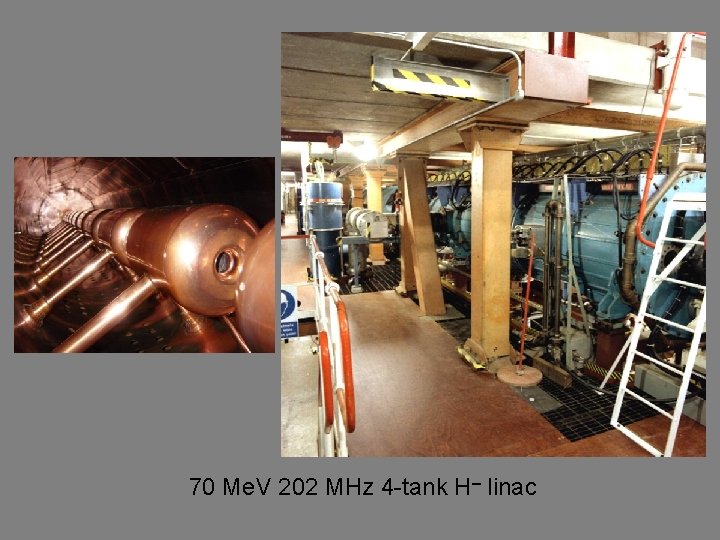
70 Me. V 202 MHz 4 -tank H– linac
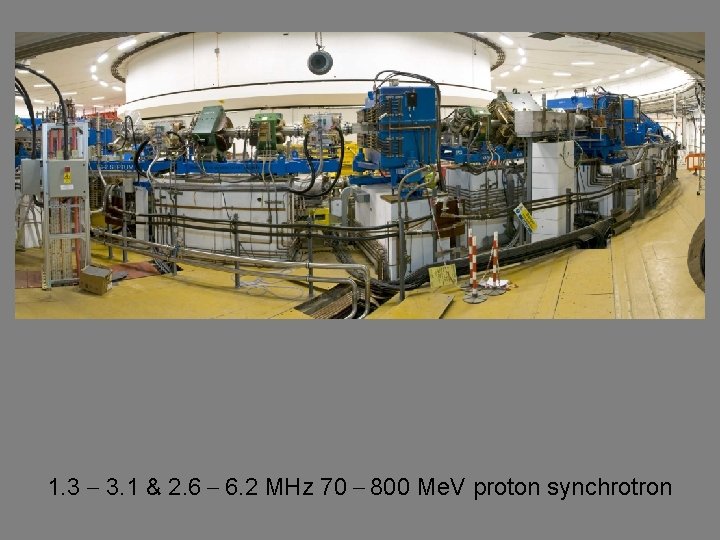
1. 3 – 3. 1 & 2. 6 – 6. 2 MHz 70 – 800 Me. V proton synchrotron
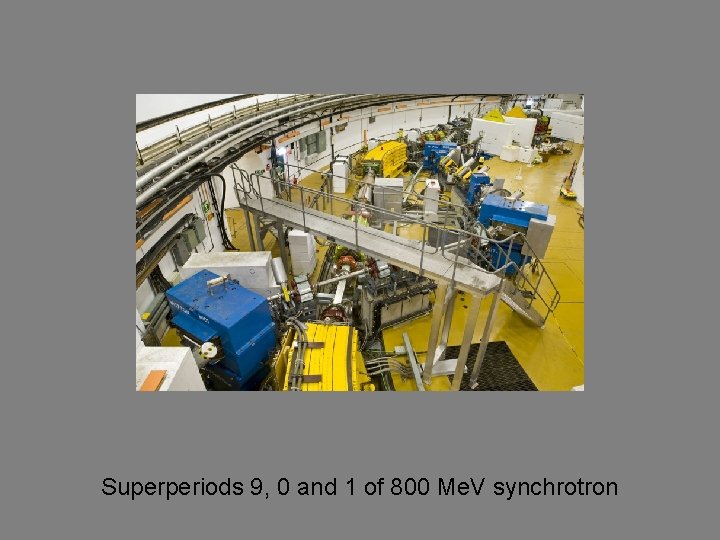
Superperiods 9, 0 and 1 of 800 Me. V synchrotron
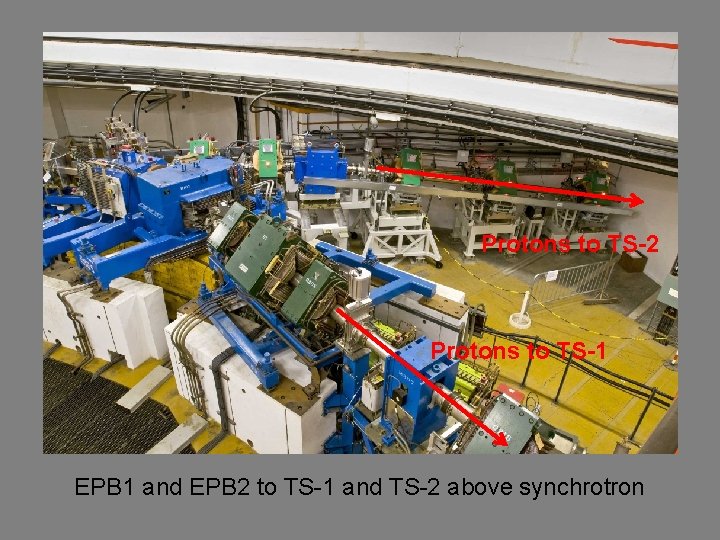
Protons to TS-2 Protons to TS-1 EPB 1 and EPB 2 to TS-1 and TS-2 above synchrotron
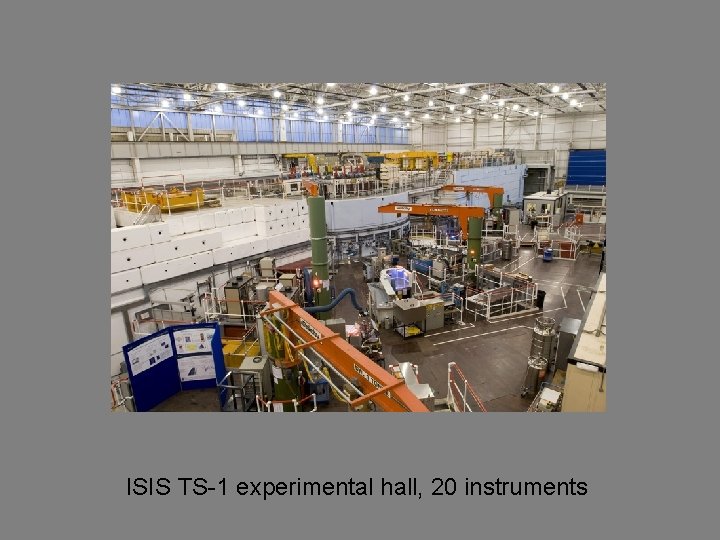
ISIS TS-1 experimental hall, 20 instruments
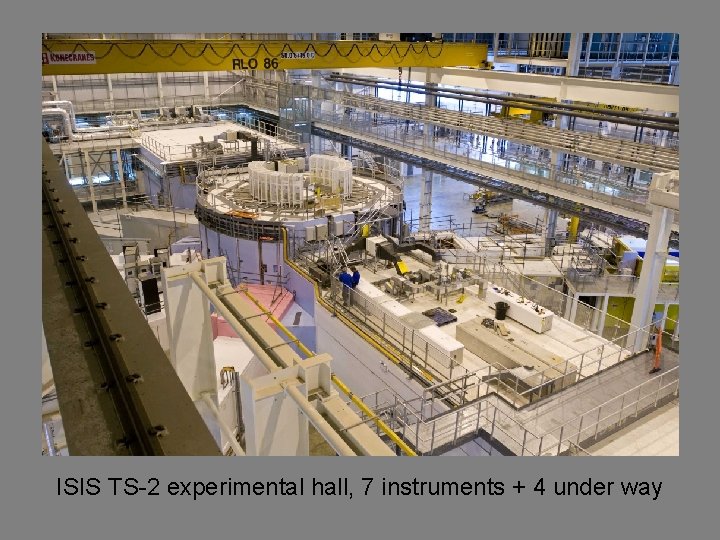
ISIS TS-2 experimental hall, 7 instruments + 4 under way
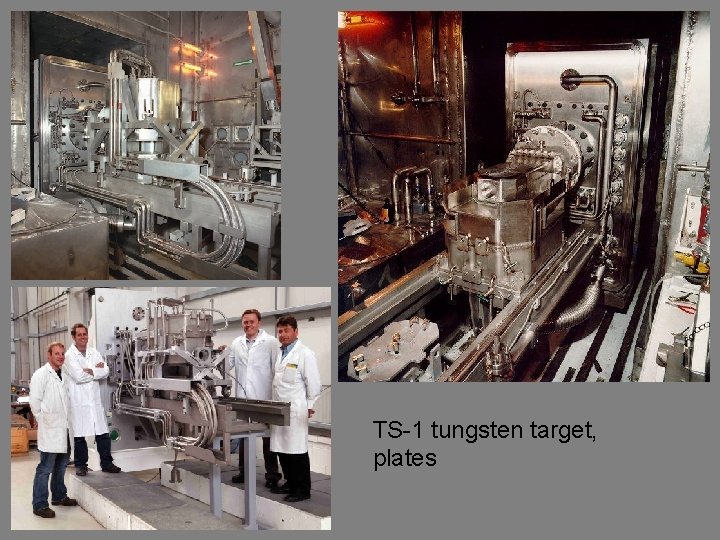
TS-1 tungsten target, plates
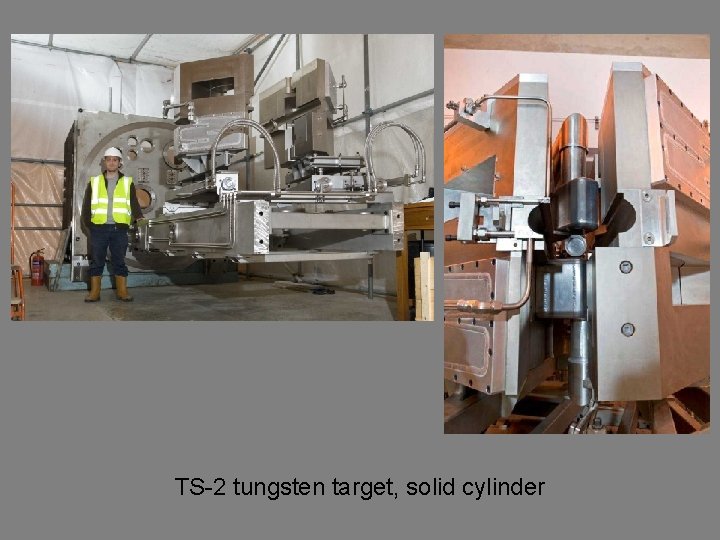
TS-2 tungsten target, solid cylinder
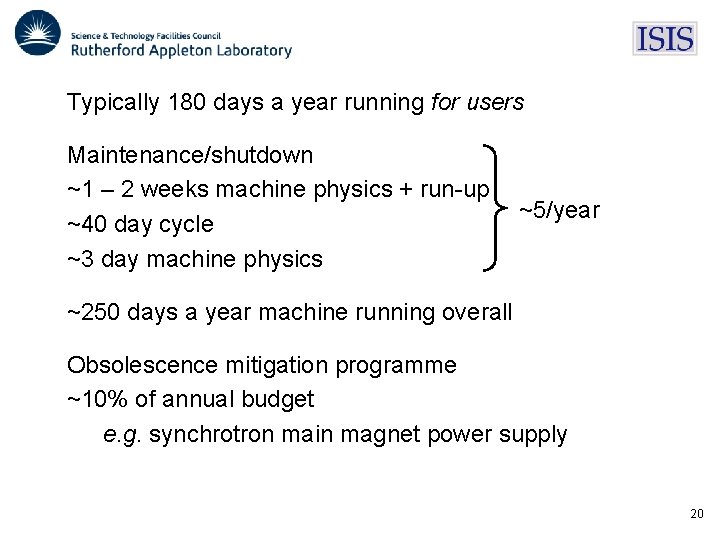
Typically 180 days a year running for users Maintenance/shutdown ~1 – 2 weeks machine physics + run-up ~40 day cycle ~3 day machine physics ~5/year ~250 days a year machine running overall Obsolescence mitigation programme ~10% of annual budget e. g. synchrotron main magnet power supply 20
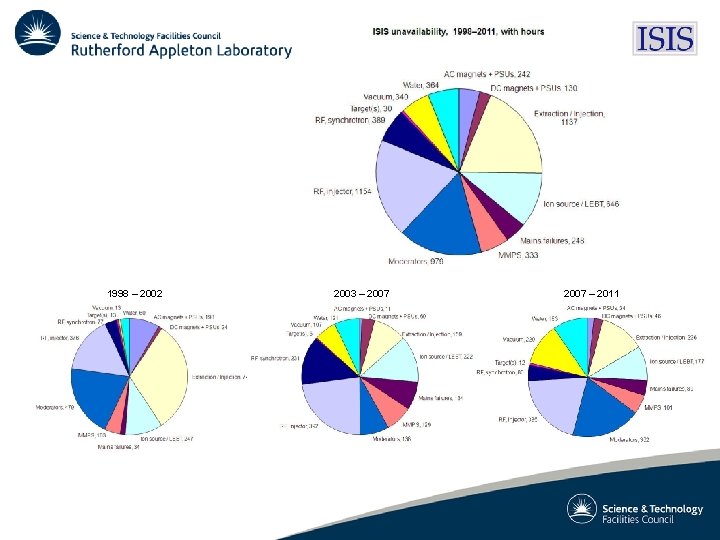
1998 – 2002 2003 – 2007 – 2011 21
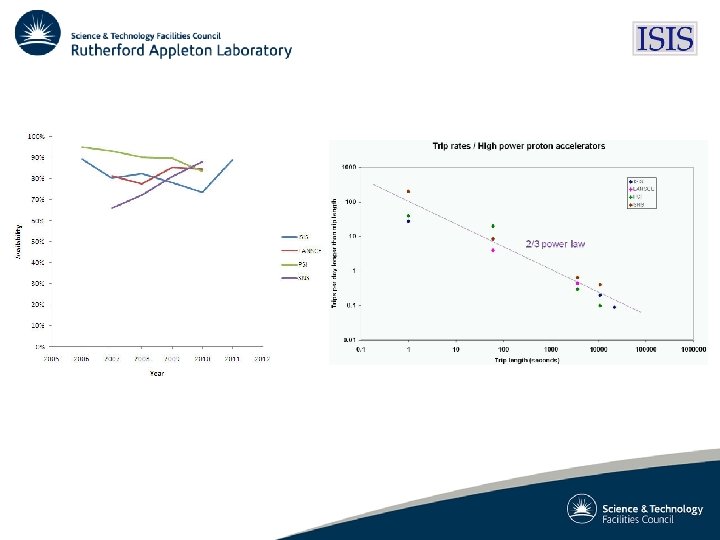
22
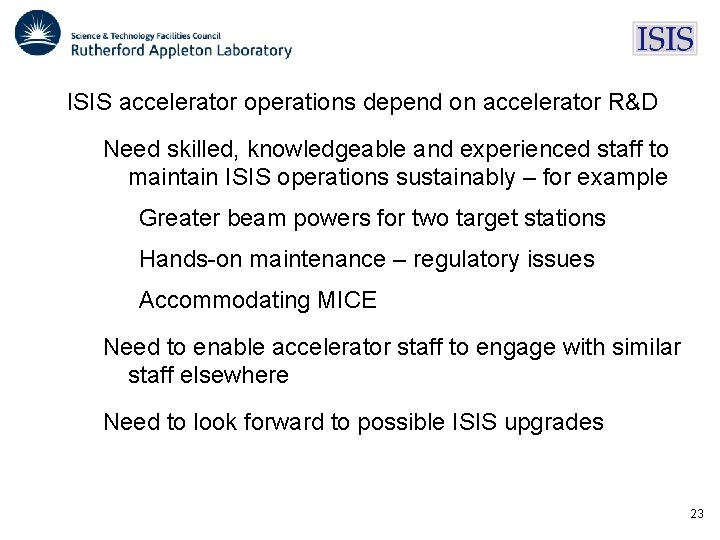
ISIS accelerator operations depend on accelerator R&D Need skilled, knowledgeable and experienced staff to maintain ISIS operations sustainably – for example Greater beam powers for two target stations Hands-on maintenance – regulatory issues Accommodating MICE Need to enable accelerator staff to engage with similar staff elsewhere Need to look forward to possible ISIS upgrades 23
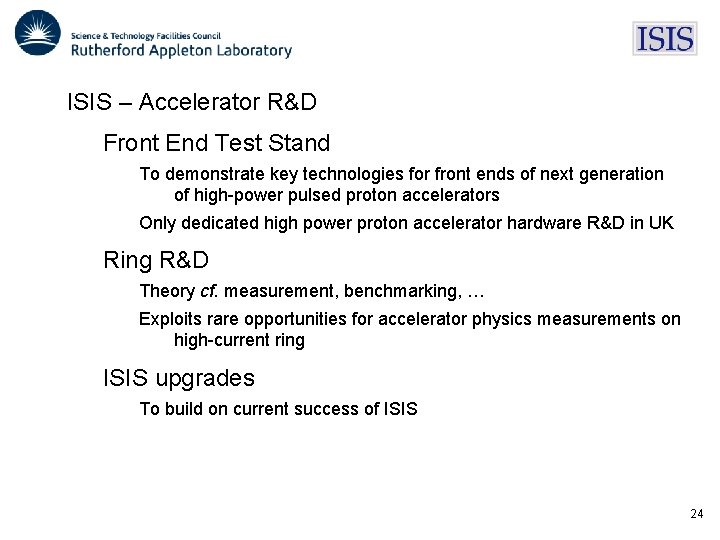
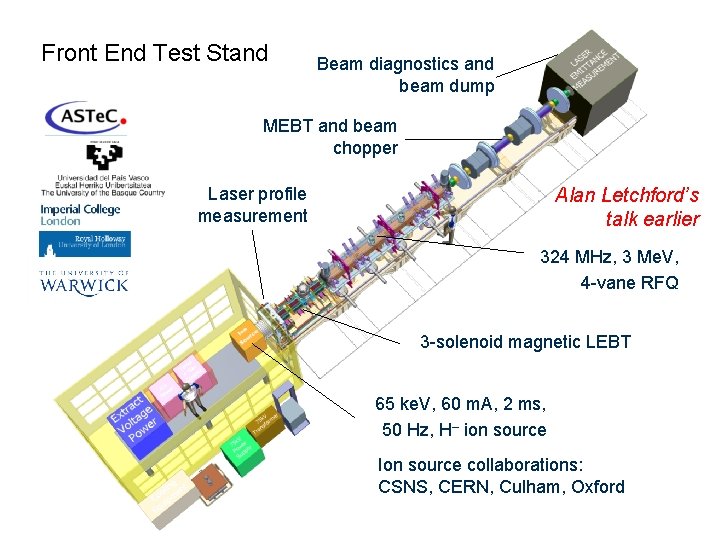
ISIS – Accelerator R&D Front End Test Stand To demonstrate key technologies for front ends of next generation of high-power pulsed proton accelerators Only dedicated high power proton accelerator hardware R&D in UK Ring R&D Theory cf. measurement, benchmarking, … Exploits rare opportunities for accelerator physics measurements on high-current ring ISIS upgrades To build on current success of ISIS 24
Front End Test Stand Beam diagnostics and beam dump MEBT and beam chopper Laser profile measurement Alan Letchford’s talk earlier 324 MHz, 3 Me. V, 4 -vane RFQ 3 -solenoid magnetic LEBT 65 ke. V, 60 m. A, 2 ms, 50 Hz, H– ion source Ion source collaborations: CSNS, CERN, Culham, Oxford
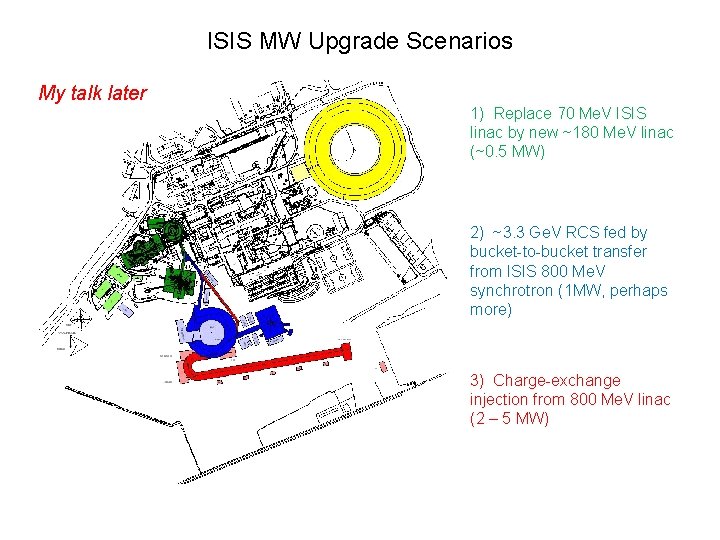
ISIS MW Upgrade Scenarios My talk later 1) Replace 70 Me. V ISIS linac by new ~180 Me. V linac (~0. 5 MW) 2) ~3. 3 Ge. V RCS fed by bucket-to-bucket transfer from ISIS 800 Me. V synchrotron (1 MW, perhaps more) 3) Charge-exchange injection from 800 Me. V linac (2 – 5 MW)
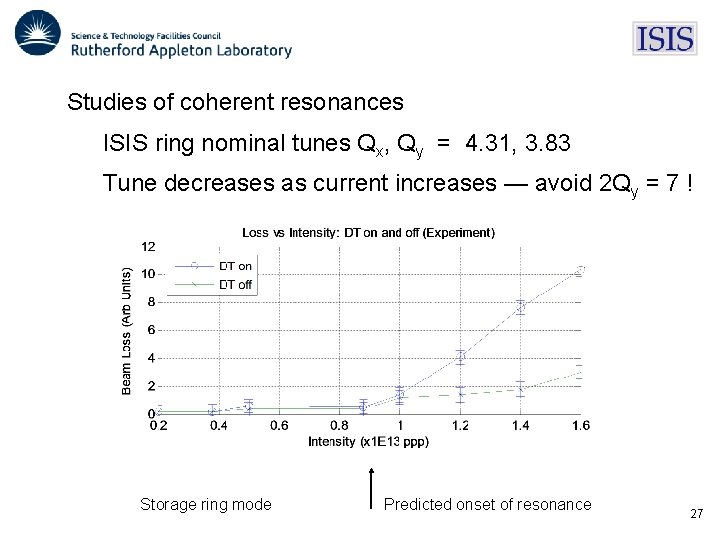
Studies of coherent resonances ISIS ring nominal tunes Qx, Qy = 4. 31, 3. 83 Tune decreases as current increases — avoid 2 Qy = 7 ! Storage ring mode Predicted onset of resonance 27
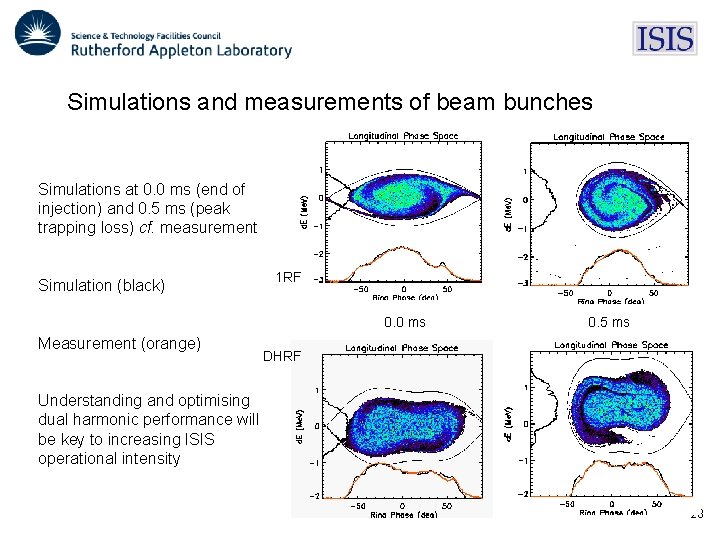
Simulations and measurements of beam bunches Simulations at 0. 0 ms (end of injection) and 0. 5 ms (peak trapping loss) cf. measurement Simulation (black) 1 RF 0. 0 ms Measurement (orange) 0. 5 ms DHRF Understanding and optimising dual harmonic performance will be key to increasing ISIS operational intensity 28
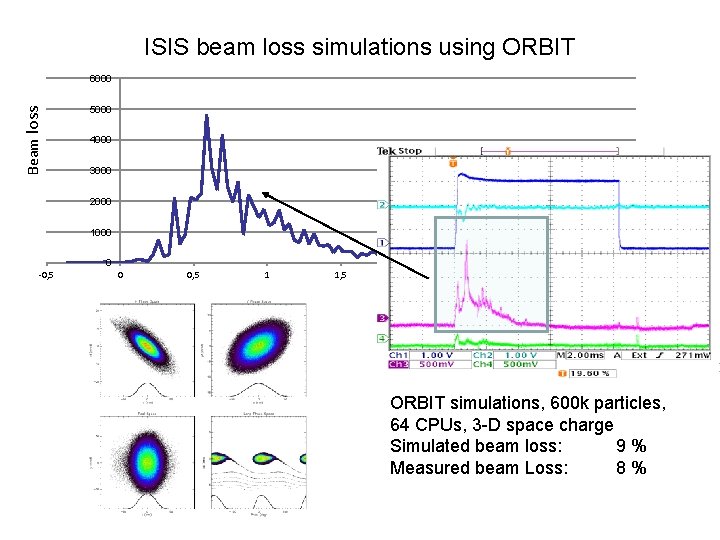
ISIS beam loss simulations using ORBIT Beam loss 6000 5000 4000 3000 2000 1000 0 -0, 5 0 0, 5 1 1, 5 2 2, 5 3 Time (ms) 3, 5 ORBIT simulations, 600 k particles, 64 CPUs, 3 -D space charge Simulated beam loss: 9% Measured beam Loss: 8%
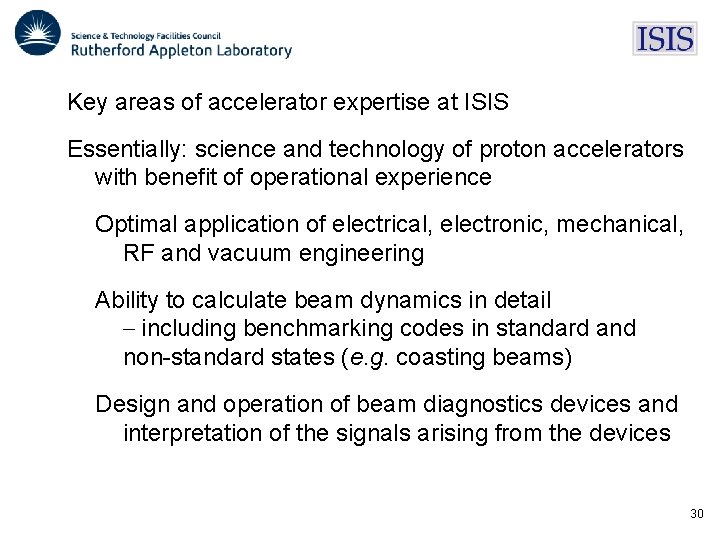
Key areas of accelerator expertise at ISIS Essentially: science and technology of proton accelerators with benefit of operational experience Optimal application of electrical, electronic, mechanical, RF and vacuum engineering Ability to calculate beam dynamics in detail – including benchmarking codes in standard and non-standard states (e. g. coasting beams) Design and operation of beam diagnostics devices and interpretation of the signals arising from the devices 30
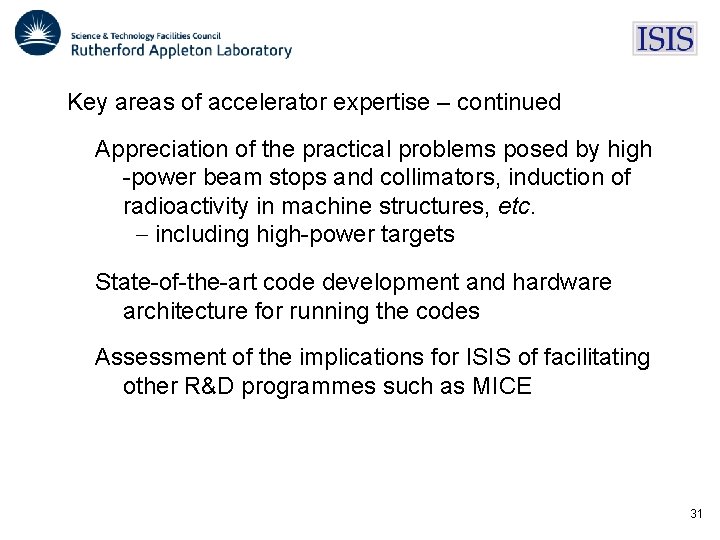
Key areas of accelerator expertise – continued Appreciation of the practical problems posed by high -power beam stops and collimators, induction of radioactivity in machine structures, etc. – including high-power targets State-of-the-art code development and hardware architecture for running the codes Assessment of the implications for ISIS of facilitating other R&D programmes such as MICE 31
Overall aims – Accelerators Run ISIS sustainably Prepare for ISIS upgrades Act as centre/host for proton accelerator R&D in UK Collaborate nationally and internationally 32
33