
The IPPC e Phyto Solution 1 The IPPC


- Slides: 22
The IPPC e. Phyto Solution 1
The IPPC e. Phyto Solution 2
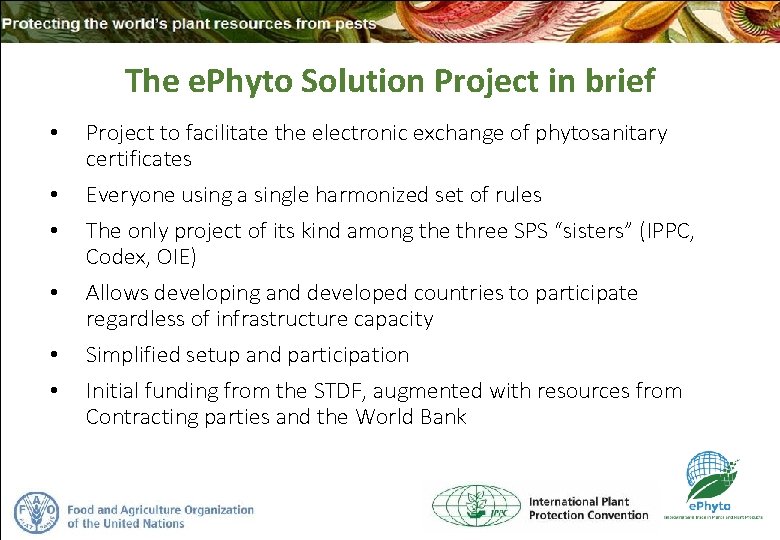
The e. Phyto Solution Project in brief • • • Project to facilitate the electronic exchange of phytosanitary certificates Everyone using a single harmonized set of rules The only project of its kind among the three SPS “sisters” (IPPC, Codex, OIE) Allows developing and developed countries to participate regardless of infrastructure capacity Simplified setup and participation Initial funding from the STDF, augmented with resources from Contracting parties and the World Bank
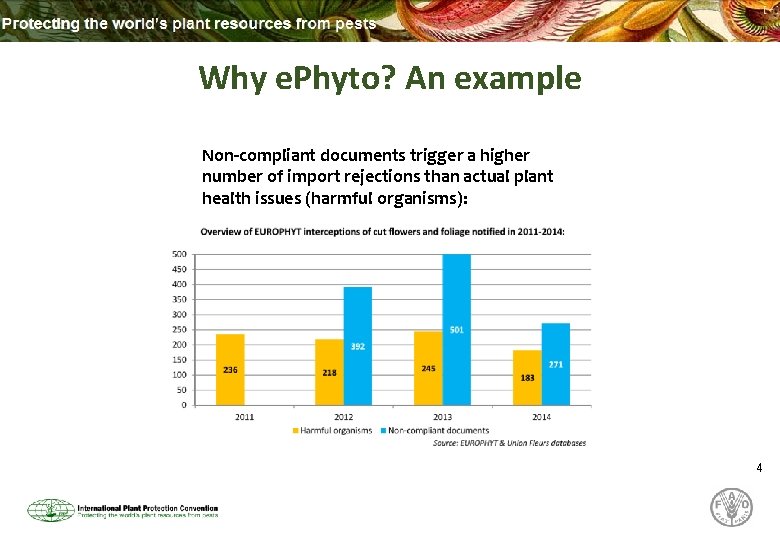
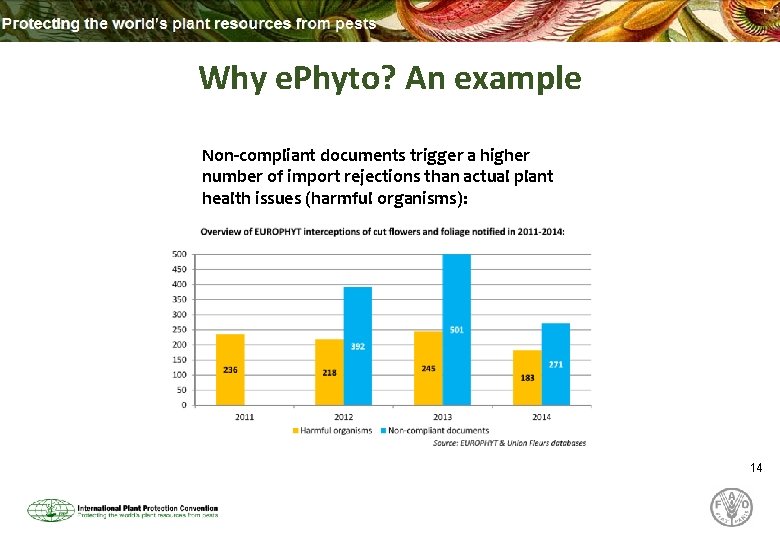
Why e. Phyto? An example Non-compliant documents trigger a higher number of import rejections than actual plant health issues (harmful organisms): 4
As well as…. • Inefficient processes in place - labor intensive and highly manual with physical paperwork being couriered around and often re-entered • Millions of emails sent – in the grains industry alone more than 275 million emails are sent annually to process the estimated 11, 000 shipments of grain transported on the ocean worldwide • Any re-issuing of paper phytosanitary certificates has a tremendous cost for business • Time and money • Deterioration of commodities waiting for clearance • Customer claims for late deliveries or bad quality • Mountains of paper, a lot of it expensive paper, are produced, printed and stored or destroyed on an annual basis 5
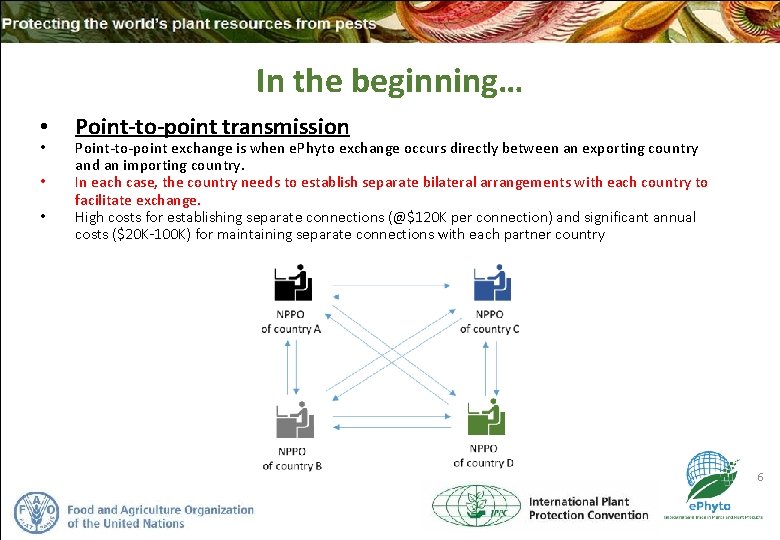
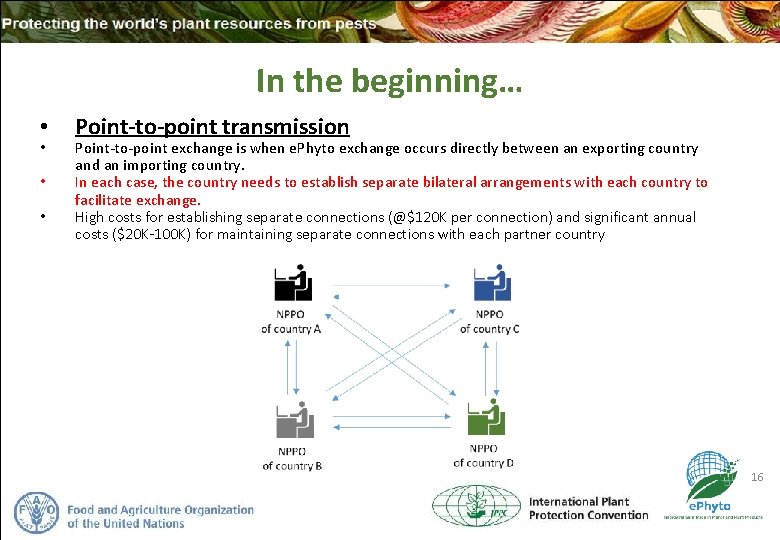
In the beginning… • • Point-to-point transmission Point-to-point exchange is when e. Phyto exchange occurs directly between an exporting country and an importing country. In each case, the country needs to establish separate bilateral arrangements with each country to facilitate exchange. High costs for establishing separate connections (@$120 K per connection) and significant annual costs ($20 K-100 K) for maintaining separate connections with each partner country 6
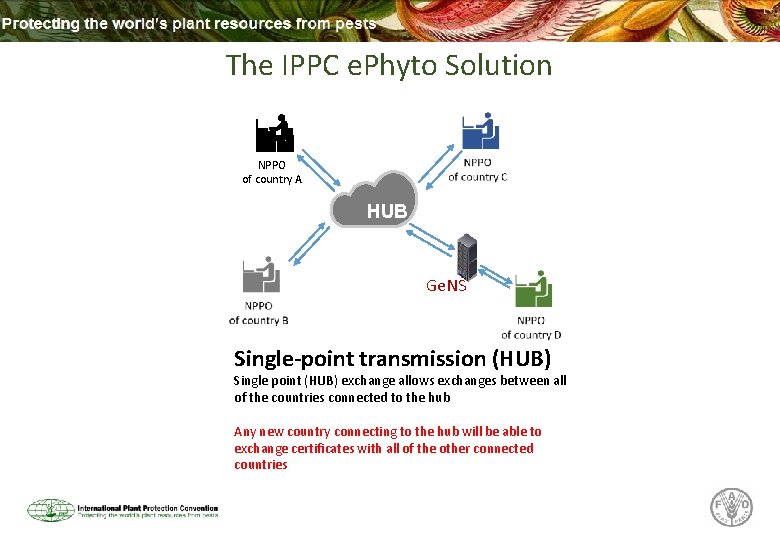
The IPPC e. Phyto Solution NPPO of country A HUB Ge. NS Single-point transmission (HUB) Single point (HUB) exchange allows exchanges between all of the countries connected to the hub Any new country connecting to the hub will be able to exchange certificates with all of the other connected countries
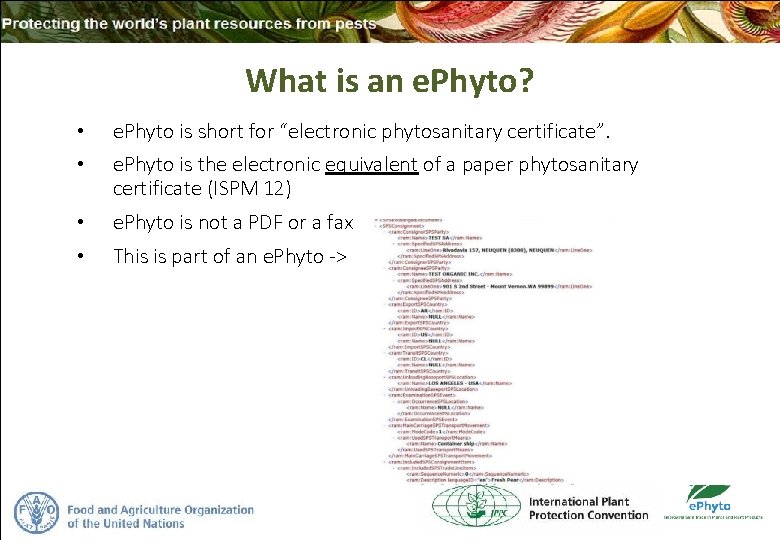
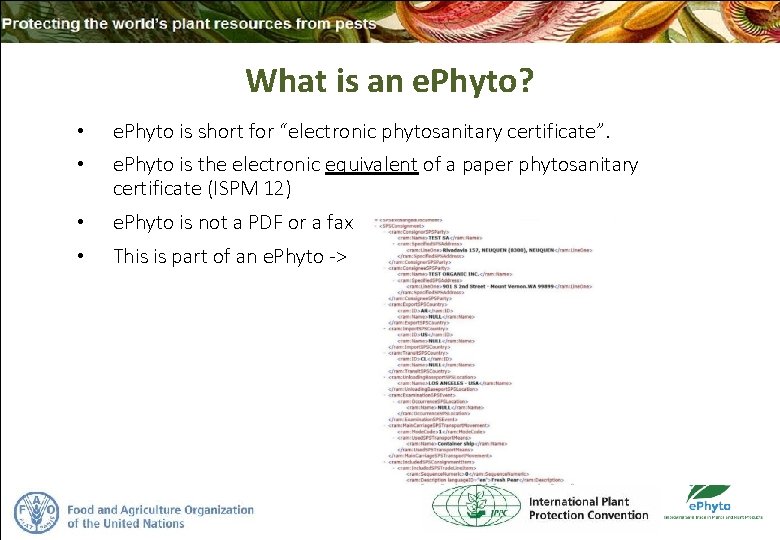
What is an e. Phyto? • e. Phyto is short for “electronic phytosanitary certificate”. • e. Phyto is the electronic equivalent of a paper phytosanitary certificate (ISPM 12) • e. Phyto is not a PDF or a fax • This is part of an e. Phyto ->
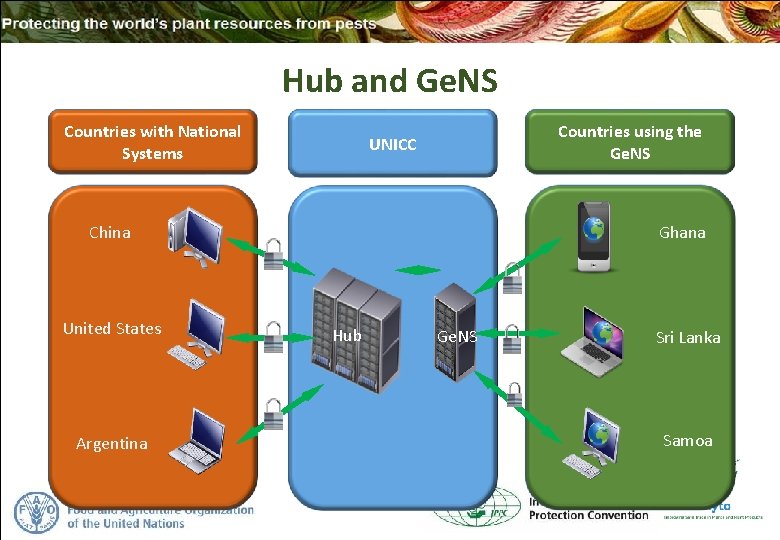
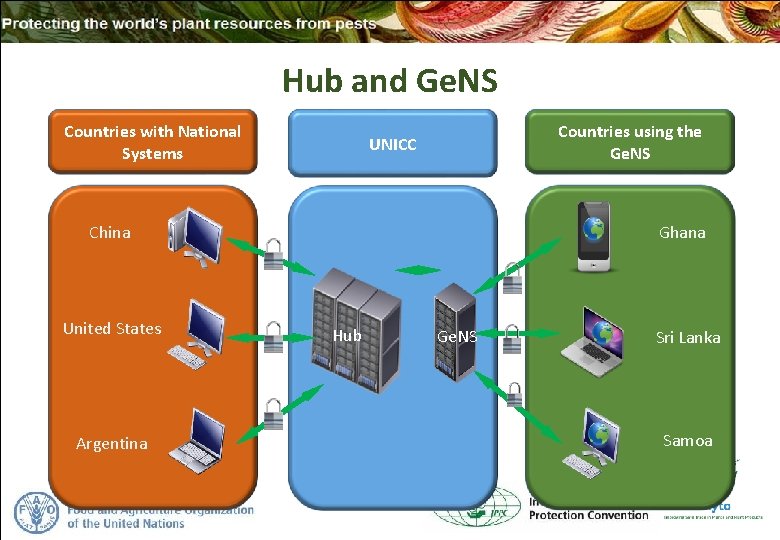
Hub and Ge. NS Countries with National Systems Countries using the Ge. NS UNICC China United States Argentina Ghana Hub Ge. NS Sri Lanka Samoa
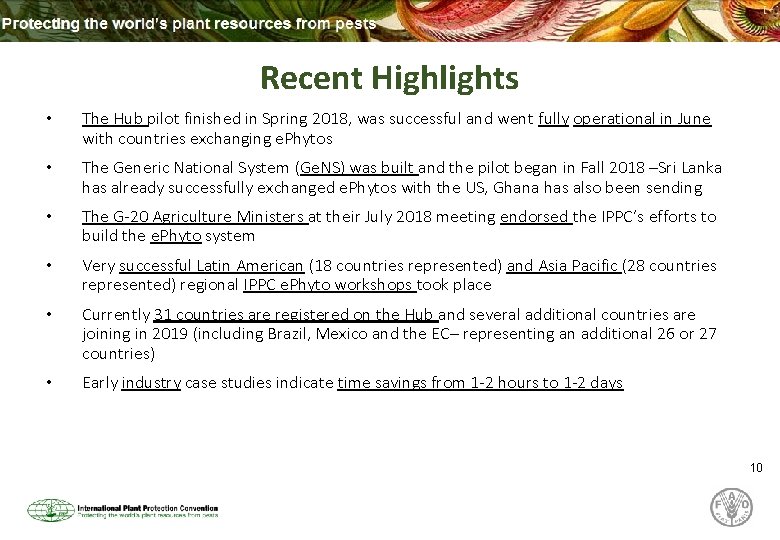
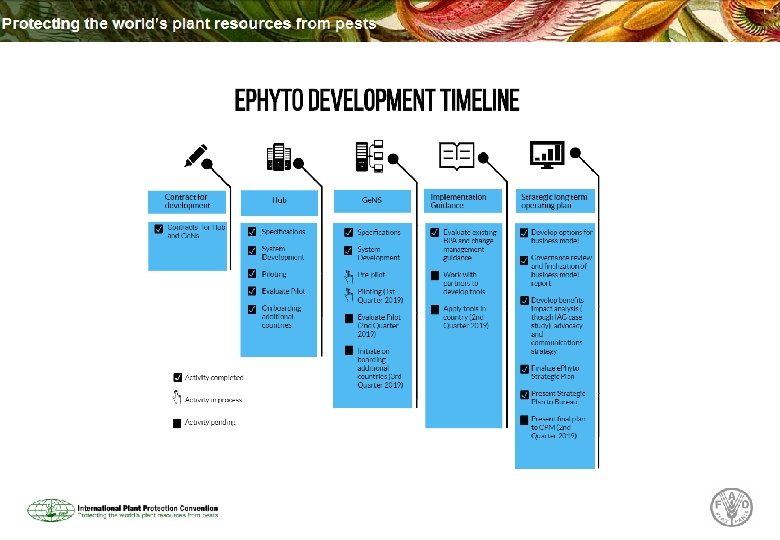
Recent Highlights • The Hub pilot finished in Spring 2018, was successful and went fully operational in June with countries exchanging e. Phytos • The Generic National System (Ge. NS) was built and the pilot began in Fall 2018 –Sri Lanka has already successfully exchanged e. Phytos with the US, Ghana has also been sending • The G-20 Agriculture Ministers at their July 2018 meeting endorsed the IPPC’s efforts to build the e. Phyto system • Very successful Latin American (18 countries represented) and Asia Pacific (28 countries represented) regional IPPC e. Phyto workshops took place • Currently 31 countries are registered on the Hub and several additional countries are joining in 2019 (including Brazil, Mexico and the EC– representing an additional 26 or 27 countries) • Early industry case studies indicate time savings from 1 -2 hours to 1 -2 days 10
The e. Phyto Solution Project in brief • • • Project to facilitate the electronic exchange of phytosanitary certificates Everyone using a single harmonized set of rules The only project of its kind among the three SPS “sisters” (IPPC, Codex, OIE) Allows developing and developed countries to participate regardless of infrastructure capacity Simplified setup and participation Initial funding from the STDF, augmented with resources from Contracting parties and the World Bank
Why e. Phyto? An example Non-compliant documents trigger a higher number of import rejections than actual plant health issues (harmful organisms): 14
As well as…. • Inefficient processes in place - labor intensive and highly manual with physical paperwork being couriered around and often re-entered • Millions of emails sent – in the grains industry alone more than 275 million emails are sent annually to process the estimated 11, 000 shipments of grain transported on the ocean worldwide • Any re-issuing of paper phytosanitary certificates has a tremendous cost for business • Time and money • Deterioration of commodities waiting for clearance • Customer claims for late deliveries or bad quality • Mountains of paper, a lot of it expensive paper, are produced, printed and stored or destroyed on an annual basis 15
In the beginning… • • Point-to-point transmission Point-to-point exchange is when e. Phyto exchange occurs directly between an exporting country and an importing country. In each case, the country needs to establish separate bilateral arrangements with each country to facilitate exchange. High costs for establishing separate connections (@$120 K per connection) and significant annual costs ($20 K-100 K) for maintaining separate connections with each partner country 16
The IPPC e. Phyto Solution NPPO of country A HUB Ge. NS Single-point transmission (HUB) Single point (HUB) exchange allows exchanges between all of the countries connected to the hub Any new country connecting to the hub will be able to exchange certificates with all of the other connected countries
What is an e. Phyto? • e. Phyto is short for “electronic phytosanitary certificate”. • e. Phyto is the electronic equivalent of a paper phytosanitary certificate (ISPM 12) • e. Phyto is not a PDF or a fax • This is part of an e. Phyto ->
Hub and Ge. NS Countries with National Systems Countries using the Ge. NS UNICC China United States Argentina Ghana Hub Ge. NS Sri Lanka Samoa
Recent Highlights • The Hub pilot finished in Spring 2018, was successful and went fully operational in June with countries exchanging e. Phytos • The Generic National System (Ge. NS) was built and the pilot began in Fall 2018 –Sri Lanka has already successfully exchanged e. Phytos with the US, Ghana has also been sending • The G-20 Agriculture Ministers at their July 2018 meeting endorsed the IPPC’s efforts to build the e. Phyto system • Very successful Latin American (18 countries represented) and Asia Pacific (28 countries represented) regional IPPC e. Phyto workshops took place • Currently 31 countries are registered on the Hub and several additional countries are joining in 2019 (including Brazil, Mexico and the EC– representing an additional 26 or 27 countries) • Early industry case studies indicate time savings from 1 -2 hours to 1 -2 days 20