
The IPCC Fourth Assessment Report AR 4 Process
- Slides: 59
The IPCC Fourth Assessment Report (AR 4) Process, and Climate Change Contributions from CCSM 3 Gerald A. Meehl NCAR Boulder, CO
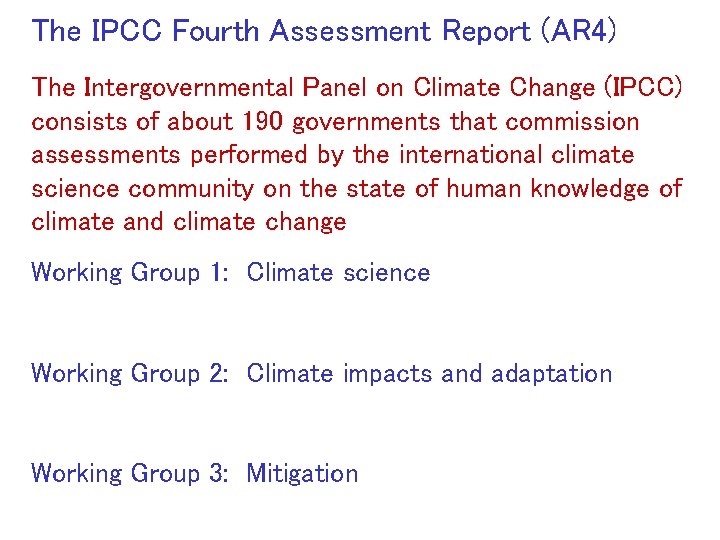
The IPCC Fourth Assessment Report (AR 4) The Intergovernmental Panel on Climate Change (IPCC) consists of about 190 governments that commission assessments performed by the international climate science community on the state of human knowledge of climate and climate change Working Group 1: Climate science Working Group 2: Climate impacts and adaptation Working Group 3: Mitigation
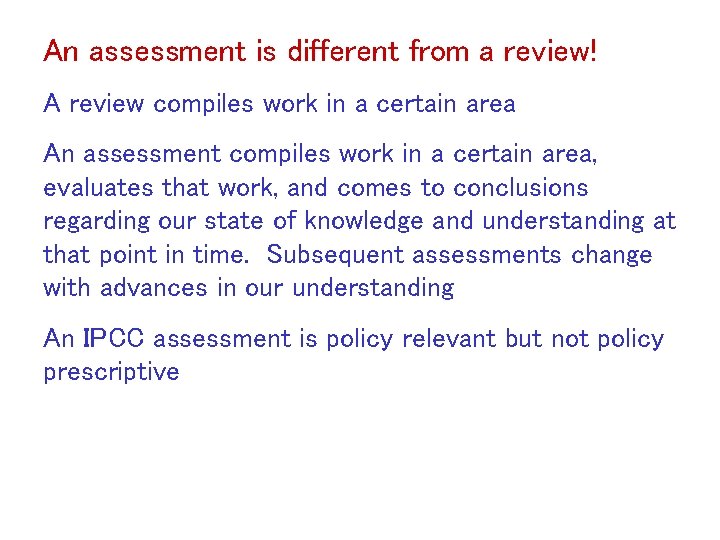
An assessment is different from a review! A review compiles work in a certain area An assessment compiles work in a certain area, evaluates that work, and comes to conclusions regarding our state of knowledge and understanding at that point in time. Subsequent assessments change with advances in our understanding An IPCC assessment is policy relevant but not policy prescriptive
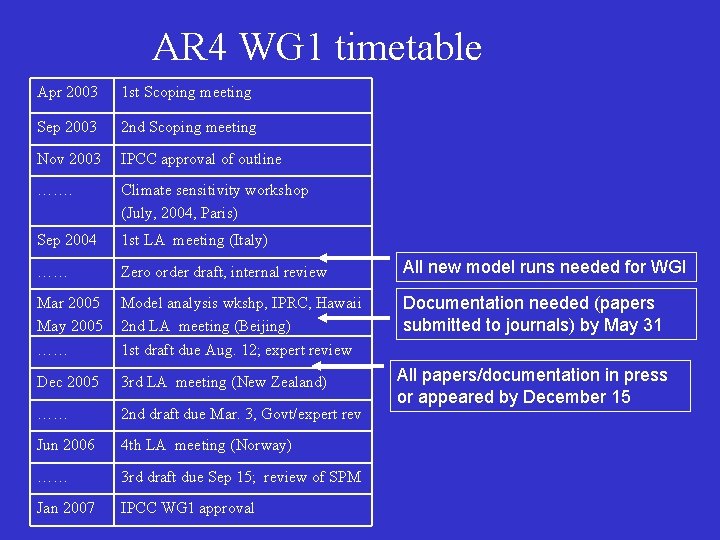
AR 4 WG 1 timetable Apr 2003 1 st Scoping meeting Sep 2003 2 nd Scoping meeting Nov 2003 IPCC approval of outline ……. Climate sensitivity workshop (July, 2004, Paris) Sep 2004 1 st LA meeting (Italy) …… Zero order draft, internal review All new model runs needed for WGI Mar 2005 May 2005 Model analysis wkshp, IPRC, Hawaii 2 nd LA meeting (Beijing) Documentation needed (papers submitted to journals) by May 31 …… 1 st draft due Aug. 12; expert review Dec 2005 3 rd LA meeting (New Zealand) …… 2 nd draft due Mar. 3, Govt/expert rev Jun 2006 4 th LA meeting (Norway) …… 3 rd draft due Sep 15; review of SPM Jan 2007 IPCC WG 1 approval All papers/documentation in press or appeared by December 15
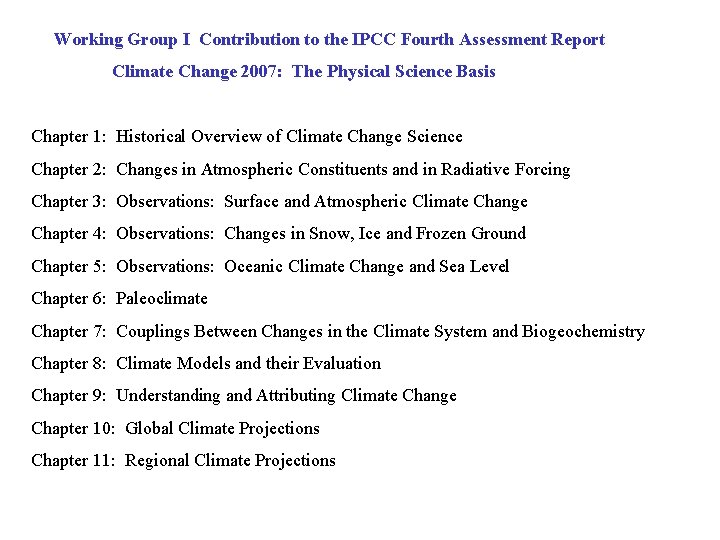
Working Group I Contribution to the IPCC Fourth Assessment Report Climate Change 2007: The Physical Science Basis Chapter 1: Historical Overview of Climate Change Science Chapter 2: Changes in Atmospheric Constituents and in Radiative Forcing Chapter 3: Observations: Surface and Atmospheric Climate Change Chapter 4: Observations: Changes in Snow, Ice and Frozen Ground Chapter 5: Observations: Oceanic Climate Change and Sea Level Chapter 6: Paleoclimate Chapter 7: Couplings Between Changes in the Climate System and Biogeochemistry Chapter 8: Climate Models and their Evaluation Chapter 9: Understanding and Attributing Climate Change Chapter 10: Global Climate Projections Chapter 11: Regional Climate Projections
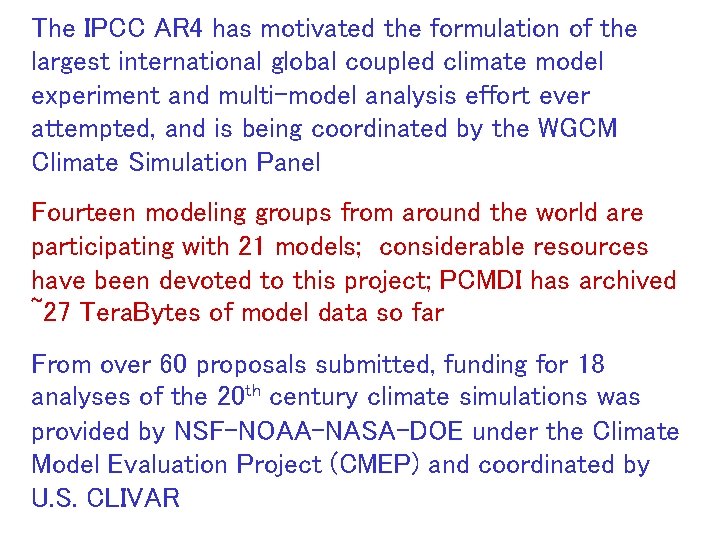
The IPCC AR 4 has motivated the formulation of the largest international global coupled climate model experiment and multi-model analysis effort ever attempted, and is being coordinated by the WGCM Climate Simulation Panel Fourteen modeling groups from around the world are participating with 21 models; considerable resources have been devoted to this project; PCMDI has archived ~27 Tera. Bytes of model data so far From over 60 proposals submitted, funding for 18 analyses of the 20 th century climate simulations was provided by NSF-NOAA-NASA-DOE under the Climate Model Evaluation Project (CMEP) and coordinated by U. S. CLIVAR
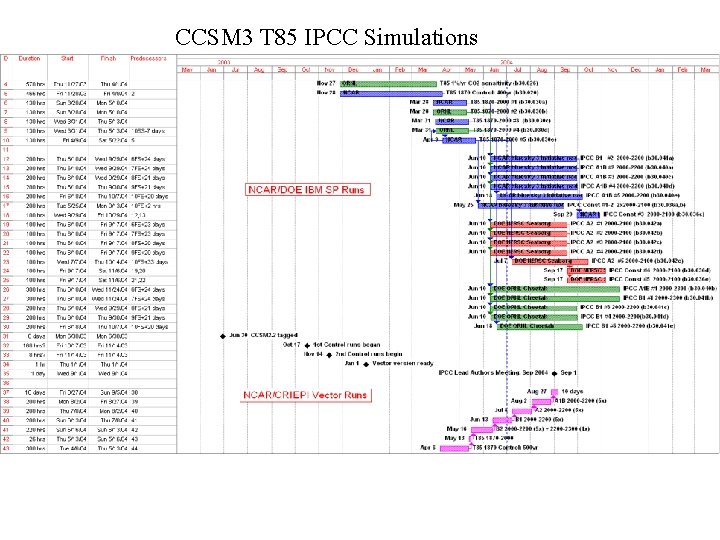
CCSM 3 T 85 IPCC Simulations
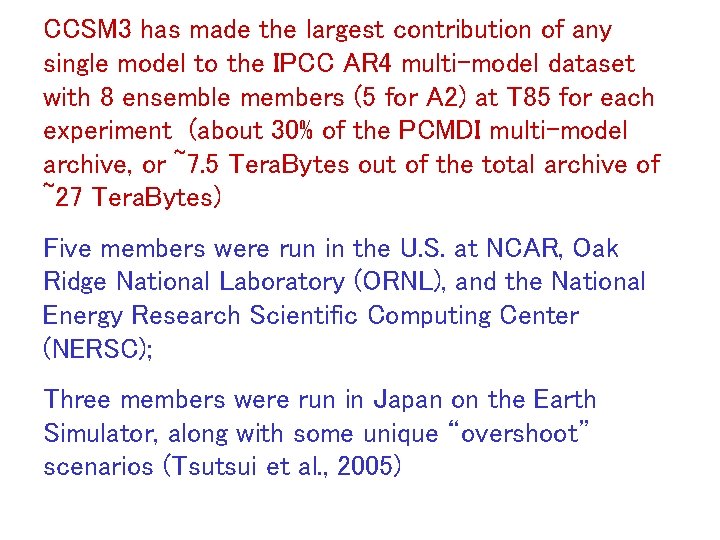
CCSM 3 has made the largest contribution of any single model to the IPCC AR 4 multi-model dataset with 8 ensemble members (5 for A 2) at T 85 for each experiment (about 30% of the PCMDI multi-model archive, or ~7. 5 Tera. Bytes out of the total archive of ~27 Tera. Bytes) Five members were run in the U. S. at NCAR, Oak Ridge National Laboratory (ORNL), and the National Energy Research Scientific Computing Center (NERSC); Three members were run in Japan on the Earth Simulator, along with some unique “overshoot” scenarios (Tsutsui et al. , 2005)
Results from analyses of the multi-model dataset were presented by 125 scientists at a workshop convened by US CLIVAR and hosted by IPRC (Univ. of Hawaii) March 1 -4, 2005, and are feeding directly into the AR 4 assessment process To date, there are 306 analysis projects registered at PCMDI, and over 220 papers have been submitted to peer-reviewed journals with results from multi-model analyses for assessment in the IPCC AR 4
Results from analyses of the multi-model dataset were presented by 125 scientists at a workshop convened by US CLIVAR and hosted by IPRC (Univ. of Hawaii) March 1 -4, 2005, and are feeding directly into the AR 4 assessment process To date, there are 306 analysis projects registered at PCMDI, and over 220 papers have been submitted to peer-reviewed journals with results from multi-model analyses for assessment in the IPCC AR 4 This is more than double our most optimistic estimate for participation
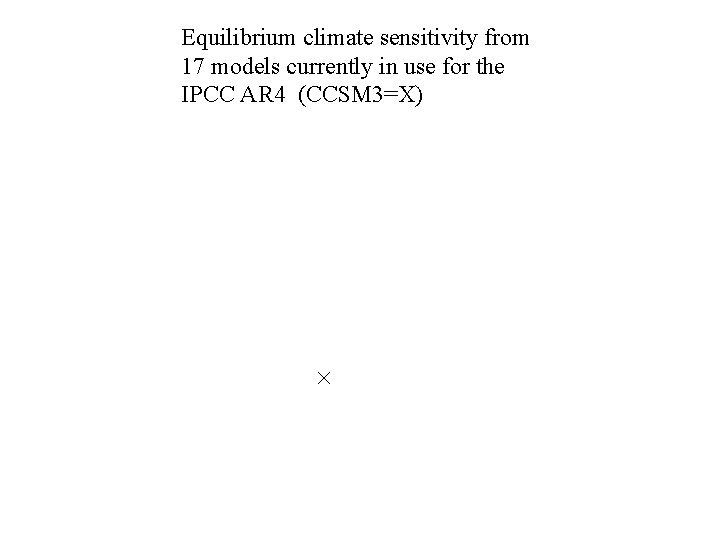
Equilibrium climate sensitivity from 17 models currently in use for the IPCC AR 4 (CCSM 3=X)
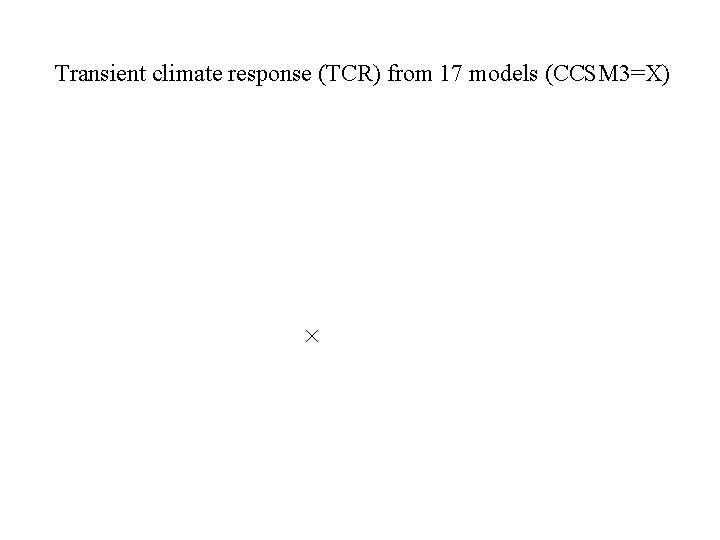
Transient climate response (TCR) from 17 models (CCSM 3=X)
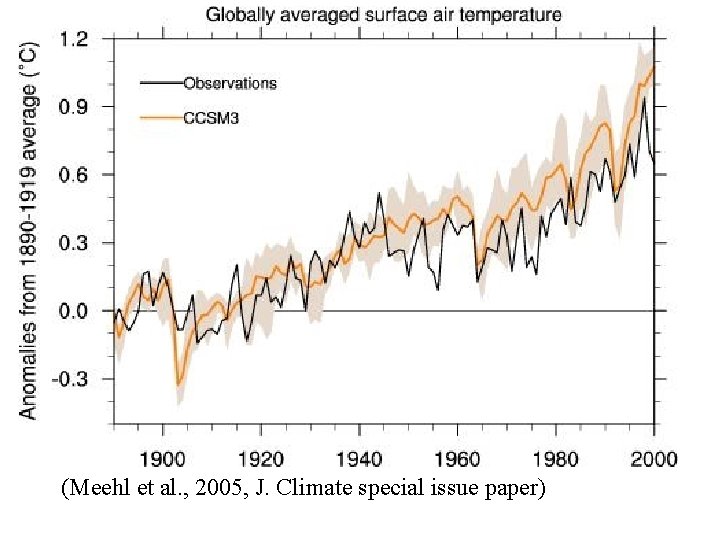
(Meehl et al. , 2005, J. Climate special issue paper)
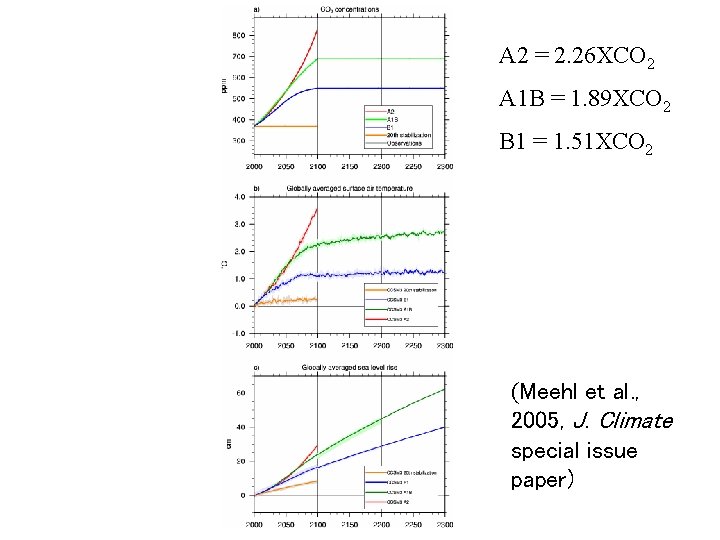
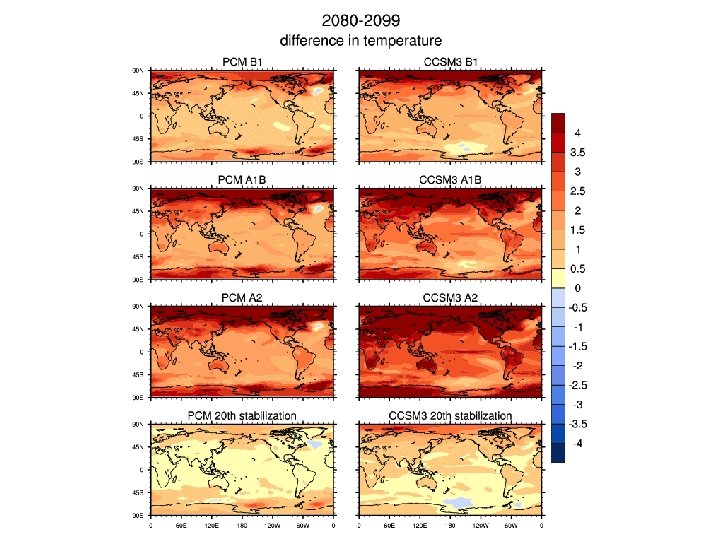
A 2 = 2. 26 XCO 2 A 1 B = 1. 89 XCO 2 B 1 = 1. 51 XCO 2 (Meehl et al. , 2005, J. Climate special issue paper)
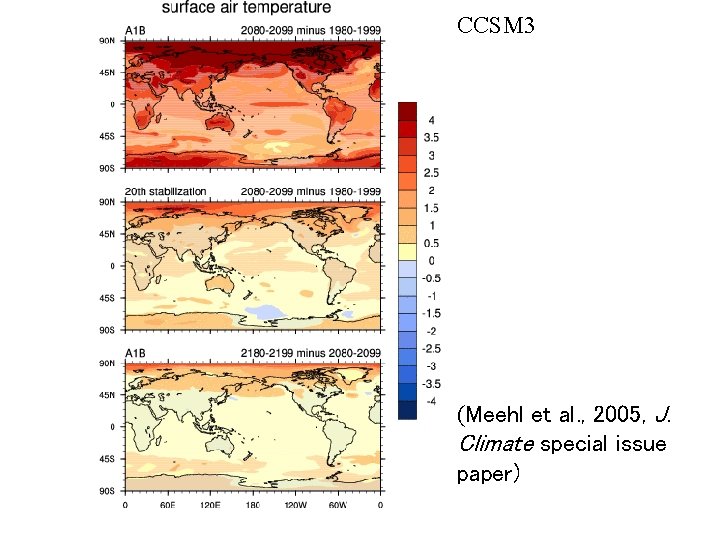
CCSM 3 (Meehl et al. , 2005, J. Climate special issue paper)
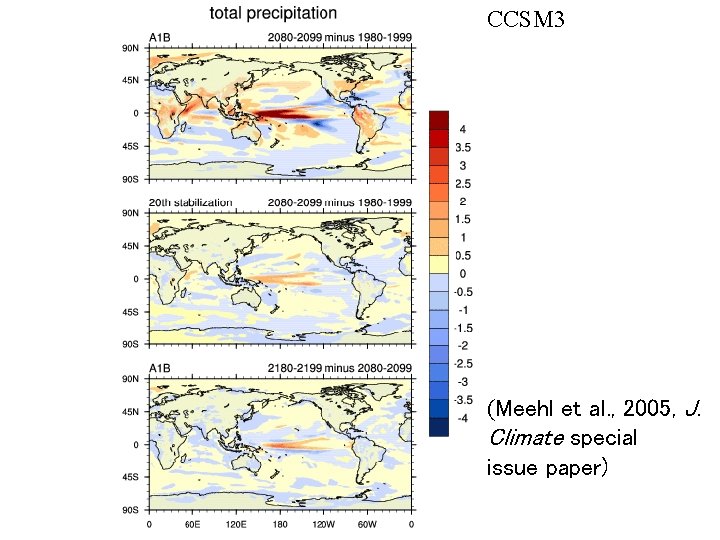
CCSM 3 (Meehl et al. , 2005, J. Climate special issue paper)
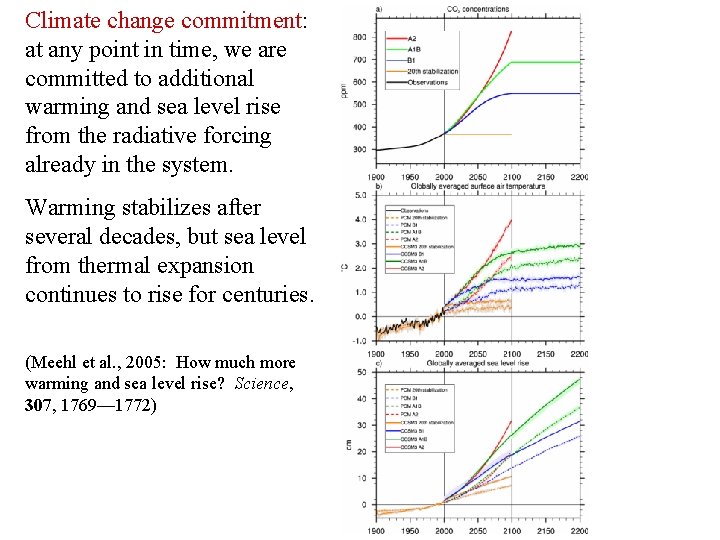
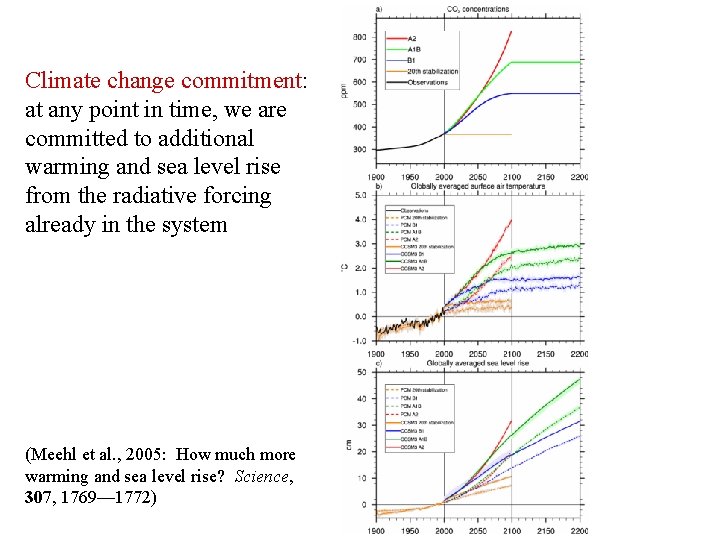
Climate change commitment: at any point in time, we are committed to additional warming and sea level rise from the radiative forcing already in the system. Warming stabilizes after several decades, but sea level from thermal expansion continues to rise for centuries. (Meehl et al. , 2005: How much more warming and sea level rise? Science, 307, 1769— 1772)
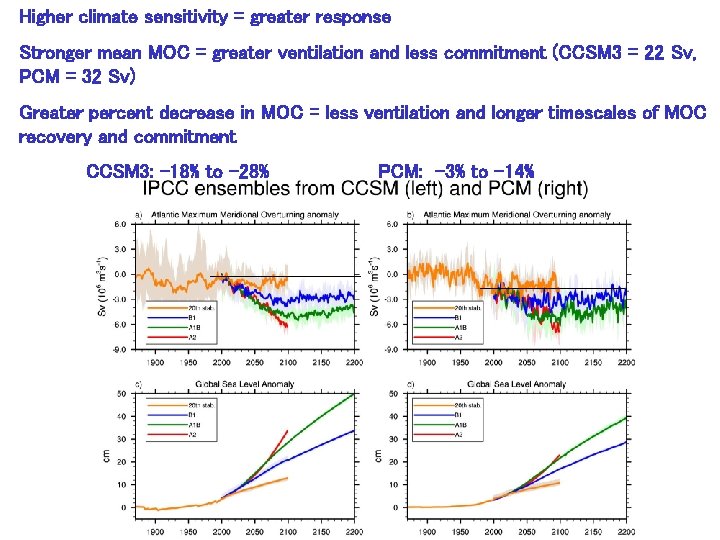
Higher climate sensitivity = greater response Stronger mean MOC = greater ventilation and less commitment (CCSM 3 = 22 Sv, PCM = 32 Sv) Greater percent decrease in MOC = less ventilation and longer timescales of MOC recovery and commitment CCSM 3: -18% to – 28% PCM: -3% to – 14%
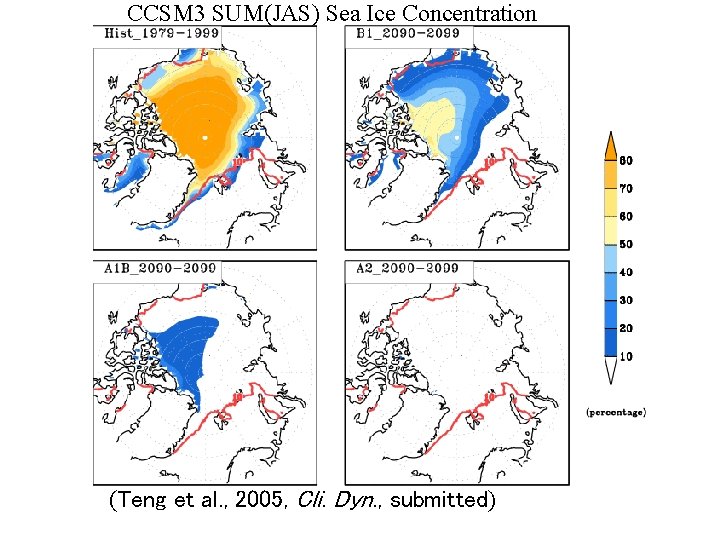
CCSM 3 SUM(JAS) Sea Ice Concentration (Teng et al. , 2005, Cli. Dyn. , submitted)
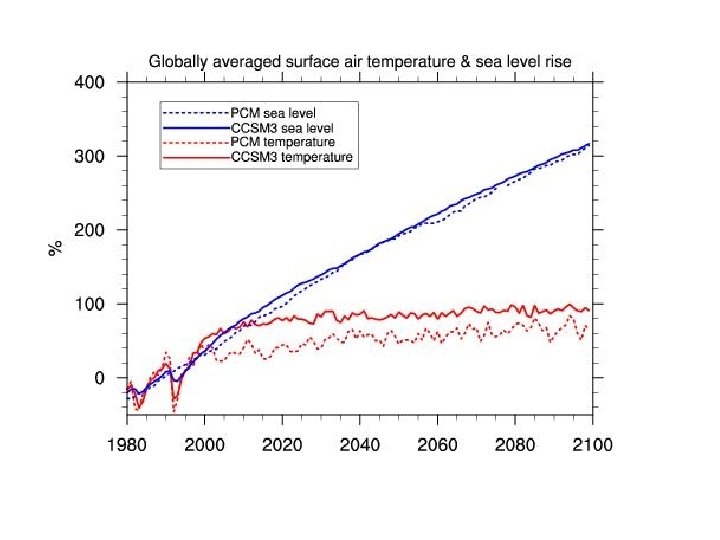
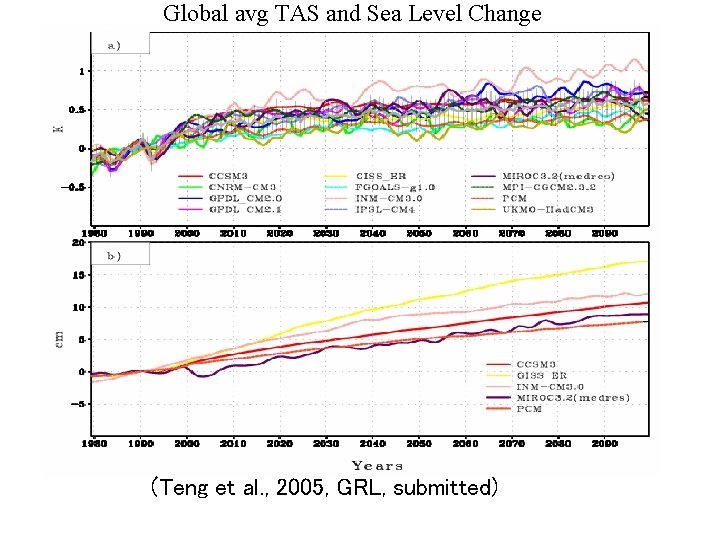
Global avg TAS and Sea Level Change (Teng et al. , 2005, GRL, submitted)
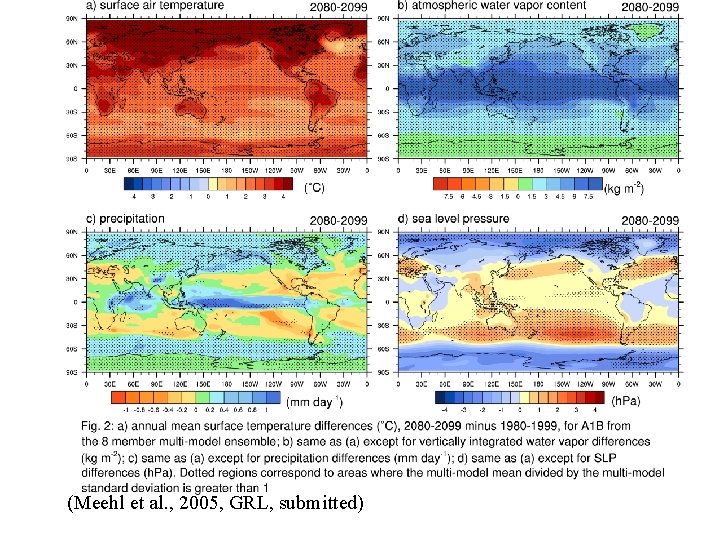
(Meehl et al. , 2005, GRL, submitted)
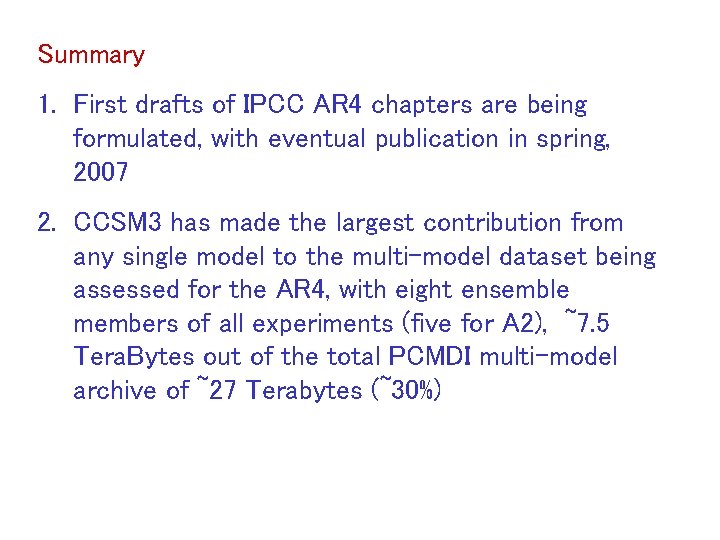
Summary 1. First drafts of IPCC AR 4 chapters are being formulated, with eventual publication in spring, 2007 2. CCSM 3 has made the largest contribution from any single model to the multi-model dataset being assessed for the AR 4, with eight ensemble members of all experiments (five for A 2), ~7. 5 Tera. Bytes out of the total PCMDI multi-model archive of ~27 Terabytes (~30%)
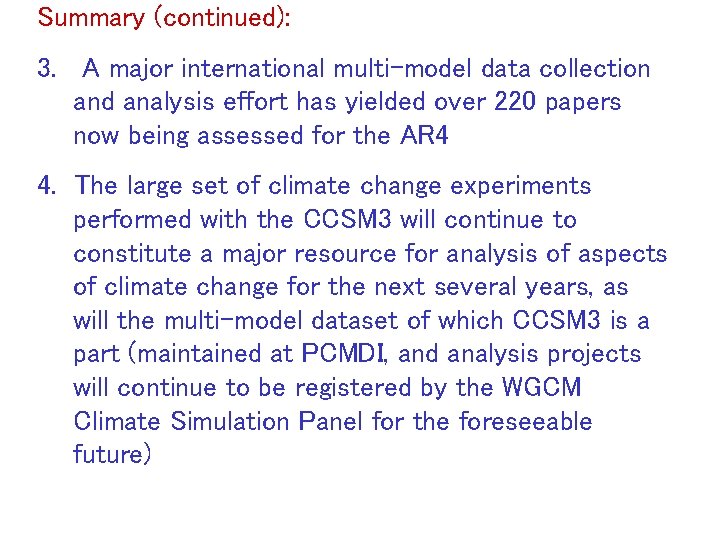
Summary (continued): 3. A major international multi-model data collection and analysis effort has yielded over 220 papers now being assessed for the AR 4 4. The large set of climate change experiments performed with the CCSM 3 will continue to constitute a major resource for analysis of aspects of climate change for the next several years, as will the multi-model dataset of which CCSM 3 is a part (maintained at PCMDI, and analysis projects will continue to be registered by the WGCM Climate Simulation Panel for the foreseeable future)
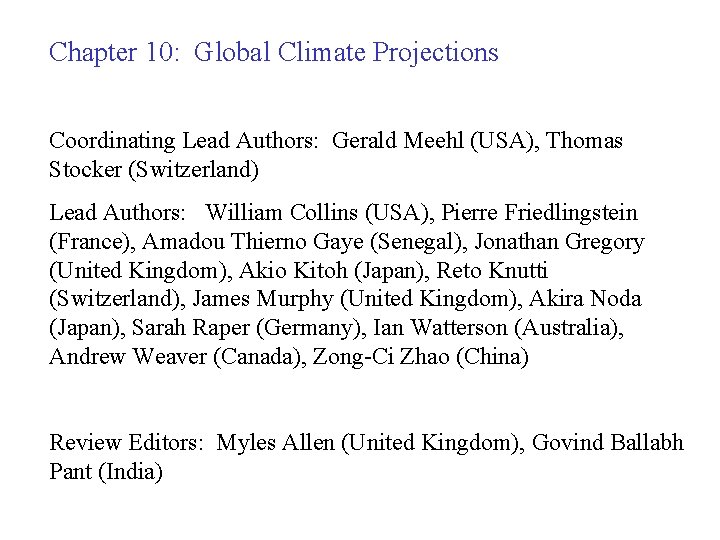
Chapter 10: Global Climate Projections Coordinating Lead Authors: Gerald Meehl (USA), Thomas Stocker (Switzerland) Lead Authors: William Collins (USA), Pierre Friedlingstein (France), Amadou Thierno Gaye (Senegal), Jonathan Gregory (United Kingdom), Akio Kitoh (Japan), Reto Knutti (Switzerland), James Murphy (United Kingdom), Akira Noda (Japan), Sarah Raper (Germany), Ian Watterson (Australia), Andrew Weaver (Canada), Zong-Ci Zhao (China) Review Editors: Myles Allen (United Kingdom), Govind Ballabh Pant (India)
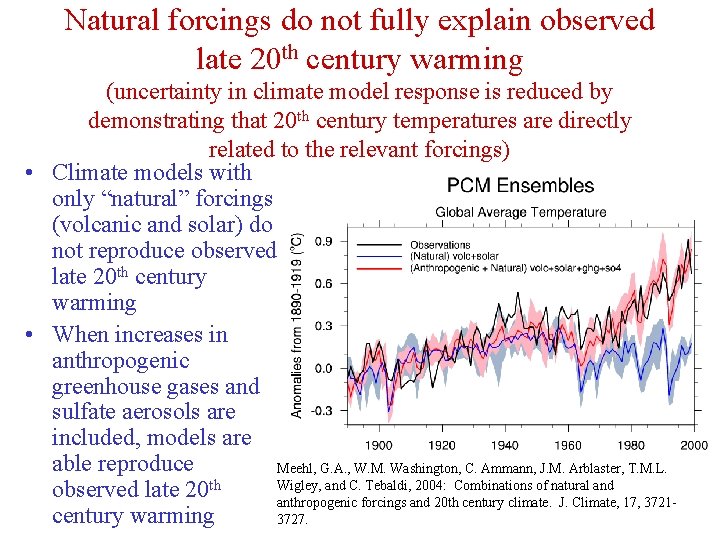
Natural forcings do not fully explain observed late 20 th century warming (uncertainty in climate model response is reduced by demonstrating that 20 th century temperatures are directly related to the relevant forcings) • Climate models with only “natural” forcings (volcanic and solar) do not reproduce observed late 20 th century warming • When increases in anthropogenic greenhouse gases and sulfate aerosols are included, models are able reproduce Meehl, G. A. , W. M. Washington, C. Ammann, J. M. Arblaster, T. M. L. Wigley, and C. Tebaldi, 2004: Combinations of natural and observed late 20 th anthropogenic forcings and 20 th century climate. J. Climate, 17, 3721 century warming 3727.
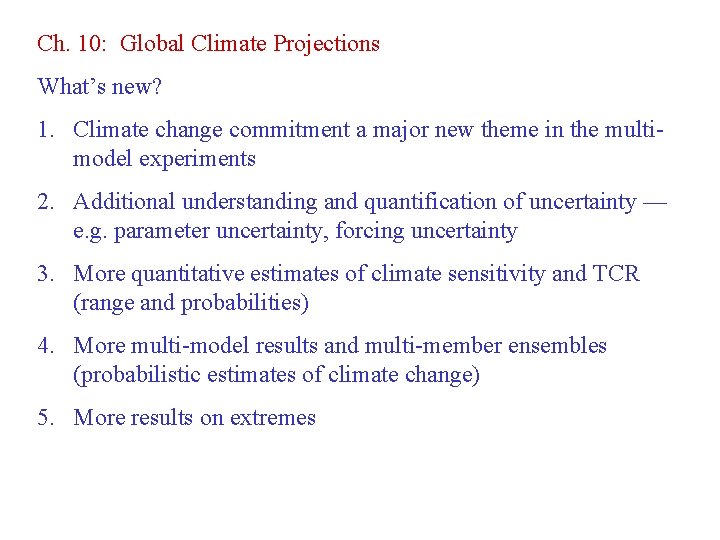
Ch. 10: Global Climate Projections What’s new? 1. Climate change commitment a major new theme in the multimodel experiments 2. Additional understanding and quantification of uncertainty — e. g. parameter uncertainty, forcing uncertainty 3. More quantitative estimates of climate sensitivity and TCR (range and probabilities) 4. More multi-model results and multi-member ensembles (probabilistic estimates of climate change) 5. More results on extremes
Climate change commitment: at any point in time, we are committed to additional warming and sea level rise from the radiative forcing already in the system (Meehl et al. , 2005: How much more warming and sea level rise? Science, 307, 1769— 1772)
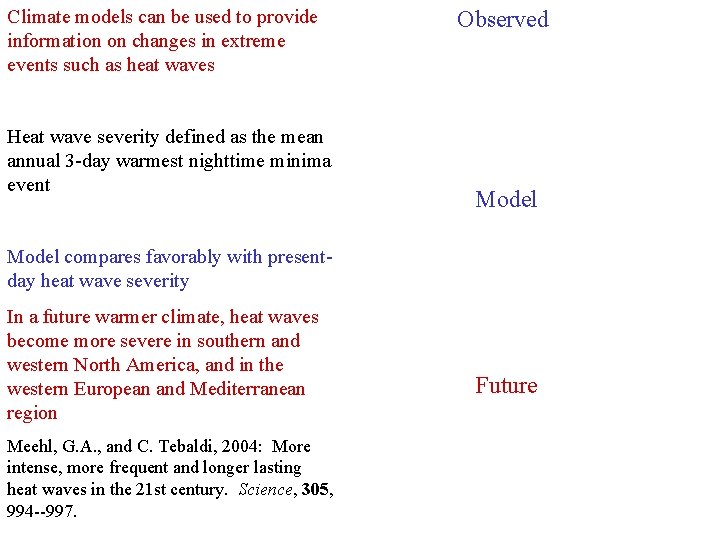
Climate models can be used to provide information on changes in extreme events such as heat waves Heat wave severity defined as the mean annual 3 -day warmest nighttime minima event Observed Model compares favorably with presentday heat wave severity In a future warmer climate, heat waves become more severe in southern and western North America, and in the western European and Mediterranean region Meehl, G. A. , and C. Tebaldi, 2004: More intense, more frequent and longer lasting heat waves in the 21 st century. Science, 305, 994 --997. Future
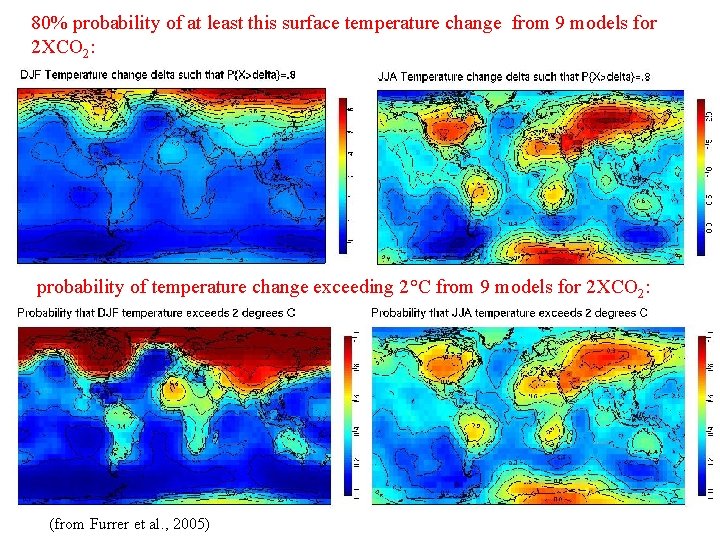
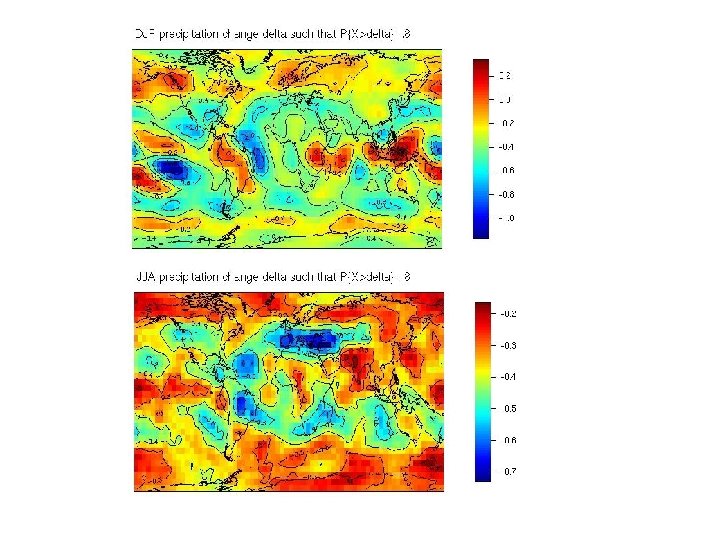
80% probability of at least this surface temperature change from 9 models for 2 XCO 2: probability of temperature change exceeding 2°C from 9 models for 2 XCO 2: (from Furrer et al. , 2005)
Summary 1. IPCC AR 4 is underway, with eventual publication in spring, 2007 2. For Ch. 10 as an example, climate change commitment is a major new theme in multi-model experiments 3. Additional understanding and quantification of uncertainty —e. g. parameter uncertainty, forcing uncertainty 4. More quantitative estimates of climate sensitivity and TCR (range and probabilities) 5. More multi-model results and multi-member ensembles (probabilistic estimates of climate change) 6. More results on extremes
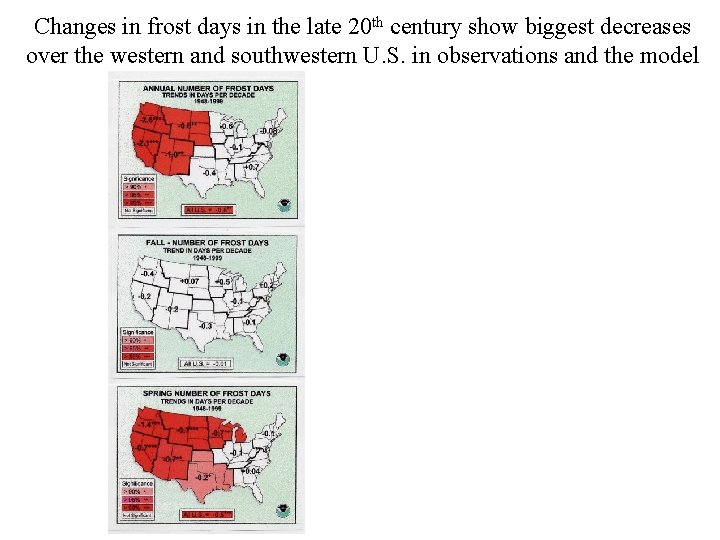
Changes in frost days in the late 20 th century show biggest decreases over the western and southwestern U. S. in observations and the model
Future changes in frost days from the climate model show greatest decreases in the western and southwestern U. S. , similar to late 20 th century
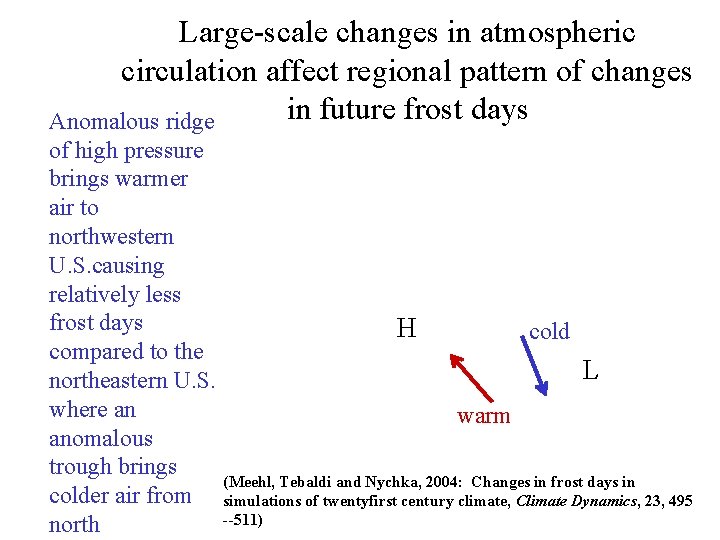
Large-scale changes in atmospheric circulation affect regional pattern of changes in future frost days Anomalous ridge of high pressure brings warmer air to northwestern U. S. causing relatively less frost days H cold compared to the L northeastern U. S. where an warm anomalous trough brings (Meehl, Tebaldi and Nychka, 2004: Changes in frost days in colder air from simulations of twentyfirst century climate, Climate Dynamics, 23, 495 --511) north
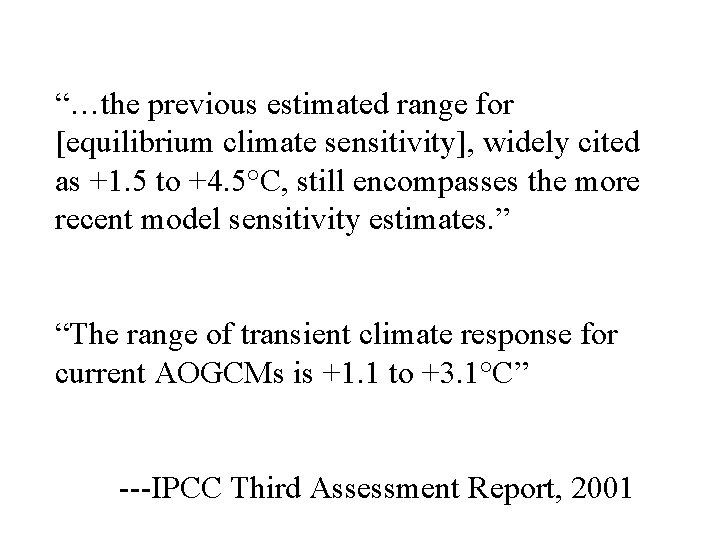
“…the previous estimated range for [equilibrium climate sensitivity], widely cited as +1. 5 to +4. 5°C, still encompasses the more recent model sensitivity estimates. ” “The range of transient climate response for current AOGCMs is +1. 1 to +3. 1°C” ---IPCC Third Assessment Report, 2001
Equilibrium climate sensitivity from 17 models currently in use for the IPCC AR 4 Transient climate response (TCR) from 17 models
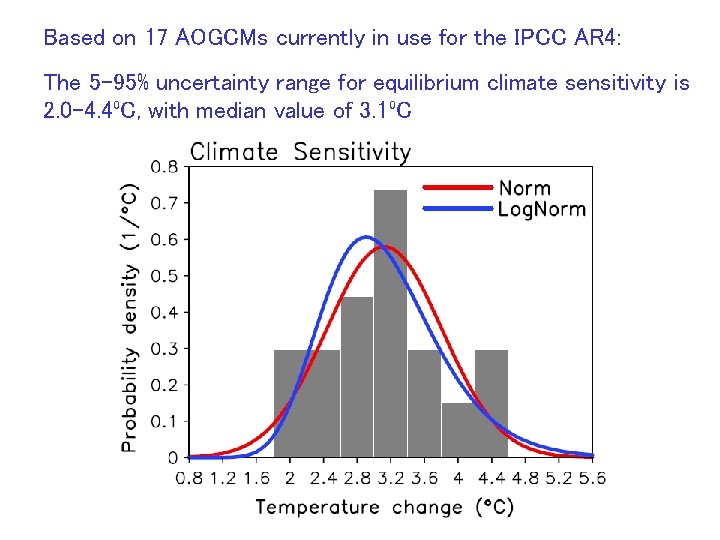
Based on 17 AOGCMs currently in use for the IPCC AR 4: The 5 -95% uncertainty range for equilibrium climate sensitivity is 2. 0 -4. 4⁰C, with median value of 3. 1⁰C
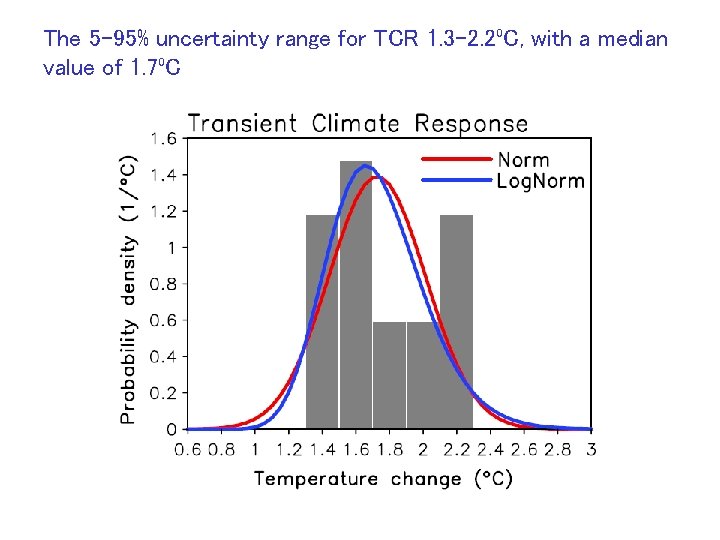
The 5 -95% uncertainty range for TCR 1. 3 -2. 2⁰C, with a median value of 1. 7⁰C
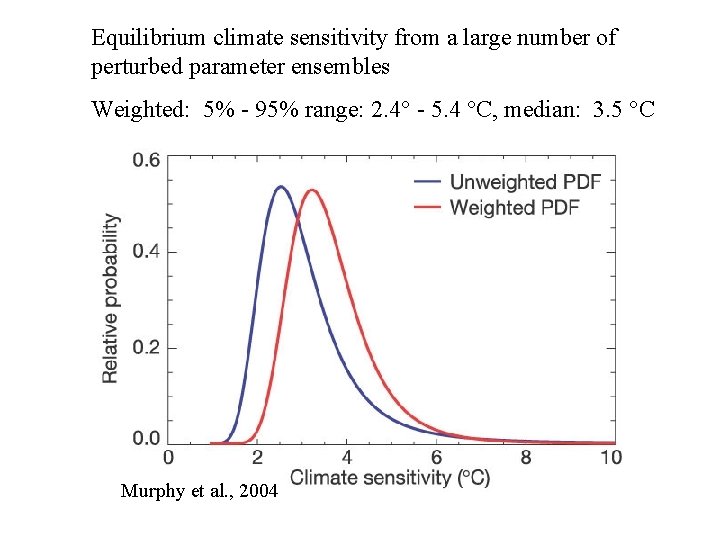
Equilibrium climate sensitivity from a large number of perturbed parameter ensembles Weighted: 5% - 95% range: 2. 4° - 5. 4 °C, median: 3. 5 °C Murphy et al. , 2004
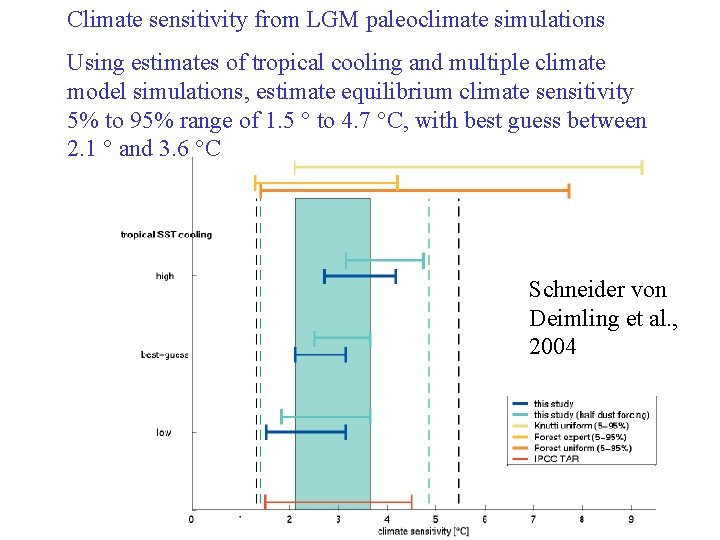
Climate sensitivity from LGM paleoclimate simulations Using estimates of tropical cooling and multiple climate model simulations, estimate equilibrium climate sensitivity 5% to 95% range of 1. 5 ° to 4. 7 °C, with best guess between 2. 1 ° and 3. 6 °C Schneider von Deimling et al. , 2004
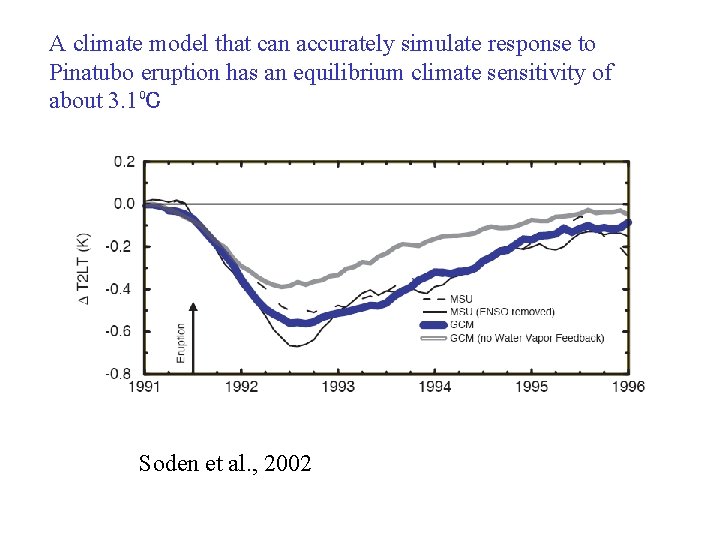
A climate model that can accurately simulate response to Pinatubo eruption has an equilibrium climate sensitivity of about 3. 1⁰C Soden et al. , 2002
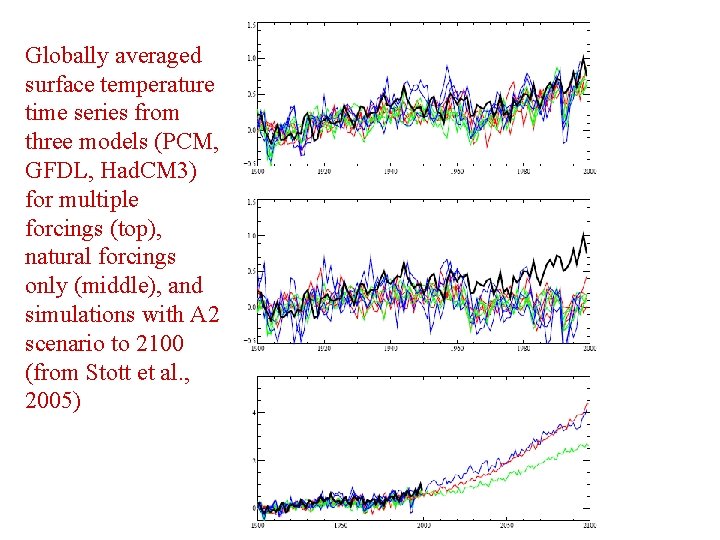
Globally averaged surface temperature time series from three models (PCM, GFDL, Had. CM 3) for multiple forcings (top), natural forcings only (middle), and simulations with A 2 scenario to 2100 (from Stott et al. , 2005)
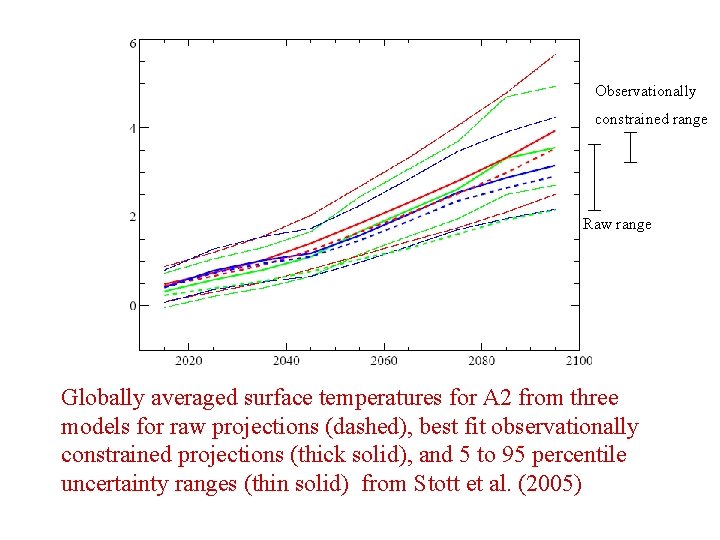
Observationally constrained range Raw range Globally averaged surface temperatures for A 2 from three models for raw projections (dashed), best fit observationally constrained projections (thick solid), and 5 to 95 percentile uncertainty ranges (thin solid) from Stott et al. (2005)
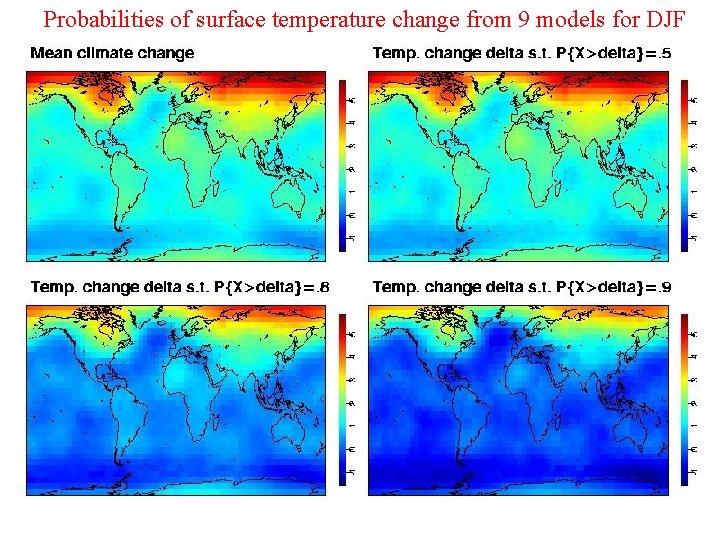
Probabilities of surface temperature change from 9 models for DJF
CCSP Synthesis and Assessment 3. 1: Climate models and their uses and limitations, including climate sensitivity, feedbacks, and uncertainty analysis Lead and Supporting Agencies: DOE, NASA, NOAA, NSF Agency Contacts: Lead DOE Anjuli Bamzai Anjuli. Bamzai@science. doe. gov Supporting: NASA Don Anderson Donald. Anderson-1@nasa. gov NOAA Ants Leetmaa Ants. Leetmaa@noaa. gov NSF Jay Fein jfein@nsf. gov
Focus on natural and human-caused factors influencing climate variability and change, ~1800 to 2000, and will characterize sources of uncertainties in comprehensive coupled climate models. Audience: Climate model researchers, modelers from impacts community (prospectus up for public comment in next few days) Specific questions to be addressed: Q 1: What are the major components and processes of the climate system that are included in present state-of-the-science climate models, and how do climate models represent these aspects of the climate system? Q 2: How are changes in the Earth’s energy balance incorporated into climate models? How sensitive is the Earth’s (modeled) climate to changes in the factors that affect the energy balance?
Q 3: How uncertain are climate model results? In what ways has uncertainty in model-based simulation and prediction both increased and decreased over time with increased knowledge about the climate system? Q 4: How well do climate models simulate natural variability and how does variability change over time? Q 5: How well do climate models simulate regional climate variability and change? Q 6: What are the tradeoffs to be made in further climate model development (e. g. , between increasing spatial/temporal resolution and representing additional physical/biological processes)?
Proposed Approach for Evaluation and Communication of Uncertainty and Confidence Levels of Climate Model Output A central theme of this CCSP Product will be uncertainty and confidence levels of climate model output with respect to climate change and sea-level rise, caused by natural forces and human activities during the period 1800 -2000. Relationship to Other National and International Assessment Processes This CCSP Product will build on previous IPCC assessments (e. g. , First, Second, and Third Assessment Reports) and NRC reports (e. g. , Climate Change Science: an Analysis of Some Key Questions). It is expected that this CCSP Product will provide input to IPCC AR 4 and to future NRC reports on climate models.
Summary An IPCC workshop in Paris, 2004, was convened to address whether we could estimate climate sensitivity better than a simple range with all values having equal probability of occurrence Compared to the TAR and previous IPCC assessments, in the AR 4 there will be probabilistic estimates of equilibrium climate sensitivity and TCR with 5% to 95% uncertainty ranges and most probable values These estimates will be based on current AOGCMs, large numbers of perturbed parameter ensembles, paleoclimate and observational (e. g. Pinatubo) analyses In addition to IPCC, the CCSP reports will document various aspects of climate sensitivity and change. For example, CCSP Synthesis and Assessment 3. 1 will address climate sensitivity, feedbacks and uncertainties (lead agency: DOE, supporting agencies: NASA, NOAA, NSF)
Based on 17 AOGCMs currently in use for the IPCC AR 4: The 5 -95% uncertainty range for equilibrium climate sensitivity is 2. 0 -4. 4⁰C and that for TCR 1. 3 -2. 2⁰C. The best (median) estimate for equilibrium climate sensitivity is 3. 1⁰C and that for TCR 1. 7⁰C.
Global Climate Sensitivity Gerald A. Meehl NCAR Boulder, CO