
The ionosphere is much more structured and variable
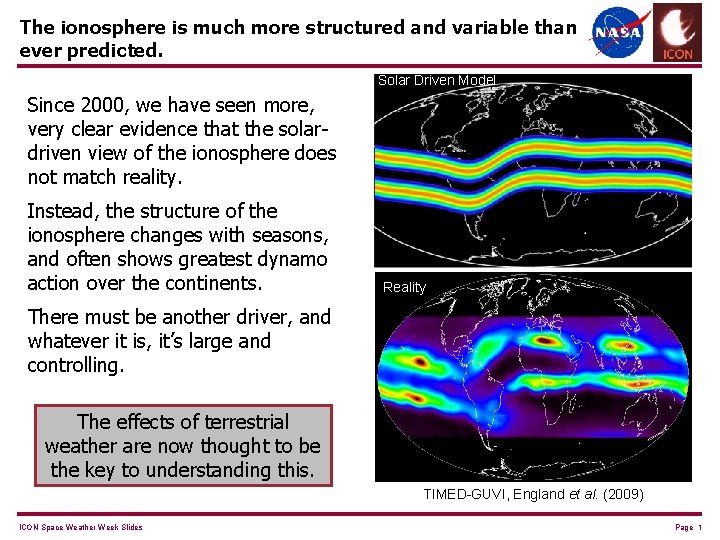
The ionosphere is much more structured and variable than ever predicted. Solar Driven Model Since 2000, we have seen more, very clear evidence that the solardriven view of the ionosphere does not match reality. Instead, the structure of the ionosphere changes with seasons, and often shows greatest dynamo action over the continents. Reality There must be another driver, and whatever it is, it’s large and controlling. The effects of terrestrial weather are now thought to be the key to understanding this. TIMED-GUVI, England et al. (2009) ICON Space Weather Week Slides Page 1
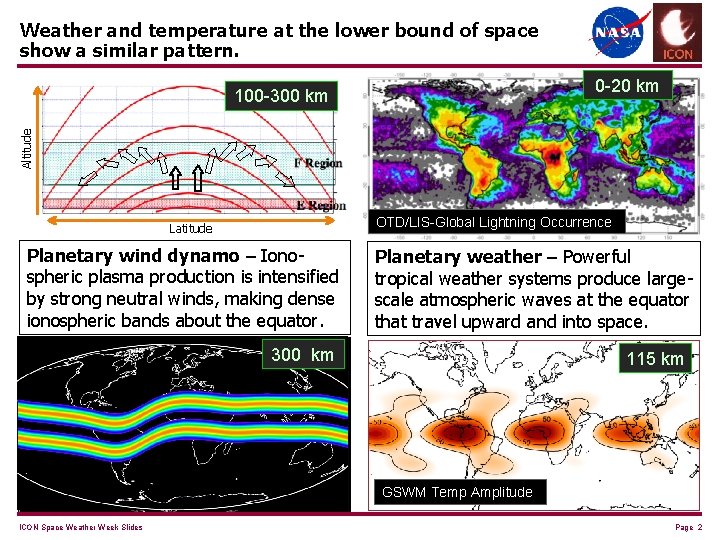
Weather and temperature at the lower bound of space show a similar pattern. 0 -20 km Altitude 100 -300 km OTD/LIS-Global Lightning Occurrence Latitude Planetary wind dynamo – Ionospheric plasma production is intensified by strong neutral winds, making dense ionospheric bands about the equator. Planetary weather – Powerful tropical weather systems produce largescale atmospheric waves at the equator that travel upward and into space. 300 km TIMED-FUV Radiance ICON Space Weather Week Slides 115 km GSWM Temp Amplitude Page 2
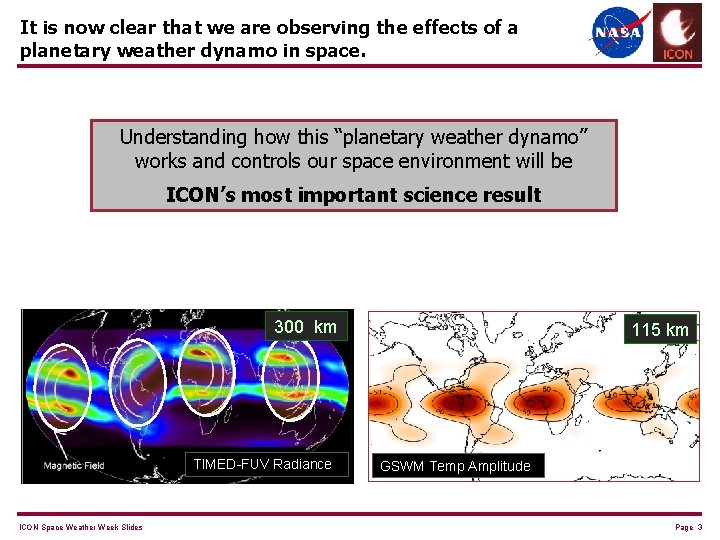
It is now clear that we are observing the effects of a planetary weather dynamo in space. Understanding how this “planetary weather dynamo” works and controls our space environment will be ICON’s most important science result 300 km TIMED-FUV Radiance ICON Space Weather Week Slides 115 km GSWM Temp Amplitude Page 3
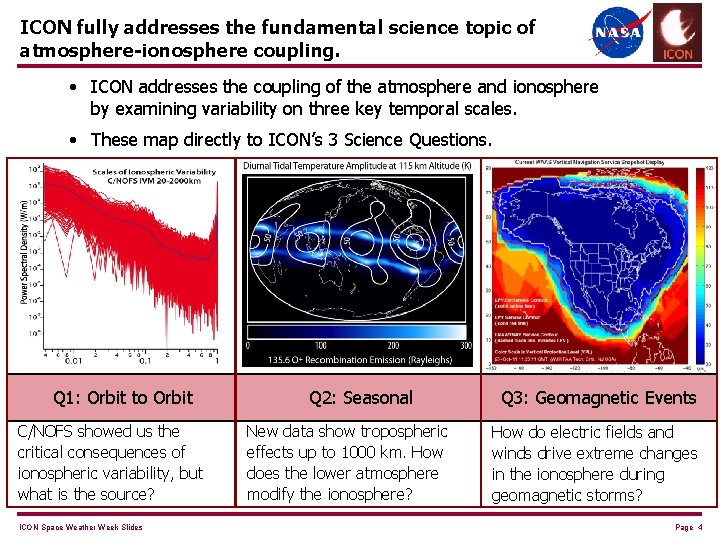
ICON fully addresses the fundamental science topic of atmosphere-ionosphere coupling. • ICON addresses the coupling of the atmosphere and ionosphere by examining variability on three key temporal scales. • These map directly to ICON’s 3 Science Questions. Q 1: Orbit to Orbit C/NOFS showed us the critical consequences of ionospheric variability, but what is the source? ICON Space Weather Week Slides Q 2: Seasonal New data show tropospheric effects up to 1000 km. How does the lower atmosphere modify the ionosphere? Q 3: Geomagnetic Events How do electric fields and winds drive extreme changes in the ionosphere during geomagnetic storms? Page 4

ICON’s instruments provide the required measurements of both drivers and responses. The Ionospheric Dynamo, driven by the neutral atmosphere, governs the motion of the plasma: • We need to measure the drivers: Neutral winds and composition of the atmosphere • along with the responses: electric field, plasma motion and plasma density in the ionosphere. • All within the context of solar wind and radiative forcing. To understand the ionospheric dynamo, the drivers and response must be measured at all relevant altitudes and at the same time. ICON Space Weather Week Slides Page 5
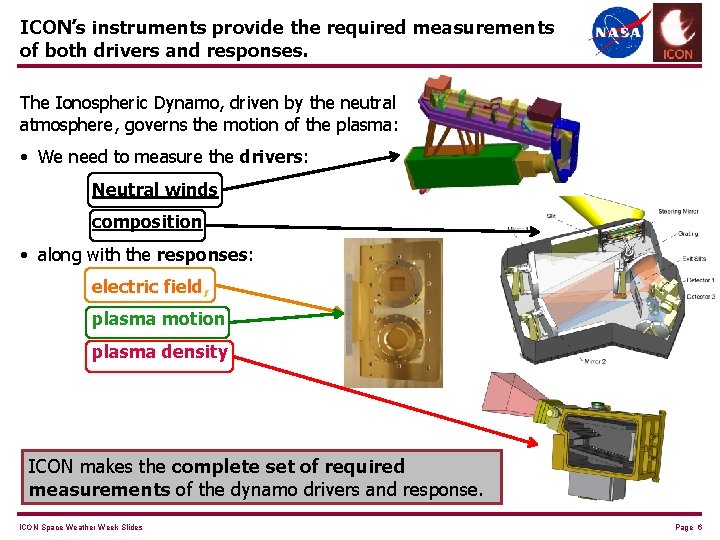
ICON’s instruments provide the required measurements of both drivers and responses. The Ionospheric Dynamo, driven by the neutral atmosphere, governs the motion of the plasma: • We need to measure the drivers: Neutral winds and composition of the neutral thermosphere • along with the responses: electric field, plasma motion and plasma density in the ionosphere. ICON makes the complete set of required measurements of the dynamo drivers and response. ICON Space Weather Week Slides Page 6
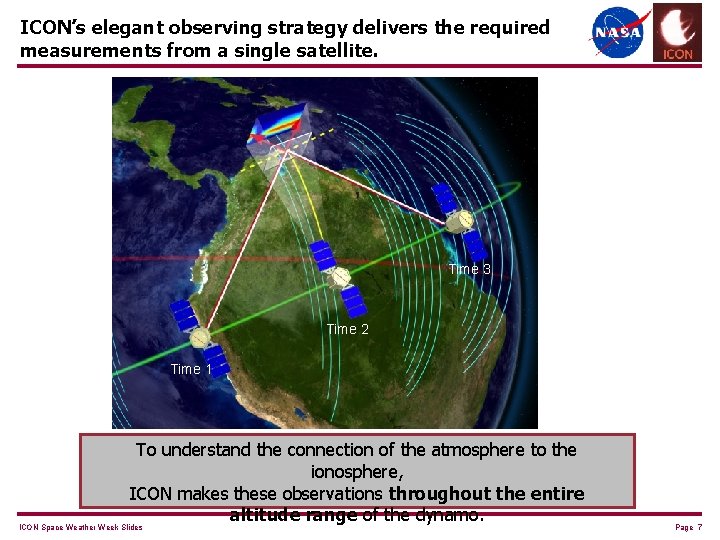
ICON’s elegant observing strategy delivers the required measurements from a single satellite. Time 3 Time 2 Time 1 To understand the connection of the atmosphere to the ionosphere, ICON makes these observations throughout the entire altitude range of the dynamo. ICON Space Weather Week Slides Page 7
- Slides: 7