
The investigation of 13 C isotopic fractionation of

![Formation Mechanisms Ex. HC 3 N [H 13 CCCN] : [HC 13 CCN] :](https://slidetodoc.com/presentation_image_h2/9d4c49ebeb9513192c93971fb96dedf8/image-8.jpg "Formation Mechanisms Ex. HC 3 N [H 13 CCCN] : [HC 13 CCN] :")

![Column Densities of 13 C Isotopologues 9, 0 Column density [1011 cm-2] HCCCC 13](https://slidetodoc.com/presentation_image_h2/9d4c49ebeb9513192c93971fb96dedf8/image-16.jpg "Column Densities of 13 C Isotopologues 9, 0 Column density [1011 cm-2] HCCCC 13")
![13 C Isotopic Fractionation [H 13 CCCCCN] : [HC 13 CCCCN] : [HCC 13](https://slidetodoc.com/presentation_image_h2/9d4c49ebeb9513192c93971fb96dedf8/image-17.jpg "13 C Isotopic Fractionation [H 13 CCCCCN] : [HC 13 CCCCN] : [HCC 13")
![Formation Pathways Leading to HC 5 N [H 13 CCCN] : [HC 13 CCN]](https://slidetodoc.com/presentation_image_h2/9d4c49ebeb9513192c93971fb96dedf8/image-18.jpg "Formation Pathways Leading to HC 5 N [H 13 CCCN] : [HC 13 CCN]")

- Slides: 32
The investigation of 13 C isotopic fractionation of HC 5 N in TMC-1 -Formation Mechanisms of Cyanopolyynes. Kotomi Taniguchi (SOKENDAI / NRO) Hiroyuki Ozeki (Toho Univ. ), Masao Saito (NRO/SOKENDAI) Fumitaka Nakamura (NAOJ/SOKENDAI), Seiji Kameno (JAO) Masatoshi Ohishi (NAOJ/SOKENDAI), Tomoya Hirota (NAOJ/SOKENDAI) Nami Sakai (The Univ. of Tokyo), Satoshi Yamamoto (The Univ. of Tokyo), Shuro Takano (Nihon Univ. )
Contents �Introduction �Observations �Results & Discussion �Summary �Future Works
Contents �Introduction �Observations �Results & Discussion �Summary �Future Works
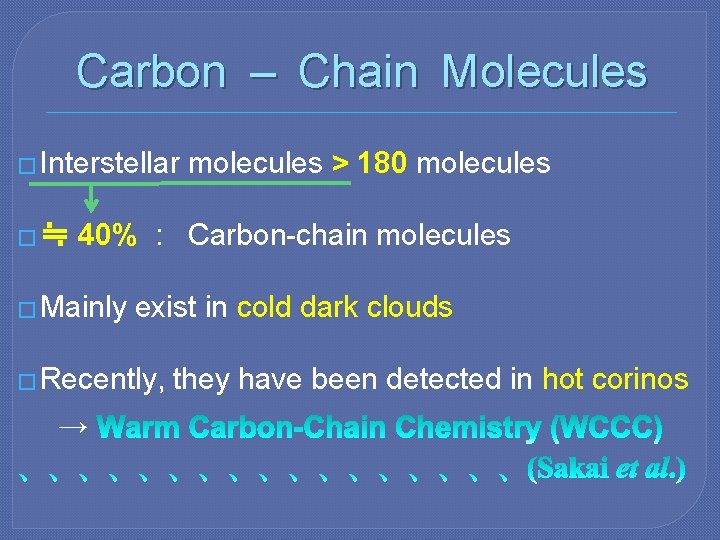
Carbon – Chain Molecules � Interstellar �≒ molecules > 180 molecules 40% : Carbon-chain molecules � Mainly exist in cold dark clouds � Recently, → they have been detected in hot corinos
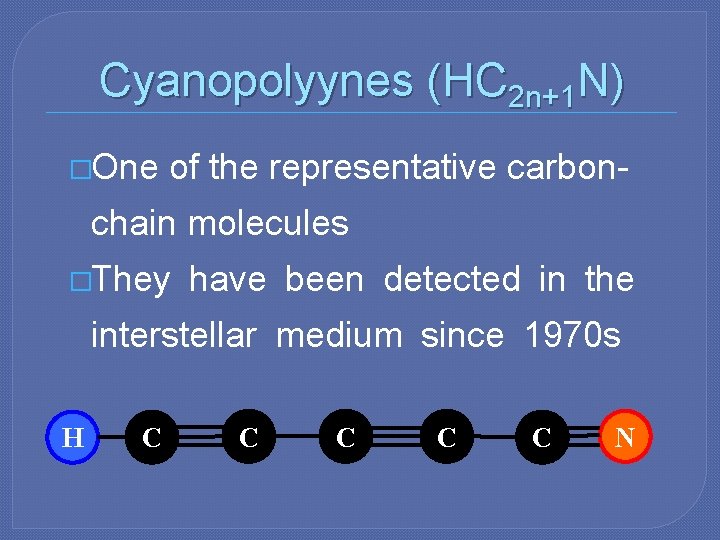
Cyanopolyynes (HC 2 n+1 N) �One of the representative carbon- chain molecules �They have been detected in the interstellar medium since 1970 s H C C C N
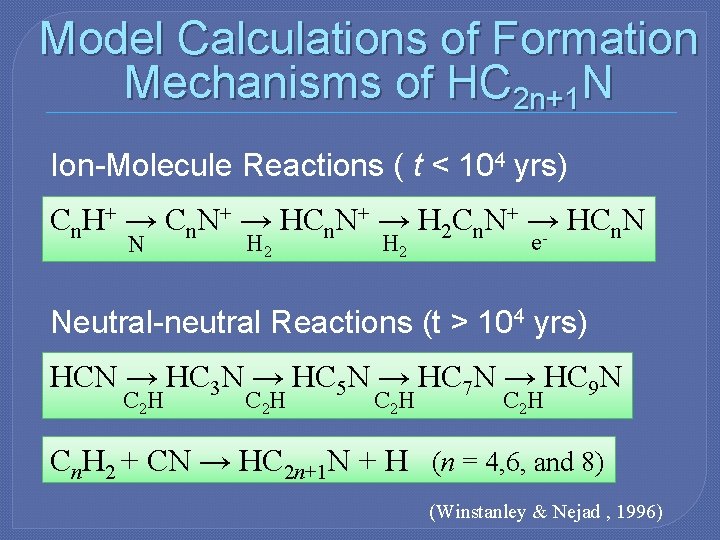
Model Calculations of Formation Mechanisms of HC 2 n+1 N Ion-Molecule Reactions ( t < 104 yrs) Cn. H+ → Cn. N+ → H 2 Cn. N+ → HCn. N N H 2 e Neutral-neutral Reactions (t > 104 yrs) HCN → HC 3 N → HC 5 N → HC 7 N → HC 9 N C 2 H Cn. H 2 + CN → HC 2 n+1 N + H (n = 4, 6, and 8) (Winstanley & Nejad , 1996)
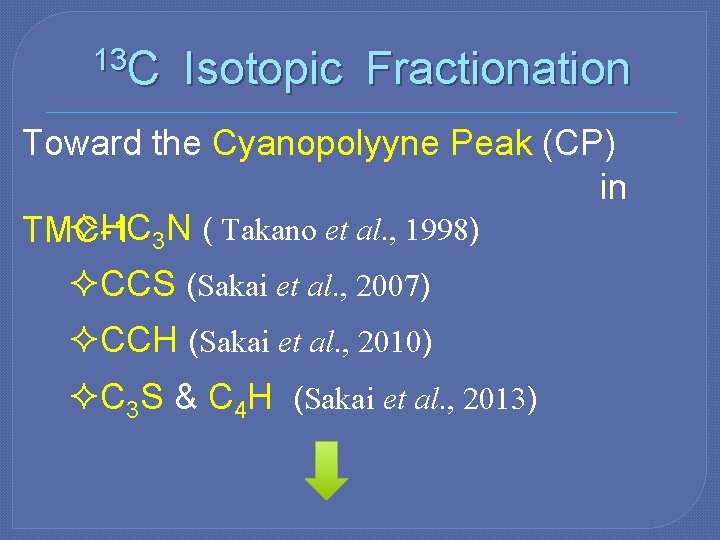
13 C Isotopic Fractionation Toward the Cyanopolyyne Peak (CP) in ²HC 3 N ( Takano et al. , 1998) TMC-1 ²CCS (Sakai et al. , 2007) ²CCH (Sakai et al. , 2010) ²C 3 S & C 4 H (Sakai et al. , 2013)
Formation Mechanisms Ex. HC 3 N [H 13 CCCN] : [HC 13 CCN] : [HCC 13 CN] = 1. 0 : 1. 4 13 C-enriched Molecules with two equivalent carbon atoms Main formation pathway C 2 H 2 + CN → HC 3 N + H
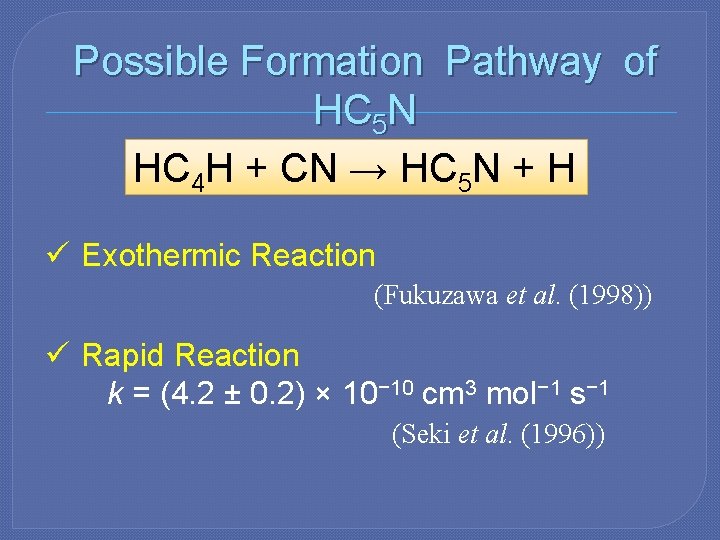
Possible Formation Pathway of HC 5 N HC 4 H + CN → HC 5 N + H ü Exothermic Reaction (Fukuzawa et al. (1998)) ü Rapid Reaction k = (4. 2 ± 0. 2) × 10− 10 cm 3 mol− 1 s− 1 (Seki et al. (1996))
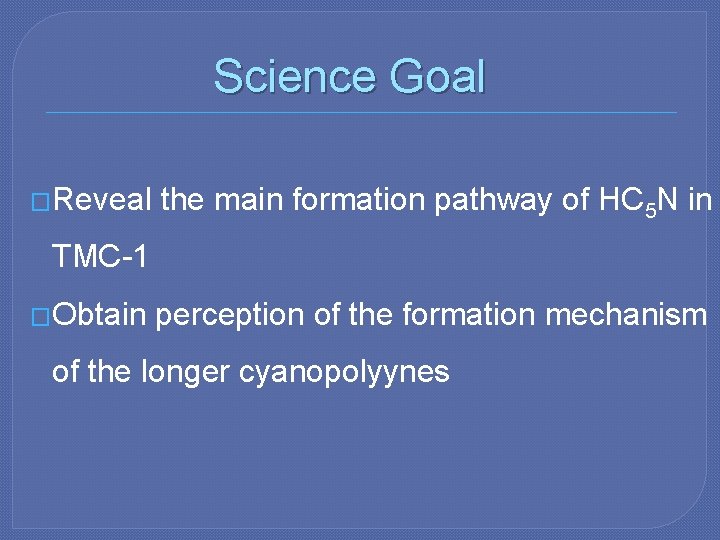
Science Goal �Reveal the main formation pathway of HC 5 N in TMC-1 �Obtain perception of the formation mechanism of the longer cyanopolyynes
Contents �Introduction �Observations �Results & Discussion �Summary �Future Works
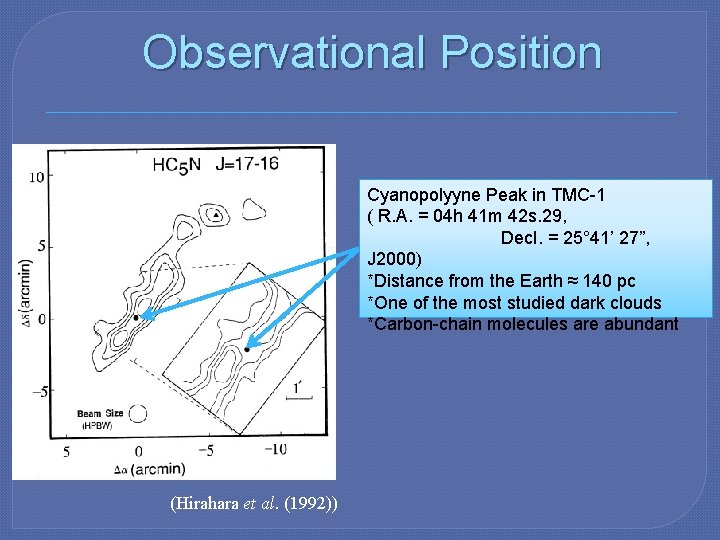
Observational Position Cyanopolyyne Peak in TMC-1 ( R. A. = 04 h 41 m 42 s. 29, Decl. = 25° 41’ 27”, J 2000) *Distance from the Earth ≈ 140 pc *One of the most studied dark clouds *Carbon-chain molecules are abundant (Hirahara et al. (1992))
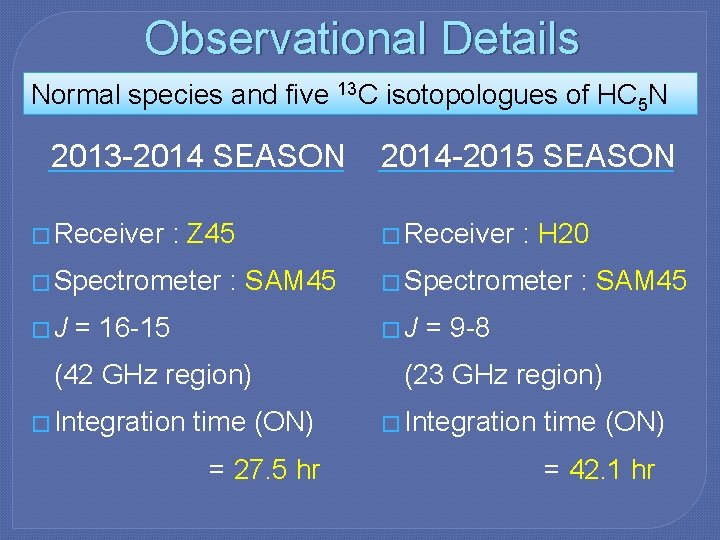
Observational Details Normal species and five 13 C isotopologues of HC 5 N 2013 -2014 SEASON � Receiver : Z 45 � Spectrometer �J : SAM 45 = 16 -15 � Receiver time (ON) = 27. 5 hr : H 20 � Spectrometer �J (42 GHz region) � Integration 2014 -2015 SEASON : SAM 45 = 9 -8 (23 GHz region) � Integration time (ON) = 42. 1 hr
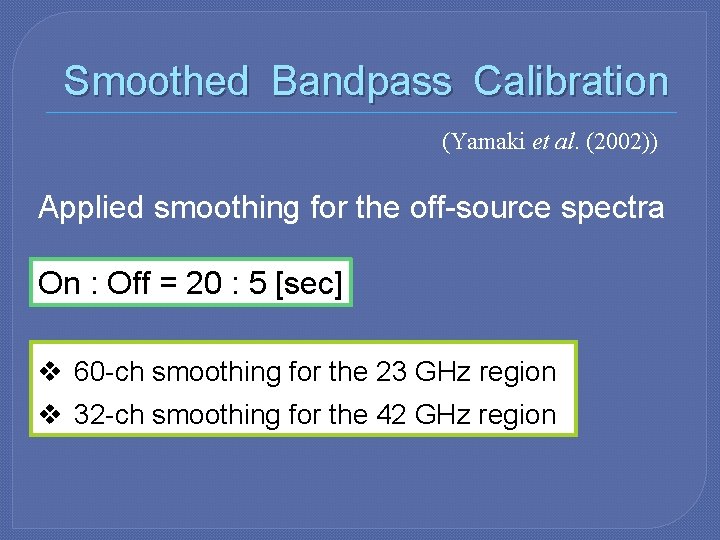
Smoothed Bandpass Calibration (Yamaki et al. (2002)) Applied smoothing for the off-source spectra On : Off = 20 : 5 [sec] v 60 -ch smoothing for the 23 GHz region v 32 -ch smoothing for the 42 GHz region
Contents �Introduction �Observations �Results & Discussion �Summary �Future Works
Column Densities of 13 C Isotopologues 9, 0 Column density [1011 cm-2] HCCCC 13 CN 8, 5 HCC 13 CCCN J=9 -8 J=16 -15 8, 0 H 13 CCCCCN 7, 5 7, 0 6, 5 6, 0 HC 13 CCCCN 5, 5 HCCC 13 CCN (1σ)
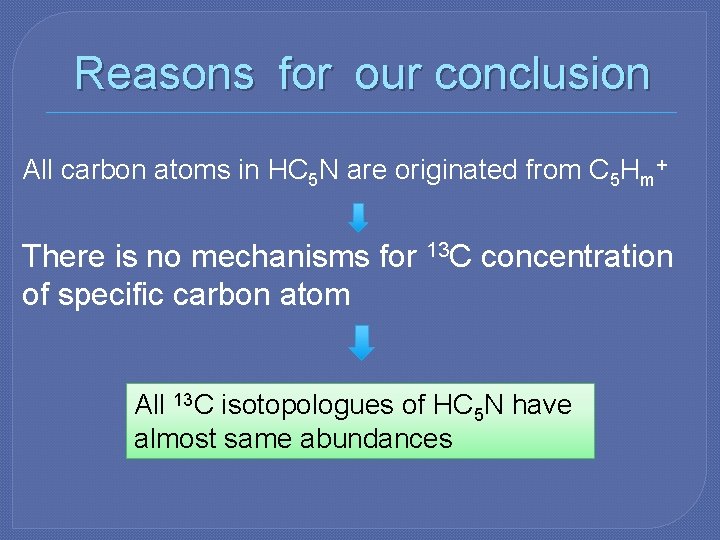
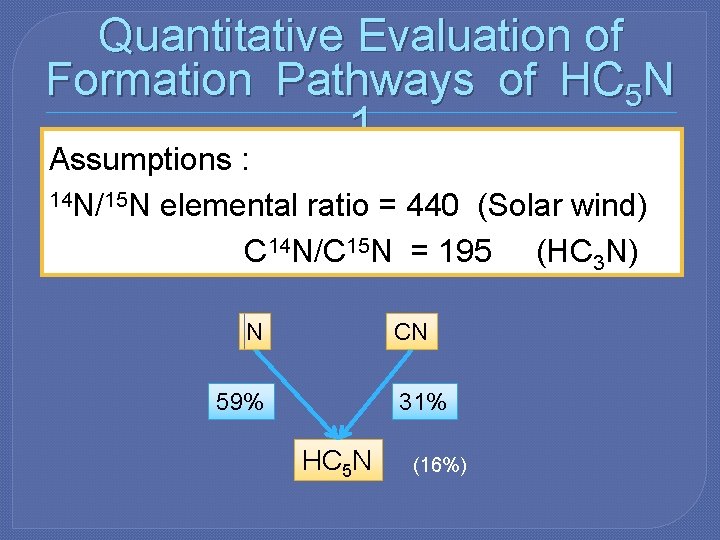
13 C Isotopic Fractionation [H 13 CCCCCN] : [HC 13 CCCCN] : [HCC 13 CCCN] : [HCCC 13 CCN] : [HCCCC 13 CN] = 1. 00 : 0. 97 : 1. 03 : 1. 05 : 1. 16 (± 0. 19) (1σ) No significant differences in abundances among the five 13 C isotopologues
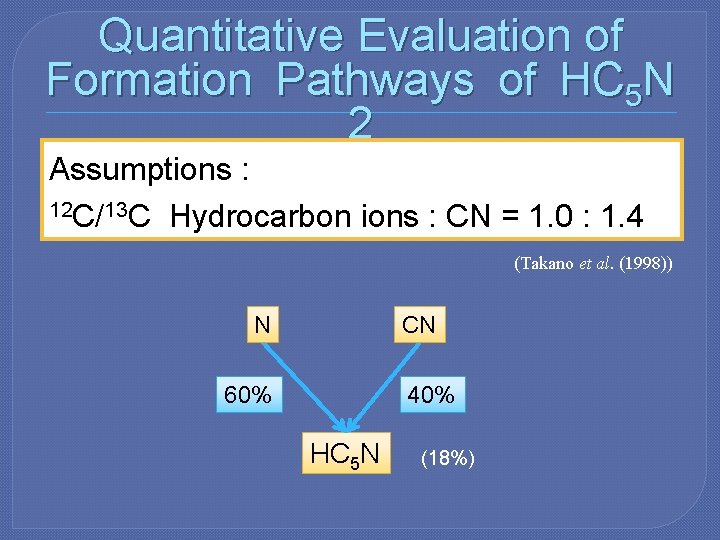
Formation Pathways Leading to HC 5 N [H 13 CCCN] : [HC 13 CCN] : [HCC 13 CN] = 1. 0 : 1. 4 (Takano et al. (1998)) If HC 5 N is formed by the reactions involving CN HCCCC 13 CN is more abundant than the other 13 C isotopologues by 1. 4
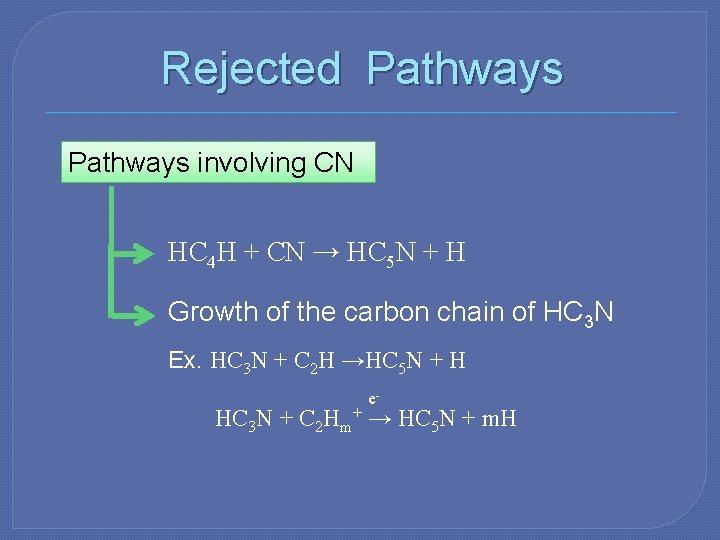
Rejected Pathways involving CN HC 4 H + CN → HC 5 N + H Growth of the carbon chain of HC 3 N Ex. HC 3 N + C 2 H →HC 5 N + H e- HC 3 N + C 2 Hm+ → HC 5 N + m. H
Reasons for our conclusion All carbon atoms in HC 5 N are originated from C 5 Hm+ There is no mechanisms for 13 C concentration of specific carbon atom All 13 C isotopologues of HC 5 N have almost same abundances
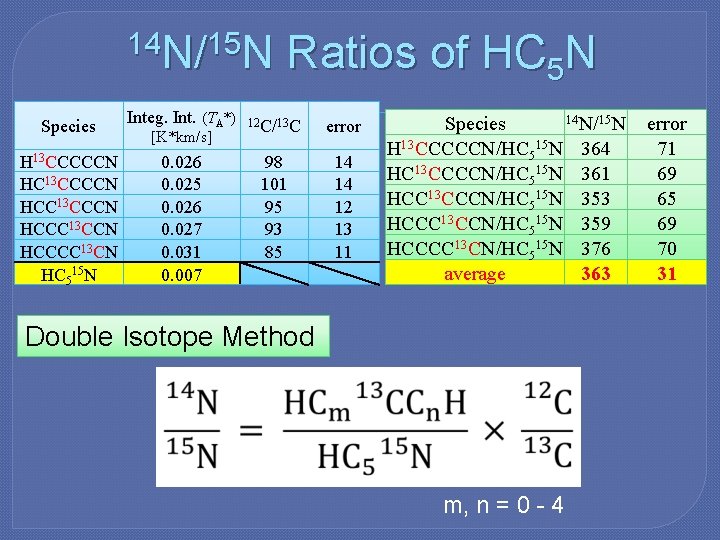
14 N/15 N Species Integ. Int. (TA*) H 13 CCCCCN HC 13 CCCCN HCC 13 CCCN HCCC 13 CCN HCCCC 13 CN HC 515 N 0. 026 0. 025 0. 026 0. 027 0. 031 0. 007 [K*km/s] Ratios of HC 5 N 12 C/13 C error 98 101 95 93 85 14 14 12 13 11 14 N/15 N Species H 13 CCCCCN/HC 515 N 364 HC 13 CCCCN/HC 515 N 361 HCC 13 CCCN/HC 515 N 353 HCCC 13 CCN/HC 515 N 359 HCCCC 13 CN/HC 515 N 376 average 363 Double Isotope Method m, n = 0 - 4 error 71 69 65 69 70 31
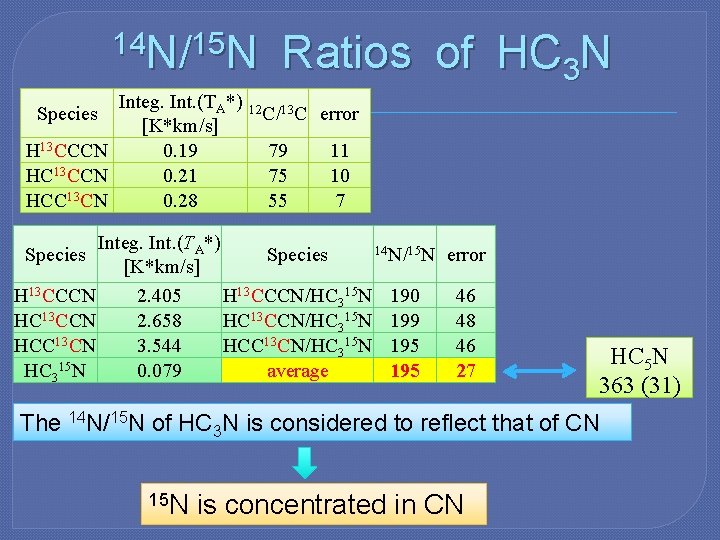
14 N/15 N Ratios of HC 3 N Integ. Int. (TA*) 12 13 C/ C error [K*km/s] H 13 CCCN 0. 19 79 11 HC 13 CCN 0. 21 75 10 HCC 13 CN 0. 28 55 7 Species Integ. Int. (TA*) 14 N/15 N error Species [K*km/s] H 13 CCCN 2. 405 H 13 CCCN/HC 315 N 190 46 HC 13 CCN 2. 658 HC 13 CCN/HC 315 N 199 48 HCC 13 CN 3. 544 HCC 13 CN/HC 315 N 195 46 HC 315 N 0. 079 average 195 27 Species HC 5 N 363 (31) The 14 N/15 N of HC 3 N is considered to reflect that of CN 15 N is concentrated in CN
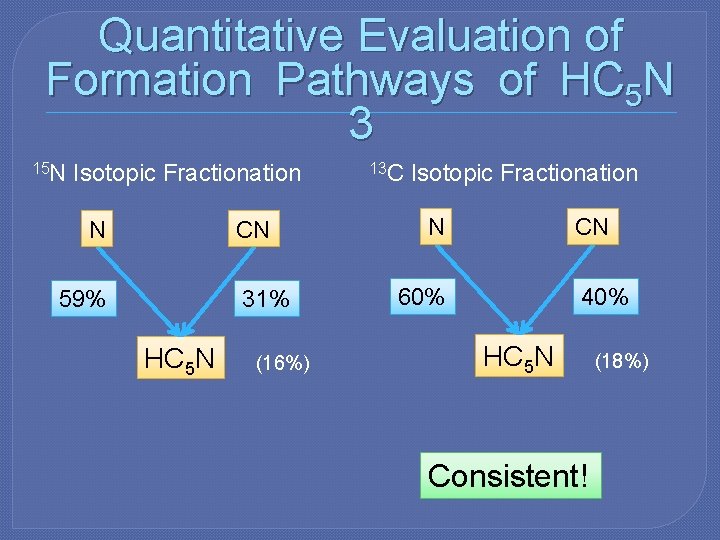
Quantitative Evaluation of Formation Pathways of HC 5 N 1 Assumptions : 14 N/15 N elemental ratio = 440 (Solar wind) C 14 N/C 15 N = 195 (HC 3 N) N CN 59% 31% HC 5 N (16%)
Quantitative Evaluation of Formation Pathways of HC 5 N 2 Assumptions : 12 C/13 C Hydrocarbon ions : CN = 1. 0 : 1. 4 (Takano et al. (1998)) N CN 60% 40% HC 5 N (18%)
Quantitative Evaluation of Formation Pathways of HC 5 N 3 15 N Isotopic Fractionation N CN 59% 31% HC 5 N (16%) 13 C Isotopic Fractionation N CN 60% 40% HC 5 N Consistent! (18%)
Contents �Introduction �Observations �Results & Discussion �Summary �Future Works
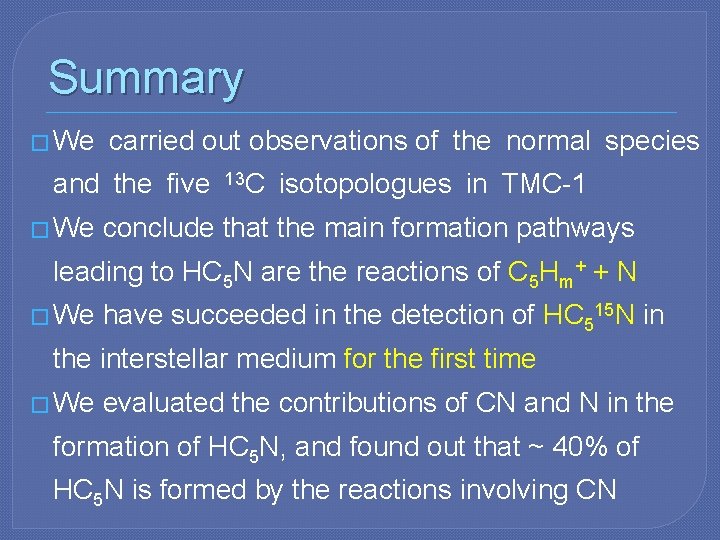
Summary � We carried out observations of the normal species and the five � We 13 C isotopologues in TMC-1 conclude that the main formation pathways leading to HC 5 N are the reactions of C 5 Hm+ + N � We have succeeded in the detection of HC 515 N in the interstellar medium for the first time � We evaluated the contributions of CN and N in the formation of HC 5 N, and found out that ~ 40% of HC 5 N is formed by the reactions involving CN
Contents �Introduction �Observations �Results & Discussion �Summary �Future Works
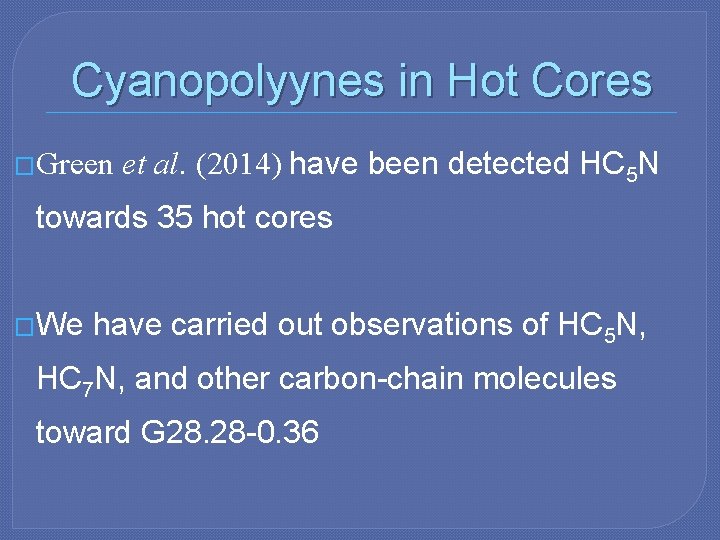
Cyanopolyynes in Hot Cores �Green et al. (2014) have been detected HC 5 N towards 35 hot cores �We have carried out observations of HC 5 N, HC 7 N, and other carbon-chain molecules toward G 28. 28 -0. 36
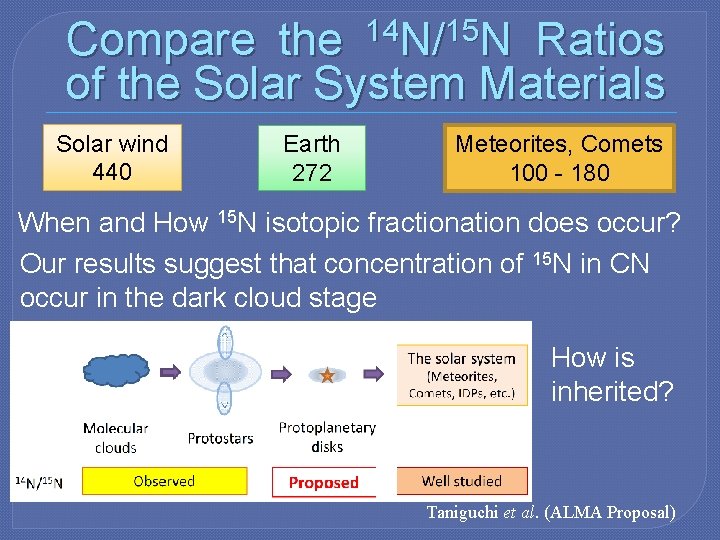
Compare the 14 N/15 N Ratios of the Solar System Materials Solar wind 440 Earth 272 Meteorites, Comets 100 - 180 When and How 15 N isotopic fractionation does occur? Our results suggest that concentration of 15 N in CN occur in the dark cloud stage How is inherited? Taniguchi et al. (ALMA Proposal)
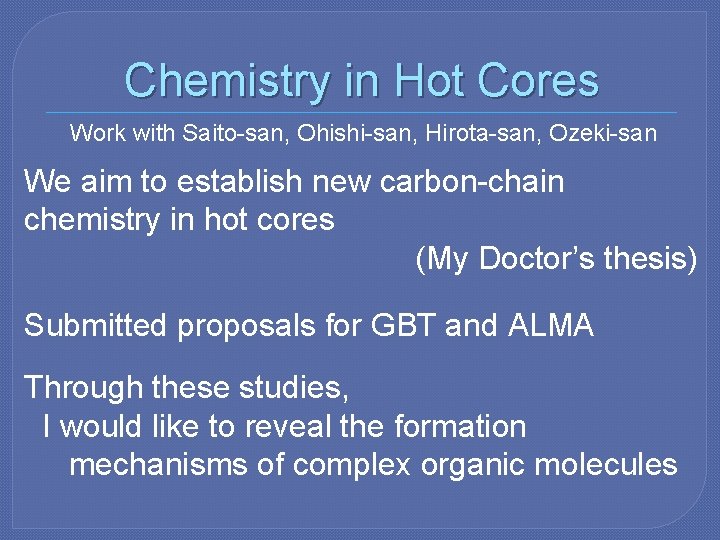
Chemistry in Hot Cores Work with Saito-san, Ohishi-san, Hirota-san, Ozeki-san We aim to establish new carbon-chain chemistry in hot cores (My Doctor’s thesis) Submitted proposals for GBT and ALMA Through these studies, I would like to reveal the formation mechanisms of complex organic molecules
Acknowledgement I thank Prof. Dobashi and Dr. Shimoikura for discussing calibration of the data of the Z 45 receiver. I’m grateful for all NRO Staff and members of Z 45 Receiver Group.