
THE INVERTEBRATES Introduction to the Animal Kingdom ZOOLOGY
THE INVERTEBRATES Introduction to the Animal Kingdom
ZOOLOGY the study of the animal kingdom
NINE PROCESSES 1. MOVEMENT § motile • locomotion § sessile • permanently fixed 2. SUPPORT § exoskeleton • tough plates covering the outside § endoskeleton • lighter, more flexible internal system of bones or cartilage
3. PROTECTIVE BODY COVERING § single layer of cells or fur, scales, skin, feathers, shells § Spines, quills, poisonous skin secretions, shells, tough hides or camouflaging coloration 4. NUTRITION § heterotrophic § includes several processes • • • ingestion – intake of food digestion – the breakdown of food assimilation – the absorption of food
5. RESPIRATION § intake of oxygen for use in cellular respiration § skin, gills, lungs, tubules 6. CIRCULATION § closed system • blood/fluid contained within vessels § open system • blood/fluid exits vessels to bathe surrounding tissues
7. EXCRETION § specialized organs that eliminate soluble wastes § ammonia is the primary waste product release by animal cells 8. RESPONSE § Irritability • the ability to respond to the environment § nerve net, ganglion, brain
9. REPRODUCTION § some asexual • budding • regeneration § all sexual • embryonic stages • larval stages
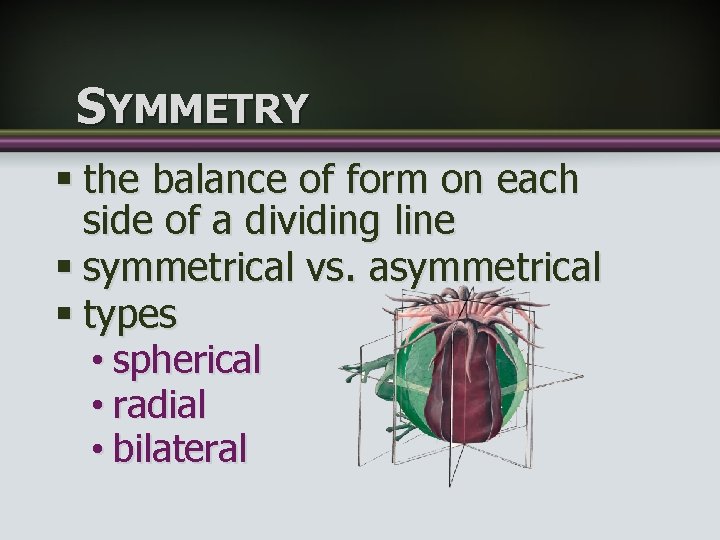
SYMMETRY § the balance of form on each side of a dividing line § symmetrical vs. asymmetrical § types • spherical • radial • bilateral
COMMON TERMS OF ANIMAL ANATOMY § § § § § (MEMORIZE! PAGE 343) Cephalic – concerning the head Caudal – concerning the tail Anterior – toward the front Posterior – toward the rear Dorsal – upper surface; back Ventral – lower surface; front Lateral – toward the side Medial – toward the middle Midline – divides into right and left Transverse – perpendicular to midline
ANIMAL CLASSIFICATION § vertebrates • animals with backbones • 5% of all animals § invertebrates • animals without backbones • 95% of all animals
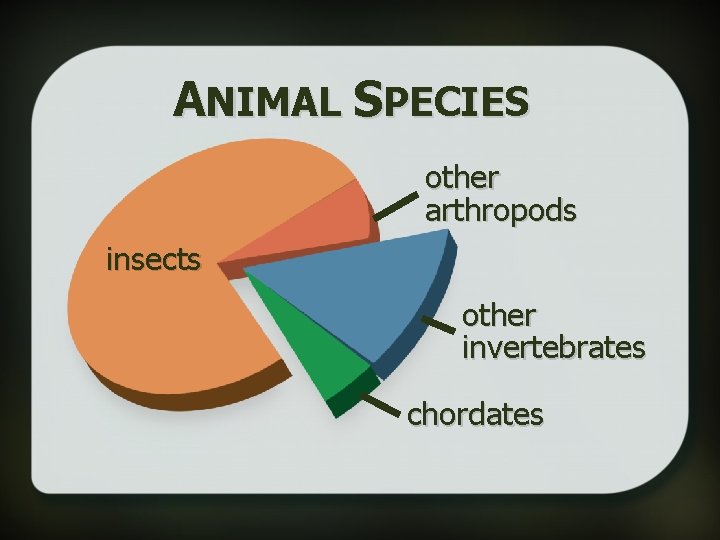
ANIMAL SPECIES other arthropods insects other invertebrates chordates
- Slides: 11