
The Inventions of the Agricultural Revolution Kaitlyn Uchishiba
The Inventions of the Agricultural Revolution Kaitlyn Uchishiba and Emily Scharenbrock Period 5
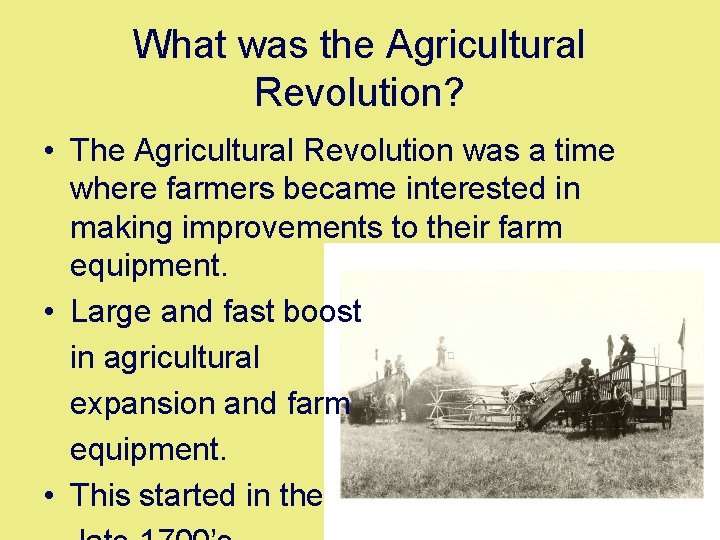
What was the Agricultural Revolution? • The Agricultural Revolution was a time where farmers became interested in making improvements to their farm equipment. • Large and fast boost in agricultural expansion and farm equipment. • This started in the
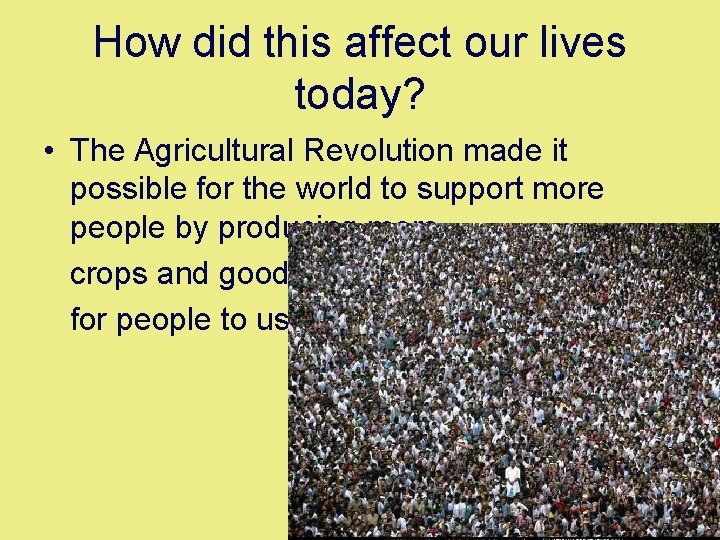
How did this affect our lives today? • The Agricultural Revolution made it possible for the world to support more people by producing more crops and goods for people to use.
Timeline of Agricultural Revolution • In 1701, Jethro Tull developed the seed drill and horse-drawn hoe. • Charles Townsend introduced the Four Year Crop Rotation in 1730. • In 1760, agriculture was revolutionized by enclosures and new innovations.
Timeline of Agricultural Revolution • Robert Bakewell produced the Longhorn cattle in 1769. • In 1780, better agricultural methods used in England had take effect by this time. • Tull’s seed drill was improved by adding gears to the rotary mechanism in 1782. • James Small developed an iron plough in 1784. • Scottish agricultural developer, Andrew Meikle, developed a threshing machine. The grain was rubbed between a metal drum and a concave metal sheet.
Timeline of Agricultural Revolution • Eli Whitney invented the Cotton Gin in 1793. • In 1834, Cyrus Mc. Cormick invented the mechanical reaper. • Also in 1834, John Lane began to manufacture plows faced with steel saw blades. • In 1837, John Deere and Leonard Andrus began to manufacture steel plows. • In 1837, practical threshing machines were
Timeline of Agricultural Revolution • In 1841, the practical grain drill was invented • The first grain elevator was invented in Buffalo, NY. • The first practical mowing machine was invented in 1844. • In 1847, irrigation started to be used widely in Europe and America.
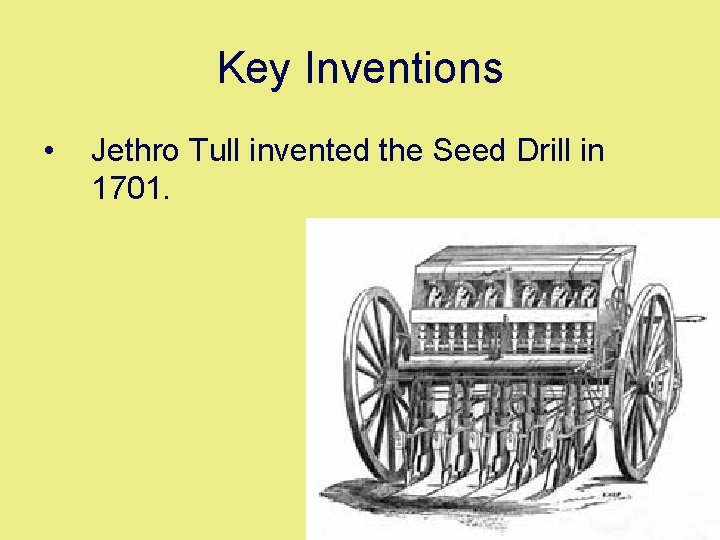
Key Inventions • Jethro Tull invented the Seed Drill in 1701.
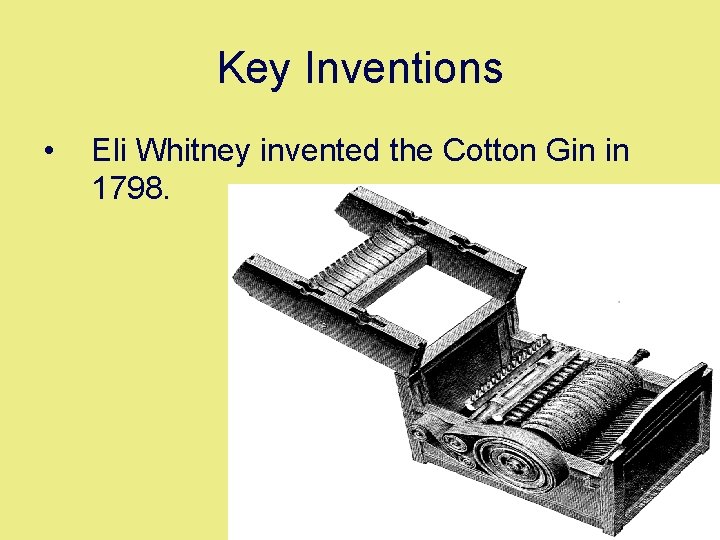
Key Inventions • Eli Whitney invented the Cotton Gin in 1798.
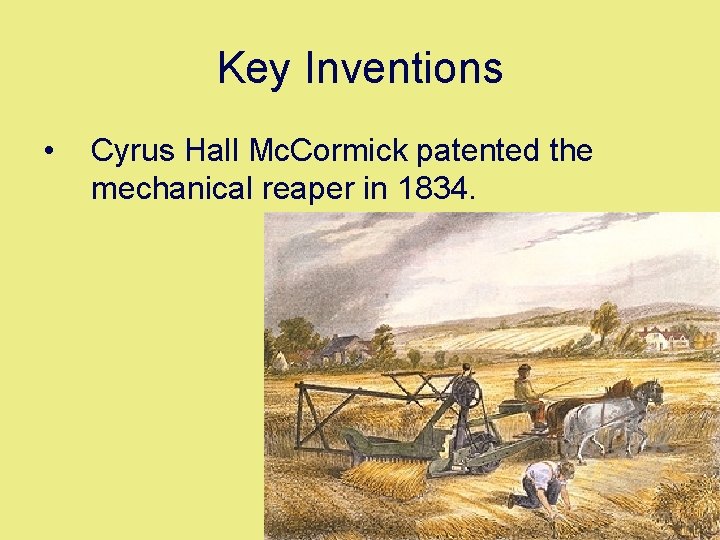
Key Inventions • Cyrus Hall Mc. Cormick patented the mechanical reaper in 1834.
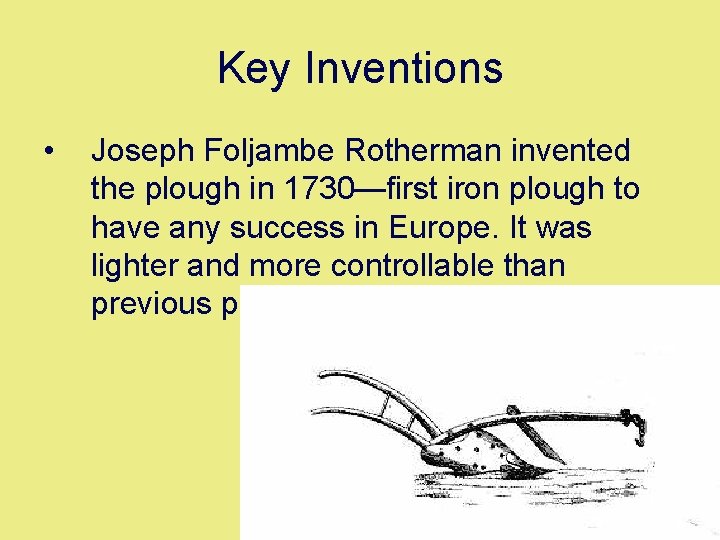
Key Inventions • Joseph Foljambe Rotherman invented the plough in 1730—first iron plough to have any success in Europe. It was lighter and more controllable than previous ploughs.

Formerly Used Crop Rotation System • Before the four year crop rotation was introduced, farmers used strips of land to grow their crops. This was not useful because much land wasted, and it was not practical.
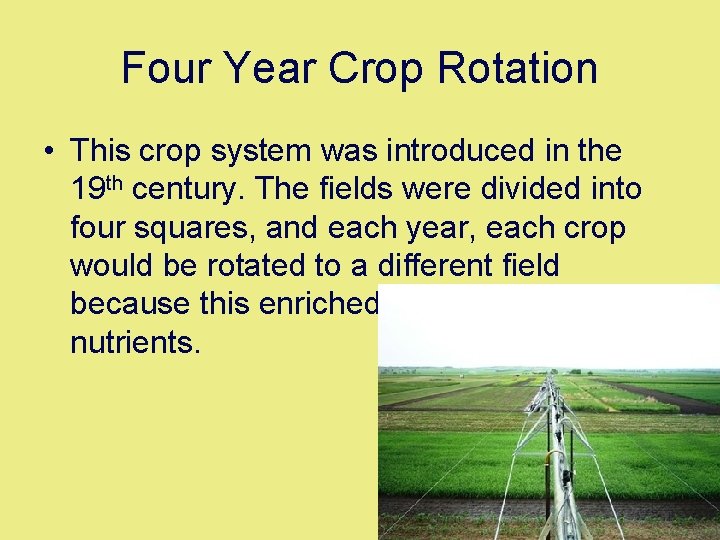
Four Year Crop Rotation • This crop system was introduced in the 19 th century. The fields were divided into four squares, and each year, each crop would be rotated to a different field because this enriched the soil with nutrients.

Selective Breeding • Robert Bakewell introduced selective breeding in 1755. He produced the Longhorn in 1769.
Working Conditions • Many people had more jobs because of all of these great inventions. There was much work to be done, and many people needing work, so wages were cheap.
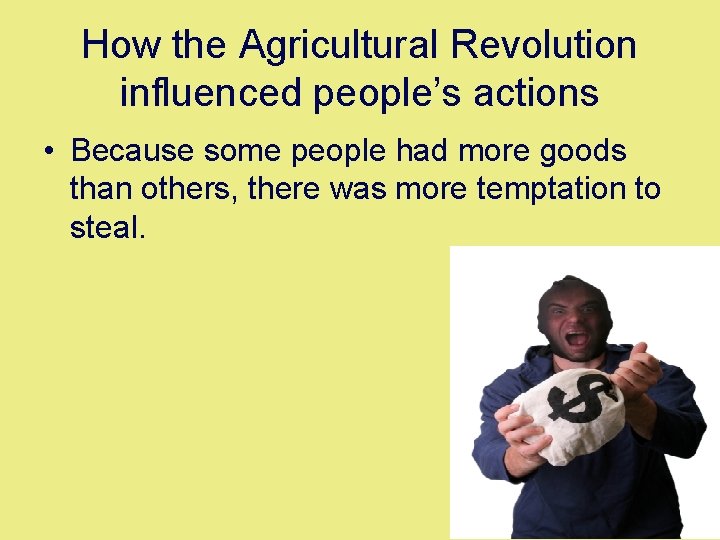
How the Agricultural Revolution influenced people’s actions • Because some people had more goods than others, there was more temptation to steal.
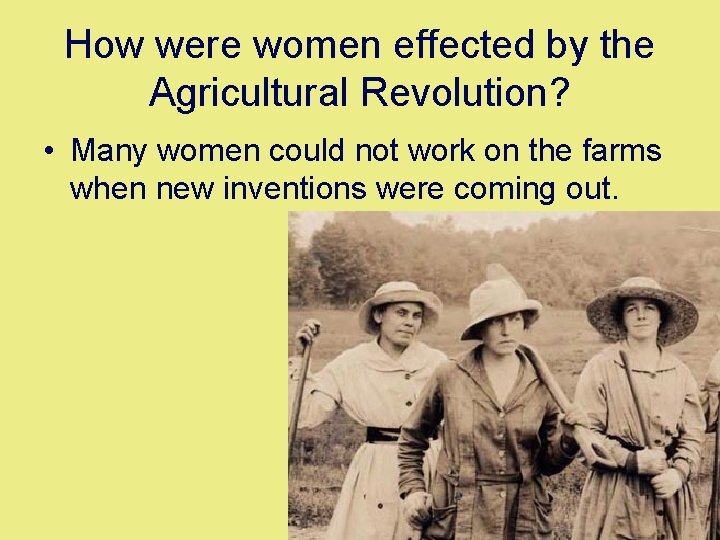
How were women effected by the Agricultural Revolution? • Many women could not work on the farms when new inventions were coming out.
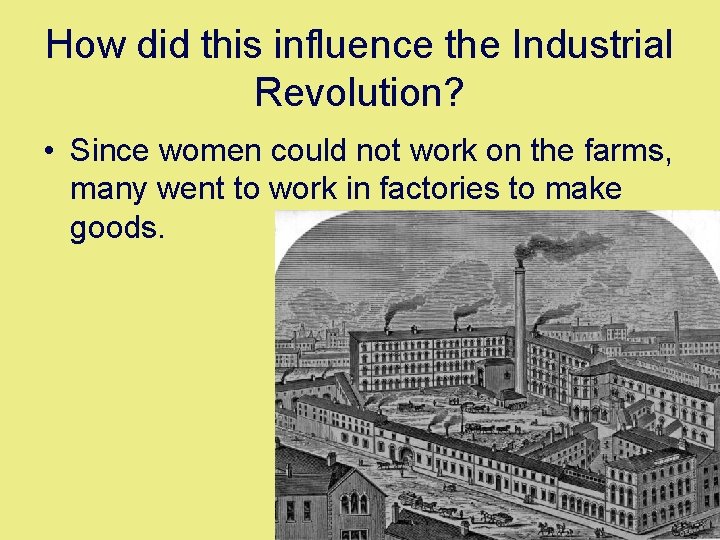
How did this influence the Industrial Revolution? • Since women could not work on the farms, many went to work in factories to make goods.
Would life be different if the Agricultural Revolution did not take place? • Yes, the world would be a very different place if the Agricultural Revolution did not take place.
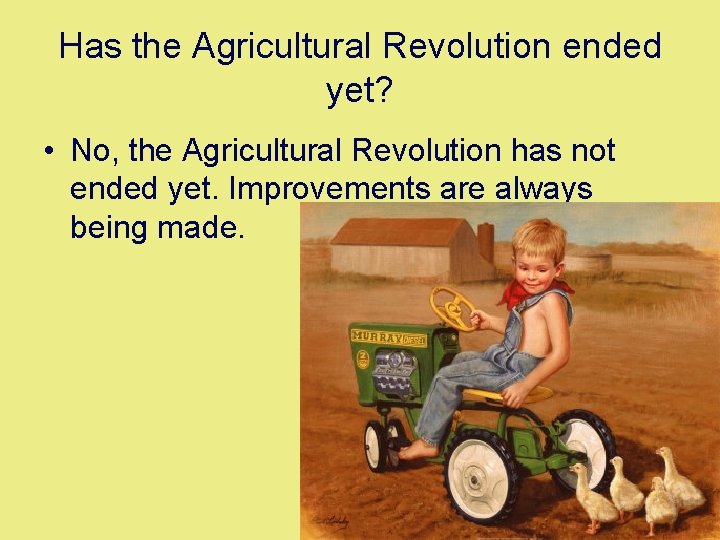
Has the Agricultural Revolution ended yet? • No, the Agricultural Revolution has not ended yet. Improvements are always being made.
Conclusion • The Agricultural Revolution was an essential event in history. It was a time when inventions and ideas transformed the way people lived and worked. It was also the cause of the Industrial Revolution. Without the Agricultural Revolution, farming probably would not be the same.
- Slides: 21