
THE INTRODUCTION OF SOUND TO CINEMA ADV 4
- Slides: 22
THE INTRODUCTION OF SOUND TO CINEMA ADV 4 M
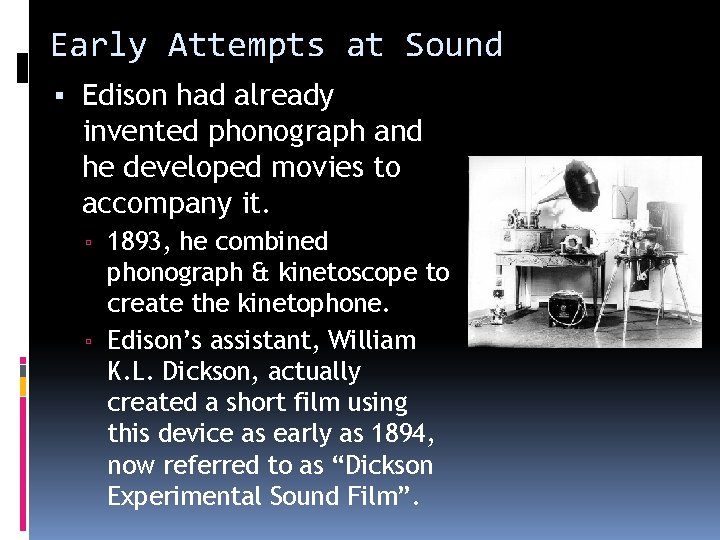
Early Attempts at Sound ▪ Edison had already invented phonograph and he developed movies to accompany it. ▫ 1893, he combined phonograph & kinetoscope to create the kinetophone. ▫ Edison’s assistant, William K. L. Dickson, actually created a short film using this device as early as 1894, now referred to as “Dickson Experimental Sound Film”.
Dickson Experimental Sound Film (1894)
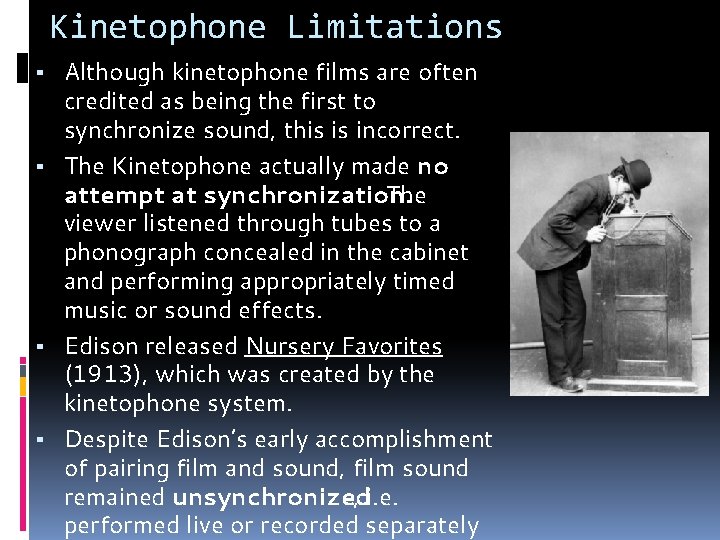
Kinetophone Limitations ▪ Although kinetophone films are often credited as being the first to synchronize sound, this is incorrect. ▪ The Kinetophone actually made no attempt at synchronization. The viewer listened through tubes to a phonograph concealed in the cabinet and performing appropriately timed music or sound effects. ▪ Edison released Nursery Favorites (1913), which was created by the kinetophone system. ▪ Despite Edison’s early accomplishment of pairing film and sound, film sound remained unsynchronized , i. e. performed live or recorded separately
Nursery Favorites (1913)
Photokinema ▪ Introduced in 1921, this system was among the first to synchronize sound and film. ▪ Photokinema used a process called sound-on-disc. ▪ Sound-on-discrefers to a process whereby a phonograph or other disc is used to record or playback sound in sync with a motion picture.
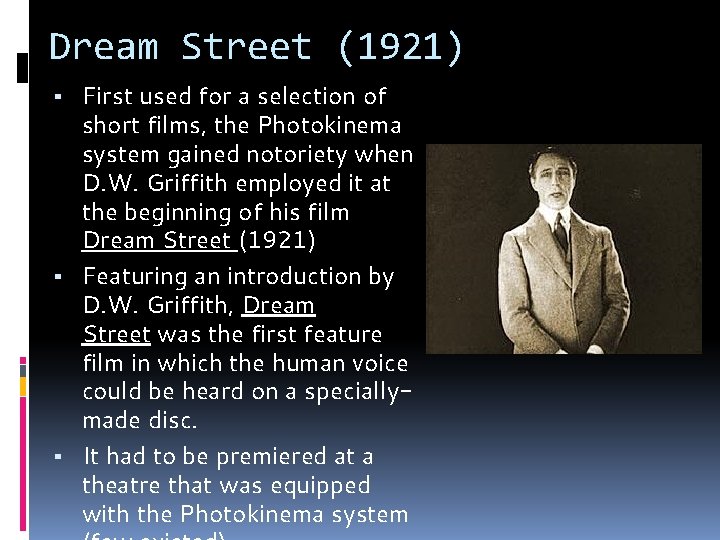
Dream Street (1921) ▪ First used for a selection of short films, the Photokinema system gained notoriety when D. W. Griffith employed it at the beginning of his film Dream Street (1921) ▪ Featuring an introduction by D. W. Griffith, Dream Street was the first feature film in which the human voice could be heard on a speciallymade disc. ▪ It had to be premiered at a theatre that was equipped with the Photokinema system
Sound’s Early Years ▪ In the early 1920 s, there were a number of inventors in several countries who worked on the possibility of more effectively generating sound for film. ▪ Tri-Ergon system developed in Germany. ▪ Voice-on-Film system developed by Lee De Forest in the United States (Phonofilm). ▪ Studios were reluctant to forge into the world of cinema sound; they did not want to change their methods of production or exhibition, especially because movie houses would require extensive renovations to
Sound in the mid-1920 s ▪ Slowly, studios began to warm to the development of sound technology for cinema. ▪ During 1925 and 1926, both Warner Brothers and Fox were carrying out experiments to develop a reliable way to synchronize sound and film.
Warner Brother’s Quest for Sound ▪ Sam Warner created a partnership with Western Electric Co. for the purpose of developing a viable sound-on-discsystem for cinema. ▪ They developed a system whereby electric signals picked up the microphones on the film set or sound stage were transferred to 17 -inch discs by specialty disc-cutting machines. ▪ These were locked into synch with the film cameras and played for about 10 minutes each.
Vitaphone Mechanics ▪ A Vitaphone-equipped theater used normal projectors equipped with a special turntable and reproducer, a fader, an amplifier, and loudspeaker system. The projectors operated as normal motorized silent projectors would, but also provided a mechanical interlock with an attached phonograph turntable. ▪ When the projector was threaded, the projectionist would align a start mark on the film and at the same time would place a phonograph record on the turntable. ▪ When the projector rolled, the phonograph turned at a fixed rate, and (theoretically) played sound in sync with the film. ▪
Vitaphone Benefits ▪ The Vitaphone process made several improvements over previous systems: ▫ Amplification- The Vitaphone system was one of the first to use electronic amplification. This allowed the sound of the phonograph to be played to a large audience at a comfortable volume. ▫ Fidelity- In the early days, Vitaphone had superior fidelity (accuracy of sound reproduction) to other sound systems, particularly at both low and high frequencies.
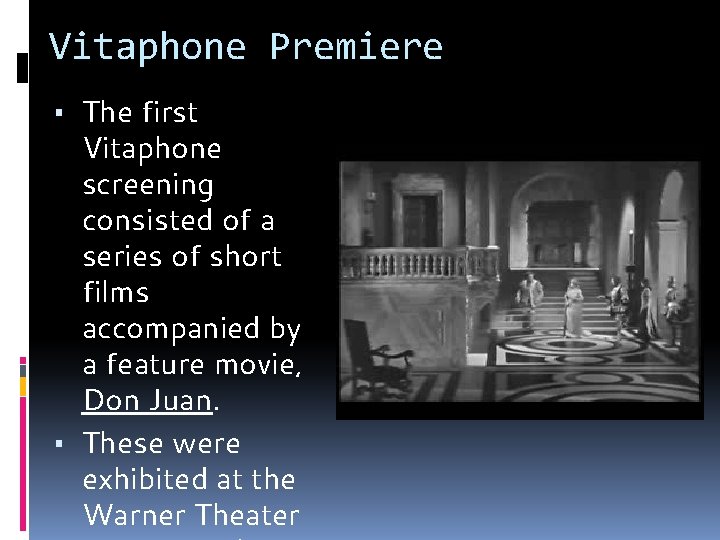
Vitaphone Premiere ▪ The first Vitaphone screening consisted of a series of short films accompanied by a feature movie, Don Juan. ▪ These were exhibited at the Warner Theater
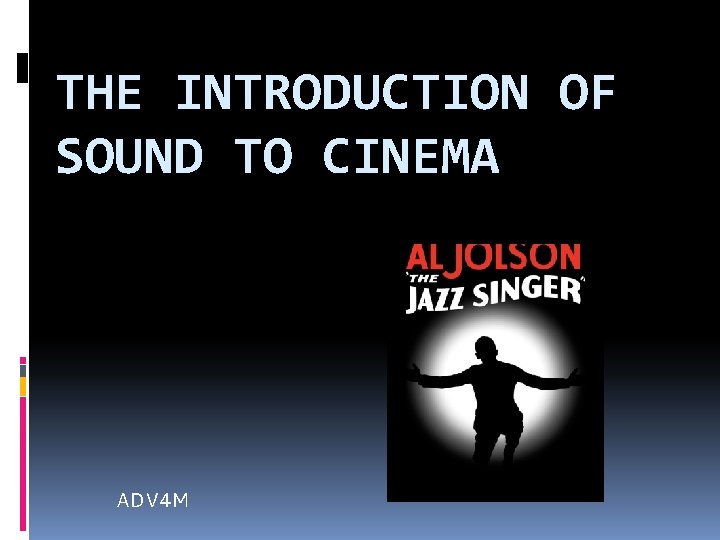
The Jazz Singer (1927) ▪ Premiered on October 6, 1927. ▪ Considered to be the first sound film, but in reality, is only a “part-talkie” as most of the film’s sequences have only orchestral accompaniment. ▪ There are only four true “talkie” scenes in the film where vaudeville star Al Jolson sings and utters only a line of dialogue.
The Jazz Singer (1927)
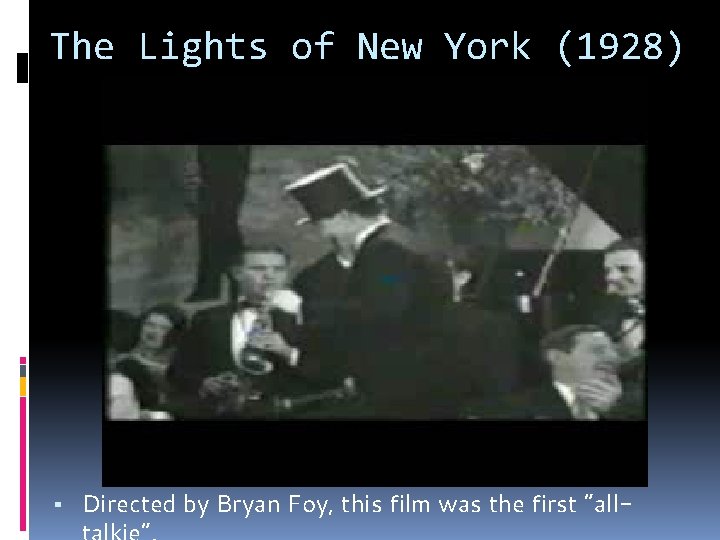
The Lights of New York (1928) ▪ Directed by Bryan Foy, this film was the first “all-
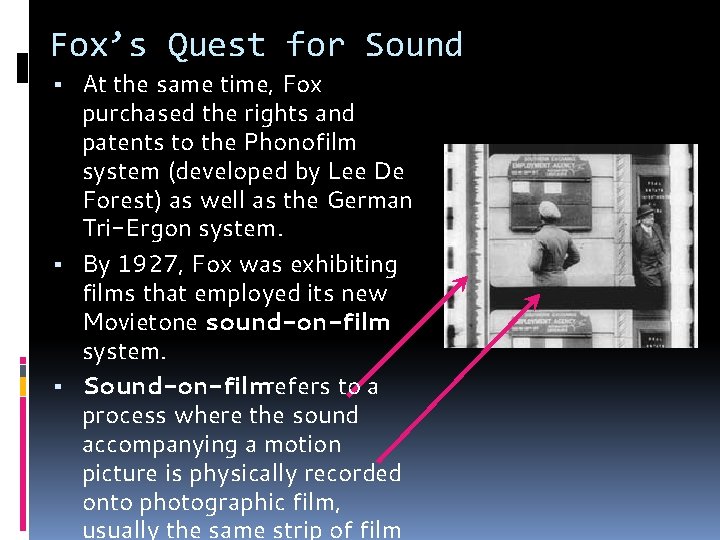
Fox’s Quest for Sound ▪ At the same time, Fox purchased the rights and patents to the Phonofilm system (developed by Lee De Forest) as well as the German Tri-Ergon system. ▪ By 1927, Fox was exhibiting films that employed its new Movietone sound-on-film system. ▪ Sound-on-filmrefers to a process where the sound accompanying a motion picture is physically recorded onto photographic film, usually the same strip of film
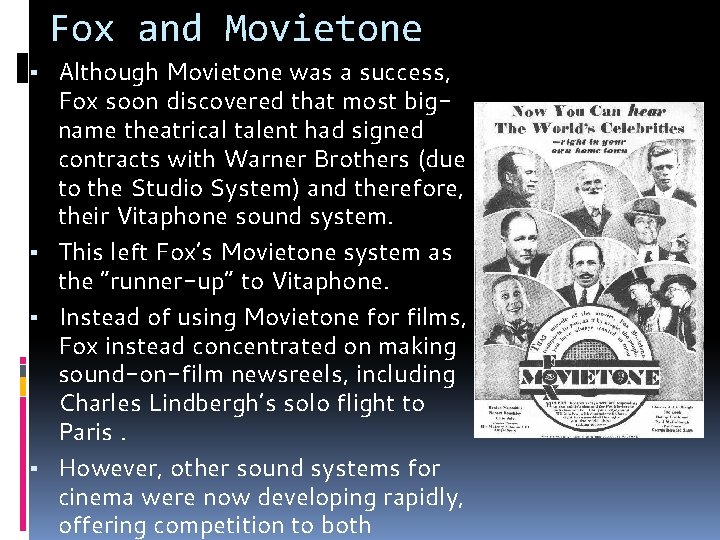
Fox and Movietone ▪ Although Movietone was a success, Fox soon discovered that most bigname theatrical talent had signed contracts with Warner Brothers (due to the Studio System) and therefore, their Vitaphone sound system. ▪ This left Fox’s Movietone system as the “runner-up” to Vitaphone. ▪ Instead of using Movietone for films, Fox instead concentrated on making sound-on-film newsreels, including Charles Lindbergh’s solo flight to Paris. ▪ However, other sound systems for cinema were now developing rapidly, offering competition to both
RCA and Photophone ▪ RCA developed another sound-on-film system technology called Photophone, which was extremely similar to Movietone. ▪ When the system premiered, it was suggested that Photophone would rival the most successful system to date, Warner’s Vitaphone, and become the industry standard.
The Big Five Agreement (1927) ▪ The five largest studios in Hollywood – MGM, Universal, First National, Paramount and Producers Distributing Corporation – proceeded cautiously regarding the incorporation of sound systems. ▪ If studios acted individually, they might choose incompatible equipment. ▪ The studios decided that lack of a common standard would hurt business overall. ▪ As a result, they signed the Big Five Agreement, pledging to act together in adopting sound for film.
Sound-on-disc v. Sound-on-film ▪ The Big Five agreed to adopt a sound-on-film system. ▪ Sound on disc was rejected because: ▫ It required discs to be distributed as well as film reels, discs could only play 20 times and broke easily. ▫ Sound-on-disc had severe and notorious synchronization problems; if a record skipped, it would fall out of sync with the picture, and the projectionist would have to manually restore sync. ▫ A phonograph record could not be physically edited, and this significantly limited the creative potential of sound-on-disc films ▫ Fidelity (accuracy of sound reproduction) was now better for sound-on-film than sound-on-disc.
Summary ▪ Although the idea of pairing sound and film had been generated in the mid-1890 s, it took almost 30 years to implement. ▪ Film makers and producers were torn between two methods of bringing sound to film: a) sound-ondisc or b) sound-on-film. ▪ Both methods had their merits, but as technology progressed, sound-on-film was proven to be more reliable. ▪ The Big Five (studios) forged an agreement that they would not make individual but group decisions regarding the adoption of sound technology to film – this is proof of and helped contribute to the studios’ power. They settled on sound-on-film in