
The interwar years and World War II 1919
- Slides: 16
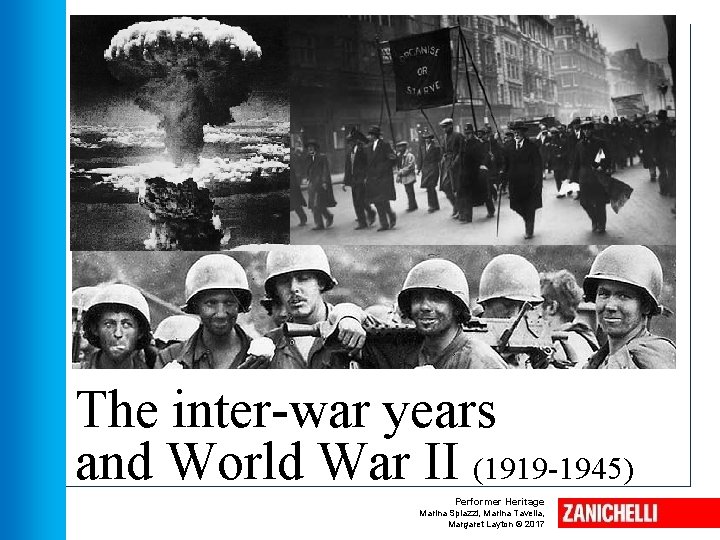
The inter-war years and World War II (1919 -1945) Performer Heritage Marina Spiazzi, Marina Tavella, Margaret Layton © 2017
The inter-war years and World War II 1. The inter-war years 1926 imperial conference creation of a new entity from the dominions of Canada, Australia, New Zealand South Africa the Commonwealth. 1931 the Statute of Westminster formalised the creation of the British Commonwealth of Nations. This marked the end of the British Empire. the recognition of equal status for all member states of the new organisation normally referred to today as The Commonwealth. The British Commonwealth of Nations is an intergovernmental organisation including fifty-four countries led by the United Kingdom. Performer Heritage
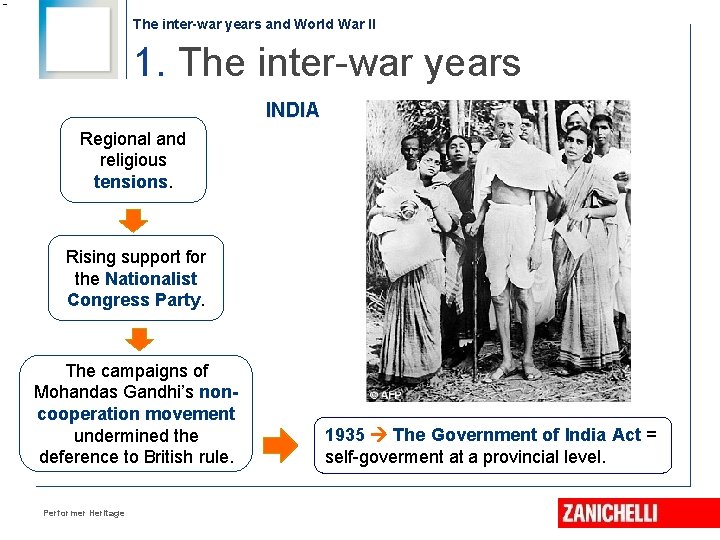
The inter-war years and World War II 1. The inter-war years INDIA Regional and religious tensions. Rising support for the Nationalist Congress Party. The campaigns of Mohandas Gandhi’s noncooperation movement undermined the deference to British rule. Performer Heritage 1935 The Government of India Act = self-goverment at a provincial level.
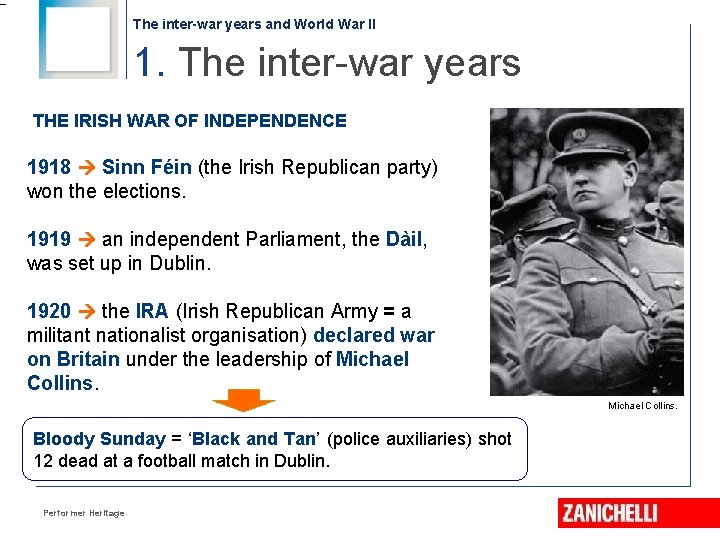
The inter-war years and World War II 1. The inter-war years THE IRISH WAR OF INDEPENDENCE 1918 Sinn Féin (the Irish Republican party) won the elections. 1919 an independent Parliament, the Dàil, was set up in Dublin. 1920 the IRA (Irish Republican Army = a militant nationalist organisation) declared war on Britain under the leadership of Michael Collins. Bloody Sunday = ‘Black and Tan’ (police auxiliaries) shot 12 dead at a football match in Dublin. Performer Heritage
The inter-war years and World War II 1. The inter-war years ECONOMIC BOOM AFTER WWI • House-building programme started. • Improvements in public health 40% of the population covered by medical insurance. • boom in the sales of the daily press. • 1927 creation of the BBC (British Broadcasting Corporation). Performer Heritage
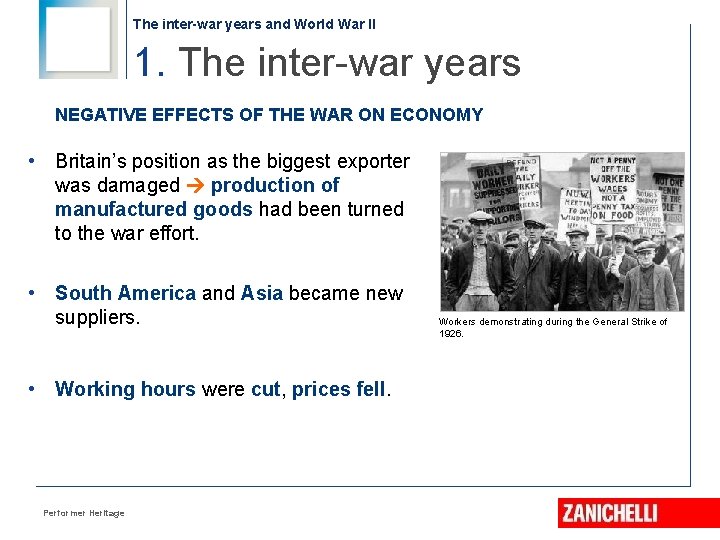
The inter-war years and World War II 1. The inter-war years NEGATIVE EFFECTS OF THE WAR ON ECONOMY • Britain’s position as the biggest exporter was damaged production of manufactured goods had been turned to the war effort. • South America and Asia became new suppliers. • Working hours were cut, prices fell. Performer Heritage Workers demonstrating during the General Strike of 1926.
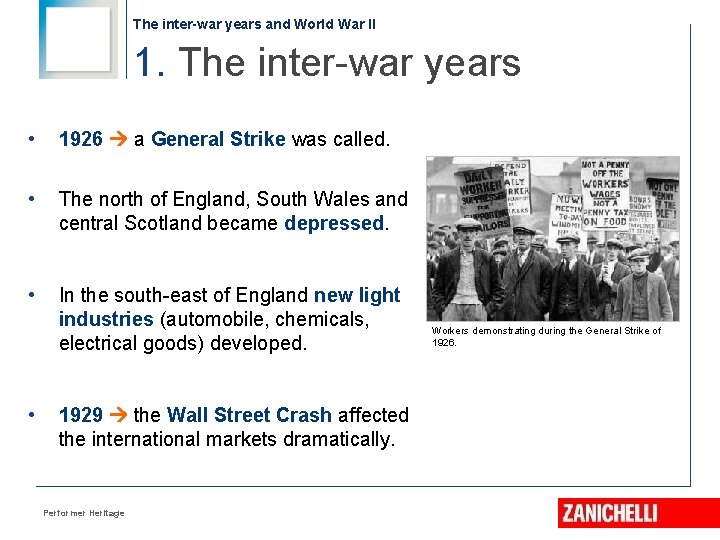
The inter-war years and World War II 1. The inter-war years • 1926 a General Strike was called. • The north of England, South Wales and central Scotland became depressed. • In the south-east of England new light industries (automobile, chemicals, electrical goods) developed. • 1929 the Wall Street Crash affected the international markets dramatically. Performer Heritage Workers demonstrating during the General Strike of 1926.
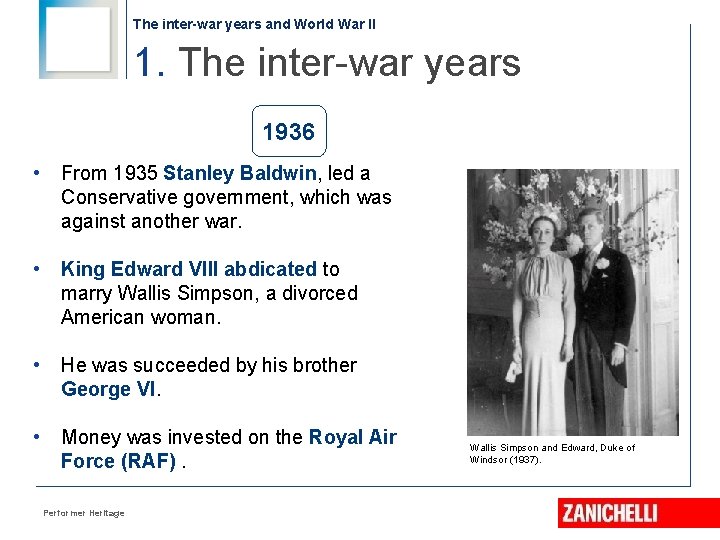
The inter-war years and World War II 1. The inter-war years 1936 • From 1935 Stanley Baldwin, led a Conservative government, which was against another war. • King Edward VIII abdicated to marry Wallis Simpson, a divorced American woman. • He was succeeded by his brother George VI. • Money was invested on the Royal Air Force (RAF). Performer Heritage Wallis Simpson and Edward, Duke of Windsor (1937).
The inter-war years and World War II 1. The inter-war years TOWARDS WORLD WAR II • 1933 Adolf Hitler and his Nazi Party came to power in Germany. • 1935 Italian dictator Benito Mussolini attacked Abyssinia and created an alliance with Germany. • 1936 Hitler sent troops into the Rhineland illegally. • 1936 the Spanish Civil War broke out. • 1937 Japan attacked China. • 1938 Hitler invaded Austria proclaiming its union with Germany. • 1938 Kristallnacht organised violence against the Jews in Germany. Performer Heritage
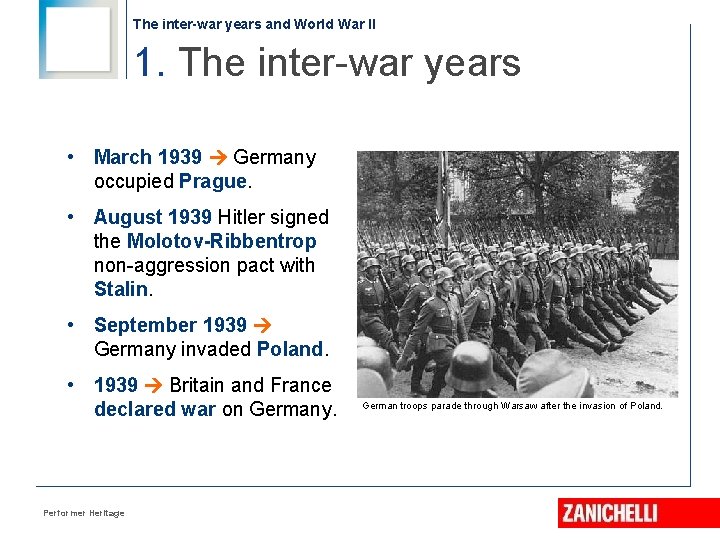
The inter-war years and World War II 1. The inter-war years • March 1939 Germany occupied Prague. • August 1939 Hitler signed the Molotov-Ribbentrop non-aggression pact with Stalin. • September 1939 Germany invaded Poland. • 1939 Britain and France declared war on Germany. Performer Heritage German troops parade through Warsaw after the invasion of Poland.
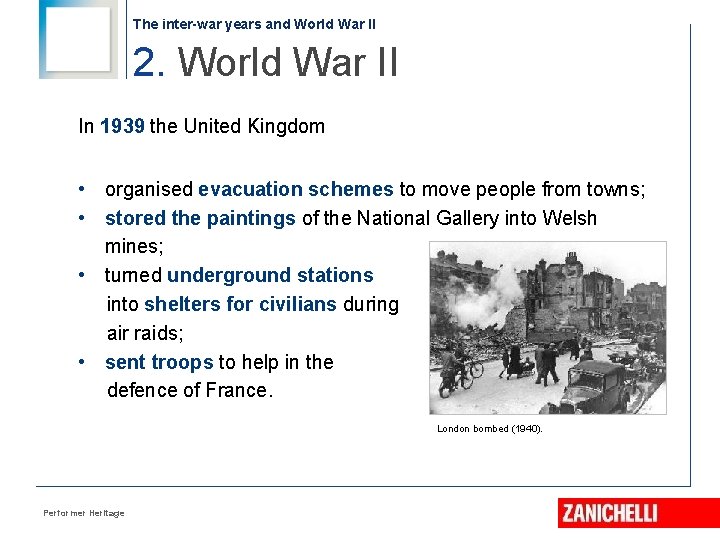
The inter-war years and World War II 2. World War II In 1939 the United Kingdom • organised evacuation schemes to move people from towns; • stored the paintings of the National Gallery into Welsh mines; • turned underground stations into shelters for civilians during air raids; • sent troops to help in the defence of France. London bombed (1940). Performer Heritage
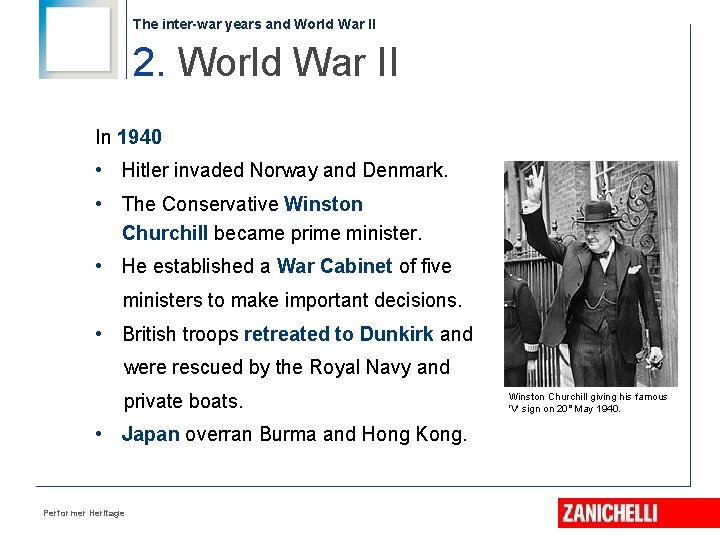
The inter-war years and World War II 2. World War II In 1940 • Hitler invaded Norway and Denmark. • The Conservative Winston Churchill became prime minister. • He established a War Cabinet of five ministers to make important decisions. • British troops retreated to Dunkirk and were rescued by the Royal Navy and private boats. • Japan overran Burma and Hong Kong. Performer Heritage Winston Churchill giving his famous 'V' sign on 20° May 1940.
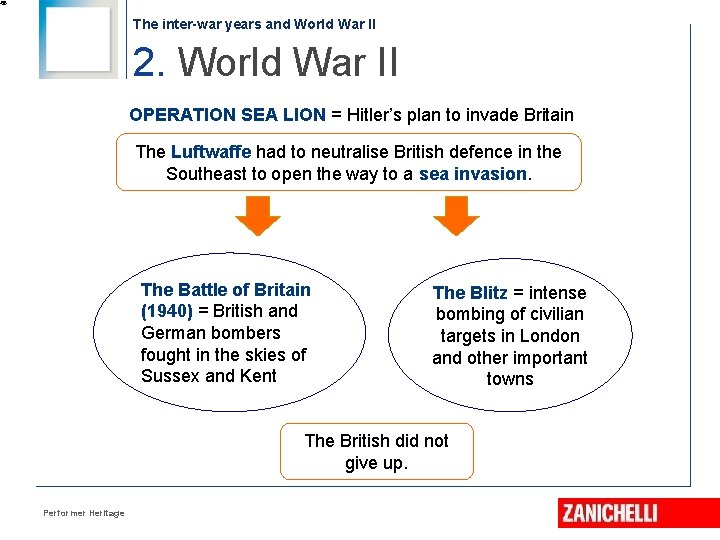
The inter-war years and World War II 2. World War II OPERATION SEA LION = Hitler’s plan to invade Britain The Luftwaffe had to neutralise British defence in the Southeast to open the way to a sea invasion. The Battle of Britain (1940) = British and German bombers fought in the skies of Sussex and Kent The Blitz = intense bombing of civilian targets in London and other important towns The British did not give up. Performer Heritage
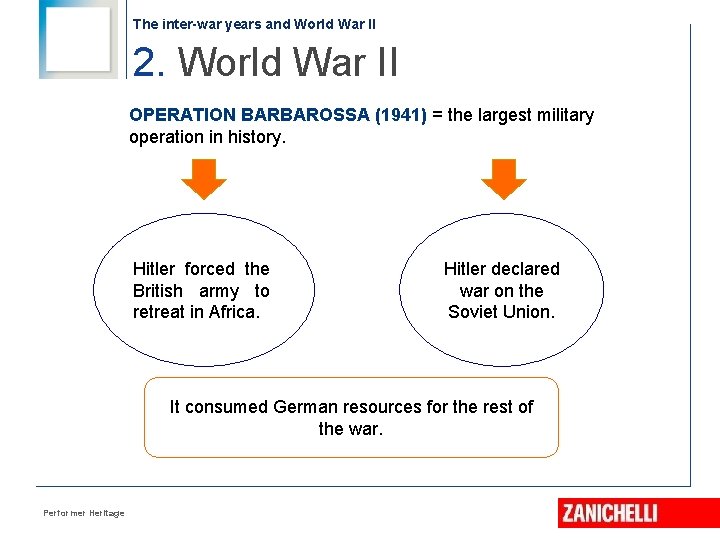
The inter-war years and World War II 2. World War II OPERATION BARBAROSSA (1941) = the largest military operation in history. Hitler forced the British army to retreat in Africa. Hitler declared war on the Soviet Union. It consumed German resources for the rest of the war. Performer Heritage
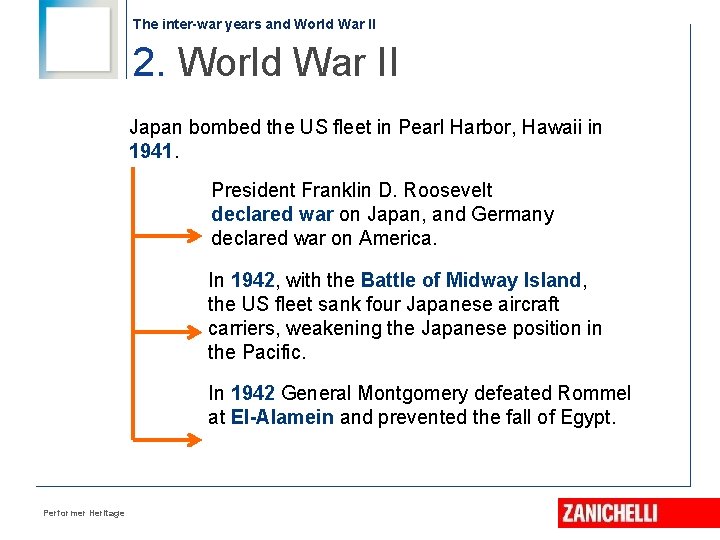
The inter-war years and World War II 2. World War II Japan bombed the US fleet in Pearl Harbor, Hawaii in 1941. President Franklin D. Roosevelt declared war on Japan, and Germany declared war on America. In 1942, with the Battle of Midway Island, the US fleet sank four Japanese aircraft carriers, weakening the Japanese position in the Pacific. In 1942 General Montgomery defeated Rommel at El-Alamein and prevented the fall of Egypt. Performer Heritage
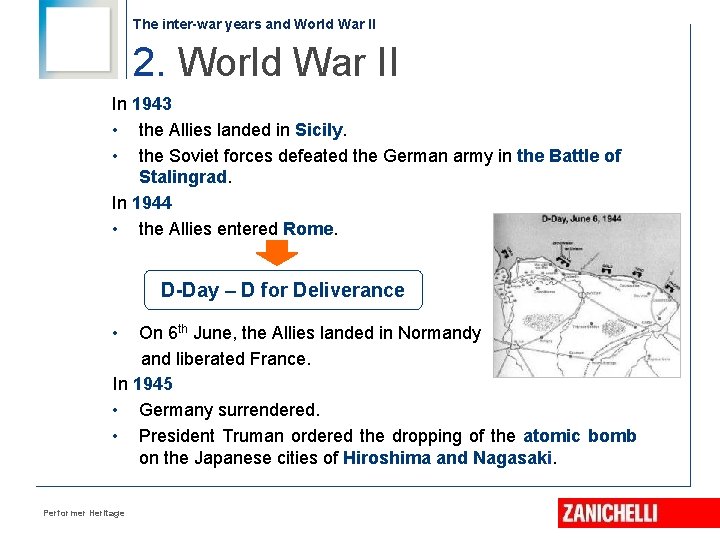
The inter-war years and World War II 2. World War II In 1943 • the Allies landed in Sicily. • the Soviet forces defeated the German army in the Battle of Stalingrad. In 1944 • the Allies entered Rome. D-Day – D for Deliverance • On 6 th June, the Allies landed in Normandy and liberated France. In 1945 • Germany surrendered. • President Truman ordered the dropping of the atomic bomb on the Japanese cities of Hiroshima and Nagasaki. Performer Heritage