
The Interview Ch 9 Notes Types of interviews
- Slides: 10
The Interview – Ch. 9 Notes • Types of interviews – Information gathering • Survey – gathering information from a number of people. Information is used to draw conclusions, make interpretations, and determine future actions. • Investigative – used to determine the cause of an event.
• Information-giving – Performance appraisal – an evaluation of how well you have achieved your goals and objectives over a set period of time. – Counseling interview – the interviewer helps the interviewer decide on a course of action
• Employment – a process employers use to judge whether a candidate is qualified & well suited for a job position within a company.
Preparing • Determine the type of interview • Research the other party – Information gathering research – Information giving research – most research falls on you finding it out before the interview – Employment research – research the company (pg. 288 for starter questions) – Interviewee questions – what are you going to ask your interviewer? – Practice
Types of questions asked • Open-ended – gives a great deal of freedom to answer • Closed – seeks a specific answer • Highly closed – specific answers maybe with specific choices to choose from • Primary – begins a new topic • Secondary – helps the interviewer understand the primary answer better
• Leading – suggests the desired answer • Neutral – implies no right or wrong answer • Direct – straightforward, leaves no room for confusion • Indirect – seeks specific information without directly asking for it • Factual – seeks information that can be proven • Opinion – asks for judgment about something • Hypothetical – a possible scenario
Post interview • Ask yourself questions about the interview • Re-cap • Send a thank-you letter
Interview do’s & don’ts • Pg. 298 – do’s & don’ts • Pg. 299 – reasons for rejecting job applicants
Check understanding • Pg. 281 – 2 -5 • Pg. 295 – 2 -5 • Pg. 302 – 2 -6
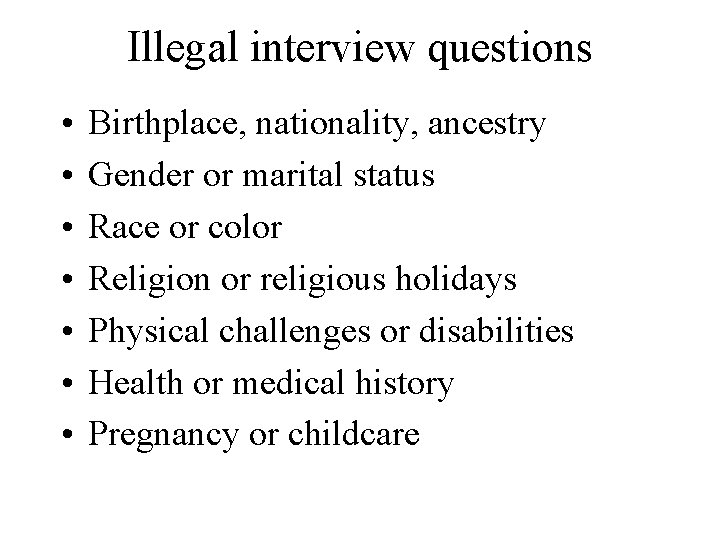
Illegal interview questions • • Birthplace, nationality, ancestry Gender or marital status Race or color Religion or religious holidays Physical challenges or disabilities Health or medical history Pregnancy or childcare