
The Interstellar Medium and Interstellar Molecules Ronald Maddalena
- Slides: 34
The Interstellar Medium and Interstellar Molecules Ronald Maddalena National Radio Astronomy Observatory
Interstellar Medium The Material Between the Stars n Constituents: n Gases: n n Dust Particles n n Hydrogen (92% by number) Helium (8%) Oxygen, Carbon, etc. (0. 1%) 1% of the mass of the ISM Average Density: 1 H atom / cm 3 12/7/2020 2
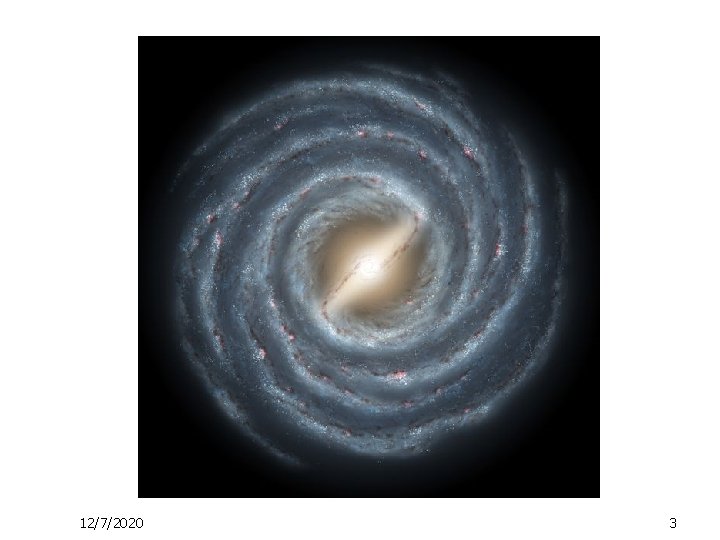
12/7/2020 3
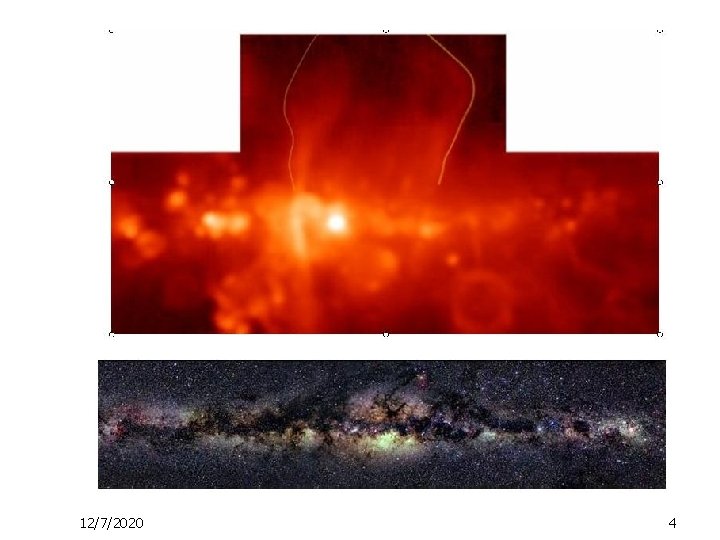
12/7/2020 4
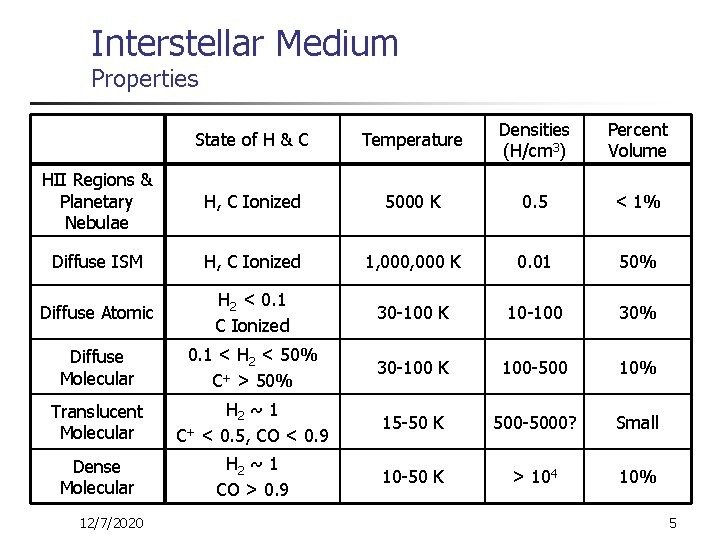
Interstellar Medium Properties State of H & C Temperature Densities (H/cm 3) Percent Volume HII Regions & Planetary Nebulae H, C Ionized 5000 K 0. 5 < 1% Diffuse ISM H, C Ionized 1, 000 K 0. 01 50% Diffuse Atomic H 2 < 0. 1 C Ionized 30 -100 K 10 -100 30% Diffuse Molecular 0. 1 < H 2 < 50% C+ > 50% 30 -100 K 100 -500 10% Translucent Molecular H 2 ~ 1 C+ < 0. 5, CO < 0. 9 15 -50 K 500 -5000? Small Dense Molecular H 2 ~ 1 CO > 0. 9 10 -50 K > 104 10% 12/7/2020 5
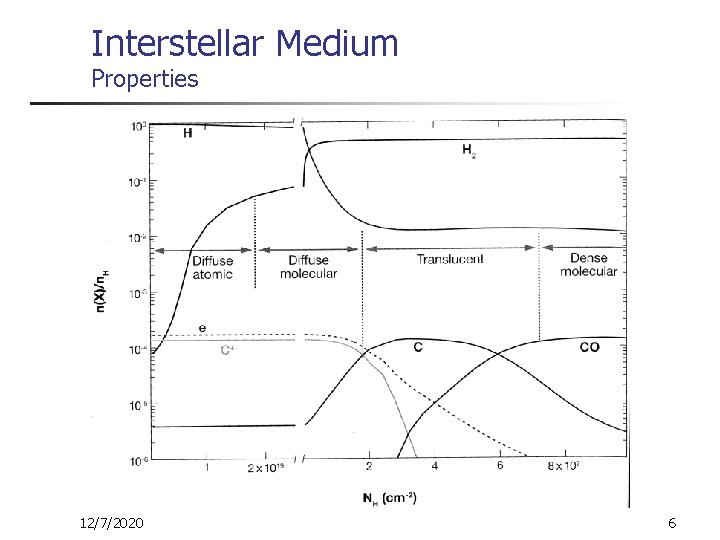
Interstellar Medium Properties 12/7/2020 6
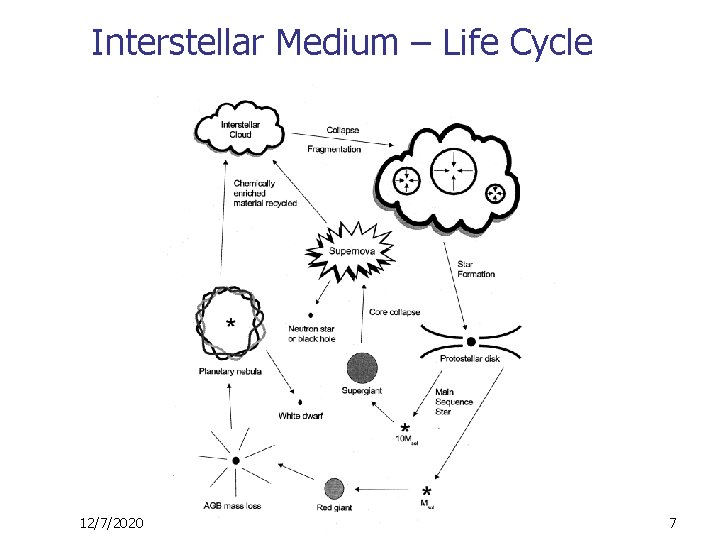
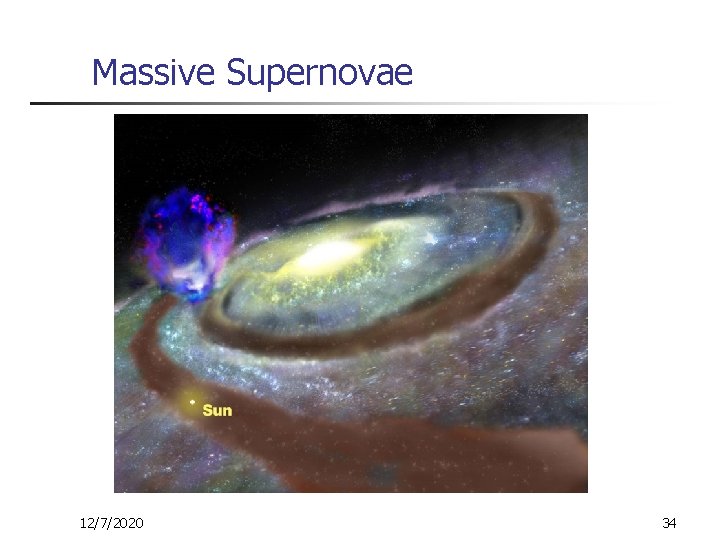
Interstellar Medium – Life Cycle 12/7/2020 7
12/7/2020 8
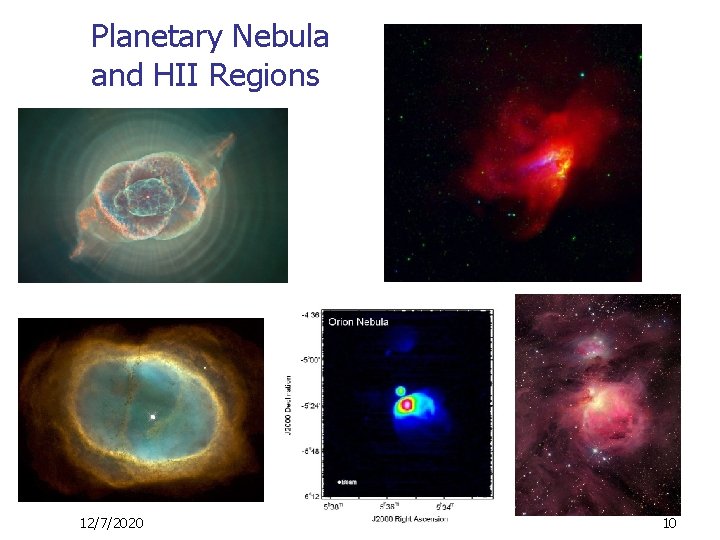
Planetary Nebula and HII Regions 12/7/2020 10
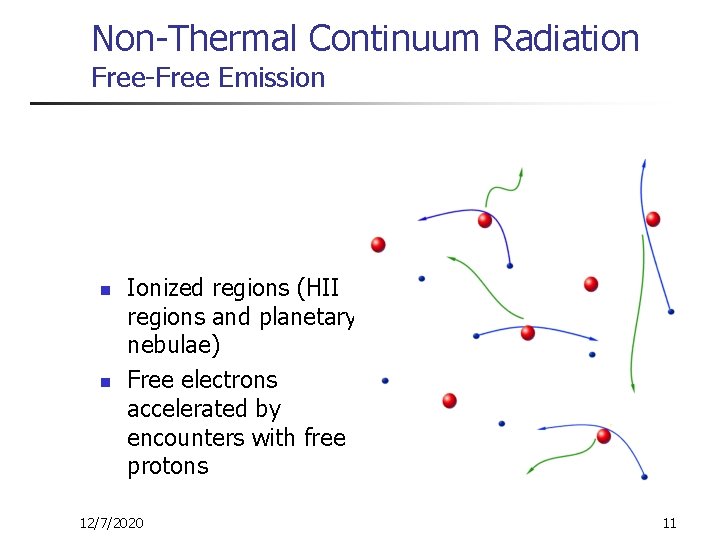
Non-Thermal Continuum Radiation Free-Free Emission n n Ionized regions (HII regions and planetary nebulae) Free electrons accelerated by encounters with free protons 12/7/2020 11
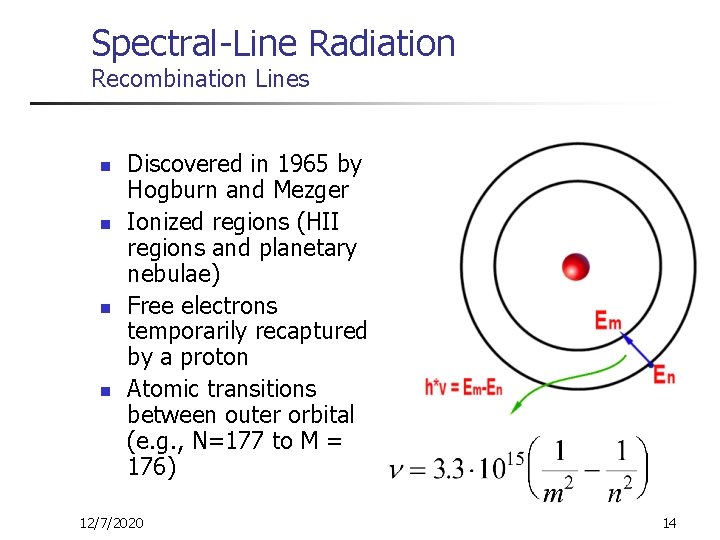
Spectral-Line Radiation Recombination Lines n n Discovered in 1965 by Hogburn and Mezger Ionized regions (HII regions and planetary nebulae) Free electrons temporarily recaptured by a proton Atomic transitions between outer orbital (e. g. , N=177 to M = 176) 12/7/2020 14
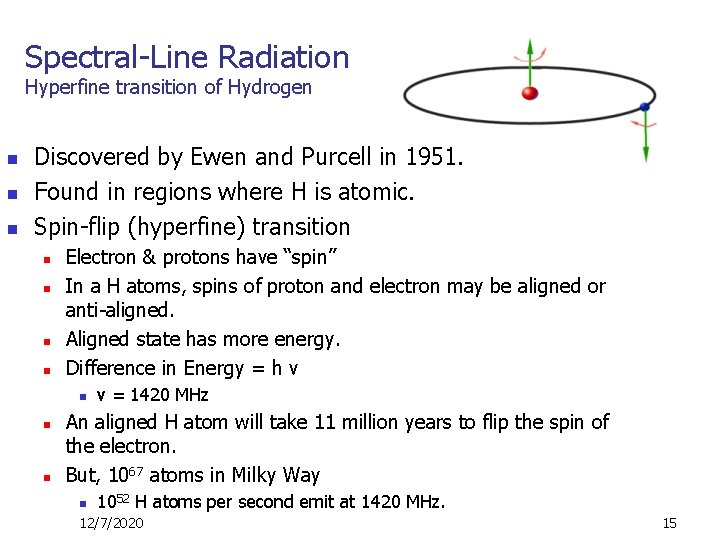
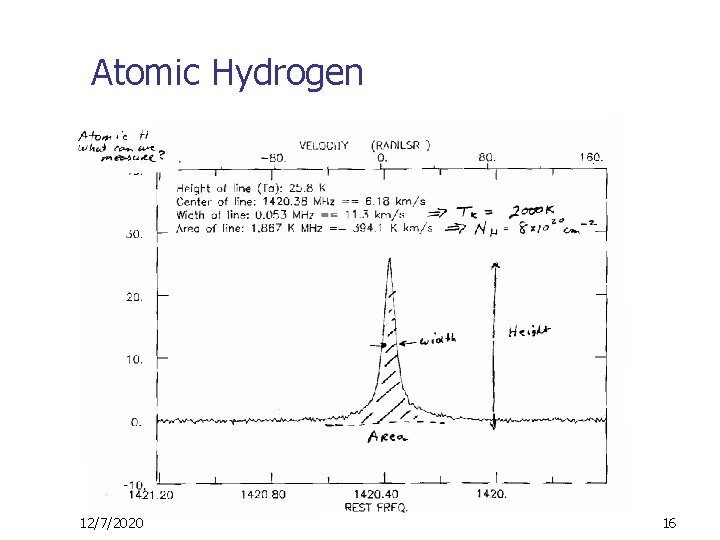
Spectral-Line Radiation Hyperfine transition of Hydrogen n Discovered by Ewen and Purcell in 1951. Found in regions where H is atomic. Spin-flip (hyperfine) transition n n Electron & protons have “spin” In a H atoms, spins of proton and electron may be aligned or anti-aligned. Aligned state has more energy. Difference in Energy = h v n n n v = 1420 MHz An aligned H atom will take 11 million years to flip the spin of the electron. But, 1067 atoms in Milky Way n 1052 H atoms per second emit at 1420 MHz. 12/7/2020 15
Atomic Hydrogen 12/7/2020 16
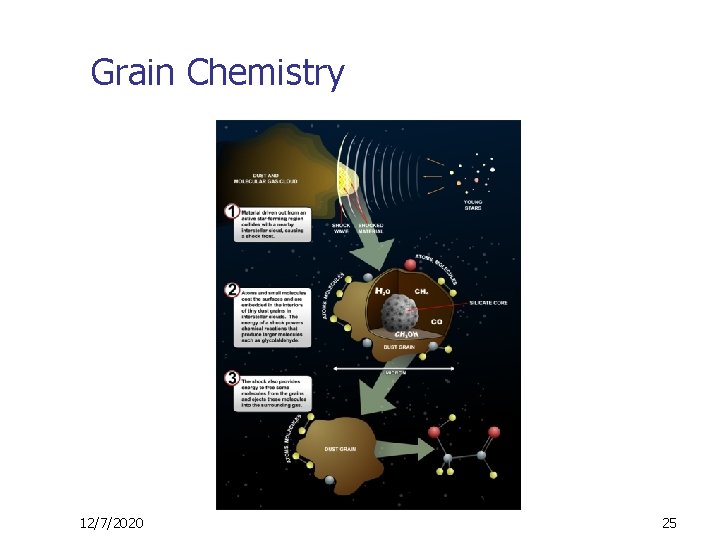
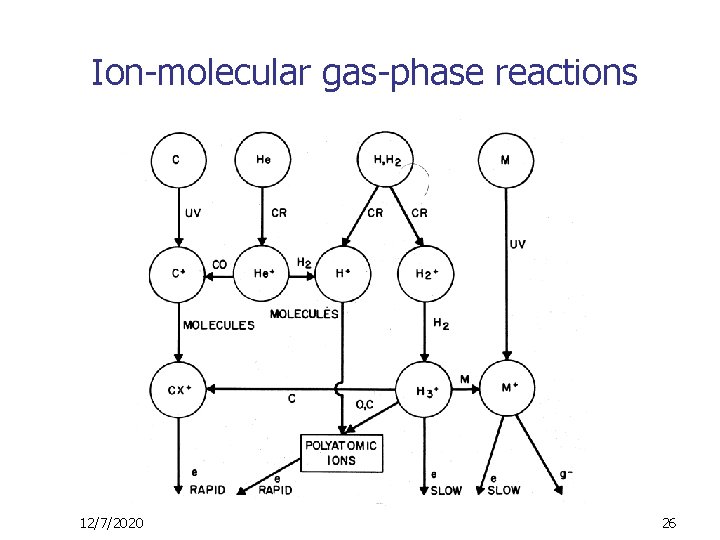
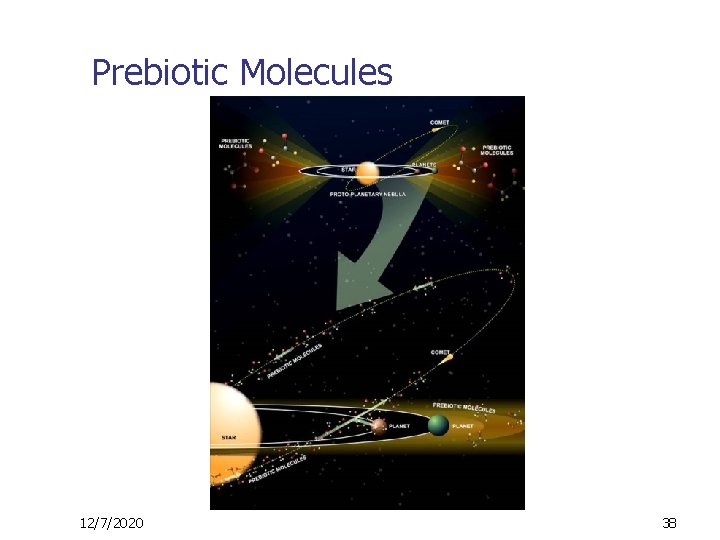
Interstellar Molecules n n Hydroxyl (OH) first molecule found with radio telescopes (1964). Molecule Formation: n Need high densities n n n Lots of dust needed to protect molecules for stellar UV But, optically obscured – need radio telescopes Low temperatures (< 100 K) Some molecules (e. g. , H 2) form on dust grains Most form via ion-molecular gas-phase reactions n n 12/7/2020 Exothermic Charge transfer 18
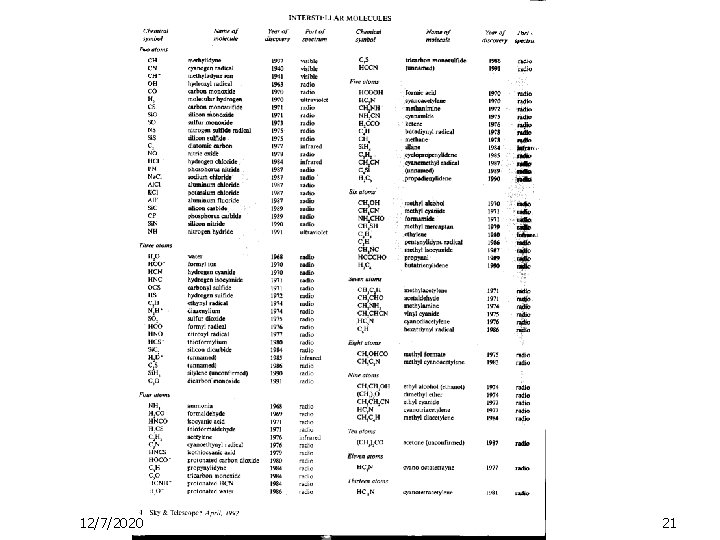
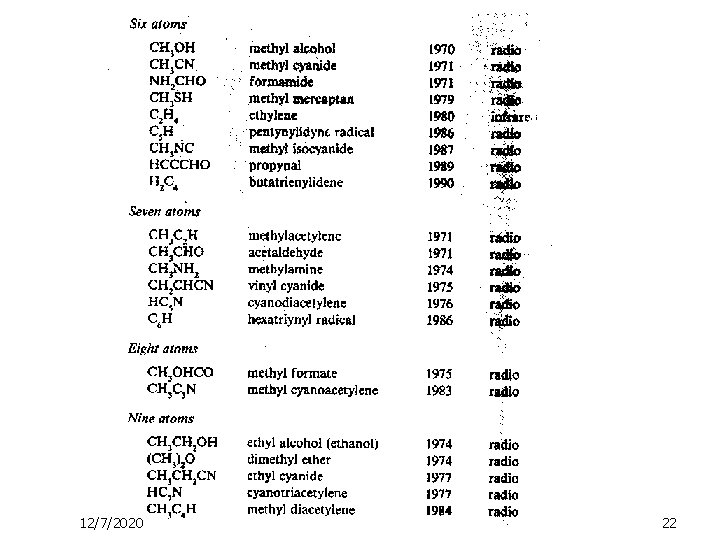
Interstellar Molecules n n n About 90% of the over 130 interstellar molecules discovered with radio telescopes. Rotational (electric dipole) Transitions Up to thirteen atoms Many carbon-based (organic) Many cannot exist in normal laboratories (e. g. , OH) H 2 most common molecule: n n n No dipole moment so no radio transition. Only observable in UV (rotational) Astronomers use CO as a tracer for H 2 12/7/2020 19
Molecular Clouds n n n n Discovered 1970 by Penzias, Jefferts, & Wilson and others. Coldest (5 -30 K), densest (100 – 106 H atoms/cm 3) parts of the ISM. Where stars are formed 25 -50% of the ISM mass A few percent of the Galaxy’s volume. Concentrated in spiral arms Dust Clouds = Molecular Clouds 12/7/2020 20
12/7/2020 21
12/7/2020 22
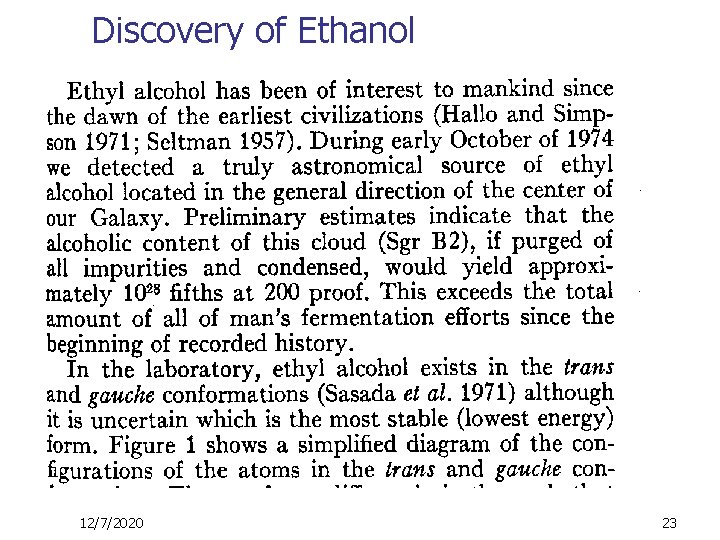
Discovery of Ethanol 12/7/2020 23
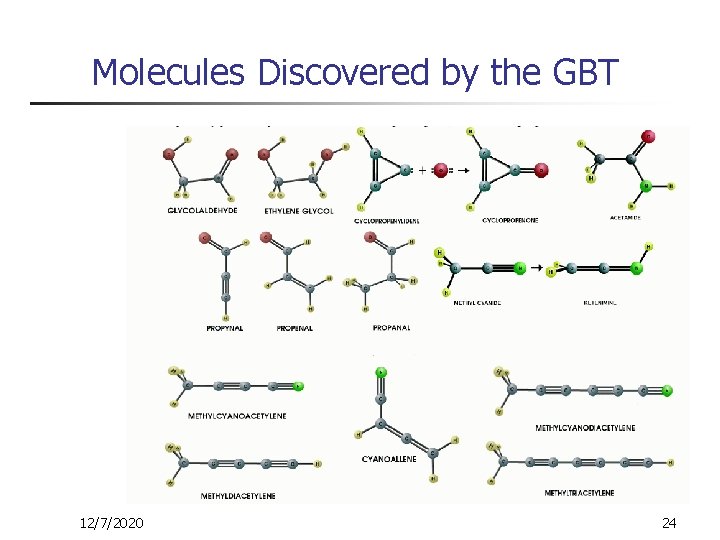
Molecules Discovered by the GBT 12/7/2020 24
Grain Chemistry 12/7/2020 25
Ion-molecular gas-phase reactions 12/7/2020 26
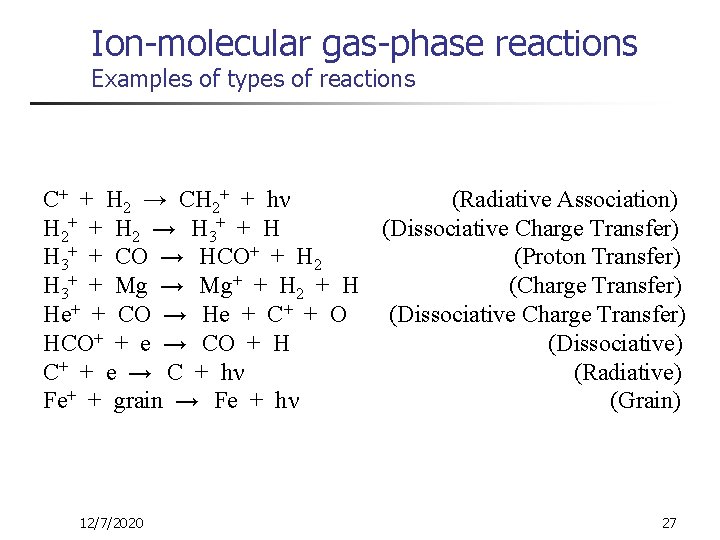
Ion-molecular gas-phase reactions Examples of types of reactions C+ + H 2 → CH 2+ + hν (Radiative Association) H 2+ + H 2 → H 3+ + H (Dissociative Charge Transfer) H 3+ + CO → HCO+ + H 2 (Proton Transfer) H 3+ + Mg → Mg+ + H 2 + H (Charge Transfer) He+ + CO → He + C+ + O (Dissociative Charge Transfer) HCO+ + e → CO + H (Dissociative) C+ + e → C + hν (Radiative) Fe+ + grain → Fe + hν (Grain) 12/7/2020 27
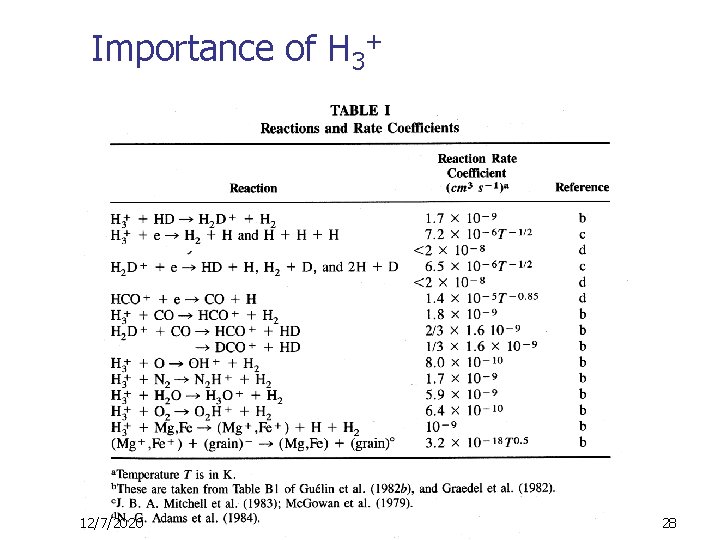
Importance of H 3+ 12/7/2020 28
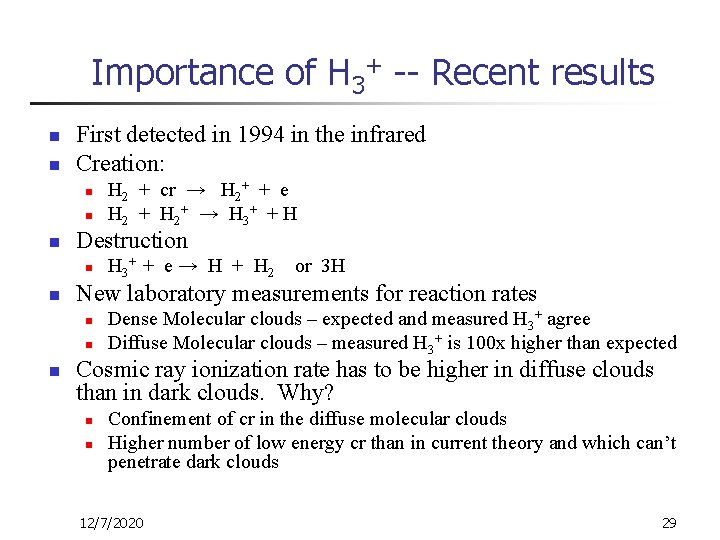
Importance of H 3+ -- Recent results n n First detected in 1994 in the infrared Creation: n n n Destruction n n H 3 + + e → H + H 2 or 3 H New laboratory measurements for reaction rates n n n H 2 + cr → H 2+ + e H 2 + → H 3 + + H Dense Molecular clouds – expected and measured H 3+ agree Diffuse Molecular clouds – measured H 3+ is 100 x higher than expected Cosmic ray ionization rate has to be higher in diffuse clouds than in dark clouds. Why? n n Confinement of cr in the diffuse molecular clouds Higher number of low energy cr than in current theory and which can’t penetrate dark clouds 12/7/2020 29
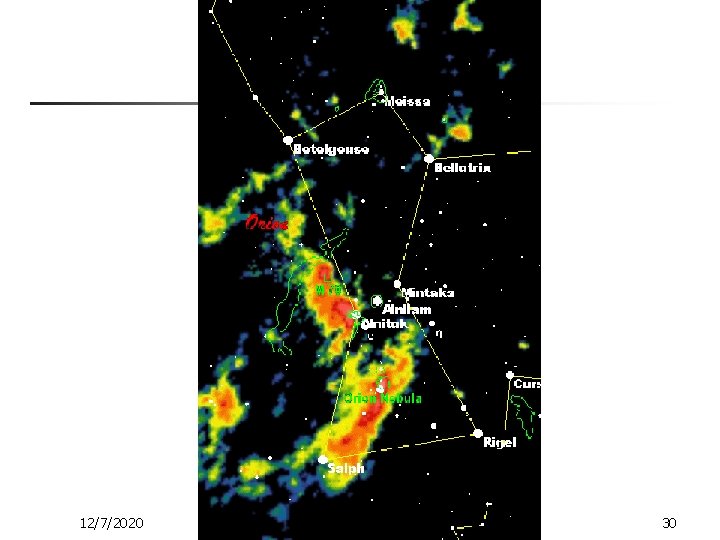
12/7/2020 30
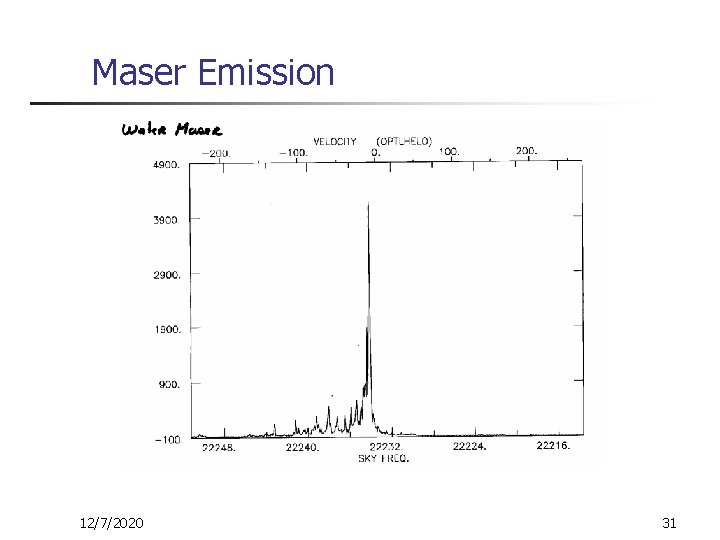
Maser Emission 12/7/2020 31
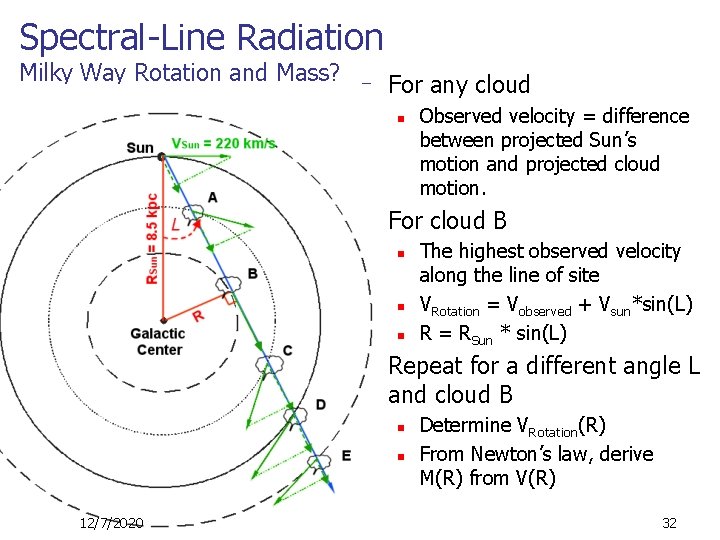
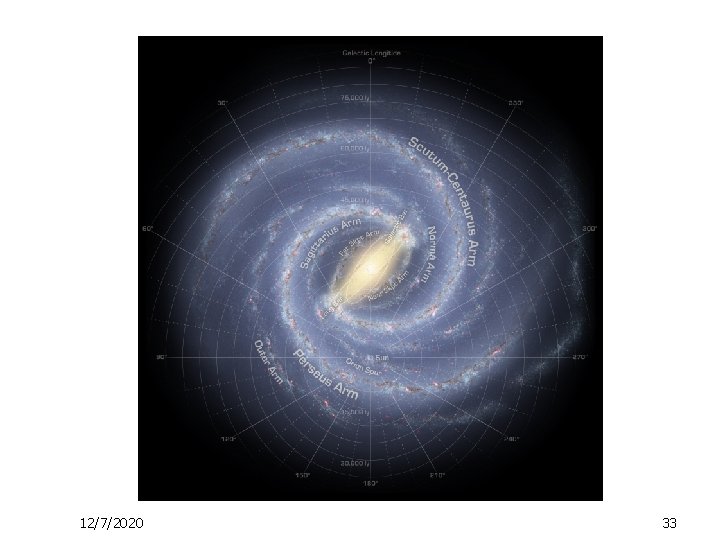
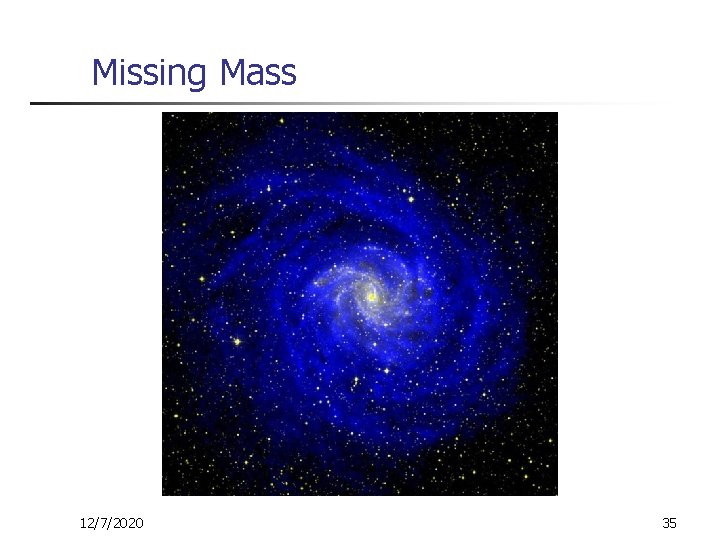
Spectral-Line Radiation Milky Way Rotation and Mass? n For any cloud n n For cloud B n n The highest observed velocity along the line of site VRotation = Vobserved + Vsun*sin(L) R = RSun * sin(L) Repeat for a different angle L and cloud B n n 12/7/2020 Observed velocity = difference between projected Sun’s motion and projected cloud motion. Determine VRotation(R) From Newton’s law, derive M(R) from V(R) 32
12/7/2020 33
Massive Supernovae 12/7/2020 34
Missing Mass 12/7/2020 35
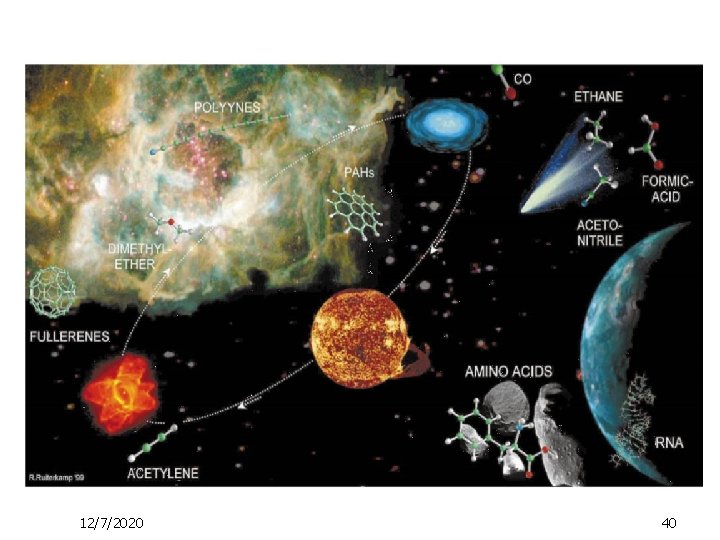
Prebiotic Molecules 12/7/2020 38
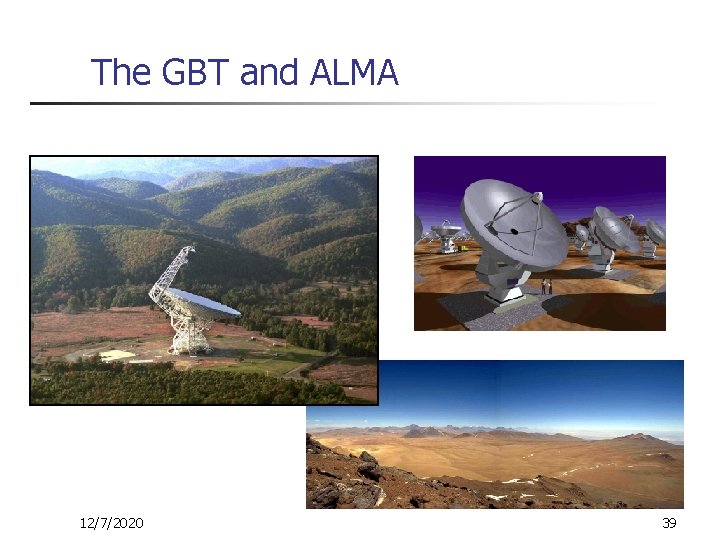
The GBT and ALMA 12/7/2020 39
12/7/2020 40