
The Intersection of SelfManagement with Emotion Regulation and
- Slides: 1
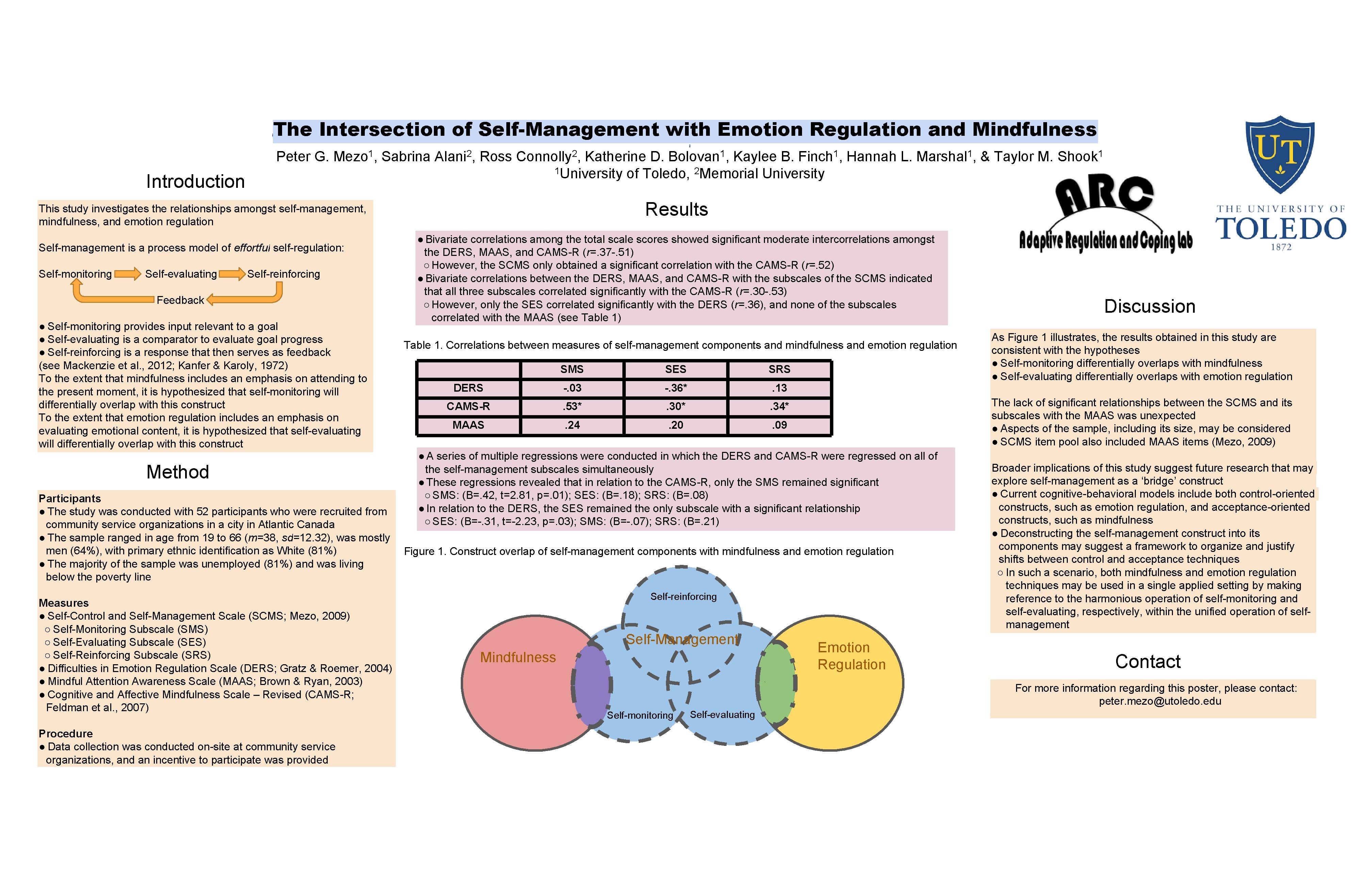
The Intersection of Self-Management with Emotion Regulation and Mindfulness j j Introduction Peter G. Mezo 1, Sabrina Alani 2, Ross Connolly 2, Katherine D. Bolovan 1, Kaylee B. Finch 1, Hannah L. Marshal 1, & Taylor M. Shook 1 1 University of Toledo, 2 Memorial University Results This study investigates the relationships amongst self-management, mindfulness, and emotion regulation Self-management is a process model of effortful self-regulation: Self-monitoring Self-evaluating Self-reinforcing Feedback ● Self-monitoring provides input relevant to a goal ● Self-evaluating is a comparator to evaluate goal progress ● Self-reinforcing is a response that then serves as feedback (see Mackenzie et al. , 2012; Kanfer & Karoly, 1972) To the extent that mindfulness includes an emphasis on attending to the present moment, it is hypothesized that self-monitoring will differentially overlap with this construct To the extent that emotion regulation includes an emphasis on evaluating emotional content, it is hypothesized that self-evaluating will differentially overlap with this construct Method Participants ● The study was conducted with 52 participants who were recruited from community service organizations in a city in Atlantic Canada ● The sample ranged in age from 19 to 66 (m=38, sd=12. 32), was mostly men (64%), with primary ethnic identification as White (81%) ● The majority of the sample was unemployed (81%) and was living below the poverty line Measures ● Self-Control and Self-Management Scale (SCMS; Mezo, 2009) ○ Self-Monitoring Subscale (SMS) ○ Self-Evaluating Subscale (SES) ○ Self-Reinforcing Subscale (SRS) ● Difficulties in Emotion Regulation Scale (DERS; Gratz & Roemer, 2004) ● Mindful Attention Awareness Scale (MAAS; Brown & Ryan, 2003) ● Cognitive and Affective Mindfulness Scale – Revised (CAMS-R; Feldman et al. , 2007) Procedure ● Data collection was conducted on-site at community service organizations, and an incentive to participate was provided ● Bivariate correlations among the total scale scores showed significant moderate intercorrelations amongst the DERS, MAAS, and CAMS-R (r=. 37 -. 51) ○ However, the SCMS only obtained a significant correlation with the CAMS-R (r=. 52) ● Bivariate correlations between the DERS, MAAS, and CAMS-R with the subscales of the SCMS indicated that all three subscales correlated significantly with the CAMS-R (r=. 30 -. 53) ○ However, only the SES correlated significantly with the DERS (r=. 36), and none of the subscales correlated with the MAAS (see Table 1) Table 1. Correlations between measures of self-management components and mindfulness and emotion regulation SMS SES SRS DERS -. 03 -. 36* . 13 CAMS-R . 53* . 30* . 34* MAAS . 24 . 20 . 09 Figure 1. Construct overlap of self-management components with mindfulness and emotion regulation Self-reinforcing Emotion Regulation Mindfulness ` Self-monitoring Self-evaluating As Figure 1 illustrates, the results obtained in this study are consistent with the hypotheses ● Self-monitoring differentially overlaps with mindfulness ● Self-evaluating differentially overlaps with emotion regulation The lack of significant relationships between the SCMS and its subscales with the MAAS was unexpected ● Aspects of the sample, including its size, may be considered ● SCMS item pool also included MAAS items (Mezo, 2009) ● A series of multiple regressions were conducted in which the DERS and CAMS-R were regressed on all of the self-management subscales simultaneously ● These regressions revealed that in relation to the CAMS-R, only the SMS remained significant ○ SMS: (B=. 42, t=2. 81, p=. 01); SES: (B=. 18); SRS: (B=. 08) ● In relation to the DERS, the SES remained the only subscale with a significant relationship ○ SES: (B=-. 31, t=-2. 23, p=. 03); SMS: (B=-. 07); SRS: (B=. 21) Self-Management Discussion Broader implications of this study suggest future research that may explore self-management as a ‘bridge’ construct ● Current cognitive-behavioral models include both control-oriented constructs, such as emotion regulation, and acceptance-oriented constructs, such as mindfulness ● Deconstructing the self-management construct into its components may suggest a framework to organize and justify shifts between control and acceptance techniques ○ In such a scenario, both mindfulness and emotion regulation techniques may be used in a single applied setting by making reference to the harmonious operation of self-monitoring and self-evaluating, respectively, within the unified operation of selfmanagement Contact For more information regarding this poster, please contact: peter. mezo@utoledo. edu