
THE INTERPRETATION OF VAGUE PREDICATES EXPERIMENTAL INSIGHTS Nicole

- Slides: 36
THE INTERPRETATION OF VAGUE PREDICATES EXPERIMENTAL INSIGHTS Nicole Gotzner, Marijan Palmovic & Stephanie Solt LOGICCC Final Conference September 15 -18 2011
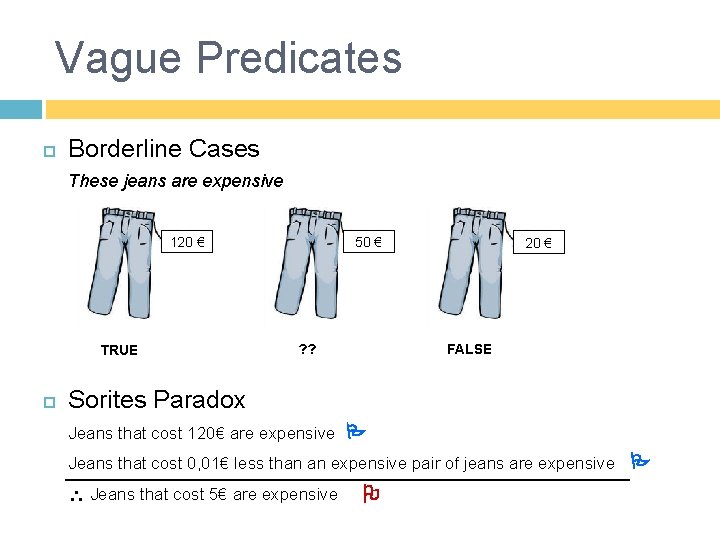
Vague Predicates Borderline Cases These jeans are expensive 120 € TRUE 50 € ? ? 20 € FALSE Sorites Paradox Jeans that cost 120€ are expensive Jeans that cost 0, 01€ less than an expensive pair of jeans are expensive Jeans that cost 5€ are expensive
Challenges to semantic analysis What is required of a formal model to capture intuitions of ‘borderline’ truth? E. g. multivalued logic? How should truth conditions of a sentence containing a vague predicate be stated? [[ These jeans are expensive ]] = 1 iff. .
Overall research questions How do ‘real’ speakers behave when presented with borderline cases of a vague predicate? On what basis do speakers judge applicability of a vague predicate? Ø Ultimate goal: input towards formal analyses of vagueness
Experiment series 1 Vague adjectives and Sorites series
Research Questions How do speakers behave when presented with a vague adjective (e. g. large) in the context of a set of stimuli representing a Sorites series? Do they allow a ‘gap’ between positive and negative extensions of a vague adjective? (cf. Bonini et al. 1999)
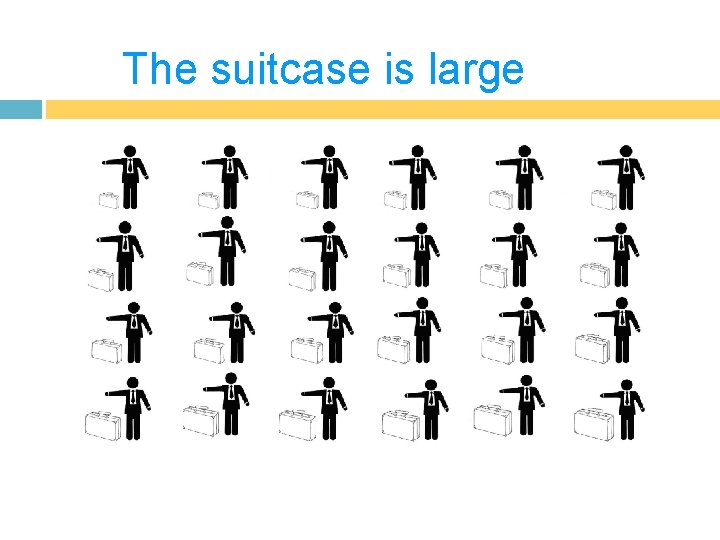
The suitcase is large
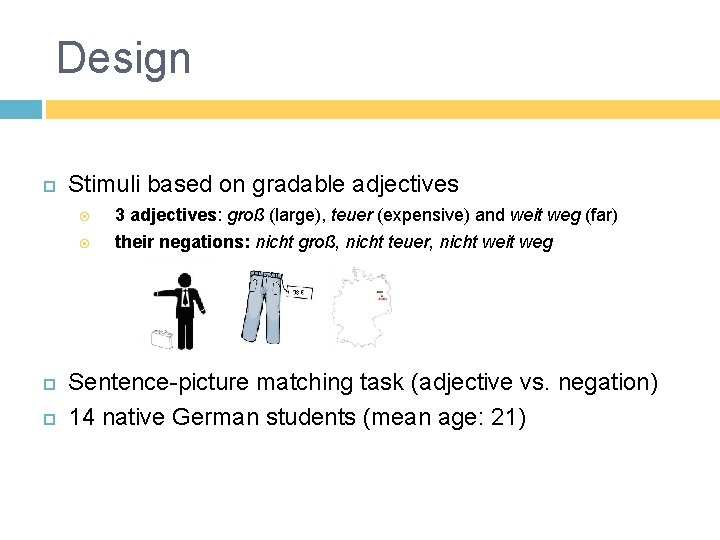
Design Stimuli based on gradable adjectives 3 adjectives: groß (large), teuer (expensive) and weit weg (far) their negations: nicht groß, nicht teuer, nicht weit weg Sentence-picture matching task (adjective vs. negation) 14 native German students (mean age: 21)
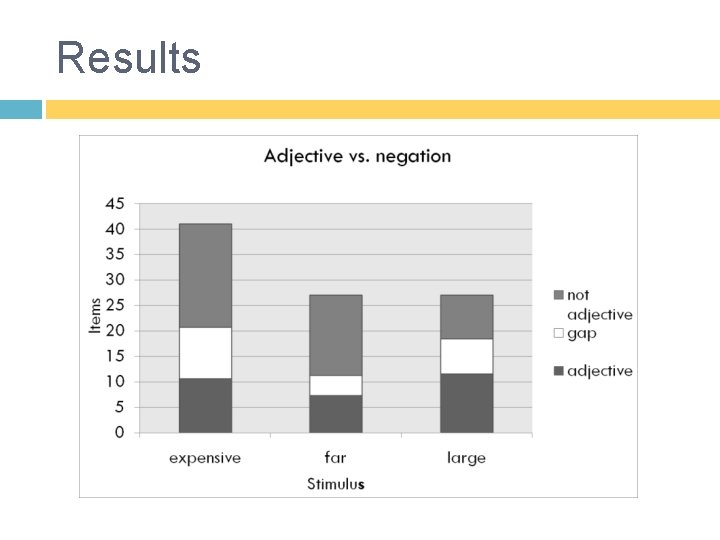
Results
Conclusions Respondents leave an extension gap: neither adjective nor its negation are applied to borderline individuals Pattern confirmed in online follow-up study Speakers acknowledge a gap when judging adjective and negation against the same picture set (pilot results) F Compatible with multiple theories of vagueness
Experiment series 2 Online processing of borderline cases
Research Questions What are the neural correlates of vagueness? How are borderline cases processed? Compared to clear cases of ‘true’? Compared to clear cases of ‘false’?
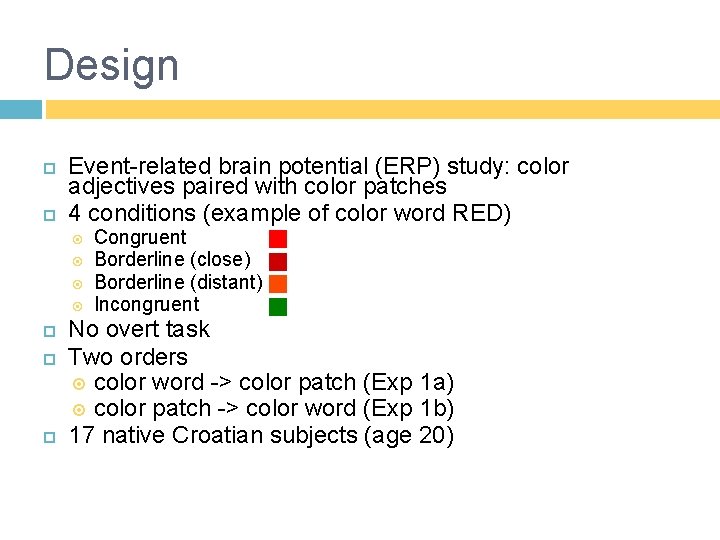
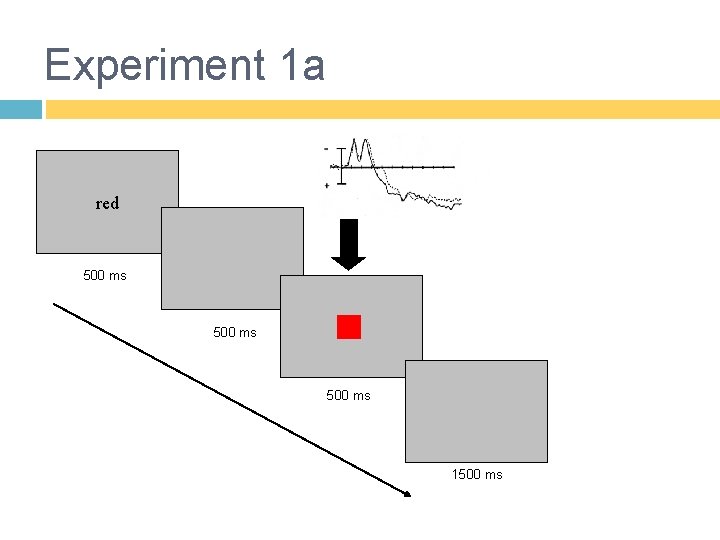
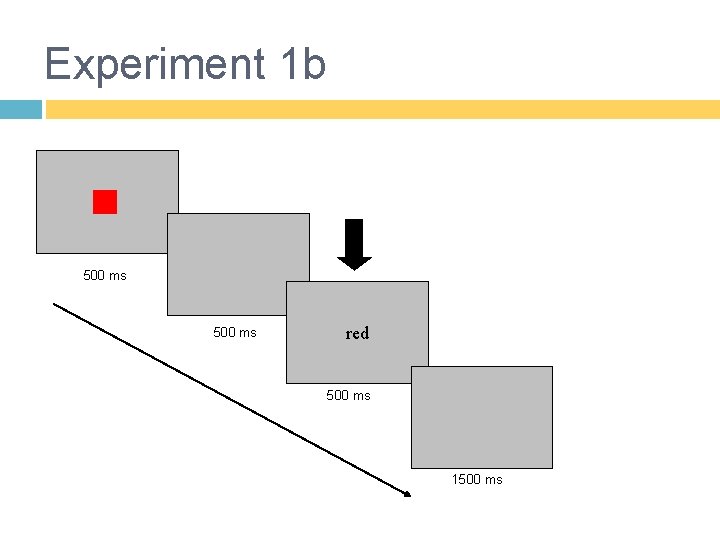
Design Event-related brain potential (ERP) study: color adjectives paired with color patches 4 conditions (example of color word RED) Congruent Borderline (close) Borderline (distant) Incongruent No overt task Two orders color word -> color patch (Exp 1 a) color patch -> color word (Exp 1 b) 17 native Croatian subjects (age 20)
Experiment 1 a red 500 ms 1500 ms
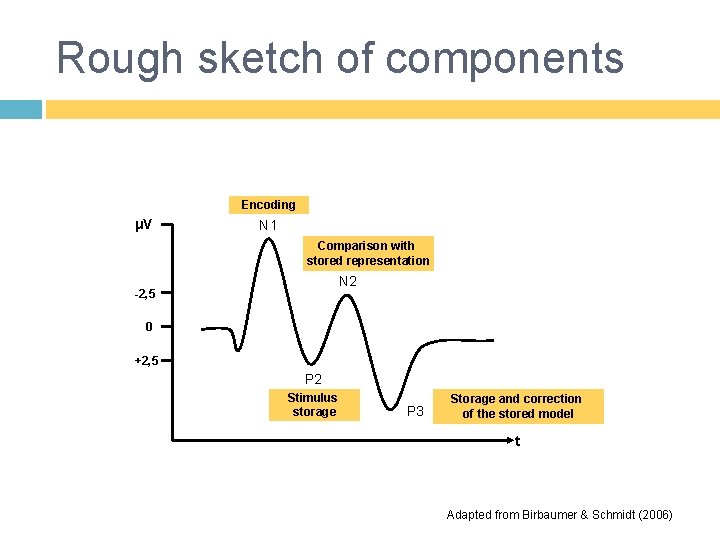
Rough sketch of components Encoding μV N 1 Comparison with stored representation N 2 -2, 5 0 +2, 5 P 2 Stimulus storage P 3 Storage and correction of the stored model t Adapted from Birbaumer & Schmidt (2006)
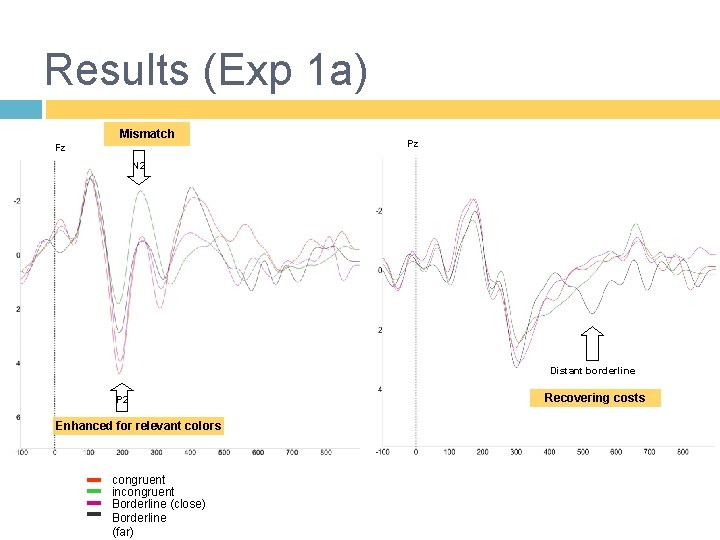
Results (Exp 1 a) Mismatch Fz Pz N 2 Distant borderline P 2 Enhanced for relevant colors congruent incongruent Borderline (close) Borderline (far) Recovering costs
Experiment 1 b 500 ms red 500 ms 1500 ms
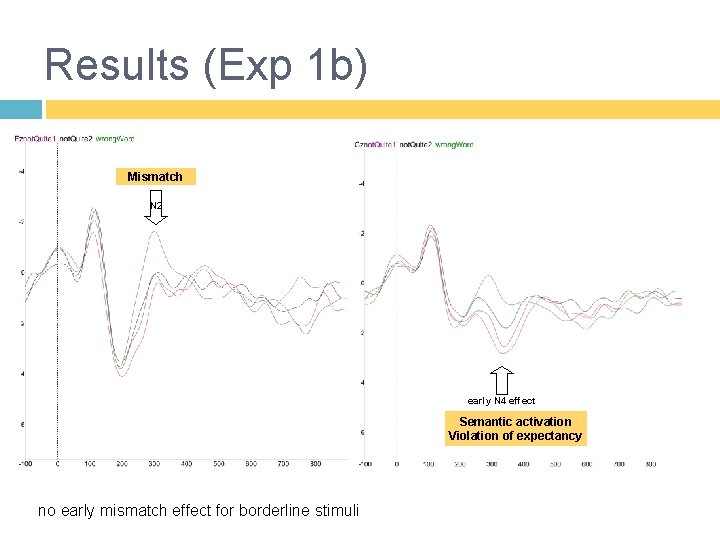
Results (Exp 1 b) Mismatch N 2 early N 4 effect Semantic activation Violation of expectancy no early mismatch effect for borderline stimuli
Conclusions Processing of borderline cases is distinct from both clear cases of true and false Borderline cases do not elicit an early mismatch effect Color word -> color patch Color patch -> color word Early prototypicality effect (differentiation of clear cases of true vs. false vs. borderline cases) Additional processing costs for (distant) borderline cases Effect on word recognition (again graded pattern) Potential next step: overt classification task
Experiment series 3 Role of comparison classes
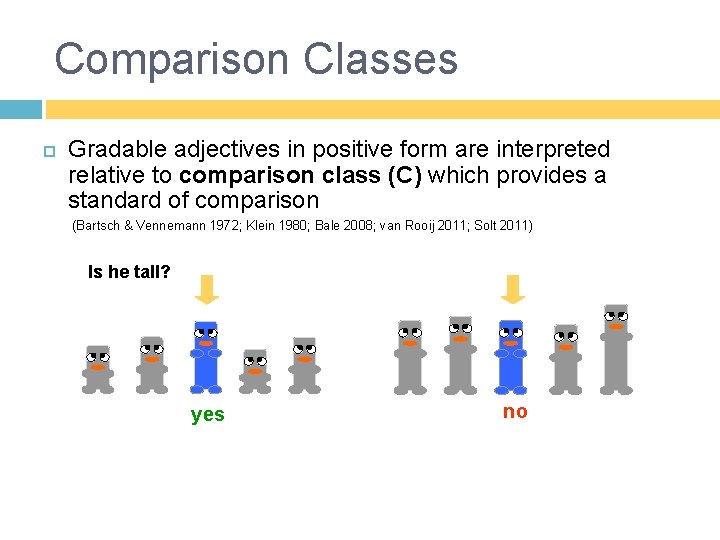
Comparison Classes Gradable adjectives in positive form are interpreted relative to comparison class (C) which provides a standard of comparison (Bartsch & Vennemann 1972; Klein 1980; Bale 2008; van Rooij 2011; Solt 2011) Is he tall? yes no
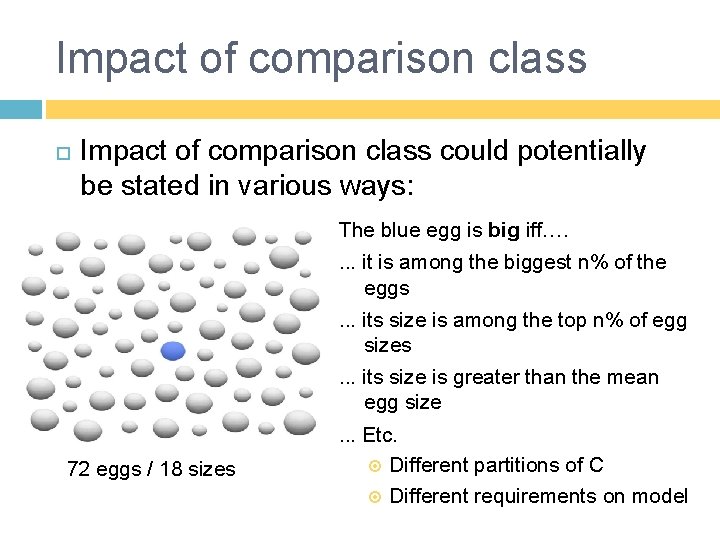
Impact of comparison class could potentially be stated in various ways: The blue egg is big iff…. . it is among the biggest n% of the eggs. . . its size is among the top n% of egg sizes. . . its size is greater than the mean egg size 72 eggs / 18 sizes . . . Etc. Different partitions of C Different requirements on model
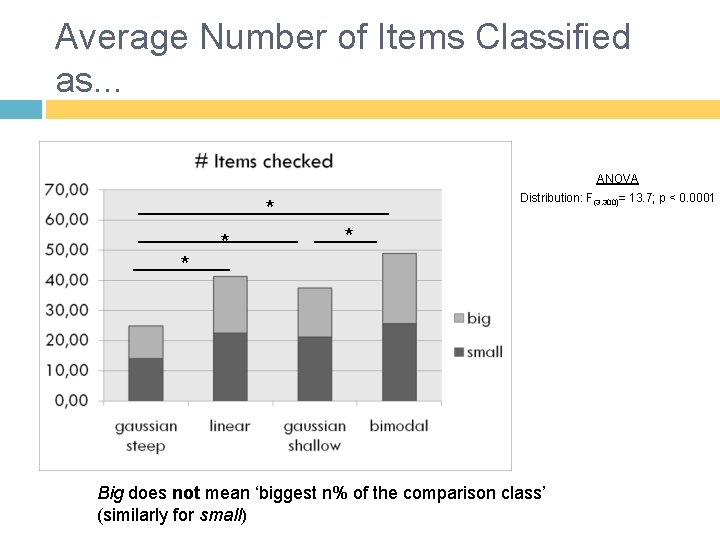
Research questions What information does the comparison class provide? How should the truth conditions for the adjective be expressed? Strategy: Adjective evaluated in context of comparison classes varying in distribution F Identify factors which impact extension of adjective
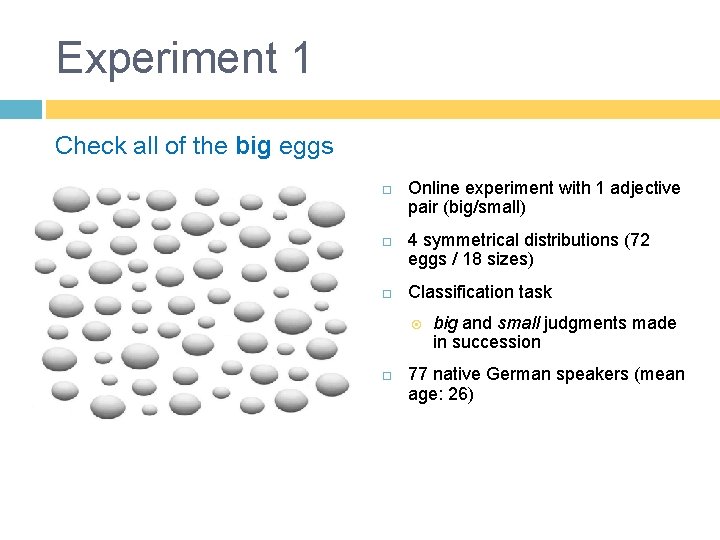
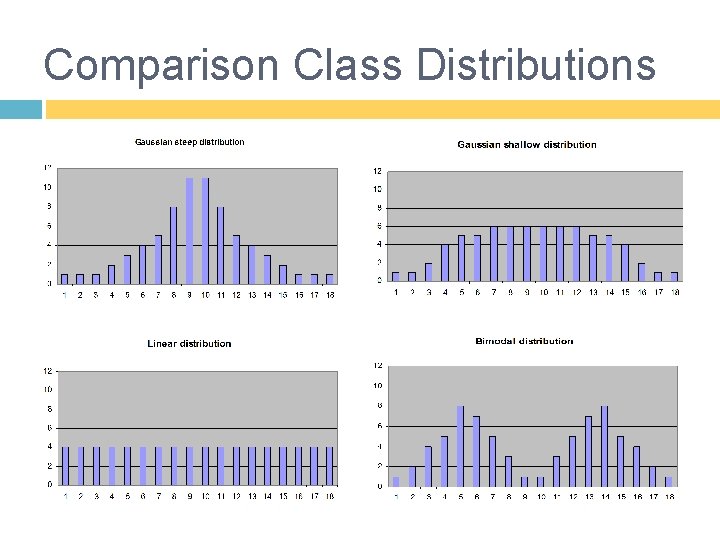
Experiment 1 Check all of the big eggs Online experiment with 1 adjective pair (big/small) 4 symmetrical distributions (72 eggs / 18 sizes) Classification task big and small judgments made in succession 77 native German speakers (mean age: 26)
Comparison Class Distributions
Average Number of Items Classified as. . . ANOVA Distribution: F(3, 300)= 13. 7; p < 0. 0001 * * Big does not mean ‘biggest n% of the comparison class’ (similarly for small)
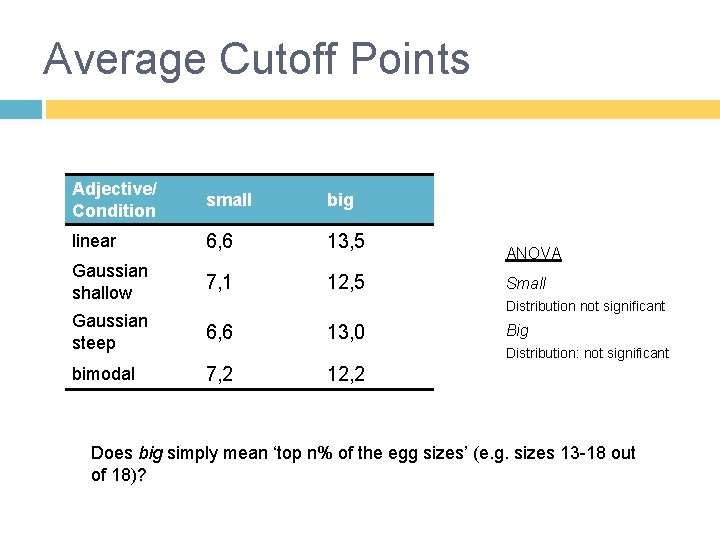
Average Cutoff Points Adjective/ Condition small big linear 6, 6 13, 5 Gaussian shallow 7, 1 12, 5 Gaussian steep 6, 6 bimodal 7, 2 ANOVA Small Distribution not significant 13, 0 Big Distribution: not significant 12, 2 Does big simply mean ‘top n% of the egg sizes’ (e. g. sizes 13 -18 out of 18)?
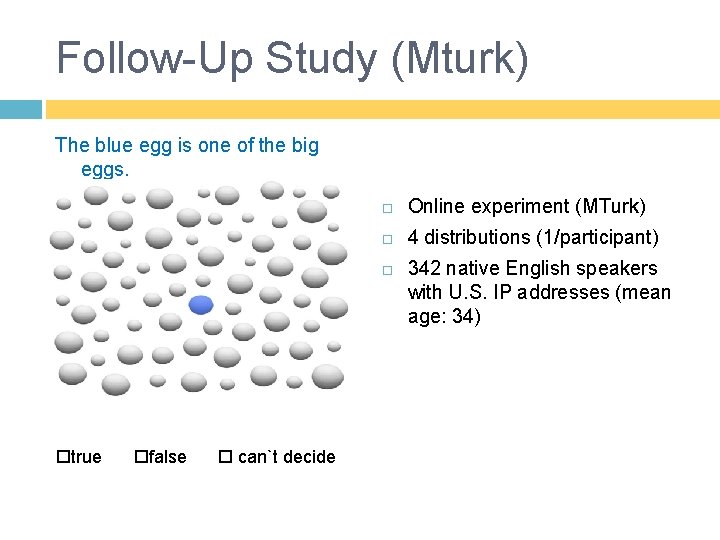
Follow-Up Study (Mturk) The blue egg is one of the big eggs. Online experiment (MTurk) 4 distributions (1/participant) true false can`t decide 342 native English speakers with U. S. IP addresses (mean age: 34)
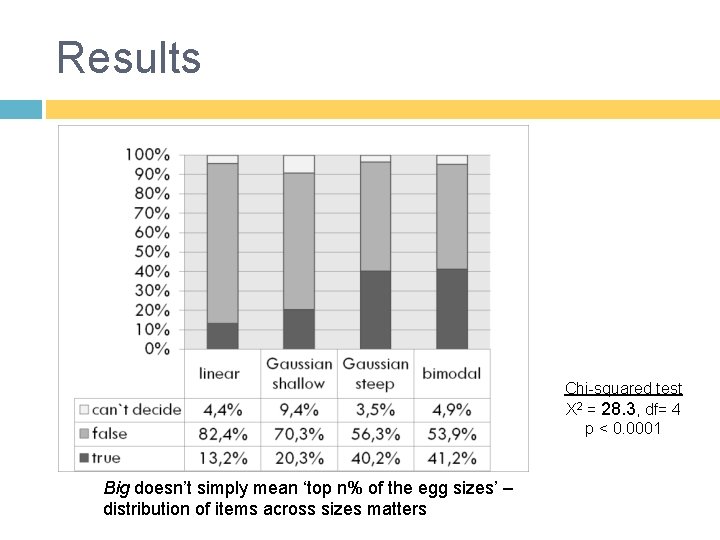
Results Chi-squared test X 2 = 28. 3, df= 4 p < 0. 0001 Big doesn’t simply mean ‘top n% of the egg sizes’ – distribution of items across sizes matters
Experiment 2 Extend previous findings to additional adjectives to different types of distributions F Better understanding of relevant factors
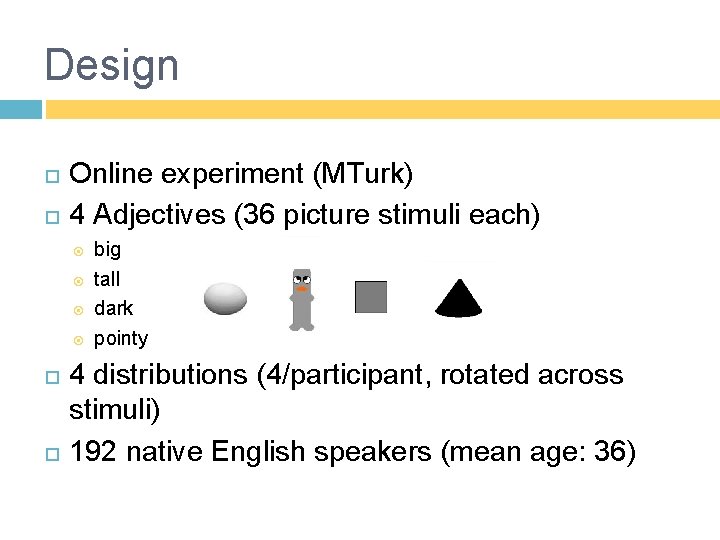
Design Online experiment (MTurk) 4 Adjectives (36 picture stimuli each) big tall dark pointy 4 distributions (4/participant, rotated across stimuli) 192 native English speakers (mean age: 36)
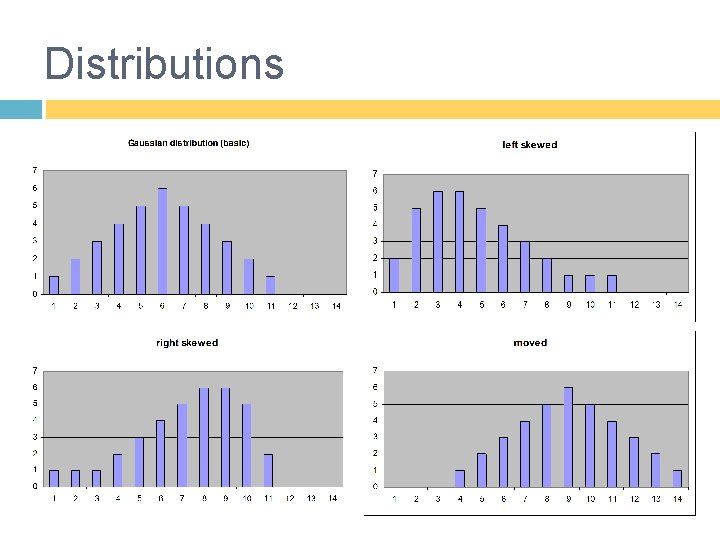
Distributions
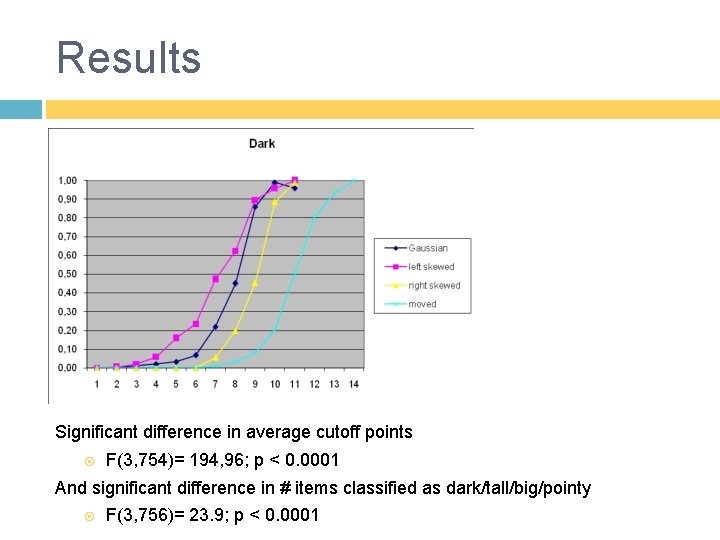
Results Significant difference in average cutoff points F(3, 754)= 194, 96; p < 0. 0001 And significant difference in # items classified as dark/tall/big/pointy F(3, 756)= 23. 9; p < 0. 0001
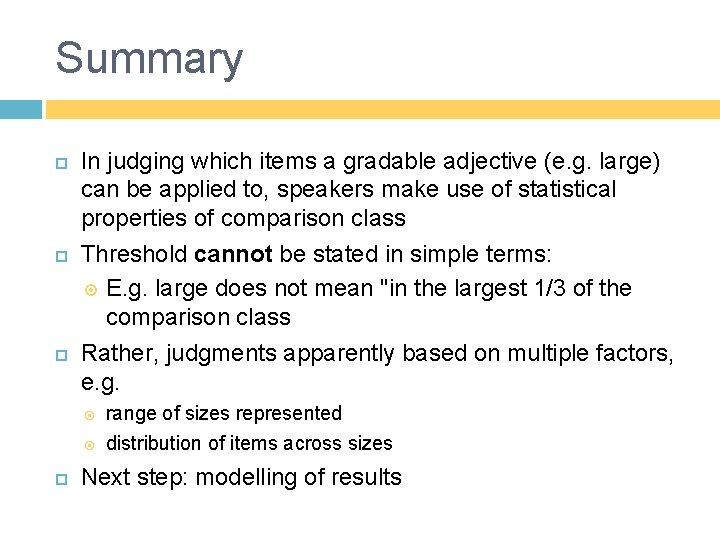
Summary In judging which items a gradable adjective (e. g. large) can be applied to, speakers make use of statistical properties of comparison class Threshold cannot be stated in simple terms: E. g. large does not mean "in the largest 1/3 of the comparison class Rather, judgments apparently based on multiple factors, e. g. range of sizes represented distribution of items across sizes Next step: modelling of results
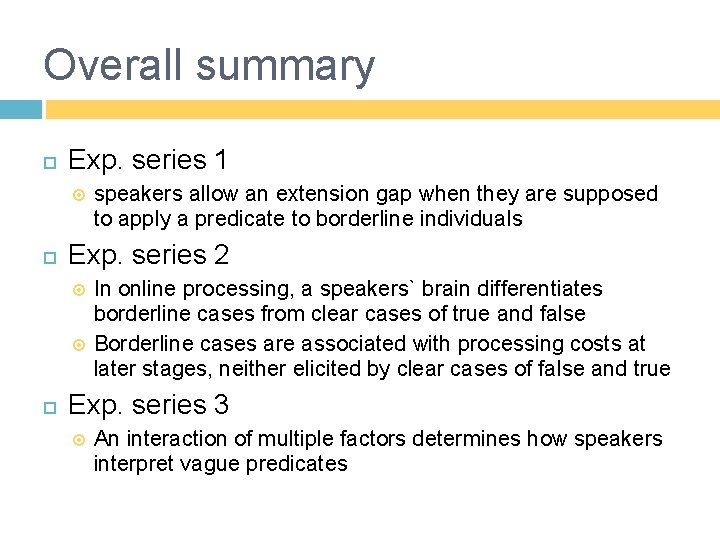
Overall summary Exp. series 1 Exp. series 2 speakers allow an extension gap when they are supposed to apply a predicate to borderline individuals In online processing, a speakers` brain differentiates borderline cases from clear cases of true and false Borderline cases are associated with processing costs at later stages, neither elicited by clear cases of false and true Exp. series 3 An interaction of multiple factors determines how speakers interpret vague predicates
References Bale, A. C. 2008. A universal scale of comparison. Linguistics and Philosophy 31: 1– 55. Bartsch, R. & Vennemann, T. 1973. Semantic structures: A study in the relation between syntax and semantics. Frankfurt: Athaenum Verlag. Birbaumer, N. & Schmidt, R. F. 2006. Biologische Psychologie, Heidelberg: Springer. Bonini, N. , Osherson, D. , Viale, R. & Williamson, T. 1999. On the Psychology of vague predicates. Mind & Language, 14, 377 -393. Klein, E. 1980. A semantics for positive and comparative adjectives. Linguistics and Philosophy, 4, 1 -45. van Rooij, R. 2011. Implicit versus explicit comparatives. In Vagueness and language use, ed. Paul Égré and Nathan Klinedinst. New York: Palgrave Macmillan. Solt, S. 2011. Notes on the comparison class. In Rick Nouwen, Robert van Rooij, Uli Sauerland Hans-Christian Schmitz (eds. ), Vagueness in Communication (Vi. C 2009), Revised Selected Papers (LNAI 6517), 189 -206. Berlin, Heidelberg: Springer.