
The Internet Radio Linking Project Presentation for the








- Slides: 64
The Internet Radio Linking Project Presentation for the Triangle Linux Users Group by Jim Price WW 4 M April 10, 2003 Portions of this presentation courtesy of KD 4 RAA, VE 3 SY, VE 7 LTD, VK 3 JED
- What is Amateur Radio? Ham Radio Activities IT and Amateur Radio Ham Radio Internet Linking The IRLP Network IRLP Hardware IRLP Software Using IRLP Listening For More Info. . . Demonstration Overview
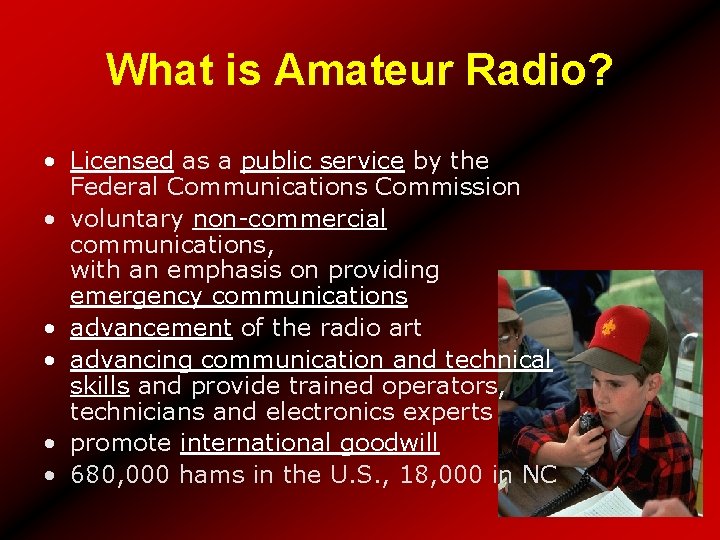
What is Amateur Radio? • Licensed as a public service by the Federal Communications Commission • voluntary non-commercial communications, with an emphasis on providing emergency communications • advancement of the radio art • advancing communication and technical skills and provide trained operators, technicians and electronics experts • promote international goodwill • 680, 000 hams in the U. S. , 18, 000 in NC
Celebrity Hams Entertainers: Chet Atkins WA 4 CZD, Ronnie Milsap WB 4 KCG, Marlon Brando FO 5 GJ, Patty Loveless KD 4 WUJ, Gary Shandling KD 6 OY, Burl Ives KA 6 HVA, Arthur Godfrey K 4 LIB, Priscilla Presley N 6 YOS Joe Walsh WB 6 ACU
. A huge number of politicians and royals including: Gov. George Pataki N 2 ZCZ, Sen. Barry Goldwater K 7 UGA, Spain’s King Juan Carlos EA 0 JC, Jordan's King Hussein JY 1 and Queen Noor JY 2, Argentina’s Pres. Carlos Menem LU 1 SM, India’s Rajiv Gandhi VU 2 RG Famous and infamous hams: most astronauts, Hugh Downs KD 6 WUS, Art Bell W 6 OBB, Kevin Mitnick N 6 NHG, and the author of The Joy of Sex, Dr. Alex Comfort KA 6 UXR Walter Cronkite KB 2 GSD
Celebrity non-Hams Forest Whitaker Phenomenon Dennis Quaid
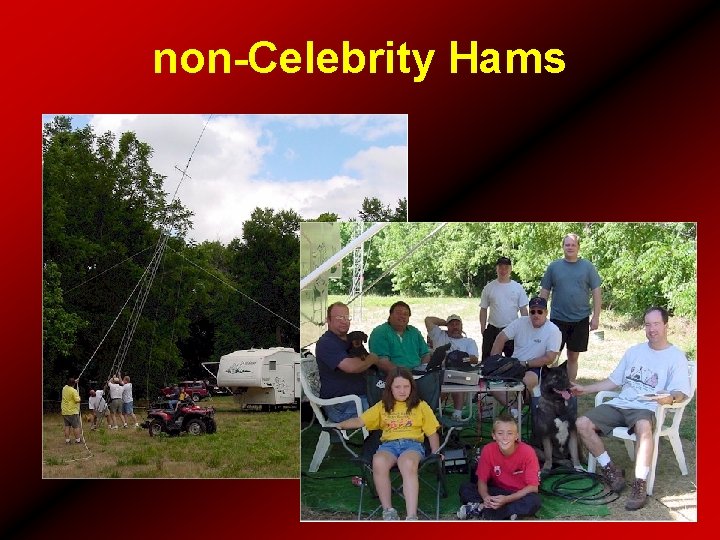
non-Celebrity Hams
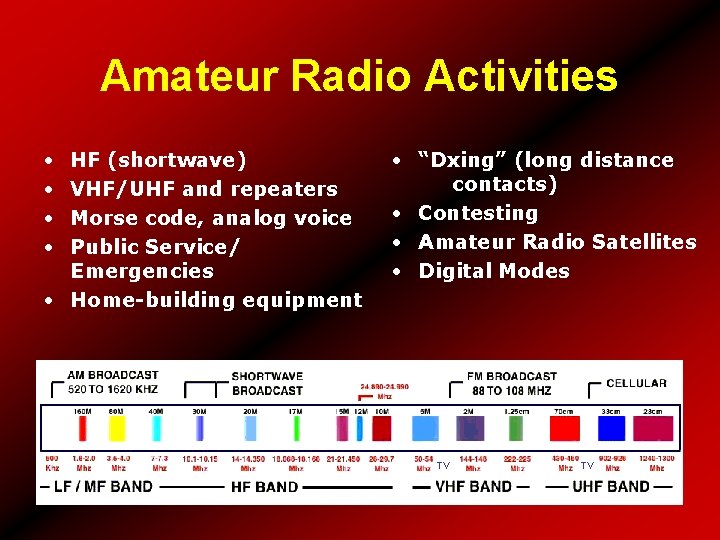
Amateur Radio Activities • • HF (shortwave) VHF/UHF and repeaters Morse code, analog voice Public Service/ Emergencies • Home-building equipment • “Dxing” (long distance contacts) • Contesting • Amateur Radio Satellites • Digital Modes TV TV
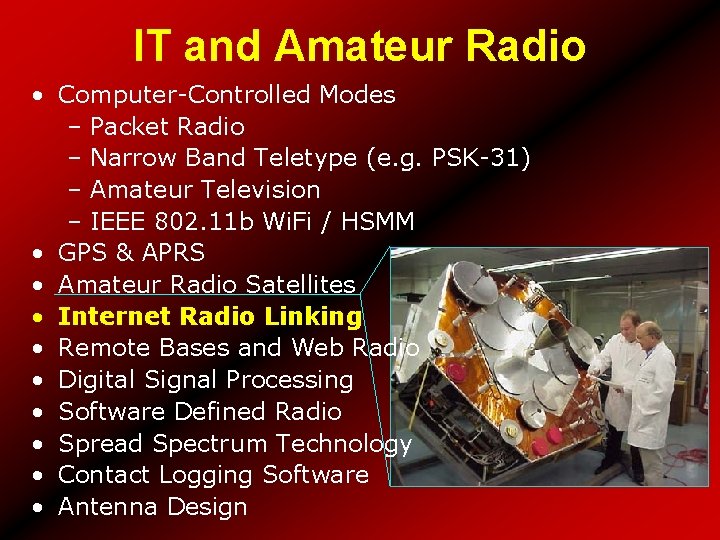
IT and Amateur Radio • Computer-Controlled Modes – Packet Radio – Narrow Band Teletype (e. g. PSK-31) – Amateur Television – IEEE 802. 11 b Wi. Fi / HSMM • GPS & APRS • Amateur Radio Satellites • Internet Radio Linking • Remote Bases and Web Radio • Digital Signal Processing • Software Defined Radio • Spread Spectrum Technology • Contact Logging Software • Antenna Design
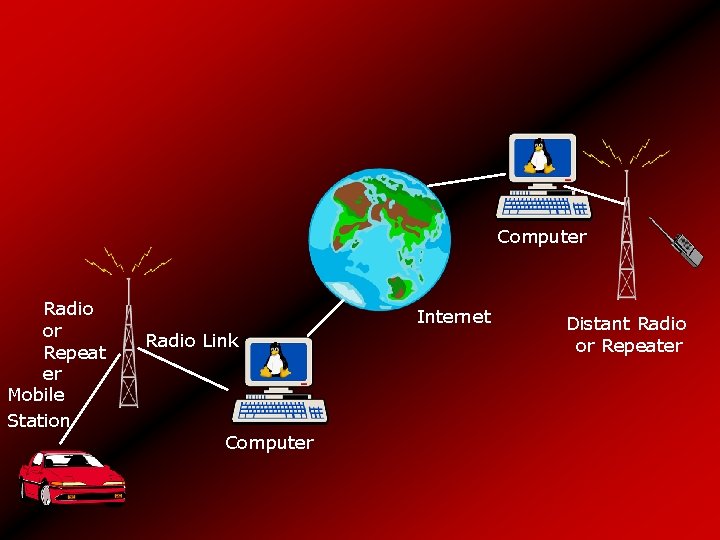
Computer Radio or Repeat er Mobile Station Internet Radio Link Computer Distant Radio or Repeater
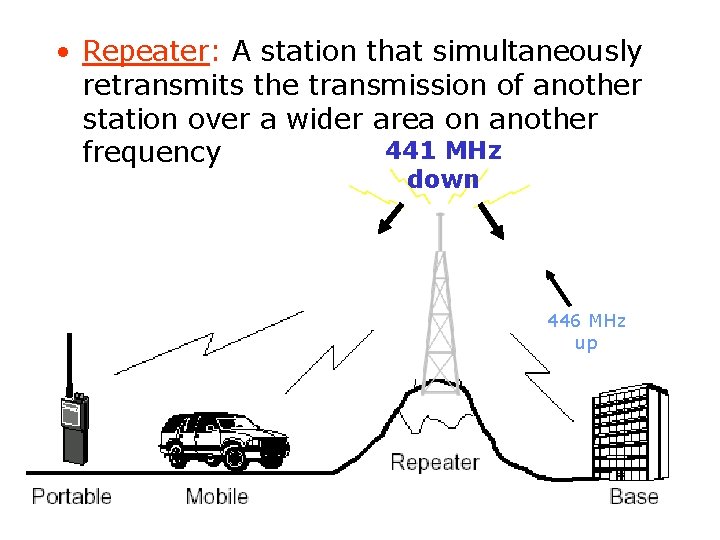
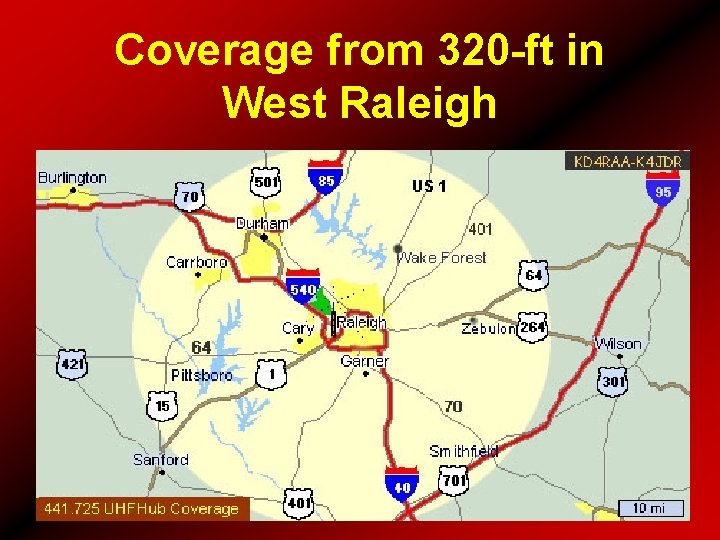
• Repeater: A station that simultaneously retransmits the transmission of another station over a wider area on another 441 MHz frequency down 446 MHz up
Coverage from 320 -ft in West Raleigh
Ham Radio - Internet Linking Radio-only Access • IRLP (linux) PC -or- Radio Access: • e. QSO (Windows) • i. Link (Windows) • WIRES (Windows) • Echo. Link (Windows or linux)
The Internet Radio Linking Project (IRLP) • Uses the Internet to link distant radio sites • Gives global coverage to normally localized VHF and UHF frequencies • Enables minimally equipped stations to communicate globally • Allows end user control of links via their radio’s DTMF (Touchtone) keypad
The Internet Radio Linking Project (IRLP) Created by Dave Cameron VE 7 LTD of Vancouver, BC Dave was frustrated with the unreliable operation of Windows-based Iphone and turned to linux. Iphone and other systems use VOX. IRLP uses COS. IRLP is radio-access only.
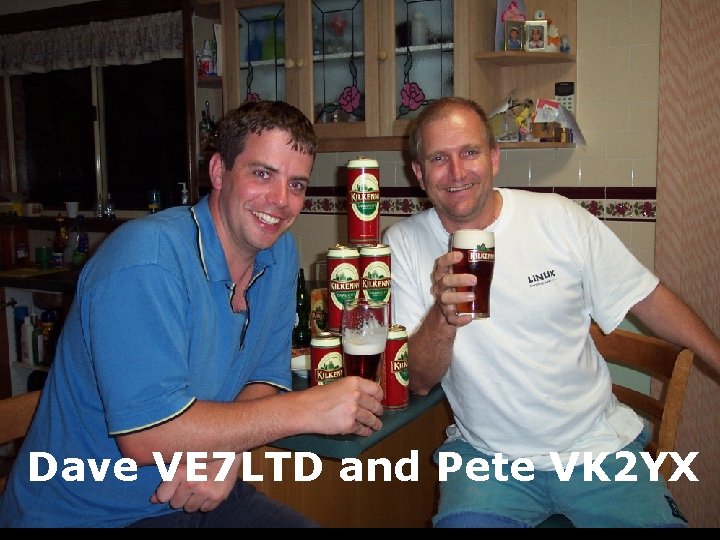
Dave VE 7 LTD and Pete VK 2 YX
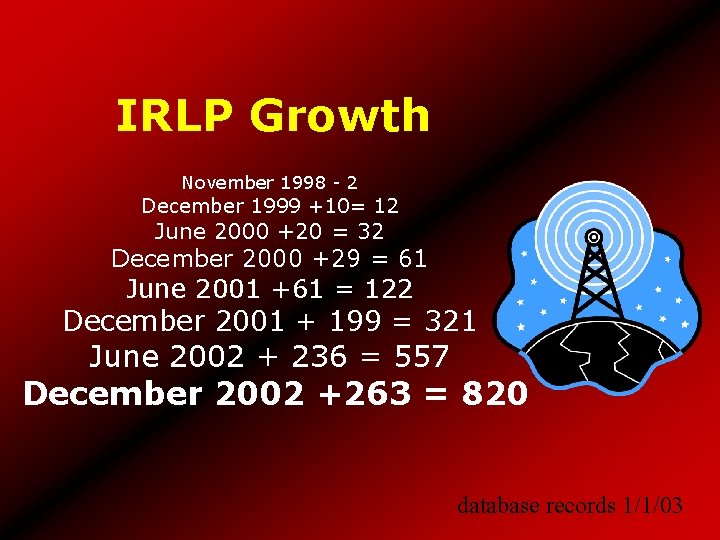
IRLP Growth November 1998 - 2 December 1999 +10= 12 June 2000 +20 = 32 December 2000 +29 = 61 June 2001 +61 = 122 December 2001 + 199 = 321 June 2002 + 236 = 557 December 2002 +263 = 820 database records 1/1/03
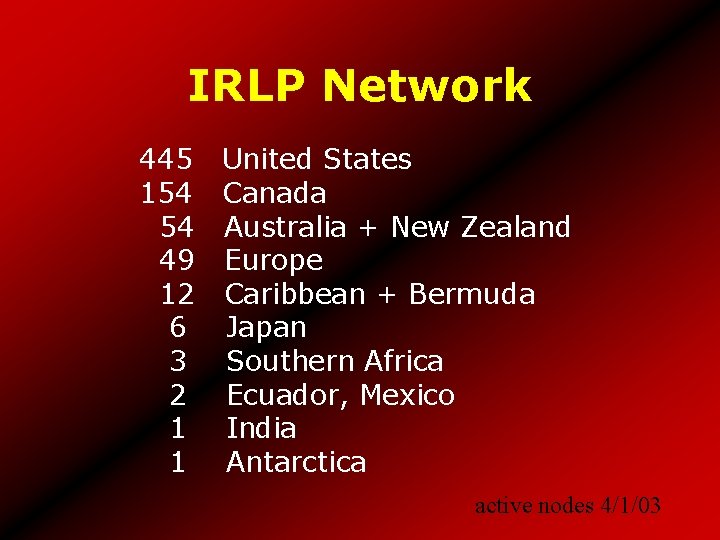
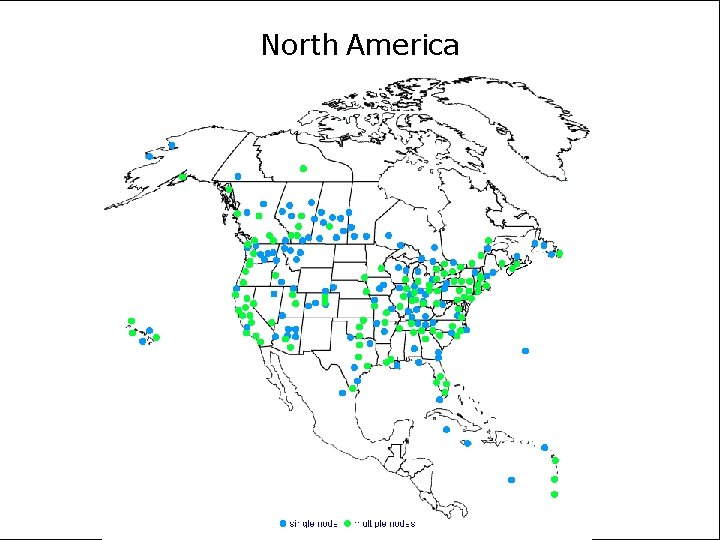
IRLP Network 445 United States 154 Canada 54 Australia + New Zealand 49 Europe 12 Caribbean + Bermuda 6 Japan 3 Southern Africa 2 Ecuador, Mexico 1 India 1 Antarctica active nodes 4/1/03
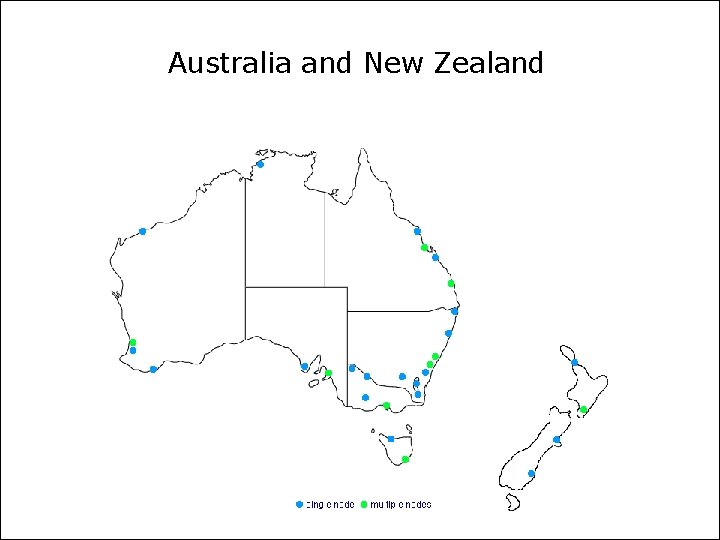
Australia and New Zealand
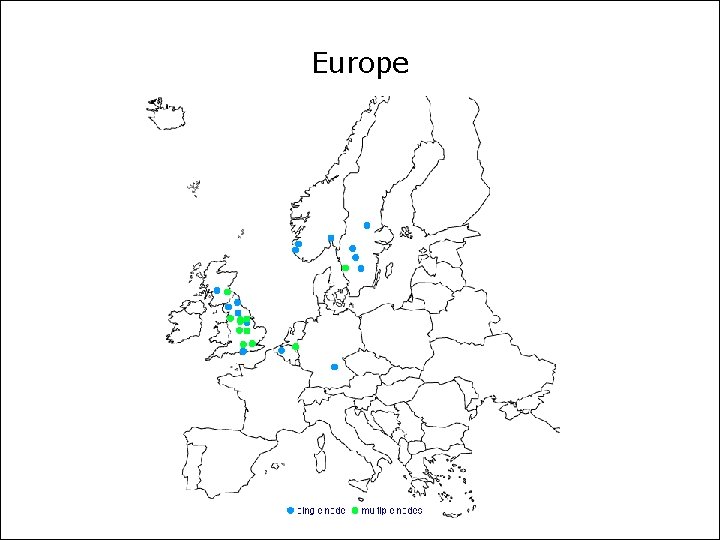
Europe
North America
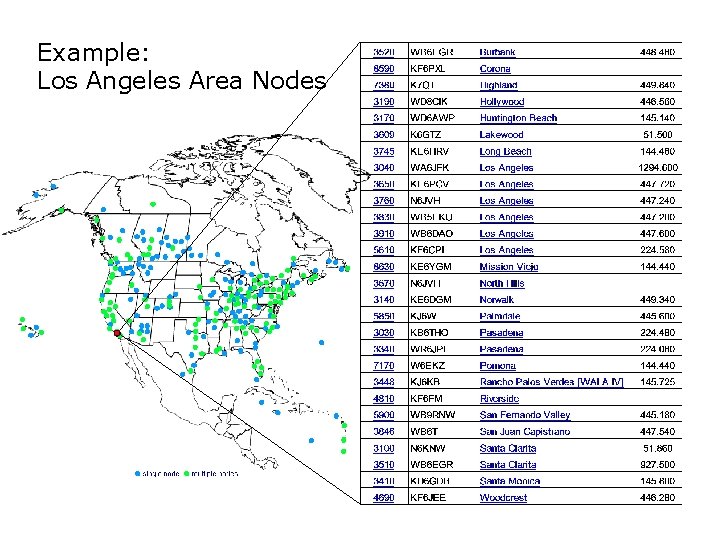
Example: Los Angeles Area Nodes
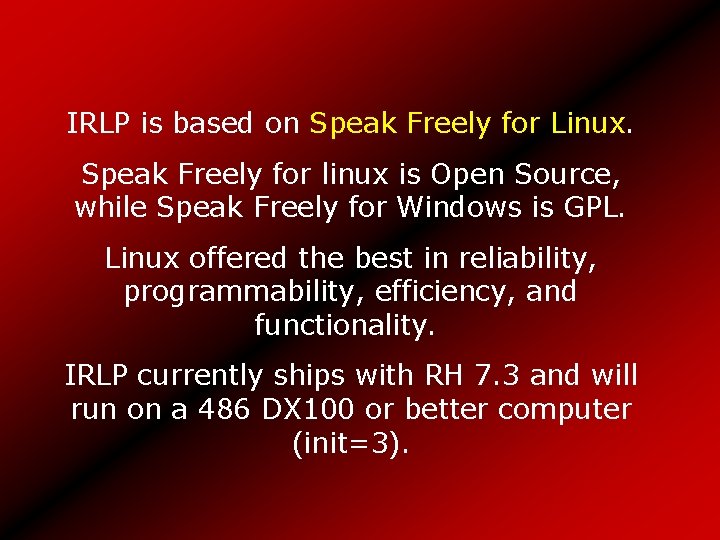
IRLP is based on Speak Freely for Linux. Speak Freely for linux is Open Source, while Speak Freely for Windows is GPL. Linux offered the best in reliability, programmability, efficiency, and functionality. IRLP currently ships with RH 7. 3 and will run on a 486 DX 100 or better computer (init=3).
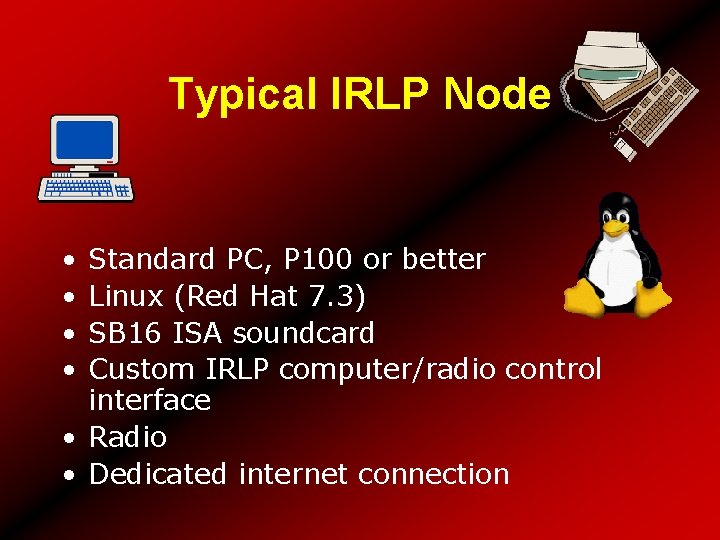
Typical IRLP Node • • Standard PC, P 100 or better Linux (Red Hat 7. 3) SB 16 ISA soundcard Custom IRLP computer/radio control interface • Radio • Dedicated internet connection
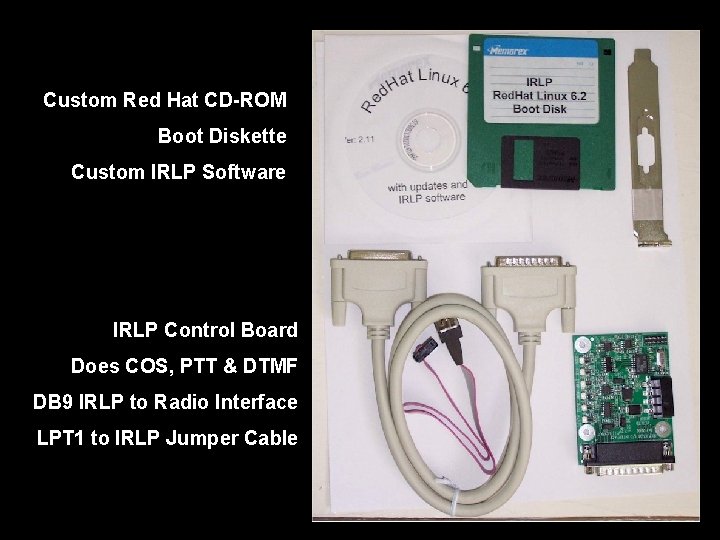
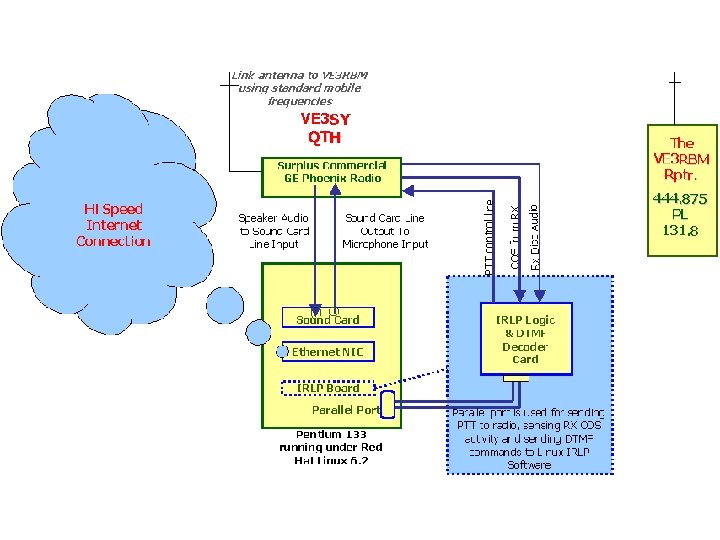
Custom Red Hat CD-ROM Boot Diskette Custom IRLP Software IRLP Control Board Does COS, PTT & DTMF DB 9 IRLP to Radio Interface LPT 1 to IRLP Jumper Cable
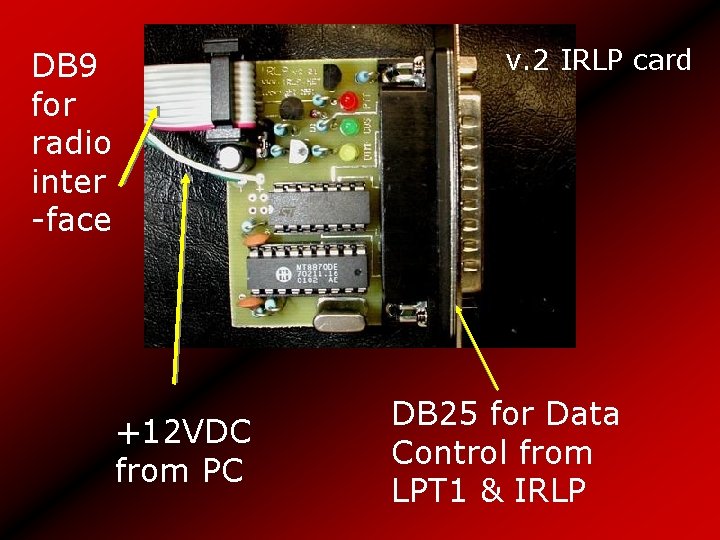
DB 9 for radio inter -face +12 VDC from PC v. 2 IRLP card DB 25 for Data Control from LPT 1 & IRLP
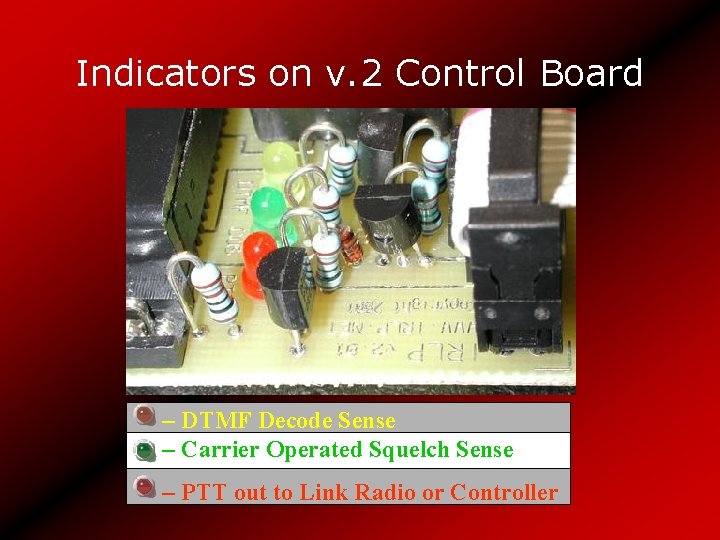
Indicators on v. 2 Control Board – DTMF Decode Sense – Carrier Operated Squelch Sense – PTT out to Link Radio or Controller
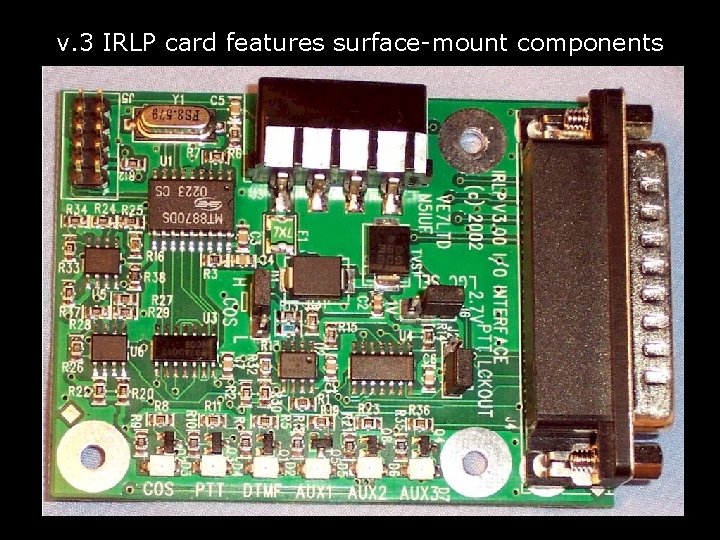
v. 3 IRLP card features surface-mount components
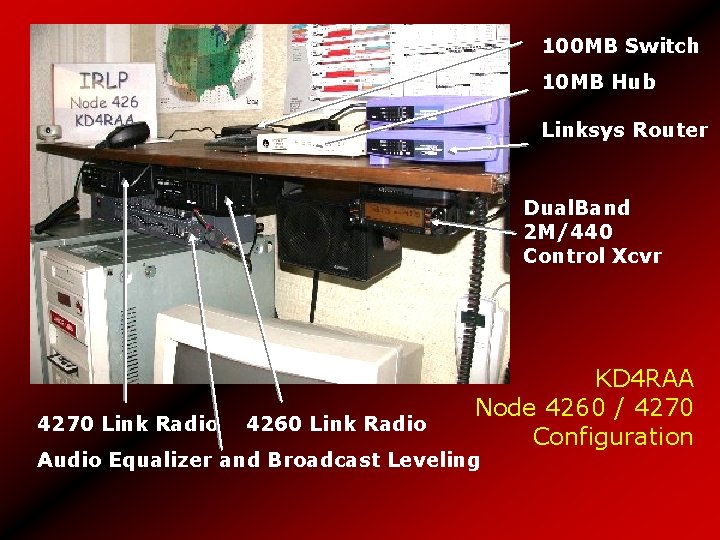
100 MB Switch 10 MB Hub Linksys Router Dual. Band 2 M/440 Control Xcvr 4270 Link Radio 4260 Link Radio KD 4 RAA Node 4260 / 4270 Configuration Audio Equalizer and Broadcast Leveling
What Happens During a Call? Notes from Dave Cameron, VE 7 LTD
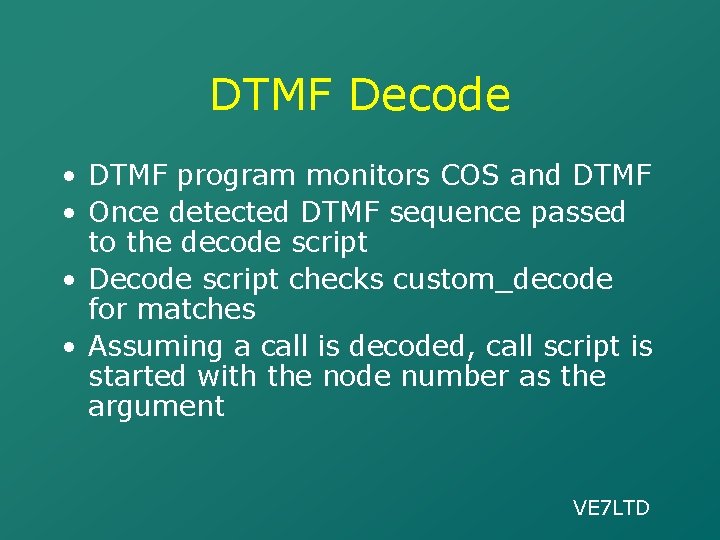
DTMF Decode • DTMF program monitors COS and DTMF • Once detected DTMF sequence passed to the decode script • Decode script checks custom_decode for matches • Assuming a call is decoded, call script is started with the node number as the argument VE 7 LTD
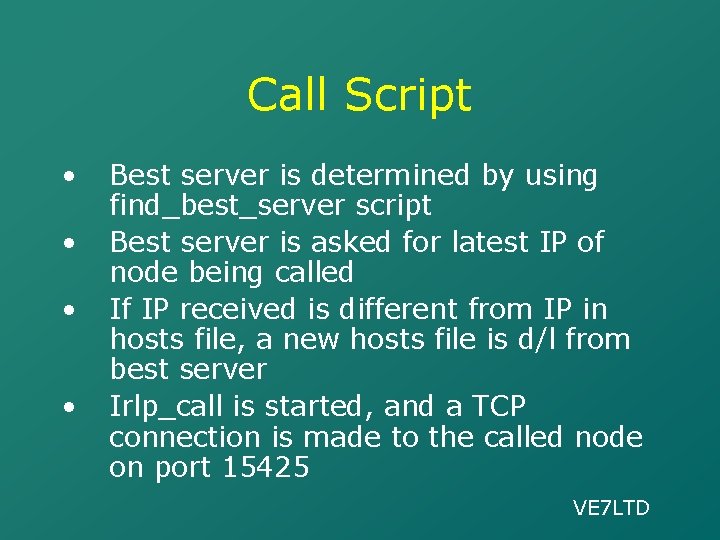
Call Script • • Best server is determined by using find_best_server script Best server is asked for latest IP of node being called If IP received is different from IP in hosts file, a new hosts file is d/l from best server Irlp_call is started, and a TCP connection is made to the called node on port 15425 VE 7 LTD
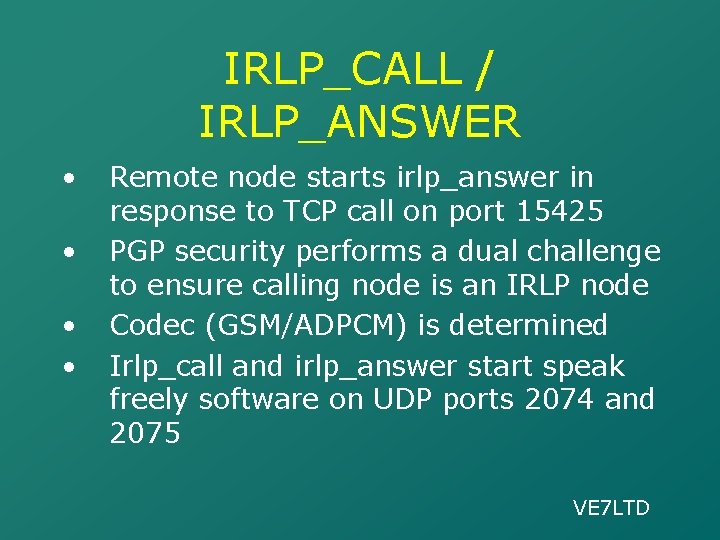
IRLP_CALL / IRLP_ANSWER • • Remote node starts irlp_answer in response to TCP call on port 15425 PGP security performs a dual challenge to ensure calling node is an IRLP node Codec (GSM/ADPCM) is determined Irlp_call and irlp_answer start speak freely software on UDP ports 2074 and 2075 VE 7 LTD
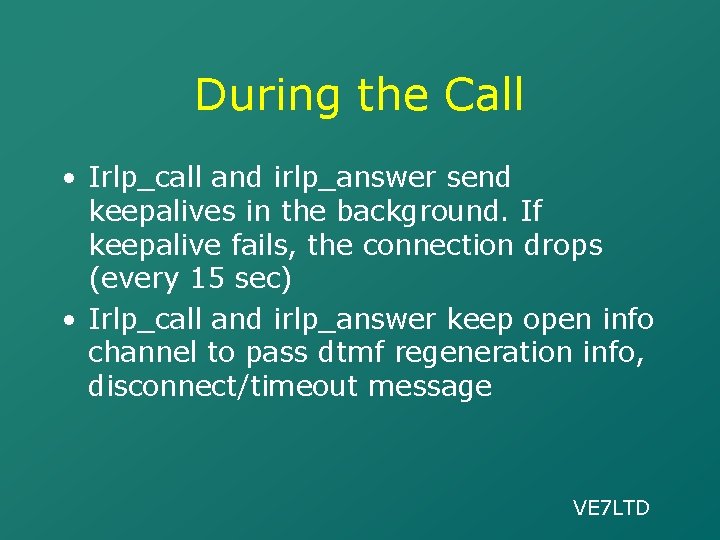
During the Call • Irlp_call and irlp_answer send keepalives in the background. If keepalive fails, the connection drops (every 15 sec) • Irlp_call and irlp_answer keep open info channel to pass dtmf regeneration info, disconnect/timeout message VE 7 LTD
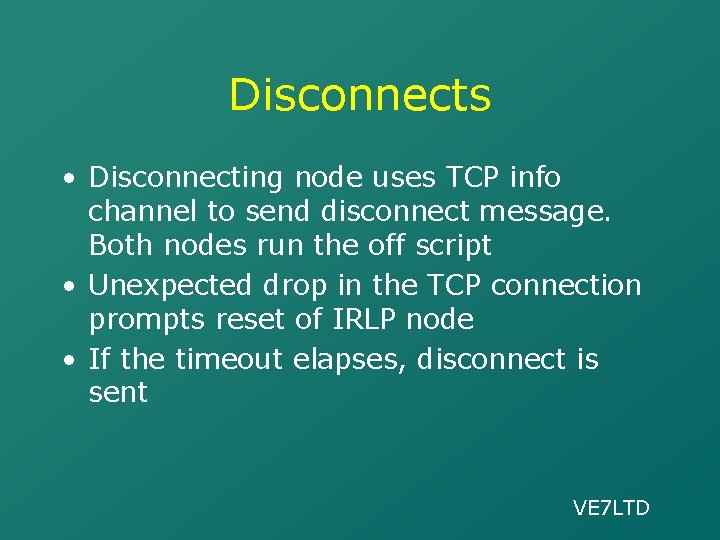
Disconnects • Disconnecting node uses TCP info channel to send disconnect message. Both nodes run the off script • Unexpected drop in the TCP connection prompts reset of IRLP node • If the timeout elapses, disconnect is sent VE 7 LTD
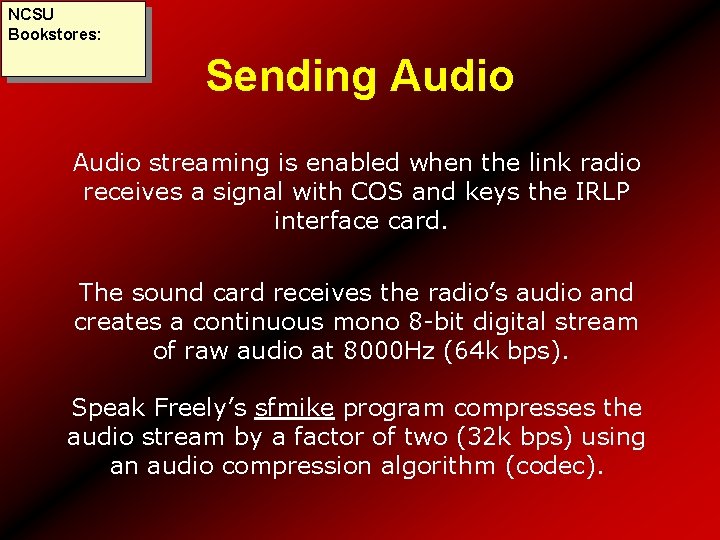
NCSU Bookstores: Sending Audio streaming is enabled when the link radio receives a signal with COS and keys the IRLP interface card. The sound card receives the radio’s audio and creates a continuous mono 8 -bit digital stream of raw audio at 8000 Hz (64 k bps). Speak Freely’s sfmike program compresses the audio stream by a factor of two (32 k bps) using an audio compression algorithm (codec).
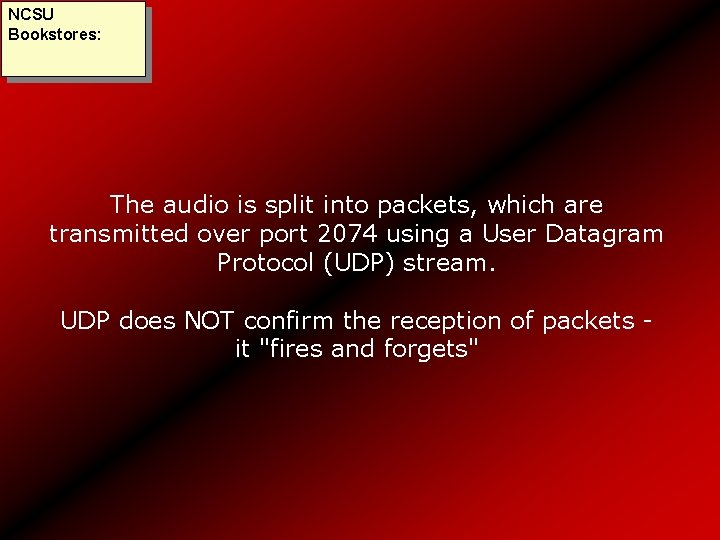
NCSU Bookstores: The audio is split into packets, which are transmitted over port 2074 using a User Datagram Protocol (UDP) stream. UDP does NOT confirm the reception of packets - it "fires and forgets"
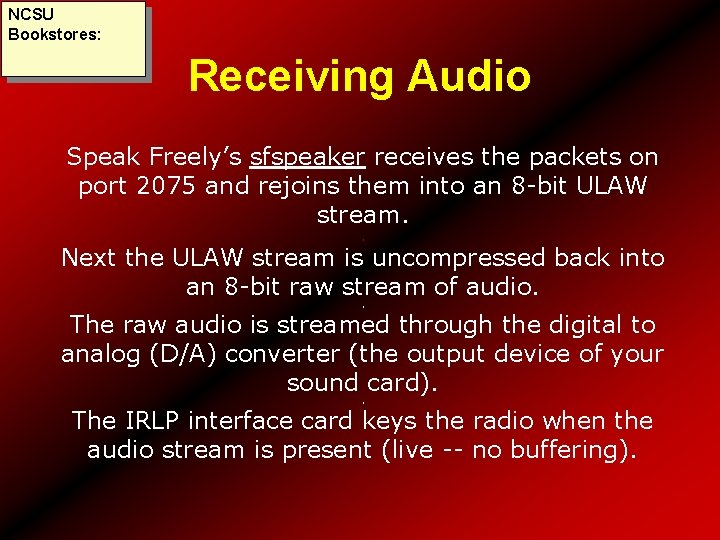
NCSU Bookstores: Receiving Audio Speak Freely’s sfspeaker receives the packets on port 2075 and rejoins them into an 8 -bit ULAW stream. . Next the ULAW stream is uncompressed back into an 8 -bit raw stream of audio. . The raw audio is streamed through the digital to analog (D/A) converter (the output device of your sound card). . The IRLP interface card keys the radio when the audio stream is present (live -- no buffering).
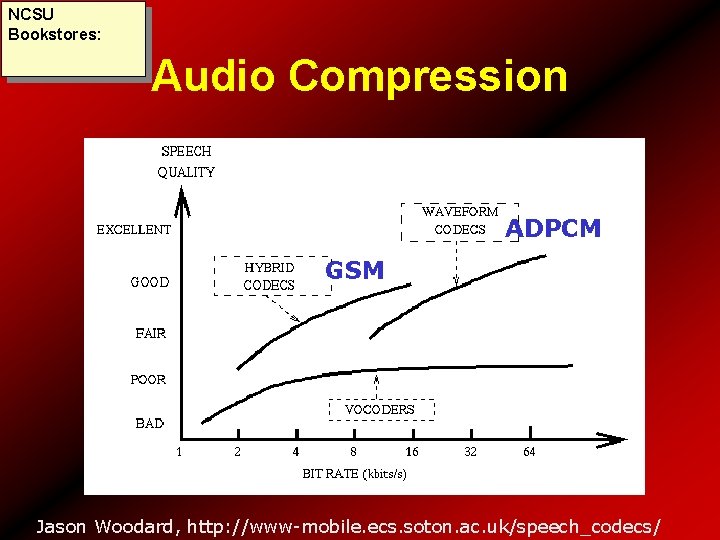
NCSU Bookstores: Audio Compression ADPCM GSM Jason Woodard, http: //www-mobile. ecs. soton. ac. uk/speech_codecs/
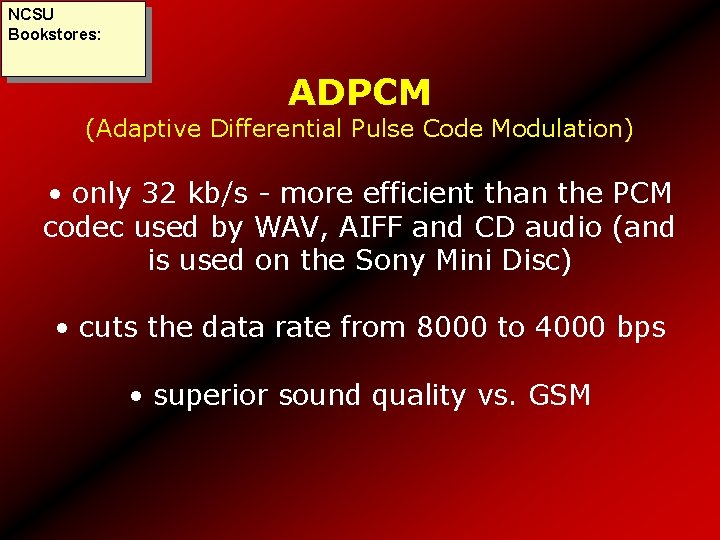
NCSU Bookstores: ADPCM (Adaptive Differential Pulse Code Modulation) • only 32 kb/s - more efficient than the PCM codec used by WAV, AIFF and CD audio (and is used on the Sony Mini Disc) • cuts the data rate from 8000 to 4000 bps • superior sound quality vs. GSM
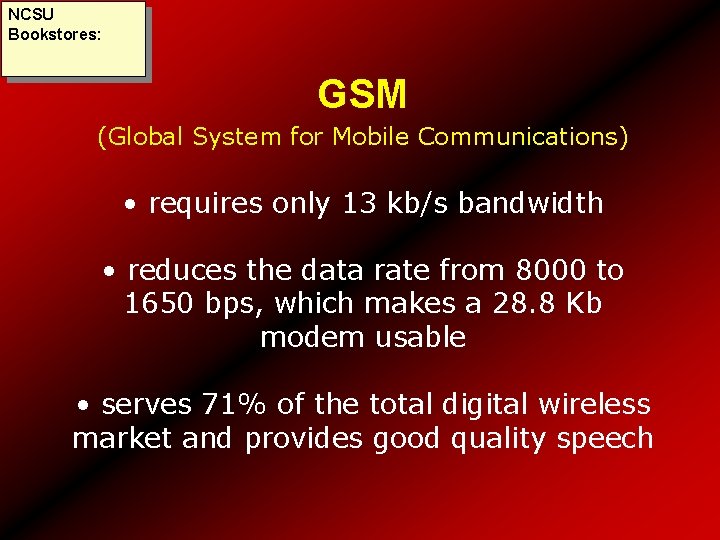
NCSU Bookstores: GSM (Global System for Mobile Communications) • requires only 13 kb/s bandwidth • reduces the data rate from 8000 to 1650 bps, which makes a 28. 8 Kb modem usable • serves 71% of the total digital wireless market and provides good quality speech
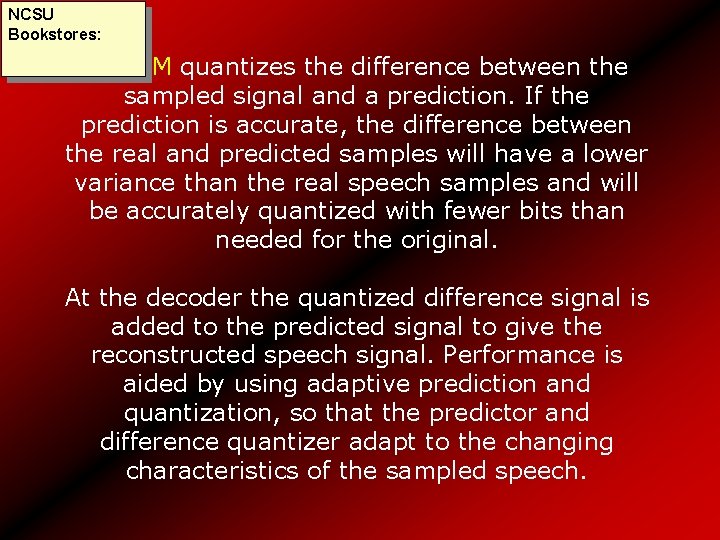
NCSU Bookstores: ADPCM quantizes the difference between the sampled signal and a prediction. If the prediction is accurate, the difference between the real and predicted samples will have a lower variance than the real speech samples and will be accurately quantized with fewer bits than needed for the original. At the decoder the quantized difference signal is added to the predicted signal to give the reconstructed speech signal. Performance is aided by using adaptive prediction and quantization, so that the predictor and difference quantizer adapt to the changing characteristics of the sampled speech.
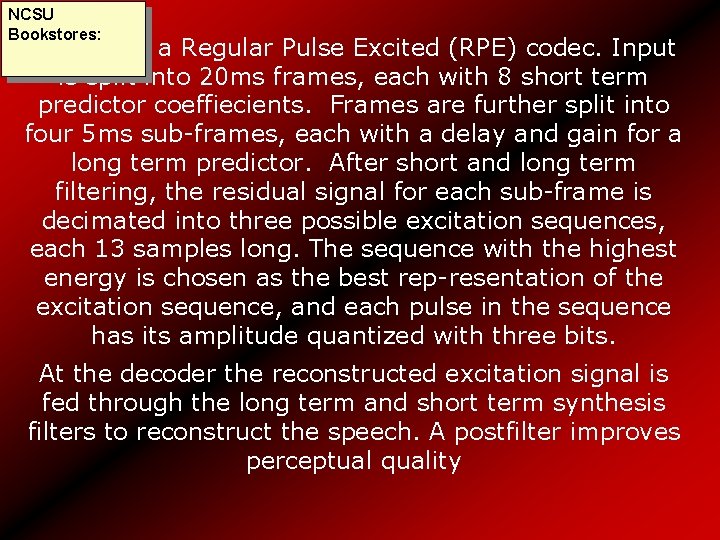
NCSU Bookstores: GSM uses a Regular Pulse Excited (RPE) codec. Input is split into 20 ms frames, each with 8 short term predictor coeffiecients. Frames are further split into four 5 ms sub-frames, each with a delay and gain for a long term predictor. After short and long term filtering, the residual signal for each sub-frame is decimated into three possible excitation sequences, each 13 samples long. The sequence with the highest energy is chosen as the best rep-resentation of the excitation sequence, and each pulse in the sequence has its amplitude quantized with three bits. At the decoder the reconstructed excitation signal is fed through the long term and short term synthesis filters to reconstruct the speech. A postfilter improves perceptual quality
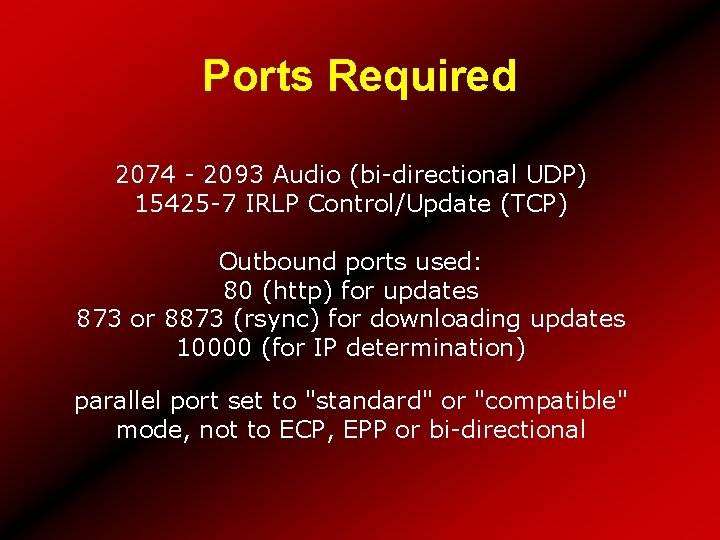
Ports Required 2074 - 2093 Audio (bi-directional UDP) 15425 -7 IRLP Control/Update (TCP) Outbound ports used: 80 (http) for updates 873 or 8873 (rsync) for downloading updates 10000 (for IP determination) parallel port set to "standard" or "compatible" mode, not to ECP, EPP or bi-directional
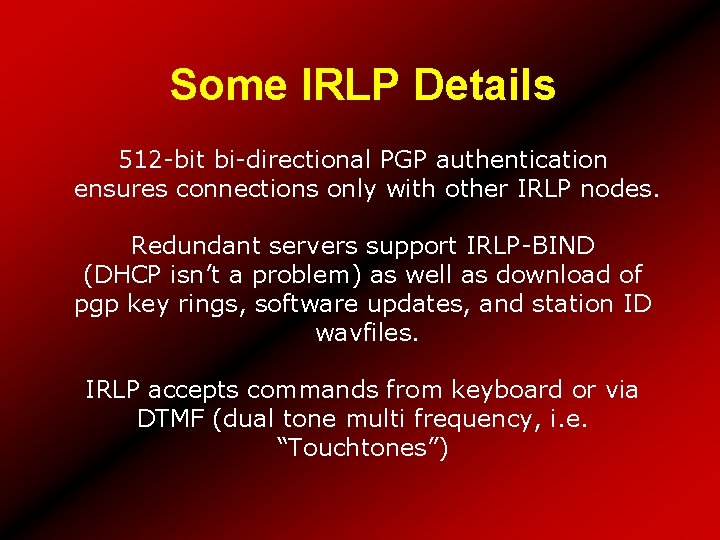
Some IRLP Details 512 -bit bi-directional PGP authentication ensures connections only with other IRLP nodes. Redundant servers support IRLP-BIND (DHCP isn’t a problem) as well as download of pgp key rings, software updates, and station ID wavfiles. IRLP accepts commands from keyboard or via DTMF (dual tone multi frequency, i. e. “Touchtones”)
IRLP and the GPL “I had released code under the GPL, and it led to nothing but 1000's of emails criticising my code, asking for features, wondering why I built this that way, etc. . . I got tired of answering questions. ” “There is a strong commercial potential for this product, and I did not want to hand several 1000 hours worth of code to the private sector just to be replicated. ” “Closed code maintains a standard, which open releases would compromise. ” VE 7 LTD
IRLP Admin • FCC regulations prohibit unlicensed people using amateur frequencies. • IRLP links are accessible only on amateur radio frequencies within range of a node. No direct Internet access. • Open. SSH used for remote administration. • Linux packages updated automatically (up 2 date, autorpm, apt). • Cron jobs to automate functions
IRLP Scripting • The IRLP software is composed largely of bash shell scripts. • Flexible: easily customized to suit local needs. • Almost anything that can be run from the console can be controlled via radio. – Morse Code ID using MIDI or wav (per FCC legal requirements) – Node status (link off/on and where linked to) – Time of day (talking clock) – Weather reports, Amber Alerts – Local Announcements – Download and play radio news programs from internet – Random dialing – *69 / “Call Waiting”
IRLP Advantages • User Flexibility - Custom Scripts • Accessible only by radio • Security • Stability of linux OS • Superior audio; COS (not VOX) • Cost: linux is free, will run on old PCs • Continues to function if servers fail
Two ways to make contacts Point-to-Point and Reflectors (like chat rooms -- multiple nodes connected together, hearing audio from one node at a time)
IRLP Reflectors • Enable multiple nodes to link together into a network – number limited only by bandwidth. • Running a reflector requires bandwidth (32 kbps per connected node) to handle the multiple data streams. Most reflectors are hosted by ISPs (like Inflow) who often donate the bandwidth.
Raleigh Reflector Established for coordinated response to severe weather events and for public service Links NC repeaters beyond the range of conventional RF linking systems During Hurricane Lily, linked stations in Louisiana with the National Hurricane Center in Florida Has linked stations from Georgia to Maryland to track several winter storms Simulcast a ham radio contact between the International Space Station and Chapel Hill middle school students Participated in the Boy Scouts’ JOTA event
Impact of Internet Linking on Amateur Radio • Level of amateur activity has increased dramatically • Amateurs who have been inactive for a long time are coming back on the air • Amateur Radio is becoming more appealing to today’s Internet-oriented youth • New opportunities for experimentation.
The Future • Internet linking is already becoming commonplace – over 800 IRLP nodes on the air. • Advances in technology will improve performance of links. • Technology can be ported to high-speed microwave and satellite links. • Enhanced global slack.
Listening to IRLP • Live Demonstration • Monitoring IRLP Reflector 2 via Live 365 streaming audio (linked from www. irlp. net) • Recorded conversation with Antarctica, and • Recorded school contact with the International Space Station (linked from www. kd 4 raa. net) • local frequencies via radio or scanner
How to Become a Ham Radio Operator • Radio amateurs are licensed by the FCC, after passing examinations in radio theory, electronics, regulations, and optionally, Morse Code. • Examinations are conducted locally by individuals or clubs almost every week and cost about $12 (10 -year renewals are free) • Many radio clubs run study courses. 1 -on-1 tutoring, book and online stuyding, and taking mock online exams are other study options.
More Info • IRLP in Raleigh • - www. kd 4 raa. net • IRLP in General - www. irlp. net • What is Amateur Radio? - www. howstuffworks. com/ham-radio. htm • Raleigh Amateur Radio Society - www. rars. org • American Radio Relay League - www. arrl. org
Thank You