
The International System of Units updated Metric System
- Slides: 7
The International System of Units (updated Metric System) August 23, 2013
Why do we use the SI system, or Système International? • Almost all other countries are using the metric system • Easy to use: base-10 system (multiples of 10!) • Scientists need a universal way to communicate data
Units of Measurement • For a measurement to make sense it needs both a number and a unit. • SI is built upon several basic units: • The meter measures LENGTH • The kilogram measures MASS • The cubic meter (or liter) measures VOLUME • Kelvin (or Celsius) measures TEMPERATURE
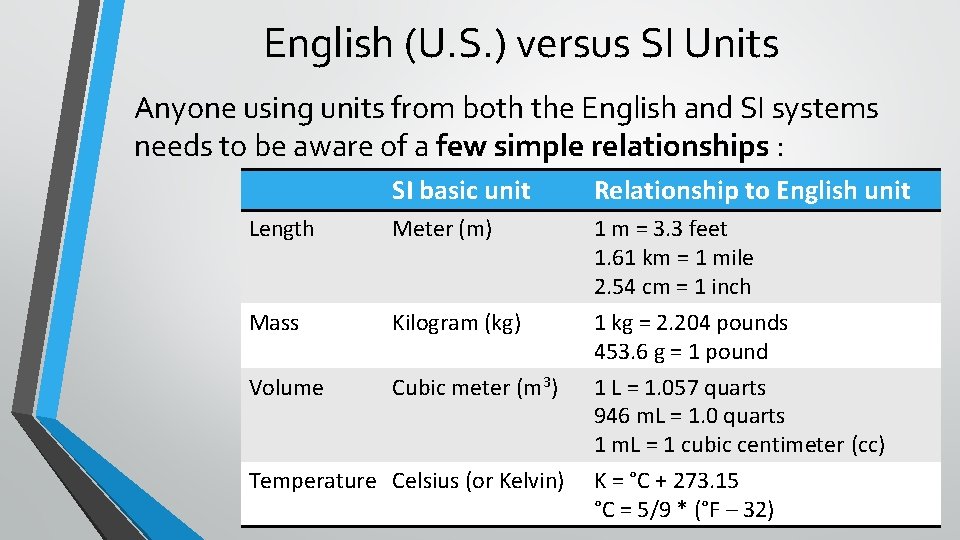
English (U. S. ) versus SI Units Anyone using units from both the English and SI systems needs to be aware of a few simple relationships : SI basic unit Relationship to English unit Length Meter (m) 1 m = 3. 3 feet 1. 61 km = 1 mile 2. 54 cm = 1 inch Mass Kilogram (kg) Volume Cubic meter (m 3) 1 kg = 2. 204 pounds 453. 6 g = 1 pound 1 L = 1. 057 quarts 946 m. L = 1. 0 quarts 1 m. L = 1 cubic centimeter (cc) Temperature Celsius (or Kelvin) K = °C + 273. 15 °C = 5/9 * (°F – 32)
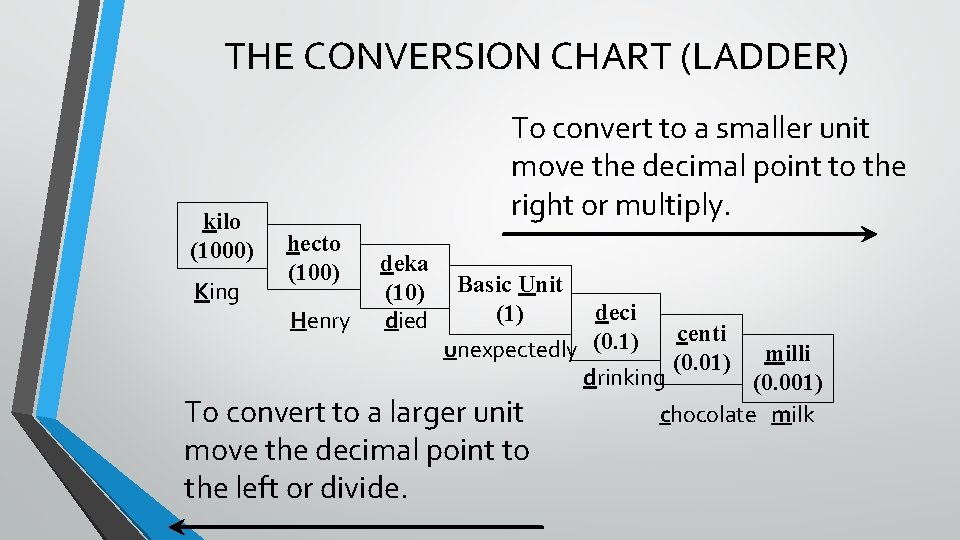
THE CONVERSION CHART (LADDER) kilo (1000) To convert to a smaller unit move the decimal point to the right or multiply. hecto (100) deka (10) died Basic Unit deci (1) Henry centi (0. 1) unexpectedly (0. 01) milli drinking (0. 001) To convert to a larger unit chocolate milk King move the decimal point to the left or divide.
TRY THIS USING THE LADDER METHOD 1000 mg = ____ g • Step 1: Determine if you are going to go up or down the ladder (left or right) • Step 2: Determine how many steps there are from milligrams to grams. • Step 3: Move the decimal point to the amount of places that was determined from Steps 1 & 2.
TRY USING THE LADDER METHOD 1 L = ______ m. L Now let’s practice some more using with the “Metric Mania” worksheet!