
The International System of Measurement Also known as

- Slides: 25
The International System of Measurement Also known as: The Metric System by Angie Shoemate Modified by Alyssa Henley
Metric System • • simple to use based on units of ten easy to make conversions used by all scientists used in the medical field used in most countries can be easily learned in an hour
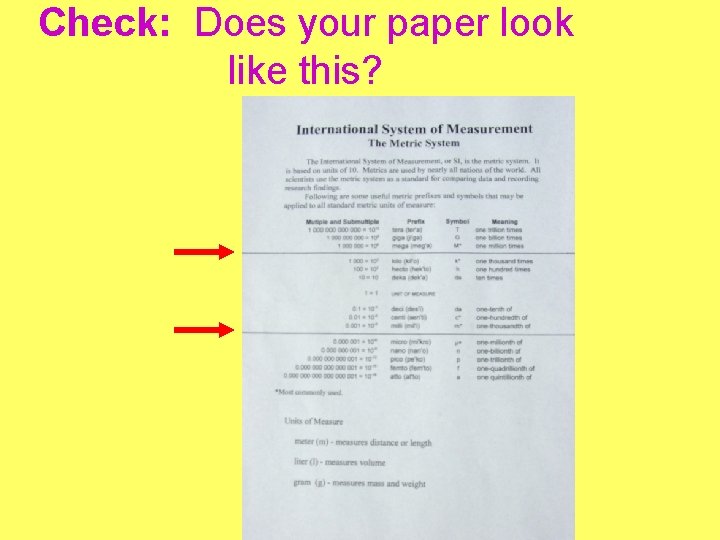
Directions • • Obtain a yellow sheet and a ruler. Write your name in the upper left corner. Locate the column of prefixes. Draw a line above kilo- all the way across the paper - edge to edge. • Draw another line below milli- all the way across the paper - edge to edge.
Check: Does your paper look like this?
You must memorize the prefixes between the lines drawn.
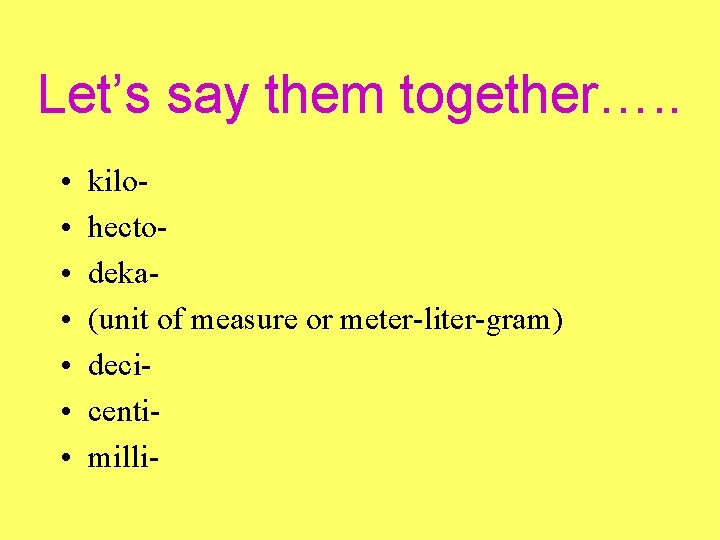
Let’s say them together…. . • • kilohectodeka(unit of measure or meter-liter-gram) decicentimilli-
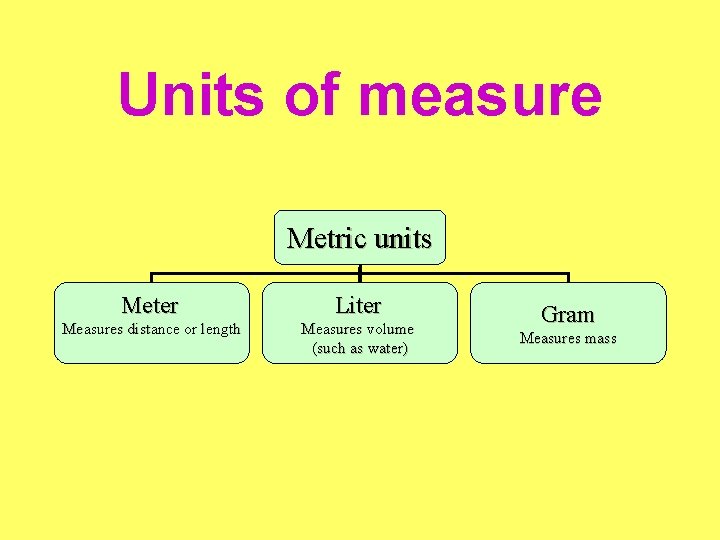
Units of measure Metric units Meter Liter Measures distance or length Measures volume (such as water) Gram Measures mass
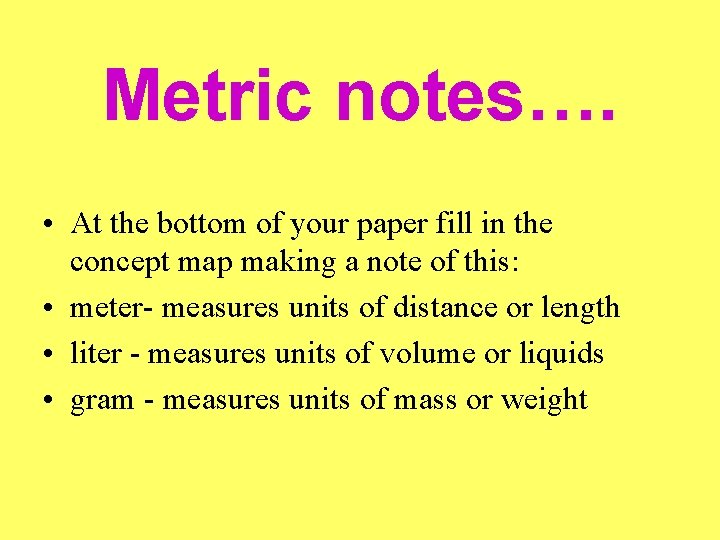
Metric notes…. • At the bottom of your paper fill in the concept map making a note of this: • meter- measures units of distance or length • liter - measures units of volume or liquids • gram - measures units of mass or weight
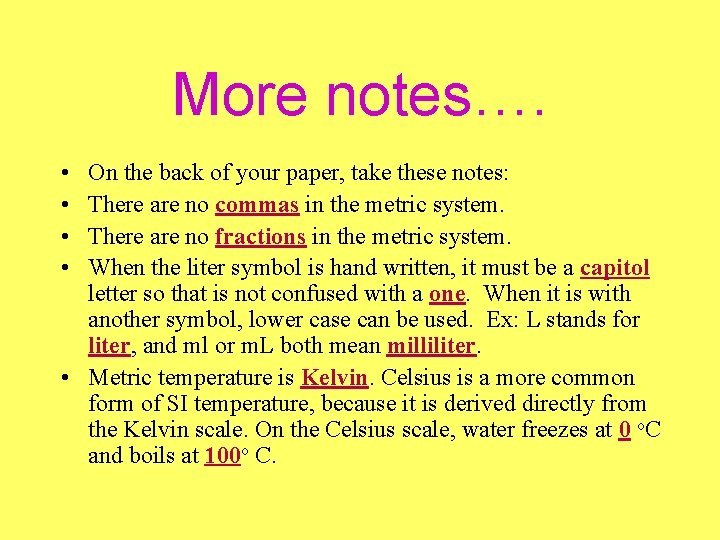
More notes…. • • On the back of your paper, take these notes: There are no commas in the metric system. There are no fractions in the metric system. When the liter symbol is hand written, it must be a capitol letter so that is not confused with a one. When it is with another symbol, lower case can be used. Ex: L stands for liter, and ml or m. L both mean milliliter. • Metric temperature is Kelvin. Celsius is a more common form of SI temperature, because it is derived directly from the Kelvin scale. On the Celsius scale, water freezes at 0 o. C and boils at 100 o C.
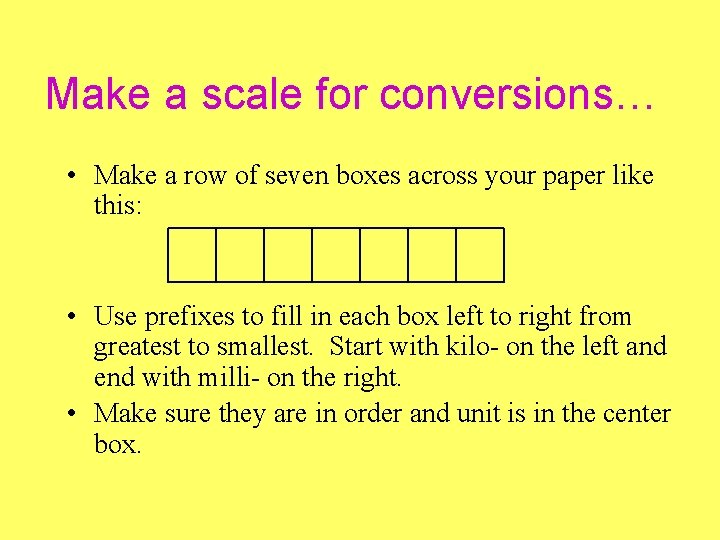
Make a scale for conversions… • Make a row of seven boxes across your paper like this: • Use prefixes to fill in each box left to right from greatest to smallest. Start with kilo- on the left and end with milli- on the right. • Make sure they are in order and unit is in the center box.
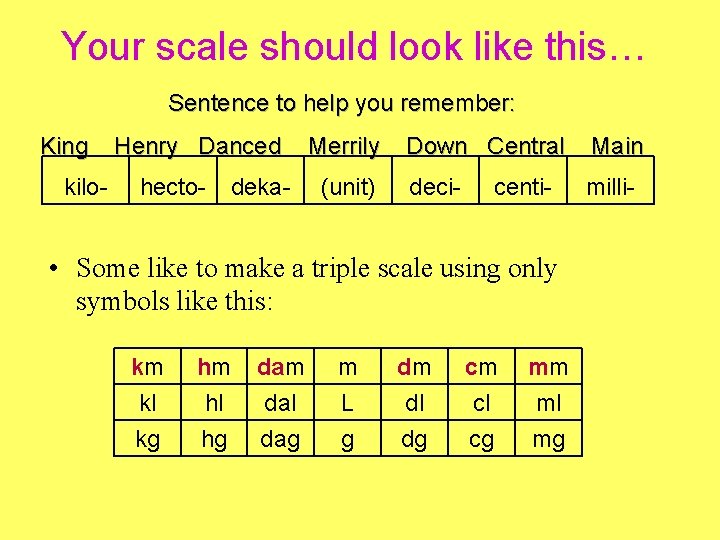
Your scale should look like this… Sentence to help you remember: King Henry Danced Merrily Down Central Main kilo- hecto- deka- (unit) deci- centi- • Some like to make a triple scale using only symbols like this: km kl kg hm hl hg dam dal dag m L g dm dl dg cm cl cg mm ml mg milli-
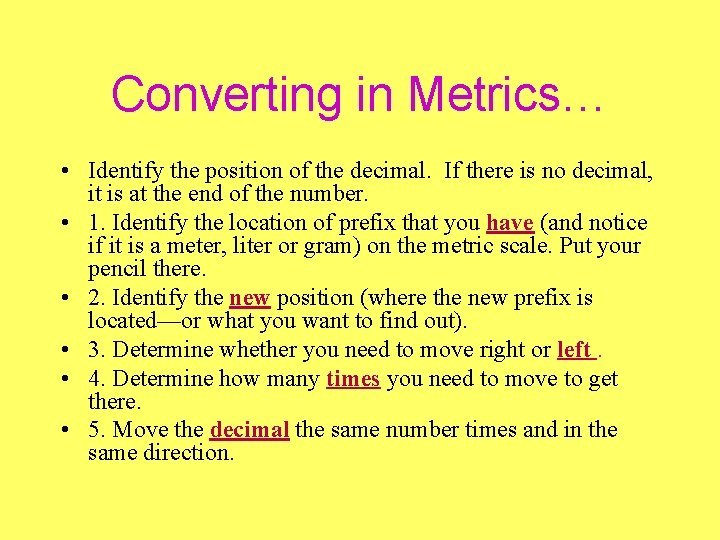
Converting in Metrics… • Identify the position of the decimal. If there is no decimal, it is at the end of the number. • 1. Identify the location of prefix that you have (and notice if it is a meter, liter or gram) on the metric scale. Put your pencil there. • 2. Identify the new position (where the new prefix is located—or what you want to find out). • 3. Determine whether you need to move right or left. • 4. Determine how many times you need to move to get there. • 5. Move the decimal the same number times and in the same direction.
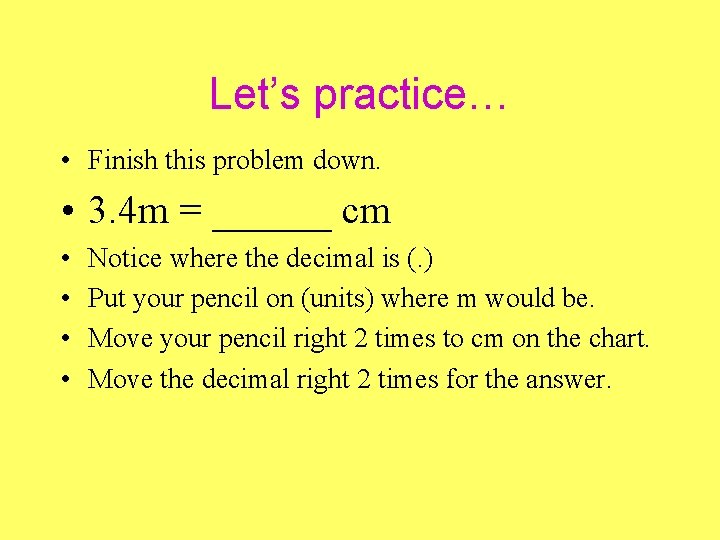
Let’s practice… • Finish this problem down. • 3. 4 m = ______ cm • • Notice where the decimal is (. ) Put your pencil on (units) where m would be. Move your pencil right 2 times to cm on the chart. Move the decimal right 2 times for the answer.
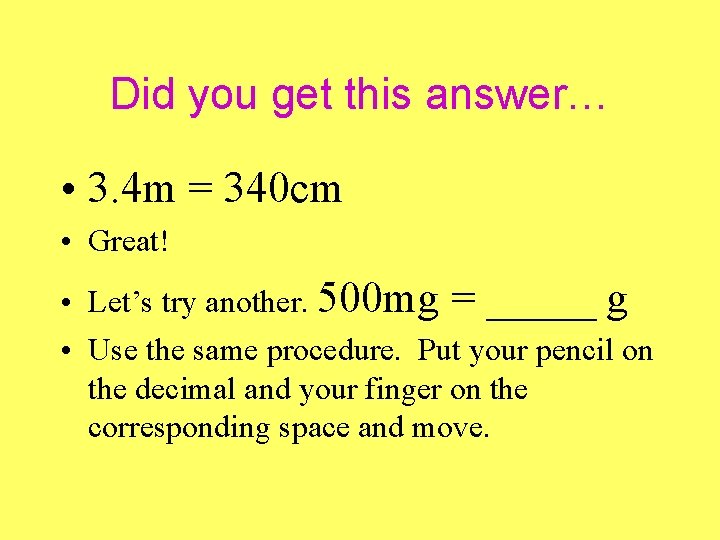
Did you get this answer… • 3. 4 m = 340 cm • Great! • Let’s try another. 500 mg = _____ g • Use the same procedure. Put your pencil on the decimal and your finger on the corresponding space and move.
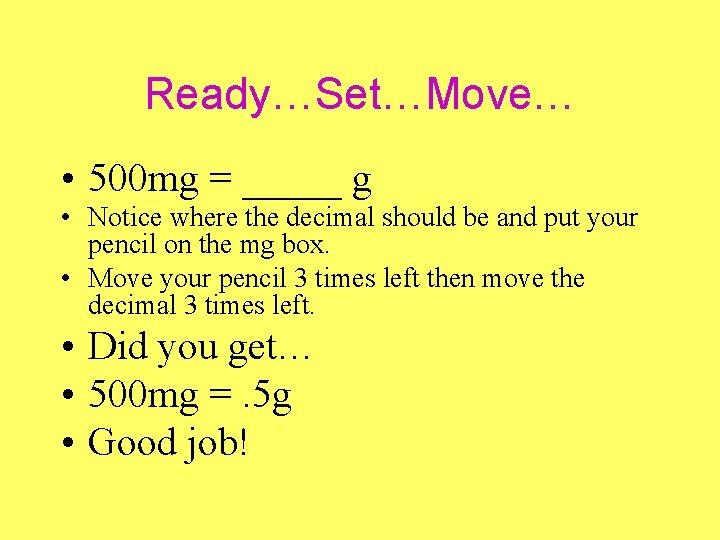
Ready…Set…Move… • 500 mg = _____ g • Notice where the decimal should be and put your pencil on the mg box. • Move your pencil 3 times left then move the decimal 3 times left. • Did you get… • 500 mg =. 5 g • Good job!
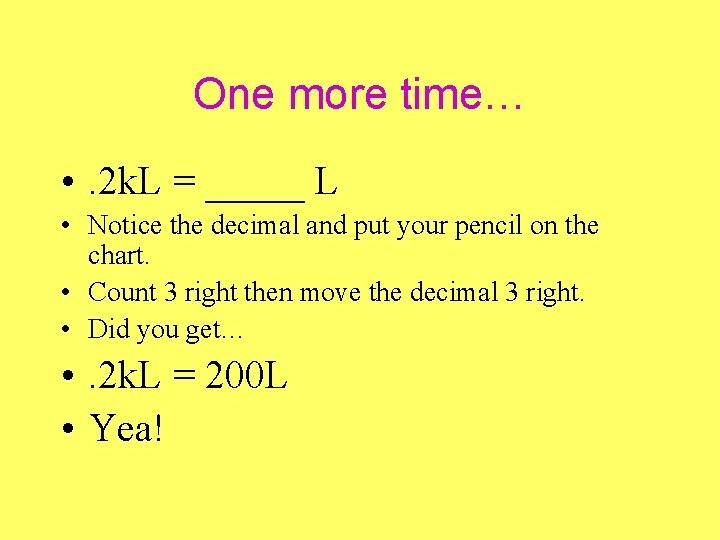
One more time… • . 2 k. L = _____ L • Notice the decimal and put your pencil on the chart. • Count 3 right then move the decimal 3 right. • Did you get… • . 2 k. L = 200 L • Yea!
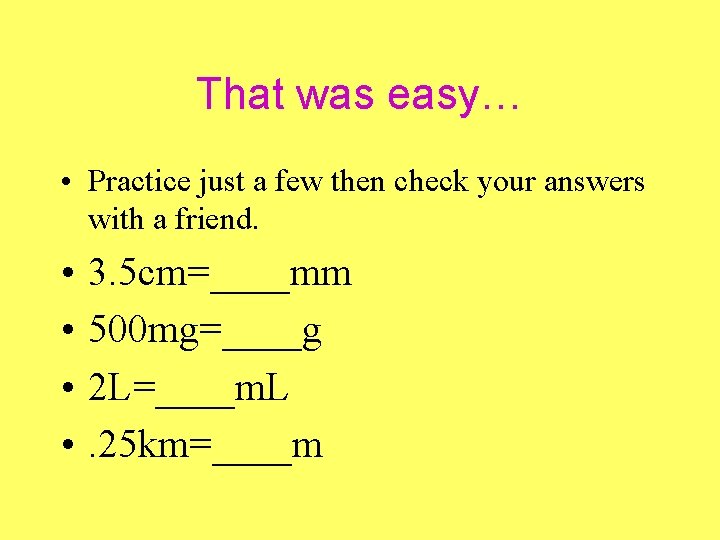
That was easy… • Practice just a few then check your answers with a friend. • • 3. 5 cm=____mm 500 mg=____g 2 L=____m. L. 25 km=____m
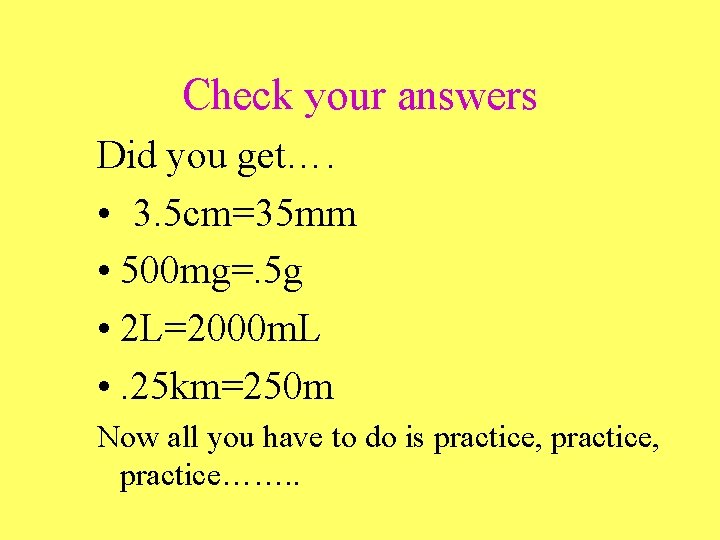
Check your answers Did you get…. • 3. 5 cm=35 mm • 500 mg=. 5 g • 2 L=2000 m. L • . 25 km=250 m Now all you have to do is practice, practice……. .
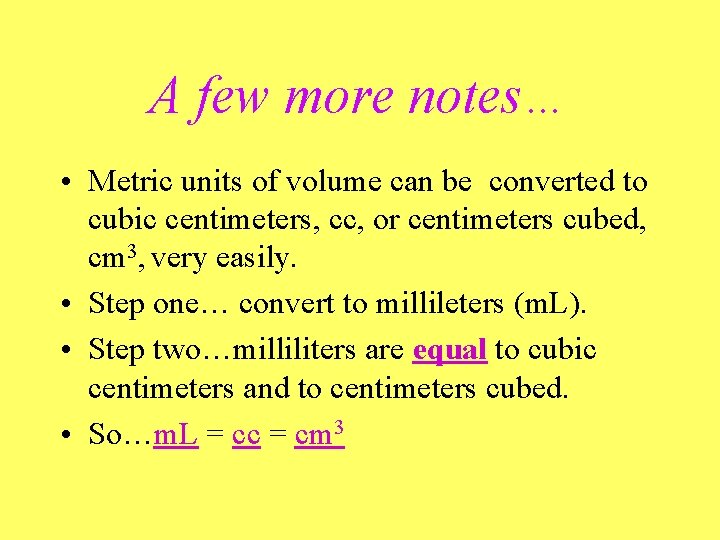
A few more notes… • Metric units of volume can be converted to cubic centimeters, cc, or centimeters cubed, cm 3, very easily. • Step one… convert to millileters (m. L). • Step two…milliliters are equal to cubic centimeters and to centimeters cubed. • So…m. L = cc = cm 3
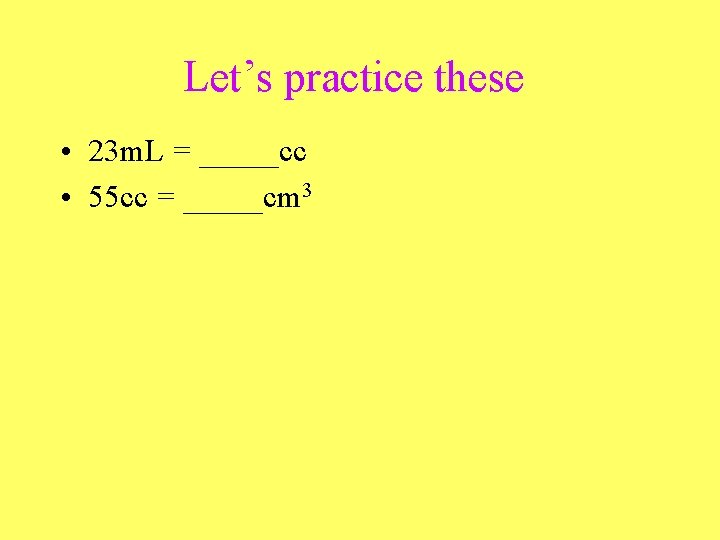
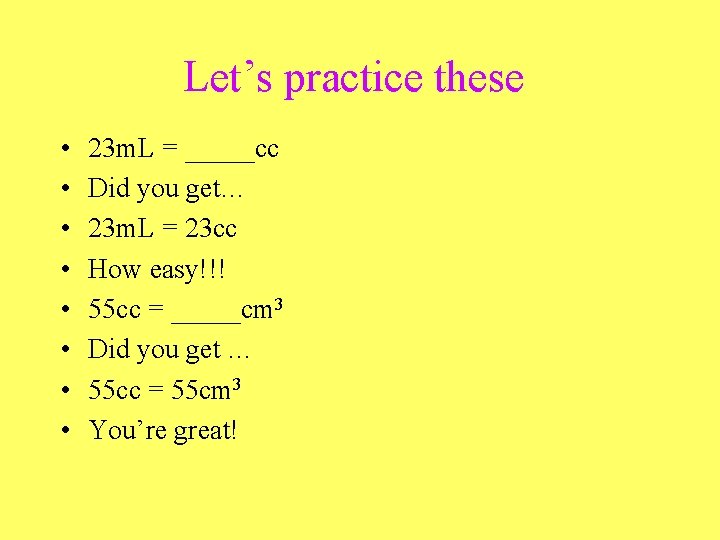
Let’s practice these • 23 m. L = _____cc • 55 cc = _____cm 3
Let’s practice these • • 23 m. L = _____cc Did you get… 23 m. L = 23 cc How easy!!! 55 cc = _____cm 3 Did you get … 55 cc = 55 cm 3 You’re great!
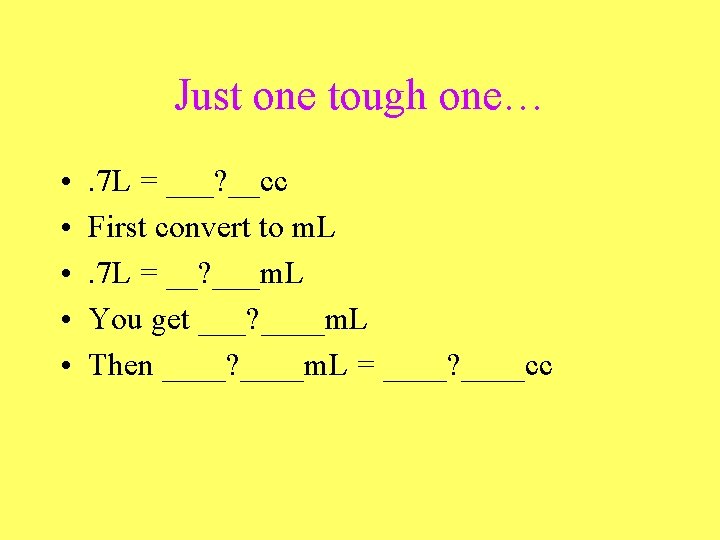
Just one tough one… • • • . 7 L = ___? __cc First convert to m. L. 7 L = __? ___m. L You get ___? ____m. L Then ____? ____m. L = ____? ____cc
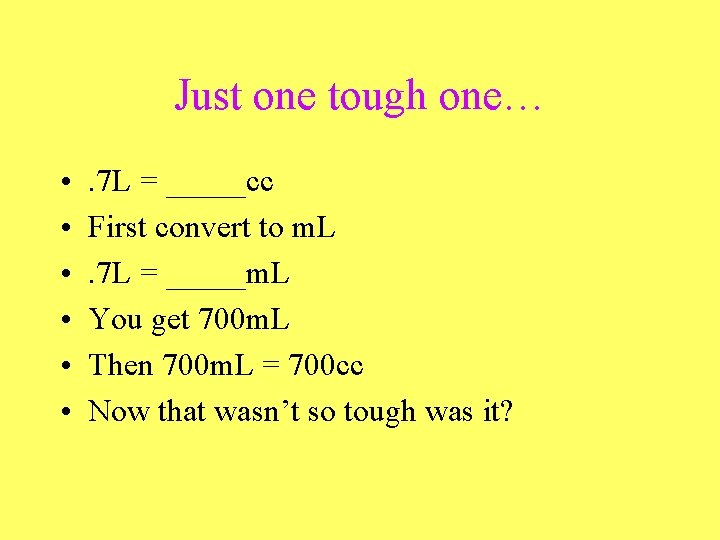
Just one tough one… • • • . 7 L = _____cc First convert to m. L. 7 L = _____m. L You get 700 m. L Then 700 m. L = 700 cc Now that wasn’t so tough was it?
Now you know the International System of Measurement! aka: SI Isn’t the metric system easier than you thought? Keep practicing!!!
Congratulations!