
The International Statistical Classification of Diseases and Related
- Slides: 18
The International Statistical Classification of Diseases and Related Health Problems, Tenth Revision, Clinical Modification David Berglund, MD, MPH Office of the Center Director National Center for Health Statistics U. S. DEPARTMENT OF HEALTH AND HUMAN SERVICES Centers for Disease Control and Prevention National Center for Health Statistics
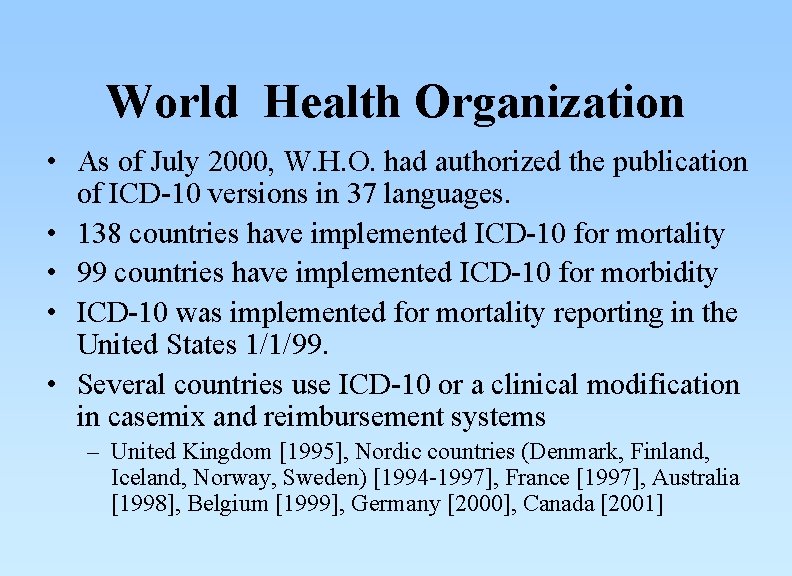
World Health Organization • As of July 2000, W. H. O. had authorized the publication of ICD-10 versions in 37 languages. • 138 countries have implemented ICD-10 for mortality • 99 countries have implemented ICD-10 for morbidity • ICD-10 was implemented for mortality reporting in the United States 1/1/99. • Several countries use ICD-10 or a clinical modification in casemix and reimbursement systems – United Kingdom [1995], Nordic countries (Denmark, Finland, Iceland, Norway, Sweden) [1994 -1997], France [1997], Australia [1998], Belgium [1999], Germany [2000], Canada [2001]
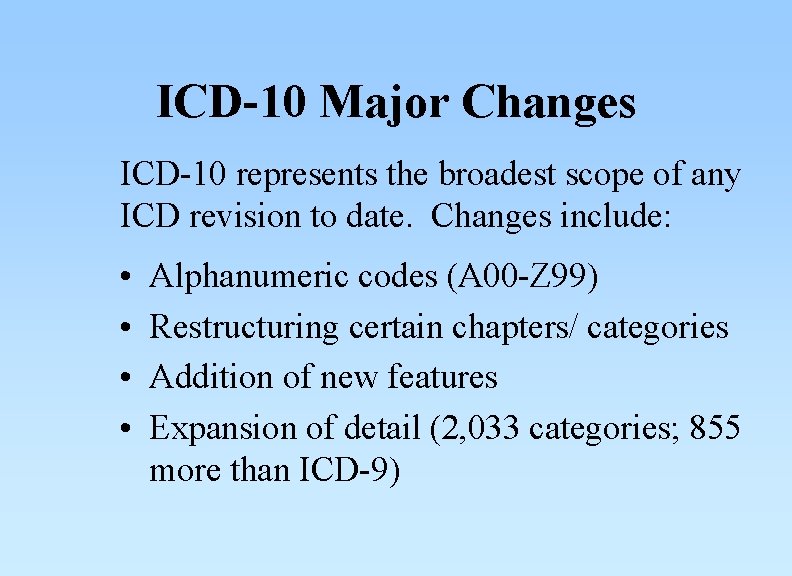
ICD-10 Major Changes ICD-10 represents the broadest scope of any ICD revision to date. Changes include: • • Alphanumeric codes (A 00 -Z 99) Restructuring certain chapters/ categories Addition of new features Expansion of detail (2, 033 categories; 855 more than ICD-9)
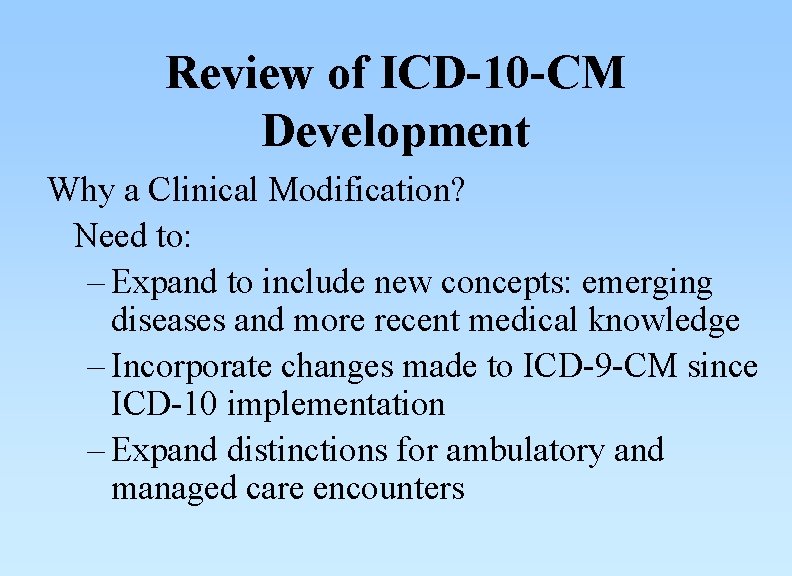
Review of ICD-10 -CM Development Why a Clinical Modification? Need to: – Expand to include new concepts: emerging diseases and more recent medical knowledge – Incorporate changes made to ICD-9 -CM since ICD-10 implementation – Expand distinctions for ambulatory and managed care encounters
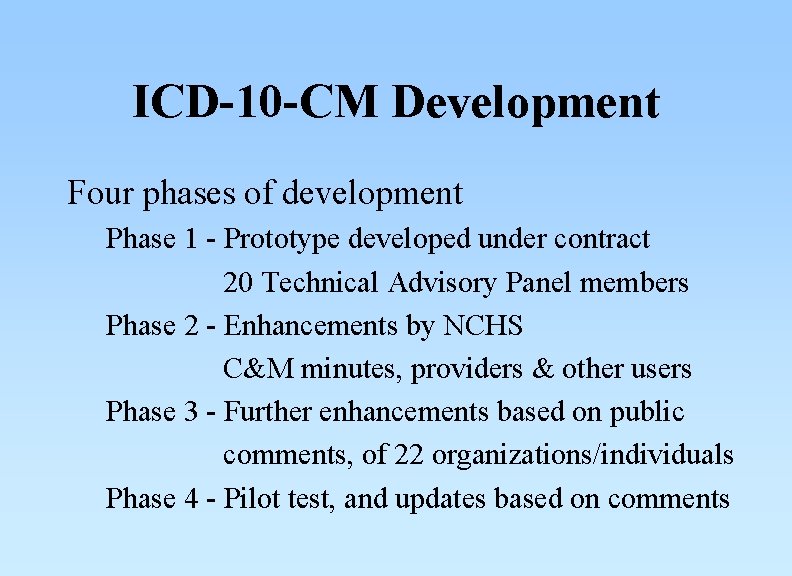
ICD-10 -CM Development Four phases of development Phase 1 - Prototype developed under contract 20 Technical Advisory Panel members Phase 2 - Enhancements by NCHS C&M minutes, providers & other users Phase 3 - Further enhancements based on public comments, of 22 organizations/individuals Phase 4 - Pilot test, and updates based on comments
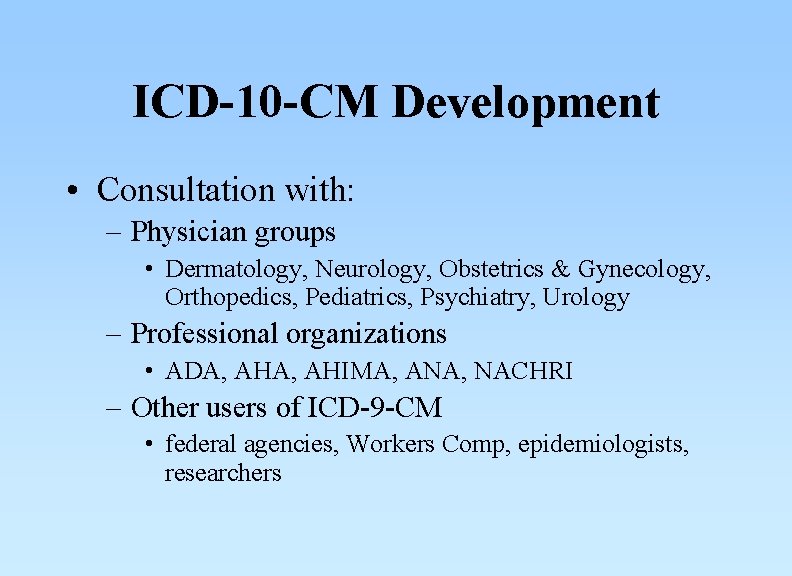
ICD-10 -CM Development • Consultation with: – Physician groups • Dermatology, Neurology, Obstetrics & Gynecology, Orthopedics, Pediatrics, Psychiatry, Urology – Professional organizations • ADA, AHIMA, ANA, NACHRI – Other users of ICD-9 -CM • federal agencies, Workers Comp, epidemiologists, researchers
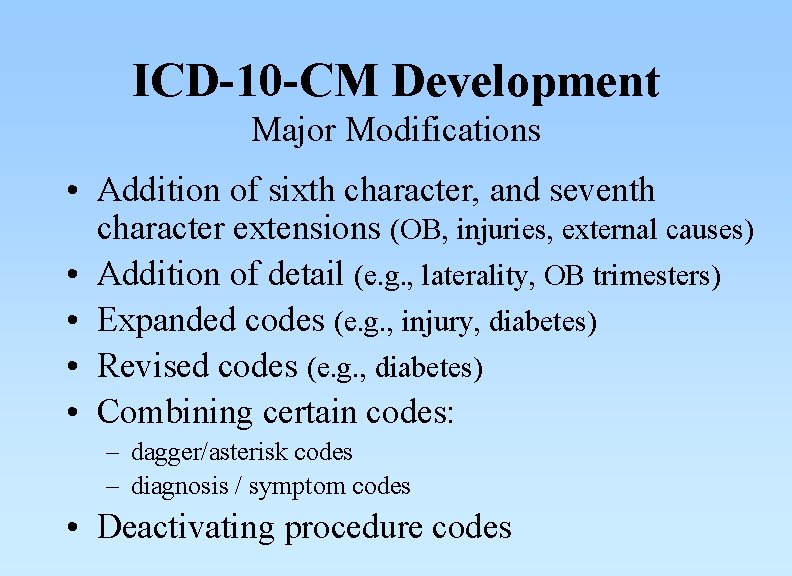
ICD-10 -CM Development Major Modifications • Addition of sixth character, and seventh character extensions (OB, injuries, external causes) • Addition of detail (e. g. , laterality, OB trimesters) • Expanded codes (e. g. , injury, diabetes) • Revised codes (e. g. , diabetes) • Combining certain codes: – dagger/asterisk codes – diagnosis / symptom codes • Deactivating procedure codes
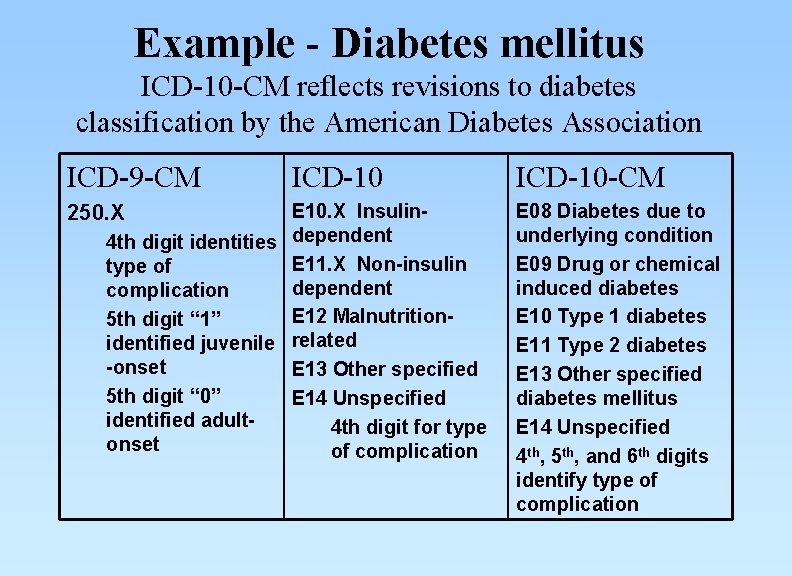
Example - Diabetes mellitus ICD-10 -CM reflects revisions to diabetes classification by the American Diabetes Association ICD-9 -CM ICD-10 E 10. X Insulin 4 th digit identities dependent E 11. X Non-insulin type of dependent complication E 12 Malnutrition 5 th digit “ 1” identified juvenile related -onset E 13 Other specified 5 th digit “ 0” E 14 Unspecified identified adult 4 th digit for type onset of complication 250. X ICD-10 -CM E 08 Diabetes due to underlying condition E 09 Drug or chemical induced diabetes E 10 Type 1 diabetes E 11 Type 2 diabetes E 13 Other specified diabetes mellitus E 14 Unspecified 4 th, 5 th, and 6 th digits identify type of complication
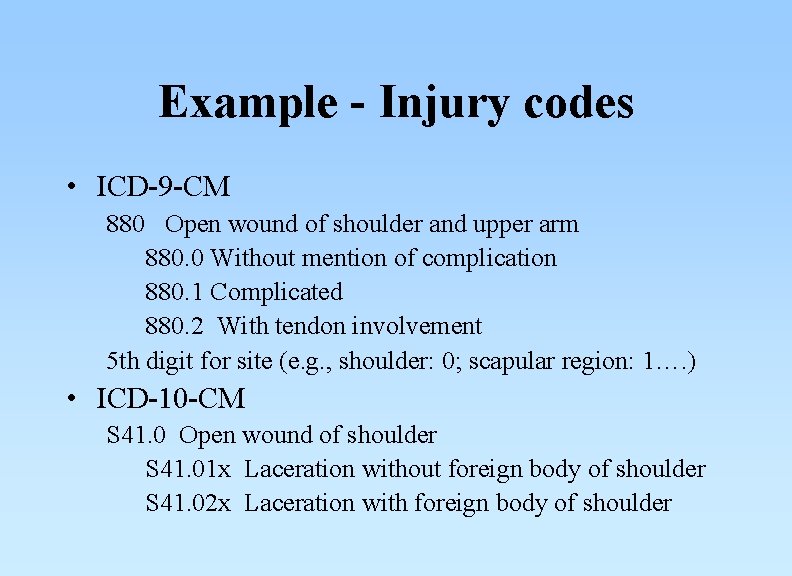
Example - Injury codes • ICD-9 -CM 880 Open wound of shoulder and upper arm 880. 0 Without mention of complication 880. 1 Complicated 880. 2 With tendon involvement 5 th digit for site (e. g. , shoulder: 0; scapular region: 1…. ) • ICD-10 -CM S 41. 0 Open wound of shoulder S 41. 01 x Laceration without foreign body of shoulder S 41. 02 x Laceration with foreign body of shoulder
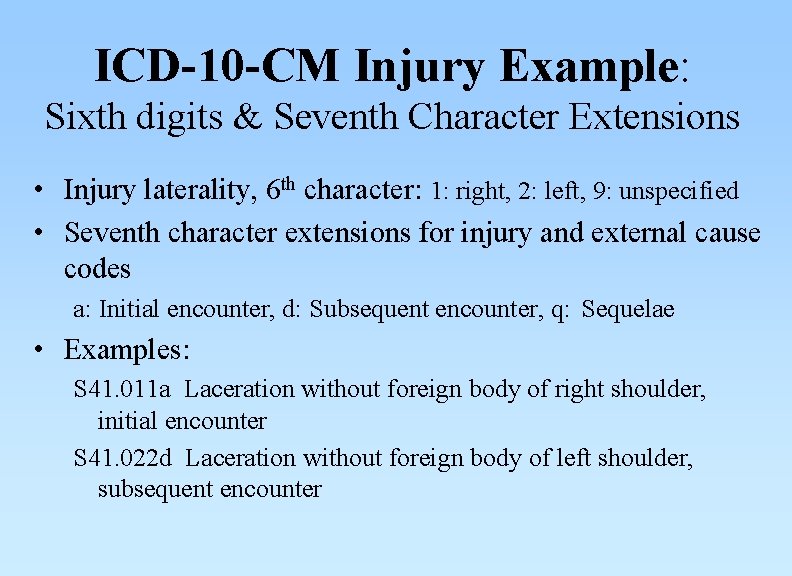
ICD-10 -CM Injury Example: Sixth digits & Seventh Character Extensions • Injury laterality, 6 th character: 1: right, 2: left, 9: unspecified • Seventh character extensions for injury and external cause codes a: Initial encounter, d: Subsequent encounter, q: Sequelae • Examples: S 41. 011 a Laceration without foreign body of right shoulder, initial encounter S 41. 022 d Laceration without foreign body of left shoulder, subsequent encounter
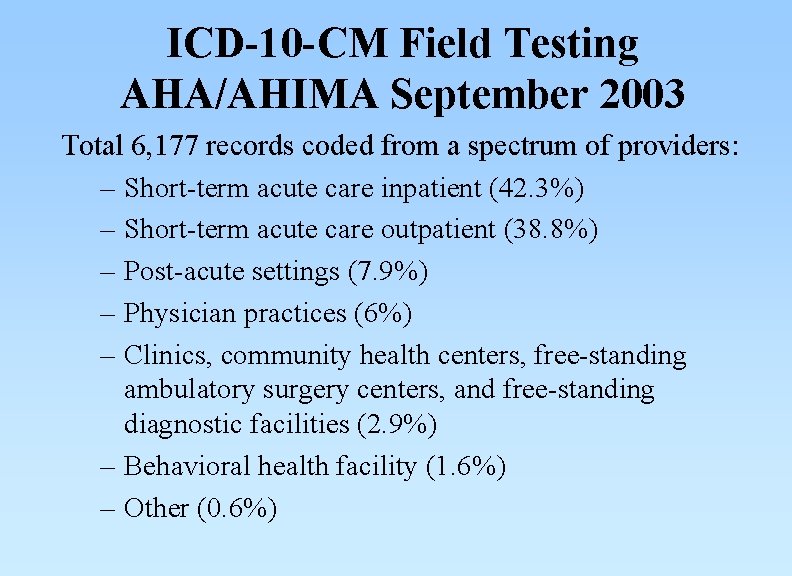
ICD-10 -CM Field Testing AHA/AHIMA September 2003 Total 6, 177 records coded from a spectrum of providers: – Short-term acute care inpatient (42. 3%) – Short-term acute care outpatient (38. 8%) – Post-acute settings (7. 9%) – Physician practices (6%) – Clinics, community health centers, free-standing ambulatory surgery centers, and free-standing diagnostic facilities (2. 9%) – Behavioral health facility (1. 6%) – Other (0. 6%)
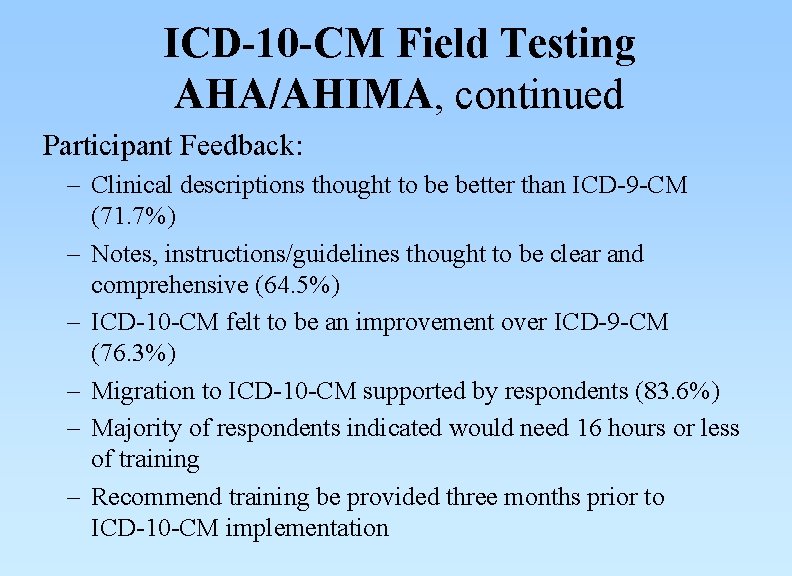
ICD-10 -CM Field Testing AHA/AHIMA, continued Participant Feedback: – Clinical descriptions thought to be better than ICD-9 -CM (71. 7%) – Notes, instructions/guidelines thought to be clear and comprehensive (64. 5%) – ICD-10 -CM felt to be an improvement over ICD-9 -CM (76. 3%) – Migration to ICD-10 -CM supported by respondents (83. 6%) – Majority of respondents indicated would need 16 hours or less of training – Recommend training be provided three months prior to ICD-10 -CM implementation
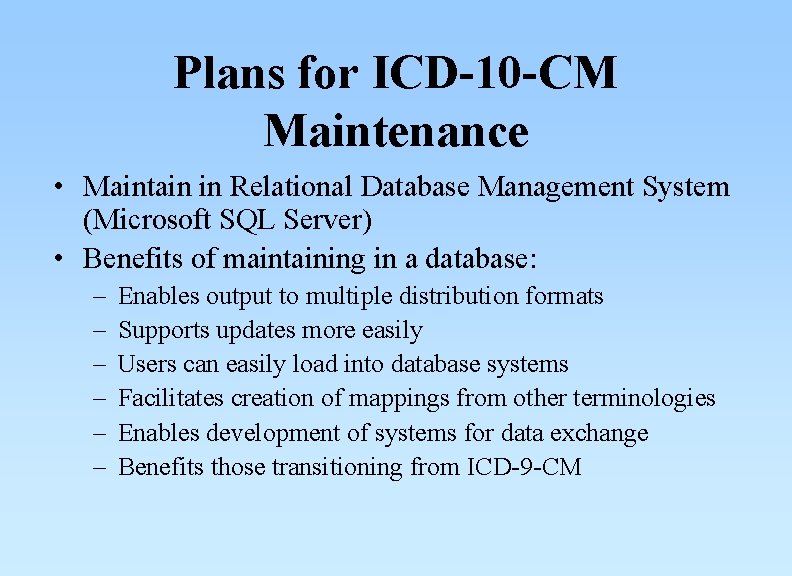
Plans for ICD-10 -CM Maintenance • Maintain in Relational Database Management System (Microsoft SQL Server) • Benefits of maintaining in a database: – – – Enables output to multiple distribution formats Supports updates more easily Users can easily load into database systems Facilitates creation of mappings from other terminologies Enables development of systems for data exchange Benefits those transitioning from ICD-9 -CM
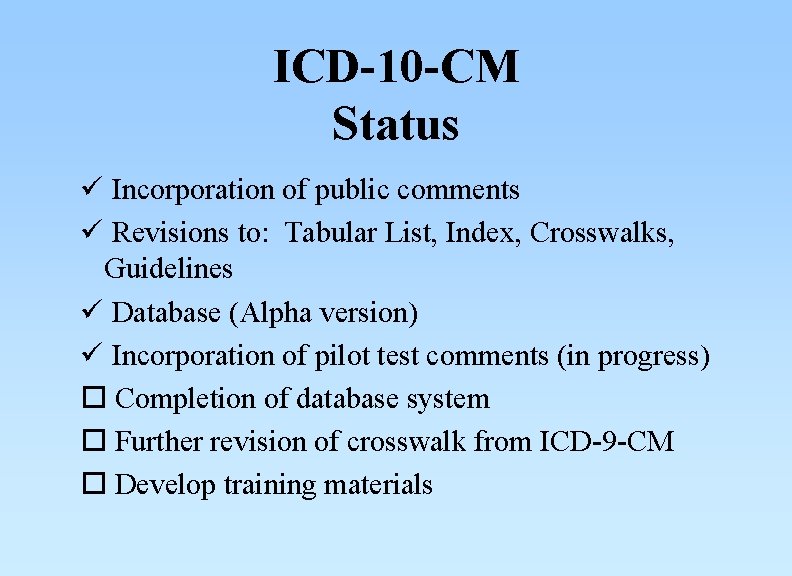
ICD-10 -CM Status ü Incorporation of public comments ü Revisions to: Tabular List, Index, Crosswalks, Guidelines ü Database (Alpha version) ü Incorporation of pilot test comments (in progress) o Completion of database system o Further revision of crosswalk from ICD-9 -CM o Develop training materials
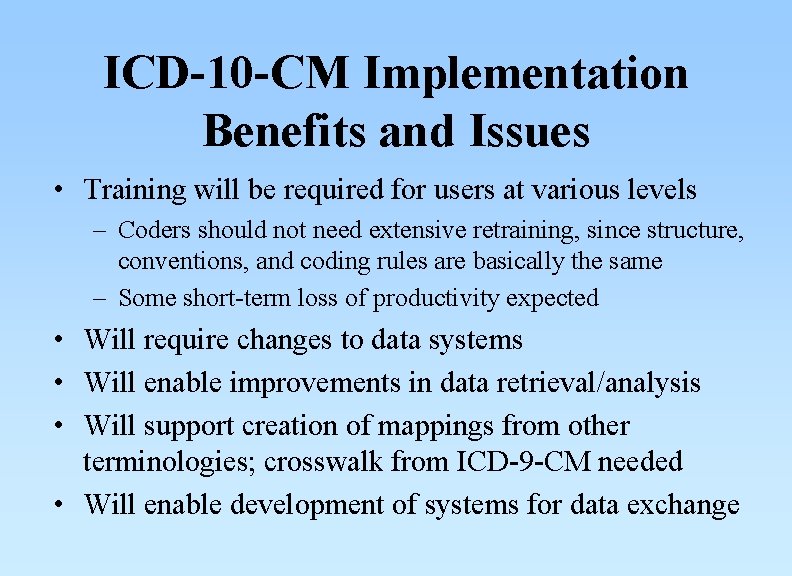
ICD-10 -CM Implementation Benefits and Issues • Training will be required for users at various levels – Coders should not need extensive retraining, since structure, conventions, and coding rules are basically the same – Some short-term loss of productivity expected • Will require changes to data systems • Will enable improvements in data retrieval/analysis • Will support creation of mappings from other terminologies; crosswalk from ICD-9 -CM needed • Will enable development of systems for data exchange
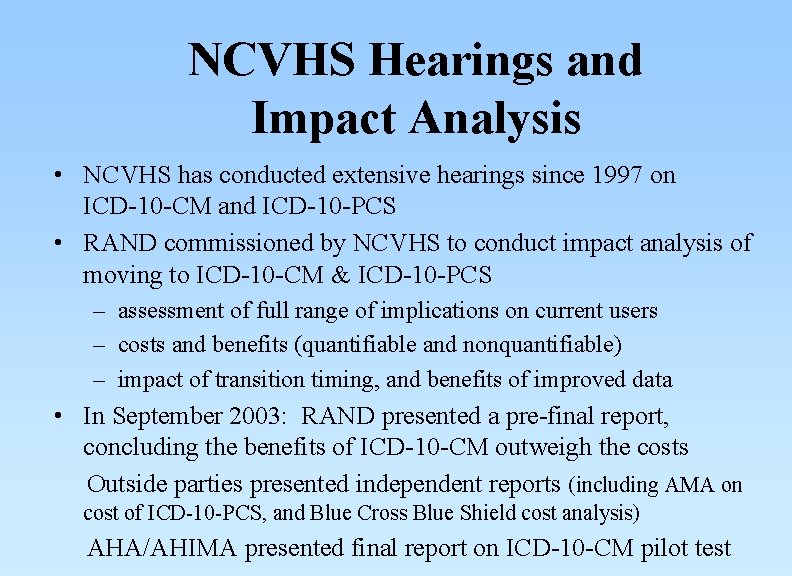
NCVHS Hearings and Impact Analysis • NCVHS has conducted extensive hearings since 1997 on ICD-10 -CM and ICD-10 -PCS • RAND commissioned by NCVHS to conduct impact analysis of moving to ICD-10 -CM & ICD-10 -PCS – assessment of full range of implications on current users – costs and benefits (quantifiable and nonquantifiable) – impact of transition timing, and benefits of improved data • In September 2003: RAND presented a pre-final report, concluding the benefits of ICD-10 -CM outweigh the costs Outside parties presented independent reports (including AMA on cost of ICD-10 -PCS, and Blue Cross Blue Shield cost analysis) AHA/AHIMA presented final report on ICD-10 -CM pilot test
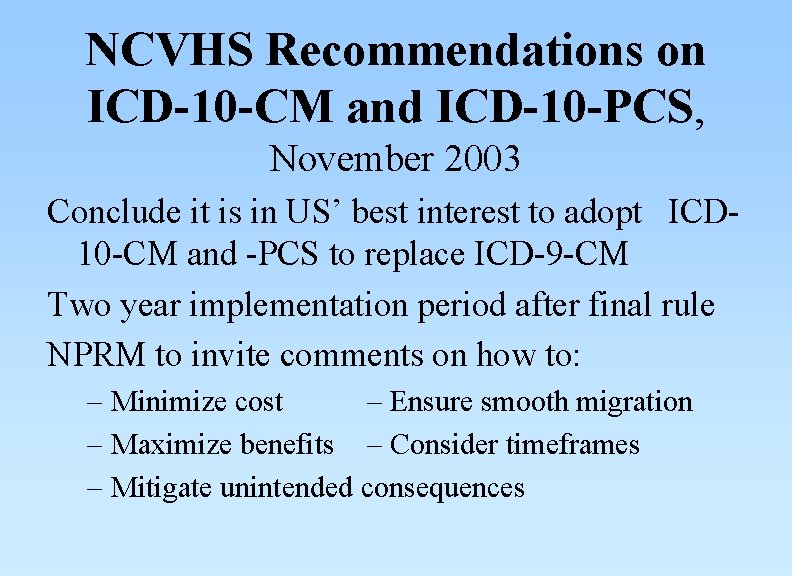
NCVHS Recommendations on ICD-10 -CM and ICD-10 -PCS, November 2003 Conclude it is in US’ best interest to adopt ICD 10 -CM and -PCS to replace ICD-9 -CM Two year implementation period after final rule NPRM to invite comments on how to: – Minimize cost – Ensure smooth migration – Maximize benefits – Consider timeframes – Mitigate unintended consequences
Web Sites NCHS Classification of Diseases: ICD-9 -CM, ICD-10 -CM, and ICF http: //www. cdc. gov/nchs/icd 9. htm National Committee on Vital and Health Statistics: http: //www. ncvhs. hhs. gov Centers for Medicare and Medicaid Services: ICD-10 -PCS http: //www. cms. hhs. gov/paymentsystems/icd 9/icd 10. asp