
The International Statistical Classification of Diseases and Related
- Slides: 29
The International Statistical Classification of Diseases and Related Health Problems, Tenth Revision, Clinical Modification Office of the Center Director, Data Policy and Standards National Center for Health Statistics Donna Pickett, MPH, RRA nchs CDC Centers for Disease Control and Prevention
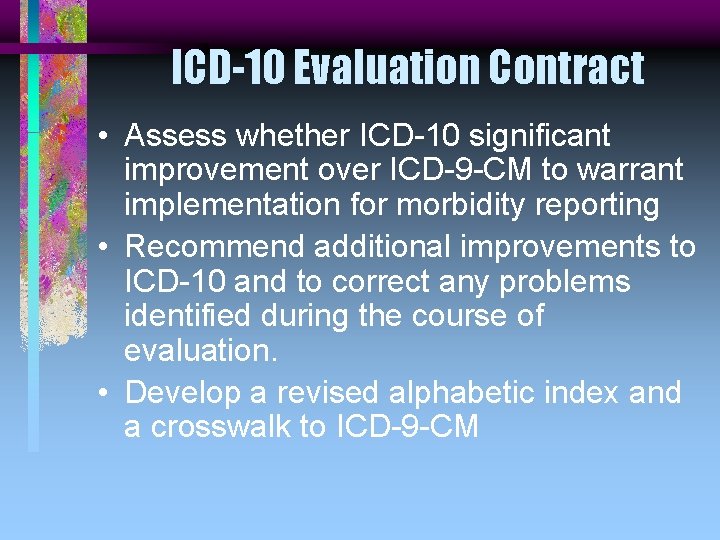
ICD-10 Evaluation Contract • Assess whether ICD-10 significant improvement over ICD-9 -CM to warrant implementation for morbidity reporting • Recommend additional improvements to ICD-10 and to correct any problems identified during the course of evaluation. • Develop a revised alphabetic index and a crosswalk to ICD-9 -CM
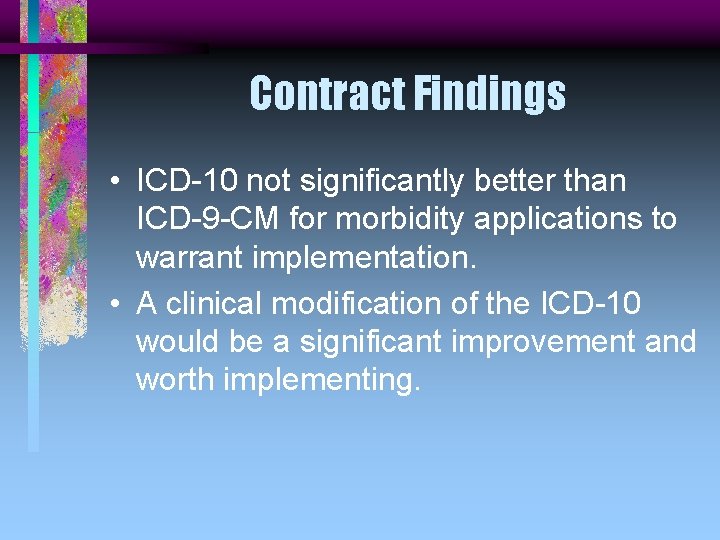
Contract Findings • ICD-10 not significantly better than ICD-9 -CM for morbidity applications to warrant implementation. • A clinical modification of the ICD-10 would be a significant improvement and worth implementing.
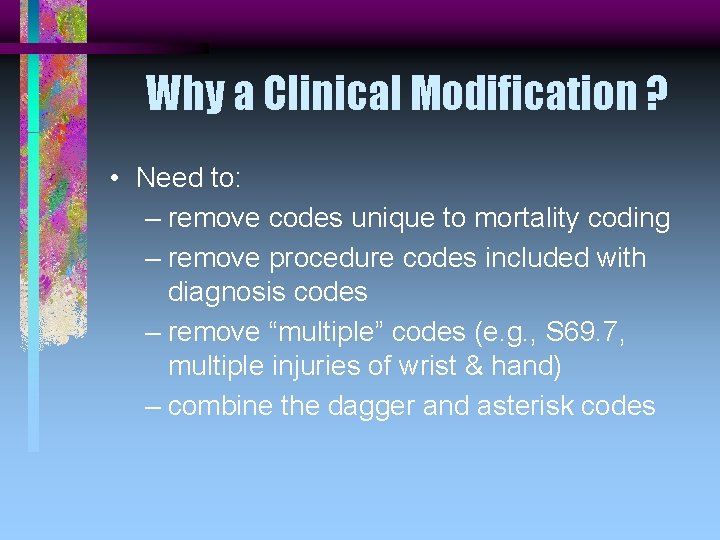
Why a Clinical Modification ? • Need to: – remove codes unique to mortality coding – remove procedure codes included with diagnosis codes – remove “multiple” codes (e. g. , S 69. 7, multiple injuries of wrist & hand) – combine the dagger and asterisk codes
Phase II Creating the Clinical Modification • Further evaluation of ICD-10 categories to provide codes for ambulatory and managed care encounters, clinical decision-making and outcomes research • Evaluation of residual categories (“Other Specified”) to determine whether further specificity is needed
Phase II Focused Reviews • Review of previous Coordination and Maintenance Committee recommendations that could not be incorporated into ICD-9 -CM due to space limitations • Consultation with physician groups and others to assure clinical accuracy
ICD-10 -CM Major Modifications • Addition of sixth character • Incorporation of common 4 th and 5 th digit subclassification • Addition of Laterality • Combining dagger/asterisk codes
ICD-10 -CM Major Modifications continued • Created combination diagnosis / symptoms codes • Deactivated procedure codes • Further expansion of post-operative complication codes
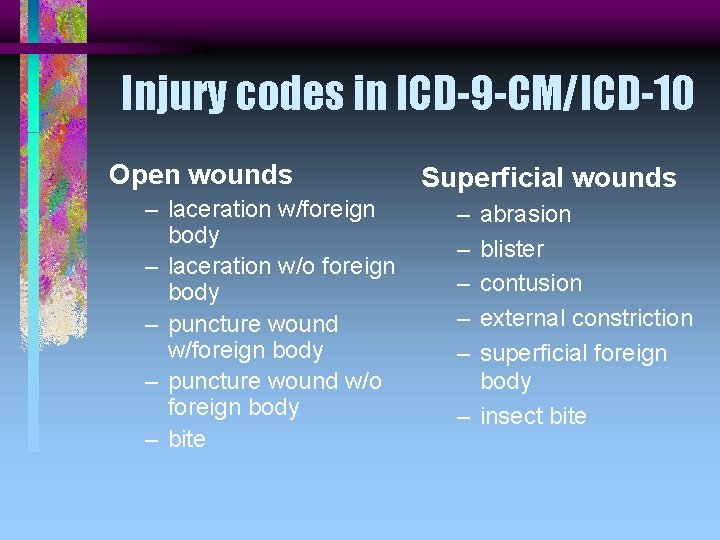
Injury codes in ICD-9 -CM/ICD-10 Open wounds – laceration w/foreign body – laceration w/o foreign body – puncture wound w/o foreign body – bite Superficial wounds – – – abrasion blister contusion external constriction superficial foreign body – insect bite
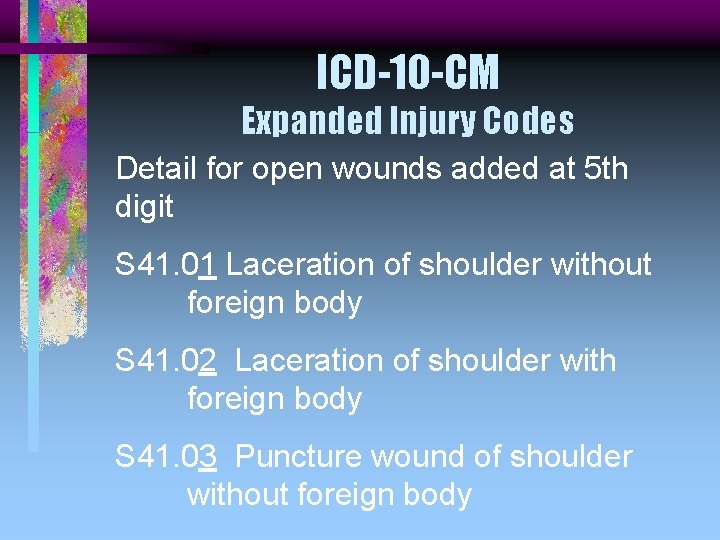
ICD-10 -CM Expanded Injury Codes Detail for open wounds added at 5 th digit S 41. 01 Laceration of shoulder without foreign body S 41. 02 Laceration of shoulder with foreign body S 41. 03 Puncture wound of shoulder without foreign body
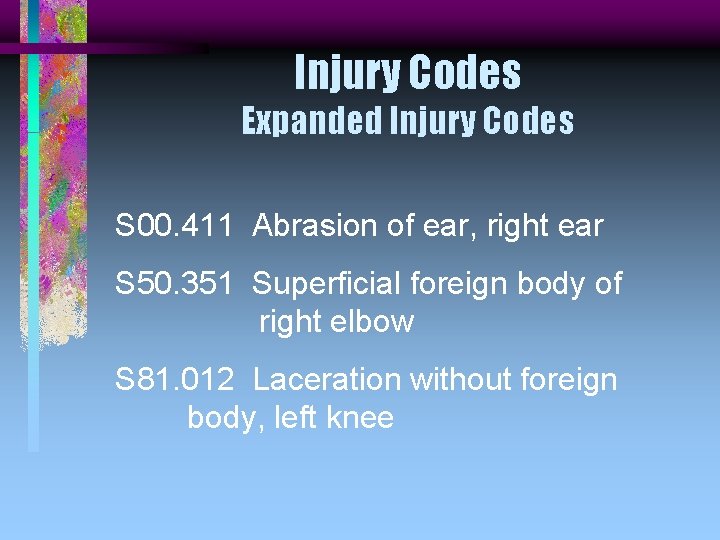
Injury Codes Expanded Injury Codes S 00. 411 Abrasion of ear, right ear S 50. 351 Superficial foreign body of right elbow S 81. 012 Laceration without foreign body, left knee
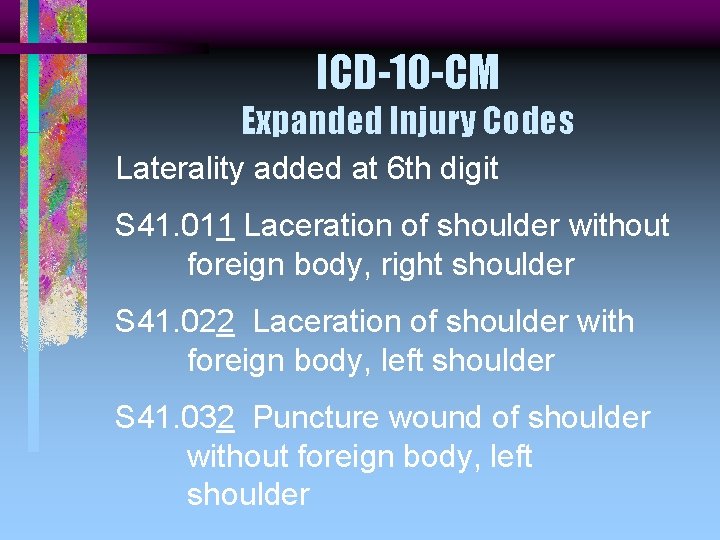
ICD-10 -CM Expanded Injury Codes Laterality added at 6 th digit S 41. 011 Laceration of shoulder without foreign body, right shoulder S 41. 022 Laceration of shoulder with foreign body, left shoulder S 41. 032 Puncture wound of shoulder without foreign body, left shoulder
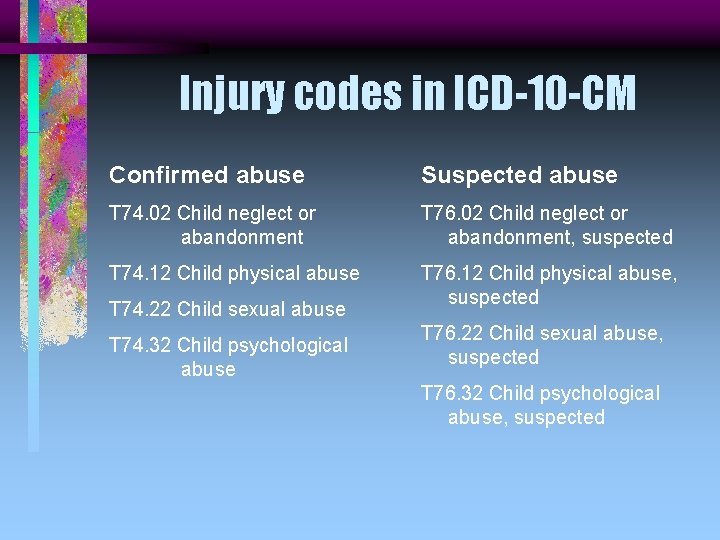
Injury codes in ICD-10 -CM Confirmed abuse Suspected abuse T 74. 02 Child neglect or abandonment T 76. 02 Child neglect or abandonment, suspected T 74. 12 Child physical abuse T 76. 12 Child physical abuse, suspected T 74. 22 Child sexual abuse T 74. 32 Child psychological abuse T 76. 22 Child sexual abuse, suspected T 76. 32 Child psychological abuse, suspected
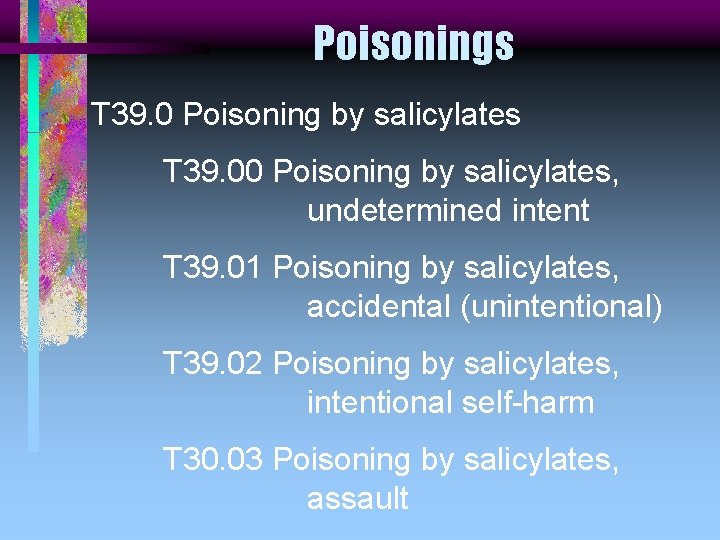
Poisonings T 39. 0 Poisoning by salicylates T 39. 00 Poisoning by salicylates, undetermined intent T 39. 01 Poisoning by salicylates, accidental (unintentional) T 39. 02 Poisoning by salicylates, intentional self-harm T 30. 03 Poisoning by salicylates, assault
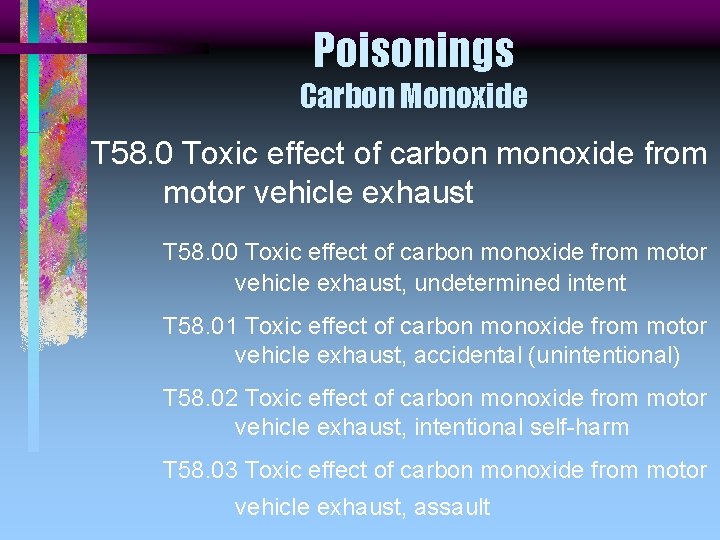
Poisonings Carbon Monoxide T 58. 0 Toxic effect of carbon monoxide from motor vehicle exhaust T 58. 00 Toxic effect of carbon monoxide from motor vehicle exhaust, undetermined intent T 58. 01 Toxic effect of carbon monoxide from motor vehicle exhaust, accidental (unintentional) T 58. 02 Toxic effect of carbon monoxide from motor vehicle exhaust, intentional self-harm T 58. 03 Toxic effect of carbon monoxide from motor vehicle exhaust, assault
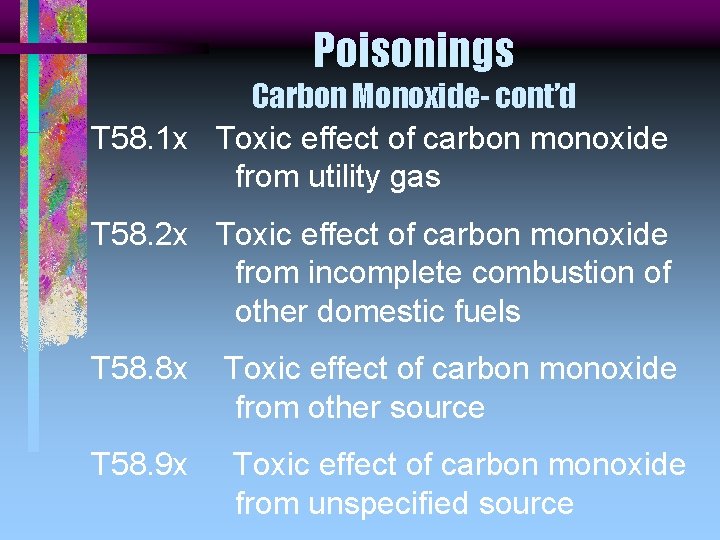
Poisonings Carbon Monoxide- cont’d T 58. 1 x Toxic effect of carbon monoxide from utility gas T 58. 2 x Toxic effect of carbon monoxide from incomplete combustion of other domestic fuels T 58. 8 x Toxic effect of carbon monoxide from other source T 58. 9 x Toxic effect of carbon monoxide from unspecified source
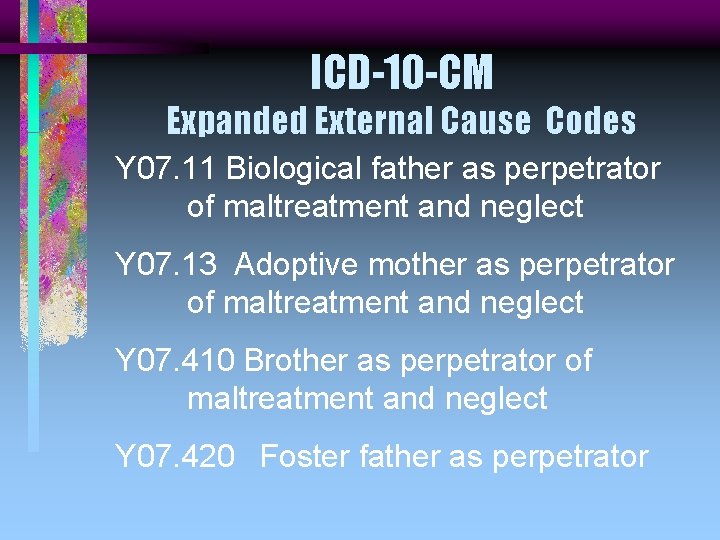
ICD-10 -CM Expanded External Cause Codes Y 07. 11 Biological father as perpetrator of maltreatment and neglect Y 07. 13 Adoptive mother as perpetrator of maltreatment and neglect Y 07. 410 Brother as perpetrator of maltreatment and neglect Y 07. 420 Foster father as perpetrator
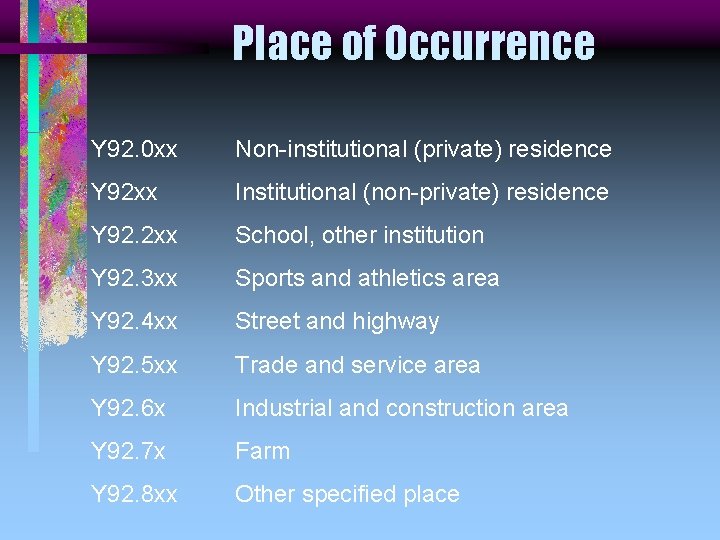
Place of Occurrence Y 92. 0 xx Non-institutional (private) residence Y 92 xx Institutional (non-private) residence Y 92. 2 xx School, other institution Y 92. 3 xx Sports and athletics area Y 92. 4 xx Street and highway Y 92. 5 xx Trade and service area Y 92. 6 x Industrial and construction area Y 92. 7 x Farm Y 92. 8 xx Other specified place
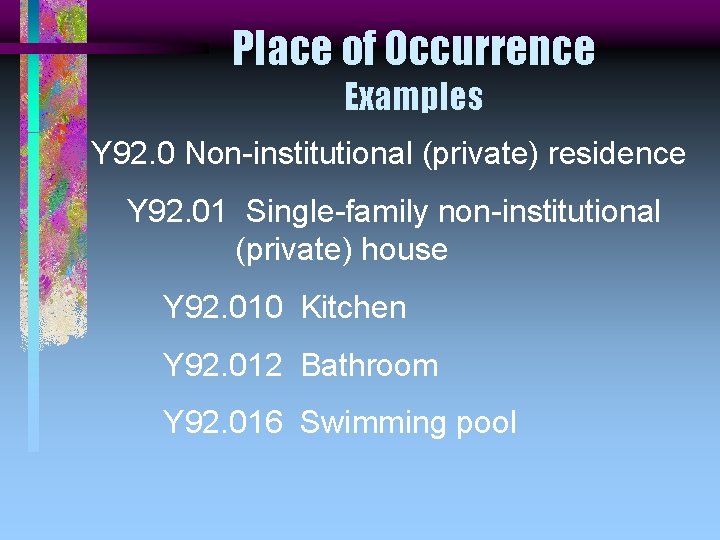
Place of Occurrence Examples Y 92. 0 Non-institutional (private) residence Y 92. 01 Single-family non-institutional (private) house Y 92. 010 Kitchen Y 92. 012 Bathroom Y 92. 016 Swimming pool
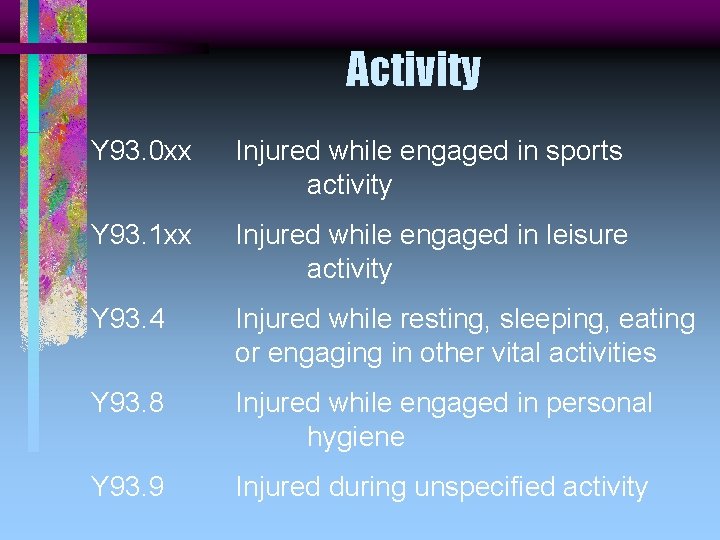
Activity Y 93. 0 xx Injured while engaged in sports activity Y 93. 1 xx Injured while engaged in leisure activity Y 93. 4 Injured while resting, sleeping, eating or engaging in other vital activities Y 93. 8 Injured while engaged in personal hygiene Y 93. 9 Injured during unspecified activity
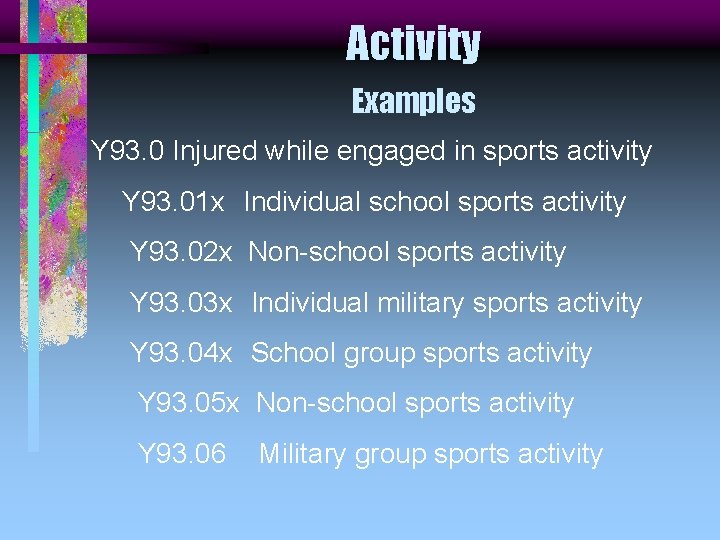
Activity Examples Y 93. 0 Injured while engaged in sports activity Y 93. 01 x Individual school sports activity Y 93. 02 x Non-school sports activity Y 93. 03 x Individual military sports activity Y 93. 04 x School group sports activity Y 93. 05 x Non-school sports activity Y 93. 06 Military group sports activity
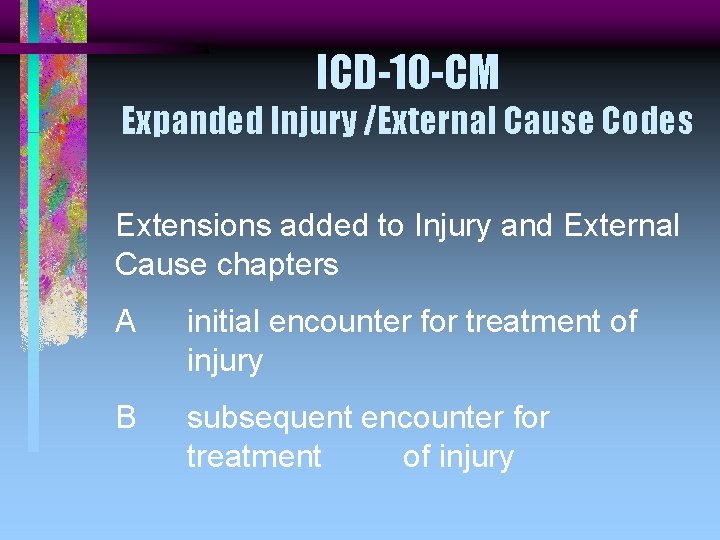
ICD-10 -CM Expanded Injury /External Cause Codes Extensions added to Injury and External Cause chapters A initial encounter for treatment of injury B subsequent encounter for treatment of injury
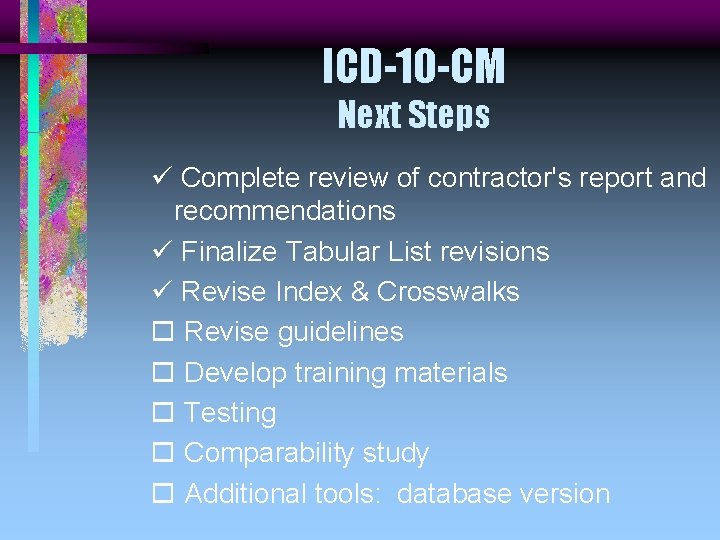
ICD-10 -CM Next Steps ü Complete review of contractor's report and recommendations ü Finalize Tabular List revisions ü Revise Index & Crosswalks o Revise guidelines o Develop training materials o Testing o Comparability study o Additional tools: database version
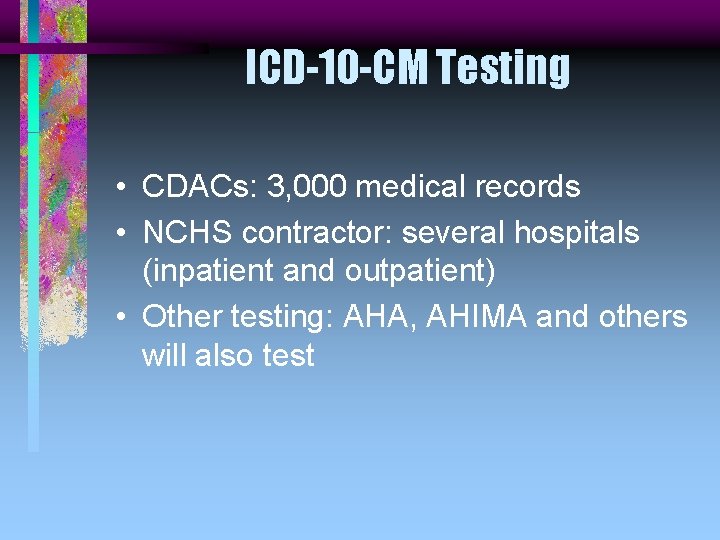
ICD-10 -CM Testing • CDACs: 3, 000 medical records • NCHS contractor: several hospitals (inpatient and outpatient) • Other testing: AHA, AHIMA and others will also test
HIPAA and ICD-10 -CM Implementation of ICD-10 -CM is tied to the standards adoption process specified in the Administrative Simplification provisions of the Health Insurance Portability and Accountability Act (HIPAA) of 1996.
HIPAA and ICD-10 -CM Implementation The Administrative Simplification (AS) provisions of HIPAA are intended to reduce the costs and administrative burdens of health care by making possible the standardized, electronic transmission of many administrative and financial transactions that are currently carried out manually on paper.
Administrative Simplification Provisions of HIPAA • Outlines national framework for: – Electronic data interchange – Health data standards – Health Information privacy – Improving efficiency and effectiveness of health care system
New Code sets Under HIPAA • No decisions have been made regarding new code sets • NPRM advised those who produce and process data to anticipate changes and build in system flexibility to allow implementation of different formats • Any recommendation for new standards requires public hearings & new NPRM
Web Sites NCHS Classification of Diseases: Information about ICD-9 -CM and ICD-10 -CM http: //www. cdc. gov/nchs/icd 9. htm Administrative Simplification Frequently Asked Questions http: //aspe. os. dhhs. gov/admnsimp/