
The International Space Station The International Space Station
- Slides: 11
The International Space Station
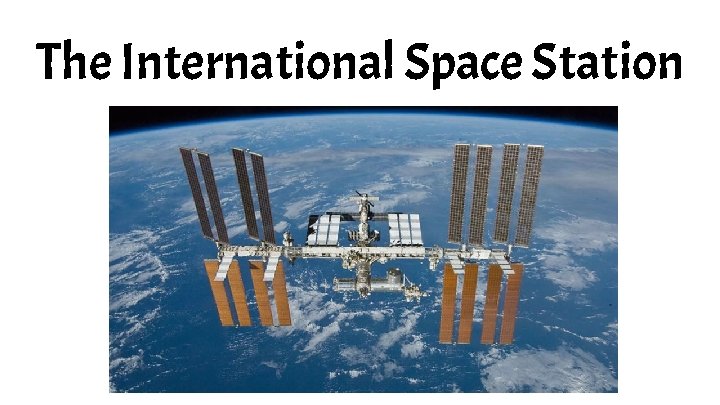
The International Space Station is a modular space station in low Earth orbit. It is a multinational collaborative project between five participating space agencies: NASA (United States), Roscosmos (Russia), JAXA (Japan), ESA (Europe), and CSA (Canada). The ownership and use of the space station are established by intergovernmental treaties and agreements.
The International Space Station Let’s get a sense of distance: - How far away is the moon? - How long does it take astronauts to travel to the moon?
The International Space Station Let’s get a sense of distance: - How far away is the moon? Average distance = 240, 000 miles or 384, 000 km - How long does it take astronauts to travel to the moon? About 3 days
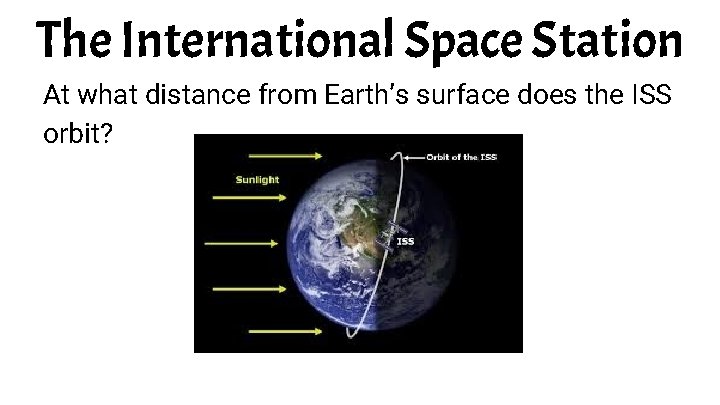
The International Space Station At what distance from Earth’s surface does the ISS orbit?
The International Space Station The ISS orbits at a of height 254 miles above Earth. (The moon is almost 1000 times farther away from Earth. ) ISS dimensions: Length: 73. 0 m (239. 4 ft) Width: 109. 0 m (357. 5 ft) The ISS is longer than a football field and the living space is about as large as the inside of a passenger jet.
The International Space Station A space station is a large artificial satellite on which people can live and work for long periods of time. It provides a place where long-term observations and experiments can be carried out in space. In the 1970 s and 1980 s, both the United States and the Soviet Union placed space stations in orbit. The Soviet space station Mir stayed in orbit for 15 years before it fell to Earth in 2001. Astronauts from many countries, including Janet Kavandi and other Americans, spent time aboard Mir.
The International Space Station In the 1980 s, the US and 15 other countries began planning the construction of the International Space Station (ISS). The first module, or section, of the station was placed in orbit in 1998. Since then, many other modules have been added. On board, astronauts and scientists from many countries carry out experiments in various fields of science. They are also learning more about how humans adapt to space.
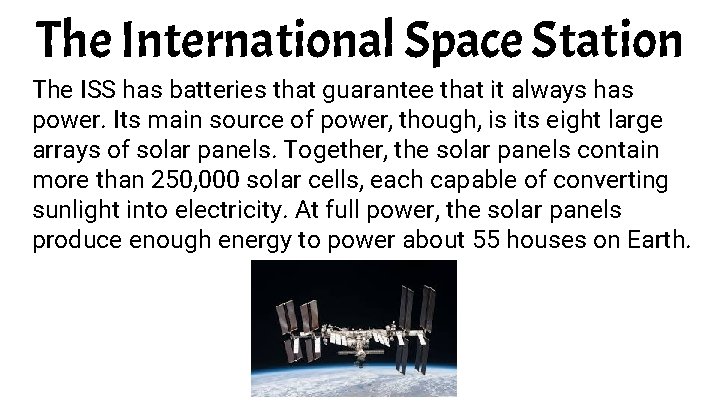
The International Space Station The ISS has batteries that guarantee that it always has power. Its main source of power, though, is its eight large arrays of solar panels. Together, the solar panels contain more than 250, 000 solar cells, each capable of converting sunlight into electricity. At full power, the solar panels produce enough energy to power about 55 houses on Earth.
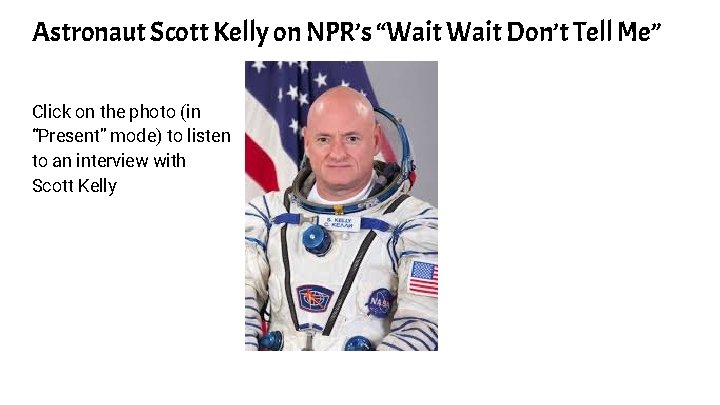
Astronaut Scott Kelly on NPR’s “Wait Don’t Tell Me” Click on the photo (in “Present” mode) to listen to an interview with Scott Kelly
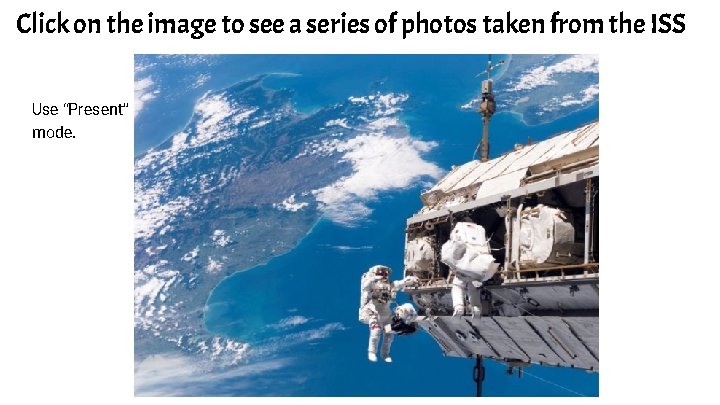
Click on the image to see a series of photos taken from the ISS Use “Present” mode.