
The International Political Economy of the BRICS Li
The International Political Economy of the BRICS Li Xing Professor/Director, Research Center on Development and International Relations Editor-in-Chief, Journal of China and International Relations Aalborg University Denmark
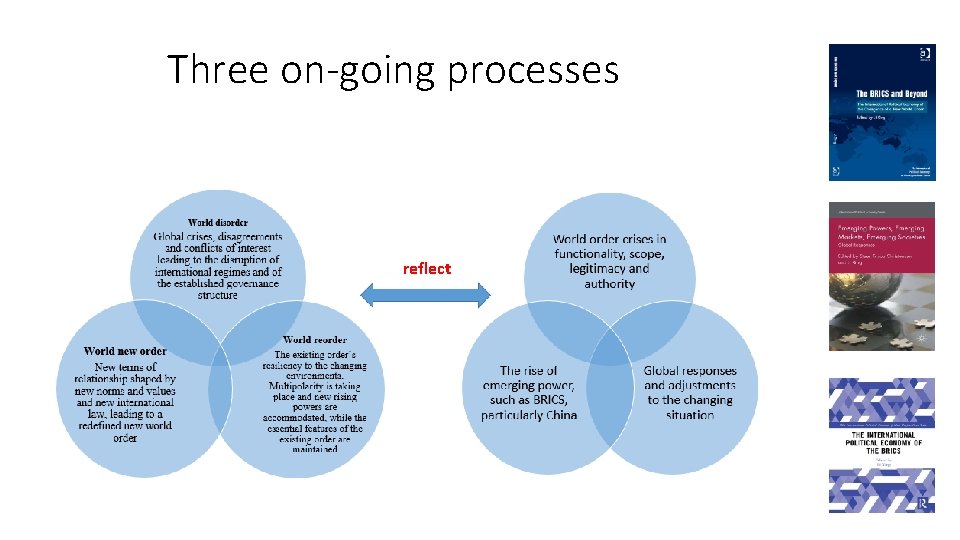
Three on-going processes reflect
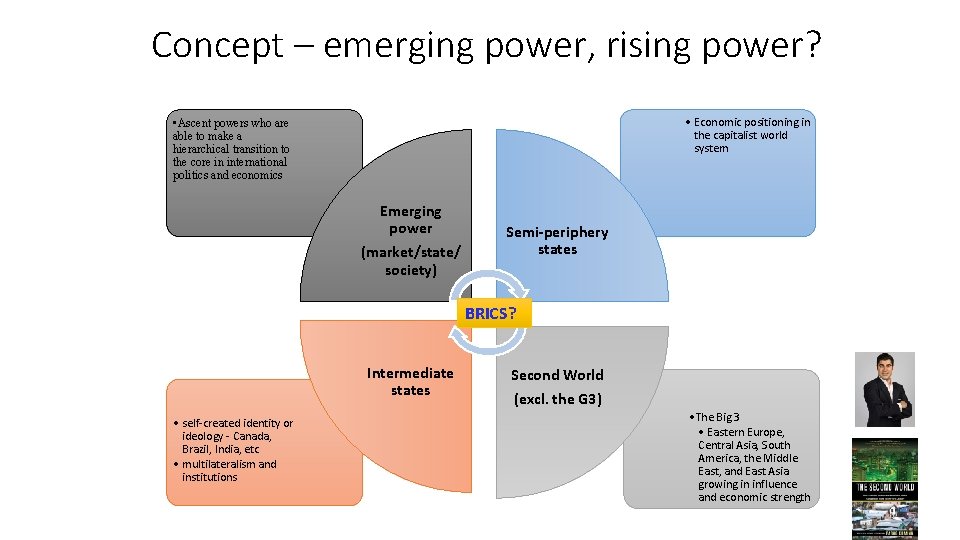
Concept – emerging power, rising power? • Economic positioning in the capitalist world system • Ascent powers who are able to make a hierarchical transition to the core in international politics and economics Emerging power (market/state/ society) Semi-periphery states BRICS? Intermediate states • self-created identity or ideology - Canada, Brazil, India, etc • multilateralism and institutions Second World (excl. the G 3) • The Big 3 • Eastern Europe, Central Asia, South America, the Middle East, and East Asia growing in influence and economic strength
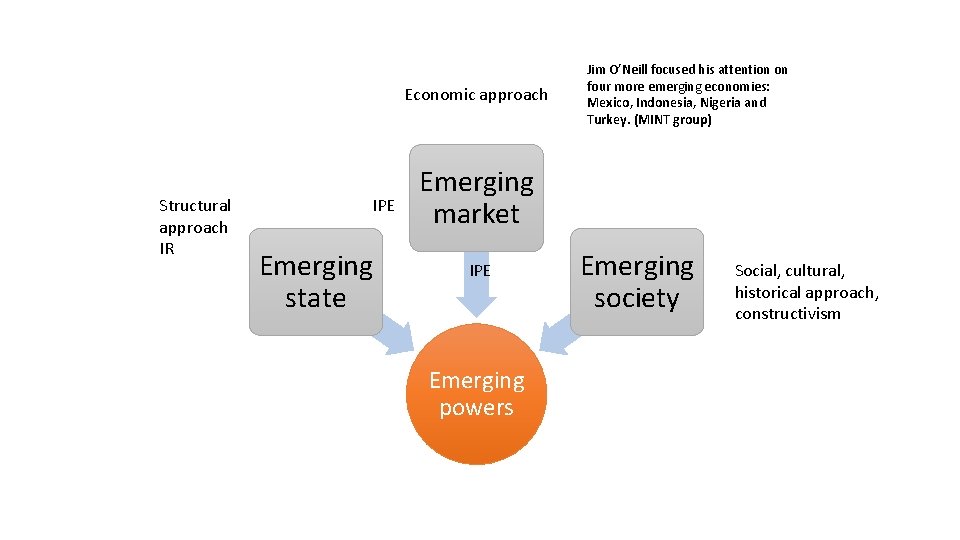
Economic approach Structural approach IR IPE Emerging state Jim O’Neill focused his attention on four more emerging economies: Mexico, Indonesia, Nigeria and Turkey. (MINT group) Emerging market IPE Emerging powers Emerging society Social, cultural, historical approach, constructivism
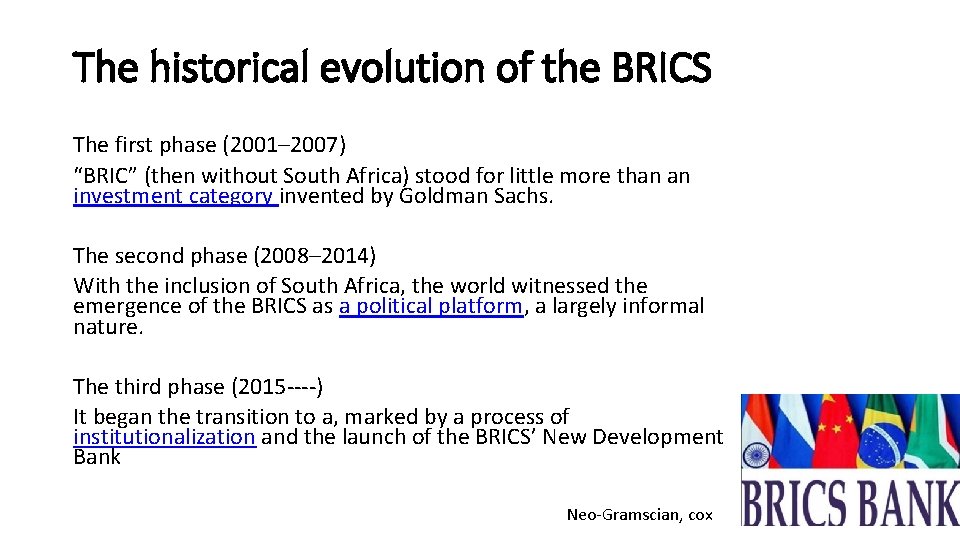
The historical evolution of the BRICS The first phase (2001– 2007) “BRIC” (then without South Africa) stood for little more than an investment category invented by Goldman Sachs. The second phase (2008– 2014) With the inclusion of South Africa, the world witnessed the emergence of the BRICS as a political platform, a largely informal nature. The third phase (2015 ----) It began the transition to a, marked by a process of institutionalization and the launch of the BRICS’ New Development Bank Neo-Gramscian, cox
PPP
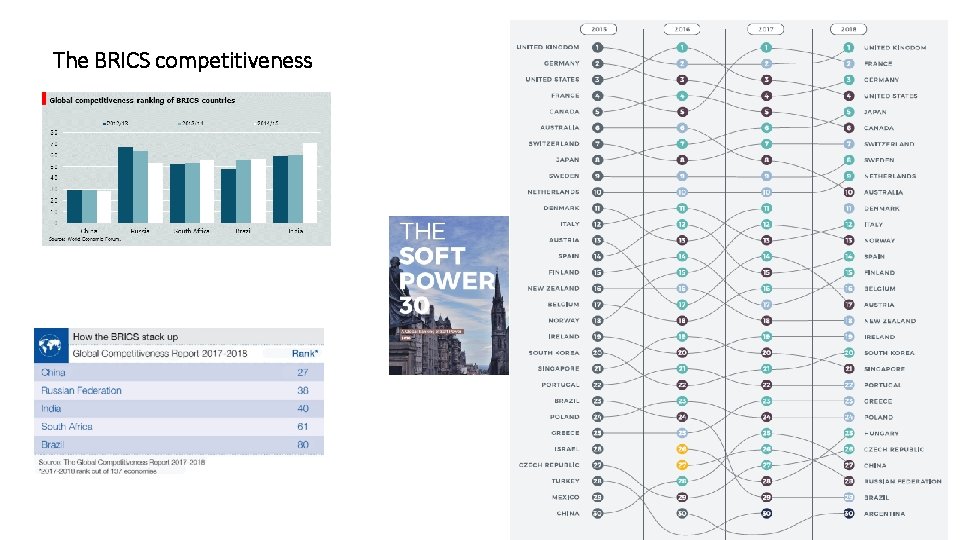
The BRICS competitiveness
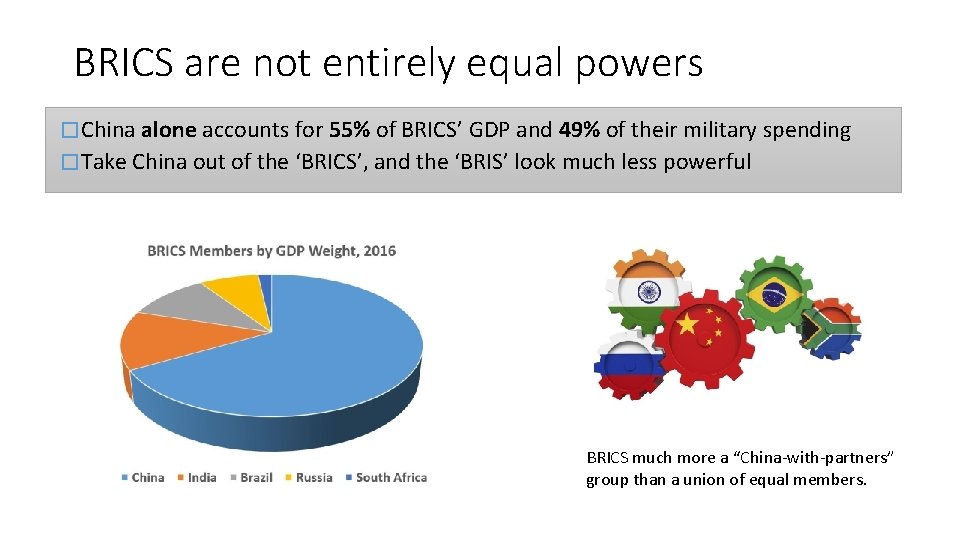
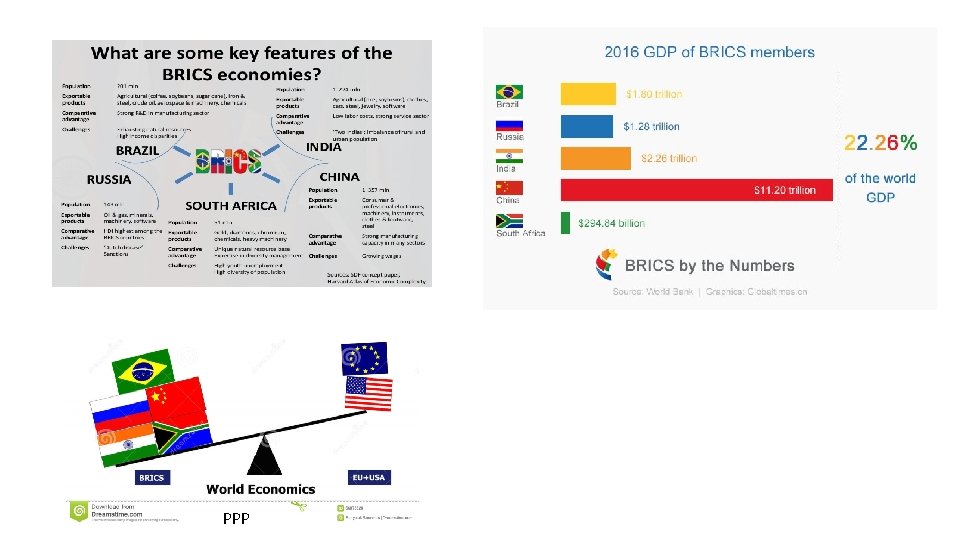
BRICS are not entirely equal powers � China alone accounts for 55% of BRICS’ GDP and 49% of their military spending � Take China out of the ‘BRICS’, and the ‘BRIS’ look much less powerful BRICS much more a “China-with-partners” group than a union of equal members.
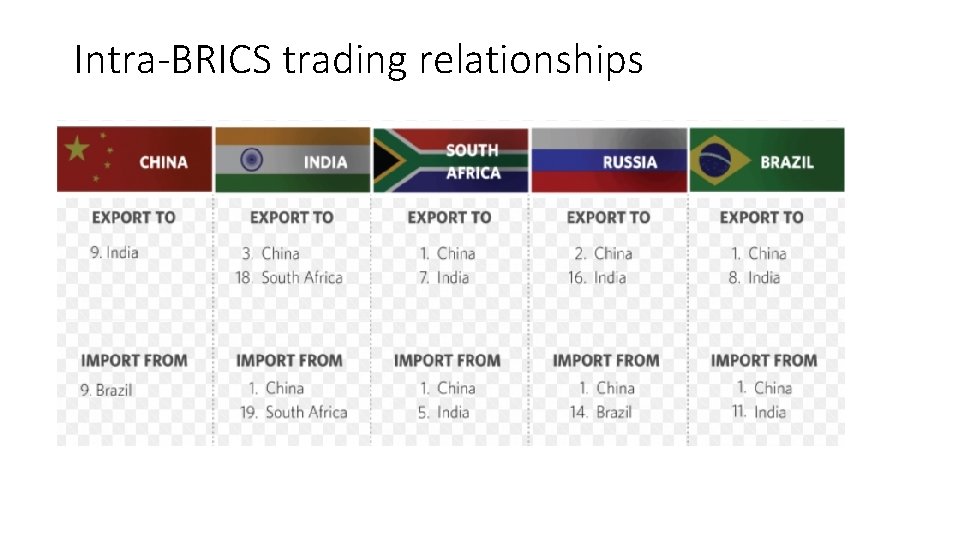
Intra-BRICS trading relationships
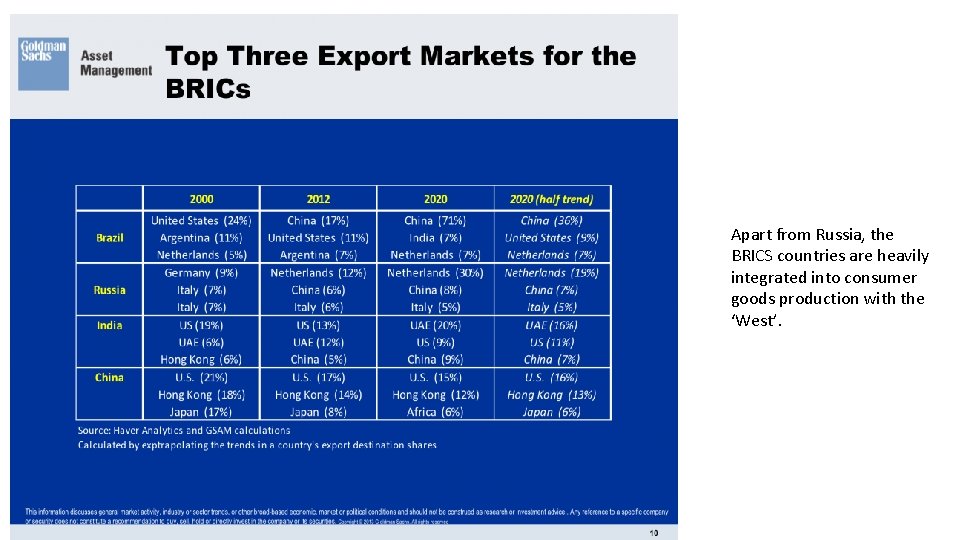
Apart from Russia, the BRICS countries are heavily integrated into consumer goods production with the ‘West’.
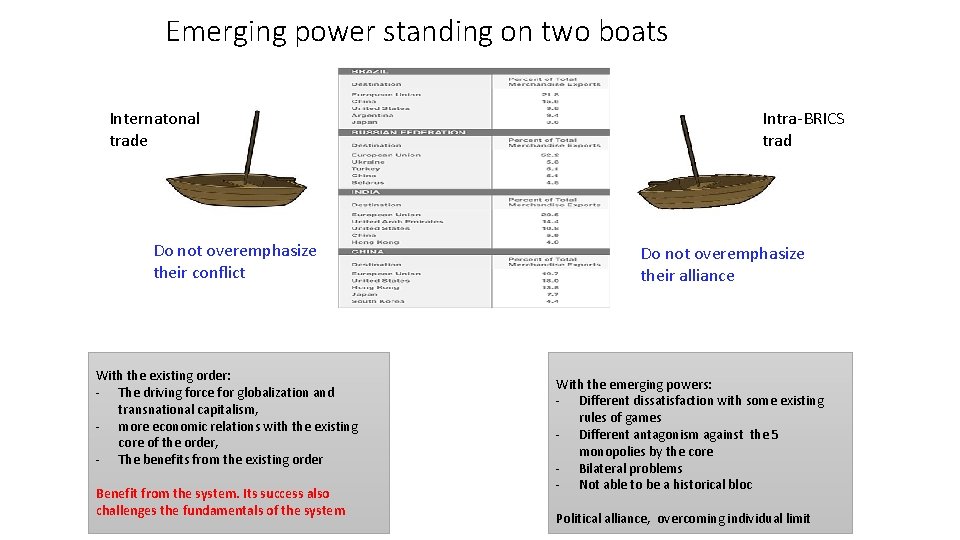
Emerging power standing on two boats Internatonal trade Do not overemphasize their conflict With the existing order: - The driving force for globalization and transnational capitalism, - more economic relations with the existing core of the order, - The benefits from the existing order Benefit from the system. Its success also challenges the fundamentals of the system Intra-BRICS trad Do not overemphasize their alliance With the emerging powers: - Different dissatisfaction with some existing rules of games - Different antagonism against the 5 monopolies by the core - Bilateral problems - Not able to be a historical bloc Political alliance, overcoming individual limit
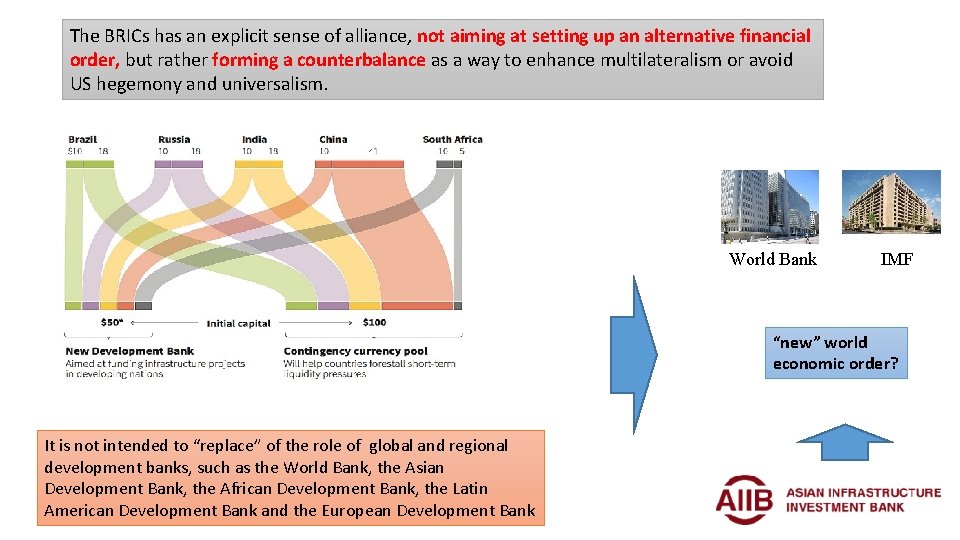
The BRICs has an explicit sense of alliance, not aiming at setting up an alternative financial order, but rather forming a counterbalance as a way to enhance multilateralism or avoid US hegemony and universalism. World Bank IMF “new” world economic order? It is not intended to “replace” of the role of global and regional development banks, such as the World Bank, the Asian Development Bank, the African Development Bank, the Latin American Development Bank and the European Development Bank
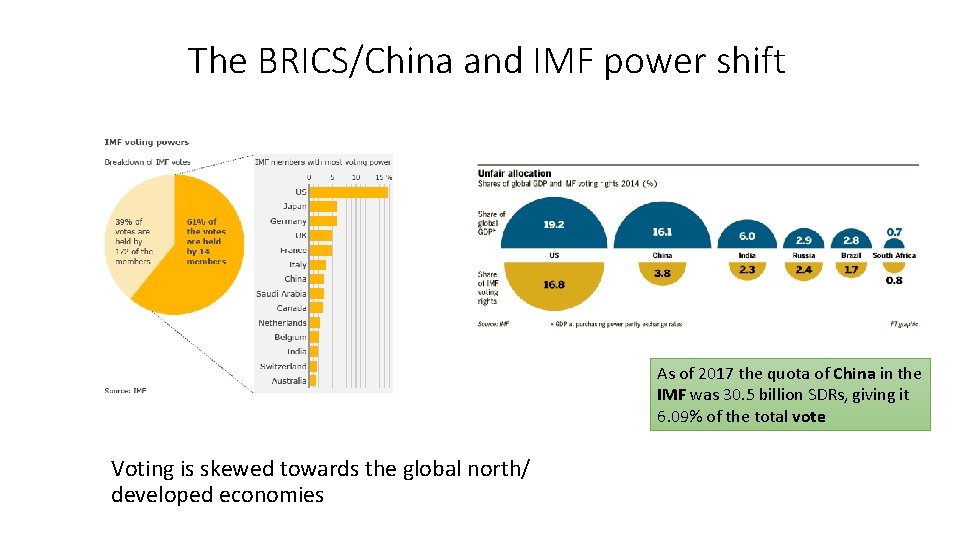
The BRICS/China and IMF power shift As of 2017 the quota of China in the IMF was 30. 5 billion SDRs, giving it 6. 09% of the total vote Voting is skewed towards the global north/ developed economies
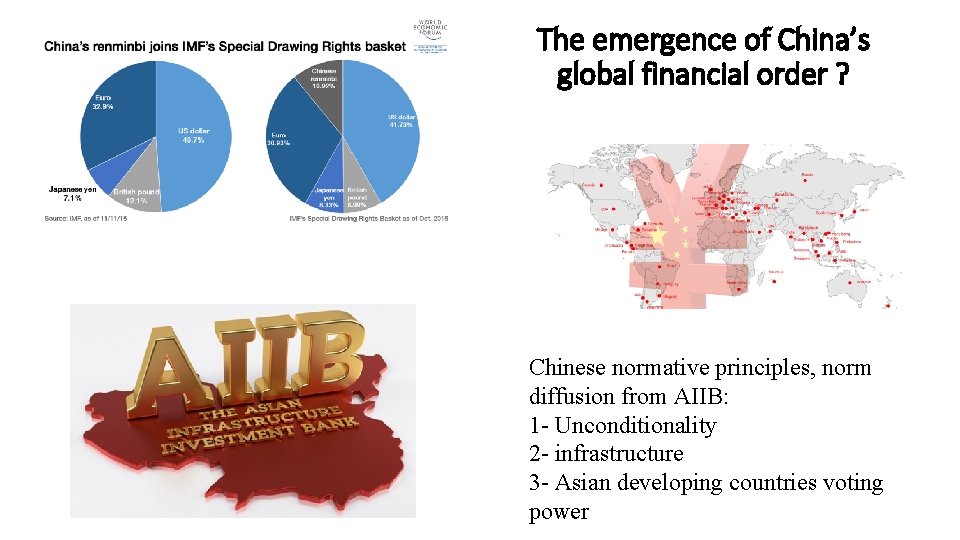
The emergence of China’s global financial order ? Chinese normative principles, norm diffusion from AIIB: 1 - Unconditionality 2 - infrastructure 3 - Asian developing countries voting power
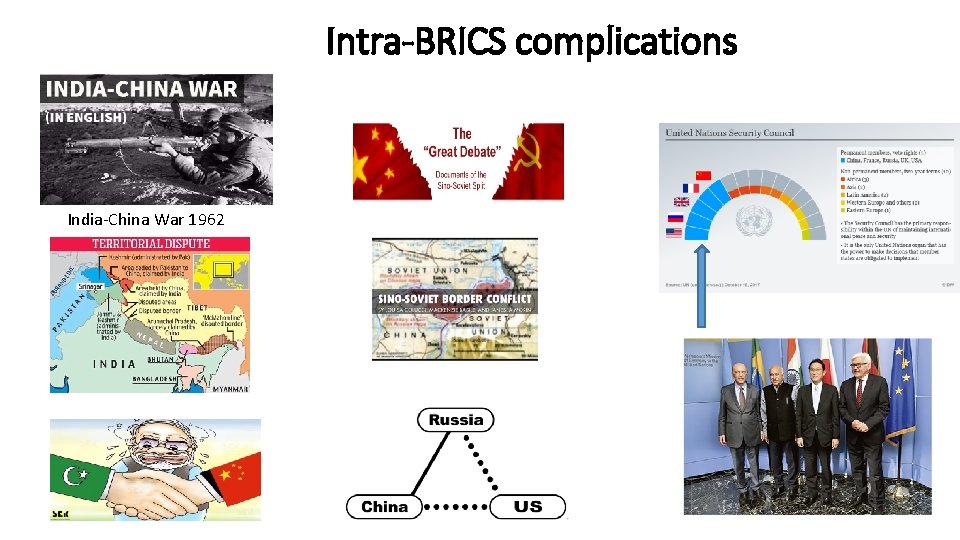
Intra-BRICS complications India-China War 1962
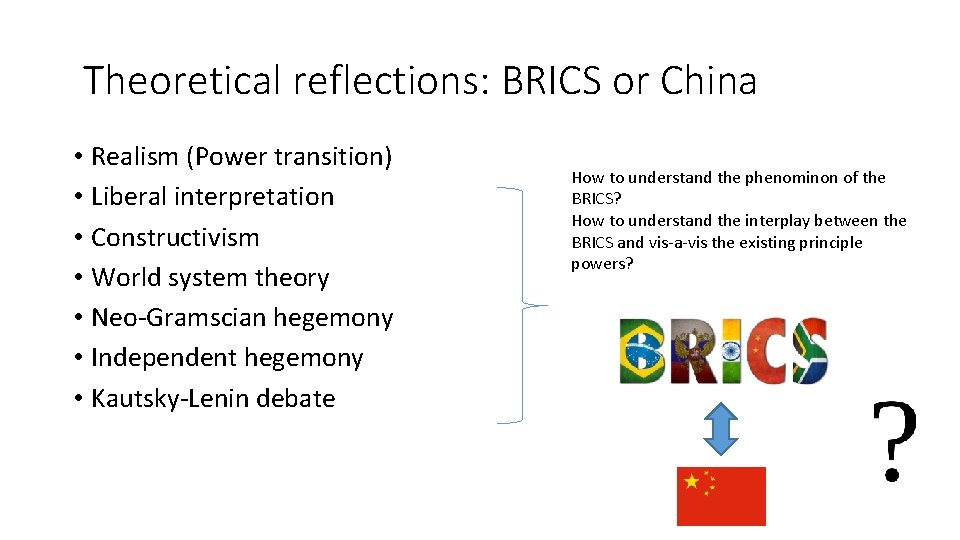
Theoretical reflections: BRICS or China • Realism (Power transition) • Liberal interpretation • Constructivism • World system theory • Neo-Gramscian hegemony • Independent hegemony • Kautsky-Lenin debate How to understand the phenominon of the BRICS? How to understand the interplay between the BRICS and vis-a-vis the existing principle powers?
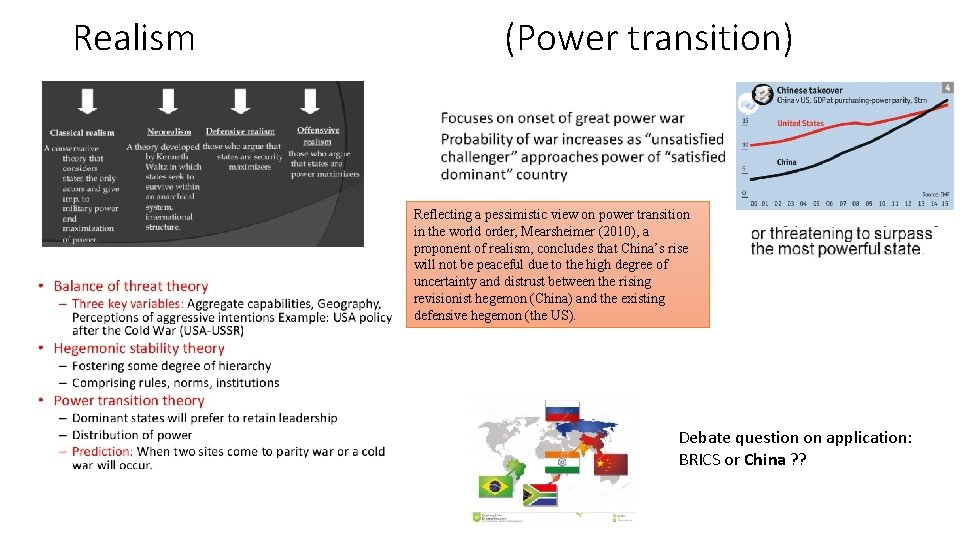
Realism (Power transition) Reflecting a pessimistic view on power transition in the world order, Mearsheimer (2010), a proponent of realism, concludes that China’s rise will not be peaceful due to the high degree of uncertainty and distrust between the rising revisionist hegemon (China) and the existing defensive hegemon (the US). Debate question on application: BRICS or China ? ?
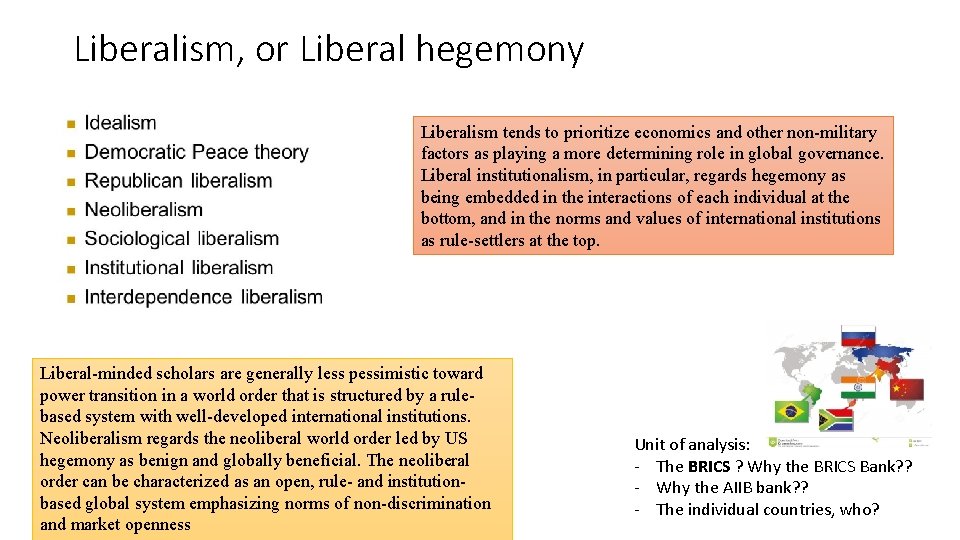
Liberalism, or Liberal hegemony Liberalism tends to prioritize economics and other non-military factors as playing a more determining role in global governance. Liberal institutionalism, in particular, regards hegemony as being embedded in the interactions of each individual at the bottom, and in the norms and values of international institutions as rule-settlers at the top. Liberal-minded scholars are generally less pessimistic toward power transition in a world order that is structured by a rulebased system with well-developed international institutions. Neoliberalism regards the neoliberal world order led by US hegemony as benign and globally beneficial. The neoliberal order can be characterized as an open, rule- and institutionbased global system emphasizing norms of non-discrimination and market openness Unit of analysis: - The BRICS ? Why the BRICS Bank? ? - Why the AIIB bank? ? - The individual countries, who?
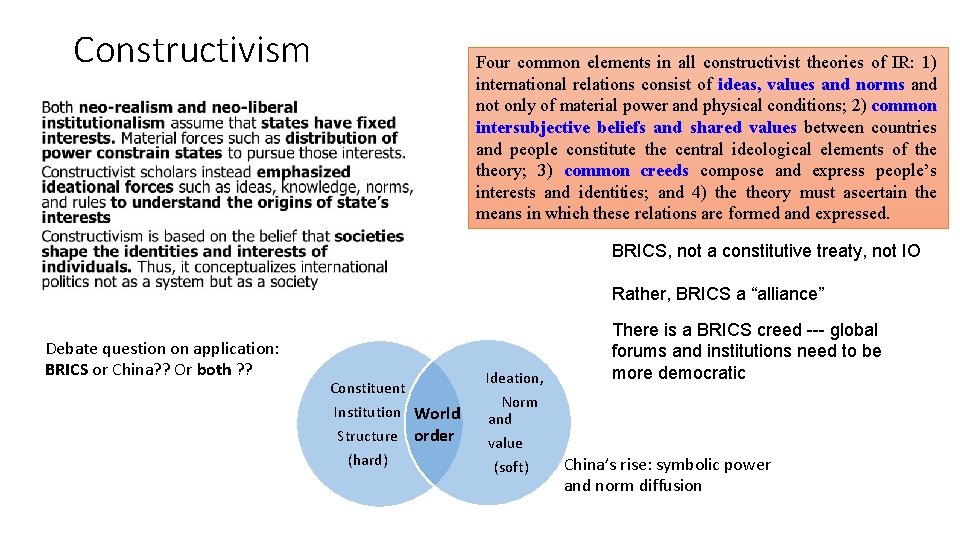
Constructivism Four common elements in all constructivist theories of IR: 1) international relations consist of ideas, values and norms and not only of material power and physical conditions; 2) common intersubjective beliefs and shared values between countries and people constitute the central ideological elements of theory; 3) common creeds compose and express people’s interests and identities; and 4) theory must ascertain the means in which these relations are formed and expressed. BRICS, not a constitutive treaty, not IO Rather, BRICS a “alliance” Debate question on application: BRICS or China? ? Or both ? ? Constituent Institution World Structure order (hard) Ideation, Norm and value (soft) There is a BRICS creed --- global forums and institutions need to be more democratic China’s rise: symbolic power and norm diffusion
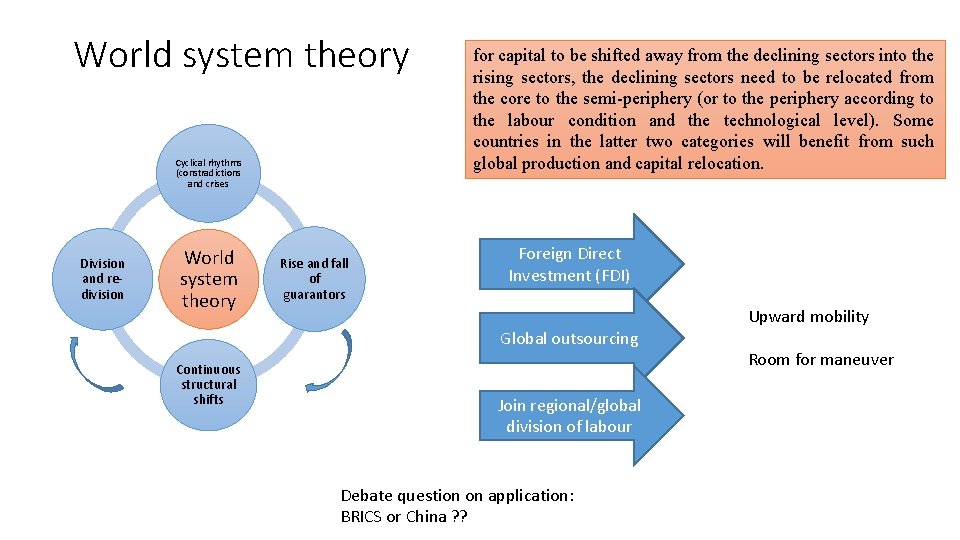
World system theory Cyclical rhythms (constradictions and crises Division and redivision World system theory Rise and fall of guarantors for capital to be shifted away from the declining sectors into the rising sectors, the declining sectors need to be relocated from the core to the semi-periphery (or to the periphery according to the labour condition and the technological level). Some countries in the latter two categories will benefit from such global production and capital relocation. Foreign Direct Investment (FDI) Global outsourcing Continuous structural shifts Join regional/global division of labour Debate question on application: BRICS or China ? ? Upward mobility Room for maneuver
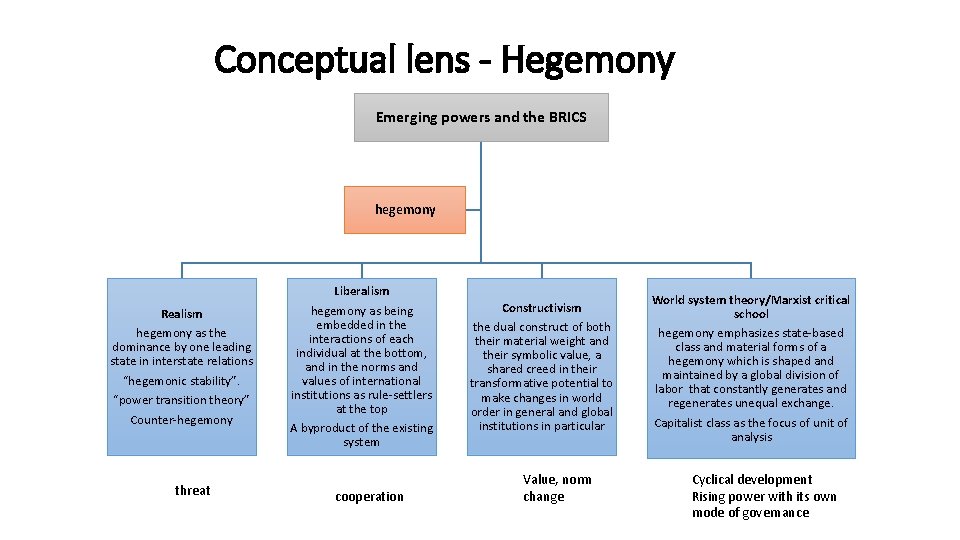
Conceptual lens - Hegemony Emerging powers and the BRICS hegemony Realism hegemony as the dominance by one leading state in interstate relations “hegemonic stability”. “power transition theory” Counter-hegemony threat Liberalism hegemony as being embedded in the interactions of each individual at the bottom, and in the norms and values of international institutions as rule-settlers at the top A byproduct of the existing system cooperation Constructivism the dual construct of both their material weight and their symbolic value, a shared creed in their transformative potential to make changes in world order in general and global institutions in particular Value, norm change World system theory/Marxist critical school hegemony emphasizes state-based class and material forms of a hegemony which is shaped and maintained by a global division of labor that constantly generates and regenerates unequal exchange. Capitalist class as the focus of unit of analysis Cyclical development Rising power with its own mode of governance
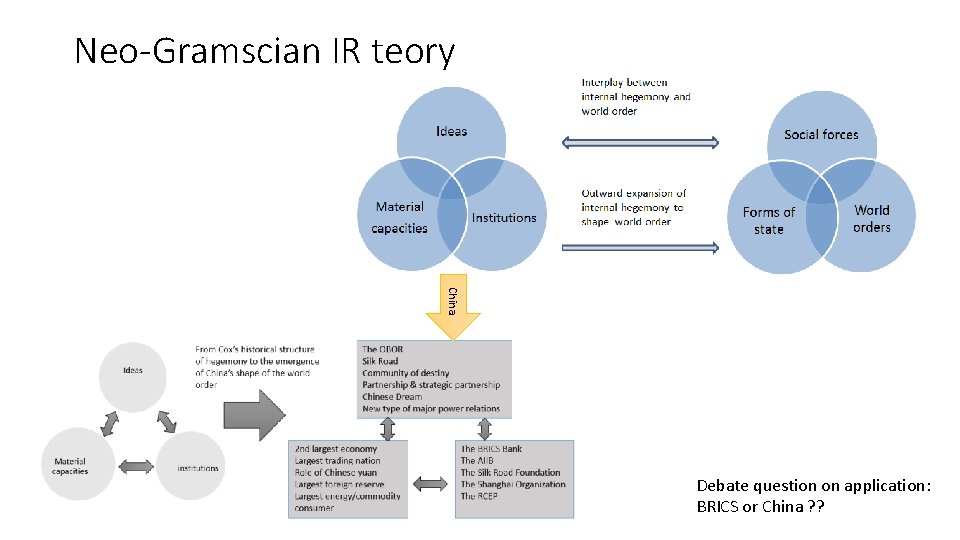
Neo-Gramscian IR teory China Debate question on application: BRICS or China ? ?
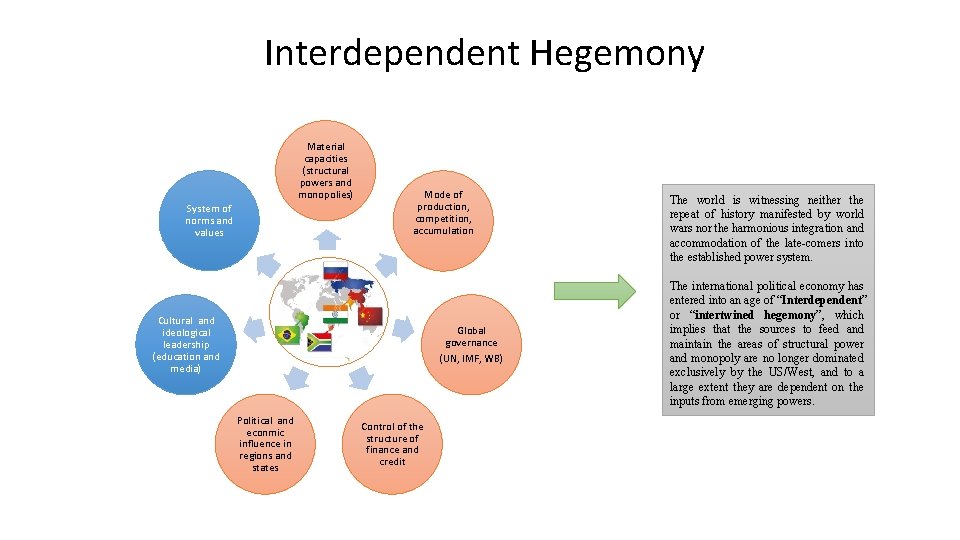
Interdependent Hegemony Material capacities (structural powers and monopolies) System of norms and values Mode of production, competition, accumulation Cultural and ideological leadership (education and media) Global governance (UN, IMF, WB) Political and econmic influence in regions and states Control of the structure of finance and credit The world is witnessing neither the repeat of history manifested by world wars nor the harmonious integration and accommodation of the late-comers into the established power system. The international political economy has entered into an age of “Interdependent” or “intertwined hegemony”, which implies that the sources to feed and maintain the areas of structural power and monopoly are no longer dominated exclusively by the US/West, and to a large extent they are dependent on the inputs from emerging powers.
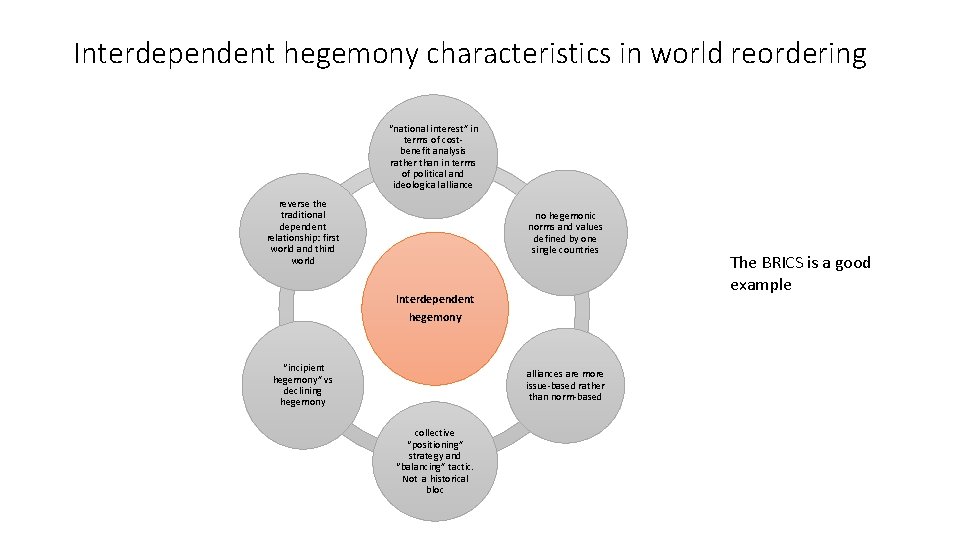
Interdependent hegemony characteristics in world reordering “national interest” in terms of costbenefit analysis rather than in terms of political and ideological alliance reverse the traditional dependent relationship: first world and third world no hegemonic norms and values defined by one single countries Interdependent hegemony “incipient hegemony” vs declining hegemony alliances are more issue-based rather than norm-based collective “positioning” strategy and “balancing” tactic. Not a historical bloc The BRICS is a good example
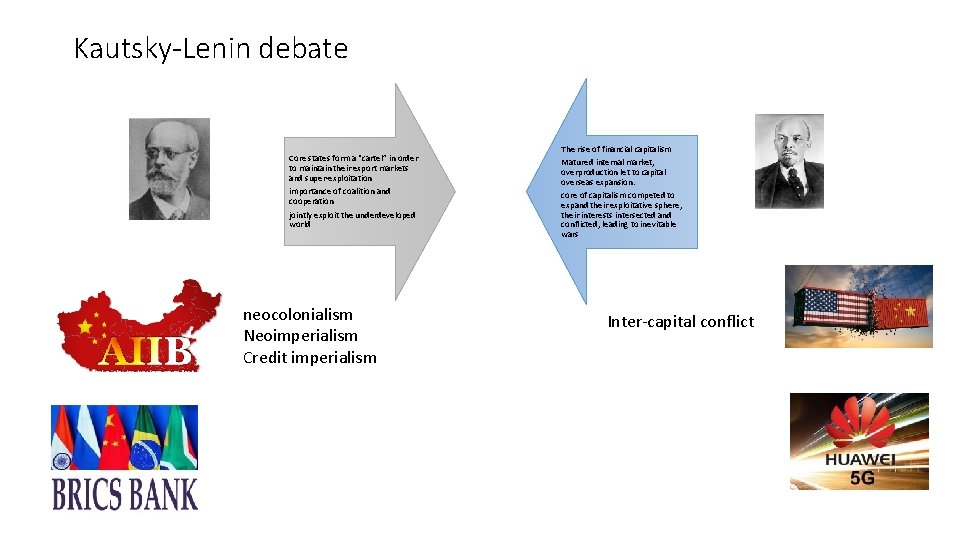
Kautsky-Lenin debate Core states form a “cartel” in order to maintain their export markets and super-exploitation importance of coalition and cooperation jointly exploit the underdeveloped world neocolonialism Neoimperialism Credit imperialism The rise of financial capitalism Matured internal market, overproduction let to capital overseas expansion. core of capitalism competed to expand their exploitative sphere, their interests intersected and conflicted, leading to inevitable wars Inter-capital conflict
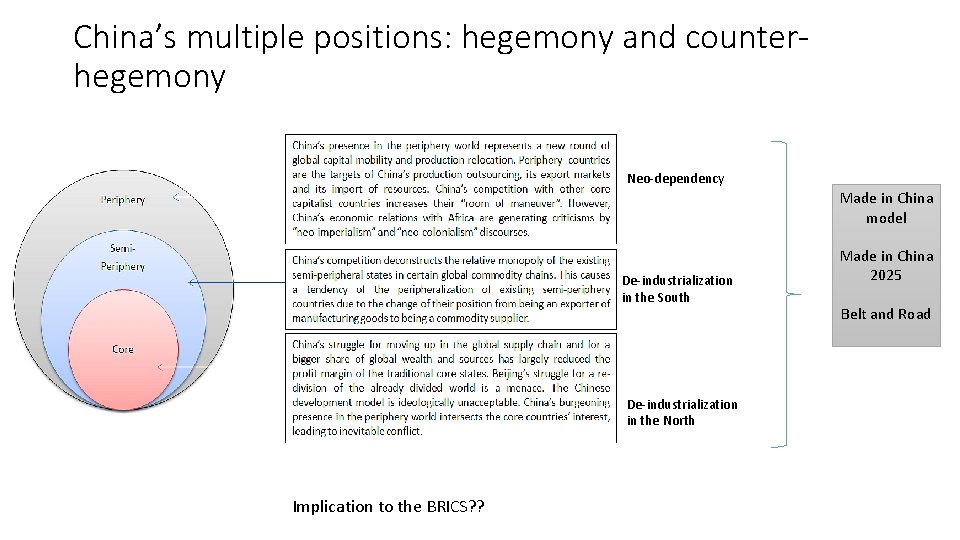
China’s multiple positions: hegemony and counterhegemony Neo-dependency Made in China model De-industrialization in the South De-industrialization in the North Implication to the BRICS? ? Made in China 2025 Belt and Road
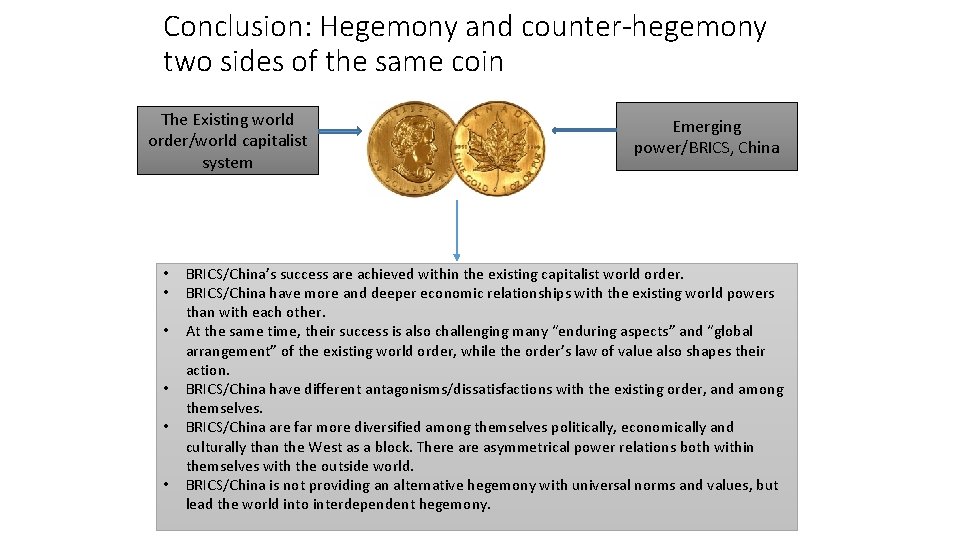
Conclusion: Hegemony and counter-hegemony two sides of the same coin The Existing world order/world capitalist system • • • Emerging power/BRICS, China BRICS/China’s success are achieved within the existing capitalist world order. BRICS/China have more and deeper economic relationships with the existing world powers than with each other. At the same time, their success is also challenging many “enduring aspects” and “global arrangement” of the existing world order, while the order’s law of value also shapes their action. BRICS/China have different antagonisms/dissatisfactions with the existing order, and among themselves. BRICS/China are far more diversified among themselves politically, economically and culturally than the West as a block. There asymmetrical power relations both within themselves with the outside world. BRICS/China is not providing an alternative hegemony with universal norms and values, but lead the world into interdependent hegemony.
- Slides: 28