
The International Monetary System Chapter 3 1 PART
- Slides: 46
The International Monetary System (國際貨幣制度) Chapter 3 1
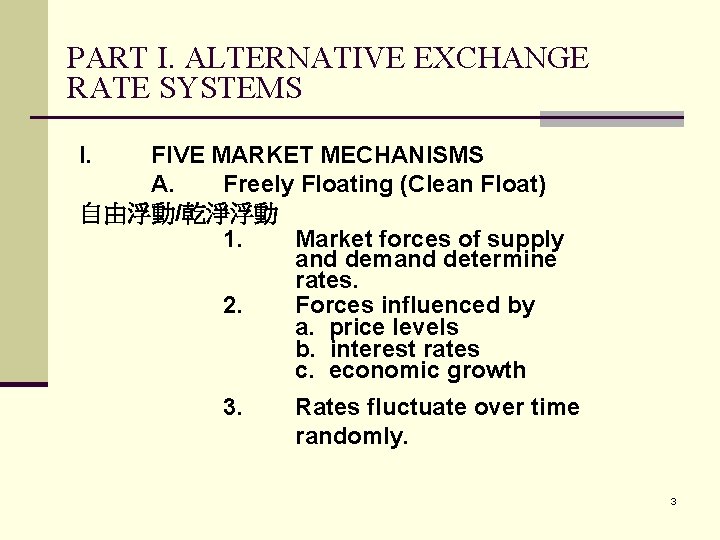
PART I. ALTERNATIVE EXCHANGE RATE SYSTEMS I. FIVE MARKET MECHANISMS A. Freely Floating (Clean Float) 自由浮動/乾淨浮動 1. Market forces of supply and demand determine rates. 2. Forces influenced by a. price levels b. interest rates c. economic growth 3. Rates fluctuate over time randomly. 3
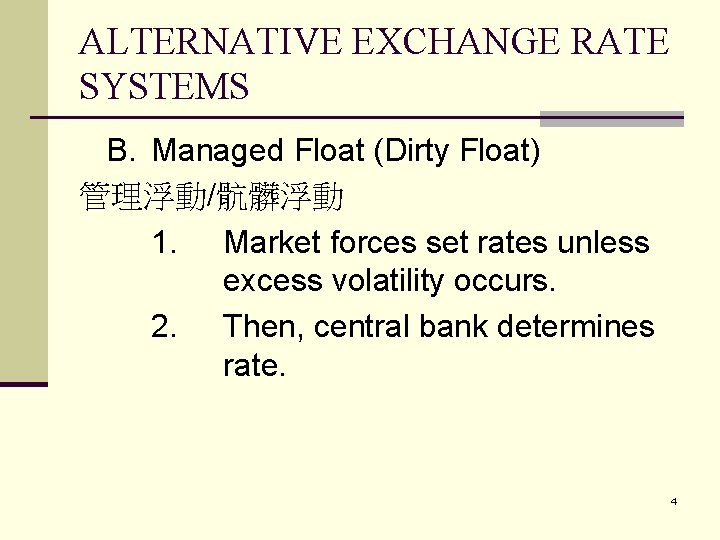
ALTERNATIVE EXCHANGE RATE SYSTEMS B. Managed Float (Dirty Float) 管理浮動/骯髒浮動 1. Market forces set rates unless excess volatility occurs. 2. Then, central bank determines rate. 4
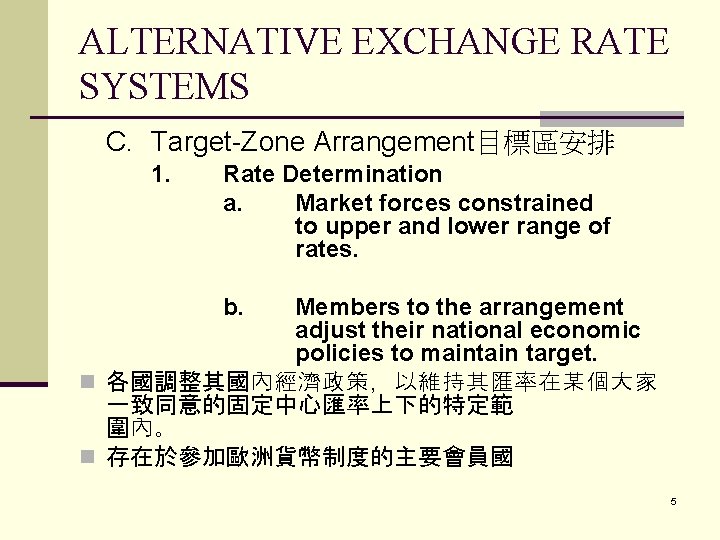
ALTERNATIVE EXCHANGE RATE SYSTEMS C. Target-Zone Arrangement目標區安排 1. Rate Determination a. Market forces constrained to upper and lower range of rates. b. Members to the arrangement adjust their national economic policies to maintain target. n 各國調整其國內經濟政策,以維持其匯率在某個大家 一致同意的固定中心匯率上下的特定範 圍內。 n 存在於參加歐洲貨幣制度的主要會員國 5
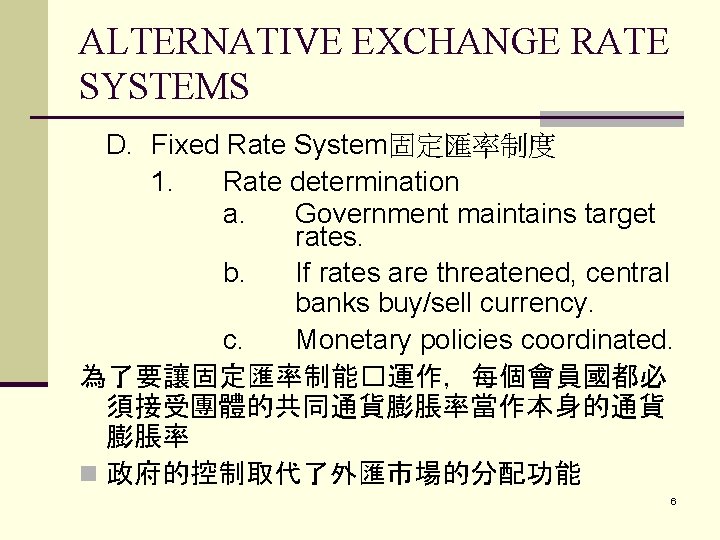
ALTERNATIVE EXCHANGE RATE SYSTEMS D. Fixed Rate System固定匯率制度 1. Rate determination a. Government maintains target rates. b. If rates are threatened, central banks buy/sell currency. c. Monetary policies coordinated. 為了要讓固定匯率制能�運作,每個會員國都必 須接受團體的共同通貨膨脹率當作本身的通貨 膨脹率 n 政府的控制取代了外匯市場的分配功能 6
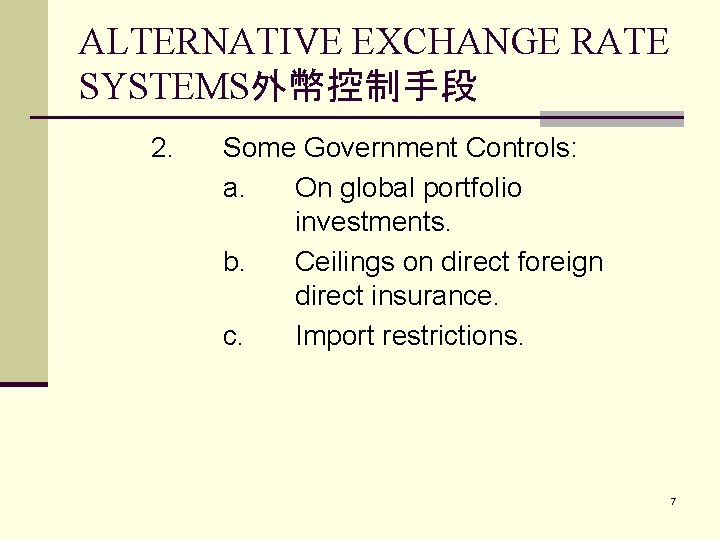
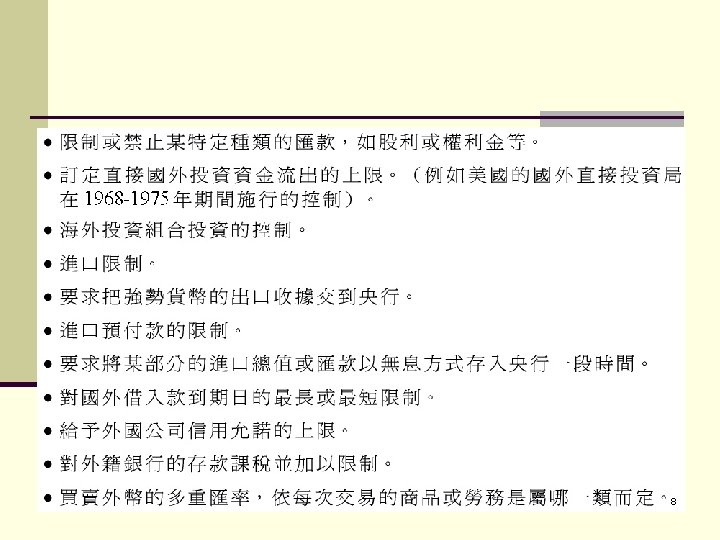
ALTERNATIVE EXCHANGE RATE SYSTEMS外幣控制手段 2. Some Government Controls: a. On global portfolio investments. b. Ceilings on direct foreign direct insurance. c. Import restrictions. 7
8
ALTERNATIVE EXCHANGE RATE SYSTEMS E. Current System現行制度 1. A hybrid system a. Major currencies: use freely-floating method b. Others move in and out of various fixed-rate systems. n 主要貨幣以管理浮動為基礎。 n 其他貨幣則視情況採各種形式的釘住匯率政策 9
PART II. A BRIEF HISTORY OF THE INTERNATIONAL MONETARY SYSTEM I. THE USE OF GOLD A. Desirable properties B. In short run: High production costs limit short-run changes. C. In long run: Commodity money insures stability. 10
A BRIEF HISTORY OF THE INTERNATIONAL MONETARY SYSTEM II. The Classical Gold Standard古典金本位制度 (1821 -1914) A. Major currencies on gold standard. 1. Involved commitment by nations to fix the price of domestic currency in terms of a specific amount of gold. 11
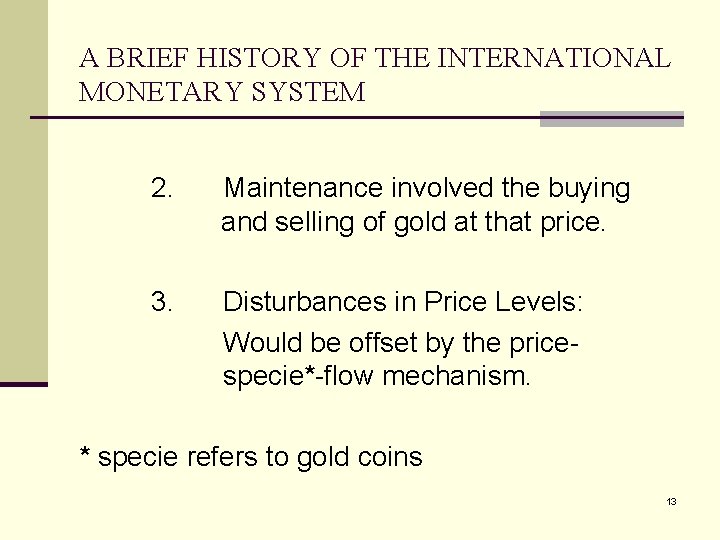
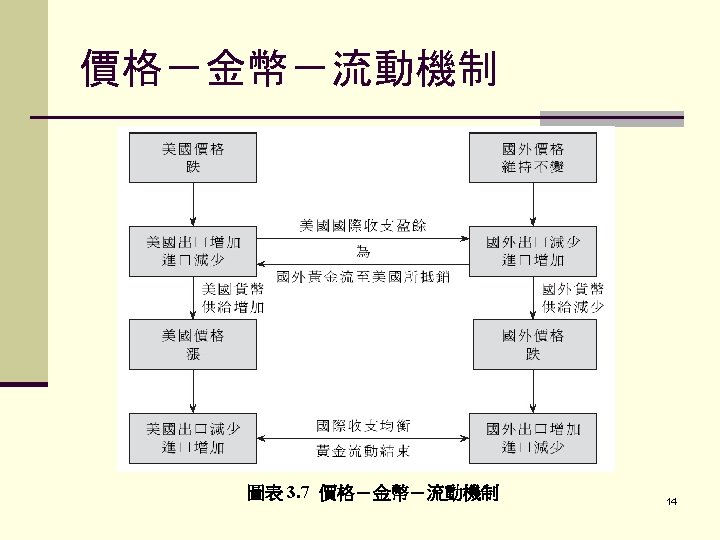
A BRIEF HISTORY OF THE INTERNATIONAL MONETARY SYSTEM 2. Maintenance involved the buying and selling of gold at that price. 3. Disturbances in Price Levels: Would be offset by the pricespecie*-flow mechanism. * specie refers to gold coins 13
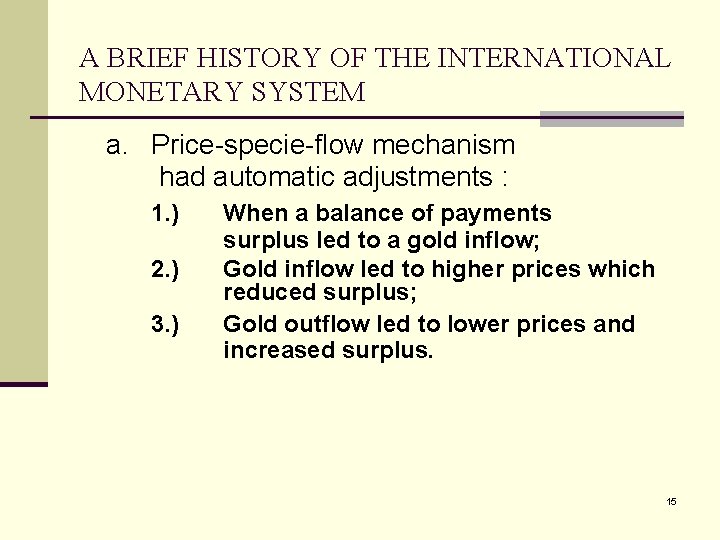
A BRIEF HISTORY OF THE INTERNATIONAL MONETARY SYSTEM a. Price-specie-flow mechanism had automatic adjustments : 1. ) 2. ) 3. ) When a balance of payments surplus led to a gold inflow; Gold inflow led to higher prices which reduced surplus; Gold outflow led to lower prices and increased surplus. 15
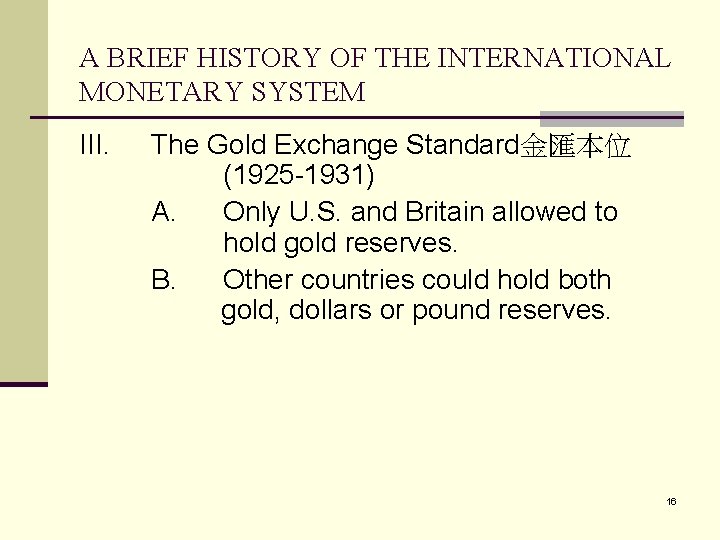
A BRIEF HISTORY OF THE INTERNATIONAL MONETARY SYSTEM III. The Gold Exchange Standard金匯本位 (1925 -1931) A. Only U. S. and Britain allowed to hold gold reserves. B. Other countries could hold both gold, dollars or pound reserves. 16
A BRIEF HISTORY OF THE INTERNATIONAL MONETARY SYSTEM C. Currencies devalued in 1931 - led to trade wars. n 1931年英鎊貶�,�生「以鄰為壑的貶�」 (beggar-thy-neighbor devaluations) D. Bretton Woods Conference (1944年布列敦森林會議)) - called in order to avoid future protectionist and destructive economic policies 17
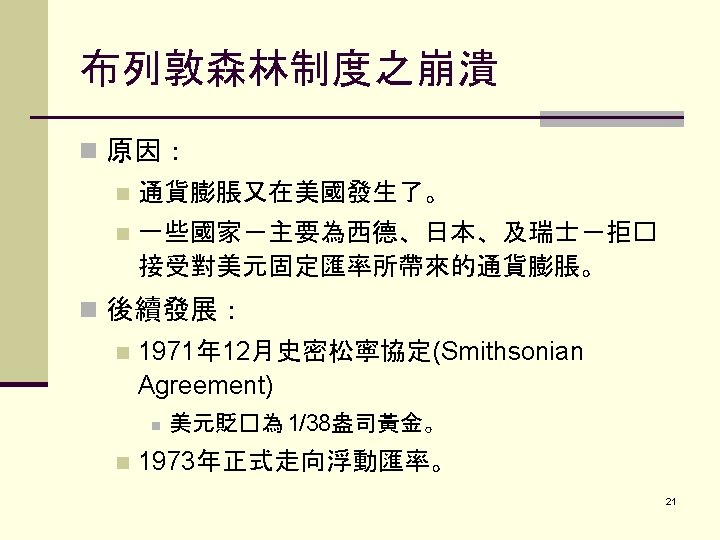
A BRIEF HISTORY OF THE INTERNATIONAL MONETARY SYSTEM V. The Bretton Woods System (1946 -1971) 布列敦森林制度 1. U. S. $ was key currency; valued at $1 - 1/35 oz. of gold. 2. All currencies linked to that price in a fixed rate system. 18
A BRIEF HISTORY OF THE INTERNATIONAL MONETARY SYSTEM 3. Exchange rates allowed to fluctuate by 1% above or below initially set rates. B. Collapse, 1971 1. Causes: a. U. S. high inflation rate b. U. S. $ depreciated sharply. 19
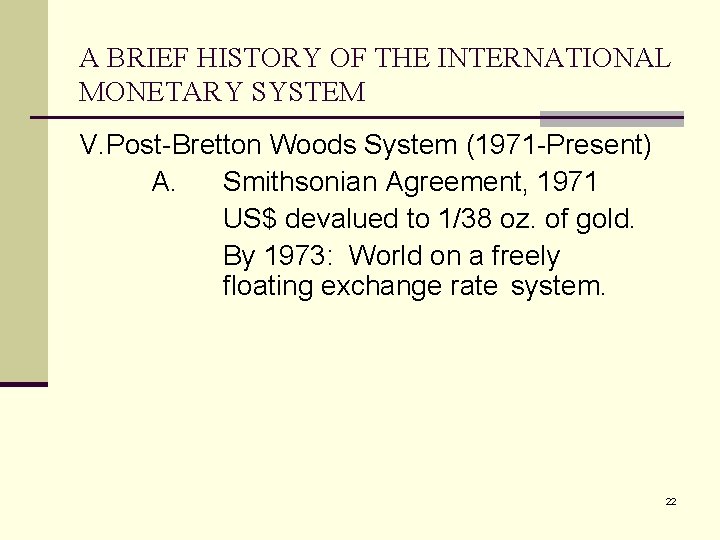
A BRIEF HISTORY OF THE INTERNATIONAL MONETARY SYSTEM V. Post-Bretton Woods System (1971 -Present) A. Smithsonian Agreement, 1971 US$ devalued to 1/38 oz. of gold. By 1973: World on a freely floating exchange rate system. 22
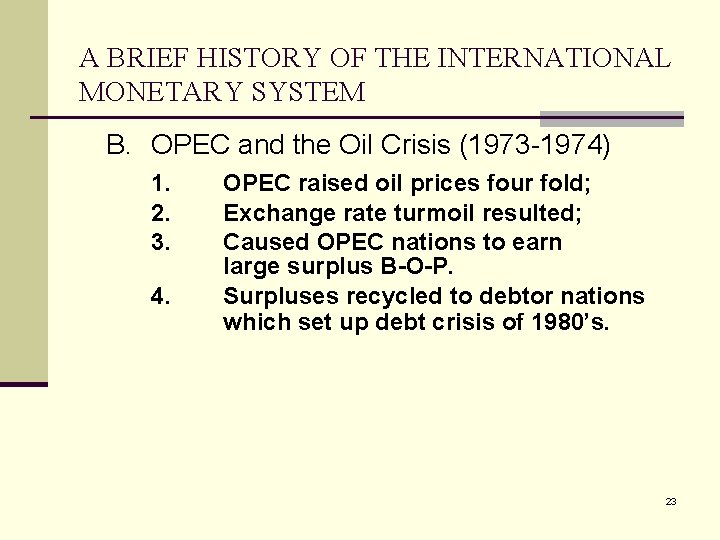
A BRIEF HISTORY OF THE INTERNATIONAL MONETARY SYSTEM B. OPEC and the Oil Crisis (1973 -1974) 1. 2. 3. 4. OPEC raised oil prices four fold; Exchange rate turmoil resulted; Caused OPEC nations to earn large surplus B-O-P. Surpluses recycled to debtor nations which set up debt crisis of 1980’s. 23
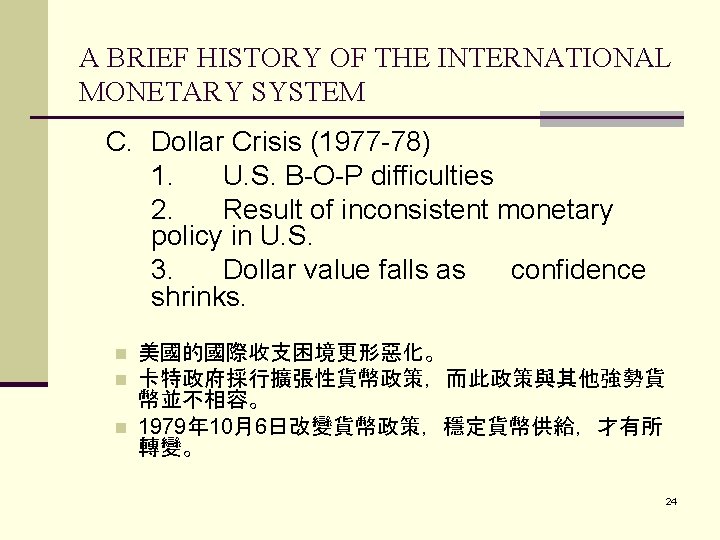
A BRIEF HISTORY OF THE INTERNATIONAL MONETARY SYSTEM C. Dollar Crisis (1977 -78) 1. U. S. B-O-P difficulties 2. Result of inconsistent monetary policy in U. S. 3. Dollar value falls as confidence shrinks. n n n 美國的國際收支困境更形惡化。 卡特政府採行擴張性貨幣政策,而此政策與其他強勢貨 幣並不相容。 1979年 10月6日改變貨幣政策,穩定貨幣供給,才有所 轉變。 24
A BRIEF HISTORY OF THE INTERNATIONAL MONETARY SYSTEM D. The Rising Dollar (1980 -85) 1. U. S. inflation subsides as the Fed raises interest rates 2. Rising rates attracts global capital to U. S. 3. Result: Dollar value rises. 25
A BRIEF HISTORY OF THE INTERNATIONAL MONETARY SYSTEM E. The Sinking Dollar: (1985 -87) 1. Dollar revaluated slowly downward; 2. Plaza Agreement 廣場協定(1985) G 5 agree to depress US$ further. 26
A BRIEF HISTORY OF THE INTERNATIONAL MONETARY SYSTEM 3. Louvre Agreement羅浮宮協定(1987) G 7 agree to support the falling US$. F. Recent History (1988 -Present) 1. 1988 US$ stabilized 2. Post-1991 Confidence resulted in stronger dollar 3. 1993 -1995 Dollar value falls 過去 25年來,美金之升貶大體上都可�出是與經 濟政策的改變有關 27
PART III. THE EUROPEAN MONETARY SYSTEM 歐洲貨幣體系與聯盟 I. INTRODUCTION A. The European Monetary System (EMS) 1. A target-zone method (1979) 2. Close macroeconomic policy coordination required. 28
THE EUROPEAN MONETARY SYSTEM B. EMS Objective: to provide exchange rate stability to all members by holding exchange rates within specified limits. 29
THE EUROPEAN MONETARY SYSTEM C. European Currency Unit (ECU)歐洲通貨單 位 A “cocktail” of European currencies with specified weights as the unit of account. 1. Exchange rate mechanism (ERM)匯率機制 each member determines mutually agreed upon central cross rate for its currency. 30
THE EUROPEAN MONETARY SYSTEM 2. Member Pledge: To keep within 15% margin above or below the central rate. D. EMS ups and downs 1. Foreign exchange interventions failed due to lack of support by coordinated monetary policies. 31
THE EUROPEAN MONETARY SYSTEM 2. n Currency Crisis of Sept. 1992 a. System broke down b. Britain and Italy forced to withdraw from EMS. 1992年遭受一連串投機客的攻擊。 G. Failure of the EMS members allowed political priorities to dominate exchange rate policies. 33
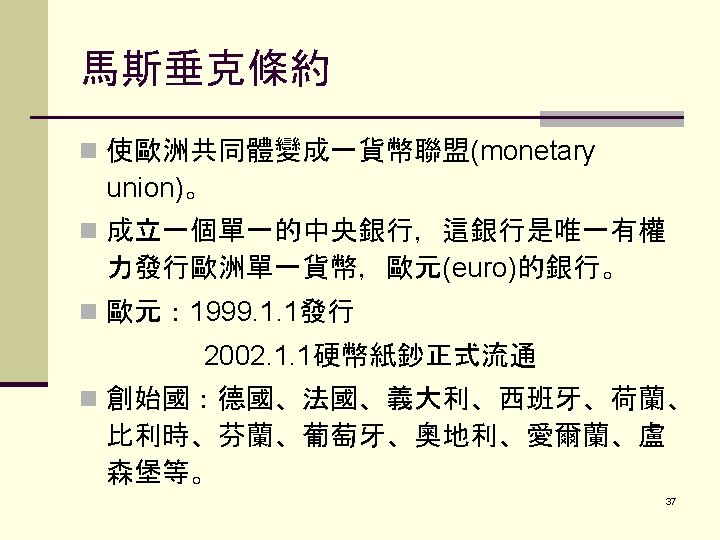
THE EUROPEAN MONETARY SYSTEM H. Maastricht Treaty馬斯垂克條約 1. 2. 3. 4. Called for Monetary Union by 1999 (moved to 2002). Established a single currency: the euro Calls for creation of a single central EU bank. Adopts tough fiscal standards. 36
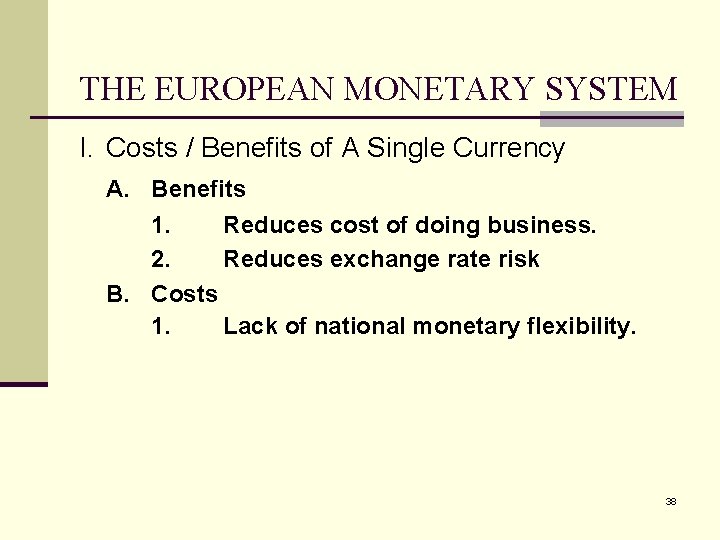
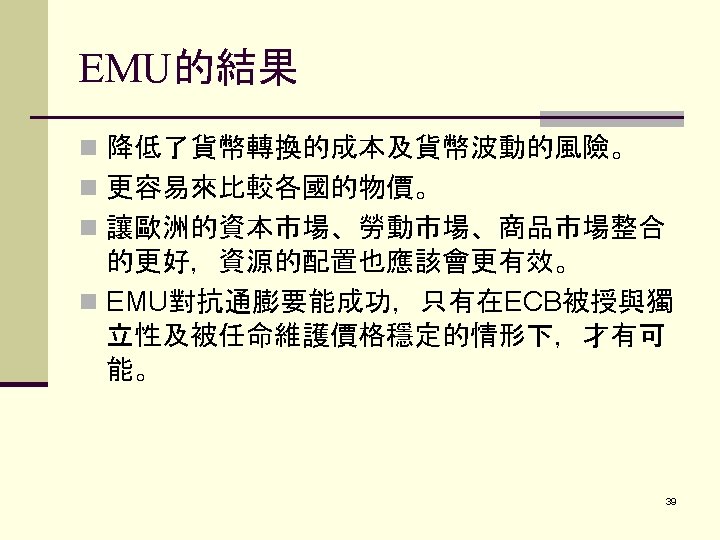
THE EUROPEAN MONETARY SYSTEM I. Costs / Benefits of A Single Currency A. Benefits 1. Reduces cost of doing business. 2. Reduces exchange rate risk B. Costs 1. Lack of national monetary flexibility. 38